Sunday Morning Greek Blog

December 14, 2025

Advent Joy: Jesus Breaks the Power of Sin and Suffering (Matthew 11:2–11; Isaiah 35:4–6)

Good morning! The Lord be with you!

As you know, today is the third Sunday of Advent, where we focus on the Joy for what Christ brings to our lives. I’m sure most of you know that there’s a difference between joy and happiness. Happiness comes from the things that happen around us. The word comes to us through the Middle English word hap, which in that time meant luck, fortune, fate, or one’s lot in life. The word had either a positive sense (“good fortune”) or a negative sense (“hard times” or a “hard lot” in life) depending on context. In modern English, of course, it’s been entirely infused with the positive meaning “happy as a lark.” It may be more of a surface feeling as well. It’s a feeling that can come and go depending on life’s circumstances.

Joy, on the other hand, is happiness on steroids if you will, at least according to Merriam-Webster. Their dictionary defines it as “a feeling of great happiness or pleasure; delight”; “a state of great happiness”; and “a source or cause of delight.” It comes from a Latin word that means “rejoice.” No surprise there. It does imply something much deeper than happiness, as the definitions suggest, something intangible, something you can’t quite put your finger on.

I experienced this feeling of joy recently, and I’d like to share it with you. Jill’s daughter Rebecca moved in with us almost three years ago when she was struggling trying to find her way in the COVID mess. Within about a year, she managed to land a job working for the Hilton Hotel downtown scheduling reservations for large events at the hotel or downtown. As it turned out, she found her niche. This past year, one of her biggest projects was working with teams and large fan groups coming for the College World Series. She was feeling the success.

In the meantime, she also rekindled her love for singing and performing by auditioning for and joining the River City Mixed Chorus, the largest chorus of its kind in the Omaha area. Last Saturday they had their annual Christmas/Holiday concert at the Holland. After the concert I paid attention to how family and friends of the chorus were excited about the evening. That really touched me to witness that. The evening was extra special in that Rebecca found out just before the concert that her bid on a house was accepted. That was the icing on the cake for the evening.

As you might imagine, when Jill and I first got together 12 years ago, it was a bit of a rough go for me and for her two teenage girls at the time. But as a man of God, I was determined to prove my mettle and stay the course by showing them just how much I loved their mom and how willing I was to support her girls in their various pursuits. Today, I have a great relationship with her grown-up and fully employed daughters. I told Rebecca last Saturday night how proud I was of her success, and I got choked up trying to get the words out of my mouth. To me, that was true joy. I felt in my heart, and I could see it in Rebecca as well. For me, that was a real moment of joy.

In our gospel passage this morning, Jesus’s cousin John the Baptizer was looking for a “sign” or a reason to be joyful in the midst of his struggles in prison. He already knew Jesus was the Messiah but he still, apparently, didn’t understand what that would look like. He sent his own messengers to ask Jesus if he was the Messiah, and Jesus’s answer did not disappoint. John may have had the same expectation others had about the Messiah when he came, that he would overthrow Roman rule and restore the theocracy.

But when Jesus offers up the “evidence” that he wants John’s disciples to take back to John, none of it has to do with political power. It has to do with restoring joy and hope to oppressed people or those gravely impacted by life’s circumstances. Think about the emotional reaction of the people who benefited from Jesus’s ministry.

The blind receive their sight: Imagine not being able to see anything, then all of the sudden one day, Jesus shows up in your town and gives you back your sight. This would be more than just a “happy” moment: you would be filled with joy to discover all that you’ve been missing: the blue sky; the beauty of the human form; the colors of flowers and birds; and so forth. You would be leaping for joy! Our neighbor when we lived in Aksarben had a color-blind son. A company called Pilestone developed a series of lenses that allow color-blind people to better distinguish colors, and he happened to get the glasses. His mom posted a video of him experiencing the vividness of color for the first time wearing these glasses. That was truly a joyful moment for that young man and his family.

How about the lame walking? A few chapters earlier in Matthew, we see Jesus tell a lame man that his sins are forgiven, and to prove that he has the power to forgive sins, Jesus also heals the man and tells him to pick up his bed and walk away free of his disability. Not only was the man overjoyed, but the text in Matthew 9 indicates “the crowd was filled with awe; and they praised God, who had given such authority to man.” We see this early in the book of Acts as well, when the apostles effectuate God’s healing: Peter speaks healing to a lame beggar in Acts 3, and the man “jumped to his feet and began to walk. Then he went with them into the temple courts, walking and jumping, and praising God.”[1]

Jesus had healed 10 people with leprosy at one point. The Bible commanded that people healed of leprosy show themselves to the priest to be declared clean. The 10 did that, but for whatever reason, only one was joyful enough to return to Jesus and give him thanks. This story is certainly relevant today: how many of us miss out on joy by failing to realize or acknowledge that God himself is the source of that joy. Even joy, though it tends to affect us deeper in our souls and lasts longer, can fade if we don’t recognize the everlasting joy we can have from our heavenly father.

The deaf hear. Just like the blind man; being able to experience any of your senses for the first time as an adult. Imagine being able to hear and understand words you’ve only experienced by sight on a page. Think about that for a minute: if you were completely deaf and suddenly could hear someone speaking for the first time, how would know what sounds go with each letter? If you can read lips, that might help you make the connection. That challenge would pale, I think, when compared next to the joy of hearing again.

The dead are raised. Lazarus wasn’t the only dead person Jesus brought back to life. He also raised Jairus’s daughter. I’ve come close to experiencing that several times in the past few years. My friend Jim contracted hepatitis at a family Thanksgiving meal a few years ago and his liver began to fail. He had gotten to the point where he was asking me to do his funeral. But something divine happened to him to change his mind about getting a liver transplant, and he’s still with us today. My sister Lindee recovered from her complicated liver issues after a liver transplant as well this year. She still has a couple challenges left to navigate, but she’s well on the road to full recovery. Another Jim who’s a good friend was at death’s door in the first year of COVID. His wife had talked to me about funeral arrangements. But he’s recovered now and still leads our men’s group study today. I and the families of these friends are glad to still have them around. Each in their own way represents what joy is all about.

The final thing Jesus mentions to John’s disciples is that the good news, the gospel, is preached to the poor. All these things are a direct reference to the Messianic prophecy in Isaiah 35:4–6:

Strengthen the feeble hands,

steady the knees that give way;

say to those with fearful hearts,

“Be strong, do not fear;

your God will come,

he will come with vengeance;

with divine retribution

he will come to save you.”

Then will the eyes of the blind be opened

and the ears of the deaf unstopped.

Then will the lame leap like a deer,

and the mute tongue shout for joy.

Water will gush forth in the wilderness

and streams in the desert. [2]

John the Baptist understood why Jesus responded the way he did. The passage from Isaiah is the precursor to the messianic sections of Isaiah that speak of a suffering servant. John was beginning to understand what Jesus certainly already did: Jesus would ultimately die for the sins of the whole human race. Jesus didn’t come to break the power of Rome. He came to break the power of a corrupted religion that enslaved people to a legalistic, punitive view of God. The power of religious leadership was in holding this threat of the judgment of God over the heads of the people.

But Jesus turned that on its head. John realized that Jesus came so people could have their sins forgiven, not to be judged for them. The “vengeance” Isaiah speaks of is not against all mankind generally, but against those who had corrupted the message of the Bible. God loves us. That was Jesus’s message as well. But not only that God loves \us, but that God wants us to spend eternity with him in a glorified state. He wants us to experience true healing and true joy for all eternity.

In the last part of our gospel passage this morning, Jesus asks the crowd about John the Baptist: why did you come out to see him? What did you expect? The answer was straightforward. John the Baptist wasn’t a sharp-dressed man who gave pep talks. He was the one who preceded Jesus to prepare the way for him. He was the first prophet in 400 years, except instead of prophesying to and about the kings of Judah and Israel, he was prophesying about the Pharisees and the Sadducees. The people flocked to him because John had the courage to stand up to them and tell them what many Jews to that time had been harboring in their hearts: “Your ways, O Pharisees, sap our strength and rob us of hope. Someone is coming who has a much better way than yours.”

Let me flip this question around and ask it in the context of our world today, December 14, 2025. Many people come to church at Christmas (and Easter) that don’t come to church regularly. What are they looking for when they come to church? Being with family may be part of that, but are they perhaps coming because they want to hear that message of hope and joy for themselves? Are they coming because they think Jesus as a baby and the whole manger scene is cute and not in the least bit threatening? Or are they coming because they want to experience awesome, transformative power of forgiveness from a risen Savior who has conquered death? Are they coming out of a sense of obligation, or are they coming because they want to experience a vibrant and encouraging fellowship with other Christ-followers? The Christmas season isn’t the only time of the year where we consider why and how Jesus came to dwell among us. Many Christians look for that weekly and practice that weekly year-round. Why? Because they find a continuous source of joy, help, hope, and strength in their church communities.

This Christmas season, reach out to those who need to know and experience the fellowship of the body of Christ. Let us go forth from here and be beacons of hope and light. May God richly bless you this Christmas season, and merry Christmas to all! Amen.


[1] The New International Version. 2011. Grand Rapids, MI: Zondervan.

[2] The New International Version. 2011. Grand Rapids, MI: Zondervan.

My views are my own.

Scott Stocking

November 23, 2025

The Reign of Christ the King (Luke 23:33–43; Colossians 1)

I preached this sermon at Mount View Presbyterian Church on November 23, 2025. It was the last Sunday of Year C of the Lectionary Calendar, commonly known as Reign of Christ the King Sunday. It was also the Sunday before Thanksgiving and the Sunday before the first Sunday in Advent. I had not checked the advanced copy of the church bulletin thinking they would have the Lectionary gospel reading for the day printed, but as it turned out, they had a Thanksgiving Service planned (more music), so I hadn’t prepared a message based on the reading. I went ahead preached the message I had prepared, which worked out find, because with more music, the service was a little longer than usual, and my message had been shorter than usual. I’ve also included some links to past Advent messages since the season is upon us.

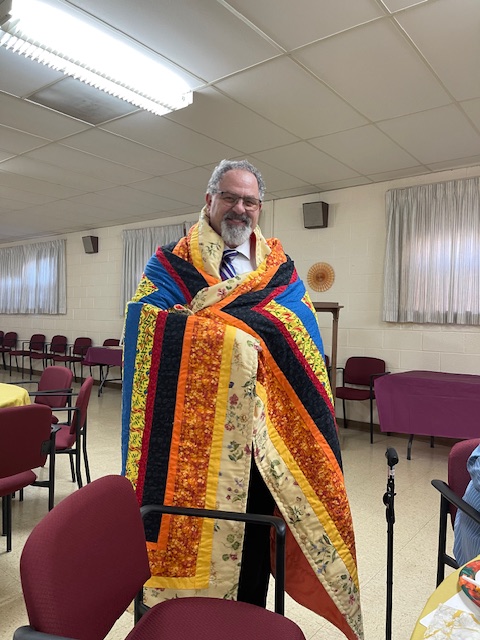
We had a soup lunch afterwards and had a drawing to give away a few of the quilts our ladies had made. I won what I’m calling my Joseph Quilt. It is a nice sized quilt worked on by several of the ladies. My mom provided the stitching/decoration around the border.

Have you ever seen one of those movies where they start with some dramatic scene. In the cop shows, it’s usually a murder or finding someone badly injured in an unexpected place. In a Hallmark movie, it might be a wedding scene or a passionate kiss (we all know that’s coming in the Hallmark movie, so no need to put it off until the end!). But then in the next scene, the graphic pops up: “Six months earlier.” The opening scene has gone by so quickly that you didn’t even get a chance to figure out much about who the characters are, then you’re thrust back in time and have to figure it out all over again.

Today we come to the conclusion of the liturgical calendar: “Reign of Christ the King” Day. It’s hard to believe Advent (and the new liturgical year) starts next week. The Lectionary is kind of like those movies I mentioned earlier. Even though we read about the crucifixion of Jesus this morning, we’re not going to get back to that dramatic event of the Resurrection that kicked off the last eight months of the calendar until Easter next year.

This past year, we’ve journeyed through the gospel of Luke, which has the most material on the life of Jesus. Five months ago, we read in Luke 9:51 that Jesus “resolutely set out for Jerusalem.” The rest of Luke’s gospel from that point on is set in that context of Jesus knowing his life would be cut short. Yet he continued loving, healing, and teaching the masses about God’s true love for them. He also did not shy away from confronting the religious leaders of his day for their abuse of the spiritual authority God had entrusted to them. That violation of God’s trust brings us to where we are today in the gospel, the crucifixion.

Luke has details in this story that the other three gospel writers do not have. Luke is the only one who has Jesus saying “Father, forgive them, for they do not know what they are doing.” He wasn’t just talking about how the Roman soldiers were treating him either. Matthew and Mark tell us that the criminals who were crucified with Jesus were BOTH hurling insults at him, but Luke indicates that one of them must have had a change of heart after hearing Jesus say “Father forgive them” and asked Jesus for forgiveness in his last hour. Jesus, of course, granted it.

The religious leaders were jeering and sneering at him as well. “He saved others, or so he claims! Let him save himself if he’s the Messiah!” One might expect that kind of behavior from criminals, but from those who had presumably dedicated their lives to serving God at the Temple or in the local synagogues? You know you must be getting close to the corruption and hardness of heart when the people who should be on your side are rejecting you for your teachings.

Even though our gospel reading stops just short of the final moments of the crucifixion, we are all familiar enough with that story to finish it from memory. And we know that because Christ defeated death and rose again into his heavenly glory, he lives and reigns as King of Kings and Lord of Lords. While his kingdom is here on earth, it is not of this world. Paul says in Ephesians 1:3 that God has “blessed us [i.e., Christ followers] in the heavenly realms with every spiritual blessing in Christ. It was evident from the moment of Pentecost that God had begun a new work in his people through the empowering of the Holy Spirit sent to us by our risen Savior.

As Christ followers, then, we are by default emissaries of the King of Kings and Lord of Lords. In the rest of the New Testament we see Paul and the other apostles planting and shepherding churches that are growing by leaps and bounds in various places. In many cases, the word of God has already spread to places where Paul had yet to travel because other believers were doing that missionary work as well. In the first chapter of Paul’s letter to the Colossians, we get a glimpse at Paul’s heart for them in the first chapter. Paul praises them for having a faith that is “bearing fruit and growing” in their hearts and around the world. Let’s pick up his praise for them in verse 9:

For this reason, since the day we heard about you, we have not stopped praying for you. We continually ask God to fill you with the knowledge of his will through all the wisdom and understanding that the Spirit gives, t 10 so that you may live a life worthy of the Lord and please him in every way: bearing fruit in every good work, growing in the knowledge of God, 11 being strengthened with all power according to his glorious might so that you may have great endurance and patience, 12 and giving joyful thanks to the Father, who has qualified you to share in the inheritance of his holy people in the kingdom of light. 13 For he has rescued us from the dominion of darkness and brought us into the kingdom of the Son he loves, 14 in whom we have redemption, the forgiveness of sins. [1]

Paul has incredible respect for the Colossians and wants to ensure they continue on the path of growing in righteousness and faithfulness. This is significant in that Colossae was an incredibly diverse town in south-central Asia Minor. He wants them to be filled “with the knowledge of his will through all the wisdom and understanding that the Spirit gives.” Paul has a similar thought for the Ephesians in the opening of that letter: “18 I pray that the eyes of your heart may be enlightened in order that you may know the hope to which he has called you, the riches of his glorious inheritance in his holy people, 19 and his incomparably great power for us who believe.”[2]

In Colossians 1:6, Paul affirms that the gospel is “bearing fruit and growing through the whole world. He reassures the Colossians are doing their small part to contribute to that in vs. 10.

Being strengthened in all power means that they understand the working of the Holy Spirit in their lives. They do have some challenges, apparently, with some coming among them making “fine sounding arguments” against the gospel. But Paul has confidence that their knowledge will help them discern false teachings and stay the course of the true gospel with patient endurance.

They are also continually giving thanks because they’ve been rescued from darkness. They believed the gospel and have been living it out boldly because they know they’ve been forgiven and redeemed.

After praising them, Paul continues from verse 15 talking about the supremacy of Christ and why he reigns as King of Kings and Lord of Lords:

15 The Son is the image of the invisible God, the firstborn over all creation. 16 For in him all things were created: things in heaven and on earth, visible and invisible, whether thrones or powers or rulers or authorities; all things have been created through him and for him. 17 He is before all things, and in him all things hold together. 18 And he is the head of the body, the church; he is the beginning and the firstborn from among the dead, so that in everything he might have the supremacy. 19 For God was pleased to have all his fullness dwell in him, 20 and through him to reconcile to himself all things, whether things on earth or things in heaven, by making peace through his blood, shed on the cross. [3]

The concept of Jesus being the “firstborn” here seems to have a dual meaning. In verse 15, Paul says Jesus is the firstborn over all creation. That seems to suggest what we learn from John, that Jesus, the light of the world, was the “light” that God created on Day One of creation. A few verses later, in verse 18, Paul calls Jesus “the beginning,” which would seem to confirm the Genesis theory, but the then also calls Jesus “firstborn from the dead.” John also uses the phrase “firstborn from the dead” of Jesus in the opening chapter of Revelation (1:5). This of course is a reference to his resurrection.

Even though there are a few others in the history of the Bible who were raised from the dead, they all came back to life in their original human bodies. Jesus is the first one whose body was raised from the dead AND transfigured into its heavenly version. That earns him the title of head of the church—King of Kings and Lord of Lords—having supremacy over everything. This supremacy is not only for this world, but in the heavenly realms as well as Paul indicates.

Harkening back to Ephesians 3:10, we see that we have a role in proclaiming the gospel not only here but also in the heavenly realms. “10 His intent was that now, through the church, the manifold wisdom of God should be made known to the rulers and authorities in the heavenly realms.”[4] The passage in Ephesians 6 on the armor of God reaffirms our role in fighting the good fight not only against flesh and blood, but against the powers in the heavenly realms. We have the divine protection and strength to stand firm in those battles because of Christ’s victory over death and the redemption he won for us. Not only does he reign as King of Kings and Lord of Lords in our lives, but he has also provided the means for us to walk faithfully in this world.

As we wrap up the liturgical year and look toward Advent and the Christmas season, we can take comfort and courage in having citizenship in the kingdom of Christ. A blessed Thanksgiving to all of you this week, and please join us for the meal after service. Amen.

Advent Hope | Sunday Morning Greek Blog

Advent Love (Luke 1:39–55; 1 Samuel 2:1–10) | Sunday Morning Greek Blog

Advent Peace: John’s Message of Baptism and Repentance (Luke 3:1–12) | Sunday Morning Greek Blog

Waiting for the Messiah…Again (Matthew 24:36–44) | Sunday Morning Greek Blog


[1] The New International Version. 2011. Grand Rapids, MI: Zondervan.

[2] The New International Version. 2011. Grand Rapids, MI: Zondervan.

[3] The New International Version. 2011. Grand Rapids, MI: Zondervan.

[4] The New International Version. 2011. Grand Rapids, MI: Zondervan.

May 19, 2025

Communion as a Call to Action (John 13:31–35)

I preached this message May 18, 2025, at Mount View Presbyterian Church, Omaha, NE. Fifth Sunday after Easter, Year C.

I find it interesting that in the weeks after Easter, the gospel passages in the Lectionary are revisiting Jesus’s Holy Week events. That probably shouldn’t surprise us with John’s gospel, though, as the last half of his gospel deals with the events of Holy Week. One explanation for this, I think, is that Jesus taught his disciples so much in that last week, and much of it occurred, apparently, immediately after the “Last Supper.” Given what happened in the 24 hours that followed that last supper, I think it’s safe to say that the apostles probably didn’t remember too much of that teaching. It’s a good thing John wrote it down, then! This gives them the opportunity to revisit those precious final moments with Jesus and to review his teachings to see what they missed about his death and resurrection.

Since we’re going back to Holy Week, and especially since today’s passage comes after John’s unique account of the Last Supper, I think it’s worth it to take a look at his account, especially, and add in the details that Matthew, Mark, and Luke provide. At the beginning of John 13, we see that the meal is already in progress, but we don’t get the “ritual” language we’ve become accustomed to from the other three gospels.

There’s no “This is my body” or “This cup is the new covenant in my blood poured out for the forgiveness of sins” in John’s gospel. That’s not to say there’s a contradiction here in the storyline: John focuses on a more radical form of demonstrating the forgiveness that would come from the shed blood of the Messiah. He tells us that the Messiah himself washes the feet of ALL the disciples. When Jesus gets to Peter, we find out a little more about Jesus’s motivation for doing this: “Unless I wash you, you have not part with me.” Jesus turns this act of service into a living, “practical” memorial that his disciples would not soon forget. Not only has he said his blood would bring forgiveness; he touches each one of the disciples, even Judas, who he knows will sell him and out, and Peter the denier, to give them “muscle memory” of forgiveness.

Matthew, Mark, and Luke all say something about the bread and the cup. Matthew and Mark both say simply: “This is my body,” while Luke adds two extra phrases: “This is my body given for you; do this in remembrance of me” (Luke 22:19). Notice that none of the gospel writers ever say, “This is my body broken for you,” although the piece of unleavened bread in this part of the ceremony was the only one formally broken. The church through history almost naturally added in that bit about “broken for you” to parallel what happens to the bread. Note also the references to the cup in the three synoptic Gospel accounts have Jesus saying that the wine is “the new covenant in my blood” or “the blood of my covenant.” Matthew is the only one who connects the blood with the forgiveness of sins.

One thing that Jesus says in all three gospel accounts may get overlooked: “I will not drink from this fruit of the vine from now on until that day when I drink it new with you in my Father’s kingdom.”[1] Jesus here is looking far beyond his own time with this statement: he’s looking ahead to his second coming where we will share in the glorious feast of the Lamb with him in heaven. It’s also worth noting here that Jesus still considers what he’s drinking is “the fruit of the vine” and NOT blood at all.

But this also begs the question: what does Jesus mean when he says, “This IS my body” and “This IS the new covenant in my blood”? I think as Presbyterians we can agree there is not some mystical transubstantiation of the wine into Jesus’s blood. Nor is there a mystical transubstantiation of the bread into the flesh of Christ. But I also don’t think the cup and the bread are merely “symbols” either. I prefer to use the word “signify” to describe the elements because they do have significance for my faith.

In this way, communion is akin to baptism. What does Paul say about baptism in Romans 6:3? “Don’t you know that all of us who were baptized into Christ Jesus were baptized into his death?”[2] Baptism signifies (there’s that word again) that we have come in contact with blood of Christ, which Matthew affirms is for the forgiveness of sins. That is our “initiation” rite, a marker or monument, if you will, that God has done something special in our lives and that we are set apart for something special. The water doesn’t become the blood of Christ when we’re baptized. But in a way that only God knows, the waters of baptism are infused with the power of spiritual cleansing and renewal.

Communion, then, is our regular connection with our baptism, because in communion, as we’ve said, we also encounter the blood of Christ, or what it signifies, in the cup at the communion table. The bread reminds us of the physical suffering Christ endured on the cross. But it also reminds us that we are all part of the body of Christ as well—that’s why we take it together, whether it’s monthly, weekly, or whenever we gather in his name. Out of all the different denominations out there, communion reminds us what we have in common: faith in Christ.

I’ve been studying what the Bible says about communion for quite a long time. It was the topic of one of my early blog posts. In my home church, we take it every Sunday, because that seems to be the practice of the early church in Acts. But my church also typically qualifies it when giving the communion meditation: “If you’re a believer in Christ, we invite you to participate.” There’s no official check for membership or a communicant’s card. Just a simple question to be answered on your honor. Some denominations or branches of mainline denominations require you to be a member of the church. Others may even suggest you’re committing heresy or blasphemy if you take communion in a church where you’re not a member.

The variety in how communion or the eucharist is handled in the modern church concerns me. Communion should be about what Jesus accomplished on the cross, not about your personal affiliation with a particular church. In that early blog article, A Truly Open Communion?, I asked the question this way:

If Jesus calls sinners to himself and eats with them; if Jesus broke bread at the Last Supper with a table full of betrayers and deserters; if Jesus can feed 5,000 men in addition to the women and children with just a few loaves of bread and some fish; why do many churches officially prohibit the Lord’s Table (communion, Eucharist) from those who are not professed Christ-followers, or worse, from those professed Christ-followers who are struggling with sin or divorce or other problems?

Should we really be denying or discouraging those who come to church looking for forgiveness and a connection to the body of Christ the very elements that Jesus uses to signify those things—the bread and the cup? Author John Mark Hicks says this in talking about communion as a “missional table”:

The table is a place where Jesus receives sinners and confronts the righteous; a place where Jesus extends grace to seekers but condemns the self-righteous. Jesus is willing to eat with sinners in order to invite them into the kingdom, but he points out the discontinuity between humanity’s tables…and the table in the kingdom of God.[3]

The implication here is that Jesus is in our midst in a special way, I think, not just because “two or three are gathered in his name,” but because we are doing this “in remembrance” of Jesus. The Old Testament concept of “remembering” is what is key here. In the Old Testament, when the writer says something like, “Then God remembered his promise to Abraham” or “Then God remembered his covenant with Israel,” this not God just calling a set of facts to mind. When God remembers like this, he also acts, and usually in a mighty way.

So when we remember, I believe it is also a call to action on our part, to be empowered by the presence of the Holy Spirit in that moment to make a commitment to action for the days that follow. It’s similar to what Jesus says in the Sermon on the Mount (Matthew 5:23–24): “Therefore, if you are offering your gift at the altar and there remember that your brother or sister has something against you, leave your gift there in front of the altar. First go and be reconciled to them; then come and offer your gift.”[4] By his blood we are forgiven and cleansed to start afresh. By remembering Christ, we are empowered to go out and serve.

As we come to today’s gospel passage again, we find ourselves at the end of the dining part of the Last Supper gathering. Jesus wants this time to be memorable for his disciples, because he tells them this is the last time they’re going to have any meaningful contact with him, at least in his earthly form. John makes a point of saying “When [Judas] was gone,” Jesus began delivering his final instructions, his “action plan” if you will, to give them assurance that they will have the guidance of the Holy Spirit after his death, burial, resurrection, and ascension. All of the elements leading up to his crucifixion have been set in motion, and there’s no turning back now.

That is why Jesus can say, “Now the Son of Man is glorified and God is glorified in him.” He knows what is about to happen. Although Jesus will experience many strong emotions, including betrayal, abandonment, and those associated with excruciating pain, he knows the end result will benefit all mankind for eternity. It’s the day he prepared for but perhaps had hoped would never come, or at least had hoped he would not have to endure alone. He knows the days ahead will be difficult, so he gives them a new command.

“Love one another. As I have loved you, so you must love one another” (John 13:34).

That word “as” carries a huge load with it. It’s not the regular word for “as” in Greek, which is also a two-letter word. The word John uses is a compound word that has the sense of its root words: “love one another according to the way I loved you.” The theme of this new command is found in a few other verses in this part of John, as well as in Luke 6:31: “Treat others according to the way you want to be treated.” “Love” is less about a feeling and more about action. Earlier in John 13, Jesus says, “I have set you an example that you should act toward others according to the way I have acted toward you.” In 15:9, he says, “I have loved you according to the way the Father has loved me,” and then repeats the command from John 13 a few verses later.

Showing this radical, sacrificial, agape kind of love that expects nothing in return is how we show the world we are Jesus followers. It calls us in some cases to reach out beyond our comfort zones and to be hospitable and welcoming to strangers. The author of Hebrews exhorts us in this way in 13:1: “Keep on loving one another as brothers and sisters. Do not forget to show hospitality to strangers, for by so doing some people have shown hospitality to angels without knowing it.”[5] We could all use an angel in our lives from time to time, right? The first chapter of Hebrews (1:14) mentions the function of angels: “Are not all angels ministering spirits sent to serve those who will inherit salvation?”[6] God uses angels, in conjunction with the Holy Spirit, to empower and enable us to show love to others. But I digress just a bit.

God demonstrated his great love for us in Jesus through his life among us, his crucifixion, and his resurrection. I want to bring in the last couple verses of our reading from Psalm 148 this morning, because it is one of the foundational prophecies that show us what the Israelites expected of the Messiah, and Jesus proved faithful to that promise:

13 Let them praise the name of the Lord,

for his name alone is exalted;

his splendor is above the earth and the heavens.

14 And he has raised up for his people a horn, k

the praise of all his faithful servants,

of Israel, the people close to his heart.

Praise the Lord. [7]

Jesus is our horn, the strength that we need to endure each day. Let us continue to hold fast to our Savior so that the world will know him, his salvation, and the power and love of God Almighty. Amen!


[1] The New International Version. 2011. Grand Rapids, MI: Zondervan.

[2] The New International Version. 2011. Grand Rapids, MI: Zondervan.

[3] Hicks, John Mark. “The Lord’s Supper as Eschatological Table” in Evangelicalism and the Stone-Campbell Movement, Volume 2: Engaging Basic Christian Doctrine. William R. Baker, ed. Abilene: ACU Press, 2006.

[4] The New International Version. 2011. Grand Rapids, MI: Zondervan.

[5] The New International Version. 2011. Grand Rapids, MI: Zondervan.

[6] The New International Version. 2011. Grand Rapids, MI: Zondervan.

[7] The New International Version. 2011. Grand Rapids, MI: Zondervan.

May 7, 2025

Sowbelly Elegy: The Majesty of God in Exegesis

With apologies to VP JD Vance for mimicking his title.

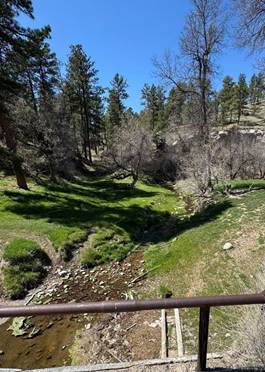
I do not do much personal reflection in this blog. I’m mostly about exegesis (studying the text of the Bible in its original languages), hermeneutics (applying the results of exegesis to the understanding and meaning of the Bible), and lately homiletics (declaring the understanding and meaning of the Bible, especially as a sermon or homily, or in this case, a blog post). This ties in with the taglines for my blog that I put on my “business” card: “Dig deeper. Read Smarter. Draw Closer.” This past weekend, I took the opportunity to go to Fort Robinson State Park in northwest Nebraska to share in a fly fishing expedition with several guys (and the wife of one of them) from our church, including our pastor. The Fort Robinson area has several excellent fishing areas, including several streams and creeks; the first ten miles or so of the White River, which ultimately runs through the Badlands in South Dakota and empties into the Missouri River; and several ponds. Many of these locations are stocked by the State fisheries with trout and other popular species of freshwater fish.

I had never done fly fishing before, but the chance to get away and spend some time with friends old and new outweighed any anxiety I may have had about that. I only spent a few hours fishing at a couple ponds and in the White River, but it was long enough for me to observe others doing it, and I got pretty good at the casting part. I had a few curious little fish check out my fly, but never did land anything, which was okay by me. I was just grateful to be there.

Putting the Pieces Together

Part 1: Reflecting on Exegesis

The timing of the trip was divinely appointed for me as it coincided with some serious reflection I’ve been doing about the relationship between the depth of Bible study I typically do (“Dig Deeper”) and what I expect from the small groups I attend or help lead. That reflection was prompted by a recent post from one of the other pastor-bloggers on WordPress, Veritas Domain, and his short article about his “simplified” exegetical method. His method is similar to mine in that there is a heavy focus on the text itself, which is not unusual. I’m trained in Greek and Hebrew, so I start with those texts first, or at least have them open in parallel with the English translation so I can take note of key words (“Read Smarter”). If I’ve done those first two steps, the “Draw Closer” principle usually follows quite nicely.

In my comment back to “SlimJim,” I mentioned that my method was similar, but along with that, I’m finding that my experience with the two small groups I’m connected with at my church and even with my preaching is that having the knowledge that comes from that kind of in-depth study may not always go over well with those who don’t have that specialized training. In our men’s group, I can typically get away with sharing that when I feel it adds something to the discussion, but even then, one of my friends in the group (who happens to be a preacher’s kid) will sometimes say “All that is nice to know, but I want to know what makes me a better Christian, a better man of God.” That is, he wants to get to the “Draw Closer” part.

This brought to mind an article I read a number of years ago (a 1997 issue of Leadership magazine) by Haddon Robinson, in which he’s quoted as saying, “More heresy is preached in application than in exegesis.” In other words, some of us preachers may be pretty good at exegeting and interpreting God’s word, but how are we doing about translating that into action for our respective audiences? Does it really matter if a divine command is in the aorist tense versus the perfect tense if we don’t follow the command ourselves or encourage our audiences to follow the command, or worse, manipulate the command with malicious intent?

Part 2: The Fort Robinson Retreat

I had decided I would drive to Fort Robinson from my Omaha, where I live, by way of Nebraska State Highways 92 (first half) and 2 (second half). Together, those two routes take you through the heart of the State, east to west. In addition, Highway 2 runs through the heart of the Sandhills. If you look at a satellite view of Earth along Highway 2, you’ll see that these Sandhills look like a bunch of sand dunes, but they all have grass growing on them, and several small ponds or lakes are scattered throughout. As I was driving through the Sandhills and listening to Rich Mullins and the Passion CDs (yeah, those date me), I began to understand what the Holy Spirit was trying to teach me. But he was only getting started.

I arrived at Fort Robinson State Park after dark, but not so late that I didn’t get to connect with my church friends who had already been there for a full day. We had breakfast the next morning at a small café in nearby Crawford, then struck out to fish. I went with a friend who had been in my small group when I moved back to Nebraska in 2010 and two of his (now grown) sons whom I hadn’t seen in quite some time. It was my first time fly fishing, so my goal was to get the hang of casting and extending my line. We tried the Ice House pond and then walked about a mile to couple bends in the White River (only about 10 miles from its headwater at that point, so no more than about eight feet wide if that. I had a few nibbles at the pond, but nothing in the river. From there we went back to the Grabel ponds, where I finished out the morning having developed a pretty good technique to cast and extend my line, even landing it on top of a 12-inch fish and spooking it away for a moment.

While I was at the section of the White River, I couldn’t help but think and marvel about how God created a means for distributing life-giving water throughout a continent (I knew the term “hydrology,” but I had to look up “limnology” as I was writing this paragraph), especially since, at the end of this month, my brother and I will be at the other end of the White River in South Dakota where it flows through the Badlands (and earns the name “White” from its sediment) and into the Missouri River south of Chamberlain for another fishing trip. God’s creation is an amazing and wonderful thing. That was what the Holy Spirit was continuing to show me, but not for the reason you might think.

Part 3: Sowbelly Canyon Road

One of the sights I had heard about from the guys who had gone up the previous year was Sowbelly Canyon, just north of Harrison, Nebraska. I had no idea what to expect from a “canyon” in Nebraska; certainly nothing like Poudre River Canyon in Colorado where my wife’s family has a cabin. Poudre Canyon is about 50 miles long, and the Poudre River is relatively wide in the canyon. Sow Belly is unique in its own way and was surprisingly beautiful and “cool” in more ways than one. I wish my wife would have been able to come along on this trip.

As you’re driving west on US 20 toward Harrison, you see nothing but a bunch of gently rolling hills on either side of the highway. One would never expect a place of such beauty was just beyond those rolling hills. Even as you crest the top of the canyon, you see an amazing sight below: a single lane dirt road running under a canopy of trees, with unusual rock formations atop the buttes, some of which have formed at right angles. The descent is moderately steep, and at times you have a wall of the canyon on your right (descending) and your left (ascending). At the bottom of the canyon is a small, babbling brook that must have taken a few centuries to form the canyon.

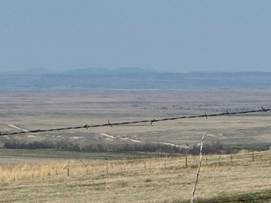
Just before you get to the end of Sowbelly Road on the east end (where it joins Pants Butte Road; no, I’m not making that name up), there’s a spot where you can see at least 80 miles to the north to the Black Hills in South Dakota (the dark mound in the far horizon). Something special happened between God and me via the Holy Spirit on that road, and especially with this particular view. I gained a whole new appreciation for the beauty, majesty, and grandeur of God’s creation. I’d expect something like that in Colorado; I never expected that in seemingly plain old northwestern Nebraska. Boy, was I wrong. What God had started teaching me in the Sandhills came to full fruition at the top of Sowbelly Road.

Part 4: Worldview, Wonder, and Wisdom

So let me bring this all together now. You might remember I started out talking about exegetical methods, methods that were heavily focused on the textual features like grammar, syntax, verb mood and tense, etc. Then it hit me: nothing in my exegetical method intentionally accounts for the majesty and glory of God and his creation. I knew I had to work that in somehow. But God still had one more piece to show me, and it hit me last night at our last small group of the season. Our senior pastor had been with us on this trip, but Sunday morning, one of the teaching pastors was preaching on the trauma Job experienced. I had tried to listen to it Sunday morning while driving through the remotest part of western Nebraska, but just couldn’t get a steady signal.

Fortunately, our Tuesday night group covered it in the study last night, and it was when we were talking about the ending of the book of Job that everything God had been teaching my finally made sense. Job had been arguing with God and his friends about how righteous he was and how he had always given God glory and so on, but God put him in his place. God recounts for Job all that He did by questioning Job: Did you lay the foundations of the earth? Did you create Leviathan and Behemoth? Who are you to tell me how I should act toward you?

That’s when I realized that I’m like Job in that moment. I think I have such a great exegetical method that will keep my doctrine sound and shred every stronghold that tries to set itself against God Almighty, but God’s word is more than the text and the grammar and verb moods and tenses and the participles and the conditional clauses. Those things are static, unchanging. But what does Hebrews 4:12 say? “For the word of God is alive and active. Sharper than any double-edged sword, it penetrates even to dividing soul and spirit, joints and marrow; it judges the thoughts and attitudes of the heart.”[1] Can grammar and syntax do that? I think not.

The other thing that occurred to me is the backstory of how the Jews would understand God’s word versus us gentile Christians. I’ll use just one example here: Communion, or as some call it, the Lord’s Supper or the Eucharist. When we look at the elements (“substantiational” leanings aside), we are meant to experience Christ in some way by “remembering” him. We see one man crucified and risen. But what do Jews remember at Passover? Not one man dying, but ALL the firstborn dying who weren’t protected by the blood of the lamb that they themselves applied to their doorways. They remember God parting the Red Sea so the Israelites could escape the oncoming Egyptians. The disciples didn’t understand immediately that Christ’s death had won them forgiveness and freedom. The Jews DID understand that immediately, with hearts pounding witnessing the very miracles of God at work to rescue them, even as they would tell the stories year after year to their descendants.

Conclusion

In other words, when I exegete and interpret Scripture, I need to look beyond the text and the grammar and all the other “in-the-weeds” details to comprehend a grand vision of a great God and all that he has done and made. That’s where the “draw closer” takes place, as it did for me this past weekend, when I understand who I am in God’s kingdom and that in spite of his greatness and grandeur, he looks with love at the least of us, at the humblest of us, at our faithfulness. He looks with compassion at those who are lost and searching and even at those who may be angry with him or agnostic toward him, prompting us to share God’s “living and active” word with those who have not yet comprehended that greater vision.

From this point forward, then, I’m adding a couple permanent elements of my “principlizing bridge” (to use Grasping God’s Word’s language) will be to ask first, “How does this passage reveal the glory and majesty and mystery of God to the world?” and second, “How is this passage ‘alive and active’ not only to me but to those I encounter as well?” I feel like I drew a little closer to God this weekend. I pray that my testimony here will do the same for you.

Scott Stocking

All contents herein are the creative and intellectual property of this author unless otherwise attributed.


[1] The New International Version. 2011. Grand Rapids, MI: Zondervan.

April 20, 2025

Running the Resurrection Race (Easter 2025; John 20:1–18)

I delivered this message Easter (Resurrection Sunday), April 20, 2025, at Mount View Presbyterian Church in Omaha, Nebraska. I focused on the theme of “running,” picking up on the account of Peter and John “racing” to the tomb.

Good morning! Hallelujah, Jesus is Risen!

The Bible has a running theme. No, seriously, the Bible talks a lot about “running” in the context of our faith. Consider these two verses from 2 Samuel 22:29–30 (par. Psalm 18:28–29) NKJV:

29          “For You are my lamp, O Lord;

The Lord shall enlighten my darkness.

30          For by You I can run against a troop;

By my God I can leap over a wall.[1]

Or how about Psalm 119:32 (NKJV):

I will run the course of Your commandments,

For You shall enlarge my heart.[2]

Then there’s Proverbs 18:10 (NKJV):

10          The name of the Lord is a strong tower;

The righteous run to it and are safe.[3]

The running theme carries over into the New Testament as well, especially in Paul’s letters:

There’s 1 Corinthians 9:24 (NIV): “Do you not know that in a race all the runners run, but only one gets the prize?”[4]

And Galatians 2:2b (NIV): “I wanted to be sure I was not running and had not been running my race in vain.”[5]

Even the author of Hebrews gets in on the theme in 12:1–2a (NIV): “Therefore, since we are surrounded by such a great cloud of witnesses, let us throw off everything that hinders and the sin that so easily entangles. And let us run with perseverance the race marked out for us, fixing our eyes on Jesus, the pioneer and perfecter of faith.”[6]

We see the running theme in the parable of the prodigal or “lost” son in Luke 15:20 (NIV), although in a slightly different way when it comes to the father in the parable:

“But while he was still a long way off, his father saw him and was filled with compassion for him; he ran to his son, threw his arms around him and kissed him.”[7]

A few verses later, we learn why the father ran to greet his son: “‘This son of mine was dead and is alive again; he was lost and is found.’ So they began to celebrate.”[8]

I think you see where I’m going with this now, right? In our gospel passage this morning, however, Mary and the disciples aren’t looking for a “lost” or prodigal son, but, as they will realize shortly, the once dead and now risen Lord and Savior, Jesus Christ. Mary runs to tell the disciples the news, and Peter and John run, no race back to the tomb to see if what she’s telling them is true. The news was that incredible that they couldn’t just take a casual morning stroll back to the tomb.

Now before I dive into this morning’s passage from John, I want to do a quick sidebar on one of the most common questions people ask about the crucifixion and resurrection. Jesus was crucified on a Friday and rose from the dead on Sunday. That sounds like about 48 hours, right? Two days? But Jesus had predicted all along that he would rise on the third day. He “borrowed” that timeline from the prophet Jonah, who had spent three days and nights in the belly of the great fish. By Jewish reckoning, the first day of anything is “day one.” We see that in Genesis: “There was evening and morning, the first day.” Jesus was arrested (i.e., “swallowed up”) on Thursday evening after sundown and subjected to a rigged trial that was illegal by Jewish laws in several ways had sealed his fate before it even started, so the period from sundown Thursday through sundown Friday was “the first day.” The Sabbath, of course was on Saturday, having begun at sundown Friday night, the second day. This of course makes Sunday the third day. Jesus could have risen any time after sundown Saturday night and would have fulfilled the prophecy of rising on the third day.

In fact, John’s account tells us it was still dark when Mary Magdalene got to the tomb Sunday morning. John says nothing about whether the guards were there. I’m guessing not, though, as they probably ran off terrified that the stone rolled away seemingly all by itself. Matthew says the guards had to make up a story about it, but they most likely would have been disciplined if not executed for their inability to keep a dead man in a tomb. The details differ among the gospel writers, but I’ll stick with John’s narrative here the rest of the way. Mary didn’t wait around to find out what happened. She had apparently looked in the tomb before running back to Peter and John (“the other disciple”) because she told them Jesus wasn’t there anymore.

Peter and John went racing back to the tomb. John made sure he reported that he won the race, but Peter went in first. Isn’t that the reverse of the Prodigal parable? The prodigal Peter, who had denied knowing Jesus three times during the illegal trial, came running back to his savior. It seems odd that they just looked into the tomb and apparently shrugged their shoulders at each other. John tells us that he and Peter found strips of linen there and a separate head cloth when they went into the tomb. Not sure what that means for the Shroud of Turin. But it does suggest that someone had to unwrap Jesus, unless his arms weren’t secured to the body.

Because they still hadn’t put two and two together yet, they decided to head home. No further investigation; no searching for clues or footprints in the dust; no trying to find eyewitnesses that may have seen what happened. What’s especially surprising to me is this: why did they leave Mary Magdalene at the tomb all alone, still crying in grief and shock that someone might have stolen Jesus’s body? Not very gentlemanly of them. And they missed the best part.

Mary, however, did not miss the best part. When she looked into the tomb again, she saw the angels, probably the same ones who unwrapped Jesus’s body that morning. Why weren’t they there when Peter and John went in? Difficult to say, except perhaps that they should have been able to recall Jesus’s teaching about him rising from the dead after three days. Or maybe it’s because Mary was the first one to arrive at the tomb, so she got to be the first one to see him when he made his appearance. Jesus was apparently just freshly resurrected, because Mary couldn’t touch him for whatever reason.

The fact that Mary has a validated claim of being the first to see Jesus risen (besides perhaps the Roman guards) might add some credibility to the resurrection story. If Peter and John had been the first ones to see him alive, it’s possible they could have been accused of a conspiracy to hide the body and say he rose from the dead. It would be more incredible to believe that a couple older Jewish women could have carried his body off than it would be to believe Jesus had risen from the dead.

Jesus told her to go find Peter and the rest of the disciples and let them know he was indeed alive. The disciples don’t have to wait too long to see the risen Savior for themselves. That very night, Jesus would appear to them behind locked doors and reveal himself. Jesus was revealing himself to more and more people and would continue to do so for the next 40 days or so to establish an irrefutable claim that he had indeed risen from the dead. He had won the victory over death and the grave so that we also could live in that hope of the same victory.

What is the message we can take from this passage today, that the disciples ran to see if the hope of Jesus survived his crucifixion? Well, lately I’ve been seeing news reports that people, especially young people, are coming back to church after the COVID shutdowns had decimated many congregations. The White House has established an Office of Faith that is, ostensibly, looking out for the rights of those who live out their faith but have been hounded or cancelled by antireligious forces. We’re even seeing some politicians be more sincerely bold about speaking about faith matters. If we’re in the start of a revival in our country, let’s jump on the bandwagon!

I want to read to you part of an opinion piece that came out Saturday morning from columnist David Marcus. In it, he speaks of the connection between the suffering the church experienced through COVID and the beautiful end result that the church experienced in history after other periods of suffering:

Perhaps we should not be surprised that the bitter cup of COVID led to greater religious observance by Christians. After all the Holy Spirit, speaking through the prophets, has told for thousands of years of periods of loss and suffering that end in the fullness of God’s light.

From the banishment from Eden, to the Flood, to the Exodus, and finally Christ’s 40 days of starvation and temptation in the desert, again and again, it is suffering that brings God’s people closest to Him.

During COVID, our desert was isolation, and especially for young people, it only exacerbated what was already a trend of smartphones replacing playgrounds, of virtual life online slowly supplanting reality.

At church, everything is very real, much as it has been for more than a thousand years. At church, we are never alone. At church, things can be beautiful and true and celebrated, unlike the snark-filled world of our screens that thrives on cruel jokes.

Human beings need a purpose and meaning beyond being a cog in the brave new world of tech. We need connection to our God and to each other.[9]

I hope that Mount View can be a place where you continue to find connection to God. If you’re visiting today, I hope and pray that you’d want to stick around and discover more of that connection to God. And if I may speak from my own heart for a moment, I want to say this: I’ve been filling the pulpit off and on for over 3½ years at this point, and much more frequently since last October. You have grown on me, and I hope that you’ve grown with me. And I pray that the testimony of your fellowship will attract more and more people who desire to connect with God. I pray that the messages here as people download them from the Internet will bear much fruit wherever it is heard and repeated.

The church is winning the race to win the hearts and souls of those who seek a deeper connection with God and with their own faith. I mean, who would have ever thought that the American Idol reality show would have a three-hour special featuring “Songs of Faith” like they’re doing tonight! I’d say the Spirit is on the move! You and I may never be on American Idol, but we can be bright and shining lights so that the world may know the hope we have.

On this day when we celebrate the resurrection of Jesus, I want to close with an encouragement to you from Paul’s letter to the Ephesians, 1:18–20 (NIV):

I pray that the eyes of your heart may be enlightened in order that you may know the hope to which he has called you, the riches of his glorious inheritance in his holy people, 19 and his incomparably great power for us who believe. That power is the same as the mighty strength 20 he exerted when he raised Christ from the dead and seated him at his right hand in the heavenly realms.[10]

Amen, and have a blessed Resurrection Sunday with friends and family.


[1] The New King James Version. 1982. Nashville: Thomas Nelson.

[2] The New King James Version. 1982. Nashville: Thomas Nelson.

[3] The New King James Version. 1982. Nashville: Thomas Nelson.

[4] The New International Version. 2011. Grand Rapids, MI: Zondervan.

[5] The New International Version. 2011. Grand Rapids, MI: Zondervan.

[6] The New International Version. 2011. Grand Rapids, MI: Zondervan.

[7] The New International Version. 2011. Grand Rapids, MI: Zondervan.

[8] The New International Version. 2011. Grand Rapids, MI: Zondervan.

[9] DAVID MARCUS: 5 years after a dark COVID Easter, faith is flourishing | Fox News, accessed 04/19/25.

[10] The New International Version. 2011. Grand Rapids, MI: Zondervan.

March 23, 2025

Bearing Fruit…and the Cross (Luke 13:1–9; Psalm 63)

I preached this message on Sunday, March 23, 2025, at Mount View Presbyterian Church. I dealt with all four passages for the Lectionary for this Sunday.

Bearing Fruit…and the Cross

Lent is typically thought of in the Christian world as a time of sacrifice. Some people give up meat only to crowd into the numerous fish fries around town. Others might give up chocolate or coffee or caffeinated beverages or shopping or any number of other things that we might consider “vices” personally, but most of those things are not innately spiritual and may in fact make us a bit more difficult at times to live with if we haven’t had our morning cup of Joe. I’m teasing you a bit, of course. But if Lent is supposed to bring us some spiritual benefit, then shouldn’t we be giving up things that can damage our relationship with God? Why not give up greed, pride, selfishness, and other such things?

That seems to be the underlying theme behind our passages today. They might be summed up by John’s exhortation when he was preaching in the wilderness in Luke 3:8: “Produce fruit in keeping with repentance.” In other words, bear fruit while you’re bearing the cross. In our passage from Luke 13 this morning, Jesus seems to be addressing the thought that some had that bad things only happened to bad people. But the circumstances of our demise do not determine our eternal destiny. In spite of the untimely and unfortunate deaths of the Galileans and those in the tower of Siloam, Jesus says the important thing is to repent and be ready.

Jesus switches to talking about the fig tree that won’t bear fruit in the next few verses. The owner of the fig tree wants to cut it down because it’s unproductive. But the vineyard manager said “Give me another year and I’ll have it bearing fruit.” But the connection here with the previous verses and John’s statement about producing fruit in keeping with repentance is unmistakable. If we’re not bearing fruit, that could affect our salvation and our relationship with our Savior. Jesus said in Matthew 7:20: “By their fruit you will recognize them.”

Paul talks about the quality of our works in 1 Corinthians 3:12–15, but he doesn’t use the language of “fruit.”

12 If anyone builds on this foundation using gold, silver, costly stones, wood, hay or straw, 13 their work will be shown for what it is, because the Day will bring it to light. It will be revealed with fire, and the fire will test the quality of each person’s work. 14 If what has been built survives, the builder will receive a reward. 15 If it is burned up, the builder will suffer loss but yet will be saved—even though only as one escaping through the flames.[1]

God, being full of grace and mercy, leaves us a way out when we fall short. That’s what he accomplished through Jesus in his death on the cross and his resurrection from the dead. But instead of focusing on these warnings for the rest of my message this morning, I want to turn the focus around to the theme I mentioned earlier: How do we bear fruit while bearing the cross? That would have been my sermon title in the bulletin if I had remembered to click send on my e-mail to Judy!

I want us then to look at the other three passages from the lectionary today in addition to our gospel passage I touched on at the beginning. In Psalm 63, we’ll look at seeking God in worship. In Isaiah 55, we’ll look at seeking God for our wellbeing. And finally in 1 Corinthians 10, we’ll look at standing firm in our faith to recognize the way out of temptations that can drag us down.

Let’s look at Psalm 63. For a long time our country has been turning away from church attendance and, by implication, from God altogether. A trusted, unbiased Web site called Statista has this summary of church attendance: “According to a 2022 survey, 31 percent of Americans never attend church or synagogue, compared to 20 percent of Americans who attend every week. Despite only about a fifth of Americans attending church or synagogue on a weekly basis, almost 40 percent consider themselves to be very religious.” A 2024 survey by Gallup puts the number of weekly attenders at 20%, with another 9% at “almost every week.” On the flip side, 31% NEVER attend church or other religious service. We could talk about the reasons for this 24/7 for a week, but we’d probably never get anywhere. Psalm 63 tells us why this shouldn’t be, though.

We should be able to come to church to find God. Granted David, who wrote this psalm, had a special relationship with God that enabled and empowered him to be a great leader of his people, but this doesn’t mean that you and I don’t have access to this same relationship in the New Covenant era. David claims to have seen God’s power “in the sanctuary.” It’s not clear exactly what he “saw,” whether it was some physical manifestation of light, a divine presence, or if he’s using the word “see” to describe what he experienced in worship. Regardless, it was clear at least in David’s day, one of the best places to be to encounter God was the sanctuary in the Temple.

In the New Covenant era, God has given his Holy Spirit to each of us who believe. You don’t have to be a king or a prophet any more to have exclusive access to the Holy Spirit. When we come together to worship, to sing praises and hymns, to read God’s word and hear it explained in such a way that it’s relevant to our live and our situations, the Holy Spirit works among us to build and shepherd that unity we have in body of Christ. When we pray together as a congregation, we let God know that we still trust in him to work in our lives and provide for our needs while at the same time letting those whom we’re praying for know that we will support them however we can. When we come together as a worshipping community for projects and collection for the poor, we show and shower God’s love upon those who are truly in need.

But our worship doesn’t just happen in the church building. Verse implies that wherever David is at, he is earnestly seeking God. Later in vs. 6, he say he remembers God in his bed and while he’s keeping watch on the battlefield at night. He sings to God and he clings to God, knowing that God’s presence is always with him through the Holy Spirit. We have that same assurance. Jesus even promised that at his ascension: “I am with you always, even to the end of the age.” Seek God and you will find him, and as you draw closer to him, others will come to see him at work in your lives as well.

As we seek God, we can also know he will provide for our basic needs and do so generously. That is the message of Isaiah 55. Verses 1 & 2 go like this:

“Come, all you who are thirsty,

come to the waters;

and you who have no money,

come, buy and eat!

Come, buy wine and milk

without money and without cost.

Why spend money on what is not bread,

and your labor on what does not satisfy?

Listen, listen to me, and eat what is good,

and you will delight in the richest of fare. [2]

God wants to richly bless us. God’s goodness is genuine and original. God isn’t giving us yesterday’s leftovers. Jeremiah says “His compassions never fail. They are new every morning; great is your faithfulness!” (Lamentations 3:22b–23). Sometimes we spend a lot of effort and money pursuing things that don’t bring lasting or eternal satisfaction. God wants us to focus on him and what he provides for us. Later on in Isaiah 55, the prophet says this:

Seek the Lord while he may be found;

call on him while he is near.

Let the wicked forsake their ways

and the unrighteous their thoughts.

Let them turn to the Lord, and he will have mercy on them,

and to our God, for he will freely pardon.[3]

You heard in that passage the idea I suggested earlier about giving up the things that tempt us to turn from God. But Isaiah also says we need to get rid of the “stinkin’ thinkin’” as well. This is complete repentance: not just changing our behavior but changing our minds and our ways of thinking as well. That’s were the worship comes in from Psalm 63: setting our hearts on Christ.

One of my favorite passages occurs a few verses later in Isaiah 55:

My word that goes out from my mouth…

will not return to me empty,

but will accomplish what I desire

and achieve the purpose for which I sent it.

12 You will go out in joy

and be led forth in peace;[4]

I believe this is one of the greatest passages on evangelism. I love that it says God’s word accomplishes the purpose for which he sent it. When I was preaching early in my career, I was never in a church that followed the lectionary or the liturgical calendar. I could preach on what I wanted or I could pick out a theme or a particular book and prepare a sermon series.

But following the lectionary puts these two verses from Isaiah in a new light for me. Now I don’t know who decided on the three cycle of passages to read, but the lectionary is a “reading plan” adopted by many churches and denominations around the world, so it carries a lot of weight and, aside from the denominational differences and nuances that work their way into sermons on these passages, many churches are on the same page when it comes to what their congregations are presented with each Sunday. Because so many churches have agreed to use it, I believe it’s something that God honors. I think there’s something divine about the spiritual foresight those responsible for developing it, so I honor that.

Occasionally I’ll look at the passage for the day and wonder, “How am I going to preach on that?!” But I trust that there’s some component of God’s timing there, that is, some spiritual benefits he has in mind for sending out his word in this way, and I want to be faithful to communicate that in a way that’s relevant to you and my larger audience on the blog. I genuinely believe the lectionary is one way that God’s word gets from his mouth to our ears and that preachers who follow the lectionary are in many and diverse ways fulling the purposes for which God sends it out in that structure.

Finally, I want to look briefly at 1 Corinthians 10. Paul concludes in the first half of chapter 10 that that the written history of God’s people is intended for our encouragement and exhortation to faithfulness. Here’s what vv. 11–13 say:

11 These things happened to them as examples and were written down as warnings for us, on whom the culmination of the ages has come. 12 So, if you think you are standing firm, be careful that you don’t fall! 13 No temptation has overtaken you except what is common to mankind. And God is faithful; he will not let you be tempted beyond what you can bear. But when you are tempted, he will also provide a way out so that you can endure it.[5]

Paul warns us that we shouldn’t rest on our laurels. Faithfulness is an active, ongoing process in the life of the Christian. There is nothing passive about it. Continue seeking God in worship; continue reading his words to hide them in your heart. Continue loving your neighbor as yourself so they too can see the love of God. Continue putting on the armor of God each and every day so you can take your stand against the devil’s schemes.

May the power of the Holy Spirit go with you this week as you serve our Lord and Savior. Amen.


[1] The New International Version. 2011. Grand Rapids, MI: Zondervan.

[2] The New International Version. 2011. Grand Rapids, MI: Zondervan.

[3] The New International Version. 2011. Grand Rapids, MI: Zondervan.

[4] The New International Version. 2011. Grand Rapids, MI: Zondervan.

[5] The New International Version. 2011. Grand Rapids, MI: Zondervan.

February 23, 2025

Family Feud: Joseph Forgives His Brothers (Genesis 45)

The Lord be with you.

I’m not looking for a show of hands here, but I want you to think about this for a moment: How many of you can say you have an enemy? Now for myself, I can’t imagine that anyone in this congregation has an enemy, but then, I don’t know everything about your lives or what struggles or challenges you all have overcome throughout your life on God’s green earth. If you have an enemy, do you remember how they became your enemy?

I have had enemies in my life. The usual way I’ve made an enemy is that I’ve spoken an uncomfortable truth to someone and they haven’t wanted to accept it. When I lived in Paxton, Illinois, a local businessman wanted to start what he called a “Raffle House.” We had had issues a few years prior to that with a native American tribe trying to reclaim some land outside the town for a casino. The community successfully rebuffed it, in part because they were able to demonstrate there was very little evidence that the tribe had legitimate historical claim to the area. Because of that opposition, I figured there was still some fire left in the community to oppose a gambling operation in our conservative little town.

To make a long story short (A Tale of Two Photos), I discovered he was essentially offering a Bingo game without a State license to play Bingo and in the process skirting the 5% tax on Bingo required by State law, so I tattled on him in a letter to the editor. The Raffle House only lasted about 8 months before it went belly-up. A few months later, I received a tip from the owner’s disgruntled ex wife (or so it seemed) about a similar operation one of his relatives was running in the large college town 25 miles down the road. I reported it to the police there, and they shut it down almost immediately. The Raffle House owner wound up getting me fired from the church I was serving at the time because he had given money to the church, which he never attended, and demanded I recant. I didn’t recant, so I quit.

I don’t think that guy ever forgave me for the grief I caused him. But I forgave him. In fact, the experience I gained in researching the laws and regulations regarding that story helped land me my first full-time job after I moved back to Omaha a few years later. Did I “love” my enemy by confronting him? I’d had no interaction or relationship with him prior to all this coming up, but I’d heard a lot of things about his character, and very little was positive. Was I doing good to him by warning him about the State laws he seemed to be violating?

The Bible speaks of many different kinds of enemies and different ways we can respond to them. Our enemies can come from anywhere and can range from those who don’t know us at all to members of our own family (Matthew 10:36). They can be people who hate or dislike you for any number of reasons, including your gender or your skin color. They could be people to whom we speak uncomfortable or challenging truths (Galatians 4:16).

The gospel writers love to cite Psalm 110:1:

“ ‘The Lord said to my Lord:

“Sit at my right hand

until I put your enemies

under your feet.” ’[1]

This of course is one of the more prominent messianic psalms about Jesus being victorious over his “enemies.” Many Jews in the time of Jesus saw that as a promise that the Messiah would overthrow Roman rule, but God had a different idea. The enemies God had in mind were the Jewish leaders who had imposed a bunch of legalistic requirements on the Jews that weren’t necessary for salvation.

Paul says in his discussion of the resurrection in 1 Corinthians 15 says that Christ “must reign until he has put all his enemies under his feet. 26 The last enemy to be destroyed is death.”[2] So we’ll never really be free of our ultimate enemy, death, until Christ is victorious at the consummation of history.

The New Testament speaks quite a bit about how to deal with our enemies. “Resist the devil and he will flee from you.” “Turn the other cheek,” which in that culture meant don’t give your enemy the opportunity to continue to pummel you unless he wants to disgrace himself. “Carry the soldier’s pack a second mile,” which would by default bring shame upon the soldier. “Lend without expecting anything back.”

I could say much more about what the Bible says about our enemies, but I think we could probably learn a little more dealing with enemies if we take a look at the story of man who had enemies within his own family as well as at the highest levels of the Egyptian government. I’m speaking, of course, about Joseph. Genesis 45:1–15 tells the story about Joseph reconciling with his brothers, and I want to read that first here. But I will go back and highlight some of the other events of his life that reveal how he responded to having and rediscovering his enemies.

Then Joseph could no longer control himself before all his attendants, and he cried out, “Have everyone leave my presence!” So there was no one with Joseph when he made himself known to his brothers. And he wept so loudly that the Egyptians heard him, and Pharaoh’s household heard about it.

Joseph said to his brothers, “I am Joseph! Is my father still living?” But his brothers were not able to answer him, because they were terrified at his presence.

Then Joseph said to his brothers, “Come close to me.” When they had done so, he said, “I am your brother Joseph, the one you sold into Egypt! And now, do not be distressed and do not be angry with yourselves for selling me here, because it was to save lives that God sent me ahead of you. For two years now there has been famine in the land, and for the next five years there will be no plowing and reaping. But God sent me ahead of you to preserve for you a remnant on earth and to save your lives by a great deliverance. w

“So then, it was not you who sent me here, but God. He made me father to Pharaoh, lord of his entire household and ruler of all Egypt. Now hurry back to my father and say to him, ‘This is what your son Joseph says: God has made me lord of all Egypt. Come down to me; don’t delay. 10 You shall live in the region of Goshen and be near me—you, your children and grandchildren, your flocks and herds, and all you have. 11 I will provide for you there, because five years of famine are still to come. Otherwise you and your household and all who belong to you will become destitute.’

12 “You can see for yourselves, and so can my brother Benjamin, that it is really I who am speaking to you. 13 Tell my father about all the honor accorded me in Egypt and about everything you have seen. And bring my father down here quickly.”

14 Then he threw his arms around his brother Benjamin and wept, and Benjamin embraced him, weeping. 15 And he kissed all his brothers and wept over them. Afterward his brothers talked with him.[3]

Those of you who know the story of Joseph, or who have seen Andrew Lloyd Webber’s Joseph and the Amazing Technicolor Dreamcoat, know how Joseph, the first born of Jacob’s first love, Rachel, was his favorite son and had received “a coat of many colors,” or as more recent translations put it, a “richly ornamented” (NIV 1984) or “ornate” (NIV 2011) coat, or as the NRSV puts it, “a long robe with sleeves,” which doesn’t sound nearly as exciting as the other descriptions. The point is it was a special coat that made his brothers extremely jealous. As the apple of Jacob’s eye, Joseph (17 years old at the time) had earned the ire of all his brothers. Not a very good way to enter adulthood!

Add to that his dreams that his whole family, including his father, would one day bow down to him, and it’s not hard to understand the intense jealousy toward him. Although it’s not biblical text, I think the line Joseph’s brothers sing in “Joseph’s Coat” from the musical captures their jealousy quite nicely: “Being told we’re also-rans/does not make us Joseph’s fans.” From that point on, they had it in for Joseph. So they did what any jealous brothers would do: they overpowered him, faked his death, and sold him to some nomadic Ishmaelites, who in turn sold him into slavery in Egypt. That haunted the brothers for the rest of story.

But Joseph, having escaped the enmity of his brothers, found himself as a favorite slave in the house of Potiphar, the captain of the Egyptian guard. However, even in that position, he had an “enemy” in Potiphar’s wife, who repeatedly attempted to seduce him. That eventually cost him his lofty position and landed him in jail. He probably could have been executed on the spot for such things, but I think Potiphar knew the character of his wife and needless to say, he didn’t think too highly of her. My guess is Potiphar knew Joseph hadn’t done anything wrong, but to save face publicly, he had to punish him.

Joseph found himself interpreting the dreams of two other officials of pharaoh, one being favorable and the other proving fatal, and the beneficiary of the favorable interpretation eventually remembered Joseph could interpret dreams and might be able to interpret a couple dreams pharaoh had dreamed. Joseph’s interpretation made sense to pharaoh, so pharaoh made him second in charge of Egypt. That essentially neutralized any of Joseph’s remaining enemies, if there were any left. Nine years later, two years into the famine, Joseph found himself with the perfect opportunity to get revenge on his brothers when they came to Egypt looking for food.

Most of you will remember that Joseph immediately recognized his brothers at this point, but they didn’t have a clue they were looking at their younger brother. So, like any good brother who’d been victimized by the rest of his brothers, he decided to play some head games with them to make them feel some pain. He had to be careful, though, because he was questioning his brothers closely about their intentions and accused them of being spies. They eventually “bought” some grain but had to leave one of their brothers in Joseph’s custody while they went back to Judah to get their youngest brother, Benjamin, whom Joseph may not have known.

The brothers went back to Judah to get Benjamin and discovered all their silver had been returned to them. Not sure how they missed THAT on the long trip. When they returned to Egypt a second time, Joseph kept at it with the mind games by seating his brothers from oldest to youngest and giving Benjamin five times the portions everyone else had.

That brings us to chapter 45. In spite of the fun Joseph must have been having playing these mind games with his brothers, he found he still loved all his brothers and broke down crying in a separate chamber. When he had composed himself, he returned to the dinner table and revealed himself to his brothers. Talk about being blindsided!!!

From this very real story then, what can we learn about dealing with anger or dealing with our enemies? [See also Psalm 37, which was read in the service before the message.] First, Joseph seemed to take much of this in stride. Never once do we read anything in the last fourth of Genesis about Joseph complaining about having been sold into slavery or wrongly accused of crimes against Potiphar’s wife. He knew what his own dreams meant and perhaps even when he was on the right path to fulfill those dreams, so he persevered through the worst conditions.

Second, and related to the first, Joseph never seemed to let anger get the best of him. When others in Joseph’s position found themselves faced with unfairness, they may not have endured with such patience and grace. His cool head landed him in the spot in Egypt, where his dreams finally came through: his father and brothers had to bow down to him to get the food they needed to survive. He trusted God to get him through to the fulfillment of those dreams.

Finally, he made a generous offer to his brothers and their now-large families: they could live in the land of Goshen during the famine so they wouldn’t have to make the longer trips from Judah. You and I may not have land-a-plenty to give away, but we can usually find a way to provide some small gift. There’s nothing wrong with a peace offering, especially if you know it would be accepted and there’s been a genuine attempt at reconciliation.

So what is the way to love your enemies? If you’re not a police officer arresting someone or a mama bear safeguarding her children, maybe you can try killing them with kindness. If God’s kindness leads us to repentance; if God can be kind to the ungrateful and wicked, then I think we can find a way to respond similarly when faced with the actions of our enemies. Kindness and love are always appropriate, and I learned even this past week just how important that is for maintaining peace. But that’s a story for later time. Grace and peace to you. Amen.


[1] The New International Version. 2011. Grand Rapids, MI: Zondervan.

[2] The New International Version. 2011. Grand Rapids, MI: Zondervan.

[3] The New International Version. 2011. Grand Rapids, MI: Zondervan.

July 26, 2012

The Mystery of Immersion (Baptism)

Author’s Note (12/10/2025): When I wrote this article in 2012, I sensed I was on the verge of connecting some ideas that I had been mulling over. As it turns out, I actually did make some very important connections between baptism, the blood of Christ, and forgiveness in this article, but I still wasn’t completely satisfied. After reading this again, it seems I was still on the fence by the time I finished this article.

But the Holy Spirit wasn’t done teaching me yet. In 2019, I wrote a follow-up to this article:

In that article, I finally put all the pieces together (or so I think) to understand baptism by immersion more completely. In that article, I describe my realization that Romans 6 is actually the climax of Paul’s arguments about justification by faith(fulness) in the first five chapters of Romans. Paul concludes Romans 6:23 with the familiar passage about “the wages of sin is death, but the gift of God is eternal life in Jesus Christ our Lord.” THAT is the summary of the baptism/immersion in Romans 6! Baptism is our Calvary moment AND our resurrection moment all wrapped up into one simple act! It also is the basis for Paul’s statement in Romans 12:1 (right after the benediction that closes out his “introductory” argument in Romans 1 through 11): “Offer yourselves as a living sacrifice….” Baptism is that “living sacrifice” moment that starts the adventure in earnest.

If you’ve made it this far, then, I would encourage you to continue reading this article to see my initial train of thought, then read the Part Two article linked above to see the end (for now) result of my thought process. I hope this encourages you to dig deeper, read smarter, and draw closer. –SAS

I have thoroughly enjoyed reading through the Greek NT again this year. I am constantly blown away by the truths God is revealing to me on at least a weekly basis, if not daily at times. On the one hand, my faith has been strengthened immensely by the journey, but on the other hand, after I think I’ve got some topic all figured out, God throws me a curve ball by raising new questions in my mind about what I believe and understand. None of these questions have ever raised any doubt in my mind about the lordship of Christ or the existence of God, but they do compel me to dig deeper to discover more profound truths. Lest I be misunderstood, don’t think that I’m onto some new teaching the church has never seen before: I think Paul and the other apostles knew much more about God and Jesus than any one man could ever uncover in a lifetime of study, although some have come close.


Some Questions about Immersion

One area that I have striven to understand is that of “immersion,” my translation of the Greek word βάπτισμα, which translators usually render “baptism.” The word itself comes from the Greek verb βάπτω plus an intensifying verbal suffix –ιζω. The intensifying suffix in my mind is something that should not be overlooked in understanding the word. Βάπτω means “I dip”, but the intensifier adds an important nuance: βαπτίζω = “I dip all the way” or “I immerse.” I was christened as an infant in the Presbyterian church, and I find value in that practice inasmuch as it serves as a dedication to the parents and the rest of the Christian community to help raise a child in the way of the Lord. But the infant still has to grow and make his or her own choices, so I don’t see it in any way as a guarantee of salvation or inclusion in the eternal kingdom of God.

That is precisely the concept about immersion that I have wrestled with over the years: Is it an absolute guarantee of salvation just because you willingly submit to it as an adult who understands the sacrament? Is there no other means by which we can enter the kingdom of heaven other than immersion? I’ve worked through many of these questions in other posts, and I’m convinced of the efficacy of immersion as an act of obedience at the minimum, but as I continue to reflect on the subject, new questions come to mind:

  • If, as some of my colleagues would say, immersion is absolutely essential, a sine qua non experience to be considered part of the body of Christ, then have we not limited God’s ability to save whom he wants to save?
  • If immersion is absolutely essential for the forgiveness of sins and entry into the kingdom, then is there some mystical transubstantiation of the water into the blood of Christ, since “without the shedding of blood, there is no forgiveness of sins”?

Putting God in Box

Whenever we make one act binding on a person who wants to become a Christ follower, we run the risk of becoming overly legalistic about it in the first place. Second, we also by default deemphasize other aspects of Christian faith which are equally important. Someone might say, “I’m a Christian because I got immersed at camp when I was a kid,” yet he cusses like a sailor, cheats on his wife, and drinks to excess every night. On the other hand, a man might study Scripture, come to Christ according to his own understanding, and lead others to Christ as well, but has only ever known a tradition of infant christening. If I were to say “Immersion is absolutely essential for salvation,” I would feel like I was putting God in a box and denying his power to “show mercy on whom [he] will show mercy.” If God can reverse the physical laws of nature by causing the earth to change its rotation, if God can suspend the law of Moses to allow David and his men to eat the grain dedicated to the priests, then God can welcome unimmersed believers into his eternal heavenly kingdom.

Requiring immersion as an absolute essential presents another problem in my mind: It implies that we have a perfect knowledge of the Scriptural teachings on salvation at least, and by default implies that perfect knowledge and praxis of a doctrine is required for salvation. Paul is clear in 1 Corinthians 13 that we know in part and prophesy in part. We don’t have perfect knowledge. Some things about God and how he operates in the world just cannot be known, and this leads into my second question: Just what is the mystery that is immersion?

Objective Truth or Subjective Mystery?

(Let me preface this section with this caveat: by “mystery,” I mean something something that cannot be known or explained by merely human reason, not necessarily a conundrum to solve. I’m using the term more like the modern day Orthodox church uses it, and as Paul used it in Ephesians.)

Here are some things I know for sure about immersion. Translations will be somewhat literal to stay close to the Greek.

Acts 2:38: Repent, and let each one of you be immersed in the name of the Lord Jesus Messiah into the forgiveness of your sins, and you will receive the gift of the Holy Spirit.

Forgiveness is a huge part of the experience of immersion. But there are other ways to experience forgiveness that are not directly linked to immersion, so immersion cannot be the only way to receive forgiveness (e.g., Matthew 6:12–15; Hebrews 9:11–28, esp. v. 22; 1 John 1:9).

Romans 6:3–4: Or don’t you know that we who have been immersed into Messiah Jesus have been been immersed into his death? We were therefore buried together with him through this immersion into death, in order that just as Messiah was raised from the dead through the glory of the Father, likewise we also will walk in newness of life.

So the experience of immersion in Paul’s view in Romans is that it is linked to the death, burial, and resurrection of Christ. But Paul never mentions “forgiveness” in that chapter. The emphasis is on cleansing and purity.

Colossians 2:9–15: There are two allusions to blood in this passage that form an inclusio: circumcision and the cross. Immersion and forgiveness are tied together in the middle of the passage, along with the “cancelling” of the charge against us.

1 Peter 3:18–22: This is the trickiest of all passages. On the surface, it sounds like it is not the act itself that is important (“not the removal of dirt from the body”). But you still have to get immersed to make the “pledge.” Just as marriage vows have no weight without the wedding and marriage themselves, so the pledge is empty unless you demonstrate the faith to go through the water.

Here are the horns of the dilemma I find myself up against as I think about these things: On the one hand, if we are to ascribe to immersion an absolute salvific power, what is it about the act that gives it that power? If there is no forgiveness without the shedding of blood, and Paul says we are immersed into Christ’s death, then is there a transubstantiation of the waters of immersion into the blood of Christ, much like the Catholics believe about the eucharistic elements? Is the mystery of becoming one with Christ that our bodies are somehow in the waters of immersion transubtantiated into Christ’s body so that we have truly experienced both his death and resurrection? If immersion is more than just a symbol of our unity with Christ, but an actual salvific event, then there is truly a mystery and a greater power at work that our human minds may never be able to comprehend fully or explain adequately.

On the other hand, if the mystery of a salvific immersion lies in the transubstantiation of the water into blood or some other mysterious power, then I cannot in good conscience deny a similar power to the eucharistic elements, the bread and the cup of the Lord’s Table. After all, Jesus said, “This is my body…. This is my blood.” Jesus never said they were “symbols” as many in the Restoration Movement (my own affiliation) have purported. We have said they were symbols because we didn’t want to be too Catholic about it. I prefer to take Jesus’s words at face value. If he and the early church instituted weekly communion as Acts seems to suggest, then like salvific immersion, there is something more powerful to the act and the elements than just symbolism, wheat, and grapes.

As I grapple these “horns,” I am coming to the conclusion that to ascribe salvific power to immersion, which is the death and resurrection of Christ, while denying salvific power (by calling it a symbol) to the Lord’s Table, which is the body and blood of Christ, is a gross theological inconsistency. Either immersion and the Lord’s Table both have a mysterious salvific power, or they are both symbols that represent spiritual truths but do not effect them (and yes, I am using “effect” correctly as a verb there).

To Transubstantiate or Not to Transubstantiate

Now I do not believe that Christ is recrucified every time I partake of the of the bread and the cup. Yet I cannot escape the very direct statements of Jesus about the bread and the cup being his body and blood, respectively. I understand that the statements could be metaphorical at least, but the reality behind that seems too profound and has too much ultimate significance to abandon to the realm of metaphor. So while I do not think the bread or the cup transubstantiate into the body and blood of Christ, I do prefer to consider there is some suprametaphorical mystery in the act of taking the bread and cup that transcends the physical elements. At the very least, the presence of the risen Lord at the Table whenever you remember the Lord’s sacrifice should put to rest that the elements are merely symbols. And if the Lord is present at the Table, those who partake may call on him for whatever needs are burdening their hearts. Even those who have been on the fence about being a Christ follower, if they recognize this deeper signification in the Lord’s Table, may partake and call upon the Lord for their own salvation.

Nor do I believe the waters of immersion transubstantiate into the blood of Christ. However, given the importance of immersion in the Scriptures, I do think it’s possible that another kind of transubstantiation takes place that I alluded to earlier. In identifying with the death, burial, and resurrection of Christ in immersion, we experience the mystery of becoming one with Christ. I think I could fully embrace the concept that we are transubstantiated into the physical body of Christ on the one hand, experiencing his death, burial, and resurrection “in the heavenly realms” as it were. But when we are immersed, we also make the public signification that we are in fact Christ followers and part of the body of Christ universal, the fellowship of all the saints. If you’re not convinced of the latter, I’m not implying any judgment here. If you’re a Christ follower who has not been immersed, I for one am in no position to say that your salvation is in question. God knows your heart; he knows the journey you’ve taken with him; and I trust that he will lead you and me into all truth as we continue to follow Christ’s leading in our lives and study his Word diligently.

Conclusion

Salvation is not merely a point in time when we say we want to be a Christ follower, whether that is in the waters of immersion, at the mourner’s bench, or raising your hand with your head bowed in the pew. Salvation is a process that happens in our lives. If it were not a process, why would Paul say “With fear and trembling fulfill (κατεργάζομαι) your own salvation, for God, who is working in you, also wills and accomplishes good things” (Philippians 2:12b–13)? Our obedience allows God to accomplish his good will in our lives. That is another great mystery that I will perhaps explore at another time. For now…

Peace,

Scott

Website Powered by WordPress.com.