It’s been a busy week with family stuff, so I apologize for the lateness of this week’s Lectionary Help. I’ll offer a few quick helps here since Palm Sunday and Holy Week offer so much material for us to preach on.
In Rigged Trial; Real Redemption (Luke 22:54–62) | Sunday Morning Greek Blog, I cover the injustices of the way the Jews used their own “legal” system to condemn Jesus. Everything about the trial before the Sanhedrin was contrary to their own laws and customs. It’s an early example of what we’ve come to call “lawfare” today.
Matthew indicates that Judas threw his blood money back in the temple and hanged himself after betraying Jesus. The pharisees bought the field where Judas hanged himself with that money (Matthew 27:5–10), which is why in Acts 1:18, Peter can say Judas bought the field. It was by proxy through the Pharisees, because they didn’t want their name associated with the title to the land because it was purchased with blood money.
Most scholars believe the description in Acts about Judas’s body bursting open is not a contradiction to Matthew’s “hanging” account. The Acts account comes from Peter to a small group of believers who were already familiar with the full story. It’s likely that Judas’s body started to bloat after he died on the tree and either the rope or the branch it was hanging from broke and caused the gruesome scene.
I also came across the following note on Matthew 27:28–31 in my files:
“The Greek text here has several words with the /pt/ sound or /p/ followed by an unstressed vowel sound. I have to think this is intentional on Matthew’s part to emphasize the mocking (ἐνέπαιξαν, from ἐμπαίζω) aspect of the scene. This passage is a chiasm as well, centering around the mocking (but true) statement, ‘Hail, king of the Jews!’”
One final note: Golgotha is likely the exact location (give or take a few hundred feet) where Abraham had taken Isaac to sacrifice him. The Hebrew text where Abraham says “God himself will provide the lamb” can be repointed (i.e., have a different vowel arrangement below the consonants; vowels weren’t added to the Hebrew text until about AD 1000) to say “God will provide himself as the lamb.” Consider the significance of that for a hot minute.
Peace to you as you approach Holy Week and the Easter season.
I preached this message at Mount View Presbyterian Church, Omaha, NE, on March 22, 2026. I had already preached my best message on Jesus raising Lazarus from the dead a couple times here, which was the gospel passage for the fifth Sunday of Lent, so I preached on the OT reading for this Sunday. I give a brief summary of all the “raised from the dead” passages in the Bible before tackling Ezekiel 37 and its context.
Do you know how many stories of dead people coming back to life are in the Bible? When I typed the question into Google to confirm if my own recollection was correct, I confirmed there are in fact ten, count ‘em, ten stories of people rising from the dead. Three of the stories are in the Old Testament, five in the gospels, and two in the book of Acts. Ezekiel 37, which I’ll read here in a bit, is another story of dead bones receiving new flesh and new breath, but it seems to end there. It reads more like a parable rather than an actual historic event, but it does seem to prefigure the story in Matthew 27:50–54 (which is included in the count) about the dead coming out of their tombs and graves the moment Jesus died on the cross.
Allow me to quickly recap the 10 miracles here so we can place the stories in their historical contexts.
Elijah raised the son of a widow in Zarephath during the drought in 1 Kings 17. Not to be outdone, Elisha did the same for a Shunammite woman’s son in Shunem. Nain, where Jesus raised the son of a widow in Luke 7, is located about halfway between Shunem and Zarephath.
Backtracking for a moment, there’s a little-known story in 2 Kings 13:20-21 where Elisha raises another man from the dead, even though Elisha had been dead for a few days! Here’s the account in 2 Kings 13:20–21:
20 Elisha died and was buried.
Now Moabite raiders used to enter the country every spring. 21 Once while some Israelites were burying a man, suddenly they saw a band of raiders; so they threw the man’s body into Elisha’s tomb. When the body touched Elisha’s bones, the man came to life and stood up on his feet.[1]
Getting back to the New Testament, in the next chapter after the boy from Nain is raised, Jesus raises the dead daughter of Jairus, a synagogue ruler. Of course, we also have Lazarus from our gospel passage this morning.
The most prominent one, though, is Jesus at the end of each of the gospels. He cites the first line of Psalm 22 to remind us that this was all prophesied a long time before his crucifixion. Psalm 22 has many details that were fulfilled in the crucifixion stories of the gospels. In Matthew 27, as I alluded to above, several people came out of their graves. Most scholars who consider that a real event assume that those people were reunited with their families, at least for a short time. It would seem odd for God to bring them back to life only to send them right back to their graves, so some scholars have suggested that they may have gone into glory when Jesus rose from the grave that first Easter morning!
Toward the end of Acts chapter 9, a young disciple named Tabitha who served the poor faithfully became sick and died. This happened in Joppa while Peter was ministering in nearby Lydda. The disciples called for Peter to come. Peter did not hesitate, and after he prayed for the young woman, he looked at her and commanded her to get up! Of course, she obliged and was restored to her community of believers.
Later, in Acts 20, Paul is giving a marathon sermon that went long into the night, and a young man named Eutychus was sitting in a third-story window listening to his message. He fell asleep, fell out of the window, and died. Paul went down and in true Elijah/Elisha fashion, stretched himself out over the young man, and God restored life to him.
These are all the stories in the Bible about people miraculously restored to life after being declared dead. In every instance, with the exception of Jesus, others were around to witness these events. The women who went to Jesus’s tomb arrived shortly after Jesus had risen, because he warned them not to touch him. And given how Jesus was treated on the cross, there was absolutely no doubt that he had died as well.
But there’s one “event” that I referred to earlier that seems to have been a vision for Ezekiel in chapter 37 and not an actual event, although the description seems real enough. The context and historical setting of this chapter is important. Ezekiel is part of the second wave of exiles being transported to Babylon. He had wanted to be a priest, but the exile happened before he could attain that position. Instead, God called him to be a prophet to the exiles and, in the latter chapters especially, to be an encouragement to them in their captivity, assuring them that one day they would be restored to the Promised Land.
Ezekiel proclaims that his role is a Watchman (ch. 33) and a messenger of the Lord, Israel’s Shepherd (ch. 34). He gives Israel and Judah the promise that they will once again be one nation after the exile. In chapter 36, he speaks of hope for the mountains of Israel and the assurance of the restoration of Israel as a nation, the chosen people of God. Ezekiel gives specific enough dates in these chapters that we can know he’s writing around 585 B.C., about 20 years after the first wave of exiles (that included Daniel) was transported.
Hear the words of Ezekiel 37:1–14:
The hand of the Lord was on me, and he brought me out by the Spirit of the Lord and set me in the middle of a valley; it was full of bones. 2 He led me back and forth among them, and I saw a great many bones on the floor of the valley, bones that were very dry. 3 He asked me, “Son of man, can these bones live?”
I said, “Sovereign Lord, you alone know.”
4 Then he said to me, “Prophesy to these bones and say to them, ‘Dry bones, hear the word of the Lord! 5 This is what the Sovereign Lord says to these bones: I will make breath enter you, and you will come to life. 6 I will attach tendons to you and make flesh come upon you and cover you with skin; I will put breath in you, and you will come to life. Then you will know that I am the Lord.’ ”
7 So I prophesied as I was commanded. And as I was prophesying, there was a noise, a rattling sound, and the bones came together, bone to bone. 8 I looked, and tendons and flesh appeared on them and skin covered them, but there was no breath in them.
9 Then he said to me, “Prophesy to the breath; prophesy, son of man, and say to it, ‘This is what the Sovereign Lord says: Come, breath, from the four winds and breathe into these slain, that they may live.’ ” 10 So I prophesied as he commanded me, and breath entered them; they came to life and stood up on their feet—a vast army.
11 Then he said to me: “Son of man, these bones are the people of Israel. They say, ‘Our bones are dried up and our hope is gone; we are cut off.’ 12 Therefore prophesy and say to them: ‘This is what the Sovereign Lord says: My people, I am going to open your graves and bring you up from them; I will bring you back to the land of Israel. 13 Then you, my people, will know that I am the Lord, when I open your graves and bring you up from them. 14 I will put my Spirit in you and you will live, and I will settle you in your own land. Then you will know that I the Lord have spoken, and I have done it, declares the Lord.’ ”[2]
The imagery is fairly simple to understand. The dry bones represent Israel in exile. They had finally withered up and dried out as a nation because they refused to follow the Lord. They had spent some 500 years in the land and never once did they give the land its rest every seven years. So now they faced 70 years of exile, one year for each of the years the land never received its rest.
God commands Ezekiel to prophesy to the bones to reanimate them. Ezekiel does so, and the bones begin to rattle like a china cabinet in an earthquake. Before Ezekiel’s eyes, he sees tendons and muscles and veins and organs form on these bones and finally a skin covering, and I would even speculate there was hair on their heads and the rest of their bodies. I don’t believe they all looked alike, like a bunch of clones. But there they were. Instead of just bones lying around, Ezekiel saw bodies lying around waiting for the breath of life. We’re not sure how many, but Ezekiel describes it as a vast army.
God then tells Ezekiel to prophesy to the “breath” so that these bodies can be filled with the breath of life again to live. And again, it worked! All these bodies began to breathe and rise to their feet. God closes out this scene by reassuring Ezekiel that God will indeed restore Israel to their homeland. The part about opening the graves and bringing them out again sounds very much like what happened in Matthew 27, when the dead came out of their graves after Jesus’s resurrection. Yet neither of my study Bibles make that connection between these two passages. I did, however, find a couple commentaries that make this connection.[3], [4]It’s hard not to think of Matthew 27:50–54 as a fulfillment of Ezekiel’s prophecy.
What is interesting here is that the word for “breath” is the exact same word in Hebrew that is translated “spirit” (as in Holy Spirit) in many other places. This is where I think we can make the connection to our own context today. COVID was a type of exile for churches everywhere. We were all but coerced to abandon meeting together in our familiar church settings and dwell in the foreign territory of “virtual church.” Some churches were connected enough and had enough resources and dedication of membership to persevere through that time. Many smaller congregations, however, did not survive or are still struggling mightily to get back to where they were.
Even before Charlie Kirk’s assassination, we were beginning to see revival take place, especially among young people. God was bringing life to the “dead bones” of those who had previously seen no hope in the church. The younger generation began to see what they had missed after willingly (or was it addictively?) spending hours per day on electronic devices only to have such a lifestyle imposed on them unwillingly by COVID and the powers that be. They didn’t like that imposition and started rebelling against it. Revival is happening because new and long-time believers stopped taking their freedoms for granted after they had them stripped for a season.
God is always moving through his Holy Spirit to bring redemption and revival for those he’s called and who call upon him. As believers, Christ-followers, we’re called to “Preach the word; be prepared in season and out of season; correct, rebuke and encourage—with great patience and careful instruction.”[5] If we are faithful to our respective ministries and to seeking the Lord with all our hearts, our faith will not return void. We will reap a harvest we may not have anticipated. I heard this the other day from an unlikely source, but it makes a lot of sense: While we are waiting on God, we should do what waiters do: serve.
May God continue to bless your ministry efforts here at Mount View. Amen.
[3] Green, Michael. 2001. The Message of Matthew: The Kingdom of Heaven. “Matthew 27:32–56.” The Bible Speaks Today. Leicester, England; Downers Grove, IL: InterVarsity Press.
The gospel passage this week is Jesus raising Lazarus from the dead. It is the only one of the seven miracles of Jesus recorded that coincides one of his seven “I am” statements he makes in John’s gospel in the same chapter.\
This passage shows the full range of Jesus’s human and divine natures, especially the human emotions that Jesus expressed. It’s important to emphasize Jesus’s humanity as evidence that he was a high priest able “to empathize with our human weaknesses—yet he did not sin.” (Hebrews 4:15),
Martha is the one trying to hold it all together. It seems as if she’s not even started the grieving process yet. She and Mary are both upset that Jesus didn’t get there in time. But Martha is sure of the resurrection, something many of the disciples, I think, were still trying to wrap their heads around.
Jesus’s response just before he himself weeps is worth noting here. When John says Jesus was “deeply moved…and troubled” (NIV), some commentators have suggested Jesus may have groaned in agony or even anger at death itself. He was doing all he could to control his emotions when he asked, “Where have you laid him?” I’m not so sure he asked that politely. More like, “Let’s get this over with.”
Jesus seems to be in take-charge mode at this point. In vs. 38 we see he is “deeply moved” again, to the “Take away the stone!” command may have sounded like a very frustrated outburst.
We must be careful not to generalize from Jesus’s actions and attitudes in this event any sort of pattern for how you and I respond to the death of a loved one. Each one of us handles grief in our own unique way, but the one generalization we can make is that Jesus was fully relying on God in this moment of earthly existence. The one who came to bring us life had to confront the very thing he came to defeat.
I do hope this will give you some good ideas on how to make this story “come to life” (so to speak) for your congregation. I’ve included a couple links below, one with an audio file of my sermon, and the other that highlights the connections between Jesus’s miracles and his “I am” statements in John.
This Wednesday marks the beginning of the season of Lent, a time when Christians worldwide anticipate the remembrance of Christ’s death on the cross and the celebration of his resurrection from the dead on Easter Sunday. I can’t help but think there must be a small bit of irony that we celebrate the birth of Jesus and his resurrection, the beginning and ending of his life on earth, only about three or four months apart. Jesus is that special to us that we choose to recognize both those events as holidays in our culture and in Christendom more broadly. Most people who have holidays today only get them for their birthdays, like President’s Day tomorrow, or Martin Luther King Day last month.
We don’t have a holiday that I’m aware of where recognize the death of an individual. We do have Memorial Day, Veterans’ Day, and Pearl Harbor Day to recognize the sacrifices of our loved ones and heroes who’ve served and in many cases given their all for this country for our freedom. Of course, as the old hymn goes, “Jesus gave it all” for each of us as well, but for our spiritual freedom and eternal life with him in Heaven.
Jesus knows what his end goal is: the cross. But he also doesn’t want his disciples to be taken by surprise by that event either. In Matthew 16, Jesus begins to warn his disciples that he must be handed over by the Jewish leaders who hated his disruption of their power over the people to the Romans for the death penalty. The first time Jesus says this, Peter is indignant: Most English translations have Peter saying something like “Never!” or “God Forbid!” The one word that Peter utters is the word for “Mercy!”
It was a dire prediction after all, and I’m sure the disciples weren’t ready for that just yet. That’s when Jesus responds to Peter, “Get thee behind me, Satan!” Keep in mind that just a few verses earlier Jesus said he was going to build his church on Peter, or at least on the truth of his confession that Jesus is the Christ.
But Jesus doesn’t stop there. In all three gospel accounts of this first prediction, Jesus goes on to say something about each of them having to take up their own cross to follow Jesus. In other words, they need to “die” too. But for those who would come to Christ later, that experience of “dying,” that is, “taking up the cross,” will look very different. That has got to be pretty earth shaking for a young group of disciples who thought that Jesus was going to lead them in breaking away from Roman rule. This background is important to emphasize here for what is about to happen.
About six days later, according to Matthew’s account, it’s at this point that the story from our gospel reading this morning kicks in. Jesus chooses what is apparently his “inner circle”—Peter, James, and John—to go up onto a high mountain, and he wastes no time getting to the reason he came: He transfigures himself before them to reveal his heavenly glory. Matthew says Jesus’s face “shone like the sun” and his clothes were “bright white.” Luke is much less dramatic: he just says Jesus’s appearance was “different.” In fact, Luke doesn’t even use the word for “transfiguration” in his account. That word is one that should be familiar to you: it’s the Greek word from which we get the English word “metamorphosis” (μεταμορφόομαι metamorphoomai, μεταμορφόω metamorphoō).
Mark is the only other gospel writer to use that word in his account. It simply means to change form. I don’t think anything “physical” happened to Jesus in this event. I think the divine nature of Jesus overpowers the physical nature and manifests its form on top of Jesus’s human form. For added excitement, Moses and Elijah show up in their heavenly forms to chat with Jesus.
But why Moses and Elijah? Luke tells us this: “They spoke about his departure, q which he was about to bring to fulfillment at Jerusalem.”[1] Elijah is not the first prophet in the Old Testament, but he is the most famous, and he never died. Maybe Elijah is sharing his experience of having his human form whisked off to heaven and what Jesus should expect at his resurrection. Elijah also represents John the Baptist, the last of the prophets under the old covenant, as Jesus would go on to explain in Matthew 17:12.
Moses’s presence is easy to explain. Moses was the one who was initially given the Law by God that he passed on to the Israelites, so it makes sense that he would be present to see the one in whom all that law is fulfilled. What did Jesus say in the Sermon on the Mount? “Do not think that I have come to abolish the Law or the Prophets; I have not come to abolish them but to fulfill them.”[2] The apostle Paul would say some 25 years later, “Christ is the culmination of the law so that there may be righteousness for everyone who believes.”[3] Both Moses and Elijah together represent the full experience of how God revealed himself in the Old Testament, and both of them get to see the fulfillment of their respective roles in that revelation firsthand.
The transfiguration event doesn’t seem to take very long, maybe a few minutes at the most, but then again, the disciples seem to be in a bit of daze at the whole event. It’s not long after they come down from that mountain-top experience that Jesus again repeats his prediction of dying. This puts a closing bracket on the transfiguration story and provides a final clue as to what we can take away from that story.
Jesus reveals his divine nature to his inner circle in the transfiguration event so that they can have assurance that Jesus’s death will not be the end of the story. The disciples see that Moses and Elijah are still alive, so there is proof of life after death. For the disciples to both see the glory of God in Jesus and hear his voice also puts them in the same unique class as Moses and Elijah, men who have seen the glory of God, have heard his voice, and have lived to tell about it.
There are at least three takeaways for us in this story, then.
Heaven is real and the patriarchs are alive and well in that realm;
Jesus himself will be resurrected when the time comes; and
Jesus has the fulness of divinity in him, i.e., he’s the Son of God.[4]
It’s possible this event may also be a sort of looking forward to what will happen on the Day of Pentecost. The tongues of fire I’m sure looked a bit different than what Peter saw in the transfiguration, but there would have been no doubt in his mind that this was God at work. In fact, Peter mentions this event in his second letter:
16 For we did not follow cleverly devised stories when we told you about the coming of our Lord Jesus Christ in power, but we were eyewitnesses of his majesty. 17 He received honor and glory from God the Father when the voice came to him from the Majestic Glory, saying, “This is my Son, whom I love; with him I am well pleased.” i18 We ourselves heard this voice that came from heaven when we were with him on the sacred mountain.[5]
Now I’ve been calling this event the “Transfiguration” because that’s the fancy, $20 religious term that’s in the Lectionary and that has been used for hundreds of years in English translations. I do believe it deserves that special designation, because it’s not something you see every day. But in everyday usage, this word simply means “transform,” and we find it in two other passages that have significance in our own faith walk. In 2 Corinthians 3, Paul is writing about the “greater glory of the new covenant” (NIV heading) and how we are being “transformed” into the image of Christ as we follow him and live in him:
“And we all, who with unveiled faces contemplate the Lord’s glory, are being transformed into his image with ever-increasing glory, which comes from the Lord, who is the Spirit.”[6]
In other words, our transformation, our heavenly visage when we finally meet our Savior in glory, will be glorious in and of itself. We really will have a “glow” to us, so it seems. I’m looking forward to that day, and I pray you are too.
The other passage where we find this word is Romans 12:1–2:
Therefore, I urge you, brothers and sisters, in view of God’s mercy, to offer your bodies as a living sacrifice, holy and pleasing to God—this is your true and proper worship. 2 Do not conform to the pattern of this world, but be transformed by the renewing of your mind. Then you will be able to test and approve what God’s will is—his good, pleasing and perfect will.[7]
The “therefore” in this passage is important, because it follows on the heels of Paul’s 11-chapter treatise on righteousness and faithfulness. At the center of that argument is the event that triggers our transformation from being world-focused to being God-focused: baptism. Paul says that those “who were baptized into Christ Jesus were baptized into his death.”[8]
This is what it means to be the “living sacrifice” Paul speaks of in Romans 12. Not only are we “buried with Christ,” but we’re raised up to live a new life. When we’re in Christ, he can begin and continue the work of transforming us into his image through the working of Holy Spirit. This is how much Christ loved us and continues to love us. He will never leave us nor forsake. Even if we blow it sometimes, he’s still faithful to continue loving and guiding us into his way.
As we transition from Epiphany to Lent this week, let us consider how we can improve our focus on Christ and living for him in service of others. May God bless you and yours this week. Amen.
I preached this sermon at Mount View Presbyterian Church on November 23, 2025. It was the last Sunday of Year C of the Lectionary Calendar, commonly known as Reign of Christ the King Sunday. It was also the Sunday before Thanksgiving and the Sunday before the first Sunday in Advent. I had not checked the advanced copy of the church bulletin thinking they would have the Lectionary gospel reading for the day printed, but as it turned out, they had a Thanksgiving Service planned (more music), so I hadn’t prepared a message based on the reading. I went ahead preached the message I had prepared, which worked out find, because with more music, the service was a little longer than usual, and my message had been shorter than usual. I’ve also included some links to past Advent messages since the season is upon us.
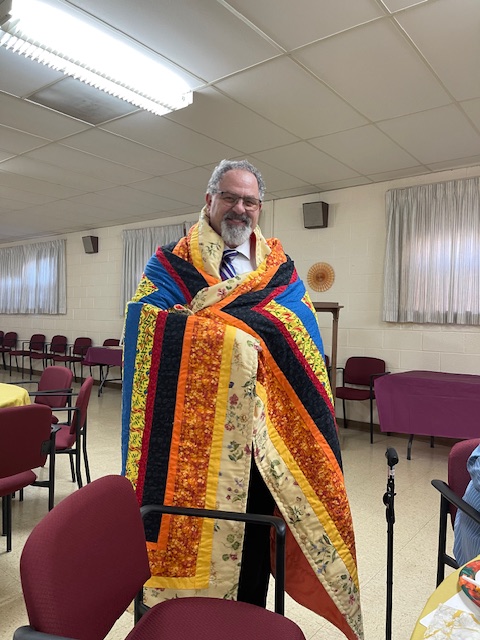
We had a soup lunch afterwards and had a drawing to give away a few of the quilts our ladies had made. I won what I’m calling my Joseph Quilt. It is a nice sized quilt worked on by several of the ladies. My mom provided the stitching/decoration around the border.
Have you ever seen one of those movies where they start with some dramatic scene. In the cop shows, it’s usually a murder or finding someone badly injured in an unexpected place. In a Hallmark movie, it might be a wedding scene or a passionate kiss (we all know that’s coming in the Hallmark movie, so no need to put it off until the end!). But then in the next scene, the graphic pops up: “Six months earlier.” The opening scene has gone by so quickly that you didn’t even get a chance to figure out much about who the characters are, then you’re thrust back in time and have to figure it out all over again.
Today we come to the conclusion of the liturgical calendar: “Reign of Christ the King” Day. It’s hard to believe Advent (and the new liturgical year) starts next week. The Lectionary is kind of like those movies I mentioned earlier. Even though we read about the crucifixion of Jesus this morning, we’re not going to get back to that dramatic event of the Resurrection that kicked off the last eight months of the calendar until Easter next year.
This past year, we’ve journeyed through the gospel of Luke, which has the most material on the life of Jesus. Five months ago, we read in Luke 9:51 that Jesus “resolutely set out for Jerusalem.” The rest of Luke’s gospel from that point on is set in that context of Jesus knowing his life would be cut short. Yet he continued loving, healing, and teaching the masses about God’s true love for them. He also did not shy away from confronting the religious leaders of his day for their abuse of the spiritual authority God had entrusted to them. That violation of God’s trust brings us to where we are today in the gospel, the crucifixion.
Luke has details in this story that the other three gospel writers do not have. Luke is the only one who has Jesus saying “Father, forgive them, for they do not know what they are doing.” He wasn’t just talking about how the Roman soldiers were treating him either. Matthew and Mark tell us that the criminals who were crucified with Jesus were BOTH hurling insults at him, but Luke indicates that one of them must have had a change of heart after hearing Jesus say “Father forgive them” and asked Jesus for forgiveness in his last hour. Jesus, of course, granted it.
The religious leaders were jeering and sneering at him as well. “He saved others, or so he claims! Let him save himself if he’s the Messiah!” One might expect that kind of behavior from criminals, but from those who had presumably dedicated their lives to serving God at the Temple or in the local synagogues? You know you must be getting close to the corruption and hardness of heart when the people who should be on your side are rejecting you for your teachings.
Even though our gospel reading stops just short of the final moments of the crucifixion, we are all familiar enough with that story to finish it from memory. And we know that because Christ defeated death and rose again into his heavenly glory, he lives and reigns as King of Kings and Lord of Lords. While his kingdom is here on earth, it is not of this world. Paul says in Ephesians 1:3 that God has “blessed us [i.e., Christ followers] in the heavenly realms with every spiritual blessing in Christ. It was evident from the moment of Pentecost that God had begun a new work in his people through the empowering of the Holy Spirit sent to us by our risen Savior.
As Christ followers, then, we are by default emissaries of the King of Kings and Lord of Lords. In the rest of the New Testament we see Paul and the other apostles planting and shepherding churches that are growing by leaps and bounds in various places. In many cases, the word of God has already spread to places where Paul had yet to travel because other believers were doing that missionary work as well. In the first chapter of Paul’s letter to the Colossians, we get a glimpse at Paul’s heart for them in the first chapter. Paul praises them for having a faith that is “bearing fruit and growing” in their hearts and around the world. Let’s pick up his praise for them in verse 9:
9 For this reason, since the day we heard about you, we have not stopped praying for you. We continually ask God to fill you with the knowledge of his will through all the wisdom and understanding that the Spirit gives, t10 so that you may live a life worthy of the Lord and please him in every way: bearing fruit in every good work, growing in the knowledge of God, 11 being strengthened with all power according to his glorious might so that you may have great endurance and patience, 12 and giving joyful thanks to the Father, who has qualified you to share in the inheritance of his holy people in the kingdom of light. 13 For he has rescued us from the dominion of darkness and brought us into the kingdom of the Son he loves, 14 in whom we have redemption, the forgiveness of sins. [1]
Paul has incredible respect for the Colossians and wants to ensure they continue on the path of growing in righteousness and faithfulness. This is significant in that Colossae was an incredibly diverse town in south-central Asia Minor. He wants them to be filled “with the knowledge of his will through all the wisdom and understanding that the Spirit gives.” Paul has a similar thought for the Ephesians in the opening of that letter: “18 I pray that the eyes of your heart may be enlightened in order that you may know the hope to which he has called you, the riches of his glorious inheritance in his holy people, 19 and his incomparably great power for us who believe.”[2]
In Colossians 1:6, Paul affirms that the gospel is “bearing fruit and growing through the whole world. He reassures the Colossians are doing their small part to contribute to that in vs. 10.
Being strengthened in all power means that they understand the working of the Holy Spirit in their lives. They do have some challenges, apparently, with some coming among them making “fine sounding arguments” against the gospel. But Paul has confidence that their knowledge will help them discern false teachings and stay the course of the true gospel with patient endurance.
They are also continually giving thanks because they’ve been rescued from darkness. They believed the gospel and have been living it out boldly because they know they’ve been forgiven and redeemed.
After praising them, Paul continues from verse 15 talking about the supremacy of Christ and why he reigns as King of Kings and Lord of Lords:
15 The Son is the image of the invisible God, the firstborn over all creation. 16 For in him all things were created: things in heaven and on earth, visible and invisible, whether thrones or powers or rulers or authorities; all things have been created through him and for him. 17 He is before all things, and in him all things hold together. 18 And he is the head of the body, the church; he is the beginning and the firstborn from among the dead, so that in everything he might have the supremacy. 19 For God was pleased to have all his fullness dwell in him, 20 and through him to reconcile to himself all things, whether things on earth or things in heaven, by making peace through his blood, shed on the cross. [3]
The concept of Jesus being the “firstborn” here seems to have a dual meaning. In verse 15, Paul says Jesus is the firstborn over all creation. That seems to suggest what we learn from John, that Jesus, the light of the world, was the “light” that God created on Day One of creation. A few verses later, in verse 18, Paul calls Jesus “the beginning,” which would seem to confirm the Genesis theory, but the then also calls Jesus “firstborn from the dead.” John also uses the phrase “firstborn from the dead” of Jesus in the opening chapter of Revelation (1:5). This of course is a reference to his resurrection.
Even though there are a few others in the history of the Bible who were raised from the dead, they all came back to life in their original human bodies. Jesus is the first one whose body was raised from the dead AND transfigured into its heavenly version. That earns him the title of head of the church—King of Kings and Lord of Lords—having supremacy over everything. This supremacy is not only for this world, but in the heavenly realms as well as Paul indicates.
Harkening back to Ephesians 3:10, we see that we have a role in proclaiming the gospel not only here but also in the heavenly realms. “10 His intent was that now, through the church, the manifold wisdom of God should be made known to the rulers and authorities in the heavenly realms.”[4] The passage in Ephesians 6 on the armor of God reaffirms our role in fighting the good fight not only against flesh and blood, but against the powers in the heavenly realms. We have the divine protection and strength to stand firm in those battles because of Christ’s victory over death and the redemption he won for us. Not only does he reign as King of Kings and Lord of Lords in our lives, but he has also provided the means for us to walk faithfully in this world.
As we wrap up the liturgical year and look toward Advent and the Christmas season, we can take comfort and courage in having citizenship in the kingdom of Christ. A blessed Thanksgiving to all of you this week, and please join us for the meal after service. Amen.
What will the resurrection be like? A similar question that some may have is, “What will Heaven be like?”
Our passage this morning opens the gates of pearl for us just a bit to give us a glimpse into life in our eternal home. We will also look at the epistle reading today a little later from 2 Thessalonians and other relevant passages to get a wider perspective of what the Bible says about life beyond the grave.
Before we get there, however, let’s take a look at our reading from Luke.
The first verse of our passage sets the context for us. The Sadducees are questioning Jesus about the resurrection, trying to trick him into some logical trap. But of course, Jesus knows what they’re up to. The Sadducees were different from the Pharisees in several ways, but the biggest difference is that the Sadducees strictly adhered to the Pentateuch, the first five books of the OT, so ALL of their theological beliefs derived from the Pentateuch. Anything that happened in the OT after that was judged in the light of the Pentateuch.
The Pentateuch, however, never explicitly mentions resurrection or anyone rising from the dead, so the Sadducees rejected the concept of the resurrection outright. Not only that, they by default rejected any concept of eternal punishment or eternal reward. If there’s no resurrection, who would be around to get punished or rewarded? They also rejected the concept of angels or any kind of spiritual realm other than that which God inhabited. This made for a very legalistic and moralistic interpretation of Scripture, because only in this life could you be rewarded for believing in God and following Torah. So, as the line we often teach to children, this is why they were sad, you see.
One interesting historical note here: the Sadducees were not a very large group. Josephus tells us that the Sadducees disappeared after the destruction of Jerusalem in AD 70. It seems like some sort of divine providence had a hand in the Sadducees rising up at the precise time in history when Jesus appeared so we’d have a record of the antiresurrection group and some examples of how to defend resurrection theology from the Old Testament.
The Sadducees try to trip Jesus up with a question about Levirate marriage, that is, the concept of the responsibility of a younger brother to provide an heir if their oldest brother failed to do so through the elder brother’s wife. That seems like a strange concept to us in the 21st Century, but in those days, it was necessary to preserve family history and property. The Sadducees go through the progression of all the brothers and the wife dying and ask Jesus whose wife she will be.
Jesus’s response is not what they expected. He basically says that marriage is strictly an earthly institution and will not be a factor in heaven. I imagine it is hard for us to grasp that concept. Jesus does seem to imply that we will recognize people we knew on earth by making the point about Abraham, Isaac, and Jacob, but he also says we will be like the angels as well. So it seems reasonable we would be reunited with loved ones.
At the end of Jesus’s explanation, some of the teachers of the law (not the Sadducees) praised Jesus for his answer. Very likely that was because the burning bush reference was from the Pentateuch, the only part of the Bible the Sadducees used for doctrine. In other words, Jesus essentially embarrassed the Sadducees by showing them they don’t understand a basic principle from the Pentateuch they revere so much.
Now when Jesus says those in Heaven will be “like the angels” needs some special consideration here. Paul uses a single word, an adjective, here that means “angel-like” (ἰσάγγελος isangelos). It’s the only time this word is used in the Bible. The implication here is not necessarily that they are of the same make-up of the angels, otherwise he would have used the regular word for angel. They are “angel-like” because they will never die. I still think we retain basic human form, but our bodies will be transformed into immortal material. Here’s how Paul words it in 1 Corinthians 15:
38 But God gives it a body as he has determined, and to each kind of seed he gives its own body. 39 Not all flesh is the same: People have one kind of flesh, animals have another, birds another and fish another. 40 There are also heavenly bodies and there are earthly bodies; but the splendor of the heavenly bodies is one kind, and the splendor of the earthly bodies is another.[1]
…
42 So will it be with the resurrection of the dead. The body that is sown is perishable, it is raised imperishable; 43 it is sown in dishonor, it is raised in glory; it is sown in weakness, it is raised in power; 44 it is sown a natural body, it is raised a spiritual body.
If there is a natural body, there is also a spiritual body.[2]
So we humans will have our own unique spiritual bodies in eternity distinct from the type of bodies angels have. I can’t prove what I’m about to say, but I’ve given considerable thought to what Paul means by comparing our bodies to a “seed.” Did you know that human DNA can survive long after the body is gone through the natural decomposition process? I have to wonder if that scientific fact about DNA has any relationship to our resurrection bodies. In other words, does our DNA contain a “divine code” that is activated at the final resurrection to reconstitute our bodies into their eternal, spiritual form? We often wonder if we will recognize others in Heaven. Wouldn’t DNA accomplish that? Now again, I’m just speculating here; I have no proof of this. God could just as easily use some other method to distinguish our appearance. But I think it is an interesting proposition worth dwelling on. My “Bones” article on my blog addresses this subject, and it’s been the second-most popular post this year, so there seems to be quite a bit of interest in the topic.
Paul addresses how we arrive at that day of resurrection. In 1 Thessalonians 4 and 5, we have these words from Paul:
13 Brothers and sisters, we do not want you to be uninformed about those who sleep in death, so that you do not grieve like the rest of mankind, who have no hope. 14 For we believe that Jesus died and rose again, and so we believe that God will bring with Jesus those who have fallen asleep in him. 15 According to the Lord’s word, we tell you that we who are still alive, who are left until the coming of the Lord, will certainly not precede those who have fallen asleep.[3]
…
4 But you, brothers and sisters, are not in darkness so that this day should surprise you like a thief. 5 You are all children of the light and children of the day. We do not belong to the night or to the darkness. 6 So then, let us not be like others, who are asleep, but let us be awake and sober.[4]
In 2 Thessalonians, the epistle reading from today’s Lectionary, Paul assures his readers that certain things must happen before the Lord returns for us:
2 Concerning the coming of our Lord Jesus Christ and our being gathered to him, we ask you, brothers and sisters, 2 not to become easily unsettled or alarmed by the teaching allegedly from us—whether by a prophecy or by word of mouth or by letter—asserting that the day of the Lord has already come. 3 Don’t let anyone deceive you in any way, for that day will not come until the rebellion occurs and the man of lawlessness is revealed, the man doomed to destruction. 4 He will oppose and will exalt himself over everything that is called God or is worshiped, so that he sets himself up in God’s temple, proclaiming himself to be God.[5]
This “man of lawlessness,” also known as the Antichrist, must be revealed at some point before the end comes. People have postulated that many historical and current figures have been the Antichrist. You can do a Google search and find out who those folks are; I won’t get into that here. But the call is not for us to be able to identify who this Antichrist is. The call is for us to be ready for that day.
Matthew 24:42–44 puts it this way:
42 “Therefore keep watch, because you do not know on what day your Lord will come. 43 But understand this: If the owner of the house had known at what time of night the thief was coming, he would have kept watch and would not have let his house be broken into. 44 So you also must be ready, because the Son of Man will come at an hour when you do not expect him.[6]
In the very next chapter we have the parable of the sheep and the goats at the judgment seat. Most of us are familiar with that story. Hebrews 9:27–28 says we all must face judgment, but if we are living our lives in and for Christ we have an absolute guarantee of salvation:
27 Just as people are destined to die once, and after that to face judgment, 28 so Christ was sacrificed once to take away the sins of many; and he will appear a second time, not to bear sin, but to bring salvation to those who are waiting for him.[7]
The judgment scene from Matthew 25 confirms this: those who are ministering to the poor and needy and who are sharing the good news of Christ not just in word but in deed as well will enter into that resurrection reward. I’m confident that you here at Mount View are all running a good race and will cross over into glory on that final day. I pray that you will have the strength to continue to do so and reap a great harvest for the kingdom of God.
God is good. God is faithful. And whether he returns before or after our final day on earth, we can know that our final destination is the place he’s prepared for us in eternity. May the peace of God go with you all today. Amen!
My brother and I went to Lake Francis Case (Chamberlain, SD) for the third time in as many years for what has become our annual walleye fishing trip. I want to give a shout-out[1] to Jason Sorensen, operator of South Dakota Walleye Charters, and Jordan Miles of Hooked Outdoors SD, who piloted the boat and guided us to a great fishing spot near the mouth of the White River. We both got our limit of walleye each day (4/day; one was 20¾”), and my brother hauled in a nice white bass as well. Here are the pictures of our spoils from two days on the boat.
I don’t fish often enough to know where the good spots are, and I wouldn’t necessarily trust Google to provide me that information. In addition, since the walleye like to hang out in about 8–12 feet of water, it’s hard to fish for them from the shore, and neither my brother nor I own a boat. The guide is an economic and practical option for us, then, to get to where we need to go.
The guide also has the necessary tools to find the fish as well. The Garmin technology he had on his boat not only guided us down river in a heavy early morning fog, but it also revealed much of what was hidden underneath us in this mighty muddy Missouri River reservoir. It can map the riverbed and show us where the fish are swimming. Walleye are typically bottom dwellers, so we use “bottom bouncer” weights that keep the bait toward the bottom of the river.
It should go without saying that we all need guides in our journey with Jesus. If you’re a seeker, you have a couple sources of guidance. The fact that you’re seeking some life answers in a relationship with Jesus most likely indicates the Holy Spirit has been prompting you and preparing you for a decision to become a Christ-follower. You also may have a Christ-following friend or acquaintance who has had some influence on you as well. While your friends may understand what is going on in your life and can provide much needed emotional and even physical support, the Holy Spirit knows best what is going on inside your heart and soul, and he knows what is best to provide whatever comfort, assurance, or healing you need on the inside. If you’ve been reading the Bible, both the Holy Spirit and your Christ-following friends can provide help with understanding it if you just ask.
If you are a Christ-follower, then you already know that Scripture, the Bible (aka God’s Word), is our ultimate source of guidance. You already know that you have received the gift of the Holy Spirit upon repenting and being baptized (Acts 2:38). The Holy Spirit will guide you into all truth, but he will never contradict what the Bible says. Reading and studying God’s Word helps to engrain the truths of God’s word into your heart, soul, and mind. Other Christian writers can provide more specific or detailed guidance as well. The stated goals of my blog are to help you “dig deeper, read smarter, and draw closer.” I’m always happy to answer any questions readers may have. If I don’t know the answer, I can usually point you in the right direction.
Experienced biblical scholars usually have a wealth of knowledge about background material relevant to the biblical accounts. They’ve studied the histories and writings of the cultures the main characters of the Bible interact with. They can also help explain some of the background customs and worldviews that are assumed and often unspoken by the biblical authors. Christ-followers who’ve studied in the hard sciences can add insight as well to things like the geography of the day, the geologic history of an area, or other culturally influenced features like architecture, art, and iconography. People trained in medical or mental health practice can also add insight to the wonderful creations we are, physically, spiritually, and socially.
In John 14:15ff., Jesus promises the Holy Spirit and instructs his disciples on what to expect from the Holy Spirit’s infilling and guidance. While the Spirit may speak to those who are seeking God but who are not yet Christ-followers, the Spirit does not dwell in those who have not fully accepted Jesus as their savior. If you are a Christ-follower, then you have assurance of the presence of the Holy Spirit in your life (and you do NOT need to manifest any gifts of the Spirit to prove that!). The Spirit is described as our Advocate in the NIV. Other versions use terms like Comforter, Counselor, or Helper. The Greek word (παράκλητος paraklētos) implies one who is called alongside you. Another role of the Holy Spirit is to remind us of the teachings of Jesus and more broadly the Bible. Jesus also uses the image of “peace” to describe the Spirit’s role in our lives, bringing order in the midst of our chaos; assurance in the midst of our turmoil.
The penultimate promise of Jesus in John 14:27c is this: “Do not let your hearts be troubled and do not be afraid.” We can live in that assurance when we have the peace of Christ dwelling in our hearts. Jesus’s ultimate promise, however, comes in the very next verse: “I am going away and I am coming back to you.” Both of these promises are repeated from the beginning of chapter 14 (vv. 1a, 3). The Spirit is meant for our life on earth. When we get to heaven, our joy and our peace will be to dwell forever with the risen and resurrected savior himself.
Peace to all of you, and thank you for reading.
Pastor Scott Stocking, M.Div.
My opinions are my own.
[1] Shout-outs from me do not imply the respective proprietors’ endorsement of my blog. These are a simple courtesy to the proprietors.
A Testimony by Scott Stocking (my views are my own).
Last week, I had the opportunity to see some of Nebraska’s unique monuments and historical sites. I have already written about my experience at Fort Robinson last weekend and how impactful that was to my spiritual well-being. The Sunday after that, I decided I would get a couple places in my National Parks Passport book checked off, essentially since they were relatively close by and no more than a reasonable detour for my trip home.
From Fort Robinson, I headed west on US 20 to Harrison, Nebraska, and from there, I took Nebraska State Highway 29 south toward Mitchell, Nebraska. (I don’t think there’s any hidden meaning in the fact that I had begun my trip west on State Highway 92.) The sign I saw when leaving Harrison said, “No services next 56 miles.” That should let you know just how remote that part of Nebraska is. I saw more tumbleweeds blow across the highway between Harrison and the outskirts of Mitchell than I did residences!
I did find some relief, however, at the Agate Fossil Beds National Monument about halfway between Harrison and Mitchell. The visitor center is about three miles off the highway and was modern and welcoming. I watched a 12-minute movie about the ancient history of the site revealed by the fossil finds, as well as the more recent history of the Native Americans who dwelt in the region. If I had had more time, I would have loved to venture off to one of the dig sites, with the fossil display and the James Cook Gallery (James Cook is the rancher who discovered the fossils).
My next stop was Scotts Bluff National Monument. This is an impressive geological feature along the historic Oregon Trail that served as milestone for travelers along that trail. I had not known that you could drive to the top of the bluff, so I took advantage of that opportunity as well (you can see about 80 miles from the top barring any terrain obstructions). At the top is the placard to Hiram Scott (links to NPS history), who had been abandoned by his employer and died in the vicinity around 1828. The details of his demise are uncertain as we have a few post-mortem accounts of his death up to six years later from various sources that do not agree on every detail. He doesn’t appear to have done anything remarkable or noteworthy other than having been a fur trader, yet his legend was significant enough to ascribe his name to the area, which later became a national monument. In fact, it occurred to me that the sheer face of the bluff is shaped like a giant tombstone.
My final stop at a national monument site on the way home was Chimney Rock National Historic Site (U.S. National Park Service). This has long been an iconic symbol of Nebraska, having the privilege of being the image on the obverse side of the State’s quarter dollar coin. The first thought of most, I think, is that it is the inert remnant of a volcano, given the “chimney” is made of different stuff than the rock it rises from.
According to the NPS Web page, Chimney Rock is the most-referenced geographical feature in pioneer diaries. One quote about it compares it to an ancient pyramid. I bought a T-shirt there that suggests maybe there’s a flying saucer hidden under the structure and the spire is its antenna! I think it would have been a much better site for filming Close Encounters of the Third Kind! While I’m waxing fancifully about conspiracy theories, I might as well speculate that maybe Sasquatch has a secret hideout there as well!
None of these fanciful theories detract from the beauty and majesty of single cone surviving in that region amongst all the giant bluffs and buttes one sees to the west of that location along the historic pioneer trails. For those early pioneers, it was a sign that they were on the right track and had some hope of making it to points further west.
Monumental Lessons
I suppose one could make any number of subjective spiritual connections to these monument sites depending on their life experiences. Many years ago, I wrote about my own “exodus” from Egypt that was Illinois, governed primarily by corrupt Chicago-machine politics with an unemployment rate twice that of Nebraska. If ever there was an argument for a governor of a State to be elected by an electoral college (and Chicago only gets one elector!!) instead of the popular vote, it would be Illinois. In that article (A Tale of Two Photos | Sunday Morning Greek Blog), I wrote about the fiery red sky I’d taken a picture of, with the clouds moving west (usually they would move east).
After the fact, I interpreted that as God calling me back to Nebraska (a Big Red cloud bank moving west, get it?). It was around that time I started hearing the Nebraska fight song in my ears, and it was NOT the ring tone on my flip phone. When I remarried in 2014, my wife and I made annual trips to her family’s cabin in Poudre Canyon. We would fly along I-80 at 75+ mph toward Cheyenne, but I always wished that we’d had a little more time to take the long way around to see Chimney Rock and Scotts Bluff, places I hadn’t seen since my childhood.
Seeing Chimney Rock especially reaffirms the decision I made 15 years ago to follow that “Big Red” cloud west back to Omaha, where I grew up. But I also knew I needed to eventually get to Chimney Rock, that signature geographic wonder in my home State, to have a fuller experience of what it means to be a proud son of Nebraska.
Although Scotts Bluff is named after someone who was just doing his job as a fur trader and had the misfortune to die in the valley near the bluff (the monument to him is on top of the bluff, but the legend says he died somewhere along the North Platte River), I think I can find a more suitable spiritual lesson for myself. The sheer face of the bluff is probably not suitable for rock climbing, that doesn’t mean you can’t get to the top. If I’d had the time and a way to protect myself from rattlesnakes, I might have walked the short trail up to the top. Instead, I took the easy way, a road that winds up to the top traversing through three tunnels along the way.
For me the lesson is simple, and perhaps overly simple enough to be a bit cheesy, but ascending to the top reminds me that I should never stop reaching for new heights in my spiritual journey. One thing I learned on this trip, both at Scotts Bluff and traversing Sow Belly Canyon in NW Nebraska, when you reach new heights, you have a better view of who you are in God’s creation. We humans are “fearfully and wonderfully made,” but to view the vast expanse and beauty of his creation he’s entrusted us with is indeed humbling.
I am grateful that I’m not living in a Matrix-like cocoon (or a Paradise-like underground city) where some sophisticated software engineer has created a simulation for us to live for who-knows-what purpose. It is good to touch and see and smell and feel and hear the wonders of God’s creation all around. No simulation could ever hope to capture the incredible diversity God has granted us in his creation. With views like I witnessed on my swing through western Nebraska, it’s easy to see how the psalmist could write Psalm 148 NIV | Bible Gateway.
Finally, I think I can even draw a spiritual lesson from the Agate Fossil Beds. I’m a young-earth creationist, so I don’t for a moment believe the fossils of ancient animals are 19 million years old. A global flood or a massive caldera explosion (like the one in Yellowstone that’s due!) would have buried those animals rapidly and given the appearance of great age, at least in the modern scientific paradigm.
I wish I could say all my old man behaviors have become extinct, but I know I still struggle from time to time. The good news is, God has not left me alone to deal with behaviors and attitudes that could lead to my untimely extinction. He’s given me life and hope in Jesus for a brighter future and a resurrection from the dead, one that will NOT leave my old bones in the grave, but like Jesus himself experienced, one that is a complete transition from our earthly bodies to our heavenly bodies. And unlike the Visitor Center there at Agate, I do not need a museum display to remind me of my past sins. God has separated them from me as far as the east is from the west.
Agate, Scotts Bluff, and Chimney Rock are all monuments of my faith, and my Fort Robinson trip (Sowbelly Elegy: The Majesty of God in Exegesis | Sunday Morning Greek Blog) reflects, in part, my community of fellowship at this time in my life. They remind me where I’ve come from and what I can look forward to; what I’ve lost and what I’ve gained; who I am and whose I am. I look forward to taking the trip again next year and mixing up the trip home to see more of the beauty of this great State I live in. I trust and pray that you have some special places you can go to have your own “Sabbath Rest” and reconnect with yourself and with God’s son, Jesus, the resurrected one.
I delivered this message Easter (Resurrection Sunday), April 20, 2025, at Mount View Presbyterian Church in Omaha, Nebraska. I focused on the theme of “running,” picking up on the account of Peter and John “racing” to the tomb.
Good morning! Hallelujah, Jesus is Risen!
The Bible has a running theme. No, seriously, the Bible talks a lot about “running” in the context of our faith. Consider these two verses from 2 Samuel 22:29–30 (par. Psalm 18:28–29) NKJV:
The running theme carries over into the New Testament as well, especially in Paul’s letters:
There’s 1 Corinthians 9:24 (NIV): “Do you not know that in a race all the runners run, but only one gets the prize?”[4]
And Galatians 2:2b (NIV): “I wanted to be sure I was not running and had not been running my race in vain.”[5]
Even the author of Hebrews gets in on the theme in 12:1–2a (NIV): “Therefore, since we are surrounded by such a great cloud of witnesses, let us throw off everything that hinders and the sin that so easily entangles. And let us run with perseverance the race marked out for us, 2 fixing our eyes on Jesus, the pioneer and perfecter of faith.”[6]
We see the running theme in the parable of the prodigal or “lost” son in Luke 15:20 (NIV), although in a slightly different way when it comes to the father in the parable:
“But while he was still a long way off, his father saw him and was filled with compassion for him; he ran to his son, threw his arms around him and kissed him.”[7]
A few verses later, we learn why the father ran to greet his son: “‘This son of mine was dead and is alive again; he was lost and is found.’ So they began to celebrate.”[8]
I think you see where I’m going with this now, right? In our gospel passage this morning, however, Mary and the disciples aren’t looking for a “lost” or prodigal son, but, as they will realize shortly, the once dead and now risen Lord and Savior, Jesus Christ. Mary runs to tell the disciples the news, and Peter and John run, no race back to the tomb to see if what she’s telling them is true. The news was that incredible that they couldn’t just take a casual morning stroll back to the tomb.
Now before I dive into this morning’s passage from John, I want to do a quick sidebar on one of the most common questions people ask about the crucifixion and resurrection. Jesus was crucified on a Friday and rose from the dead on Sunday. That sounds like about 48 hours, right? Two days? But Jesus had predicted all along that he would rise on the third day. He “borrowed” that timeline from the prophet Jonah, who had spent three days and nights in the belly of the great fish. By Jewish reckoning, the first day of anything is “day one.” We see that in Genesis: “There was evening and morning, the first day.” Jesus was arrested (i.e., “swallowed up”) on Thursday evening after sundown and subjected to a rigged trial that was illegal by Jewish laws in several ways had sealed his fate before it even started, so the period from sundown Thursday through sundown Friday was “the first day.” The Sabbath, of course was on Saturday, having begun at sundown Friday night, the second day. This of course makes Sunday the third day. Jesus could have risen any time after sundown Saturday night and would have fulfilled the prophecy of rising on the third day.
In fact, John’s account tells us it was still dark when Mary Magdalene got to the tomb Sunday morning. John says nothing about whether the guards were there. I’m guessing not, though, as they probably ran off terrified that the stone rolled away seemingly all by itself. Matthew says the guards had to make up a story about it, but they most likely would have been disciplined if not executed for their inability to keep a dead man in a tomb. The details differ among the gospel writers, but I’ll stick with John’s narrative here the rest of the way. Mary didn’t wait around to find out what happened. She had apparently looked in the tomb before running back to Peter and John (“the other disciple”) because she told them Jesus wasn’t there anymore.
Peter and John went racing back to the tomb. John made sure he reported that he won the race, but Peter went in first. Isn’t that the reverse of the Prodigal parable? The prodigal Peter, who had denied knowing Jesus three times during the illegal trial, came running back to his savior. It seems odd that they just looked into the tomb and apparently shrugged their shoulders at each other. John tells us that he and Peter found strips of linen there and a separate head cloth when they went into the tomb. Not sure what that means for the Shroud of Turin. But it does suggest that someone had to unwrap Jesus, unless his arms weren’t secured to the body.
Because they still hadn’t put two and two together yet, they decided to head home. No further investigation; no searching for clues or footprints in the dust; no trying to find eyewitnesses that may have seen what happened. What’s especially surprising to me is this: why did they leave Mary Magdalene at the tomb all alone, still crying in grief and shock that someone might have stolen Jesus’s body? Not very gentlemanly of them. And they missed the best part.
Mary, however, did not miss the best part. When she looked into the tomb again, she saw the angels, probably the same ones who unwrapped Jesus’s body that morning. Why weren’t they there when Peter and John went in? Difficult to say, except perhaps that they should have been able to recall Jesus’s teaching about him rising from the dead after three days. Or maybe it’s because Mary was the first one to arrive at the tomb, so she got to be the first one to see him when he made his appearance. Jesus was apparently just freshly resurrected, because Mary couldn’t touch him for whatever reason.
The fact that Mary has a validated claim of being the first to see Jesus risen (besides perhaps the Roman guards) might add some credibility to the resurrection story. If Peter and John had been the first ones to see him alive, it’s possible they could have been accused of a conspiracy to hide the body and say he rose from the dead. It would be more incredible to believe that a couple older Jewish women could have carried his body off than it would be to believe Jesus had risen from the dead.
Jesus told her to go find Peter and the rest of the disciples and let them know he was indeed alive. The disciples don’t have to wait too long to see the risen Savior for themselves. That very night, Jesus would appear to them behind locked doors and reveal himself. Jesus was revealing himself to more and more people and would continue to do so for the next 40 days or so to establish an irrefutable claim that he had indeed risen from the dead. He had won the victory over death and the grave so that we also could live in that hope of the same victory.
What is the message we can take from this passage today, that the disciples ran to see if the hope of Jesus survived his crucifixion? Well, lately I’ve been seeing news reports that people, especially young people, are coming back to church after the COVID shutdowns had decimated many congregations. The White House has established an Office of Faith that is, ostensibly, looking out for the rights of those who live out their faith but have been hounded or cancelled by antireligious forces. We’re even seeing some politicians be more sincerely bold about speaking about faith matters. If we’re in the start of a revival in our country, let’s jump on the bandwagon!
I want to read to you part of an opinion piece that came out Saturday morning from columnist David Marcus. In it, he speaks of the connection between the suffering the church experienced through COVID and the beautiful end result that the church experienced in history after other periods of suffering:
Perhaps we should not be surprised that the bitter cup of COVID led to greater religious observance by Christians. After all the Holy Spirit, speaking through the prophets, has told for thousands of years of periods of loss and suffering that end in the fullness of God’s light.
From the banishment from Eden, to the Flood, to the Exodus, and finally Christ’s 40 days of starvation and temptation in the desert, again and again, it is suffering that brings God’s people closest to Him.
During COVID, our desert was isolation, and especially for young people, it only exacerbated what was already a trend of smartphones replacing playgrounds, of virtual life online slowly supplanting reality.
At church, everything is very real, much as it has been for more than a thousand years. At church, we are never alone. At church, things can be beautiful and true and celebrated, unlike the snark-filled world of our screens that thrives on cruel jokes.
Human beings need a purpose and meaning beyond being a cog in the brave new world of tech. We need connection to our God and to each other.[9]
I hope that Mount View can be a place where you continue to find connection to God. If you’re visiting today, I hope and pray that you’d want to stick around and discover more of that connection to God. And if I may speak from my own heart for a moment, I want to say this: I’ve been filling the pulpit off and on for over 3½ years at this point, and much more frequently since last October. You have grown on me, and I hope that you’ve grown with me. And I pray that the testimony of your fellowship will attract more and more people who desire to connect with God. I pray that the messages here as people download them from the Internet will bear much fruit wherever it is heard and repeated.
The church is winning the race to win the hearts and souls of those who seek a deeper connection with God and with their own faith. I mean, who would have ever thought that the American Idol reality show would have a three-hour special featuring “Songs of Faith” like they’re doing tonight! I’d say the Spirit is on the move! You and I may never be on American Idol, but we can be bright and shining lights so that the world may know the hope we have.
On this day when we celebrate the resurrection of Jesus, I want to close with an encouragement to you from Paul’s letter to the Ephesians, 1:18–20 (NIV):
I pray that the eyes of your heart may be enlightened in order that you may know the hope to which he has called you, the riches of his glorious inheritance in his holy people, 19 and his incomparably great power for us who believe. That power is the same as the mighty strength 20 he exerted when he raised Christ from the dead and seated him at his right hand in the heavenly realms.[10]
Amen, and have a blessed Resurrection Sunday with friends and family.
I preached this message on April 6, 2025, which was also National Tartan Day. I wore the standard Gordon family kilt (great-great-grandfather through the maternal line) and the necktie is Gordon Red (purchased in Scotland). I’ve included a few pictures. Now I can say I’ve preached in a kilt! :-)
The Lord be with you.
Before I get to my main message, I want to go back a few months when I preached on Psalm 126, our Old Testament reading this morning, because it was also our reading on October 27. At that time I said that we should consider verse 4 a prayer for this congregation: “Restore our fortunes, Lord, like streams in the Negev.” That continues to be my prayer for this congregation today, and I hope it is yours as well. I heard recently that church attendance is starting to pick up again, so I pray we can take the opportunity to tap into that resurgence.
Our gospel passage this morning, John 12:1–8, is one of the few stories of Jesus’s ministry that all four gospel authors included, probably because Matthew and Mark both said that what she’d done would be told wherever the gospel was preached. Matthew and Mark both include the story after the time of Jesus’s triumphal entry into Jerusalem and two days before the Last Supper. Luke places it much earlier in his gospel, and he emphasizes that the woman’s sins were forgiven because of what she’d done. We can’t be sure why Luke has the story so much earlier. He may be “borrowing” it from the future in his gospel so he can tie it in with the story of the response to forgiveness based on the depth of one’s sins.
But in our passage this morning from John, he places the story just before Jesus’s triumphal entry into Jerusalem. This event may serve to bring to mind the anointings that the Israelites were commanded to do for their priests and kings. Listen to what David says in the very short Psalm 133:
This refers to Leviticus 8, where not only was the oil poured on Aaron’s head for consecration, it was also used to consecrate everything in the newly assembled tabernacle. Matthew and Mark do not name the woman who brings in the alabaster jar. Nothing in those accounts suggests they know who the woman is. Luke says the woman lived a sinful life and suggests she shouldn’t even be there.
John is the only one who names the woman in his gospel. The woman is Mary, Lazarus’s sister. We do know a bit more about Mary and Martha than other people mentioned in passing in the Gospels. At the end of Luke 10, Martha is frustrated with Mary because she is sitting at Jesus’s feet listening to his teaching while Martha is busy preparing a meal. This probably isn’t the meal John mentions, and it’s nowhere near Luke’s account of the foot anointing. In the previous chapter of John, Jesus had raised Lazarus from the dead to prove he was the “resurrection and the life.” Lazarus’s death seems to have hit Mary the hardest in that story, as she is the one who seems most disturbed by Jesus’s delay in coming to see Lazarus. It makes sense, then, that Mary would be the one who wanted to anoint Jesus’s feet for resurrecting her beloved brother.
John is the only one who doesn’t indicate that the container for the nard was an alabaster jar, but the alabaster jar was considered the most appropriate container for nard or perfume at that time, so I think we’re safe to assume it was. Alabaster was made from gypsum, so it was somewhat delicate and finely textured. Breaking the seal probably meant that the neck of the jar had to be broken to pour the thick nard out and apply it. It wasn’t a very big jar either. We know it was about a pint, and it would have all had to have been used at that moment; otherwise it would spoil or lose its aroma. Matthew and Mark say the woman poured the nard on Jesus’s head, much like it would have been for the OT priests mentioned above, while Luke and John say the woman poured it on Jesus’s feet, perhaps an acknowledgment of Jesus’s servant attitude.
Although the details of this story vary among the gospel accounts, a couple themes of the story do stand out across the board. Many of those present at the dinner, especially Judas Iscariot in John’s account, view this as a wasteful act. This perfume was not cheap; Judas, along with other players in the parallel account, are concerned that such a valuable commodity could have been sold so the money would be given to the poor. John reminds us though that Judas’s concern was more selfish than compassionate. Judas had been helping himself to the till.
What this tells us, I think, for our walk with Christ today is that it’s okay to be a little extravagant when giving to the Lord’s work. Now obviously we don’t need to prepare Jesus for another crucifixion as the woman was doing in that day. But just as Jesus turned the water into the best wine served at the wedding at Cana for his first miracle, so we too can dedicate our excellence in whatever we do for or offer to the body of Christ and the work of the kingdom.
A second principle at work here is that, while the work of helping the poor is noble and a never-ending ministry of the church, there will be times when we have to take care of our own, and I’m not necessarily referring to when we die. It’s not selfish when we do that. It’s a necessary part of taking care of our family. While our loved ones are alive, we buy thoughtful gifts for them. When they pass, we pick out a nice coffin or urn. The ancient Jews used an ossuary, basically a stone box, to store the bones of a loved one once the flesh had decayed and often would put some sort of inscription on it. When the Jews brought Joseph’s bones out of Egypt, it was most likely in an Egyptian mummy case. That’s a little odd for us to think in those terms today, though, so we find other ways to memorialize our loved ones.
Unlike the pharisees and Judas Iscariot then, we should not look with judgment on those who do nice things for their loved ones at death. How we choose to remember a loved one is an important part of the grieving process. But I have to wonder here: Mary had already witnessed Jesus raise her brother Lazarus from the dead. Did she, or any of the other disciples for that matter, have any inkling that Jesus’s impending crucifixion might be followed up by his own resurrection? Judging from the disciples’ reaction in the gospels when Jesus spoke of his death, I’m pretty sure they hadn’t put two and two together yet.
Our gospel passage this morning has focused on what Mary did to prepare Jesus for his death. But what was Jesus doing to prepare his disciples for his death? We’ll address some of this after Easter in the Sundays leading up to Pentecost, but for now I think it’s important to see that, although he was speaking somewhat figuratively at times, he did not leave his disciples without reason for hope after his death.
The next event after our gospel passage this morning is Jesus’s triumphal entry into Jerusalem: Palm Sunday as we’ve come to know it. Chapter 13 is the Last Supper, where Jesus imparts his final teachings to his disciples before his arrest and crucifixion. John recorded five chapters worth of Jesus’s words, longer than the Sermon on the Mount. In those final hours he has with his disciples, he:
Models servanthood by washing their feet
Predicts Peter’s denial
Reassures them that he’ll come back to take them to the place he’s preparing for them
Promises the Holy Spirit will dwell in them and guide them in all truth
Encourages them to stay connected to the vine, to Jesus, so they can bear fruit
Reaffirms the coming, indwelling power of the Holy Spirit
Predicts that they will be scattered, but they will also eventually know peace
Prays for their unity so that the kingdom can move forward and their faith will be unshakable.
That must have been quite the emotional and gut-wrenching after-seder gathering. Most of what John records in those chapters was unique to his gospel. None of the other Gospel come close to the depth of this teaching. Luke and Matthew have passing references to receiving the Holy Spirit without too much detail to describe it. As a gospel writer, John seems to have had special dispensation to capture these final teachings. He, after all, was the only one who shows up at the cross on crucifixion day.
This is not to discount the other teachings of Jesus prior to his triumphal entry. His whole ministry was about preparing you and me for the new way God would work among his people. The Sermon on the Mount and the parables in Matthew; Luke’s sermon on the plain; and Mark’s emphasis on the urgency of Jesus’s ministry are all signs in their own way that Jesus was preparing ordinary people to extraordinary things for the kingdom of God.
Isaiah looked forward to this new time in 43:18–19:
As we continue toward Easter, you and I know how the story ends. We do not need to fret like those first disciples. We know we have the victory. We know we have forgiveness. We know we have the empowerment of the Holy Spirit. Let us go forth from here boldly and confidently in that knowledge and be shining lights for the Savior! Amen.