Consider this a “throwback Thursday” post. I found this is one of my old folders. I’m not sure I ever got to use it anywhere on a Sunday morning, at least not in this form, but the concept has stuck with me all these years.
I’ve been thinking much about remembrance lately, especially as it has to do with the Lord’s Table. I read an article about how the idea of remembrance not only relates to the past, but it has present and future implications as well. Originally, I had every intention of writing a communion meditation on that theme, but recently, the Holy Spirit reminded me about what the Bible means when an author says God “remembers.”
Three times in the flood story of Genesis, God says he remembers or will remember Noah and the covenant represented by the rainbow. Numerous other times in the OT, the biblical author says something similar about our heavenly Father. God just doesn’t say, “Oh yeah, I made a promise,” but rather when he remembers, he actively begins fulfilling that promise and the terms of the covenant. Remembering for God is not just a mental act but a practical act as well.
I want to challenge us this morning to take this same attitude when it comes to partaking of the bread and the cup in remembrance of Christ. Let this not just be a mental act of remembering that Jesus died for our sins but let us act on the pledge each of us made to Christ when we professed our trust in him. Let us wait on the Lord in all we do and pledge ourselves again to live and act faithfully in him. Let us act in accordance with his promise of salvation, knowing that God is faithful to bring us to that day of ultimate salvation in him.
Scripture: Lamentations 3:19–26
19 I remember my affliction and my wandering, the bitterness and the gall.
20 I well remember them, and my soul is downcast within me.
21 Yet this I call to mind and therefore I have hope:
22 Because of the Lord’s great love we are not consumed, for his compassions never fail.
23 They are new every morning; great is your faithfulness.
24 I say to myself, “The Lord is my portion; therefore I will wait for him.”
25 The Lord is good to those whose hope is in him, to the one who seeks him;
26 it is good to wait quietly for the salvation of the Lord.[1]
For prayer: Jeremiah 14:20–21
20 O Lord, we acknowledge our wickedness and the guilt of our fathers; we have indeed sinned against you.
21 For the sake of your name do not despise us; do not dishonor your glorious throne. Remember your covenant with us and do not break it.[2]
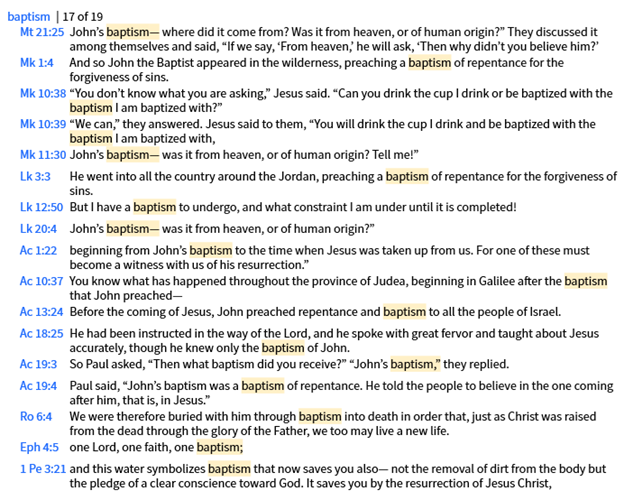
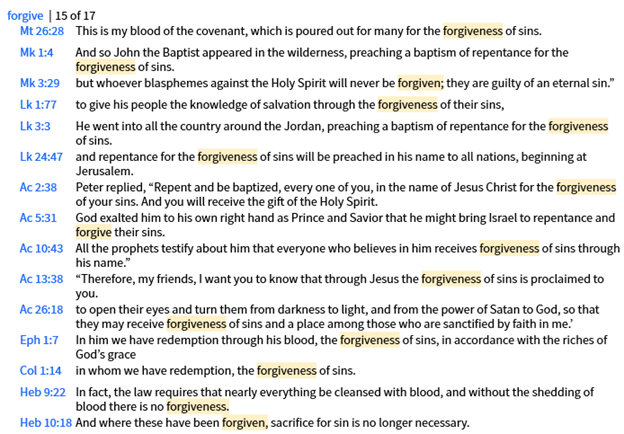
The New Testament writers make no bones about connecting baptism and forgiveness to the blood of Christ. Baptism, forgiveness, and Christ’s blood are inextricably linked throughout the New Testament. In the brotherhood I belong to (Christian Church/Stone-Campbell or Restoration Movement) we have two primary “sacraments”: Communion, in which Jesus definitely connects his shed blood to forgiveness (Matthew 26:28), and Baptism (Romans 6:1–4) where Paul connects it with the death and resurrection of Christ. In fact, an analysis of the whole argument of Romans reveals that the central and climactic chapter of Romans 1–11 is chapter 6 on Baptism. The end of Romans 6 has the well known verse about “The wages of sin is death, but the gift of God is eternal life in Jesus Christ our Lord.” Read in context, that verse refers to baptism: we pay the wages of sin by going under the water and receive eternal life by rising up out of the water. This sets up the reason Paul can say “Offer your bodies a living sacrifice” in Romans 12:1, after he’s finished his argument in 1–11. The “living sacrifice” is exactly what baptism is. Offer your bodies to be baptized/immersed. Baptism is our participation in the sacrifice of Christ on the cross and his resurrection from the dead.
Louw & Nida, Greek-English Lexicon Based on Semantic Domains
53.41βαπτίζωb; βάπτισμα,τος n; βαπτισμόςb,οῦ m: to employ water in a religious ceremony designed to symbolize purification and initiation on the basis of repentance—‘to baptize, baptism.’
……
According to the Didache (early second century) different forms of baptism were practiced in the early church, but with evident preference given to immersion.
The baptism practiced by John the Baptist would seem to reflect far more the Jewish pattern of ritual washing than the type of baptism employed by Christians, which constituted a symbol of initiation into the Christian community on the basis of belief in and loyalty to Jesus Christ as Lord and Savior. There seems, however, to be no reason to employ a different expression for baptism in the case of John than in the case of the early Christians.[1]
I preached this message on the third Sunday of Easter, April 19, 2026, at Mount View Presbyterian Church.
Psalms 111 through 119 make up a unique subsection of what your English Bibles call “Book V” of the psalms. They are called the “Egyptian Hallel” because each chapter begins or ends with the shout “Hallelujah.” We know that means “Praise God!” Psalms 111–112 are introductions to the Hallel, each being an acrostic psalm, that is, each “half-verse” of the psalm begins with successive letters of the Hebrew alphabet. The last chapter of this Hallel, 119, is of course an acrostic as well, and most English Bibles will indicate that. Chapter 119 has 22 sets of 8 verses that are in alphabetical order according to the first letters of each of the verses in the respective sections. Psalm 119, the longest chapter in the Bible, is also famous for its exaltation of God’s words and decrees, with all but three verses mentioning God’s word or decrees using a variety of terms.
The central psalms in the Hallel are 113–118. These are the psalms that were sung before and after the Passover seder meal, with Psalms 113–114 sung prior to the meal, and psalms 115–118 sung after the meal. This context “sets the table” (allusion intended) for taking a deeper dive into Psalm 116 this morning. Psalm 116 is reads like two psalms in one, because the second half of the psalm parallels the first half. As such, I want us to compare the two halves and see what gems we can discover. It’s also possible that the Emmaus disciples sang this psalm after their “surprise” dinner with Jesus since they were not too far out from Passover.
First of all, you may have noticed from our reading that there is a pervasive theme across the whole psalm of “calling on the name of the Lord.” In fact, it seems intentional that those who decided to pick and choose a few verses from Psalm 116 for the Lectionary reading were intentional about focusing on that theme. So let’s run with that.
You’ll notice that in the first half of the psalm, the author is calling on the name of the Lord in the midst of trouble and sorrow in vv. 1–4. The author speaks of crying out for mercy, being entangled in the cords of death, and overcome by grief, anguish, and distress. I think we can all relate to that at certain times in our lives. As we switch back and forth between having the air conditioning and furnace running in our not-so-stable Nebraska spring weather pattern, we ask the Lord that neither system fails us, right?
On a more serious note, we feel the sense of dependence when we lose a loved one or a loved one is facing serious medical issues. Even some of those who don’t attend church regularly will cry out to God for help in those situations. We feel the need for something beyond us to step in and bring hope or healing.
On the flip side of that, in the second half of this psalm, we see the author calling on God in the midst of good times as well. When he speaks of “lifting up the cup of salvation,” he’s referring to the last cup of the seder dinner, the same cup that Christ used when he said it was the new covenant in his blood for the forgivenss of tins. (see Luke 22:20, Matthew 26:28).
The good times, ironically, are also the times we can forget about calling on the Lord. Everything is going great, yet we forget that God is the one who had a hand in making things great for us. We forget to ask (and answer) the question in verse 12: “What shall I return to the Lord for all his goodness to me?” Since the context here is the Passover seder, the author is saying he will participate with joy in the celebration of escaping the slavery of Egypt. In other words, he sees the big picture of God’s plan from the earliest days of their nation. He also takes the opportunity to renew his pledge to live righteously in the world.
Allow me for a moment to switch to a related sidebar here: As Christians, we keep the Passover, so to speak, by taking communion together. Jesus essentially redefined the Passover seder to focus on his pending sacrifice on the cross. I know you know this, but it bears repeating: Communion is the time we come into the presence of the Savior and sit at the table he’s invited us to. Not only is it a time of remembrance for us, but also a time of recommitment to follow him. When the Bible says, “God remembered his promise,” that always means God is ready to act on the fulfillment of that promise. When we do communion “in remembrance of him,” we’re pledging ourselves to continue to walk in his ways.
Now let us look at the two halves of this Psalm side-by-side. In verse 1, the author says “I love the Lord,” while in verse 11, that love for the Lord prompts him to say “I trusted in the Lord” when he poured out his heart about his troubles. In verse 1, he also has the confidence to say that the Lord has heard his voice and turned his ear toward him.
The imagery in that last statement is key to God’s love for us: God doesn’t just sit on his throne and process prayer requests all day long. He leans into it. You and I might lean in to a conversation because our hearing is getting bad, but God doesn’t have a problem with hearing. He wants to hear what you have to say, and he never tires or gets weary of listening to us when we come to him in faith and humility. God wants to know our complaint or concern, even if it’s a broad generalization like in verse 12: “Everyone is a liar!” He knows what we mean. He knows what’s on our heart at the moment. Let’s not forget the promise of Romans 8:26 either:
In the same way, the Spirit helps us in our weakness. We do not know what we ought to pray for, but the Spirit himself intercedes for us through wordless groans.[1]
The promise that follows in Romans here is why we can have confidence and trust in calling on the name of the Lord:
God works for the good of those who love him, who have been called according to his purpose.[2]
The cry in vs. 4 after the author pours out his heart is “Lord, save me!” Verses 13–14 parallel this by the author providing his own solution: “I will lift up the cup of salvation.” He knows the seder ritual is more than just a ritual, but a powerful promise of God’s presence, just as I spoke of when I compared this our own communion service.
Hear the words of vv. 5–6, since they weren’t included in our reading this morning:
5 The Lord is gracious and righteous; our God is full of compassion.
6 The Lord protects the unwary; when I was brought low, he saved me.[3]
The author follows through here on his cry in vs. 4 by affirming that the Lord did indeed save him at his lowest point. The author’s desperation at the beginning of the psalm may have put him in a frame of mind where he thought he was going to die. In verse 15, he has the confidence to say that the death of a faithful servant is “precious” in the Lord’s sight, so it would seem he had come to terms with his own mortality. This could also be a messianic prophecy about Jesus and the martyrdom in the early days of the church. We saw in verse 14 that he committed himself to live faithfully, and he does so again here in verse 16: “Truly I am your servant, Lord,” and compares it to the history of his own mother’s servant heart.
Verse 7 is a turning point in the first half of the psalm. The author feels complete, made whole because of the Lord’s goodness to him. This parallels the question of vs. 12 I spoke of earlier. In verses 8 and 9, he reaffirms that God has rescued him from sorrow and calamity. In verses 17–19, the author basically repeats verses 14–15, just like a singer might do with the chorus when they come to the end of their song. That’s the clue to us, the readers and worshipers, that this was the intended point of the whole psalm, and it sums up the psalm’s main points succinctly:
First, let us never fail to give thanks for the salvation we have through Jesus Christ. Whether we do that with words or worship, we can have the confidence to speak boldly and not hold back on those things that concern us. We can absolutely be certain that the Lord is trustworthy.
Second, call on the Lord. This is an essential part of our salvation experience. Romans 10:9 says:
If you declare with your mouth, “Jesus is Lord,” and believe in your heart that God raised him from the dead, you will be saved.[4]
Additionally, Paul addresses the church at Corinth in terms of both their calling and whom they call upon:
To the church of God in Corinth, to those sanctified in Christ Jesus and called to be his holy people, together with all those everywhere who call on the name of our Lord Jesus Christ—their Lord and ours.[5]
Third, but not necessarily finally, commit or reaffirm your commitment regularly, and do so publicly. That doesn’t mean you need to make an alter call every Sunday morning; “publicly” just means you’re not hiding it. If you have an accountability partner or good friend that can keep you honest, that’s a good place to start. If you want to proclaim it more broadly, do that too. After all, the author says in the closing verse he will fulfill his vows in the temple as well as in the heart of the city of Jerusalem for all to see.
May God bless you this week as you continue to spread the gospel in word and in deed. Amen.
I preached this message May 18, 2025, at Mount View Presbyterian Church, Omaha, NE. Fifth Sunday after Easter, Year C.
I find it interesting that in the weeks after Easter, the gospel passages in the Lectionary are revisiting Jesus’s Holy Week events. That probably shouldn’t surprise us with John’s gospel, though, as the last half of his gospel deals with the events of Holy Week. One explanation for this, I think, is that Jesus taught his disciples so much in that last week, and much of it occurred, apparently, immediately after the “Last Supper.” Given what happened in the 24 hours that followed that last supper, I think it’s safe to say that the apostles probably didn’t remember too much of that teaching. It’s a good thing John wrote it down, then! This gives them the opportunity to revisit those precious final moments with Jesus and to review his teachings to see what they missed about his death and resurrection.
Since we’re going back to Holy Week, and especially since today’s passage comes after John’s unique account of the Last Supper, I think it’s worth it to take a look at his account, especially, and add in the details that Matthew, Mark, and Luke provide. At the beginning of John 13, we see that the meal is already in progress, but we don’t get the “ritual” language we’ve become accustomed to from the other three gospels.
There’s no “This is my body” or “This cup is the new covenant in my blood poured out for the forgiveness of sins” in John’s gospel. That’s not to say there’s a contradiction here in the storyline: John focuses on a more radical form of demonstrating the forgiveness that would come from the shed blood of the Messiah. He tells us that the Messiah himself washes the feet of ALL the disciples. When Jesus gets to Peter, we find out a little more about Jesus’s motivation for doing this: “Unless I wash you, you have not part with me.” Jesus turns this act of service into a living, “practical” memorial that his disciples would not soon forget. Not only has he said his blood would bring forgiveness; he touches each one of the disciples, even Judas, who he knows will sell him and out, and Peter the denier, to give them “muscle memory” of forgiveness.
Matthew, Mark, and Luke all say something about the bread and the cup. Matthew and Mark both say simply: “This is my body,” while Luke adds two extra phrases: “This is my body given for you; do this in remembrance of me” (Luke 22:19). Notice that none of the gospel writers ever say, “This is my body broken for you,” although the piece of unleavened bread in this part of the ceremony was the only one formally broken. The church through history almost naturally added in that bit about “broken for you” to parallel what happens to the bread. Note also the references to the cup in the three synoptic Gospel accounts have Jesus saying that the wine is “the new covenant in my blood” or “the blood of my covenant.” Matthew is the only one who connects the blood with the forgiveness of sins.
One thing that Jesus says in all three gospel accounts may get overlooked: “I will not drink from this fruit of the vine from now on until that day when I drink it new with you in my Father’s kingdom.”[1] Jesus here is looking far beyond his own time with this statement: he’s looking ahead to his second coming where we will share in the glorious feast of the Lamb with him in heaven. It’s also worth noting here that Jesus still considers what he’s drinking is “the fruit of the vine” and NOT blood at all.
But this also begs the question: what does Jesus mean when he says, “This IS my body” and “This IS the new covenant in my blood”? I think as Presbyterians we can agree there is not some mystical transubstantiation of the wine into Jesus’s blood. Nor is there a mystical transubstantiation of the bread into the flesh of Christ. But I also don’t think the cup and the bread are merely “symbols” either. I prefer to use the word “signify” to describe the elements because they do have significance for my faith.
In this way, communion is akin to baptism. What does Paul say about baptism in Romans 6:3? “Don’t you know that all of us who were baptized into Christ Jesus were baptized into his death?”[2] Baptism signifies (there’s that word again) that we have come in contact with blood of Christ, which Matthew affirms is for the forgiveness of sins. That is our “initiation” rite, a marker or monument, if you will, that God has done something special in our lives and that we are set apart for something special. The water doesn’t become the blood of Christ when we’re baptized. But in a way that only God knows, the waters of baptism are infused with the power of spiritual cleansing and renewal.
Communion, then, is our regular connection with our baptism, because in communion, as we’ve said, we also encounter the blood of Christ, or what it signifies, in the cup at the communion table. The bread reminds us of the physical suffering Christ endured on the cross. But it also reminds us that we are all part of the body of Christ as well—that’s why we take it together, whether it’s monthly, weekly, or whenever we gather in his name. Out of all the different denominations out there, communion reminds us what we have in common: faith in Christ.
I’ve been studying what the Bible says about communion for quite a long time. It was the topic of one of my early blog posts. In my home church, we take it every Sunday, because that seems to be the practice of the early church in Acts. But my church also typically qualifies it when giving the communion meditation: “If you’re a believer in Christ, we invite you to participate.” There’s no official check for membership or a communicant’s card. Just a simple question to be answered on your honor. Some denominations or branches of mainline denominations require you to be a member of the church. Others may even suggest you’re committing heresy or blasphemy if you take communion in a church where you’re not a member.
The variety in how communion or the eucharist is handled in the modern church concerns me. Communion should be about what Jesus accomplished on the cross, not about your personal affiliation with a particular church. In that early blog article, A Truly Open Communion?, I asked the question this way:
If Jesus calls sinners to himself and eats with them; if Jesus broke bread at the Last Supper with a table full of betrayers and deserters; if Jesus can feed 5,000 men in addition to the women and children with just a few loaves of bread and some fish; why do many churches officially prohibit the Lord’s Table (communion, Eucharist) from those who are not professed Christ-followers, or worse, from those professed Christ-followers who are struggling with sin or divorce or other problems?
Should we really be denying or discouraging those who come to church looking for forgiveness and a connection to the body of Christ the very elements that Jesus uses to signify those things—the bread and the cup? Author John Mark Hicks says this in talking about communion as a “missional table”:
The table is a place where Jesus receives sinners and confronts the righteous; a place where Jesus extends grace to seekers but condemns the self-righteous. Jesus is willing to eat with sinners in order to invite them into the kingdom, but he points out the discontinuity between humanity’s tables…and the table in the kingdom of God.[3]
The implication here is that Jesus is in our midst in a special way, I think, not just because “two or three are gathered in his name,” but because we are doing this “in remembrance” of Jesus. The Old Testament concept of “remembering” is what is key here. In the Old Testament, when the writer says something like, “Then God remembered his promise to Abraham” or “Then God remembered his covenant with Israel,” this not God just calling a set of facts to mind. When God remembers like this, he also acts, and usually in a mighty way.
So when we remember, I believe it is also a call to action on our part, to be empowered by the presence of the Holy Spirit in that moment to make a commitment to action for the days that follow. It’s similar to what Jesus says in the Sermon on the Mount (Matthew 5:23–24): “Therefore, if you are offering your gift at the altar and there remember that your brother or sister has something against you, leave your gift there in front of the altar. First go and be reconciled to them; then come and offer your gift.”[4] By his blood we are forgiven and cleansed to start afresh. By remembering Christ, we are empowered to go out and serve.
As we come to today’s gospel passage again, we find ourselves at the end of the dining part of the Last Supper gathering. Jesus wants this time to be memorable for his disciples, because he tells them this is the last time they’re going to have any meaningful contact with him, at least in his earthly form. John makes a point of saying “When [Judas] was gone,” Jesus began delivering his final instructions, his “action plan” if you will, to give them assurance that they will have the guidance of the Holy Spirit after his death, burial, resurrection, and ascension. All of the elements leading up to his crucifixion have been set in motion, and there’s no turning back now.
That is why Jesus can say, “Now the Son of Man is glorified and God is glorified in him.” He knows what is about to happen. Although Jesus will experience many strong emotions, including betrayal, abandonment, and those associated with excruciating pain, he knows the end result will benefit all mankind for eternity. It’s the day he prepared for but perhaps had hoped would never come, or at least had hoped he would not have to endure alone. He knows the days ahead will be difficult, so he gives them a new command.
“Love one another. As I have loved you, so you must love one another” (John 13:34).
That word “as” carries a huge load with it. It’s not the regular word for “as” in Greek, which is also a two-letter word. The word John uses is a compound word that has the sense of its root words: “love one another according to the way I loved you.” The theme of this new command is found in a few other verses in this part of John, as well as in Luke 6:31: “Treat others according to the way you want to be treated.” “Love” is less about a feeling and more about action. Earlier in John 13, Jesus says, “I have set you an example that you should act toward others according to the way I have acted toward you.” In 15:9, he says, “I have loved you according to the way the Father has loved me,” and then repeats the command from John 13 a few verses later.
Showing this radical, sacrificial, agape kind of love that expects nothing in return is how we show the world we are Jesus followers. It calls us in some cases to reach out beyond our comfort zones and to be hospitable and welcoming to strangers. The author of Hebrews exhorts us in this way in 13:1: “Keep on loving one another as brothers and sisters. 2 Do not forget to show hospitality to strangers, for by so doing some people have shown hospitality to angels without knowing it.”[5] We could all use an angel in our lives from time to time, right? The first chapter of Hebrews (1:14) mentions the function of angels: “Are not all angels ministering spirits sent to serve those who will inherit salvation?”[6] God uses angels, in conjunction with the Holy Spirit, to empower and enable us to show love to others. But I digress just a bit.
God demonstrated his great love for us in Jesus through his life among us, his crucifixion, and his resurrection. I want to bring in the last couple verses of our reading from Psalm 148 this morning, because it is one of the foundational prophecies that show us what the Israelites expected of the Messiah, and Jesus proved faithful to that promise:
Jesus is our horn, the strength that we need to endure each day. Let us continue to hold fast to our Savior so that the world will know him, his salvation, and the power and love of God Almighty. Amen!
[3] Hicks, John Mark. “The Lord’s Supper as Eschatological Table” in Evangelicalism and the Stone-Campbell Movement, Volume 2: Engaging Basic Christian Doctrine. William R. Baker, ed. Abilene: ACU Press, 2006.
Note: This was my workshop at our 2018 Men’s Retreat.
When things break, what do we guys do? I would guess many of us would find a way to fix it, right? Now some of us are naturals at that kind of thing. Whether its our cars, our homes, our motorcycles, lawn mowers, we’d like to think we can take a stab at fixing these things. For some of us, the rule is not “necessity is the mother of invention,” but “necessity is the motivation for self-education.” We’re not afraid to find that video on YouTube that shows us how to do a complete brake job, how to fix a broken pipe, change a blown circuit breaker, or install a ceiling fan. We dive right in and give it the old college try. If it goes right and we don’t burn the house down, it’s a success. But when the inevitable problem you never saw coming rears its head, that’s when things can get ugly, and expensive.
Now when things break, we generally need to know what the original looked like, or what a complete, functional version of the thing looks like. In other words, we need a model or a manual from the manufacturer (that is, a source of truth) to show us the right way. If we can fix it ourselves with the model or manual, great! But if we don’t have the right tools, the tools are too expensive, or we just don’t have the resources or skill to fix it, we need to call the experts. They have the experience, the knowledge, and the tools to not only get the job done right, but to anticipate and work through those problems you never saw coming. And when whatever it is gets fixed, it looks right, works right, and is a source of joy or pride instead of frustration to its owner.
Now fixing material things is relatively easy. But how do we fix things that we can’t put our hands on? How do we fix an irreconcilable break in our marriage? How do we overcome PTSD after experiencing military conflict, violence, or a bad accident? How do we repair a relationship with a child who’s taken the wrong path, and how do we help repair that child? These problems are much bigger than ourselves, and we typically need more than a YouTube video to find the answers. When our hearts and our minds are troubled by things larger than ourselves, we can turn to the maker of our hearts and minds, God, to begin the healing process.
On a personal level, this is what salvation is. God created a perfect world with a perfect couple and gave them only one simple warning to heed in order to maintain that perfection, and Adam and Eve blew it. That one act of disobedience forever broke mankind’s relationship with God. Because that relationship was bigger than any human could fathom, God needed a big solution to fix it: one man who was fully human and fully God, so that he understood completely and intimately within himself what our relationship with God should be like. This God-man, this Son of God/Son of Man, of course, is Jesus. He is the only one who can fix our broken lives so that we can live as he intended us to in this world and be a source of joy not only for God, but for those around us.
Personal side of salvation
Ephesians 2:1–10: Break it down:
We were worldly, but God loved us enough to reunite us with Christ
Made alive
Raised us up
Seated us with him
Grace used three times in this passage
Grace through the faithfulness of Jesus (compare Romans 3:23–24 here)
Jesus’s life and death
Faithfulness to go to the cross
One sacrifice for sin (Hebrews 9:15; 10:12–13)
Created to do good works
Personal response to salvation
Mental Assent: Belief
Romans 1:16–17: Break it down
God’s righteousness revealed; Jesus lived for God faithfully so we could know the salvation he brings.
Physical Assent: Baptism & Communion
So if we have a savior who laid down his very life for us on the cross, a physical sacrifice, can we accept such a great act of love without a response? The blood of Jesus cleanses us from all sin, so it makes sense that our response to that should be something that puts us in contact with, figuratively speaking, the blood of Christ. This is where baptism, or more accurately, immersion, and communion come in.
Romans 6:1–14: Break it down (read at least through 7 if time is short)
Word means immerse; derives from the sound of something or someone going into the water: /Bahpt/. Βαπτω = dip, but βαπτίζω = dip completely, immerse. It’s more intense than just dipping.
Connects us not only with the blood of Jesus, but also his resurrection, so can have assurance as well.
Christ is our new master; no longer slaves to sin
Communion: Our weekly reminder of and connection to Christ’s sacrifice.
The Big Picture of Salvation: Saved from our enemies
Luke 1:68–75: Read it and explain briefly that God’s salvation is also deliverance from our enemies
Who are our “enemies”? Not just those who don’t like us personally, but those in the world who reject Christianity, who call us bigots and a host of other pejoratives for taking a stand against things out of whack with God’s created order, who reclassify our fellowship as isolationism. Maybe 30 years ago, we didn’t feel this way; but more and more, it feels like the end is getting nearer as persecution begins to ramp up.
Assurance
1 John 5:1–15: Break it down
We KNOW we’re God’s children
We overcome the world, our enemies, the hostile attitudes toward us, with God’s love.
Action
Titus 2:11–14 is nice little compact “formula” for what salvation is and isn’t. Let’s close by looking at those verses (read them)
Premise: The saving grace of God has appeared to all people
Reason: Teaching us to live self-controlled, righteous, and godly lives
Condition: While denying ungodliness and worldly passions in this present age.
Hope: Waiting for the glorious appearing of our great God and Savior Jesus Christ.
Xenophon, one of Socrates’s students, wrote about the three ways to live in his own polytheistic context, using these same words or synonyms:
Godliness: Right conduct toward God (Socrates: can only be godly if the gods think, or in our case, if God thinks, you are)
Righteous: Right conduct toward others
Self-controlled: Right conduct toward self
Conclusion/Invitation
Your action items:
Talk to someone here about getting immersed if you haven’t been already, then do it!
Write out your own testimony about being saved
Invite another person to hear your testimony, and have him share his
Make a list of any lingering questions you may have about salvation. Talk to one of the leaders or pastors here about them
Make a list of areas you need to work on for right conduct toward God, others, and self.
For centuries, scholars have debated the significance of Jesus’ words in the Gospels’ descriptions of the Lord’s Table, or what other traditions call “communion” or “eucharist.” The four short verses in Matthew have quite a bit to unpack, and I will not be able to do them justice here, but I do want to highlight a few things. The parallel passages are Matthew 26:26–30, Mark 14:22–26; Luke 22:15–20; John 13 has a very different account of that last night with the disciples.
First, Jesus treats the bread and cup differently, at least in Matthew’s and Mark’s accounts. Both of those Gospel writers say that Jesus “blessed” (εὐλογέω, eulogeō) the bread (reminiscent of Matthew 14:19, the feeding of the 5,000), but he “gave thanks” (εὐχαριστέω, eucharisteō) for the cup. Luke says in his account that Jesus “gave thanks” for both.
Second, Jesus does break the bread when he blesses it, and he does say, “This is my body,” but nowhere in any Gospel account does he say, “This is my body, broken for you.” That final phrase is found in some manuscripts (MSS) of the account in 1 Corinthians 11:24, but those MSS do not carry the same historic or epigraphic weight as those that do not have the phrase, so you will not find it in most contemporary English Bibles.
Third, when Jesus takes the cup, Matthew and Luke (Paul follows Luke in 1 Corinthians) have slightly different versions of what Jesus said, but not necessarily contradictory. Matthew records Jesus’ words as, “This is my blood of the covenant.” But that could be rendered a couple different ways depending on how one understands the “my” (μου, mou) in that verse.
In Matthew 16:18, when Jesus says, “I will build my church,” the μου comes before the Greek word translated “church.” So it is possible to render Matthew 26:28 similarly: “This is the blood of my covenant.” In Greek grammar, μου, as genitive pronoun, could also indicate source: “This is the blood from me of the covenant,” anticipating his very next words after that, “which is poured out for many.” However, I think the best explanation, though, is that μου comes between “blood” and “covenant” because it applies to both: “This is my blood of my covenant.”
Luke’s (and Paul’s parallel) account is slightly different, perhaps reflecting the liturgy that had developed among the congregations at the time: “This cup is the new covenant in my blood.” The significance here is that Luke and Paul both make the connection between the covenant and the blood, just as Matthew does.
But finally, I think the most significant aspect of this passage, particularly in Matthew’s account, is the final phrase in Matthew 26:28: εἰς ἄφεσιν ἁμαρτιῶν (eis aphesin hamartiōn, ‘for the forgiveness of sins’). The almost identical phrase is found in Acts 2:38, except it adds the definite article with “sins” along with the possessive pronoun “your”: “Repent, and let each one of you be immersed in the name of the Lord Jesus Christ for the forgiveness of your sins.”
The connection between immersion and forgiveness has been downplayed by many. My own background, Independent Christian Church/Church of Christ, has, I think, made the best sense of this verse: The preposition εἰς generally implies motion “into” some place or state of being. Bringing Romans 6 and 1 Peter 3:21 into the mix, I believe we get the full counsel of Scripture on this topic. Here’s the logic as I see it:
John immersed with water for repentance, and Jesus was obedient to that immersion (Matthew 3:11–17).
Jesus says his blood is poured out “for the forgiveness of sins” (Matthew 26:28);
Peter commands the crowd, “Repent and let each one of you be immersed for the forgiveness of your sins” (Acts 2:38; ties together John’s immersion philosophy and Jesus’ blood);
Paul makes the connection between immersion and the death of Jesus, i.e., the pouring out of his blood at the cross; the water is important as a “signification” of burial (Romans 6:1–10);
Peter says that immersion saves, but by the power of the resurrection, not by the power of the water; the water is still important, because without it, you can’t be immersed (1 Peter 3:21).
So there seems to be trend as you read from Matthew to Revelation to heighten increasingly the significance of immersion. In fact, immersion is a “signification,” not just a symbol, of forgiveness and salvation, not just an optional exercise or an outward show. Everything about immersion in the Scriptures indicates that some inward transformation is occurring. At the very least, it is commanded, so it can’t be optional, regardless of what else you may think of immersion. On the other hand, when the people in Acts understood the significance of immersion, they didn’t hesitate to get it done (e.g., Acts 8:36–38, 9:16, et passim). That should suggest something about how it was presented in the early days of the church.
Some scholars have tried to argue that the phrase in Acts 2:38 should be understood “in reference to the forgiveness of your sins,” implying that immersion is a response to forgiveness already received. I would like to know how those scholars would apply that translation to Matthew 26:28. Do they really want to say Jesus’ shed blood was only “in reference to the forgiveness of sins”? I don’t think even the most stubborn evangelical scholars would want to downplay the blood of Christ to that extent.
Peace!
For further reference, see sense 2 of the meaning of “signification” in Merriam-Webster’s Collegiate Dictionary.
Today is President’s Day, so I have the day off and the opportunity to record some of my thoughts in writing again. Today, I read Mark 2, and God reminded me of an issue that is very close to my heart. I realize I may stir up a hornet’s nest with this as well, but here it goes.
In Mark 2:13–17, Jesus calls Levi (aka Matthew) from his tax collector booth to follow him. Levi takes Jesus home and organizes a meal for him and many other “tax collectors and sinners.” Mark tells us in this pericope (puh RIK uh pee; fancy theological word for “story”) that Jesus already had a large following, including the Scribes and Pharisees, who were criticizing his every move.
True to form, the Scribes and Pharisees question Jesus’ disciples (note they don’t ask Jesus directly): “Why does he [Jesus] eat with tax collectors and sinners?” But Jesus, always in the know, calls them on the carpet: “The strong have no need of a doctor, but those having sickness [do]. I did not come to call the righteous, but sinners.”
Here is the question I have that gets at the heart of something I’ve been studying for the past few years: If Jesus calls sinners to himself and eats with them, if Jesus broke bread at the Last Supper with a table full of betrayers and deserters, if Jesus can feed 5000 men in addition to the women and children with just a few loaves of bread and some fish, why do many churches officially prohibit the Lord’s Table (communion, Eucharist) from those who are not professed Christ-followers, or worse, from those professed Christ-followers who are struggling with sin or divorce or other problems? (The latter tends to happen in congregations that have a very legalistic or ritualistic view of communion/Eucharist; some Catholic traditions deny the Eucharist to the divorced.)
Our Sunday school class just finished a series of lessons on the Good Samaritan and how that story should call us to social justice in many areas that the contemporary church ignores. Our final lesson yesterday was on loving the forsaken. I asked myself this same question during the video portion of the lesson, but didn’t get to raise the issue in class. Are we neglecting an opportunity for the Lord to minister to the lost by restricting communion?
Think about it: Jesus knows his disciples will betray him and desert him, yet he still offers up his blood “for the forgiveness of sins.” Jesus, the one who healed us by his stripes, says the sick need healing. In Evangelicalism and the Stone Campbell Movement, vol. 2, John Mark Hicks tells the true story of an 18th-century Scottish preacher who, when approached by a “seeker” who asked if she could take communion, told her, “Tak’ it; it’s for sinners.”
The bread and the cup are a signification (there I go using that word again) of the salvation we have in Jesus. How healing would it be for sinners, the disenfranchised, the prisoners, the divorced, etc., to “taste and see that the Lord is good” by partaking in that salvation event for themselves? This is not to say that taking communion saves you in the same way that I have spoken of immersion in my previous notes, but it does prefigure that salvation event for the one seeking forgiveness and restoration.
And it is, after all, the Lord’s Table, not ours, so who are we to uninvite those whom the Lord has invited?
I can’t speak for other congregations, but I would like to encourage my friends, especially my pastor friends, to rethink how they understand and present the Lord’s Table to their respective congregations and to those to whom they are ministering. The Lord’s Table is a powerful evangelistic element of our services, and as such, it should be completely open to all, regardless of their faith profession or background.