The New Testament writers make no bones about connecting baptism and forgiveness to the blood of Christ. Baptism, forgiveness, and Christ’s blood are inextricably linked throughout the New Testament. In the brotherhood I belong to (Christian Church/Stone-Campbell or Restoration Movement) we have two primary “sacraments”: Communion, in which Jesus definitely connects his shed blood to forgiveness (Matthew 26:28), and Baptism (Romans 6:1–4) where Paul connects it with the death and resurrection of Christ. In fact, an analysis of the whole argument of Romans reveals that the central and climactic chapter of Romans 1–11 is chapter 6 on Baptism. The end of Romans 6 has the well known verse about “The wages of sin is death, but the gift of God is eternal life in Jesus Christ our Lord.” Read in context, that verse refers to baptism: we pay the wages of sin by going under the water and receive eternal life by rising up out of the water. This sets up the reason Paul can say “Offer your bodies a living sacrifice” in Romans 12:1, after he’s finished his argument in 1–11. The “living sacrifice” is exactly what baptism is. Offer your bodies to be baptized/immersed. Baptism is our participation in the sacrifice of Christ on the cross and his resurrection from the dead.
Louw & Nida, Greek-English Lexicon Based on Semantic Domains
53.41 βαπτίζωb; βάπτισμα,τος n; βαπτισμόςb,οῦ m: to employ water in a religious ceremony designed to symbolize purification and initiation on the basis of repentance—‘to baptize, baptism.’
……
According to the Didache (early second century) different forms of baptism were practiced in the early church, but with evident preference given to immersion.
The baptism practiced by John the Baptist would seem to reflect far more the Jewish pattern of ritual washing than the type of baptism employed by Christians, which constituted a symbol of initiation into the Christian community on the basis of belief in and loyalty to Jesus Christ as Lord and Savior. There seems, however, to be no reason to employ a different expression for baptism in the case of John than in the case of the early Christians.[1]
- Strength from Forgiveness (Psalm 51; 1 Timothy 2:12–17)
- Saved by the Bris: Colossians 2 and the “Circumcision of Christ”
- Obedience of Faithfulness: A Walk on the Romans Road
- The Mystery of Immersion (Baptism)
- Mystery of Immersion (Baptism), Part Two
- Immersion (Baptism) that Saves: 1 Peter 3:18–22
- Mark 1: More on “For the Forgiveness of Sins”
- εἰς ἄφεσιν ἁμαρτιῶν (eis aphesin hamartiōn, ‘for the forgiveness of sins’)
- Deciphering the Mark 1:4 Variants
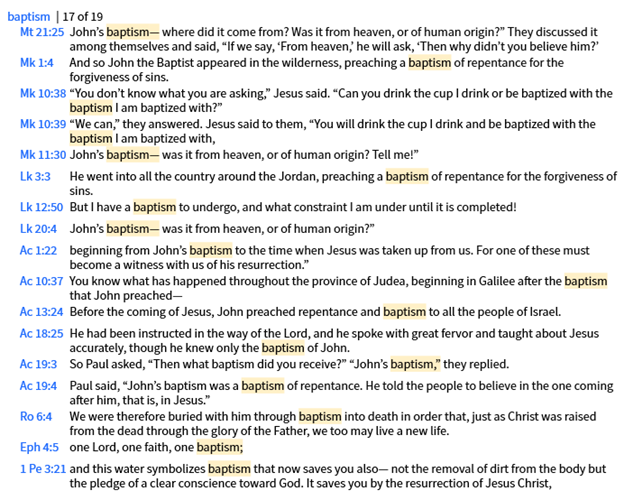
βάπτισμα,τος n:Concordance List from Logos (built-in feature with language resources)
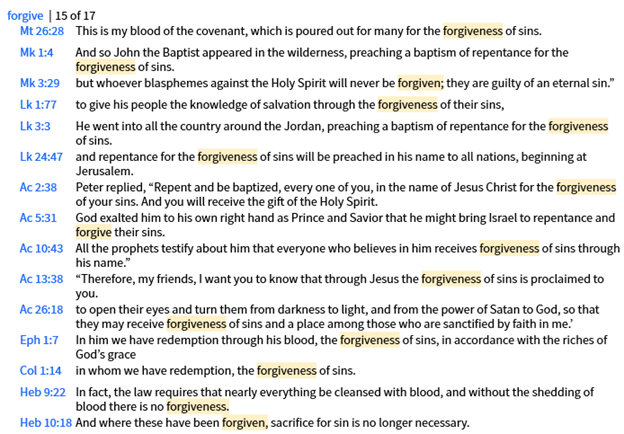
ἄφεσιςa,εως f; Concordance List from Logos
Pastor Scott Stocking, M. Div.
My views are my own.
[1] Louw, Johannes P., and Eugene Albert Nida. 1996. In Greek-English Lexicon of the New Testament: Based on Semantic Domains, electronic ed. of the 2nd edition., 1:536–37. New York: United Bible Societies.

