My, how time flies! Next Sunday, February 15, 2026, is “Transfiguration Sunday,” the last Sunday before the Lenten season begins. Thank you for reading my new Lectionary Help series. Last week’s post was the most popular post on my blog for the week, almost twice what it was the week before. If you’re sharing these with your congregation or colleagues, a double dose of thanks for that! Now, let’s look at Matthew 17:1–9.
Word Study
We can’t talk about “transfiguration” without talking about the Greek word Matthew uses to describe the event, and it should be a familiar one to you: μεταμορφόομαι (metamorphoomai), μεταμορφόω (metamorphoō).[1] Those of you who studied Greek may recognize that this verb occurs in deponent form (usually implies no direct object or perhaps middle voice, suggesting the action of the verb is focused on the speaker themselves) and active voice, at least in the lexical entry.
New Testament authors only use the verb four times.[2] In addition to today’s passage, we find it in Mark’s account of the event (9:2). Luke does not use this word in his account (9:28–36) but only mentions that Jesus’s “appearance” changed (“The form [εἶδος eidos] of his face [was] different”).
Paul uses the word in Romans 12:2 (“be transformed by the renewing of your minds”) and 2 Corinthians 3:18 (“And we all, who with unveiled faces contemplate the Lord’s glory, are being transformed into his image with ever-increasing glory, which comes from the Lord, who is the Spirit.”[3]). In both instances, the passive would seem to be appropriate since it refers to changes you and I undergo because of what Christ is doing in the lives of the faithful. Although Paul was not yet a follower at the time of the Transfiguration event, it seems clear in the 2 Corinthians passage that he’s alluding to that.
In all four occurrences, the morphologies I checked[4] all identified the forms as passive voice. However, I would argue that the two occurrences in the gospels should be identified as middle voice, because Jesus has the power within himself to control the event. I don’t know that this is a huge thing theologically, whether God was doing it or Jesus was doing it, but as I’ll discuss below, I think the events leading up to this suggest Jesus initiates this for his inner circle.
The other NT reading for the Lectionary is 2 Peter 1:16–21. Peter references his participation in the Transfiguration event, which he is now free to do since Christ has risen. It’s in the opening chapter of his first epistle, so I wonder how long he was holding on to that little tidbit waiting for the opportunity to publish it! It’s not a boast, though. He’s merely establishing his credibility as an eyewitness to the event, so we can, I think, safely say that the Transfiguration is a genuine event and not resort to some psychological, metaphysical, or naturalistic explanation for the event.
Context
In the synoptic gospels, all three authors have the Transfiguration story closely tied to Jesus’s first and second predictions of his death. Matthew and Luke have it immediately after that prediction, while Mark inserts the pericope about taking up the cross after the prediction. All three follow the Transfiguration pericope with a pericope of Jesus healing a demon-possessed boy followed by Jesus’s second prediction of dying. Luke adds after the second prediction that “Jesus resolutely set out for Jerusalem,”[5] which establishes the historical setting for the rest of Luke’s gospel. I don’t think it’s too much of a leap of faith to say that Jesus is using the Transfiguration event to assure his disciples that:
Heaven is real and the patriarchs are alive and well in that realm;
Jesus himself will be resurrected when the time comes; and
Jesus has the fulness of divinity in him, i.e., he’s the Son of God.[6]
Those are the highlights I noticed as I begin my own preparation for preparing a message for next Sunday. As always, feel free to comment here in the blog or on my Facebook page for the blog. Also watch for the Reel as I’m going to dive into creating some video content for these Lectionary Help posts as well.
If you want to see past Lectionary Help articles on the blog, just search “Lectionary” from the blog search feature, usually on the right side of your computer screen. Peace to you all!
I preached this sermon at Mount View Presbyterian Church on November 23, 2025. It was the last Sunday of Year C of the Lectionary Calendar, commonly known as Reign of Christ the King Sunday. It was also the Sunday before Thanksgiving and the Sunday before the first Sunday in Advent. I had not checked the advanced copy of the church bulletin thinking they would have the Lectionary gospel reading for the day printed, but as it turned out, they had a Thanksgiving Service planned (more music), so I hadn’t prepared a message based on the reading. I went ahead preached the message I had prepared, which worked out find, because with more music, the service was a little longer than usual, and my message had been shorter than usual. I’ve also included some links to past Advent messages since the season is upon us.
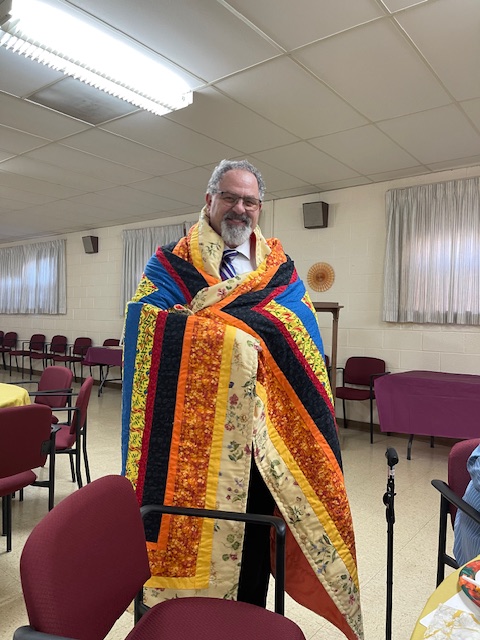
We had a soup lunch afterwards and had a drawing to give away a few of the quilts our ladies had made. I won what I’m calling my Joseph Quilt. It is a nice sized quilt worked on by several of the ladies. My mom provided the stitching/decoration around the border.
Have you ever seen one of those movies where they start with some dramatic scene. In the cop shows, it’s usually a murder or finding someone badly injured in an unexpected place. In a Hallmark movie, it might be a wedding scene or a passionate kiss (we all know that’s coming in the Hallmark movie, so no need to put it off until the end!). But then in the next scene, the graphic pops up: “Six months earlier.” The opening scene has gone by so quickly that you didn’t even get a chance to figure out much about who the characters are, then you’re thrust back in time and have to figure it out all over again.
Today we come to the conclusion of the liturgical calendar: “Reign of Christ the King” Day. It’s hard to believe Advent (and the new liturgical year) starts next week. The Lectionary is kind of like those movies I mentioned earlier. Even though we read about the crucifixion of Jesus this morning, we’re not going to get back to that dramatic event of the Resurrection that kicked off the last eight months of the calendar until Easter next year.
This past year, we’ve journeyed through the gospel of Luke, which has the most material on the life of Jesus. Five months ago, we read in Luke 9:51 that Jesus “resolutely set out for Jerusalem.” The rest of Luke’s gospel from that point on is set in that context of Jesus knowing his life would be cut short. Yet he continued loving, healing, and teaching the masses about God’s true love for them. He also did not shy away from confronting the religious leaders of his day for their abuse of the spiritual authority God had entrusted to them. That violation of God’s trust brings us to where we are today in the gospel, the crucifixion.
Luke has details in this story that the other three gospel writers do not have. Luke is the only one who has Jesus saying “Father, forgive them, for they do not know what they are doing.” He wasn’t just talking about how the Roman soldiers were treating him either. Matthew and Mark tell us that the criminals who were crucified with Jesus were BOTH hurling insults at him, but Luke indicates that one of them must have had a change of heart after hearing Jesus say “Father forgive them” and asked Jesus for forgiveness in his last hour. Jesus, of course, granted it.
The religious leaders were jeering and sneering at him as well. “He saved others, or so he claims! Let him save himself if he’s the Messiah!” One might expect that kind of behavior from criminals, but from those who had presumably dedicated their lives to serving God at the Temple or in the local synagogues? You know you must be getting close to the corruption and hardness of heart when the people who should be on your side are rejecting you for your teachings.
Even though our gospel reading stops just short of the final moments of the crucifixion, we are all familiar enough with that story to finish it from memory. And we know that because Christ defeated death and rose again into his heavenly glory, he lives and reigns as King of Kings and Lord of Lords. While his kingdom is here on earth, it is not of this world. Paul says in Ephesians 1:3 that God has “blessed us [i.e., Christ followers] in the heavenly realms with every spiritual blessing in Christ. It was evident from the moment of Pentecost that God had begun a new work in his people through the empowering of the Holy Spirit sent to us by our risen Savior.
As Christ followers, then, we are by default emissaries of the King of Kings and Lord of Lords. In the rest of the New Testament we see Paul and the other apostles planting and shepherding churches that are growing by leaps and bounds in various places. In many cases, the word of God has already spread to places where Paul had yet to travel because other believers were doing that missionary work as well. In the first chapter of Paul’s letter to the Colossians, we get a glimpse at Paul’s heart for them in the first chapter. Paul praises them for having a faith that is “bearing fruit and growing” in their hearts and around the world. Let’s pick up his praise for them in verse 9:
9 For this reason, since the day we heard about you, we have not stopped praying for you. We continually ask God to fill you with the knowledge of his will through all the wisdom and understanding that the Spirit gives, t10 so that you may live a life worthy of the Lord and please him in every way: bearing fruit in every good work, growing in the knowledge of God, 11 being strengthened with all power according to his glorious might so that you may have great endurance and patience, 12 and giving joyful thanks to the Father, who has qualified you to share in the inheritance of his holy people in the kingdom of light. 13 For he has rescued us from the dominion of darkness and brought us into the kingdom of the Son he loves, 14 in whom we have redemption, the forgiveness of sins. [1]
Paul has incredible respect for the Colossians and wants to ensure they continue on the path of growing in righteousness and faithfulness. This is significant in that Colossae was an incredibly diverse town in south-central Asia Minor. He wants them to be filled “with the knowledge of his will through all the wisdom and understanding that the Spirit gives.” Paul has a similar thought for the Ephesians in the opening of that letter: “18 I pray that the eyes of your heart may be enlightened in order that you may know the hope to which he has called you, the riches of his glorious inheritance in his holy people, 19 and his incomparably great power for us who believe.”[2]
In Colossians 1:6, Paul affirms that the gospel is “bearing fruit and growing through the whole world. He reassures the Colossians are doing their small part to contribute to that in vs. 10.
Being strengthened in all power means that they understand the working of the Holy Spirit in their lives. They do have some challenges, apparently, with some coming among them making “fine sounding arguments” against the gospel. But Paul has confidence that their knowledge will help them discern false teachings and stay the course of the true gospel with patient endurance.
They are also continually giving thanks because they’ve been rescued from darkness. They believed the gospel and have been living it out boldly because they know they’ve been forgiven and redeemed.
After praising them, Paul continues from verse 15 talking about the supremacy of Christ and why he reigns as King of Kings and Lord of Lords:
15 The Son is the image of the invisible God, the firstborn over all creation. 16 For in him all things were created: things in heaven and on earth, visible and invisible, whether thrones or powers or rulers or authorities; all things have been created through him and for him. 17 He is before all things, and in him all things hold together. 18 And he is the head of the body, the church; he is the beginning and the firstborn from among the dead, so that in everything he might have the supremacy. 19 For God was pleased to have all his fullness dwell in him, 20 and through him to reconcile to himself all things, whether things on earth or things in heaven, by making peace through his blood, shed on the cross. [3]
The concept of Jesus being the “firstborn” here seems to have a dual meaning. In verse 15, Paul says Jesus is the firstborn over all creation. That seems to suggest what we learn from John, that Jesus, the light of the world, was the “light” that God created on Day One of creation. A few verses later, in verse 18, Paul calls Jesus “the beginning,” which would seem to confirm the Genesis theory, but the then also calls Jesus “firstborn from the dead.” John also uses the phrase “firstborn from the dead” of Jesus in the opening chapter of Revelation (1:5). This of course is a reference to his resurrection.
Even though there are a few others in the history of the Bible who were raised from the dead, they all came back to life in their original human bodies. Jesus is the first one whose body was raised from the dead AND transfigured into its heavenly version. That earns him the title of head of the church—King of Kings and Lord of Lords—having supremacy over everything. This supremacy is not only for this world, but in the heavenly realms as well as Paul indicates.
Harkening back to Ephesians 3:10, we see that we have a role in proclaiming the gospel not only here but also in the heavenly realms. “10 His intent was that now, through the church, the manifold wisdom of God should be made known to the rulers and authorities in the heavenly realms.”[4] The passage in Ephesians 6 on the armor of God reaffirms our role in fighting the good fight not only against flesh and blood, but against the powers in the heavenly realms. We have the divine protection and strength to stand firm in those battles because of Christ’s victory over death and the redemption he won for us. Not only does he reign as King of Kings and Lord of Lords in our lives, but he has also provided the means for us to walk faithfully in this world.
As we wrap up the liturgical year and look toward Advent and the Christmas season, we can take comfort and courage in having citizenship in the kingdom of Christ. A blessed Thanksgiving to all of you this week, and please join us for the meal after service. Amen.
I preached this message on July 27, 2025 (Year C, Proper 12), at Mount View Presbyterian Church, Omaha, NE.
The last line of our Declaration of Independence says this:
“And for the support of this Declaration, with a firm reliance on the protection of divine Providence, we mutually pledge to each other our Lives, our Fortunes and our sacred Honor.”
The Declaration of Independence uses several different terms for our heavenly Father: “Nature’s God,” “Creator,” “Supreme Judge of the world,” and in the last line of the Declaration, “Providence.” Even “Prudence,”[1] might be considered a reference to God because it derives from the same root for “Providence.”
“Providence,” when capitalized, means “God conceived as the power sustaining and guiding human destiny.” The adjective “provident” is relevant to our passage today: “making provision for the future.”
As you listened to the New Testament reading this morning, you may have thought the switch from an abridged version of the Lord’s prayer to teaching about God’s providence seemed a bit “abrupt.” But if you look closely at how the portion of the Lord’s prayer is formatted in most English Bible, you’ll see that the central line is “Give us this day our daily bread.” He then goes on to relate Jesus’s teaching about what a good neighbor might do even though they might feel “put-out” by the expectation in the middle of the night.
To understand the story of the neighbor’s request, I want to remind you about what I talked about a couple weeks ago about what it meant to be a neighbor and part of an in-group. First of all, notice that Jesus puts his listeners in the position of the one needing the bread. To make this easier to follow, I’m going to give the three men in this story names. Since the man in story is played by you in Jesus’s parable, you can insert your own name in there, but I’m going to use Joel for our example, because he’s always willing to play along with me when I ask for audience participation, and Joel is a good biblical name. We’ll call Joel’s neighbor Hosea since that’s the Bible book that comes before Joel, and we’ll call Joel’s visitor Malachi, since that’s the last book of the minor prophets.
Even though Hosea probably doesn’t know Malachi, because both men are friends with Joel, Joel would have a cultural, in-group expectation that Hosea would show the same hospitality and respect to Malachi as he would to him and would not make Joel look bad to Malachi. The other thing to consider here is that Joel seemingly has enough trust in his relationship with Hosea that waking him up at midnight for bread doesn’t seem out of bounds with the cultural norms of the day. Hosea is certainly not happy about being awakened in this manner, but he realizes that his neighbor Joel must really be in a bind if he has the “shameless audacity” to wake him up at midnight. It is that trust in the relationship between Joel and Hosea that compels Hosea to get up and give Joel the bread he needs.[2]
One final note here: Joel’s audacious act would have signaled to Hosea that if Hosea was ever in a similar spot, Joel would be willing to help him as well. This was not so much a matter of tit-for-tat; Hosea would not have had an expectation of any compensation or immediate reciprocation. It was more of a “pay-it-forward” act. Nor was it “charity” or even “welfare” in the way we might typically think of it. It’s a two-way street. It is simply the mindset of those first-century listeners who would have understood the cultural dynamic at work here and who take their cultural obligations seriously.
The important consideration here is that this cultural dynamic was intended for the success and longevity of the community. When those in the in-group and allied with the in-group are supported by the in-group, the in-group becomes stronger and more closely united. This provides a sense of internal security for the in-group. They don’t have to rely on outside sources to support their cultural priorities.
This is the kind of thing we see going on in the early chapters of the book of Acts. We see the believers willingly selling property to help meet the needs of less fortunate believers. We see them sharing meals together. We see them meeting together for prayer, worship, and instruction. We see them resolving conflicts so that all the widows can be cared for. And we even see Paul condemn Ananias and Sapphira to death for lying about what they gave for those needs, even though they had absolutely no obligation to give every last drachma of their proceeds on the sale.
As I said a couple weeks ago, this kind of internal support system is how the community maintained their honor and integrity. This also represents how God works with us, especially when it comes to prayer. Verses 9–10 give us the moral of the story: don’t be afraid to ask—and be persistent when you do!
I wish I understood why our current culture has gotten to the place where we are afraid or embarrassed to ask for help from those we know, especially within the church. Part of it may have to do with the government thinking they need to take over the responsibility of “charity,” and then regulating it to the point where it becomes burdensome for private nonprofit entities to respond to needs. I fear it’s created a mindset that government should be the first place you look for help, not the church.
But I digress. The last part of our gospel passage this morning reveals the goodness of God. Some may have the opinion that God only wants to punish us, or that the bad things that happen to us are the result of a cruel God. But God is not cruel in the way he responds to our prayers. James confirms the goodness of God as revealed in the last part of our gospel passage:
James 1:5–8 says:
5 If any of you lacks wisdom, you should ask God, who gives generously to all without finding fault, and it will be given to you. 6 But when you ask, you must believe and not doubt, because the one who doubts is like a wave of the sea, blown and tossed by the wind. 7 That person should not expect to receive anything from the Lord. 8 Such a person is double-minded and unstable in all they do.[3]
And later in 4:1–3, James says almost the same thing, with a different twist:
What causes fights and quarrels among you? Don’t they come from your desires that battle within you? 2 You desire but do not have, so you kill. You covet but you cannot get what you want, so you quarrel and fight. You do not have because you do not ask God.3 When you ask, you do not receive, because you ask with wrong motives, that you may spend what you get on your pleasures.[4]
Our reading form Psalm 138 this morning also affirms the goodness of God when we ask him for help. Verse 3 says, “When I called, you answered me;
you greatly emboldened me.[5]” There’s that boldness we saw in the man who asked for bread from his neighbor. Verse 6 says, “Though the Lord is exalted, he looks kindly on the lowly; though lofty, he sees them from afar.”[6]
Your presumed standing with God matters not. In fact, he has a special place in his heart for those of us who think we’re “lowly.”
David is willing to bow down to God and give him unfettered praise for the way he has provided for him. He recognizes God’s protection, God’s preservation, and God’s power. God is there for us when we need him. Even if we don’t get the answer we want, we, like the three men in the fiery furnace, know that God will save us one way or another when we put our trust in him.
Paul affirms this in Colossians 2:6–7 as well: “So then, just as you received Christ Jesus as Lord, continue to live your lives in him, 7 rooted and built up in him, strengthened in the faith as you were taught, and overflowing with thankfulness.”[7] We can show the same thankfulness that David did in Psalm 138.
At the beginning of my message this morning, I mentioned how the Declaration of Independence refers to God as “Providence.” He is the provider and we can trust in him. But this also implies a mutual trust as well, just as we have as the body of Christ united. Jefferson closes the Declaration of Independence with a line that sums up nicely the commitment we should have to the body of Christ as we walk faithfully with Jesus: “We mutually pledge to each other our Lives, our Fortunes and our sacred Honor.”[8] We are God’s witnesses on earth to his great and marvelous deeds. How can we do anything less than give him all our praise for the ways he provides for us. Don’t be afraid to ask God to do some great things for you as you walk with him. Amen.
[1] According to Merriam-Webster, “prudence” is derived from the same root as “providence.” “Prudence” means “the ability to govern and discipline oneself by the use of reason” or “skill and good judgment in the use of resources,” which is perhaps a meaning relevant to this message.
[2] This is known as a “dyadic alliance” or “dyadic contract.” See Malina, Bruce J. The New Testament World: Insights from Cultural Anthropology, revised edition, pp. 99–103, 115. Wesley/John Knox Press, 1993. See also Malina’s Windows on the World of Jesus, pp. 48–49.
How many of you had “preteen” kids around you at your holiday celebrations this year? Honestly, that was my nightmare week of summer church camp if I ever got called to help lead that back in the day. So much drama! As I reflect on that, I wonder why we never made the kids memorize Bible verses about gossip! They’re at that age where they want to be independent but still have to pass notes or create a “grapevine” to find out who likes who.
The stories you get as a camp counselor may be hard to follow sometimes too. “Maggie asked her BFF Jenny to ask Jake if he would ask Maggie to sit with her at the campfire, but Jake likes Jenny better than Maggie so Jake asked Jenny to the campfire instead and Jenny said yes so now Maggie’s mad at Jenny” and so on and so on….
Fortunately (or rather, “divinely”), the preteen, 12-year-old Jesus in our Bible passage this morning shows no signs of having that kind of drama to worry about or distract him from preparing for his ministry as an adult. In fact, he is SO not into that kind of drama that he creates his own drama by not telling his family he’s going to hang out at the temple as they’re departing and talk to a bunch of old theologically minded men about what his real dad is really like. No playing tag or hide-and-seek with his cousins and half-siblings on the way home from Jerusalem for this Savior-to-be!
When you think about it, this really is a remarkable account of the early life of Jesus. We very rarely got that with other important biblical figures in the Old Testament. With Isaac and Jacob and Esau, we didn’t really have too much of their early life, other than Jacob holding onto to Esau’s heel when those twins were born. Joseph was 17 when he started having visions of grandeur and was subsequently sold into slavery by his brothers. We looked at Samuel’s birth briefly last week as well.
Then of course there was David. He was the youngest of Jesse’s eight sons. But he also was seemingly quite brave, having bragged to King Saul about killing a lion and a bear. This set the stage for his confrontation with Goliath and thus giving him a reputation as a great warrior king. David would not be allowed to build God’s Temple, his “earthly” residence in Jerusalem, because he had blood on his hands, but Solomon would.
The tabernacle had certainly been through the ringer in the over 200 years it had been used for worship in the wilderness and as they settled into the Promised Land. David wanted to replace it with something beautiful and more permanent. He drew up the plans, and Solomon would eventually build it. But even that temple would fall into disrepair and ruin after the exile and its abandonment. Herod built a new temple, but even though it wasn’t the original built by Jesus’s earthly ancestor Solomon son of David, Jesus, the Son of Man of the lineage of David, would still come to call Herod’s temple his father’s house.
What is interesting about the youth and young adult stories we have about all these forefathers is that, since Cain killed Abel in the early chapters of Genesis, the Old Testament seems to have an underlying theme of disfavor on the firstborn among the family line of God’s chosen people. It’s not clear if Abraham was firstborn, because his story in Genesis is told under the title, “This is the account Terah,” his father’s name. Isaac was not Abraham’s first son. Jacob of course was second born to Isaac. Joseph was Jacob’s (Israel’s) second to last child of twelve sons and one daughter. Samuel wasn’t Elkanah’s first born, and David was the youngest of eight.
But we do know that Jesus is Mary’s first born, and this is where the disfavor of the firstborn gets nipped in the bud. Jesus knows, even at the tender age of 12, that he is God’s one and only begotten son, and not only that, that his father’s house is his home too by inheritance. In this temple encounter, Jesus asserts not only his first-born responsibility to bring honor and respect to his parents, and by extension to the rest of his family, but also honor, respect, and glory to his true father, his heavenly father, in the place his heavenly father calls home on earth.
Unfortunately, we do not have a transcript of Jesus’s discussion with the teachers in the temple. That would have been fascinating indeed. Jesus was only one year away from what was essentially his bar mitzvah, that is, becoming a “son of the commandment,” and thus being formally held to account for his observance of the law. Jesus was obviously trying his hand at dialoguing with the teachers of the law to understand the human and religious reasoning and logic these teachers applied to the law.
The dialogue would have been very Socratic as well. Lots of questions going back and forth, including answering questions with questions each way. The amazement the teachers had with Jesus probably stemmed from his depth of understanding of the law, his ability to answer their questions, and his own penchant for asking intelligent and thought-provoking questions himself. I’ll venture a guess and say he even tried out a parable or two on them.
Proverbs 22:6 tells us, “Start children off on the way they should go, and even when they are old they will not turn from it.”[1] Of course, Jesus was most likely a self-starter once he had awareness of his divine nature (and we can only speculate on when that happened). But our children obviously need guidance if we’re going to expect them to have any awareness of faith in God, a relationship with Jesus, or sensitivity to the Holy Spirit speaking into their lives.
To the extent that you can, if you can have any influence in the spiritual formation of the children in your extended family, take the opportunity to exercise that influence. Send them cards and letters. Record a video or two for them. Create a photo album with family stories included. I’d like to think my own blog is the spiritual legacy I’m leaving for my kids and grandkids.
As God’s chosen people, we have an obligation to pass on the legacy of our faith to our families. The other New Testament passage from today’s lectionary readings comes from Colossians 3:12–17, where Paul gives us insight as to how we can be shining lights to our families and the world around us:
12 Therefore, as God’s chosen people, holy and dearly loved, clothe yourselves with compassion, kindness, humility, gentleness and patience. 13 Bear with each other and forgive one another if any of you has a grievance against someone. Forgive as the Lord forgave you. 14 And over all these virtues put on love, which binds them all together in perfect unity.
15 Let the peace of Christ rule in your hearts, since as members of one body you were called to peace. And be thankful. 16 Let the message of Christ dwell among you richly as you teach and admonish one another with all wisdom through psalms, hymns, and songs from the Spirit, singing to God with gratitude in your hearts. 17 And whatever you do, whether in word or deed, do it all in the name of the Lord Jesus, giving thanks to God the Father through him.[2]
In some ways, this passage reads like a further explanation of the fruit of the Spirit: “love, joy, peace, forbearance, kindness, goodness, faithfulness, gentleness and self-control.”[3] If you’re considering any New Year’s resolutions for 2025, this passage from Colossians would be a good way to start, to recommit yourself to being a better follower of Christ. This past year has certainly been pretty hectic and emotional given what’s happened on both the political and cultural fronts. Maybe it’s time we wipe the slate clean by injecting a heaping helping of forgiveness where we’ve encountered negative feedback from friends and family.
I like how the NIV translation uses “forbearance” in the fruit of the Spirit passage, the only time the NIV translates the Greek word that way. Every other time, it’s translated “patience” or “patient” in the New Testament. I’m not sure why that is, but the translation “forbearance” seems to have a more active nuance than the word “patience.” Patience seems to imply just waiting around for something to happen, while forbearance seems to suggest that you’re actively praying about whatever the situation is and how you can keep your emotions in check if it’s something you’re not comfortable with but have little to no control over.
As we talked about during the Advent season, seek the peace of Christ as well. “Let [it] rule in your hearts,” says Paul. Peace is not necessarily the absence of conflict, although that helps greatly, but the security of knowing you’re safe in Christ and in your faith. Spend time in Scripture and commit yourself to maintaining a connection with your faith family here or wherever you may attend regularly. That is how the word of God can dwell “among you” (notice it says “among” and not “in,” that’s significant!) richly and how you can have the experience of singing the songs of praise together that our Psalm 148 reading spoke about today.
As we close the books on 2024 this year, my prayer is that you will draw even closer to God in the new year. I pray for you (and me) like Paul prayed for the Ephesians: “That the eyes of your heart may be enlightened in order that you may know the hope to which he has called you, the riches of his glorious inheritance in his holy people, 19 and his incomparably great power for us who believe.”[4] Power, riches, and hope (and not the hope of the MegaMillions jackpot type of riches). Jesus wants us to be strong in the faith for him and look to him for our joy. May God richly bless you as we enter 2025 this week. Amen!
Sermon preached at Mt. View Presbyterian Church July 31, 2022. Lightly edited for publication.
Probably a lot of people were asking each other this past week, “What would you do with a billion dollars?” With one of the largest jackpots ever, who could blame us for asking, right? If I had won it, I’d probably quit my job, go back to school to get my PhD, and spend the rest of my days preaching and writing. I’d also build, or hire someone to build, a really great model train layout so I’d have something entertaining for myself. And of course, my wife and I would travel to the historic sites of the Bible and other great places in the world.
But as Christians, of course, we’d have to be careful that our wishful thinking about a billion dollars doesn’t turn into outright greed. There’s nothing wrong with wealth in and of itself. But perhaps we should ask ourselves a different question if we have any thoughts about buying that longshot ticket to fortune: “What would a billion dollars do to me?”
Jesus addressed that issue with his followers and disciples in several different ways: “What good is it if for someone to gain the whole world, and yet lose or forfeit their very soul?” (Luke 9:25). In our Gospel reading this morning (Luke 12:13–21), Jesus said to the rich fool, “Life does not consist in an abundance of possessions.” Jesus told the pharisees, “You cannot serve both God and Money” (Luke 16:13). He also told a parable about a man who was forgiven thousands of dollars’ worth of debt, but then couldn’t even offer that same forgiveness to someone who owed him a couple hundred dollars (Matthew 18:21–35).
I’ll tell you how I’d answer the question, “What would a billion dollars do to me?” because I’ve thought about it quite a bit, and some of the answers I don’t like. For starters, I think I’d be a little paranoid about people doing all kinds of crazy things to get a piece of the pie. Like claiming to have injured themselves by slipping on the ice in front of my house…in August…when the projected high is over 90 degrees for the next two weeks. I have a mindset that God has me where he wants me, and if I’d win that much money, I might not be doing what God wants me to do anymore. That actually scares me a little. But then again, God can redirect me at any moment he chooses, jackpot or not. I’m not sure I’d tell my kids, either. I want them to know what it’s like to have a career and work for the things that are important to them. That builds character, personality, integrity, and wisdom. I turn 60 in a few months, so I’m thinking more and more about retirement and less and less about working!
But alas, some lucky person in Des Plaines, IL, purchased the winning ticket, so I won’t have to wrestle with that question any time soon, or probably ever. It’s probably a good thing too, because in today’s passage, Colossians 3, Paul warns us about the dangers of greed and inappropriate desires, not to mention a host of other sins and concerning behaviors.
Now to refresh your memories, last week we looked at chapter 2 and how we have fullness and a foundation in Christ that helps us to stand strong in our faith. Paul also used the imagery of baptism to show us how we have been saved from eternal death through the power of Christ’s resurrection that baptism represents. This is where Paul picks up the discussion in chapter 3.
Since, then, you have been raised with Christ, set your hearts on things above, where Christ is seated at the right hand of God. 2 Set your minds on things above, not on earthly things. 3 For you died, and your life is now hidden with Christ in God. 4 When Christ, who is your life, appears, then you also will appear with him in glory.[1]
I want to stop there because these four verses are intended to let us know what our standing with Christ is, and I want to break that down a little bit.
I mentioned last week that Colossians and Ephesians have numerous parallel themes. The first verse in Colossians 3 sounds very much like Ephesians 2:6: “And God raised us up with Christ and seated us with him in the heavenly realms in Christ Jesus.” Paul goes on to say in Ephesians 3:6 that we are “sharers together in the promise in Christ Jesus.” In a spiritual sense, then we can live and act with the authority of Christ. That doesn’t mean we’re bossing others around, but it does mean we have the spiritual authority to speak against the evil that Satan tries to throw our way.
When talking about spiritual warfare in Ephesians 6, Paul says we have the full armor of God so we can stand against the devil’s schemes. And that armor isn’t just “standard issue” that any soldier would get. If you look up the Old Testament references to the armor Paul describes in Ephesians 6, you’ll find that in every case, it refers to armor that God himself figuratively wears. We have divine protection in Christ. And corporately, as a congregation, Paul says in Ephesians 1 that we have every spiritual blessing in Christ. How cool is that!
Colossians 3:3 lets us know we’re protected from Satan’s reach by being “hidden with Christ.” This doesn’t mean that we’ll never be tempted or never have bad things happen to us, but that we can have confidence that Christ will see us through whatever may come our way. And at the consummation of his kingdom, we know that we will appear with Christ in glory ready to embark on our eternal journey in heaven.
But until such time as we depart from this mortal life, Paul warns us about several sins and behaviors that tend to lead us into temptation and sin.
5 Put to death, therefore, whatever belongs to your earthly nature: sexual immorality, impurity, lust, evil desires and greed, which is idolatry. 6 Because of these, the wrath of God is coming. 7 You used to walk in these ways, in the life you once lived. 8 But now you must also rid yourselves of all such things as these: anger, rage, malice, slander, and filthy language from your lips. 9 Do not lie to each other, since you have taken off your old self with its practices 10 and have put on the new self, which is being renewed in knowledge in the image of its Creator. 11 Here there is no Gentile or Jew, circumcised or uncircumcised, barbarian, Scythian, slave or free, but Christ is all, and is in all.
This is probably one of the most comprehensive lists in the NT of bad behavior and stinkin’ thinkin’. In Colossians 2:11, Paul says “Your whole self ruled by the flesh was put off when you were circumcised by Christ.” In Ephesians 4:22, Paul says something similar: “22 You were taught, with regard to your former way of life, to put off your old self, which is being corrupted by its deceitful desires.”
Now all sin is equal in God’s eyes, so I don’t think the fact that we seem to have two lists here (vss. 5 and 8) can be used to imply some sort of ranking of sins from worst to not-so-bad. Paul seems to suggest in vs. 5 that the sins listed there have to do with our earthly nature, our “body of flesh” as Paul put it in the previous chapter. They also seem to be a little more aligned directly with the Ten Commandments, especially when he equates greed with idolatry. He also specifically says after that list that it is these things that bring on the wrath of God. He seems especially concerned about these, because those sins were apparently once a way of life for the Colossians.
The second list in vs. 8 seems to be more about behaviors that are not related to our bodies of flesh but rather our minds or our learned behaviors that dishonor God and his kingdom. For example, on anger, Paul says in Ephesians 4:26–27: “26 Get angry but do not sin”: Do not let the sun go down while you are still angry, 27 and do not give the devil a foothold.” In other words, it’s not a sin to get angry; that’s a natural response we have to certain situations. Our modern English translations don’t translate the first part of 26 as a command, but that’s what it is in NT Greek text and the Greek translation of the Hebrew text of Psalm 4:4. It warns us about dealing with our anger quickly and not “sleeping on it,” as that could give the devil an “in” to make your life miserable. Unresolved anger and grudges can eat away at our souls.
And note that Paul in vs. 9 especially highlights not lying to each other and ties that in with the fact that we’ve put off the old self and put on the new self. Lying, along with all the other sins and bad behavior listed here, are not consistent with a new or a renewed life in Christ. We’re learning how to live, love, and act as Jesus would have, because we’ve been transformed into a new creation in the image of Christ.
In a world that spends a lot of energy looking at diversity, verse 11 becomes all the more important. God doesn’t want us looking at people from a worldly point of view or according to their worldly, innate characteristics. Barbarians were those who didn’t speak Greek and lived primarily in northern and central parts of Europe. Scythians lived north of the Black Sea, in what is now modern-day Ukraine. Both were considered to be quite primitive, and the Scythians were considered especially brutal, little more than wild animals. It’s interesting they’re mentioned here, because their civilization had been overthrown by around 200 BC. Survivors of that culture had evidently migrated south across or around the Black Sea into Asia Minor and especially the area around Colossae. Knowing that, one has to wonder if some of the behaviors described in the previous verses may have been from a remnant of the Scythian peoples as they were assimilated into the culture of Asia Minor.
The only thing that matters, then, is whether we have Christ, who is all in all, and are living according to his standards.
Now it’s not enough just to get rid of the old. It’s important to replace our bad behaviors and stinkin’ thinkin’ with a renewed lifestyle and mindset. In Luke 11:24–26, Jesus gives us this teaching:
24 “When an impure spirit comes out of a person, it goes through arid places seeking rest and does not find it. Then it says, ‘I will return to the house I left.’ 25 When it arrives, it finds the house swept clean and put in order. 26 Then it goes and takes seven other spirits more wicked than itself, and they go in and live there. And the final condition of that person is worse than the first.”
If we don’t replace the bad stuff with something positive, we run the danger of letting the bad stuff come in again, and potentially make things much worse for us than before. That’s where Colossians 3:12–17 comes in. Paul doesn’t leave us hanging. He gives us a corresponding list of the good behaviors and the mindset we need to lead a successful Christian life.
12 Therefore, as God’s chosen people, holy and dearly loved, clothe yourselves with compassion, kindness, humility, gentleness and patience. 13 Bear with each other and forgive one another if any of you has a grievance against someone. Forgive as the Lord forgave you. 14 And over all these virtues put on love, which binds them all together in perfect unity.
15 Let the peace of Christ rule in your hearts, since as members of one body you were called to peace. And be thankful. 16 Let the message of Christ dwell among you richly as you teach and admonish one another with all wisdom through psalms, hymns, and songs from the Spirit, singing to God with gratitude in your hearts. 17 And whatever you do, whether in word or deed, do it all in the name of the Lord Jesus, giving thanks to God the Father through him.
That phrase “God’s chosen people” in vs. 12 is not just a nice sentiment or a randomly chosen designation. That’s the same phrase Peter uses in his first letter, chapter 2, verse 9. Peter’s first epistle shares a number of common themes with Ephesians and Colossians as well. “But you are a chosen people, a royal priesthood, a holy nation, God’s special possession, that you may declare the praises of him who called you out of darkness into his wonderful light.” This goes right back to the authority Paul says we have because we’re raised up with Christ and seated with him. We’re “being built into a spiritual house” as the body of Christ, “offering spiritual sacrifices acceptable to God” (1 Peter 2:5).
The list of good stuff sounds very much like the fruit of the Spirit from Galatians. And notice how he puts it: he wants us to “clothe” ourselves in all these good things. This is a direct verbal contrast to our passage last week where he speaks of “putting off” the old self. I think we all know what the virtues listed are, so we don’t need to dive too deeply into that. I will say something about “kindness,” though. There does seem to be a slight difference between being “nice” and being “kind.” A nice person might not want to confront an issue because they don’t want to upset someone, whereas a kind person would confront an issue and give the other person a chance to do better.
I’ll take a recent example from my own life. We had some new siding put on the north side of our house in April, and it didn’t get painted until June. I was looking at the paint job when it was done, and noticed it was patchy; some places either didn’t have a second coat or perhaps they had two batches with a slightly different tint. As I started to look closer at the siding job, I began to notice there were gaps at the seams of the horizontal planks that were not acceptable. It was wavy and uneven. And to boot, some of the nails were already starting to pop through the siding leaving noticeable holes. Basically that would have left me with the same problem I was trying to fix.
If I had decided to be “nice,” I might have said, “Oh well, they did their best, I guess I’ll have to live with it,” and spend thousands more a few years down the road to fix the same problems all over again. But the “kind” thing to do in my mind was to let the company know and give them a chance to make it right. That may be more painful for all involved, especially for the siding company financially, but in the end we’re both better off knowing it’s a job well done.
The point is, these virtues aren’t intended to make us milquetoast. It takes a certain strength of character and a good deal of self-control to be gentle and patient in the face of life’s challenges. It takes courage to bear with each other through the tough times and forgive one another when we’ve been hurt. Even as Jesus was hanging on the cross, he said, “Father, forgive them, for they don’t know what they’re doing.”
And just like 1 Corinthians 13, the greatest virtue of all to put on is love. Love covers over a multitude of sin, as Peter says.
And not only are we called to put on new behaviors, but a new mindset as well. “Let the peace of Christ rule in your hearts.” What does that look like? That may be different for each one of us. When we’re ruled by the love and peace of Christ, we are bold evangelists for the good news. Unbelievers will be more inclined to listen to us if our actions are consistent with what we profess to believe about Christ. And I’m sure many of you have heard the adage, “I may not remember what someone said to me, but I do remember how they made me feel.” If we act and speak in the name of the Lord Jesus, the world will see that and perhaps share in giving glory and thanks to God.
So as we go from here today, let’s remember that not only do we have fullness in Christ, but that he’s empowered and equipped us to live lives holy and pleasing to him. Amen.
[1]The New International Version. 2011. Grand Rapids, MI: Zondervan. Note that I did not include the comma after “is” as the NIV (2011) version and other versions have it in 3:1. The Greek text appears to be periphrastic, with four words separating ἐστιν and καθήμενος. The NIV and other versions presume that οὗ ὁ Χριστός ἐστιν modifies ἄνω. But this makes no sense, since the rest of the sentence doesn’t flow neatly after that. The periphrastic makes the most sense here, because Christ is seated at the right hand of God. It does NOT refer to Paul’s audience, since he addresses his audience in the plural, and the participle is singular. (For comparison, see Ephesians 2:6, where Paul says we are “seated with Christ in the heavenly realms.”) The comma only serves to make this poor English syntax.
Sermon preached at Mt. View Presbyterian Church, July 24, 2022. Lightly edited for publication.
I want to pose a question to you as I begin this morning, and I promise I will help you realize the answer by the time I’m done about 25 minutes from now. Here’s the question: What is “the circumcision of Christ”? The follow-up question to that is: “How does it save us?” Intrigued? Good. Let’s dive into Colossians chapter 2.
Colossae was a diminishing river town along a major trade route in what is now southern Turkey between Ephesus on the west coast and the Euphrates River in the east. Its close neighbors, Laodicea and Hierapolis had long before New Testament times overtaken it in prominence and prosperity. But that didn’t stop Epaphras, a convert from Paul’s two-and-a-half-year ministry in Ephesus, from founding a successful congregation there in the mid first century.
At some point early in the life of that congregation, they came under the attack or influence of some heretical teaching. It’s not really clear what exactly the nature of that teaching was, but we can glean some ideas based on the themes Paul addresses in the letter. Most likely, the primary challenge to the Christian faith that was emerging at that time, Gnosticism, was that threat. Gnosticism says that anything done in the flesh is evil, therefore, nothing we do really matters for eternity. What was important in Gnosticism was that you know and believe the right things, things about God and the order of the universe and spiritual powers at work in the universe.
This is why Paul spends a significant part of the first chapter writing about who Christ is and revealing some very important truths about Christ that we don’t get anywhere else. Listen to his words about Christ in chapter 1:
15 The Son is the image of the invisible God, the firstborn over all creation. 16 For in him all things were created: things in heaven and on earth, visible and invisible, whether thrones or powers or rulers or authorities; all things have been created through him and for him. 17 He is before all things, and in him all things hold together. 18 And he is the head of the body, the church; he is the beginning and the firstborn from among the dead, so that in everything he might have the supremacy. 19 For God was pleased to have all his fullness dwell in him, 20 and through him to reconcile to himself all things, whether things on earth or things in heaven, by making peace through his blood, shed on the cross.
21 Once you were alienated from God and were enemies in your minds because of your evil behavior. 22 But now he has reconciled you by Christ’s physical body through death to present you holy in his sight, without blemish and free from accusation[1]
Note what he says here: Jesus is the firstborn of all creation. God didn’t have a wife in heaven, of course, so “firstborn” doesn’t mean a literal birth, but that he is the primary and ultimate expression of every God-created element, every being, every creature born at any other time in the world. We know from John 1 that he was with God in the beginning when he began creating the world. In Genesis 1, we hear the refrain over and over again: “And God saw that it was good.”
But the ultimate knock to the Gnostic heresy is Colossians 1:19: “God was pleased to have all his fullness dwell in him.” That must have blown the Gnostics minds! In their thinking, there’s no way a holy God would have or could have put all his fullness into a physical form they believed to be thoroughly evil. And not only that, Paul emphasizes in vs. 22 that it is through Christ’s physical body, through his death on the cross, that we are reconciled to God. I can imagine the Gnostics were running away with their fingers in their ears screaming “la la la la la la, I can’t hear you!”
Paul goes on to exhort the Colossians to stand firm in the face of this heresy and in fact commends them for doing just that. And he also makes the argument against the Gnostic heresy personal by saying that his own physical suffering for the church is working to spread the gospel and encourage his readers all the more toward undying faithfulness.
And so we come to our passage this morning: Colossians 2:6–15. Let’s look first at vv. 6–8 and see how Paul makes the transition here to the heart of the passage that begins in vs. 9.
6 So then, just as you received Christ Jesus as Lord, continue to live your lives in him, 7 rooted and built up in him, strengthened in the faith as you were taught, and overflowing with thankfulness.
8 See to it that no one takes you captive through hollow and deceptive philosophy, which depends on human tradition and the elemental spiritual forces of this world rather than on Christ.[2]
Paul recognizes that the Colossians are living faithfully and holding fast to the Gospel message that Epaphras had brought to them in the beginning. It’s good to know that not every church he wrote to had problems from within, as he must address in other letters. The Colossians are exemplary in that regard, but they are still dogged by the outside influence of some Gnostics.
So Paul again addresses the Gnostic heresy here with his warning about “hollow and deceptive philosophy” and the “elemental spiritual forces of this world,” which are probably nothing more than angels, demons, and perhaps some low-level spiritual powers and authorities. The Jews of Paul’s day had access to a great deal of apocryphal, pseudobiblical literature and oral traditions that told tales of angels, demons, and other spiritual forces. Some of these had the names of patriarchs and prophets attached to them, which may have given them a false veneer of credibility. But Paul is reaffirming that everything we need to know about our salvation and about how God interacts with his creation comes from Jesus himself. Let’s look at vv. 9–15 from the English Standard Version, mostly. In verses 11–13, I’m going to give my own translation, partially because most English translations either read too much into what Paul is saying or they don’t respect the strong verbal parallels with similar passages in Ephesians.
A For in him the whole fullness of deity dwells bodily, and you have been filledin him,
B who is the head of all rule and authority.
C In whom you were also circumcised with a hands-free circumcision by the putting off (τῇ ἀπεκδύσει, see vs. 15) of the body of flesh, that is, by the “circumcision” of Christ.
D You were buried AND raised with him in baptism
E through the faithful work of God
D’ who raised Christ from the dead. Even though you were dead in your sins
C’ and the uncircumcision of your flesh,
D” God made you alive with Christ, forgiving all your sins.
C” by canceling the record of debt that stood against us with its legal demands. This he set aside, nailing it to the cross.
B ‘ He disarmed (disrobed? ἀπεκδυσάμενος) the rulers and authorities and put them to open shame,
Before we put meat on the bones here, I’d like you to take a look at how the passage is formatted above. You can see how it has successive indents as you read through the passage, and then the indents start to move leftward in the last half of the passage. The bold statement in the center (line E) that has the greatest indent is the key point in the passage: God raises us up and makes us alive in him because of his faithfulness to us. God’s faithfulness is what gives the Colossians the courage to stand up to the Gnosticism they encountered and to stand firm in their faith in spite of sometimes intense opposition. And God is still faithful today, so that you and I can have that same confidence in him to stand firm and carry on with our respective ministries and mission.
You will notice that I’ve italicized some words as well. In addition to similar index indents, those italicized words help you see the verbal parallels between the different parts of the passage. So, for example, in lines B & B’ of the passage, you’ll see the words “rule and authority” highlighted.
If you remember at the beginning, I asked you to dwell on the question, “What is the circumcision of Christ”? It is in the structure of this passage as I’ve laid it out here that we get that answer. Look at verse 11 (line C). Notice that a form of the word “circumcise” is used three times here. Then look down to line C’ (v. 13b): there’s the word “uncircumcision.” At that point, the outline “backtracks” a couple levels to previous verbal connections. Line C” (vs. 14), then, is at the same outline level as the circumcision phrases. But instead of using “circumcision” here, he makes a statement about the crucifixion: “This he removed from our midst, nailing it to the cross.” So here’s the answer to the question: “The circumcision of Christ” is in fact the crucifixion! The crucifixion is, if you’ll allow me this, the circumcision to end all circumcisions. Here’s the logic behind this.
Paul’s use of the phrase “removed from our midst” sounds very much like the statement in vs. 11 about the “putting off” of the body of flesh. And given that Colossians and Ephesians have dozens of verbal parallels, this sounds a lot like Paul’s discussion of this topic in Ephesians 4:22–24:
22 You were taught, with regard to your former way of life, to put off (ἀποθέσθαι) your old self, which is being corrupted by its deceitful desires; 23 to be made new in the attitude of your minds; 24 and to put on (ἐνδύσασθαι) the new self, created to be like God in true righteousness and holiness.[4]
The word for “putting on” the new self is the exact opposite of the word for “putting off” the body of flesh in Colossians. In Ephesians 2:3, Paul speaks of us “gratifying the cravings of our flesh,” from which God saved us. He says a little later in 2:15 something very similar to our Colossians passage about “waging war in his flesh against the commandments and regulations” and making peace with the new creation we are in Christ. The original act of circumcision was intended to set Israelite males apart from all others. It was a sign of the original covenant, but it had no power to save. The crucifixion, however, when we believe in its efficacy, not only sets us apart, but prepares our “new creation” bodies by putting off the whole old person and putting on the new to receive the fullness of Christ through the Holy Spirit.
This is what baptism (practiced as immersion in the early church) represents as well: connecting with the death, burial, and resurrection of Christ and recognizing the connection with the body of Christ and newness of life we have in him. And all this is possible because, as the central verse of our passage says, God is faithful to work in and through us for the glory of his kingdom.
So, now that we have the theology out of the way, what does that mean for how we live our “new creation” lives in the kingdom of God? Well, Colossians isn’t just about theology. Here are just a few of the exhortations from Paul for us from chapters 1 & 2:
1:23: “Continue in your faith, established and firm, and do not move from the hope of the Gospel.”
1:28: “So that we may present everyone fully mature in Christ.”
2:2: “That they may be encouraged in heart and united in love.”
2:4: “That no one may deceive you by fine-sounding arguments.”
2:6–7: “Continue to live your lives in him, rooted and built up in him, strengthened in the faith…overflowing with thankfulness.”
2:8: “See to it that no one takes you captive through hollow and deceptive philosophy, which depends on human tradition and the elemental spiritual forces of this world rather than on Christ.”
2:20: “Since you died with Christ to the elemental spiritual forces of this world, why, as though you still belonged to the world, do you submit to its rules?”
2:16: “Don’t let anyone judge you.” (repeat)
Here’s the bottom line: Colossians says that in Christ, you have been brought to fullness. What that means here is that you have everything you need in Christ to carry out the ministries and missions he’s called you to, individually or collectively. Your faith in Christ is your own. You’re the only one who will answer to God for it before the throne. Your faith doesn’t belong to a family member. It doesn’t belong to a friend. It doesn’t belong to a pastor. It doesn’t belong to a congregation, although we hope you’ll share your faith with your congregation, friends, and family. And dare I say it doesn’t belong to any earthly institution or establishment of religion. The Holy Spirit alone determines how his gifts are distributed, and he does so without regard to where you find yourself in any local congregation or church body.
And speaking of gifts of the Spirit, your calling in Christ is your own, except to the extent that that calling leads you to find common cause with others in the local congregation or the broader body of Christ. We are saved as a part of the body of Christ, not apart from the body of Christ. As Paul said in 2:16, “Don’t let anyone judge you” for how you choose to live out your calling. Romans says his gifts and calling are without repentance. God knew what he was doing when he called you to your ministry or mission, and no one should have the power to take that away from you.
And if you want to explore Colossians further, try reading it alongside Ephesians some time. I said at the top of my message that the congregation at Colossae probably started while Paul was preaching in Ephesus. It’s no accident that many of the themes in Ephesians have found their way into Colossians, but in a different order. Ephesians has a very sophisticated organization, while Colossians is, to be kind, a rearranged and shortened version of Ephesians for a different audience and purpose. I guarantee such a study would be very fruitful.
20 Now to him who is able to do immeasurably more than all we ask or imagine, according to his power that is at work within us, 21 to him be glory in the church and in Christ Jesus throughout all generations, for ever and ever! Amen.[5]
Author’s Note (12/10/2025): When I wrote this article in 2012, I sensed I was on the verge of connecting some ideas that I had been mulling over. As it turns out, I actually did make some very important connections between baptism, the blood of Christ, and forgiveness in this article, but I still wasn’t completely satisfied. After reading this again, it seems I was still on the fence by the time I finished this article.
But the Holy Spirit wasn’t done teaching me yet. In 2019, I wrote a follow-up to this article:
In that article, I finally put all the pieces together (or so I think) to understand baptism by immersion more completely. In that article, I describe my realization that Romans 6 is actually the climax of Paul’s arguments about justification by faith(fulness) in the first five chapters of Romans. Paul concludes Romans 6:23 with the familiar passage about “the wages of sin is death, but the gift of God is eternal life in Jesus Christ our Lord.” THAT is the summary of the baptism/immersion in Romans 6! Baptism is our Calvary moment AND our resurrection moment all wrapped up into one simple act! It also is the basis for Paul’s statement in Romans 12:1 (right after the benediction that closes out his “introductory” argument in Romans 1 through 11): “Offer yourselves as a living sacrifice….” Baptism is that “living sacrifice” moment that starts the adventure in earnest.
If you’ve made it this far, then, I would encourage you to continue reading this article to see my initial train of thought, then read the Part Two article linked above to see the end (for now) result of my thought process. I hope this encourages you to dig deeper, read smarter, and draw closer. –SAS
I have thoroughly enjoyed reading through the Greek NT again this year. I am constantly blown away by the truths God is revealing to me on at least a weekly basis, if not daily at times. On the one hand, my faith has been strengthened immensely by the journey, but on the other hand, after I think I’ve got some topic all figured out, God throws me a curve ball by raising new questions in my mind about what I believe and understand. None of these questions have ever raised any doubt in my mind about the lordship of Christ or the existence of God, but they do compel me to dig deeper to discover more profound truths. Lest I be misunderstood, don’t think that I’m onto some new teaching the church has never seen before: I think Paul and the other apostles knew much more about God and Jesus than any one man could ever uncover in a lifetime of study, although some have come close.
Some Questions about Immersion
One area that I have striven to understand is that of “immersion,” my translation of the Greek word βάπτισμα, which translators usually render “baptism.” The word itself comes from the Greek verb βάπτω plus an intensifying verbal suffix –ιζω. The intensifying suffix in my mind is something that should not be overlooked in understanding the word. Βάπτω means “I dip”, but the intensifier adds an important nuance: βαπτίζω = “I dip all the way” or “I immerse.” I was christened as an infant in the Presbyterian church, and I find value in that practice inasmuch as it serves as a dedication to the parents and the rest of the Christian community to help raise a child in the way of the Lord. But the infant still has to grow and make his or her own choices, so I don’t see it in any way as a guarantee of salvation or inclusion in the eternal kingdom of God.
That is precisely the concept about immersion that I have wrestled with over the years: Is it an absolute guarantee of salvation just because you willingly submit to it as an adult who understands the sacrament? Is there no other means by which we can enter the kingdom of heaven other than immersion? I’ve worked through many of these questions in other posts, and I’m convinced of the efficacy of immersion as an act of obedience at the minimum, but as I continue to reflect on the subject, new questions come to mind:
If, as some of my colleagues would say, immersion is absolutely essential, a sine qua non experience to be considered part of the body of Christ, then have we not limited God’s ability to save whom he wants to save?
If immersion is absolutely essential for the forgiveness of sins and entry into the kingdom, then is there some mystical transubstantiation of the water into the blood of Christ, since “without the shedding of blood, there is no forgiveness of sins”?
Putting God in Box
Whenever we make one act binding on a person who wants to become a Christ follower, we run the risk of becoming overly legalistic about it in the first place. Second, we also by default deemphasize other aspects of Christian faith which are equally important. Someone might say, “I’m a Christian because I got immersed at camp when I was a kid,” yet he cusses like a sailor, cheats on his wife, and drinks to excess every night. On the other hand, a man might study Scripture, come to Christ according to his own understanding, and lead others to Christ as well, but has only ever known a tradition of infant christening. If I were to say “Immersion is absolutely essential for salvation,” I would feel like I was putting God in a box and denying his power to “show mercy on whom [he] will show mercy.” If God can reverse the physical laws of nature by causing the earth to change its rotation, if God can suspend the law of Moses to allow David and his men to eat the grain dedicated to the priests, then God can welcome unimmersed believers into his eternal heavenly kingdom.
Requiring immersion as an absolute essential presents another problem in my mind: It implies that we have a perfect knowledge of the Scriptural teachings on salvation at least, and by default implies that perfect knowledge and praxis of a doctrine is required for salvation. Paul is clear in 1 Corinthians 13 that we know in part and prophesy in part. We don’t have perfect knowledge. Some things about God and how he operates in the world just cannot be known, and this leads into my second question: Just what is the mystery that is immersion?
Objective Truth or Subjective Mystery?
(Let me preface this section with this caveat: by “mystery,” I mean something something that cannot be known or explained by merely human reason, not necessarily a conundrum to solve. I’m using the term more like the modern day Orthodox church uses it, and as Paul used it in Ephesians.)
Here are some things I know for sure about immersion. Translations will be somewhat literal to stay close to the Greek.
Acts 2:38: Repent, and let each one of you be immersed in the name of the Lord Jesus Messiah into the forgiveness of your sins, and you will receive the gift of the Holy Spirit.
Forgiveness is a huge part of the experience of immersion. But there are other ways to experience forgiveness that are not directly linked to immersion, so immersion cannot be the only way to receive forgiveness (e.g., Matthew 6:12–15; Hebrews 9:11–28, esp. v. 22; 1 John 1:9).
Romans 6:3–4: Or don’t you know that we who have been immersed into Messiah Jesus have been been immersed into his death? We were therefore buried together with him through this immersion into death, in order that just as Messiah was raised from the dead through the glory of the Father, likewise we also will walk in newness of life.
So the experience of immersion in Paul’s view in Romans is that it is linked to the death, burial, and resurrection of Christ. But Paul never mentions “forgiveness” in that chapter. The emphasis is on cleansing and purity.
Colossians 2:9–15: There are two allusions to blood in this passage that form an inclusio: circumcision and the cross. Immersion and forgiveness are tied together in the middle of the passage, along with the “cancelling” of the charge against us.
1 Peter 3:18–22: This is the trickiest of all passages. On the surface, it sounds like it is not the act itself that is important (“not the removal of dirt from the body”). But you still have to get immersed to make the “pledge.” Just as marriage vows have no weight without the wedding and marriage themselves, so the pledge is empty unless you demonstrate the faith to go through the water.
Here are the horns of the dilemma I find myself up against as I think about these things: On the one hand, if we are to ascribe to immersion an absolute salvific power, what is it about the act that gives it that power? If there is no forgiveness without the shedding of blood, and Paul says we are immersed into Christ’s death, then is there a transubstantiation of the waters of immersion into the blood of Christ, much like the Catholics believe about the eucharistic elements? Is the mystery of becoming one with Christ that our bodies are somehow in the waters of immersion transubtantiated into Christ’s body so that we have truly experienced both his death and resurrection? If immersion is more than just a symbol of our unity with Christ, but an actual salvific event, then there is truly a mystery and a greater power at work that our human minds may never be able to comprehend fully or explain adequately.
On the other hand, if the mystery of a salvific immersion lies in the transubstantiation of the water into blood or some other mysterious power, then I cannot in good conscience deny a similar power to the eucharistic elements, the bread and the cup of the Lord’s Table. After all, Jesus said, “This is my body…. This is my blood.” Jesus never said they were “symbols” as many in the Restoration Movement (my own affiliation) have purported. We have said they were symbols because we didn’t want to be too Catholic about it. I prefer to take Jesus’s words at face value. If he and the early church instituted weekly communion as Acts seems to suggest, then like salvific immersion, there is something more powerful to the act and the elements than just symbolism, wheat, and grapes.
As I grapple these “horns,” I am coming to the conclusion that to ascribe salvific power to immersion, which is the death and resurrection of Christ, while denying salvific power (by calling it a symbol) to the Lord’s Table, which is the body and blood of Christ, is a gross theological inconsistency. Either immersion and the Lord’s Table both have a mysterious salvific power, or they are both symbols that represent spiritual truths but do not effect them (and yes, I am using “effect” correctly as a verb there).
To Transubstantiate or Not to Transubstantiate
Now I do not believe that Christ is recrucified every time I partake of the of the bread and the cup. Yet I cannot escape the very direct statements of Jesus about the bread and the cup being his body and blood, respectively. I understand that the statements could be metaphorical at least, but the reality behind that seems too profound and has too much ultimate significance to abandon to the realm of metaphor. So while I do not think the bread or the cup transubstantiate into the body and blood of Christ, I do prefer to consider there is some suprametaphorical mystery in the act of taking the bread and cup that transcends the physical elements. At the very least, the presence of the risen Lord at the Table whenever you remember the Lord’s sacrifice should put to rest that the elements are merely symbols. And if the Lord is present at the Table, those who partake may call on him for whatever needs are burdening their hearts. Even those who have been on the fence about being a Christ follower, if they recognize this deeper signification in the Lord’s Table, may partake and call upon the Lord for their own salvation.
Nor do I believe the waters of immersion transubstantiate into the blood of Christ. However, given the importance of immersion in the Scriptures, I do think it’s possible that another kind of transubstantiation takes place that I alluded to earlier. In identifying with the death, burial, and resurrection of Christ in immersion, we experience the mystery of becoming one with Christ. I think I could fully embrace the concept that we are transubstantiated into the physical body of Christ on the one hand, experiencing his death, burial, and resurrection “in the heavenly realms” as it were. But when we are immersed, we also make the public signification that we are in fact Christ followers and part of the body of Christ universal, the fellowship of all the saints. If you’re not convinced of the latter, I’m not implying any judgment here. If you’re a Christ follower who has not been immersed, I for one am in no position to say that your salvation is in question. God knows your heart; he knows the journey you’ve taken with him; and I trust that he will lead you and me into all truth as we continue to follow Christ’s leading in our lives and study his Word diligently.
Conclusion
Salvation is not merely a point in time when we say we want to be a Christ follower, whether that is in the waters of immersion, at the mourner’s bench, or raising your hand with your head bowed in the pew. Salvation is a process that happens in our lives. If it were not a process, why would Paul say “With fear and trembling fulfill (κατεργάζομαι) your own salvation, for God, who is working in you, also wills and accomplishes good things” (Philippians 2:12b–13)? Our obedience allows God to accomplish his good will in our lives. That is another great mystery that I will perhaps explore at another time. For now…
 Sunday Morning Greek Blog