Sunday Morning Greek Blog

May 19, 2025

Communion as a Call to Action (John 13:31–35)

I preached this message May 18, 2025, at Mount View Presbyterian Church, Omaha, NE. Fifth Sunday after Easter, Year C.

I find it interesting that in the weeks after Easter, the gospel passages in the Lectionary are revisiting Jesus’s Holy Week events. That probably shouldn’t surprise us with John’s gospel, though, as the last half of his gospel deals with the events of Holy Week. One explanation for this, I think, is that Jesus taught his disciples so much in that last week, and much of it occurred, apparently, immediately after the “Last Supper.” Given what happened in the 24 hours that followed that last supper, I think it’s safe to say that the apostles probably didn’t remember too much of that teaching. It’s a good thing John wrote it down, then! This gives them the opportunity to revisit those precious final moments with Jesus and to review his teachings to see what they missed about his death and resurrection.

Since we’re going back to Holy Week, and especially since today’s passage comes after John’s unique account of the Last Supper, I think it’s worth it to take a look at his account, especially, and add in the details that Matthew, Mark, and Luke provide. At the beginning of John 13, we see that the meal is already in progress, but we don’t get the “ritual” language we’ve become accustomed to from the other three gospels.

There’s no “This is my body” or “This cup is the new covenant in my blood poured out for the forgiveness of sins” in John’s gospel. That’s not to say there’s a contradiction here in the storyline: John focuses on a more radical form of demonstrating the forgiveness that would come from the shed blood of the Messiah. He tells us that the Messiah himself washes the feet of ALL the disciples. When Jesus gets to Peter, we find out a little more about Jesus’s motivation for doing this: “Unless I wash you, you have not part with me.” Jesus turns this act of service into a living, “practical” memorial that his disciples would not soon forget. Not only has he said his blood would bring forgiveness; he touches each one of the disciples, even Judas, who he knows will sell him and out, and Peter the denier, to give them “muscle memory” of forgiveness.

Matthew, Mark, and Luke all say something about the bread and the cup. Matthew and Mark both say simply: “This is my body,” while Luke adds two extra phrases: “This is my body given for you; do this in remembrance of me” (Luke 22:19). Notice that none of the gospel writers ever say, “This is my body broken for you,” although the piece of unleavened bread in this part of the ceremony was the only one formally broken. The church through history almost naturally added in that bit about “broken for you” to parallel what happens to the bread. Note also the references to the cup in the three synoptic Gospel accounts have Jesus saying that the wine is “the new covenant in my blood” or “the blood of my covenant.” Matthew is the only one who connects the blood with the forgiveness of sins.

One thing that Jesus says in all three gospel accounts may get overlooked: “I will not drink from this fruit of the vine from now on until that day when I drink it new with you in my Father’s kingdom.”[1] Jesus here is looking far beyond his own time with this statement: he’s looking ahead to his second coming where we will share in the glorious feast of the Lamb with him in heaven. It’s also worth noting here that Jesus still considers what he’s drinking is “the fruit of the vine” and NOT blood at all.

But this also begs the question: what does Jesus mean when he says, “This IS my body” and “This IS the new covenant in my blood”? I think as Presbyterians we can agree there is not some mystical transubstantiation of the wine into Jesus’s blood. Nor is there a mystical transubstantiation of the bread into the flesh of Christ. But I also don’t think the cup and the bread are merely “symbols” either. I prefer to use the word “signify” to describe the elements because they do have significance for my faith.

In this way, communion is akin to baptism. What does Paul say about baptism in Romans 6:3? “Don’t you know that all of us who were baptized into Christ Jesus were baptized into his death?”[2] Baptism signifies (there’s that word again) that we have come in contact with blood of Christ, which Matthew affirms is for the forgiveness of sins. That is our “initiation” rite, a marker or monument, if you will, that God has done something special in our lives and that we are set apart for something special. The water doesn’t become the blood of Christ when we’re baptized. But in a way that only God knows, the waters of baptism are infused with the power of spiritual cleansing and renewal.

Communion, then, is our regular connection with our baptism, because in communion, as we’ve said, we also encounter the blood of Christ, or what it signifies, in the cup at the communion table. The bread reminds us of the physical suffering Christ endured on the cross. But it also reminds us that we are all part of the body of Christ as well—that’s why we take it together, whether it’s monthly, weekly, or whenever we gather in his name. Out of all the different denominations out there, communion reminds us what we have in common: faith in Christ.

I’ve been studying what the Bible says about communion for quite a long time. It was the topic of one of my early blog posts. In my home church, we take it every Sunday, because that seems to be the practice of the early church in Acts. But my church also typically qualifies it when giving the communion meditation: “If you’re a believer in Christ, we invite you to participate.” There’s no official check for membership or a communicant’s card. Just a simple question to be answered on your honor. Some denominations or branches of mainline denominations require you to be a member of the church. Others may even suggest you’re committing heresy or blasphemy if you take communion in a church where you’re not a member.

The variety in how communion or the eucharist is handled in the modern church concerns me. Communion should be about what Jesus accomplished on the cross, not about your personal affiliation with a particular church. In that early blog article, A Truly Open Communion?, I asked the question this way:

If Jesus calls sinners to himself and eats with them; if Jesus broke bread at the Last Supper with a table full of betrayers and deserters; if Jesus can feed 5,000 men in addition to the women and children with just a few loaves of bread and some fish; why do many churches officially prohibit the Lord’s Table (communion, Eucharist) from those who are not professed Christ-followers, or worse, from those professed Christ-followers who are struggling with sin or divorce or other problems?

Should we really be denying or discouraging those who come to church looking for forgiveness and a connection to the body of Christ the very elements that Jesus uses to signify those things—the bread and the cup? Author John Mark Hicks says this in talking about communion as a “missional table”:

The table is a place where Jesus receives sinners and confronts the righteous; a place where Jesus extends grace to seekers but condemns the self-righteous. Jesus is willing to eat with sinners in order to invite them into the kingdom, but he points out the discontinuity between humanity’s tables…and the table in the kingdom of God.[3]

The implication here is that Jesus is in our midst in a special way, I think, not just because “two or three are gathered in his name,” but because we are doing this “in remembrance” of Jesus. The Old Testament concept of “remembering” is what is key here. In the Old Testament, when the writer says something like, “Then God remembered his promise to Abraham” or “Then God remembered his covenant with Israel,” this not God just calling a set of facts to mind. When God remembers like this, he also acts, and usually in a mighty way.

So when we remember, I believe it is also a call to action on our part, to be empowered by the presence of the Holy Spirit in that moment to make a commitment to action for the days that follow. It’s similar to what Jesus says in the Sermon on the Mount (Matthew 5:23–24): “Therefore, if you are offering your gift at the altar and there remember that your brother or sister has something against you, leave your gift there in front of the altar. First go and be reconciled to them; then come and offer your gift.”[4] By his blood we are forgiven and cleansed to start afresh. By remembering Christ, we are empowered to go out and serve.

As we come to today’s gospel passage again, we find ourselves at the end of the dining part of the Last Supper gathering. Jesus wants this time to be memorable for his disciples, because he tells them this is the last time they’re going to have any meaningful contact with him, at least in his earthly form. John makes a point of saying “When [Judas] was gone,” Jesus began delivering his final instructions, his “action plan” if you will, to give them assurance that they will have the guidance of the Holy Spirit after his death, burial, resurrection, and ascension. All of the elements leading up to his crucifixion have been set in motion, and there’s no turning back now.

That is why Jesus can say, “Now the Son of Man is glorified and God is glorified in him.” He knows what is about to happen. Although Jesus will experience many strong emotions, including betrayal, abandonment, and those associated with excruciating pain, he knows the end result will benefit all mankind for eternity. It’s the day he prepared for but perhaps had hoped would never come, or at least had hoped he would not have to endure alone. He knows the days ahead will be difficult, so he gives them a new command.

“Love one another. As I have loved you, so you must love one another” (John 13:34).

That word “as” carries a huge load with it. It’s not the regular word for “as” in Greek, which is also a two-letter word. The word John uses is a compound word that has the sense of its root words: “love one another according to the way I loved you.” The theme of this new command is found in a few other verses in this part of John, as well as in Luke 6:31: “Treat others according to the way you want to be treated.” “Love” is less about a feeling and more about action. Earlier in John 13, Jesus says, “I have set you an example that you should act toward others according to the way I have acted toward you.” In 15:9, he says, “I have loved you according to the way the Father has loved me,” and then repeats the command from John 13 a few verses later.

Showing this radical, sacrificial, agape kind of love that expects nothing in return is how we show the world we are Jesus followers. It calls us in some cases to reach out beyond our comfort zones and to be hospitable and welcoming to strangers. The author of Hebrews exhorts us in this way in 13:1: “Keep on loving one another as brothers and sisters. Do not forget to show hospitality to strangers, for by so doing some people have shown hospitality to angels without knowing it.”[5] We could all use an angel in our lives from time to time, right? The first chapter of Hebrews (1:14) mentions the function of angels: “Are not all angels ministering spirits sent to serve those who will inherit salvation?”[6] God uses angels, in conjunction with the Holy Spirit, to empower and enable us to show love to others. But I digress just a bit.

God demonstrated his great love for us in Jesus through his life among us, his crucifixion, and his resurrection. I want to bring in the last couple verses of our reading from Psalm 148 this morning, because it is one of the foundational prophecies that show us what the Israelites expected of the Messiah, and Jesus proved faithful to that promise:

13 Let them praise the name of the Lord,

for his name alone is exalted;

his splendor is above the earth and the heavens.

14 And he has raised up for his people a horn, k

the praise of all his faithful servants,

of Israel, the people close to his heart.

Praise the Lord. [7]

Jesus is our horn, the strength that we need to endure each day. Let us continue to hold fast to our Savior so that the world will know him, his salvation, and the power and love of God Almighty. Amen!


[1] The New International Version. 2011. Grand Rapids, MI: Zondervan.

[2] The New International Version. 2011. Grand Rapids, MI: Zondervan.

[3] Hicks, John Mark. “The Lord’s Supper as Eschatological Table” in Evangelicalism and the Stone-Campbell Movement, Volume 2: Engaging Basic Christian Doctrine. William R. Baker, ed. Abilene: ACU Press, 2006.

[4] The New International Version. 2011. Grand Rapids, MI: Zondervan.

[5] The New International Version. 2011. Grand Rapids, MI: Zondervan.

[6] The New International Version. 2011. Grand Rapids, MI: Zondervan.

[7] The New International Version. 2011. Grand Rapids, MI: Zondervan.

April 20, 2025

Running the Resurrection Race (Easter 2025; John 20:1–18)

I delivered this message Easter (Resurrection Sunday), April 20, 2025, at Mount View Presbyterian Church in Omaha, Nebraska. I focused on the theme of “running,” picking up on the account of Peter and John “racing” to the tomb.

Good morning! Hallelujah, Jesus is Risen!

The Bible has a running theme. No, seriously, the Bible talks a lot about “running” in the context of our faith. Consider these two verses from 2 Samuel 22:29–30 (par. Psalm 18:28–29) NKJV:

29          “For You are my lamp, O Lord;

The Lord shall enlighten my darkness.

30          For by You I can run against a troop;

By my God I can leap over a wall.[1]

Or how about Psalm 119:32 (NKJV):

I will run the course of Your commandments,

For You shall enlarge my heart.[2]

Then there’s Proverbs 18:10 (NKJV):

10          The name of the Lord is a strong tower;

The righteous run to it and are safe.[3]

The running theme carries over into the New Testament as well, especially in Paul’s letters:

There’s 1 Corinthians 9:24 (NIV): “Do you not know that in a race all the runners run, but only one gets the prize?”[4]

And Galatians 2:2b (NIV): “I wanted to be sure I was not running and had not been running my race in vain.”[5]

Even the author of Hebrews gets in on the theme in 12:1–2a (NIV): “Therefore, since we are surrounded by such a great cloud of witnesses, let us throw off everything that hinders and the sin that so easily entangles. And let us run with perseverance the race marked out for us, fixing our eyes on Jesus, the pioneer and perfecter of faith.”[6]

We see the running theme in the parable of the prodigal or “lost” son in Luke 15:20 (NIV), although in a slightly different way when it comes to the father in the parable:

“But while he was still a long way off, his father saw him and was filled with compassion for him; he ran to his son, threw his arms around him and kissed him.”[7]

A few verses later, we learn why the father ran to greet his son: “‘This son of mine was dead and is alive again; he was lost and is found.’ So they began to celebrate.”[8]

I think you see where I’m going with this now, right? In our gospel passage this morning, however, Mary and the disciples aren’t looking for a “lost” or prodigal son, but, as they will realize shortly, the once dead and now risen Lord and Savior, Jesus Christ. Mary runs to tell the disciples the news, and Peter and John run, no race back to the tomb to see if what she’s telling them is true. The news was that incredible that they couldn’t just take a casual morning stroll back to the tomb.

Now before I dive into this morning’s passage from John, I want to do a quick sidebar on one of the most common questions people ask about the crucifixion and resurrection. Jesus was crucified on a Friday and rose from the dead on Sunday. That sounds like about 48 hours, right? Two days? But Jesus had predicted all along that he would rise on the third day. He “borrowed” that timeline from the prophet Jonah, who had spent three days and nights in the belly of the great fish. By Jewish reckoning, the first day of anything is “day one.” We see that in Genesis: “There was evening and morning, the first day.” Jesus was arrested (i.e., “swallowed up”) on Thursday evening after sundown and subjected to a rigged trial that was illegal by Jewish laws in several ways had sealed his fate before it even started, so the period from sundown Thursday through sundown Friday was “the first day.” The Sabbath, of course was on Saturday, having begun at sundown Friday night, the second day. This of course makes Sunday the third day. Jesus could have risen any time after sundown Saturday night and would have fulfilled the prophecy of rising on the third day.

In fact, John’s account tells us it was still dark when Mary Magdalene got to the tomb Sunday morning. John says nothing about whether the guards were there. I’m guessing not, though, as they probably ran off terrified that the stone rolled away seemingly all by itself. Matthew says the guards had to make up a story about it, but they most likely would have been disciplined if not executed for their inability to keep a dead man in a tomb. The details differ among the gospel writers, but I’ll stick with John’s narrative here the rest of the way. Mary didn’t wait around to find out what happened. She had apparently looked in the tomb before running back to Peter and John (“the other disciple”) because she told them Jesus wasn’t there anymore.

Peter and John went racing back to the tomb. John made sure he reported that he won the race, but Peter went in first. Isn’t that the reverse of the Prodigal parable? The prodigal Peter, who had denied knowing Jesus three times during the illegal trial, came running back to his savior. It seems odd that they just looked into the tomb and apparently shrugged their shoulders at each other. John tells us that he and Peter found strips of linen there and a separate head cloth when they went into the tomb. Not sure what that means for the Shroud of Turin. But it does suggest that someone had to unwrap Jesus, unless his arms weren’t secured to the body.

Because they still hadn’t put two and two together yet, they decided to head home. No further investigation; no searching for clues or footprints in the dust; no trying to find eyewitnesses that may have seen what happened. What’s especially surprising to me is this: why did they leave Mary Magdalene at the tomb all alone, still crying in grief and shock that someone might have stolen Jesus’s body? Not very gentlemanly of them. And they missed the best part.

Mary, however, did not miss the best part. When she looked into the tomb again, she saw the angels, probably the same ones who unwrapped Jesus’s body that morning. Why weren’t they there when Peter and John went in? Difficult to say, except perhaps that they should have been able to recall Jesus’s teaching about him rising from the dead after three days. Or maybe it’s because Mary was the first one to arrive at the tomb, so she got to be the first one to see him when he made his appearance. Jesus was apparently just freshly resurrected, because Mary couldn’t touch him for whatever reason.

The fact that Mary has a validated claim of being the first to see Jesus risen (besides perhaps the Roman guards) might add some credibility to the resurrection story. If Peter and John had been the first ones to see him alive, it’s possible they could have been accused of a conspiracy to hide the body and say he rose from the dead. It would be more incredible to believe that a couple older Jewish women could have carried his body off than it would be to believe Jesus had risen from the dead.

Jesus told her to go find Peter and the rest of the disciples and let them know he was indeed alive. The disciples don’t have to wait too long to see the risen Savior for themselves. That very night, Jesus would appear to them behind locked doors and reveal himself. Jesus was revealing himself to more and more people and would continue to do so for the next 40 days or so to establish an irrefutable claim that he had indeed risen from the dead. He had won the victory over death and the grave so that we also could live in that hope of the same victory.

What is the message we can take from this passage today, that the disciples ran to see if the hope of Jesus survived his crucifixion? Well, lately I’ve been seeing news reports that people, especially young people, are coming back to church after the COVID shutdowns had decimated many congregations. The White House has established an Office of Faith that is, ostensibly, looking out for the rights of those who live out their faith but have been hounded or cancelled by antireligious forces. We’re even seeing some politicians be more sincerely bold about speaking about faith matters. If we’re in the start of a revival in our country, let’s jump on the bandwagon!

I want to read to you part of an opinion piece that came out Saturday morning from columnist David Marcus. In it, he speaks of the connection between the suffering the church experienced through COVID and the beautiful end result that the church experienced in history after other periods of suffering:

Perhaps we should not be surprised that the bitter cup of COVID led to greater religious observance by Christians. After all the Holy Spirit, speaking through the prophets, has told for thousands of years of periods of loss and suffering that end in the fullness of God’s light.

From the banishment from Eden, to the Flood, to the Exodus, and finally Christ’s 40 days of starvation and temptation in the desert, again and again, it is suffering that brings God’s people closest to Him.

During COVID, our desert was isolation, and especially for young people, it only exacerbated what was already a trend of smartphones replacing playgrounds, of virtual life online slowly supplanting reality.

At church, everything is very real, much as it has been for more than a thousand years. At church, we are never alone. At church, things can be beautiful and true and celebrated, unlike the snark-filled world of our screens that thrives on cruel jokes.

Human beings need a purpose and meaning beyond being a cog in the brave new world of tech. We need connection to our God and to each other.[9]

I hope that Mount View can be a place where you continue to find connection to God. If you’re visiting today, I hope and pray that you’d want to stick around and discover more of that connection to God. And if I may speak from my own heart for a moment, I want to say this: I’ve been filling the pulpit off and on for over 3½ years at this point, and much more frequently since last October. You have grown on me, and I hope that you’ve grown with me. And I pray that the testimony of your fellowship will attract more and more people who desire to connect with God. I pray that the messages here as people download them from the Internet will bear much fruit wherever it is heard and repeated.

The church is winning the race to win the hearts and souls of those who seek a deeper connection with God and with their own faith. I mean, who would have ever thought that the American Idol reality show would have a three-hour special featuring “Songs of Faith” like they’re doing tonight! I’d say the Spirit is on the move! You and I may never be on American Idol, but we can be bright and shining lights so that the world may know the hope we have.

On this day when we celebrate the resurrection of Jesus, I want to close with an encouragement to you from Paul’s letter to the Ephesians, 1:18–20 (NIV):

I pray that the eyes of your heart may be enlightened in order that you may know the hope to which he has called you, the riches of his glorious inheritance in his holy people, 19 and his incomparably great power for us who believe. That power is the same as the mighty strength 20 he exerted when he raised Christ from the dead and seated him at his right hand in the heavenly realms.[10]

Amen, and have a blessed Resurrection Sunday with friends and family.


[1] The New King James Version. 1982. Nashville: Thomas Nelson.

[2] The New King James Version. 1982. Nashville: Thomas Nelson.

[3] The New King James Version. 1982. Nashville: Thomas Nelson.

[4] The New International Version. 2011. Grand Rapids, MI: Zondervan.

[5] The New International Version. 2011. Grand Rapids, MI: Zondervan.

[6] The New International Version. 2011. Grand Rapids, MI: Zondervan.

[7] The New International Version. 2011. Grand Rapids, MI: Zondervan.

[8] The New International Version. 2011. Grand Rapids, MI: Zondervan.

[9] DAVID MARCUS: 5 years after a dark COVID Easter, faith is flourishing | Fox News, accessed 04/19/25.

[10] The New International Version. 2011. Grand Rapids, MI: Zondervan.

April 6, 2025

Giving Our Best for the Savior (John 12:1–8)

I preached this message on April 6, 2025, which was also National Tartan Day. I wore the standard Gordon family kilt (great-great-grandfather through the maternal line) and the necktie is Gordon Red (purchased in Scotland). I’ve included a few pictures. Now I can say I’ve preached in a kilt! :-)

The Lord be with you.

Before I get to my main message, I want to go back a few months when I preached on Psalm 126, our Old Testament reading this morning, because it was also our reading on October 27. At that time I said that we should consider verse 4 a prayer for this congregation: “Restore our fortunes, Lord, like streams in the Negev.” That continues to be my prayer for this congregation today, and I hope it is yours as well. I heard recently that church attendance is starting to pick up again, so I pray we can take the opportunity to tap into that resurgence.

Our gospel passage this morning, John 12:1–8, is one of the few stories of Jesus’s ministry that all four gospel authors included, probably because Matthew and Mark both said that what she’d done would be told wherever the gospel was preached. Matthew and Mark both include the story after the time of Jesus’s triumphal entry into Jerusalem and two days before the Last Supper. Luke places it much earlier in his gospel, and he emphasizes that the woman’s sins were forgiven because of what she’d done. We can’t be sure why Luke has the story so much earlier. He may be “borrowing” it from the future in his gospel so he can tie it in with the story of the response to forgiveness based on the depth of one’s sins.

But in our passage this morning from John, he places the story just before Jesus’s triumphal entry into Jerusalem. This event may serve to bring to mind the anointings that the Israelites were commanded to do for their priests and kings. Listen to what David says in the very short Psalm 133:

How good and pleasant it is

when God’s people live together in unity!

It is like precious oil poured on the head,

running down on the beard,

running down on Aaron’s beard,

down on the collar of his robe.

It is as if the dew of Hermon

were falling on Mount Zion.

For there the Lord bestows his blessing,

even life forevermore.[1]

This refers to Leviticus 8, where not only was the oil poured on Aaron’s head for consecration, it was also used to consecrate everything in the newly assembled tabernacle. Matthew and Mark do not name the woman who brings in the alabaster jar. Nothing in those accounts suggests they know who the woman is. Luke says the woman lived a sinful life and suggests she shouldn’t even be there.

John is the only one who names the woman in his gospel. The woman is Mary, Lazarus’s sister. We do know a bit more about Mary and Martha than other people mentioned in passing in the Gospels. At the end of Luke 10, Martha is frustrated with Mary because she is sitting at Jesus’s feet listening to his teaching while Martha is busy preparing a meal. This probably isn’t the meal John mentions, and it’s nowhere near Luke’s account of the foot anointing. In the previous chapter of John, Jesus had raised Lazarus from the dead to prove he was the “resurrection and the life.” Lazarus’s death seems to have hit Mary the hardest in that story, as she is the one who seems most disturbed by Jesus’s delay in coming to see Lazarus. It makes sense, then, that Mary would be the one who wanted to anoint Jesus’s feet for resurrecting her beloved brother.

John is the only one who doesn’t indicate that the container for the nard was an alabaster jar, but the alabaster jar was considered the most appropriate container for nard or perfume at that time, so I think we’re safe to assume it was. Alabaster was made from gypsum, so it was somewhat delicate and finely textured. Breaking the seal probably meant that the neck of the jar had to be broken to pour the thick nard out and apply it. It wasn’t a very big jar either. We know it was about a pint, and it would have all had to have been used at that moment; otherwise it would spoil or lose its aroma. Matthew and Mark say the woman poured the nard on Jesus’s head, much like it would have been for the OT priests mentioned above, while Luke and John say the woman poured it on Jesus’s feet, perhaps an acknowledgment of Jesus’s servant attitude.

Although the details of this story vary among the gospel accounts, a couple themes of the story do stand out across the board. Many of those present at the dinner, especially Judas Iscariot in John’s account, view this as a wasteful act. This perfume was not cheap; Judas, along with other players in the parallel account, are concerned that such a valuable commodity could have been sold so the money would be given to the poor. John reminds us though that Judas’s concern was more selfish than compassionate. Judas had been helping himself to the till.

What this tells us, I think, for our walk with Christ today is that it’s okay to be a little extravagant when giving to the Lord’s work. Now obviously we don’t need to prepare Jesus for another crucifixion as the woman was doing in that day. But just as Jesus turned the water into the best wine served at the wedding at Cana for his first miracle, so we too can dedicate our excellence in whatever we do for or offer to the body of Christ and the work of the kingdom.

A second principle at work here is that, while the work of helping the poor is noble and a never-ending ministry of the church, there will be times when we have to take care of our own, and I’m not necessarily referring to when we die. It’s not selfish when we do that. It’s a necessary part of taking care of our family. While our loved ones are alive, we buy thoughtful gifts for them. When they pass, we pick out a nice coffin or urn. The ancient Jews used an ossuary, basically a stone box, to store the bones of a loved one once the flesh had decayed and often would put some sort of inscription on it. When the Jews brought Joseph’s bones out of Egypt, it was most likely in an Egyptian mummy case. That’s a little odd for us to think in those terms today, though, so we find other ways to memorialize our loved ones.

Unlike the pharisees and Judas Iscariot then, we should not look with judgment on those who do nice things for their loved ones at death. How we choose to remember a loved one is an important part of the grieving process. But I have to wonder here: Mary had already witnessed Jesus raise her brother Lazarus from the dead. Did she, or any of the other disciples for that matter, have any inkling that Jesus’s impending crucifixion might be followed up by his own resurrection? Judging from the disciples’ reaction in the gospels when Jesus spoke of his death, I’m pretty sure they hadn’t put two and two together yet.

Our gospel passage this morning has focused on what Mary did to prepare Jesus for his death. But what was Jesus doing to prepare his disciples for his death? We’ll address some of this after Easter in the Sundays leading up to Pentecost, but for now I think it’s important to see that, although he was speaking somewhat figuratively at times, he did not leave his disciples without reason for hope after his death.

The next event after our gospel passage this morning is Jesus’s triumphal entry into Jerusalem: Palm Sunday as we’ve come to know it. Chapter 13 is the Last Supper, where Jesus imparts his final teachings to his disciples before his arrest and crucifixion. John recorded five chapters worth of Jesus’s words, longer than the Sermon on the Mount. In those final hours he has with his disciples, he:

  • Models servanthood by washing their feet
  • Predicts Peter’s denial
  • Reassures them that he’ll come back to take them to the place he’s preparing for them
  • Promises the Holy Spirit will dwell in them and guide them in all truth
  • Encourages them to stay connected to the vine, to Jesus, so they can bear fruit
  • Reaffirms the coming, indwelling power of the Holy Spirit
  • Predicts that they will be scattered, but they will also eventually know peace
  • Prays for their unity so that the kingdom can move forward and their faith will be unshakable.

That must have been quite the emotional and gut-wrenching after-seder gathering. Most of what John records in those chapters was unique to his gospel. None of the other Gospel come close to the depth of this teaching. Luke and Matthew have passing references to receiving the Holy Spirit without too much detail to describe it. As a gospel writer, John seems to have had special dispensation to capture these final teachings. He, after all, was the only one who shows up at the cross on crucifixion day.

This is not to discount the other teachings of Jesus prior to his triumphal entry. His whole ministry was about preparing you and me for the new way God would work among his people. The Sermon on the Mount and the parables in Matthew; Luke’s sermon on the plain; and Mark’s emphasis on the urgency of Jesus’s ministry are all signs in their own way that Jesus was preparing ordinary people to extraordinary things for the kingdom of God.

Isaiah looked forward to this new time in 43:18–19:

18 “Forget the former things;

do not dwell on the past.

19 See, I am doing a new thing!

Now it springs up; do you not perceive it?

I am making a way in the wilderness

and streams in the wasteland.[2]

The final two verses from our OT reading this morning hint at a future sorrow that will end with joy as well:

Those who sow with tears

will reap with songs of joy.

Those who go out weeping,

carrying seed to sow,

will return with songs of joy,

carrying sheaves with them.[3]

As we continue toward Easter, you and I know how the story ends. We do not need to fret like those first disciples. We know we have the victory. We know we have forgiveness. We know we have the empowerment of the Holy Spirit. Let us go forth from here boldly and confidently in that knowledge and be shining lights for the Savior! Amen.


[1] The New International Version. 2011. Grand Rapids, MI: Zondervan.

[2] The New International Version. 2011. Grand Rapids, MI: Zondervan.

[3] The New International Version. 2011. Grand Rapids, MI: Zondervan.

March 23, 2025

Bearing Fruit…and the Cross (Luke 13:1–9; Psalm 63)

I preached this message on Sunday, March 23, 2025, at Mount View Presbyterian Church. I dealt with all four passages for the Lectionary for this Sunday.

Bearing Fruit…and the Cross

Lent is typically thought of in the Christian world as a time of sacrifice. Some people give up meat only to crowd into the numerous fish fries around town. Others might give up chocolate or coffee or caffeinated beverages or shopping or any number of other things that we might consider “vices” personally, but most of those things are not innately spiritual and may in fact make us a bit more difficult at times to live with if we haven’t had our morning cup of Joe. I’m teasing you a bit, of course. But if Lent is supposed to bring us some spiritual benefit, then shouldn’t we be giving up things that can damage our relationship with God? Why not give up greed, pride, selfishness, and other such things?

That seems to be the underlying theme behind our passages today. They might be summed up by John’s exhortation when he was preaching in the wilderness in Luke 3:8: “Produce fruit in keeping with repentance.” In other words, bear fruit while you’re bearing the cross. In our passage from Luke 13 this morning, Jesus seems to be addressing the thought that some had that bad things only happened to bad people. But the circumstances of our demise do not determine our eternal destiny. In spite of the untimely and unfortunate deaths of the Galileans and those in the tower of Siloam, Jesus says the important thing is to repent and be ready.

Jesus switches to talking about the fig tree that won’t bear fruit in the next few verses. The owner of the fig tree wants to cut it down because it’s unproductive. But the vineyard manager said “Give me another year and I’ll have it bearing fruit.” But the connection here with the previous verses and John’s statement about producing fruit in keeping with repentance is unmistakable. If we’re not bearing fruit, that could affect our salvation and our relationship with our Savior. Jesus said in Matthew 7:20: “By their fruit you will recognize them.”

Paul talks about the quality of our works in 1 Corinthians 3:12–15, but he doesn’t use the language of “fruit.”

12 If anyone builds on this foundation using gold, silver, costly stones, wood, hay or straw, 13 their work will be shown for what it is, because the Day will bring it to light. It will be revealed with fire, and the fire will test the quality of each person’s work. 14 If what has been built survives, the builder will receive a reward. 15 If it is burned up, the builder will suffer loss but yet will be saved—even though only as one escaping through the flames.[1]

God, being full of grace and mercy, leaves us a way out when we fall short. That’s what he accomplished through Jesus in his death on the cross and his resurrection from the dead. But instead of focusing on these warnings for the rest of my message this morning, I want to turn the focus around to the theme I mentioned earlier: How do we bear fruit while bearing the cross? That would have been my sermon title in the bulletin if I had remembered to click send on my e-mail to Judy!

I want us then to look at the other three passages from the lectionary today in addition to our gospel passage I touched on at the beginning. In Psalm 63, we’ll look at seeking God in worship. In Isaiah 55, we’ll look at seeking God for our wellbeing. And finally in 1 Corinthians 10, we’ll look at standing firm in our faith to recognize the way out of temptations that can drag us down.

Let’s look at Psalm 63. For a long time our country has been turning away from church attendance and, by implication, from God altogether. A trusted, unbiased Web site called Statista has this summary of church attendance: “According to a 2022 survey, 31 percent of Americans never attend church or synagogue, compared to 20 percent of Americans who attend every week. Despite only about a fifth of Americans attending church or synagogue on a weekly basis, almost 40 percent consider themselves to be very religious.” A 2024 survey by Gallup puts the number of weekly attenders at 20%, with another 9% at “almost every week.” On the flip side, 31% NEVER attend church or other religious service. We could talk about the reasons for this 24/7 for a week, but we’d probably never get anywhere. Psalm 63 tells us why this shouldn’t be, though.

We should be able to come to church to find God. Granted David, who wrote this psalm, had a special relationship with God that enabled and empowered him to be a great leader of his people, but this doesn’t mean that you and I don’t have access to this same relationship in the New Covenant era. David claims to have seen God’s power “in the sanctuary.” It’s not clear exactly what he “saw,” whether it was some physical manifestation of light, a divine presence, or if he’s using the word “see” to describe what he experienced in worship. Regardless, it was clear at least in David’s day, one of the best places to be to encounter God was the sanctuary in the Temple.

In the New Covenant era, God has given his Holy Spirit to each of us who believe. You don’t have to be a king or a prophet any more to have exclusive access to the Holy Spirit. When we come together to worship, to sing praises and hymns, to read God’s word and hear it explained in such a way that it’s relevant to our live and our situations, the Holy Spirit works among us to build and shepherd that unity we have in body of Christ. When we pray together as a congregation, we let God know that we still trust in him to work in our lives and provide for our needs while at the same time letting those whom we’re praying for know that we will support them however we can. When we come together as a worshipping community for projects and collection for the poor, we show and shower God’s love upon those who are truly in need.

But our worship doesn’t just happen in the church building. Verse implies that wherever David is at, he is earnestly seeking God. Later in vs. 6, he say he remembers God in his bed and while he’s keeping watch on the battlefield at night. He sings to God and he clings to God, knowing that God’s presence is always with him through the Holy Spirit. We have that same assurance. Jesus even promised that at his ascension: “I am with you always, even to the end of the age.” Seek God and you will find him, and as you draw closer to him, others will come to see him at work in your lives as well.

As we seek God, we can also know he will provide for our basic needs and do so generously. That is the message of Isaiah 55. Verses 1 & 2 go like this:

“Come, all you who are thirsty,

come to the waters;

and you who have no money,

come, buy and eat!

Come, buy wine and milk

without money and without cost.

Why spend money on what is not bread,

and your labor on what does not satisfy?

Listen, listen to me, and eat what is good,

and you will delight in the richest of fare. [2]

God wants to richly bless us. God’s goodness is genuine and original. God isn’t giving us yesterday’s leftovers. Jeremiah says “His compassions never fail. They are new every morning; great is your faithfulness!” (Lamentations 3:22b–23). Sometimes we spend a lot of effort and money pursuing things that don’t bring lasting or eternal satisfaction. God wants us to focus on him and what he provides for us. Later on in Isaiah 55, the prophet says this:

Seek the Lord while he may be found;

call on him while he is near.

Let the wicked forsake their ways

and the unrighteous their thoughts.

Let them turn to the Lord, and he will have mercy on them,

and to our God, for he will freely pardon.[3]

You heard in that passage the idea I suggested earlier about giving up the things that tempt us to turn from God. But Isaiah also says we need to get rid of the “stinkin’ thinkin’” as well. This is complete repentance: not just changing our behavior but changing our minds and our ways of thinking as well. That’s were the worship comes in from Psalm 63: setting our hearts on Christ.

One of my favorite passages occurs a few verses later in Isaiah 55:

My word that goes out from my mouth…

will not return to me empty,

but will accomplish what I desire

and achieve the purpose for which I sent it.

12 You will go out in joy

and be led forth in peace;[4]

I believe this is one of the greatest passages on evangelism. I love that it says God’s word accomplishes the purpose for which he sent it. When I was preaching early in my career, I was never in a church that followed the lectionary or the liturgical calendar. I could preach on what I wanted or I could pick out a theme or a particular book and prepare a sermon series.

But following the lectionary puts these two verses from Isaiah in a new light for me. Now I don’t know who decided on the three cycle of passages to read, but the lectionary is a “reading plan” adopted by many churches and denominations around the world, so it carries a lot of weight and, aside from the denominational differences and nuances that work their way into sermons on these passages, many churches are on the same page when it comes to what their congregations are presented with each Sunday. Because so many churches have agreed to use it, I believe it’s something that God honors. I think there’s something divine about the spiritual foresight those responsible for developing it, so I honor that.

Occasionally I’ll look at the passage for the day and wonder, “How am I going to preach on that?!” But I trust that there’s some component of God’s timing there, that is, some spiritual benefits he has in mind for sending out his word in this way, and I want to be faithful to communicate that in a way that’s relevant to you and my larger audience on the blog. I genuinely believe the lectionary is one way that God’s word gets from his mouth to our ears and that preachers who follow the lectionary are in many and diverse ways fulling the purposes for which God sends it out in that structure.

Finally, I want to look briefly at 1 Corinthians 10. Paul concludes in the first half of chapter 10 that that the written history of God’s people is intended for our encouragement and exhortation to faithfulness. Here’s what vv. 11–13 say:

11 These things happened to them as examples and were written down as warnings for us, on whom the culmination of the ages has come. 12 So, if you think you are standing firm, be careful that you don’t fall! 13 No temptation has overtaken you except what is common to mankind. And God is faithful; he will not let you be tempted beyond what you can bear. But when you are tempted, he will also provide a way out so that you can endure it.[5]

Paul warns us that we shouldn’t rest on our laurels. Faithfulness is an active, ongoing process in the life of the Christian. There is nothing passive about it. Continue seeking God in worship; continue reading his words to hide them in your heart. Continue loving your neighbor as yourself so they too can see the love of God. Continue putting on the armor of God each and every day so you can take your stand against the devil’s schemes.

May the power of the Holy Spirit go with you this week as you serve our Lord and Savior. Amen.


[1] The New International Version. 2011. Grand Rapids, MI: Zondervan.

[2] The New International Version. 2011. Grand Rapids, MI: Zondervan.

[3] The New International Version. 2011. Grand Rapids, MI: Zondervan.

[4] The New International Version. 2011. Grand Rapids, MI: Zondervan.

[5] The New International Version. 2011. Grand Rapids, MI: Zondervan.

March 16, 2025

Approaching the Cross (Psalm 27; Luke 13:31–35)

I presented this message on March 16, 2025, at Mount View Presbyterian Church in Omaha, Nebraska. In studying the two passages, I discovered several thematic connections between Psalm 27 and the central part of Luke’s gospel, especially from 9:51 through Christ’s triumphal entry into Jerusalem in Luke 19.

I had attended StoneBridge (my home church) for the worship part of their service before going to preach, and they did a version of St. Patrick’s Breastplate. I started my message with that this morning (the 15 lines toward the end of the longer prayer).

May the Lord be with you.

Have you ever thought about how you read certain types of literature? If you’re reading a fictional novel, or perhaps a true historical account of real event or someone’s life, it’s probably best to start at the beginning and read through to the end. It’s important to have all the details of the story because some of those details will be important throughout or later in the book. If you’re reading a history book or a historical biography, you may want to focus on a certain topic or certain era covered in the book to get the specific information you’re looking for, but you might miss some important background information that gives more context to events of that period. When you read a newspaper, you look for the headlines that interest you. If you’re looking for a specific answer on something like “How do I change a tire,” “Where do the Sandhill Cranes migrate to,” or “How do I calculate the area of a circle,” you typically wouldn’t have to read an entire reference book relevant to the subject. You’d go to the index or table of contents and look up where to find the information you’re looking for.

The Bible is sort of all these types of literature wrapped up in one collection that contains all these things, from the fictional, but true-to-life parables to the priestly “Chronicles” of the kings to the history of the patriarchs and the gospels, right up to the fantastical imagery of Revelation. Because of this, it’s important that we don’t lock ourselves into one way of reading the Bible. While it’s good to sit down and read large sections of the Bible in one sitting from time to time, we can still miss “the big picture” if we don’t understand or know the historical setting in which it was written.

Even when you read the gospels, if you have a Bible with footnotes, you’ll see that there are all sorts of references to passages in both the Old and New Testament where the gospel writer is either quoting the Old Testament or the editor perceives a connection to another New Testament author’s writings. That’s something you don’t typically get in a fictional novel, but would be helpful, I think.

Our two passages today, Psalm 27[1] and Luke 13, have a thematic connection, but it’s important to recognize that this connection compels us to look at the larger context of Luke’s gospel. Luke 13 is a little more than halfway through Luke’s 24-chapter gospel, but more importantly for our purposes, it’s about halfway between Luke 9:51 and Luke 19:28, which is the beginning of the story of Jesus’s triumphal entry into Jerusalem. Why is 9:51 an important marker? Luke says this: “As the time approached for him to be taken up to heaven, Jesus resolutely set out for Jerusalem.”[2] Luke isn’t even halfway through his gospel and he’s already talking about Jesus getting ready for the cross!

Luke frames the rest of his gospel from 9:51 on in the context of Jesus approaching the cross and preparing himself and his disciples for the implications of that seminal event. In fact, the footnote on this verse in my NIV Bible lists the references to this in the story line along the way: Luke 13:22, 17:11, 18:31, and 19:28.

So let’s take a look at the thematic comparisons between Luke and Psalm 27. Psalm 27:1 is the initial confidence builder for David as he pens this psalm: The Lord is his light, his salvation, and his stronghold, so David has nothing to fear as he leads his people. This confidence is paralleled in Luke 9:51 with his statement that Jesus “resolutely” set out for Jerusalem. The phrase here literally means to “set your face” (or by extension, “set your eyes”) upon Jerusalem. This ties in with Psalm 27:4 as well, when David speaks of dwelling in the house of the Lord and gazing on his beauty in the temple. The temple, of course, was in Jerusalem. In today’s gospel passage, Jesus seems to hint that he’s only three days away from Jerusalem and needs to press on.

In Psalm 27:2–3, David says that in spite of his enemies advancing against him, he will remain confident of the Lord’s help. As Jesus journeys toward Jerusalem in Luke, he encounters his own opposition along the way. In 9:53, the Samaritan village he was near wanted nothing to do with him because he was headed for Jerusalem. In chapter 11, we see opposition from the pharisees and experts in the law as he’s working miracles and teaching about the kingdom. By the end of chapter 11, Luke says this after delivering a list of “woes” to his critics: “53 When Jesus went outside, the Pharisees and the teachers of the law began to oppose him fiercely and to besiege him with questions, 54 waiting to catch him in something he might say.”[3] No love lost there between Jesus and that group of elitists.

Just like David, though, Jesus’s confidence doesn’t wane. He continues on his journey gathering an ever-larger following warning them about the opposition they themselves would face for being his followers and encouraging them to be ready when his time does come. In chapter 13, he faces opposition from a synagogue leader who is upset because Jesus healed someone on the Sabbath! Imagine that! In our passage this morning, the Pharisees seem to think they’re doing Jesus a favor by telling him to leave the region because Herod wants to kill him. But Jesus presses on, even with a bit of sarcasm, or so it seems, when he says in so many words that Jerusalem is the only place for a prophet to die.

The rest of Luke up to the point where he reaches Jerusalem gives us several more examples of this opposition, but we can save that for another time. I mentioned earlier about Psalm 27:4–5 hinting at the importance of temple. For Jesus, the temple was the true home of his family: after all, it was his father’s house. If he knows he’s going to die, he wants to be as close to his family home as possible. His statement in Luke 13:35 about “Blessed is he who comes in the name of the Lord” looks forward to his triumphal entry into Jerusalem. I believe Jesus takes a sense of pride and ownership in the temple, even though it is a structure made by human hands.

We saw after Christmas how Jesus as a boy stayed at the temple and impressed the religious leaders with his knowledge of and wisdom about God’s law. His first order of business after arriving in Jerusalem at the end of Luke 19 is to clear out the corruption in his father’s house. Even as he knew this would be one of his last weeks to experience the earthly temple, he wanted to leave it in better condition than he found it by restoring it to a place of prayer and genuine worship. He knew he would be the sacrificial lamb, and there would be no more need to sell lambs and birds in the temple for the sacrifices. It would be restored to a purer state. In the book of Acts, we see that his followers have been meeting regularly at the temple since his crucifixion, and it is there that the church is born on the day of Pentecost. That was the “Garden of Eden” for Christ followers.

The last half of Psalm 27 is one of David’s most heartfelt prayers for protection against his enemies and for the security of God’s presence with and acceptance of David as his chosen ruler for God’s people. Jesus taught his disciples to pray in Luke 11, the shorter version of the Lord’s prayer. In that prayer, we hear some of the same themes of praise, provision, and forgiveness. He understands the goodness of God’s provision.

But we also hear in that Psalm the foreshadowing of the cross. In verse 12, David asks not to be turned over to his enemies, which sounds very much like Jesus’s plea in the Garden of Gethsemane to have the cup of suffering removed from him. David’s pleas in verse 9 sound very much like Jesus’s words on the cross, “Why have you forsaken me?” Those words come from Psalm 22, where many of the aspects of Jesus’s crucifixion are foretold.

Just as David in the last two verses of Psalm 27 affirms his confidence in the goodness of the Lord and can encourage the worshipers to “be strong and take heart,” so Jesus has confidence in his dying moments to selflessly tell the thief on the cross that he too will join him in paradise when they die. I don’t believe that David intended Psalm 27 to be a messianic psalm, nor do I think Luke intended the central part of his gospel to mirror the themes of Psalm 27, but the parallels are striking and certainly worth noting.

But these parallels are academic. What does all this mean for you and me as we walk with our savior?

First, when we run up against roadblocks or challenges to our faith or we find that doubts are creeping in, we can remain confident that our light, our stronghold, surrounds us with his protection. We need not fear or doubt, but if we wait on the Lord and strengthen our hearts by abiding in God’s word, we can be confident we will see the goodness of the Lord, just as David was. We can walk in the victory of the cross in the overcoming resurrection of our savior.

Second, we can heed the exhortation of Hebrews 10:19–25, which sums up these three themes concisely:

19 Therefore, brothers and sisters, since we have confidence to enter the Most Holy Place by the blood of Jesus, 20 by a new and living way opened for us through the curtain, that is, his body, 21 and since we have a great priest over the house of God, 22 let us draw near to God with a sincere heart and with the full assurance that faith brings, having our hearts sprinkled to cleanse us from a guilty conscience and having our bodies washed with pure water. 23 Let us hold unswervingly to the hope we profess, for he who promised is faithful. 24 And let us consider how we may spur one another on toward love and good deeds, 25 not giving up meeting together, as some are in the habit of doing, but encouraging one another—and all the more as you see the Day approaching.[4]

Worshiping together as a church family, whether we’re a family of 20 or 200 or 2,000, provides a powerful sense of belonging to each of us. We know we have a place to call our spiritual home, just as Jesus considered the temple his spiritual home. We can feel safe here with one another.

Finally, the power of praying together as a church family cannot be overstated. Our prayers, whether in our own closets at home or corporately in our liturgy here, keep us connected to and in constant communication with our heavenly father. We can be assured that he hears us and works to respond to our prayers according to his will and his love for us.

As we go through this Lenten season, let us not forget the forgiveness we have from God and not forget to offer forgiveness and grace to those who need to hear that message. Peace to all of you. Amen.

Pastor Scott Stocking, M.Div.


[1] Psalm 27 parallels Psalm 31 with similar themes. Psalm 31 will figure prominently in the Lectionary beginning the Sunday before Palm Sunday next month.

[2] The New International Version. 2011. Grand Rapids, MI: Zondervan.

[3] The New International Version. 2011. Grand Rapids, MI: Zondervan.

[4] The New International Version. 2011. Grand Rapids, MI: Zondervan.

January 19, 2025

The Abundance of God’s Gifts (Psalm 36:5–10)

Good morning and happy new year! The Lord be with you! The big question of the morning is, “How are you doing at keeping your New Year’s resolutions?” Whatever resolutions you made, I do hope that one of them was drawing closer to God. Advent, Christmas, and Epiphany give those of us who are Christ-followers a unique opportunity to reflect on why the Savior came to earth to be a living testimony of how one can live for God in a fallen world. Our Psalms passage today, Psalm 36:5–10, gives us the upbeat side of our relationship with God. Let’s hear it again:

Your love, Lord, reaches to the heavens,

your faithfulness to the skies.

Your righteousness is like the highest mountains,

your justice like the great deep.

You, Lord, preserve both people and animals.

How priceless is your unfailing love, O God!

People take refuge in the shadow of your wings.

They feast on the abundance of your house;

you give them drink from your river of delights.

For with you is the fountain of life;

in your light we see light.

10 Continue your love to those who know you,

your righteousness to the upright in heart.

11 May the foot of the proud not come against me,

nor the hand of the wicked drive me away.

12 See how the evildoers lie fallen—

thrown down, not able to rise![1]

Before I get into talking about the positive stuff in Psalm 36, I think it’s important to place this psalm in the context of the psalms around it. Psalm 36 is in the middle of four psalms that were grouped together with a similar theme, Psalms 34–37. I don’t think anyone knows for sure why these psalms are grouped, but the introduction to Psalm 34 says David wrote it “When he pretended to be insane before Abimelek, who drove him away, and he left.”[2] It’s possible these four psalms may refer to that event in David’s life.

Psalms 34 and 37 are both acrostic psalms, that is, each verse begins with a successive letter of the Hebrew alphabet. Acrostics tend to make things easier to memorize. This makes a nice little set of bookends for this group. These two psalms “contain wisdom-like instruction in godliness and related warnings concerning the fate of the wicked—instruction and warnings that reinforce the key themes” of the middle two “prayer” psalms, 35 and 36.[3]

Psalm 36 begins with a warning to the wicked, setting the context for the prayer that we read above:

I have a message from God in my heart

concerning the sinfulness of the wicked: s

There is no fear of God

before their eyes.

In their own eyes they flatter themselves

too much to detect or hate their sin.

The words of their mouths are wicked and deceitful;

they fail to act wisely or do good.

Even on their beds they plot evil;

they commit themselves to a sinful course

and do not reject what is wrong. [4]

Examples of the warnings from Psalm 34 and 37 are plentiful, but I’ll give a few examples here that are relevant to our passage today. One of the promises from 34:15–16 says this, which is what prompts the boldness of the prayers that follow:

15 The eyes of the Lord are on the righteous,

and his ears are attentive to their cry;

16 but the face of the Lord is against those who do evil,

to blot out their name from the earth. [5]

The remainder of Psalm 34 goes on to speak of how the Lord will hear the righteous when they cry out in prayer; deliver the righteous from their oppressors and their troubles; and spare them from the ultimate condemnation reserved for the wicked.

In Psalm 35, David opens with a prayer to the Lord to fight against his enemies, making it personal to his own situation. In a culture that values honor, David understands the impact of the additional humiliation he wants his enemies to suffer. “May those who seek my life be disgraced and put to shame” (vs. 4). In vs. 26, David repeats his prayer: “May all who gloat over my distress be put to shame and confusion; may all who exalt themselves over me be clothed with shame and disgrace.”[6]

It’s not enough to just win a battle; David wants to win so handily that his enemies will be a fleeting memory to the surrounding nations. This not only will affect their reputation, but their economic security as well, as nations would be less likely to trade with a “shamed” nation.

In Psalm 37, David reassures the worshippers that these wicked will in fact be brought down and made irrelevant:

12 The wicked plot against the righteous

and gnash their teeth at them;

13 but the Lord laughs at the wicked,

for he knows their day is coming. [7]

But enough about the bad news for the wicked and those who have no regard for God. Let’s look at some of the positives these four chapters of Psalms have to offer. The passage we read at the beginning today focuses on God’s love, God’s provision, and God’s righteousness.

In this Psalm, David’s words tell us several things about God’s love and the other gifts he gives us. First, we see that God’s love is infinite and everywhere present, just like the sky. We see it all around us and yet we can never fully comprehend the extent of his love.

Paul’s instruction about love in 1 Corinthians 13 reflects the depths of God’s love as well. We could go to the highest mountain or even farther than that to where the Psalmist says God’s love reaches, but if we don’t grasp that love for ourselves and to share with others, we are nothing. Psalm 34 opens with David expressing his love for God in the form of praise: “I will extol the Lord at all times; his praise will always be on my lips.”[8]

God’s love is so reliable and so real that David can assure the worshippers that they can “take refuge in the shadow of [his] wings.” That “refuge” is mentioned several times in the context of Psalms 34–37 and indeed throughout the Psalms. Psalm 34:8 says, “Taste and see that the Lord is good; blessed is the one who takes refuge in him.”[9]  Verse 22 affirms this: “The Lord will rescue his servants; no one who takes refuge in him will be condemned.”[10]

Second, God has given us great gifts as we walk through a fallen world that often cannot understand the reason for our hope. His provision is boundless. David says that we will feast on the abundance of God’s house and that God gives us access to the “fountain of life” (36:8, 9). Psalm 34:9–10 says:

Fear the Lord, you his holy people,

for those who fear him lack nothing.

10 The lions may grow weak and hungry,

but those who seek the Lord lack no good thing.[11]

I mentioned 1 Corinthians 13 above. The other NT passage from the lectionary today is 1 Corinthians 12 about the gifts of the Spirit. God shows his love to us by empowering us through the Holy Spirit. Jesus promised in John 14 that if he went away, he would send another advocate, the Holy Spirit, and Paul explains in 1 Corinthians 12 how that works. The Spirit provides us with one or more of the gifts mentioned: word of wisdom, word of knowledge, healing, prophecy, discernment, and so forth. It would be rare for any one Christian to have them all, which is one reason why we gather as a body. As Ephesians 1 says, we are “blessed in the heavenly realms with every spiritual blessing in Christ.” This is body-of-Christ talk, not individual-believer talk. And while we’re in Ephesians, let’s not forget about God’s armor that he makes available to us so “we can take our stand against the devil’s schemes.”

God’s love and provision for and gifting of us is truly amazing. But we cannot forget that God’s righteousness and justice are of the highest standards and are deeply rooted and incorruptible in the depths of the earth. “Your righteousness is like the highest mountains, your justice like the great deep” (36:6). “Vindicate me in your righteousness” says David in Psalm 35:24. A few verses later (v. 28), David concludes that Psalm with “My tongue will proclaim your righteousness, your praises all day long.” In 37:5–6, if we commit to and trust in the Lord, “He will make [our] righteous reward shine like the dawn, [our] vindication like the noonday sun.”[12]

I think a fitting close to this message is the last two verses of Psalm 37, and I think they speak for themselves:

39 The salvation of the righteous comes from the Lord;

he is their stronghold in time of trouble.

40 The Lord helps them and delivers them;

he delivers them from the wicked and saves them,

because they take refuge in him. [13]

Peace to you. Amen.

Pastor Scott Stocking, M.Div.


[1] The New International Version. 2011. Grand Rapids, MI: Zondervan.

[2] The New International Version. 2011. Grand Rapids, MI: Zondervan.

[3] Barker, Kenneth, gen. ed. The NIV Study Bible (2011 edition; commentary note on “Ps 34–37,” p. 891). Grand Rapids, MI: Zondervan

[4] The New International Version. 2011. Grand Rapids, MI: Zondervan.

[5] The New International Version. 2011. Grand Rapids, MI: Zondervan.

[6] The New International Version. 2011. Grand Rapids, MI: Zondervan.

[7] The New International Version. 2011. Grand Rapids, MI: Zondervan.

[8] The New International Version. 2011. Grand Rapids, MI: Zondervan.

[9] The New International Version. 2011. Grand Rapids, MI: Zondervan.

[10] The New International Version. 2011. Grand Rapids, MI: Zondervan.

[11] The New International Version. 2011. Grand Rapids, MI: Zondervan.

[12] The New International Version. 2011. Grand Rapids, MI: Zondervan.

[13] The New International Version. 2011. Grand Rapids, MI: Zondervan.

December 29, 2024

Advent Love (Luke 1:39–55; 1 Samuel 2:1–10)

Message preached at Mount View Presbyterian Church on December 22, 2024, fourth Sunday in Advent.

Welcome to the fourth Sunday in Advent. May the Lord be with you. [And also with you.] As we mentioned in the Advent Candle ceremony, we’ve already explored the other three themes of this holy season: Hope in the salvation we have in Jesus and his return to bring us to his eternal home; the Peace that comes from living a life united with the Savior; and the Joy of the fellowship we have with one another.

Today, we look at the final theme of Advent, Love. God’s love is the foundation that supports and sustains our Hope, our Peace, and our Joy. God’s love also enables us to love one another, and this love binds us together as a congregation and allows us to be a powerful witness in the community, the city, and the world.

It is God’s love, then, that makes us a family, children of God and brothers and sisters in Christ and members of the body of Christ. It should not surprise us then that God chooses to keep the revelation of his son within one extended family as well. We looked at John the Baptist a couple weeks ago, whose mother, Elizabeth, was Mary’s “relative.” John’s conception was a bit of a mystery as well. When another older couple in the Bible, Abraham and Sarah, had a baby, we’re told that Abraham “had relations” with Sarah and she conceived. In Luke’s gospel, we’re never told that Zechariah had relations with Elizabeth. Was John’s conception a miracle as well? It wouldn’t have been “immaculate” like Jesus’s was, as Elizabeth certainly wasn’t a virgin at her age. But she had been barren. Makes you go “Hmmm.” I’ll save the rest of my speculation for a blog article.

We don’t know exactly what the relationship was between Mary and Elizabeth. Given the age difference, one might suspect Elizabeth was her aunt. Regardless, the end result was that Jesus and John the Baptist likely grew up together, so John was a first-hand witness to Jesus’s early life and could vouch for Jesus’s character and perhaps even his divine nature.

In our Gospel passage today, we read about Mary going to see Elizabeth when they both are pregnant. Elizabeth was already six months along (Luke 1:26, 36). We see that even in the womb, John the would-be Baptist understood that Mary was pregnant with the Son of God. Elizabeth knew as well, as she called Mary “the mother of my Lord.” On the one hand, our rational minds might say John could not possibly have any memory of that encounter. But on the other hand, we might also say that John had an innate. Elijah-esque spiritual insight into who Jesus was.

It would seem that Mary had gone to help Elizabeth with her pregnancy. We know Elizabeth was six months along, and at the end of our passage this morning, we find out Mary stayed with her for about three months. It doesn’t take too much speculation to assume Mary was there for the birth of John. If John leapt in Elizabeth’s womb when pregnant Mary arrived, can you imagine what it must have been like while they were that close to each other for three months? How anxious was he to be born? Did Mary get a chance to hold John close to her pregnant belly so he could hear the early stages of Jesus’s beating heart in her womb?

I know a lot of $20 theological words, but I can’t think of any that might describe an innate spiritual connection of two sons of different mothers still in the womb. It would have been very interesting to see John and Jesus together as children. They would have had a connection stronger than twins!

The family connection and family dynamic between Jesus and John is made quite obvious in the early chapters of the Gospels. It’s almost certain that Elizabeth would have told John the story of how he leapt in her womb upon “meeting” Jesus for the first time. Mary probably didn’t have to tell Jesus whose son he really was. Jesus seems to have already figured that out by the age of 12, as he gets separated from his earthly parents. I have to wonder if John in the entourage that had traveled to Jerusalem for the Passover when Jesus found himself talking with the teachers of the law at the steps of the temple.

Jesus knew the temple was his Father’s house. Which meant it was also his “inheritance.” His to honor. His to defend the integrity of. His to ensure the freedom of entry and access to all peoples. Of course, we find out in Acts after his resurrection that his followers would no longer be restricted to the temple to worship. His followers themselves would be the temple of God. All the more reason for Jesus to love the church and pay the ultimate price for its salvation and longevity.

Before I dive into discussing Mary’s Magnificat, I want to remind you of another miraculous birth story of sorts; miraculous because it was the answer to one woman’s earnest prayers for a child. Her name was Hannah, and we read about her in the beginning of a book that bears her son’s name, 1 Samuel. She wanted a son so badly that she pledged her firstborn to be dedicated to the Lord’s service for life. After Samuel was born and weaned, she turned him over to the care and training of Eli, the father of two of the priests at Shiloh. Samuel would grow up a Nazarite, like Samson, but he would remain faithful to the end. He oversaw the transition of Israel from a theocracy to a monarchy and was responsible for appointing and anointing David as King of Israel after the people’s choice, Saul, failed miserably.

Samuel’s complete story is also for another time. The reason I mention this story is that, along with Hannah offering up her son to Eli’s care, she also offers up a prayer of thanksgiving that is most likely the model for Mary’s Magnificat. Here’s what she says in 1 Samuel 2:1–10 and see if you hear the parallels to Mary’s song and to a certain extent, Zechariah’s song at the end of Luke 1:

“My heart rejoices in the Lord; in the Lord my horn is lifted high.

My mouth boasts over my enemies, for I delight in your deliverance.

“There is no one holy like the Lord; there is no one besides you; there is no Rock like our God.

“Do not keep talking so proudly or let your mouth speak such arrogance,

For the Lord is a God who knows, and by him deeds are weighed.

“The bows of the warriors are broken, but those who stumbled are armed with strength.

Those who were full hire themselves out for food, but those who were hungry are hungry no more.

She who was barren has borne seven children, but she who has had many sons pines away.

“The Lord brings death and makes alive; he brings down to the grave and raises up.

The Lord sends poverty and wealth; he humbles and he exalts.

He raises the poor from the dust and lifts the needy from the ash heap;

He seats them with princes and has them inherit a throne of honor.

“For the foundations of the earth are the Lord’s; on them he has set the world.

He will guard the feet of his faithful servants, but the wicked will be silenced in the place of darkness.

“It is not by strength that one prevails; 10 those who oppose the Lord will be broken.

The Most High will thunder from heaven; the Lord will judge the ends of the earth.

“He will give strength to his king and exalt the horn of his anointed.”

It’s pretty easy to see the parallels between the two texts. They speak of personal and political victories over enemies; relief for the poor and oppressed, and the Lord’s sovereignty and power in the heavens and on earth.

Getting back to the Mary and Elizabeth story again, we can see there is something mighty that happens when a family follows the Lord and supports each other in prayer and service. Although these events we’re reading about seem to have a little more historical significance than anything you or I may have done or ever do, we should not let that discourage us from rejoicing with family and praising God for the birth of our precious children. It is nearly impossible to trace the influence and the domino effect of what we do and how that may impact the future. You only have to watch “It’s a Wonderful Life” to see a fictional portrayal of how one man influenced his small home town for the good of all.

We can of course always pray for our families and especially our children, that they might know the blessings of the Lord and the rewards and support of connecting with a faith community. We can pray for our young children that they would be protected from the negative and unhealthy influences that increasingly show up in ads and content on social media apps and sites and even in some kids’ television shows and educational materials. We can pray for opportunities to show mercy and compassion to those who need help and support in times of great need. We can and have been praying for loved ones facing serious illness or end-of-life issues and be there for them with emotional, material, and prayerful support. I can speak from personal experience that in this time when I’ve been praying for my sister Lindee that I have sensed the presence of the Lord more deeply and that my faith has been strengthened even more.

As the body of Christ here at Mount View, our own church family, you have done great things to the extent of your ability, providing help and comfort with gifts and offerings of quilts, food, and clothing items dedicated to those in need. God has truly blessed this congregation as you continue to reach out and draw closer to him and to each other through your ministry.

For those here who haven’t been to church in a while, I would like to encourage you to consider finding a congregation that is a good fit for you and your family situation. Of course, we’d love to have you here every Sunday. But if you don’t live around here or you’re looking for a different style of worship, churches are like each of us: unique in their makeup, their ministry, and their demographic. I can guarantee you that if you look with an open heart and mind, you will find a congregation that’s a good fit for you. But also remember that the church is made up of imperfect people, so no church is perfect. But they might be a little more perfect if you get involved. Think about that for a minute, hmm?

Jesus was born to show us the way back to God. Those of us here believe the church, whether it be Mount View or somewhere else, is the way to find and remain connected to God and Christ-followers. I pray that all of you will have a blessed Christmas season and that in some way, big or small, you will experience the hope, peace, joy, and love of Christ and his family of believers. Amen.

My opinions are my own.

Pastor Scott Stocking, M.Div.
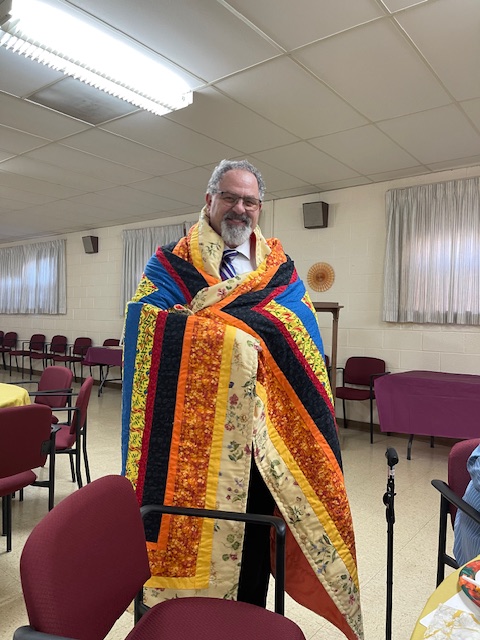
December 8, 2024

Advent Peace: John’s Message of Baptism and Repentance (Luke 3:1–12)

Message preached at Mount View Presbyterian Church in Omaha, NE, December 8, 2024. I thought the message might be a little “heavy” theologically, but I got some positive responses from people about digging deep into the background of the words and phrases.

Welcome to the second Sunday of Advent. May the peace of Christ be with you. [And also with you.] “Peace” is one of the most prominent themes in Scripture. In fact, it is so prominent, I’m pretty sure most of you can tell me what the Hebrew word is for “peace” is: שָׁלוֹם (šā·lôm). This noun is found 232 times in the Hebrew Old Testament, and the New International Version translates it as “peace” or a form of that word over half the time. Other translations of the word in the OT make sense when you think about them, and those translations typically represent one small aspect of the complete concept of “peace”: two of the most common translations are “safe” and “prosper.”

In the New Testament, we find the word for “peace” (εἰρήνη eirēnē) 90 times and at least once in every book except 1 John. In the Old Testament, we do find at times that peace refers to the absence of war or the ceasing of hostilities. But that is a very small part of the way shalom is used in the Bible. In both the Old and New Testaments, peace often means something more like a sense of personal security and safety, a sense of wholeness, or even a lack of need or other strife that may disrupt your life. The phrase “peace be with you” was used by Jesus three times in his post-resurrection appearances to assuage his disciples’ fear of seeing him alive again in John 20. Paul uses it often in his greetings (as do most Middle Eastern cultures): “Grace and peace to you.”

In our Gospel passage today from Luke 3, we see the events leading up to Jesus being revealed to the world as Messiah, the one to come. Luke happens to use the word “peace” three times in the first two chapters to sort of “set the stage” what would be one of his ministries to those who believe. At the end of chapter 1, Luke records Zechariah’s blessing upon the birth of John, who would later be known as John the Baptist:

76 And you, my child, will be called a prophet of the Most High; for you will go on before the Lord to prepare the way for him, to give his people the knowledge of salvation through the forgiveness of their sins,… to shine on those living in darkness and in the shadow of death, to guide our feet into the path of peace.[1]

When Jesus was born and the heavenly host appeared to the shepherds in the nearby fields, they heard this familiar pronouncement: “Glory to God in the highest heaven, and on earth peace to those on whom his favor rests.”[2] Eight days later, Simeon speaks these precious words of blessing when he sees Jesus in the Temple: “Sovereign Lord, as you have promised, you may now dismiss your servant in peace. 30 For my eyes have seen your salvation.”[3]

Before we look at the gospel passage, some of you might know your Bible well enough to know Jesus made a negative statement about peace. Yep, that’s right. I’m not going to gloss over that and pretend it’s not there. But I bring it up because it does have a tie-in to our main passage this morning. In Luke 12:49–51, Jesus says this: “I have come to bring fire on the earth, and how I wish it were already kindled! 50 But I have a baptism to undergo, and what constraint I am under until it is completed! 51 Do you think I came to bring peace on earth? No, I tell you, but division.”[4] What did Jesus mean by this? As you read through the gospels and indeed the rest of the New Testament, you find out that Jesus calls us to live radically different lives from the world around us. He expects us to “troublemakers” of a sort for those who trouble us by imposing legalistic requirements on our faith or compelling us to jump through certain hoops that the Bible knows nothing about to supposedly make us feel “saved” and safe from God’s displeasure or wrath.

John seems have a similar mindset in his gospel, as he doesn’t have Jesus saying anything about peace until after the account of the last Supper in his gospel, that is, until he starts preparing his disciples for his crucifixion. As he’s teaching his disciples about the Holy Spirit, he makes this commitment to them: “Peace I leave with you; my peace I give you. I do not give to you as the world gives. Do not let your hearts be troubled and do not be afraid.”[5] The peace he gives will be the peace the disciples need, because he knows they will face persecution after his resurrection, and they will need every ounce of peace and strength Jesus and the Holy Spirit will provide for them.

Now that we’ve got the preliminaries out of the way, let’s look at our gospel passage, Luke 3. The historical data here helps scholars narrow down the time frame of the beginning of John the Baptist’s ministry to somewhere between September of AD 27 and October of AD 28. This would mean Jesus and John were in their early 30s. We haven’t seen anything of the adult Jesus yet in Luke’s gospel, nor in the other two gospels that relate the parallel accounts of this story. Luke tells us that John’s ministry to “prepare the way for the Lord” is a fulfillment of the prophecy from Isaiah 40:3–5.

This quote from Isaiah is where we get the connection to shalom peace described above. Making a “straight path” to the Lord meant that a new way of relating to God was on the horizon. This is the aspect of shalom that implies there will be no more strife about approaching God. The Law and its use by religious leaders had become a hurdle so burdensome that it would be difficult for the average person to feel any sense of security or safety in their salvation. This new way of relating to God, it required a radical symbol of obedience to symbolize the break with the old and adoption of the new way.

That radical break was John preaching in the wilderness “a baptism of repentance for the forgiveness of sins.” Now baptism was not a new thing for Jews in that day. Gentiles who wanted to convert to Judaism would submit to a ritual bathing, a “baptism,” that was a memorable representation of their cleansing from their pagan ways. But John insisted that even the Jews needed to baptized as a sign of breaking from the legalistic application of the Law and starting anew on the same footing with the Gentiles. The distinction between Jew and Gentile was being put in the rear-view mirror. All people would come to God on the same terms without any bias.

Now I want to give a caveat here: I’m going to talk about baptism here as it was historically practiced in that day, that is, by immersion. In doing so, I want you to know that this is in no way intended to disparage or diminish the importance and significance of whatever baptism you had by whatever mode. I trust you know me well enough by now that I would never do that to you. I’ve shared my own personal journey with you before, that I was baptized by sprinkling as an infant here in this church and when I got older, I chose to be immersed to have my own personal memory of owning my faith. It’s a personal choice we each must make based on our convictions and our tolerance for getting wet. Having said that, if you’ve never been baptized and decide that’s something you want to do at some point, let’s talk. I’ve got connections.

This baptism, and the repentance that must accompany it according to John’s preaching, is the beginning our source of shalom peace, especially as it relates to our wholeness, purity, and security. The word “baptism” is just an English version of the Greek word, βάπτισμα (baptisma; verb: βαπτίζω baptizō), that drops the final vowel. In other words, there was no attempt to translate the meaning of the word, just to adopt the word itself and expect people to understand its meaning. It derives from a shorter Greek word, βάπτω (baptō), which means “to dip.” That word refers to dipping a finger in water or to the bread dipped in the bowl at the Last Supper. The –isma part of baptisma acts like an intensifier, much like the similar sounding ending added to “forte” (f) “loud” to make “fortissimo” (ff) “very loud” in music notation. So “baptism” in that time meant “immersion,” that is, “a complete dip under water.”

As I said above, then, this immersion is intended to represent a complete break with the past for the Jews and the Gentiles, just like the accompanying repentance was meant to be a complete 180° turnaround in thinking about one’s relationship with God. This was the first step in making peace with God: getting back on the straight and narrow path with him. We see John warning the religious leaders, the “brood of vipers” (cf. Matthew 3:7ff), to repent as well. Even the tax collectors want to be baptized, probably because they’re tired of feeling the stigma from the Jews about having such a career. They’re disgusted with themselves and desire perhaps more than anyone else that clean break with their past.

It’s important to notice here the end result of baptism and repentance as Luke and others describe it: “for the forgiveness of sins.” Many scholars debate whether this means the baptism and repentance are necessary for the forgiveness or if that is simply the recognition of our forgiveness of sin apart from the act itself. We don’t need to debate that here, though,[6] because the important part of that is our sins ARE forgiven. This phrase shows up in several other places in Scripture that are worth noting.

The phrase is found in the parallel passage in Mark 1:4, so no big surprise there. It’s found in Matthew’s account of the Last Supper (26:28) with respect to the cup: “This is my blood of the covenant, which is poured out for many for the forgiveness of sins.”[7] Jesus uses the phrase in Luke 24:46–47 when he makes a post-resurrection appearance to his disciples: “This is what is written: The Messiah will suffer and rise from the dead on the third day, 47 and repentance for the forgiveness of sins will be preached in his name to all nations, beginning at Jerusalem.”[8] Finally, we see it in Acts 2:38, connected with baptism and the gift of the Holy Spirit, when Peter concludes his Pentecost sermon: “Repent and be baptized, every one of you, in the name of Jesus Christ for the forgiveness of your sins. And you will receive the gift of the Holy Spirit.”[9] The response of the crowd is the birthday of the church!

Now this is a lot of information but let me pull it together here in one paragraph. In communion, we recognize the blood of Jesus would be and has been shed for the forgiveness our sins. John the Baptist says prophetically that our corresponding response to Jesus’s sacrifice should be repentance and baptism. If we read a little farther down in the gospel accounts, we come to the point where Jesus is baptized and we see the Holy Spirit descending like a dove. That sounds very much like the experience of the apostles and those in the upper room in Acts 2 on the day of Pentecost, which is why Peter can say to the crowd that after they repent and are baptized, they will receive the gift of the Holy Spirit. John the Baptist says it more dramatically: “John answered them all, ‘I baptize you with water. But one who is more powerful than I will come, the straps of whose sandals I am not worthy to untie. He will baptize [that is, immerse] you with the Holy Spirit and fire.’”[10] Finally, in the gospel of John, Jesus lets us know that he’s leaving his peace with us in the person and presence of the Holy Spirit in our lives. The entire gospel story of our salvation and forgiveness is represented by two significant sacraments of the church: our once-in-a-lifetime baptism (or twice for someone like me) and our regular monthly communion. But we also have a daily, or even constant reminder of our salvation with the presence and infilling of the Holy Spirit.

By the time the apostle Paul writes Romans, perhaps within 25 years of the earthly ministry of Jesus, he has processed all this information as well. The first four chapters of Romans represent Paul’s argument about why we need Christ for our salvation and to help us achieve “the obedience of faithfulness” he speaks about. In chapter 5, Paul begins to write about how this impacts the life of the believer in baptism. In 5:1, he writes: “Therefore, since we have been justified through faith, we have peace with God through our Lord Jesus Christ.”[11] Then in chapter 6, he says this about baptism: “Don’t you know that all of us who were baptized into Christ Jesus were baptized into his death? We were therefore buried with him through baptism into death in order that, just as Christ was raised from the dead through the glory of the Father, we too may live a new life.”[12] Baptism, like communion, is another way we encounter the blood of Christ that brings us forgiveness.

In chapter 8, Paul reassures his readers that the roadblocks have been removed, another element of the shalom peace we have with God: “Therefore, there is now no condemnation for those who are in Christ Jesus, because through Christ Jesus the law of the Spirit who gives life has set you free from the law of sin and death.”[13] Finally, in chapter 12, Paul reminds us that because of Christ’s sacrifice for us, we can be living sacrifices for him: “Therefore, I urge you, brothers and sisters, in view of God’s mercy, to offer your bodies as a living sacrifice, holy and pleasing to God—this is your true and proper worship.[14]

God desires to give us peace in abundance, not just in this advent season, but each and every day we walk with him. That peace comes from the blessings he’s bestowed upon us as learn to live out the good works he’s prepared in advance for us to do (Ephesians 2:10). It comes from recognizing the work of the Holy Spirit in our own lives to sanctify us and draw us closer to God. It comes from sharing the good news with others who need to hear it or who want to find a church home they’re comfortable in. And it comes from meeting together in sweet fellowship each and every Sunday as we walk in unison as the body of Christ.

May the peace of God go with you today and always. Amen.


[1] The New International Version. Luke 1:76–77, 79. 2011. Grand Rapids, MI: Zondervan.

[2] The New International Version. Luke 2:14. 2011. Grand Rapids, MI: Zondervan.

[3] The New International Version. Luke 2:29–30. 2011. Grand Rapids, MI: Zondervan.

[4] The New International Version. Luke 12:49–51. 2011. Grand Rapids, MI: Zondervan.

[5] The New International Version. John 14:27. 2011. Grand Rapids, MI: Zondervan.

[6] I have written about this elsewhere in my blog. The Mystery of Immersion (Baptism); Mystery of Immersion (Baptism), Part Two; For the Forgiveness of Sins)

[7] The New International Version. 2011. Matthew 26:28. Grand Rapids, MI: Zondervan.

[8] The New International Version. 2011. Luke 24:46–47; see also Isaiah 2:3. Grand Rapids, MI: Zondervan.

[9] The New International Version. 2011. Acts 2:38. Grand Rapids, MI: Zondervan.

[10] The New International Version. 2011. Luke 3:16. Grand Rapids, MI: Zondervan.

[11] The New International Version. 2011. Romans 5:1. Grand Rapids, MI: Zondervan.

[12] The New International Version. 2011. Romans 6:3–4. Grand Rapids, MI: Zondervan.

[13] The New International Version. 2011. Romans 8:1–2. Grand Rapids, MI: Zondervan.

[14] The New International Version. 2011. Romans 12:1. Grand Rapids, MI: Zondervan.

Pastor Scott Stocking, M.Div.

My views are my own.

December 7, 2024

Advent Hope (Luke 21:25–36)

I presented this message at Mount View Presbyterian Church in Omaha, NE, on December 1, 2024, the first Sunday in Advent.

What comes to mind when you hear the word “hope”?

If they’re motivated to stay off electronic devices for a while, a young girl might say, “I hope I get an American Girl doll for Christmas,” or a tweenage boy might say “I hope I get a remote-control race car.” The parents might say, “I hope we can pay off our credit cards after Christmas.” In the case of the kids, the “hope” that they might get what they asked for is at its core just a wish, but depending on their relationship with the potential gift givers (or promises made by those potential gift givers), their hope may have a firmer foundation than just a wish.

In the case of the parents, that “hope” becomes more of a pledge or commitment to do the hard work to pay off the cards and not so much winning the lottery, and “hoping” that no other major expenses arise that put a roadblock up against that goal.

For those who face more serious problems than what to get or how to pay for Christmas, their hope may take on a whole new dimension. This is very real in my own family situation right now. When the situation is bigger than you can handle on your own and you have little to no control how such help will come to you, “hope” begins to take on aspects of faith. This is similar to the kind of hope Paul ascribes to Abraham in Romans 4:18 when discussing the promise that Abraham would be the father of many nations even though he was old: “Against all hope, Abraham in hope believed and so became the father of many nations, just as it had been said to him, ‘So shall your offspring be.’”

That hope sustained Abraham and the rest of his descendants not only in the long term, but it sustained him when God had asked him to sacrifice his son at Mount Moriah. He did not hesitate, because he knew, as we find out Hebrews 11 later, God could raise Isaac from the dead if that’s what it took to fulfill the promise.

Now you may find it interesting that the noun for “hope” (ἐλπίς elpis) never appears in the gospels. The verb (ἐλπίζω elpizō) only appears three times: once in an Old Testament quotation (Matthew 12:21) and twice in Luke (23:8; 24:21), once in reference to Herod’s hope that Jesus would perform a miracle in front of him, and the other in the disappointment of the disciples on the road to Emmaus about their hope that the recently crucified Jesus (who was walking with them at the time!) would redeem Israel. In fact the concept of “hope” does not really come to the fore until Paul is converted and begins his evangelistic mission to the Gentiles and writing his own letters to the young churches. Equally surprising is that neither the noun nor the verb is found in the book of Revelation, the book that documents our ultimate victory and fulfillment of our eternal hope.

One way to interpret this, I think, is that because the gospels record the life and events of Jesus the Messiah, the Old Testament hope of his coming was realized. They didn’t have to hope any more because he was there! But Jesus’s death and resurrection put new spin on what Jesus’s ministry on earth was really all about. It wasn’t about overthrowing Rome; it was about showing the Jews how God wants to relate to them. The Jews up to that point thought that his first coming was his only coming, and that would be the establishment of the eternal kingdom. But Jesus’s resurrection was not only for the Jews but for all mankind, and so the new hope, the hope of a resurrection into eternity, was what Christ-followers now had to communicate to the Gentiles AND the Jews. Everyone needed to know the message. The book of Revelation emphasizes the role of the Savior, the Lamb of God, in the last days, so again, that is the story of hope realized.

That is one reason why our NT passage today speaks about the end times. But since we just covered that from Mark’s gospel a couple weeks ago, we’ll simply use that as a jumping-off point to talk about the theme of this first Sunday of Advent: Hope.

Hebrews 11:1 says, “Faith is confidence in what we hope for and assurance about what we do not see.” In context, that was referring to Old Testament patriarchs’ trust in the promise that the Messiah would come. Paul says in 1 Corinthians 13:13 that there are three things that will never pass away: “faith, hope, and love.” The question is, then, what is the eternal nature of this “hope” Paul and the other NT writers speak of? I would suggest that there are three main aspects of this hope:

  1. A more immediate hope for Christ-followers that gives them encouragement and strength to face the day-to-day battles.
  2. A hope for the ministry of the church that the gospel message would spread around the world and especially to the Gentiles.
  3. The hope of our final salvation and transformation into our eternal home in heaven.

Let’s take a look at each of these.

We’ve already hinted at the more immediate hope for believers as Paul described Abraham’s hope and faith in Romans 4 above. We see in Romans 12:12 that Paul wants the believers to “be joyful in hope, patient in affliction, faithful in prayer,” activities in the here and now. We also see this toward the end of Romans in 15:13 in a sort of “mini benediction”: “13 May the God of hope fill you with all joy and peace as you trust in him, so that you may overflow with hope by the power of the Holy Spirit.”[1] Paul wants them to know the joy and peace of following Jesus in this life so that hope springs eternal in them.

We see in Ephesians 1:18 that Paul is praying they (and you) might know “the hope to which he has called you,” and he goes on to describe that hope in chapters 4 through 6 of that epistle: “just as you were called to one hope when you were called” (4:4b). In the verses immediately following that passage Paul describes the ways in which can live for Christ and live the Christian life to the fullest. Jesus equips us to minister in our own unique ways. He promises that when we do this, we will move on to maturity, learning what it means to put off the old self and to allow Christ to give us a new heart and a new attitude.

Paul even praises the Thessalonians for their exemplary faith and actions: “19 For what is our hope, our joy, or the crown in which we will glory in the presence of our Lord Jesus when he comes? Is it not you?”[2] The Thessalonians had willingly received and committed themselves to the word of God in spite of the suffering that ensued from their own people. Paul suggests that the Corinthians are in the same boat as the Thessalonians when he says, “And our hope for you is firm, because we know that just as you share in our sufferings, so also you share in our comfort.”[3]

On the second aspect, the ministry of the church, Paul recounts his own experience as he speaks of the hope he and the people of Israel had been waiting for: “This is the promise our twelve tribes are hoping to see fulfilled as they earnestly serve God day and night. King Agrippa, it is because of this hope that these Jews are accusing me.”[4] Paul would go on in that testimony to affirm that Jesus had called him to be a minister to the Gentiles so they would know the hope of the gospel. In Peter’s first letter, he says: “15 But in your hearts revere Christ as Lord. Always be prepared to give an answer to everyone who asks you to give the reason for the hope that you have.”[5] He’s giving instruction there to those who are facing persecution, so that those who hold firm to their faith and do this “with gentleness and respect” might win over their haters and bring them into the fold for Christ.

Paul speaks of this in 1 Corinthians 9:10b as well: “Whoever plows and threshes should be able to do so in the hope of sharing in the harvest.”[6] Paul is talking here about his work as an apostle in taking the gospel to the Corinthians so that they might know the eternal hope of the gospel. Let’s take a look at this third and final aspect of hope, the hope of eternity in our heavenly reward.

In Acts 23:6, we have what is likely the earliest reference of Paul introducing the word “hope” into our Christian vocabulary in the sense of eternal hope. This happens after his arrest for allegedly disrupting Temple protocol. He’s standing there in front of the Sanhedrin as well as Roman soldiers, and Paul distracts the proceedings by bringing up a subject that causes infighting among the members of the Sanhedrin: “Then Paul, knowing that some of them were Sadducees and the others Pharisees, called out in the Sanhedrin, ‘My brothers, I am a Pharisee, descended from Pharisees. I stand on trial because of the hope of the resurrection of the dead.’”[7] Paul indicates here that the reason for his hope is based on the truth of Jesus’s own resurrection from the dead. Paul had perhaps already written his first letter to the Corinthians at this point, in which he says this about the resurrection: “16 For if the dead are not raised, then Christ has not been raised either. 17 And if Christ has not been raised, your faith is futile; you are still in your sins. 18 Then those also who have fallen asleep in Christ are lost. 19 If only for this life we have hope in Christ, we are of all people most to be pitied. 20 But Christ has indeed been raised from the dead, the firstfruits of those who have fallen asleep.”[8]

Paul understood that without the resurrection, there could be no hope of eternal life in heaven. Heaven is a real place, and our new, resurrected bodies will be “spiritual” in the sense that they will be incorruptible (1 Corinthians 15:42–44). This seems to suggest some unique makeup we can’t completely comprehend. Heaven has streets of gold, so we’ll be walking around. The tree of life will bear fruit each month (Revelation 22:2), so I’m guessing we’ll have something to eat.

Galatians 5:5 says, “For through the Spirit we eagerly await by faith the righteousness for which we hope.”[9] Paul emphasizes that in 1 Thessalonians 5:8–9: “But since we belong to the day, let us be sober, putting on faith and love as a breastplate, and the hope of salvation as a helmet. For God did not appoint us to suffer wrath but to receive salvation through our Lord Jesus Christ.”[10] God “predestined” that those of us who believe would receive that eternal reward in heaven. Hold firmly to that promise until the end, as Colossians 1:22–23 says: “22 But now he has reconciled you by Christ’s physical body through death to present you holy in his sight, without blemish and free from accusation—23 if you continue in your faith, established and firm, and do not move from the hope held out in the gospel.”[11]

Paul says in Romans 15:4 that the Old Testament also points us in this same direction, toward eternity with God in heaven: “For everything that was written in the past was written to teach us, so that through the endurance taught in the Scriptures and the encouragement they provide we might have hope.”[12]

Titus 2:11–14 has a powerful summary of the three aspects of hope I’ve presented to you today:

11 For the grace of God has appeared that offers salvation to all people. 12 It teaches us to say “No” to ungodliness and worldly passions, and to live self-controlled, upright and godly lives in this present age, 13 while we wait for the blessed hope—the appearing of the glory of our great God and Savior, Jesus Christ, 14 who gave himself for us to redeem us from all wickedness and to purify for himself a people that are his very own, eager to do what is good.[13]

As we commence with the Advent season, let both remember and share the hope we have in Jesus, not only for our life in the here and now, but in our eternal life in the hereafter. May God bless you and your families and friends this Christmas season. Amen.


[1] The New International Version. 2011. Grand Rapids, MI: Zondervan.

[2] The New International Version. 2011. 1 Thessalonians 2:19. Grand Rapids, MI: Zondervan.

[3] The New International Version. 2011. 2 Corinthians 1:7. Grand Rapids, MI: Zondervan.

[4] The New International Version. 2011. Acts 26:7 Grand Rapids, MI: Zondervan.

[5] The New International Version. 2011. 1 Peter 3:15. Grand Rapids, MI: Zondervan.

[6] The New International Version. 2011. Grand Rapids, MI: Zondervan.

[7] The New International Version. 2011. Grand Rapids, MI: Zondervan.

[8] The New International Version. 2011. 1 Corinthians 15:16-20. Grand Rapids, MI: Zondervan.

[9] The New International Version. 2011. Grand Rapids, MI: Zondervan.

[10] The New International Version. 2011. Grand Rapids, MI: Zondervan.

[11] The New International Version. 2011. Grand Rapids, MI: Zondervan.

[12] The New International Version. 2011. Grand Rapids, MI: Zondervan. (See also Titus 1:2).

[13] The New International Version. 2011. Grand Rapids, MI: Zondervan.

May 13, 2024

A Mother’s Courage (Psalm 1; Exodus 2; 1 Samuel 1–2)

Message preached on May 12, 2024, (Mother’s Day; Ascension Sunday) at Mount View Presbyterian Church, Omaha, NE. Scripture readings for the day were Psalm 1 and Luke 24:44–53 (from Ascension Thursday).

I want to read the first half of Psalm 1 again. As I read those three verses, I’d like you to think about someone you know who might fit that description.

Blessed is the one
who does not walk in step with the wicked

or stand in the way that sinners take
or sit in the company of mockers,

but whose delight is in the law of the Lord,
and who meditates on his law day and night.

That person is like a tree planted by streams of water,
which yields its fruit in season

and whose leaf does not wither—
whatever they do prospers.[1]

One person who fits that bill in my life is my mom, and I’m guessing that might be true for some of you as well. I think I can make a pretty safe bet that some of your kids would say that about each of you as well. You know the sacrifices you’ve made, the labors of love you’ve persevered through, and the happy times you’ve provided to give your children a loving environment in which to grow and thrive. Moms, this day is for you, and this message is for you this morning as well.

I want to look at the courage of three mothers in the Bible who faced some incredibly difficult choices, the mother of Moses; Hannah, the mother of Samuel; and Mary, the mother of Jesus. We don’t have many details about their respective backgrounds or their upbringing, but their stories were important enough to memorialize in Scripture, so they’re worth a closer look.

We read about Moses’s mother in Exodus. Moses’s mother and father were Levites, who after the Exodus would live their lives in service of the Tabernacle and later the Temple. Pharoah had given an order that all the Hebrew newborn boys should be thrown into the Nile, reflecting an ancient, barbaric practice known as “exposure.” Exposure involved abandoning an unwanted child in a remote location and letting the wild animals or nature “take its course.” In Sophocles account of Oedipus Tyrannus, such an abandoned child was maimed intentionally to make them less desirable should they happen to survive or be rescued by a more compassionate soul.

Moses’s mother, of course, was too compassionate and loved her child too much to allow something like that to happen to Moses. Even the Egyptian midwives knew that what they were commanded to do—kill all Hebrew male babies at birth—was morally abhorrent. They conspired to tell Pharaoh that Hebrew women gave birth so quickly they had no time to get to the birthing event. She tried to hide Moses for a few months, but when that became impossible to do, she followed through with Pharoah’s edict, sort of.

She placed Moses in a covered basket coated with tar and pitch so it would float on water. The word for “basket” there is the same word used for Noah’s “Ark,” תֵּבָה (tē·ḇā(h)), so there’s an obvious thematic connection there: God’s deliverance. But Moses’s mother was not interested in seeing her newborn die in the Nile. Moses’s mother knew just where to place the basket so it would float right to the spot where Pharaoh’s daughter would bathe and find him. Moses’s mother took an incredible chance at this point, a chance that one of Pharaoh’s soldier could have found the basket first and killed Moses on the spot; maybe even a chance that the crocodiles, if there were any around, would get to him first.[2] She let her child float down the river, under the watchful eye of Moses’s older sister, until Pharaoh’s daughter would find him. In case you’re wondering, yes, the Nile does have crocodiles, but it’s not clear whether they were common in this part of the Nile. I’m guessing not if it was the royal bathing site.

Most of us know the rest of the story. Pharaoh’s daughter rescued Moses from the river, and Moses’s sister was brave enough to approach her to offer the services of his mother as a wet nurse, so she got paid to do her motherly duty! Moses would eventually grow up to be educated in all the wisdom and knowledge of Egypt, making him the perfect “rebel” to lead his people out of Egypt to the Promised Land. Moses’s mother’s incredible courage to keep him alive against the wishes of a tyrant led the most significant event in early Hebrew history, the Exodus of the Hebrews from Egypt.

From the time of the Exodus and entry into the Promised Land, we jump forward a few hundred years to the end of the period of the Judges. In 1 Samuel, we’re introduced to the family of Elkanah. He is an Ephraimite with two wives: Peninnah and Hannah. Elkanah had children with Peninnah, but Hannah had had no such luck, and in that culture, barrenness was the worst form of shame for a married woman. We learn in the story that Peninnah taunts Hannah relentlessly because she is barren, amplifying the shame Hannah felt. But Elkanah was acutely aware of Hannah’s shame and her desire to have a child, even giving her a double portion of the sacrificial meat after the sacrifice.

At one of these sacrificial meals in Shiloh, Hannah got up and went to pray for a child at “the Lord’s house.” Eli the priest noticed that as she prayed and wept, her lips were moving but he couldn’t hear her voice. He thought she was drunk. Hannah explained that she was in anguish, and it probably didn’t take Eli too long to figure out why, and instead of continuing to chide her for what he thought was a drunken display, he blessed her: “Go in peace, and may the God of Israel grant you what you have asked of him.”

We’re not sure of the timeline after that, but it would seem that it happened within the next year, Hannah gave birth to a son and named him “Heard by God,” which in Hebrew is Samuel. Out of her joy, Hannah agreed to dedicate Samuel to the work of the Lord when he was old enough to be weaned, and Eli took him under his wing. Hannah continued to look after Samuel every year, bringing him a new robe at each visit. Hannah was blessed with two more sons and two daughters as well.

Samuel turned out to be a shining light of integrity as a “surrogate” son in the family business of leading in the Tabernacle, especially since Eli’s own two sons were little better than scoundrels. Samuel would be instrumental in the transition from the period where Israel was led by judges to the monarchy and appointment of Saul and then David as kings of Israel. Given the character of most of the judges up through Samuel, it’s difficult to say what would have happened had Samuel, a man after God’s own heart himself, had not come on the scene when Israel went through its transition. We can thank Hannah’s courage and her fervent prayers for the birth and life of Samuel and his faithful work guiding the early monarchs of Israel into its Golden Age.

Hannah’s prayer (1 Samuel 2) after dedicating Samuel to the Lord may sound familiar to some of you. Listen to her prayer and see if doesn’t sound similar to a prayer of another mother who came on the scene about 1,000 years later:

“My heart rejoices in the Lord;

in the Lord my horn u is lifted high.

My mouth boasts over my enemies,

for I delight in your deliverance.

“There is no one holy like the Lord;

there is no one besides you;

there is no Rock like our God.

“Do not keep talking so proudly

or let your mouth speak such arrogance,

for the Lord is a God who knows,

and by him deeds are weighed.

“The bows of the warriors are broken,

but those who stumbled are armed with strength.

Those who were full hire themselves out for food,

but those who were hungry are hungry no more.

She who was barren has borne seven children,

but she who has had many sons pines away.

“The Lord brings death and makes alive;

he brings down to the grave and raises up.

The Lord sends poverty and wealth;

he humbles and he exalts.

He raises the poor from the dust

and lifts the needy from the ash heap;

he seats them with princes

and has them inherit a throne of honor.

“For the foundations of the earth are the Lord’s;

on them he has set the world.

He will guard the feet of his faithful servants,

but the wicked will be silenced in the place of darkness.

“It is not by strength that one prevails;

10   those who oppose the Lord will be broken.

The Most High will thunder from heaven;

the Lord will judge the ends of the earth.

“He will give strength to his king

and exalt the horn of his anointed.” [3]

Of course, that mother was Mary, the mother of Jesus, and her Magnificat that Luke records in chapter 1 seems to pick up on many of the themes Hannah had highlighted in her own prayer.

In spite of their very similar songs of praise to God, they had quite different circumstances in their lives when their firstborns came along. Hannah was in a committed marriage relationship. It’s not clear why she was one of two wives. If I had to make an educated guess, I’d say Hannah may have been the wife of one of Elkanah’s brothers who passed away, and through the custom of the Levirate marriage, Elkanah would have been obligated to “marry” his brother’s widow and through that marriage provide an heir for his brother, her late husband. You’ll notice that the story doesn’t make any moral judgments about the arrangement. This could explain Hannah’s earnest and seemingly anxious desire to have a son.

Mary, on the other hand, was most likely too young to have thought of herself as barren, especially since she had not formally tied the knot with Joseph at the time she learns she is pregnant with Jesus. She wasn’t asking God for children when the Gospel writers introduce us to her. In fact, having any children was certainly not “top-of-mind” for her. She is shocked but does not respond with disbelief at God’s promise to her. Even though Joseph shows concern for ending the relationship for both their sakes, so he thinks, to save face, Mary cannot escape the fact that an archangel of the Lord had revealed God’s purpose and promise to her, so she presses forward all the while anticipating what was to come.

We don’t hear anything in the Gospel accounts of Mary and Joseph during Mary’s pregnancy until we get to the birth of Jesus in the stable. Luke picks up the story just as they are headed out from Nazareth to his ancestral home in Bethlehem, even though Mary is obviously in the last month of her pregnancy. She and Joseph persevere through the most unlikely place for a baby to be born: an animal stable instead of their comfortable home back in Nazareth. But that night, the shepherds in the nearby fields found out from a heavenly host that the savior has been born, and they hurry to see him that very night in his humble digs.

But her journey is far from over. Luke tells us Jesus was presented on the eighth day at the temple and receives the two blessings from Anna and Simeon, which must have hit her hard, especially the part about causing the rising and falling of many. Matthew tells us that on the heels of that dedication that “magi” from the East come to worship him and bestow him with gifts, gold, frankincense, and myrrh. I’m guessing that gold would have come in handy when God warned them to flee even further from Nazareth, into Egypt, because Herod, like Pharaoh of old, had ordered all babies under two years old to be killed. They were able to return to Nazareth a few years later.

It must have been quite the challenge for Mary to watch Jesus grow up, I mean, he was the son of God. What kind of behavior would you expect from a kid who had all the fulness of deity dwelling in him? We know from the gospel accounts that Mary never seems to be too far away from Jesus throughout his ministry. Of all the people who knew Jesus and associated with him closely, Mary would have been the one to truly understand his mission, especially when he started talking about his impending death. She may not have wanted to understand, but she couldn’t deny that she did, and yet she faced each day with and for him.

Mary is the only one of the three mothers we’ve looked at this morning to see what happens to her son at the end of his life on earth. Yet her incredible sorrow and anguish at witnessing his crucifixion was transformed to inexpressible joy when she encountered him risen from the dead. I’m not sure that Mary would have picked up on Jesus hinting at his own resurrection, even after finding out Jesus had called forth the recently deceased Lazarus from the tomb.

These three mothers, whose sons had significant ministries and a crucial mission for their own times, exemplified the kind of faith and courage that earn them the designation of Psalm 1:3: “She is like a tree planted by streams of water, which yields its fruit in season and whose leaf does not wither—whatever she does prospers.”

Today, let us give thanks to God for the faithfulness of mothers who stood by us and with us as we were growing and maturing. We give thanks to you who are faithful mothers who even today give comfort and encouragement to your adult kids and to your grandkids. And let us give thanks for and encourage younger mothers as they face their own unique challenges in raising the next generation. May the peace and love of God be with you all. Amen.


[1] The New International Version. 2011. Grand Rapids, MI: Zondervan.

[2] It does seem odd that crocodiles aren’t mentioned in this story. Perhaps Pharaoh had a “Croc Patrol” to keep the river clear of them where royalty used it for bathing.

[3] The New International Version. 2011. Grand Rapids, MI: Zondervan.

« Previous PageNext Page »

Website Powered by WordPress.com.