Sunday Morning Greek Blog

December 14, 2025

Advent Joy: Jesus Breaks the Power of Sin and Suffering (Matthew 11:2–11; Isaiah 35:4–6)

Good morning! The Lord be with you!

As you know, today is the third Sunday of Advent, where we focus on the Joy for what Christ brings to our lives. I’m sure most of you know that there’s a difference between joy and happiness. Happiness comes from the things that happen around us. The word comes to us through the Middle English word hap, which in that time meant luck, fortune, fate, or one’s lot in life. The word had either a positive sense (“good fortune”) or a negative sense (“hard times” or a “hard lot” in life) depending on context. In modern English, of course, it’s been entirely infused with the positive meaning “happy as a lark.” It may be more of a surface feeling as well. It’s a feeling that can come and go depending on life’s circumstances.

Joy, on the other hand, is happiness on steroids if you will, at least according to Merriam-Webster. Their dictionary defines it as “a feeling of great happiness or pleasure; delight”; “a state of great happiness”; and “a source or cause of delight.” It comes from a Latin word that means “rejoice.” No surprise there. It does imply something much deeper than happiness, as the definitions suggest, something intangible, something you can’t quite put your finger on.

I experienced this feeling of joy recently, and I’d like to share it with you. Jill’s daughter Rebecca moved in with us almost three years ago when she was struggling trying to find her way in the COVID mess. Within about a year, she managed to land a job working for the Hilton Hotel downtown scheduling reservations for large events at the hotel or downtown. As it turned out, she found her niche. This past year, one of her biggest projects was working with teams and large fan groups coming for the College World Series. She was feeling the success.

In the meantime, she also rekindled her love for singing and performing by auditioning for and joining the River City Mixed Chorus, the largest chorus of its kind in the Omaha area. Last Saturday they had their annual Christmas/Holiday concert at the Holland. After the concert I paid attention to how family and friends of the chorus were excited about the evening. That really touched me to witness that. The evening was extra special in that Rebecca found out just before the concert that her bid on a house was accepted. That was the icing on the cake for the evening.

As you might imagine, when Jill and I first got together 12 years ago, it was a bit of a rough go for me and for her two teenage girls at the time. But as a man of God, I was determined to prove my mettle and stay the course by showing them just how much I loved their mom and how willing I was to support her girls in their various pursuits. Today, I have a great relationship with her grown-up and fully employed daughters. I told Rebecca last Saturday night how proud I was of her success, and I got choked up trying to get the words out of my mouth. To me, that was true joy. I felt in my heart, and I could see it in Rebecca as well. For me, that was a real moment of joy.

In our gospel passage this morning, Jesus’s cousin John the Baptizer was looking for a “sign” or a reason to be joyful in the midst of his struggles in prison. He already knew Jesus was the Messiah but he still, apparently, didn’t understand what that would look like. He sent his own messengers to ask Jesus if he was the Messiah, and Jesus’s answer did not disappoint. John may have had the same expectation others had about the Messiah when he came, that he would overthrow Roman rule and restore the theocracy.

But when Jesus offers up the “evidence” that he wants John’s disciples to take back to John, none of it has to do with political power. It has to do with restoring joy and hope to oppressed people or those gravely impacted by life’s circumstances. Think about the emotional reaction of the people who benefited from Jesus’s ministry.

The blind receive their sight: Imagine not being able to see anything, then all of the sudden one day, Jesus shows up in your town and gives you back your sight. This would be more than just a “happy” moment: you would be filled with joy to discover all that you’ve been missing: the blue sky; the beauty of the human form; the colors of flowers and birds; and so forth. You would be leaping for joy! Our neighbor when we lived in Aksarben had a color-blind son. A company called Pilestone developed a series of lenses that allow color-blind people to better distinguish colors, and he happened to get the glasses. His mom posted a video of him experiencing the vividness of color for the first time wearing these glasses. That was truly a joyful moment for that young man and his family.

How about the lame walking? A few chapters earlier in Matthew, we see Jesus tell a lame man that his sins are forgiven, and to prove that he has the power to forgive sins, Jesus also heals the man and tells him to pick up his bed and walk away free of his disability. Not only was the man overjoyed, but the text in Matthew 9 indicates “the crowd was filled with awe; and they praised God, who had given such authority to man.” We see this early in the book of Acts as well, when the apostles effectuate God’s healing: Peter speaks healing to a lame beggar in Acts 3, and the man “jumped to his feet and began to walk. Then he went with them into the temple courts, walking and jumping, and praising God.”[1]

Jesus had healed 10 people with leprosy at one point. The Bible commanded that people healed of leprosy show themselves to the priest to be declared clean. The 10 did that, but for whatever reason, only one was joyful enough to return to Jesus and give him thanks. This story is certainly relevant today: how many of us miss out on joy by failing to realize or acknowledge that God himself is the source of that joy. Even joy, though it tends to affect us deeper in our souls and lasts longer, can fade if we don’t recognize the everlasting joy we can have from our heavenly father.

The deaf hear. Just like the blind man; being able to experience any of your senses for the first time as an adult. Imagine being able to hear and understand words you’ve only experienced by sight on a page. Think about that for a minute: if you were completely deaf and suddenly could hear someone speaking for the first time, how would know what sounds go with each letter? If you can read lips, that might help you make the connection. That challenge would pale, I think, when compared next to the joy of hearing again.

The dead are raised. Lazarus wasn’t the only dead person Jesus brought back to life. He also raised Jairus’s daughter. I’ve come close to experiencing that several times in the past few years. My friend Jim contracted hepatitis at a family Thanksgiving meal a few years ago and his liver began to fail. He had gotten to the point where he was asking me to do his funeral. But something divine happened to him to change his mind about getting a liver transplant, and he’s still with us today. My sister Lindee recovered from her complicated liver issues after a liver transplant as well this year. She still has a couple challenges left to navigate, but she’s well on the road to full recovery. Another Jim who’s a good friend was at death’s door in the first year of COVID. His wife had talked to me about funeral arrangements. But he’s recovered now and still leads our men’s group study today. I and the families of these friends are glad to still have them around. Each in their own way represents what joy is all about.

The final thing Jesus mentions to John’s disciples is that the good news, the gospel, is preached to the poor. All these things are a direct reference to the Messianic prophecy in Isaiah 35:4–6:

Strengthen the feeble hands,

steady the knees that give way;

say to those with fearful hearts,

“Be strong, do not fear;

your God will come,

he will come with vengeance;

with divine retribution

he will come to save you.”

Then will the eyes of the blind be opened

and the ears of the deaf unstopped.

Then will the lame leap like a deer,

and the mute tongue shout for joy.

Water will gush forth in the wilderness

and streams in the desert. [2]

John the Baptist understood why Jesus responded the way he did. The passage from Isaiah is the precursor to the messianic sections of Isaiah that speak of a suffering servant. John was beginning to understand what Jesus certainly already did: Jesus would ultimately die for the sins of the whole human race. Jesus didn’t come to break the power of Rome. He came to break the power of a corrupted religion that enslaved people to a legalistic, punitive view of God. The power of religious leadership was in holding this threat of the judgment of God over the heads of the people.

But Jesus turned that on its head. John realized that Jesus came so people could have their sins forgiven, not to be judged for them. The “vengeance” Isaiah speaks of is not against all mankind generally, but against those who had corrupted the message of the Bible. God loves us. That was Jesus’s message as well. But not only that God loves \us, but that God wants us to spend eternity with him in a glorified state. He wants us to experience true healing and true joy for all eternity.

In the last part of our gospel passage this morning, Jesus asks the crowd about John the Baptist: why did you come out to see him? What did you expect? The answer was straightforward. John the Baptist wasn’t a sharp-dressed man who gave pep talks. He was the one who preceded Jesus to prepare the way for him. He was the first prophet in 400 years, except instead of prophesying to and about the kings of Judah and Israel, he was prophesying about the Pharisees and the Sadducees. The people flocked to him because John had the courage to stand up to them and tell them what many Jews to that time had been harboring in their hearts: “Your ways, O Pharisees, sap our strength and rob us of hope. Someone is coming who has a much better way than yours.”

Let me flip this question around and ask it in the context of our world today, December 14, 2025. Many people come to church at Christmas (and Easter) that don’t come to church regularly. What are they looking for when they come to church? Being with family may be part of that, but are they perhaps coming because they want to hear that message of hope and joy for themselves? Are they coming because they think Jesus as a baby and the whole manger scene is cute and not in the least bit threatening? Or are they coming because they want to experience awesome, transformative power of forgiveness from a risen Savior who has conquered death? Are they coming out of a sense of obligation, or are they coming because they want to experience a vibrant and encouraging fellowship with other Christ-followers? The Christmas season isn’t the only time of the year where we consider why and how Jesus came to dwell among us. Many Christians look for that weekly and practice that weekly year-round. Why? Because they find a continuous source of joy, help, hope, and strength in their church communities.

This Christmas season, reach out to those who need to know and experience the fellowship of the body of Christ. Let us go forth from here and be beacons of hope and light. May God richly bless you this Christmas season, and merry Christmas to all! Amen.


[1] The New International Version. 2011. Grand Rapids, MI: Zondervan.

[2] The New International Version. 2011. Grand Rapids, MI: Zondervan.

My views are my own.

Scott Stocking

November 23, 2025

The Reign of Christ the King (Luke 23:33–43; Colossians 1)

I preached this sermon at Mount View Presbyterian Church on November 23, 2025. It was the last Sunday of Year C of the Lectionary Calendar, commonly known as Reign of Christ the King Sunday. It was also the Sunday before Thanksgiving and the Sunday before the first Sunday in Advent. I had not checked the advanced copy of the church bulletin thinking they would have the Lectionary gospel reading for the day printed, but as it turned out, they had a Thanksgiving Service planned (more music), so I hadn’t prepared a message based on the reading. I went ahead preached the message I had prepared, which worked out find, because with more music, the service was a little longer than usual, and my message had been shorter than usual. I’ve also included some links to past Advent messages since the season is upon us.

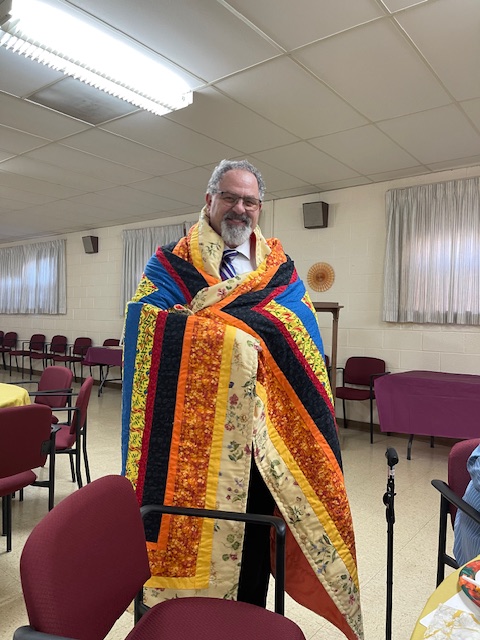
We had a soup lunch afterwards and had a drawing to give away a few of the quilts our ladies had made. I won what I’m calling my Joseph Quilt. It is a nice sized quilt worked on by several of the ladies. My mom provided the stitching/decoration around the border.

Have you ever seen one of those movies where they start with some dramatic scene. In the cop shows, it’s usually a murder or finding someone badly injured in an unexpected place. In a Hallmark movie, it might be a wedding scene or a passionate kiss (we all know that’s coming in the Hallmark movie, so no need to put it off until the end!). But then in the next scene, the graphic pops up: “Six months earlier.” The opening scene has gone by so quickly that you didn’t even get a chance to figure out much about who the characters are, then you’re thrust back in time and have to figure it out all over again.

Today we come to the conclusion of the liturgical calendar: “Reign of Christ the King” Day. It’s hard to believe Advent (and the new liturgical year) starts next week. The Lectionary is kind of like those movies I mentioned earlier. Even though we read about the crucifixion of Jesus this morning, we’re not going to get back to that dramatic event of the Resurrection that kicked off the last eight months of the calendar until Easter next year.

This past year, we’ve journeyed through the gospel of Luke, which has the most material on the life of Jesus. Five months ago, we read in Luke 9:51 that Jesus “resolutely set out for Jerusalem.” The rest of Luke’s gospel from that point on is set in that context of Jesus knowing his life would be cut short. Yet he continued loving, healing, and teaching the masses about God’s true love for them. He also did not shy away from confronting the religious leaders of his day for their abuse of the spiritual authority God had entrusted to them. That violation of God’s trust brings us to where we are today in the gospel, the crucifixion.

Luke has details in this story that the other three gospel writers do not have. Luke is the only one who has Jesus saying “Father, forgive them, for they do not know what they are doing.” He wasn’t just talking about how the Roman soldiers were treating him either. Matthew and Mark tell us that the criminals who were crucified with Jesus were BOTH hurling insults at him, but Luke indicates that one of them must have had a change of heart after hearing Jesus say “Father forgive them” and asked Jesus for forgiveness in his last hour. Jesus, of course, granted it.

The religious leaders were jeering and sneering at him as well. “He saved others, or so he claims! Let him save himself if he’s the Messiah!” One might expect that kind of behavior from criminals, but from those who had presumably dedicated their lives to serving God at the Temple or in the local synagogues? You know you must be getting close to the corruption and hardness of heart when the people who should be on your side are rejecting you for your teachings.

Even though our gospel reading stops just short of the final moments of the crucifixion, we are all familiar enough with that story to finish it from memory. And we know that because Christ defeated death and rose again into his heavenly glory, he lives and reigns as King of Kings and Lord of Lords. While his kingdom is here on earth, it is not of this world. Paul says in Ephesians 1:3 that God has “blessed us [i.e., Christ followers] in the heavenly realms with every spiritual blessing in Christ. It was evident from the moment of Pentecost that God had begun a new work in his people through the empowering of the Holy Spirit sent to us by our risen Savior.

As Christ followers, then, we are by default emissaries of the King of Kings and Lord of Lords. In the rest of the New Testament we see Paul and the other apostles planting and shepherding churches that are growing by leaps and bounds in various places. In many cases, the word of God has already spread to places where Paul had yet to travel because other believers were doing that missionary work as well. In the first chapter of Paul’s letter to the Colossians, we get a glimpse at Paul’s heart for them in the first chapter. Paul praises them for having a faith that is “bearing fruit and growing” in their hearts and around the world. Let’s pick up his praise for them in verse 9:

For this reason, since the day we heard about you, we have not stopped praying for you. We continually ask God to fill you with the knowledge of his will through all the wisdom and understanding that the Spirit gives, t 10 so that you may live a life worthy of the Lord and please him in every way: bearing fruit in every good work, growing in the knowledge of God, 11 being strengthened with all power according to his glorious might so that you may have great endurance and patience, 12 and giving joyful thanks to the Father, who has qualified you to share in the inheritance of his holy people in the kingdom of light. 13 For he has rescued us from the dominion of darkness and brought us into the kingdom of the Son he loves, 14 in whom we have redemption, the forgiveness of sins. [1]

Paul has incredible respect for the Colossians and wants to ensure they continue on the path of growing in righteousness and faithfulness. This is significant in that Colossae was an incredibly diverse town in south-central Asia Minor. He wants them to be filled “with the knowledge of his will through all the wisdom and understanding that the Spirit gives.” Paul has a similar thought for the Ephesians in the opening of that letter: “18 I pray that the eyes of your heart may be enlightened in order that you may know the hope to which he has called you, the riches of his glorious inheritance in his holy people, 19 and his incomparably great power for us who believe.”[2]

In Colossians 1:6, Paul affirms that the gospel is “bearing fruit and growing through the whole world. He reassures the Colossians are doing their small part to contribute to that in vs. 10.

Being strengthened in all power means that they understand the working of the Holy Spirit in their lives. They do have some challenges, apparently, with some coming among them making “fine sounding arguments” against the gospel. But Paul has confidence that their knowledge will help them discern false teachings and stay the course of the true gospel with patient endurance.

They are also continually giving thanks because they’ve been rescued from darkness. They believed the gospel and have been living it out boldly because they know they’ve been forgiven and redeemed.

After praising them, Paul continues from verse 15 talking about the supremacy of Christ and why he reigns as King of Kings and Lord of Lords:

15 The Son is the image of the invisible God, the firstborn over all creation. 16 For in him all things were created: things in heaven and on earth, visible and invisible, whether thrones or powers or rulers or authorities; all things have been created through him and for him. 17 He is before all things, and in him all things hold together. 18 And he is the head of the body, the church; he is the beginning and the firstborn from among the dead, so that in everything he might have the supremacy. 19 For God was pleased to have all his fullness dwell in him, 20 and through him to reconcile to himself all things, whether things on earth or things in heaven, by making peace through his blood, shed on the cross. [3]

The concept of Jesus being the “firstborn” here seems to have a dual meaning. In verse 15, Paul says Jesus is the firstborn over all creation. That seems to suggest what we learn from John, that Jesus, the light of the world, was the “light” that God created on Day One of creation. A few verses later, in verse 18, Paul calls Jesus “the beginning,” which would seem to confirm the Genesis theory, but the then also calls Jesus “firstborn from the dead.” John also uses the phrase “firstborn from the dead” of Jesus in the opening chapter of Revelation (1:5). This of course is a reference to his resurrection.

Even though there are a few others in the history of the Bible who were raised from the dead, they all came back to life in their original human bodies. Jesus is the first one whose body was raised from the dead AND transfigured into its heavenly version. That earns him the title of head of the church—King of Kings and Lord of Lords—having supremacy over everything. This supremacy is not only for this world, but in the heavenly realms as well as Paul indicates.

Harkening back to Ephesians 3:10, we see that we have a role in proclaiming the gospel not only here but also in the heavenly realms. “10 His intent was that now, through the church, the manifold wisdom of God should be made known to the rulers and authorities in the heavenly realms.”[4] The passage in Ephesians 6 on the armor of God reaffirms our role in fighting the good fight not only against flesh and blood, but against the powers in the heavenly realms. We have the divine protection and strength to stand firm in those battles because of Christ’s victory over death and the redemption he won for us. Not only does he reign as King of Kings and Lord of Lords in our lives, but he has also provided the means for us to walk faithfully in this world.

As we wrap up the liturgical year and look toward Advent and the Christmas season, we can take comfort and courage in having citizenship in the kingdom of Christ. A blessed Thanksgiving to all of you this week, and please join us for the meal after service. Amen.

Advent Hope | Sunday Morning Greek Blog

Advent Love (Luke 1:39–55; 1 Samuel 2:1–10) | Sunday Morning Greek Blog

Advent Peace: John’s Message of Baptism and Repentance (Luke 3:1–12) | Sunday Morning Greek Blog

Waiting for the Messiah…Again (Matthew 24:36–44) | Sunday Morning Greek Blog


[1] The New International Version. 2011. Grand Rapids, MI: Zondervan.

[2] The New International Version. 2011. Grand Rapids, MI: Zondervan.

[3] The New International Version. 2011. Grand Rapids, MI: Zondervan.

[4] The New International Version. 2011. Grand Rapids, MI: Zondervan.

December 29, 2024

Advent Love (Luke 1:39–55; 1 Samuel 2:1–10)

Message preached at Mount View Presbyterian Church on December 22, 2024, fourth Sunday in Advent.

Welcome to the fourth Sunday in Advent. May the Lord be with you. [And also with you.] As we mentioned in the Advent Candle ceremony, we’ve already explored the other three themes of this holy season: Hope in the salvation we have in Jesus and his return to bring us to his eternal home; the Peace that comes from living a life united with the Savior; and the Joy of the fellowship we have with one another.

Today, we look at the final theme of Advent, Love. God’s love is the foundation that supports and sustains our Hope, our Peace, and our Joy. God’s love also enables us to love one another, and this love binds us together as a congregation and allows us to be a powerful witness in the community, the city, and the world.

It is God’s love, then, that makes us a family, children of God and brothers and sisters in Christ and members of the body of Christ. It should not surprise us then that God chooses to keep the revelation of his son within one extended family as well. We looked at John the Baptist a couple weeks ago, whose mother, Elizabeth, was Mary’s “relative.” John’s conception was a bit of a mystery as well. When another older couple in the Bible, Abraham and Sarah, had a baby, we’re told that Abraham “had relations” with Sarah and she conceived. In Luke’s gospel, we’re never told that Zechariah had relations with Elizabeth. Was John’s conception a miracle as well? It wouldn’t have been “immaculate” like Jesus’s was, as Elizabeth certainly wasn’t a virgin at her age. But she had been barren. Makes you go “Hmmm.” I’ll save the rest of my speculation for a blog article.

We don’t know exactly what the relationship was between Mary and Elizabeth. Given the age difference, one might suspect Elizabeth was her aunt. Regardless, the end result was that Jesus and John the Baptist likely grew up together, so John was a first-hand witness to Jesus’s early life and could vouch for Jesus’s character and perhaps even his divine nature.

In our Gospel passage today, we read about Mary going to see Elizabeth when they both are pregnant. Elizabeth was already six months along (Luke 1:26, 36). We see that even in the womb, John the would-be Baptist understood that Mary was pregnant with the Son of God. Elizabeth knew as well, as she called Mary “the mother of my Lord.” On the one hand, our rational minds might say John could not possibly have any memory of that encounter. But on the other hand, we might also say that John had an innate. Elijah-esque spiritual insight into who Jesus was.

It would seem that Mary had gone to help Elizabeth with her pregnancy. We know Elizabeth was six months along, and at the end of our passage this morning, we find out Mary stayed with her for about three months. It doesn’t take too much speculation to assume Mary was there for the birth of John. If John leapt in Elizabeth’s womb when pregnant Mary arrived, can you imagine what it must have been like while they were that close to each other for three months? How anxious was he to be born? Did Mary get a chance to hold John close to her pregnant belly so he could hear the early stages of Jesus’s beating heart in her womb?

I know a lot of $20 theological words, but I can’t think of any that might describe an innate spiritual connection of two sons of different mothers still in the womb. It would have been very interesting to see John and Jesus together as children. They would have had a connection stronger than twins!

The family connection and family dynamic between Jesus and John is made quite obvious in the early chapters of the Gospels. It’s almost certain that Elizabeth would have told John the story of how he leapt in her womb upon “meeting” Jesus for the first time. Mary probably didn’t have to tell Jesus whose son he really was. Jesus seems to have already figured that out by the age of 12, as he gets separated from his earthly parents. I have to wonder if John in the entourage that had traveled to Jerusalem for the Passover when Jesus found himself talking with the teachers of the law at the steps of the temple.

Jesus knew the temple was his Father’s house. Which meant it was also his “inheritance.” His to honor. His to defend the integrity of. His to ensure the freedom of entry and access to all peoples. Of course, we find out in Acts after his resurrection that his followers would no longer be restricted to the temple to worship. His followers themselves would be the temple of God. All the more reason for Jesus to love the church and pay the ultimate price for its salvation and longevity.

Before I dive into discussing Mary’s Magnificat, I want to remind you of another miraculous birth story of sorts; miraculous because it was the answer to one woman’s earnest prayers for a child. Her name was Hannah, and we read about her in the beginning of a book that bears her son’s name, 1 Samuel. She wanted a son so badly that she pledged her firstborn to be dedicated to the Lord’s service for life. After Samuel was born and weaned, she turned him over to the care and training of Eli, the father of two of the priests at Shiloh. Samuel would grow up a Nazarite, like Samson, but he would remain faithful to the end. He oversaw the transition of Israel from a theocracy to a monarchy and was responsible for appointing and anointing David as King of Israel after the people’s choice, Saul, failed miserably.

Samuel’s complete story is also for another time. The reason I mention this story is that, along with Hannah offering up her son to Eli’s care, she also offers up a prayer of thanksgiving that is most likely the model for Mary’s Magnificat. Here’s what she says in 1 Samuel 2:1–10 and see if you hear the parallels to Mary’s song and to a certain extent, Zechariah’s song at the end of Luke 1:

“My heart rejoices in the Lord; in the Lord my horn is lifted high.

My mouth boasts over my enemies, for I delight in your deliverance.

“There is no one holy like the Lord; there is no one besides you; there is no Rock like our God.

“Do not keep talking so proudly or let your mouth speak such arrogance,

For the Lord is a God who knows, and by him deeds are weighed.

“The bows of the warriors are broken, but those who stumbled are armed with strength.

Those who were full hire themselves out for food, but those who were hungry are hungry no more.

She who was barren has borne seven children, but she who has had many sons pines away.

“The Lord brings death and makes alive; he brings down to the grave and raises up.

The Lord sends poverty and wealth; he humbles and he exalts.

He raises the poor from the dust and lifts the needy from the ash heap;

He seats them with princes and has them inherit a throne of honor.

“For the foundations of the earth are the Lord’s; on them he has set the world.

He will guard the feet of his faithful servants, but the wicked will be silenced in the place of darkness.

“It is not by strength that one prevails; 10 those who oppose the Lord will be broken.

The Most High will thunder from heaven; the Lord will judge the ends of the earth.

“He will give strength to his king and exalt the horn of his anointed.”

It’s pretty easy to see the parallels between the two texts. They speak of personal and political victories over enemies; relief for the poor and oppressed, and the Lord’s sovereignty and power in the heavens and on earth.

Getting back to the Mary and Elizabeth story again, we can see there is something mighty that happens when a family follows the Lord and supports each other in prayer and service. Although these events we’re reading about seem to have a little more historical significance than anything you or I may have done or ever do, we should not let that discourage us from rejoicing with family and praising God for the birth of our precious children. It is nearly impossible to trace the influence and the domino effect of what we do and how that may impact the future. You only have to watch “It’s a Wonderful Life” to see a fictional portrayal of how one man influenced his small home town for the good of all.

We can of course always pray for our families and especially our children, that they might know the blessings of the Lord and the rewards and support of connecting with a faith community. We can pray for our young children that they would be protected from the negative and unhealthy influences that increasingly show up in ads and content on social media apps and sites and even in some kids’ television shows and educational materials. We can pray for opportunities to show mercy and compassion to those who need help and support in times of great need. We can and have been praying for loved ones facing serious illness or end-of-life issues and be there for them with emotional, material, and prayerful support. I can speak from personal experience that in this time when I’ve been praying for my sister Lindee that I have sensed the presence of the Lord more deeply and that my faith has been strengthened even more.

As the body of Christ here at Mount View, our own church family, you have done great things to the extent of your ability, providing help and comfort with gifts and offerings of quilts, food, and clothing items dedicated to those in need. God has truly blessed this congregation as you continue to reach out and draw closer to him and to each other through your ministry.

For those here who haven’t been to church in a while, I would like to encourage you to consider finding a congregation that is a good fit for you and your family situation. Of course, we’d love to have you here every Sunday. But if you don’t live around here or you’re looking for a different style of worship, churches are like each of us: unique in their makeup, their ministry, and their demographic. I can guarantee you that if you look with an open heart and mind, you will find a congregation that’s a good fit for you. But also remember that the church is made up of imperfect people, so no church is perfect. But they might be a little more perfect if you get involved. Think about that for a minute, hmm?

Jesus was born to show us the way back to God. Those of us here believe the church, whether it be Mount View or somewhere else, is the way to find and remain connected to God and Christ-followers. I pray that all of you will have a blessed Christmas season and that in some way, big or small, you will experience the hope, peace, joy, and love of Christ and his family of believers. Amen.

My opinions are my own.

Scott Stocking

December 8, 2024

Advent Peace: John’s Message of Baptism and Repentance (Luke 3:1–12)

Message preached at Mount View Presbyterian Church in Omaha, NE, December 8, 2024. I thought the message might be a little “heavy” theologically, but I got some positive responses from people about digging deep into the background of the words and phrases.

Welcome to the second Sunday of Advent. May the peace of Christ be with you. [And also with you.] “Peace” is one of the most prominent themes in Scripture. In fact, it is so prominent, I’m pretty sure most of you can tell me what the Hebrew word is for “peace” is: שָׁלוֹם (šā·lôm). This noun is found 232 times in the Hebrew Old Testament, and the New International Version translates it as “peace” or a form of that word over half the time. Other translations of the word in the OT make sense when you think about them, and those translations typically represent one small aspect of the complete concept of “peace”: two of the most common translations are “safe” and “prosper.”

In the New Testament, we find the word for “peace” (εἰρήνη eirēnē) 90 times and at least once in every book except 1 John. In the Old Testament, we do find at times that peace refers to the absence of war or the ceasing of hostilities. But that is a very small part of the way shalom is used in the Bible. In both the Old and New Testaments, peace often means something more like a sense of personal security and safety, a sense of wholeness, or even a lack of need or other strife that may disrupt your life. The phrase “peace be with you” was used by Jesus three times in his post-resurrection appearances to assuage his disciples’ fear of seeing him alive again in John 20. Paul uses it often in his greetings (as do most Middle Eastern cultures): “Grace and peace to you.”

In our Gospel passage today from Luke 3, we see the events leading up to Jesus being revealed to the world as Messiah, the one to come. Luke happens to use the word “peace” three times in the first two chapters to sort of “set the stage” what would be one of his ministries to those who believe. At the end of chapter 1, Luke records Zechariah’s blessing upon the birth of John, who would later be known as John the Baptist:

76 And you, my child, will be called a prophet of the Most High; for you will go on before the Lord to prepare the way for him, to give his people the knowledge of salvation through the forgiveness of their sins,… to shine on those living in darkness and in the shadow of death, to guide our feet into the path of peace.[1]

When Jesus was born and the heavenly host appeared to the shepherds in the nearby fields, they heard this familiar pronouncement: “Glory to God in the highest heaven, and on earth peace to those on whom his favor rests.”[2] Eight days later, Simeon speaks these precious words of blessing when he sees Jesus in the Temple: “Sovereign Lord, as you have promised, you may now dismiss your servant in peace. 30 For my eyes have seen your salvation.”[3]

Before we look at the gospel passage, some of you might know your Bible well enough to know Jesus made a negative statement about peace. Yep, that’s right. I’m not going to gloss over that and pretend it’s not there. But I bring it up because it does have a tie-in to our main passage this morning. In Luke 12:49–51, Jesus says this: “I have come to bring fire on the earth, and how I wish it were already kindled! 50 But I have a baptism to undergo, and what constraint I am under until it is completed! 51 Do you think I came to bring peace on earth? No, I tell you, but division.”[4] What did Jesus mean by this? As you read through the gospels and indeed the rest of the New Testament, you find out that Jesus calls us to live radically different lives from the world around us. He expects us to “troublemakers” of a sort for those who trouble us by imposing legalistic requirements on our faith or compelling us to jump through certain hoops that the Bible knows nothing about to supposedly make us feel “saved” and safe from God’s displeasure or wrath.

John seems have a similar mindset in his gospel, as he doesn’t have Jesus saying anything about peace until after the account of the last Supper in his gospel, that is, until he starts preparing his disciples for his crucifixion. As he’s teaching his disciples about the Holy Spirit, he makes this commitment to them: “Peace I leave with you; my peace I give you. I do not give to you as the world gives. Do not let your hearts be troubled and do not be afraid.”[5] The peace he gives will be the peace the disciples need, because he knows they will face persecution after his resurrection, and they will need every ounce of peace and strength Jesus and the Holy Spirit will provide for them.

Now that we’ve got the preliminaries out of the way, let’s look at our gospel passage, Luke 3. The historical data here helps scholars narrow down the time frame of the beginning of John the Baptist’s ministry to somewhere between September of AD 27 and October of AD 28. This would mean Jesus and John were in their early 30s. We haven’t seen anything of the adult Jesus yet in Luke’s gospel, nor in the other two gospels that relate the parallel accounts of this story. Luke tells us that John’s ministry to “prepare the way for the Lord” is a fulfillment of the prophecy from Isaiah 40:3–5.

This quote from Isaiah is where we get the connection to shalom peace described above. Making a “straight path” to the Lord meant that a new way of relating to God was on the horizon. This is the aspect of shalom that implies there will be no more strife about approaching God. The Law and its use by religious leaders had become a hurdle so burdensome that it would be difficult for the average person to feel any sense of security or safety in their salvation. This new way of relating to God, it required a radical symbol of obedience to symbolize the break with the old and adoption of the new way.

That radical break was John preaching in the wilderness “a baptism of repentance for the forgiveness of sins.” Now baptism was not a new thing for Jews in that day. Gentiles who wanted to convert to Judaism would submit to a ritual bathing, a “baptism,” that was a memorable representation of their cleansing from their pagan ways. But John insisted that even the Jews needed to baptized as a sign of breaking from the legalistic application of the Law and starting anew on the same footing with the Gentiles. The distinction between Jew and Gentile was being put in the rear-view mirror. All people would come to God on the same terms without any bias.

Now I want to give a caveat here: I’m going to talk about baptism here as it was historically practiced in that day, that is, by immersion. In doing so, I want you to know that this is in no way intended to disparage or diminish the importance and significance of whatever baptism you had by whatever mode. I trust you know me well enough by now that I would never do that to you. I’ve shared my own personal journey with you before, that I was baptized by sprinkling as an infant here in this church and when I got older, I chose to be immersed to have my own personal memory of owning my faith. It’s a personal choice we each must make based on our convictions and our tolerance for getting wet. Having said that, if you’ve never been baptized and decide that’s something you want to do at some point, let’s talk. I’ve got connections.

This baptism, and the repentance that must accompany it according to John’s preaching, is the beginning our source of shalom peace, especially as it relates to our wholeness, purity, and security. The word “baptism” is just an English version of the Greek word, βάπτισμα (baptisma; verb: βαπτίζω baptizō), that drops the final vowel. In other words, there was no attempt to translate the meaning of the word, just to adopt the word itself and expect people to understand its meaning. It derives from a shorter Greek word, βάπτω (baptō), which means “to dip.” That word refers to dipping a finger in water or to the bread dipped in the bowl at the Last Supper. The –isma part of baptisma acts like an intensifier, much like the similar sounding ending added to “forte” (f) “loud” to make “fortissimo” (ff) “very loud” in music notation. So “baptism” in that time meant “immersion,” that is, “a complete dip under water.”

As I said above, then, this immersion is intended to represent a complete break with the past for the Jews and the Gentiles, just like the accompanying repentance was meant to be a complete 180° turnaround in thinking about one’s relationship with God. This was the first step in making peace with God: getting back on the straight and narrow path with him. We see John warning the religious leaders, the “brood of vipers” (cf. Matthew 3:7ff), to repent as well. Even the tax collectors want to be baptized, probably because they’re tired of feeling the stigma from the Jews about having such a career. They’re disgusted with themselves and desire perhaps more than anyone else that clean break with their past.

It’s important to notice here the end result of baptism and repentance as Luke and others describe it: “for the forgiveness of sins.” Many scholars debate whether this means the baptism and repentance are necessary for the forgiveness or if that is simply the recognition of our forgiveness of sin apart from the act itself. We don’t need to debate that here, though,[6] because the important part of that is our sins ARE forgiven. This phrase shows up in several other places in Scripture that are worth noting.

The phrase is found in the parallel passage in Mark 1:4, so no big surprise there. It’s found in Matthew’s account of the Last Supper (26:28) with respect to the cup: “This is my blood of the covenant, which is poured out for many for the forgiveness of sins.”[7] Jesus uses the phrase in Luke 24:46–47 when he makes a post-resurrection appearance to his disciples: “This is what is written: The Messiah will suffer and rise from the dead on the third day, 47 and repentance for the forgiveness of sins will be preached in his name to all nations, beginning at Jerusalem.”[8] Finally, we see it in Acts 2:38, connected with baptism and the gift of the Holy Spirit, when Peter concludes his Pentecost sermon: “Repent and be baptized, every one of you, in the name of Jesus Christ for the forgiveness of your sins. And you will receive the gift of the Holy Spirit.”[9] The response of the crowd is the birthday of the church!

Now this is a lot of information but let me pull it together here in one paragraph. In communion, we recognize the blood of Jesus would be and has been shed for the forgiveness our sins. John the Baptist says prophetically that our corresponding response to Jesus’s sacrifice should be repentance and baptism. If we read a little farther down in the gospel accounts, we come to the point where Jesus is baptized and we see the Holy Spirit descending like a dove. That sounds very much like the experience of the apostles and those in the upper room in Acts 2 on the day of Pentecost, which is why Peter can say to the crowd that after they repent and are baptized, they will receive the gift of the Holy Spirit. John the Baptist says it more dramatically: “John answered them all, ‘I baptize you with water. But one who is more powerful than I will come, the straps of whose sandals I am not worthy to untie. He will baptize [that is, immerse] you with the Holy Spirit and fire.’”[10] Finally, in the gospel of John, Jesus lets us know that he’s leaving his peace with us in the person and presence of the Holy Spirit in our lives. The entire gospel story of our salvation and forgiveness is represented by two significant sacraments of the church: our once-in-a-lifetime baptism (or twice for someone like me) and our regular monthly communion. But we also have a daily, or even constant reminder of our salvation with the presence and infilling of the Holy Spirit.

By the time the apostle Paul writes Romans, perhaps within 25 years of the earthly ministry of Jesus, he has processed all this information as well. The first four chapters of Romans represent Paul’s argument about why we need Christ for our salvation and to help us achieve “the obedience of faithfulness” he speaks about. In chapter 5, Paul begins to write about how this impacts the life of the believer in baptism. In 5:1, he writes: “Therefore, since we have been justified through faith, we have peace with God through our Lord Jesus Christ.”[11] Then in chapter 6, he says this about baptism: “Don’t you know that all of us who were baptized into Christ Jesus were baptized into his death? We were therefore buried with him through baptism into death in order that, just as Christ was raised from the dead through the glory of the Father, we too may live a new life.”[12] Baptism, like communion, is another way we encounter the blood of Christ that brings us forgiveness.

In chapter 8, Paul reassures his readers that the roadblocks have been removed, another element of the shalom peace we have with God: “Therefore, there is now no condemnation for those who are in Christ Jesus, because through Christ Jesus the law of the Spirit who gives life has set you free from the law of sin and death.”[13] Finally, in chapter 12, Paul reminds us that because of Christ’s sacrifice for us, we can be living sacrifices for him: “Therefore, I urge you, brothers and sisters, in view of God’s mercy, to offer your bodies as a living sacrifice, holy and pleasing to God—this is your true and proper worship.[14]

God desires to give us peace in abundance, not just in this advent season, but each and every day we walk with him. That peace comes from the blessings he’s bestowed upon us as learn to live out the good works he’s prepared in advance for us to do (Ephesians 2:10). It comes from recognizing the work of the Holy Spirit in our own lives to sanctify us and draw us closer to God. It comes from sharing the good news with others who need to hear it or who want to find a church home they’re comfortable in. And it comes from meeting together in sweet fellowship each and every Sunday as we walk in unison as the body of Christ.

May the peace of God go with you today and always. Amen.


[1] The New International Version. Luke 1:76–77, 79. 2011. Grand Rapids, MI: Zondervan.

[2] The New International Version. Luke 2:14. 2011. Grand Rapids, MI: Zondervan.

[3] The New International Version. Luke 2:29–30. 2011. Grand Rapids, MI: Zondervan.

[4] The New International Version. Luke 12:49–51. 2011. Grand Rapids, MI: Zondervan.

[5] The New International Version. John 14:27. 2011. Grand Rapids, MI: Zondervan.

[6] I have written about this elsewhere in my blog. The Mystery of Immersion (Baptism); Mystery of Immersion (Baptism), Part Two; For the Forgiveness of Sins)

[7] The New International Version. 2011. Matthew 26:28. Grand Rapids, MI: Zondervan.

[8] The New International Version. 2011. Luke 24:46–47; see also Isaiah 2:3. Grand Rapids, MI: Zondervan.

[9] The New International Version. 2011. Acts 2:38. Grand Rapids, MI: Zondervan.

[10] The New International Version. 2011. Luke 3:16. Grand Rapids, MI: Zondervan.

[11] The New International Version. 2011. Romans 5:1. Grand Rapids, MI: Zondervan.

[12] The New International Version. 2011. Romans 6:3–4. Grand Rapids, MI: Zondervan.

[13] The New International Version. 2011. Romans 8:1–2. Grand Rapids, MI: Zondervan.

[14] The New International Version. 2011. Romans 12:1. Grand Rapids, MI: Zondervan.

Scott Stocking. My views are my own.

December 7, 2024

Advent Hope

I presented this message at Mount View Presbyterian Church in Omaha, NE, on December 1, 2024, the first Sunday in Advent.

What comes to mind when you hear the word “hope”?

If they’re motivated to stay off electronic devices for a while, a young girl might say, “I hope I get an American Girl doll for Christmas,” or a tweenage boy might say “I hope I get a remote-control race car.” The parents might say, “I hope we can pay off our credit cards after Christmas.” In the case of the kids, the “hope” that they might get what they asked for is at its core just a wish, but depending on their relationship with the potential gift givers (or promises made by those potential gift givers), their hope may have a firmer foundation than just a wish.

In the case of the parents, that “hope” becomes more of a pledge or commitment to do the hard work to pay off the cards and not so much winning the lottery, and “hoping” that no other major expenses arise that put a roadblock up against that goal.

For those who face more serious problems than what to get or how to pay for Christmas, their hope may take on a whole new dimension. This is very real in my own family situation right now. When the situation is bigger than you can handle on your own and you have little to no control how such help will come to you, “hope” begins to take on aspects of faith. This is similar to the kind of hope Paul ascribes to Abraham in Romans 4:18 when discussing the promise that Abraham would be the father of many nations even though he was old: “Against all hope, Abraham in hope believed and so became the father of many nations, just as it had been said to him, ‘So shall your offspring be.’”

That hope sustained Abraham and the rest of his descendants not only in the long term, but it sustained him when God had asked him to sacrifice his son at Mount Moriah. He did not hesitate, because he knew, as we find out Hebrews 11 later, God could raise Isaac from the dead if that’s what it took to fulfill the promise.

Now you may find it interesting that the noun for “hope” (ἐλπίς elpis) never appears in the gospels. The verb (ἐλπίζω elpizō) only appears three times: once in an Old Testament quotation (Matthew 12:21) and twice in Luke (23:8; 24:21), once in reference to Herod’s hope that Jesus would perform a miracle in front of him, and the other in the disappointment of the disciples on the road to Emmaus about their hope that the recently crucified Jesus (who was walking with them at the time!) would redeem Israel. In fact the concept of “hope” does not really come to the fore until Paul is converted and begins his evangelistic mission to the Gentiles and writing his own letters to the young churches. Equally surprising is that neither the noun nor the verb is found in the book of Revelation, the book that documents our ultimate victory and fulfillment of our eternal hope.

One way to interpret this, I think, is that because the gospels record the life and events of Jesus the Messiah, the Old Testament hope of his coming was realized. They didn’t have to hope any more because he was there! But Jesus’s death and resurrection put new spin on what Jesus’s ministry on earth was really all about. It wasn’t about overthrowing Rome; it was about showing the Jews how God wants to relate to them. The Jews up to that point thought that his first coming was his only coming, and that would be the establishment of the eternal kingdom. But Jesus’s resurrection was not only for the Jews but for all mankind, and so the new hope, the hope of a resurrection into eternity, was what Christ-followers now had to communicate to the Gentiles AND the Jews. Everyone needed to know the message. The book of Revelation emphasizes the role of the Savior, the Lamb of God, in the last days, so again, that is the story of hope realized.

That is one reason why our NT passage today speaks about the end times. But since we just covered that from Mark’s gospel a couple weeks ago, we’ll simply use that as a jumping-off point to talk about the theme of this first Sunday of Advent: Hope.

Hebrews 11:1 says, “Faith is confidence in what we hope for and assurance about what we do not see.” In context, that was referring to Old Testament patriarchs’ trust in the promise that the Messiah would come. Paul says in 1 Corinthians 13:13 that there are three things that will never pass away: “faith, hope, and love.” The question is, then, what is the eternal nature of this “hope” Paul and the other NT writers speak of? I would suggest that there are three main aspects of this hope:

  1. A more immediate hope for Christ-followers that gives them encouragement and strength to face the day-to-day battles.
  2. A hope for the ministry of the church that the gospel message would spread around the world and especially to the Gentiles.
  3. The hope of our final salvation and transformation into our eternal home in heaven.

Let’s take a look at each of these.

We’ve already hinted at the more immediate hope for believers as Paul described Abraham’s hope and faith in Romans 4 above. We see in Romans 12:12 that Paul wants the believers to “be joyful in hope, patient in affliction, faithful in prayer,” activities in the here and now. We also see this toward the end of Romans in 15:13 in a sort of “mini benediction”: “13 May the God of hope fill you with all joy and peace as you trust in him, so that you may overflow with hope by the power of the Holy Spirit.”[1] Paul wants them to know the joy and peace of following Jesus in this life so that hope springs eternal in them.

We see in Ephesians 1:18 that Paul is praying they (and you) might know “the hope to which he has called you,” and he goes on to describe that hope in chapters 4 through 6 of that epistle: “just as you were called to one hope when you were called” (4:4b). In the verses immediately following that passage Paul describes the ways in which can live for Christ and live the Christian life to the fullest. Jesus equips us to minister in our own unique ways. He promises that when we do this, we will move on to maturity, learning what it means to put off the old self and to allow Christ to give us a new heart and a new attitude.

Paul even praises the Thessalonians for their exemplary faith and actions: “19 For what is our hope, our joy, or the crown in which we will glory in the presence of our Lord Jesus when he comes? Is it not you?”[2] The Thessalonians had willingly received and committed themselves to the word of God in spite of the suffering that ensued from their own people. Paul suggests that the Corinthians are in the same boat as the Thessalonians when he says, “And our hope for you is firm, because we know that just as you share in our sufferings, so also you share in our comfort.”[3]

On the second aspect, the ministry of the church, Paul recounts his own experience as he speaks of the hope he and the people of Israel had been waiting for: “This is the promise our twelve tribes are hoping to see fulfilled as they earnestly serve God day and night. King Agrippa, it is because of this hope that these Jews are accusing me.”[4] Paul would go on in that testimony to affirm that Jesus had called him to be a minister to the Gentiles so they would know the hope of the gospel. In Peter’s first letter, he says: “15 But in your hearts revere Christ as Lord. Always be prepared to give an answer to everyone who asks you to give the reason for the hope that you have.”[5] He’s giving instruction there to those who are facing persecution, so that those who hold firm to their faith and do this “with gentleness and respect” might win over their haters and bring them into the fold for Christ.

Paul speaks of this in 1 Corinthians 9:10b as well: “Whoever plows and threshes should be able to do so in the hope of sharing in the harvest.”[6] Paul is talking here about his work as an apostle in taking the gospel to the Corinthians so that they might know the eternal hope of the gospel. Let’s take a look at this third and final aspect of hope, the hope of eternity in our heavenly reward.

In Acts 23:6, we have what is likely the earliest reference of Paul introducing the word “hope” into our Christian vocabulary in the sense of eternal hope. This happens after his arrest for allegedly disrupting Temple protocol. He’s standing there in front of the Sanhedrin as well as Roman soldiers, and Paul distracts the proceedings by bringing up a subject that causes infighting among the members of the Sanhedrin: “Then Paul, knowing that some of them were Sadducees and the others Pharisees, called out in the Sanhedrin, ‘My brothers, I am a Pharisee, descended from Pharisees. I stand on trial because of the hope of the resurrection of the dead.’”[7] Paul indicates here that the reason for his hope is based on the truth of Jesus’s own resurrection from the dead. Paul had perhaps already written his first letter to the Corinthians at this point, in which he says this about the resurrection: “16 For if the dead are not raised, then Christ has not been raised either. 17 And if Christ has not been raised, your faith is futile; you are still in your sins. 18 Then those also who have fallen asleep in Christ are lost. 19 If only for this life we have hope in Christ, we are of all people most to be pitied. 20 But Christ has indeed been raised from the dead, the firstfruits of those who have fallen asleep.”[8]

Paul understood that without the resurrection, there could be no hope of eternal life in heaven. Heaven is a real place, and our new, resurrected bodies will be “spiritual” in the sense that they will be incorruptible (1 Corinthians 15:42–44). This seems to suggest some unique makeup we can’t completely comprehend. Heaven has streets of gold, so we’ll be walking around. The tree of life will bear fruit each month (Revelation 22:2), so I’m guessing we’ll have something to eat.

Galatians 5:5 says, “For through the Spirit we eagerly await by faith the righteousness for which we hope.”[9] Paul emphasizes that in 1 Thessalonians 5:8–9: “But since we belong to the day, let us be sober, putting on faith and love as a breastplate, and the hope of salvation as a helmet. For God did not appoint us to suffer wrath but to receive salvation through our Lord Jesus Christ.”[10] God “predestined” that those of us who believe would receive that eternal reward in heaven. Hold firmly to that promise until the end, as Colossians 1:22–23 says: “22 But now he has reconciled you by Christ’s physical body through death to present you holy in his sight, without blemish and free from accusation—23 if you continue in your faith, established and firm, and do not move from the hope held out in the gospel.”[11]

Paul says in Romans 15:4 that the Old Testament also points us in this same direction, toward eternity with God in heaven: “For everything that was written in the past was written to teach us, so that through the endurance taught in the Scriptures and the encouragement they provide we might have hope.”[12]

Titus 2:11–14 has a powerful summary of the three aspects of hope I’ve presented to you today:

11 For the grace of God has appeared that offers salvation to all people. 12 It teaches us to say “No” to ungodliness and worldly passions, and to live self-controlled, upright and godly lives in this present age, 13 while we wait for the blessed hope—the appearing of the glory of our great God and Savior, Jesus Christ, 14 who gave himself for us to redeem us from all wickedness and to purify for himself a people that are his very own, eager to do what is good.[13]

As we commence with the Advent season, let both remember and share the hope we have in Jesus, not only for our life in the here and now, but in our eternal life in the hereafter. May God bless you and your families and friends this Christmas season. Amen.


[1] The New International Version. 2011. Grand Rapids, MI: Zondervan.

[2] The New International Version. 2011. 1 Thessalonians 2:19. Grand Rapids, MI: Zondervan.

[3] The New International Version. 2011. 2 Corinthians 1:7. Grand Rapids, MI: Zondervan.

[4] The New International Version. 2011. Acts 26:7 Grand Rapids, MI: Zondervan.

[5] The New International Version. 2011. 1 Peter 3:15. Grand Rapids, MI: Zondervan.

[6] The New International Version. 2011. Grand Rapids, MI: Zondervan.

[7] The New International Version. 2011. Grand Rapids, MI: Zondervan.

[8] The New International Version. 2011. 1 Corinthians 15:16-20. Grand Rapids, MI: Zondervan.

[9] The New International Version. 2011. Grand Rapids, MI: Zondervan.

[10] The New International Version. 2011. Grand Rapids, MI: Zondervan.

[11] The New International Version. 2011. Grand Rapids, MI: Zondervan.

[12] The New International Version. 2011. Grand Rapids, MI: Zondervan. (See also Titus 1:2).

[13] The New International Version. 2011. Grand Rapids, MI: Zondervan.

March 4, 2023

Life Lessons From a Year Through the Lectionary (Isaiah 58–61)

Background

I’m in the midst of a few weeks off from preaching, so I’ve had some time to reflect on the past 14 months of preaching through the Lectionary/Liturgical Calendar[1] at the behest of my childhood home church, Mt. View Presbyterian in Omaha. At the beginning of 2022, they had asked me to follow the Revised Common Lectionary, because that makes it easy for their small church to plan out bulletins and coordinate with other guest preachers.

It’s kind of like being back in seminary, having a different assignment due every two weeks or so, and because I’m not afraid of any challenge when it comes to preaching the Bible, I wholeheartedly agreed. I will admit as well that it’s beneficial to me, because I don’t have to think about topics in advance. Lincoln (IL) Christian Seminary taught me some great skills when it comes to hermeneutics (the science of interpretation) and homiletics (the skills for preaching), so I already know how to go through the motions to prepare.

Although I was raised in the Presbyterian faith and went through my church’s confirmation process, not much of that stuck as a sixth grader (or however old I was at the time). By the time I got to high school, I had begun to form my own ideas about my faith, and I started to look for something that was grounded more directly in Scripture and less reliant on the “traditions of men.” I found that home in the Restoration Movement (independent Christian Church) when I went to college.

The Restoration Movement traces its roots to the frontier Midwest (Kentucky, Pennsylvania, Ohio areas) where a group of preachers decided the best way to “do” church was to primarily stick to what the Bible said and not make manmade creeds or religious rules a test of faith or fidelity. “No creed but Christ; no book but the Bible”; “Where Scripture speaks, we speak; where they are silent there’s freedom” or “we’re silent.” Accordingly, things like the Liturgical Calendar or traditional Holy Days were downplayed, unless there was biblical precedent (e.g., the birth of Christ announced by angels). Historically, we’ve operated under the principle that the operations of God’s grace are not dictated by the Liturgical Calendar or any other calendar.

The operations of God’s grace are not dictated by the Liturgical Calendar or any other calendar.

While I still generally operate under that principle, I have come to discover the biblical underpinnings of many of the Holy Days or Seasons. In addition to that, I have come to see how important some of these traditions are to the Mt. View congregation as currently constituted. I have been refreshed and uplifted in my faith in God and my knowledge of his word by the work I’ve had to do to prepare messages based on the Lectionary readings for a particular Sunday. As such, I want to take the opportunity of this article to share what I’ve discovered about some of the lesser-known Holy Days and Seasons, at least among those in the Restoration Movement tradition, and perhaps encourage my brothers and sisters in the Restoration Movement to consider a more intentional approach to them.

Advent: Preparing for the Coming Messiah

As with most things, it’s best to start at the beginning, so I want to take a look at Advent first. The Lectionary cycles through three years (Years A, B, and C) of readings, and Advent marks the beginning of the new liturgical year.[2] As you might imagine, Advent is the most familiar to me. I have fond memories of getting the Advent calendars with chocolate or other goodies in them (maybe even a Bible verse?) and especially of lighting the Advent candles in church service with my family. I know our family got to do it at least one Advent Sunday when I was growing up.

What I had forgotten was that each Sunday in Advent had its own special theme. This may vary among the traditions, but the four common themes are usually Hope, Peace, Joy, and Love. For Advent 2022 (Year A of the new cycle), the OT passages focused on Isaiah.[3] What I find interesting is that many of these passages could have dual fulfillment, referring both to the first coming of the Messiah and the second coming of the Messiah. For example, Isaiah 2:3 (Year A, first Sunday) mentions going to the temple where God will teach his ways, while 2:4 speaks of beating swords into plowshares, which is typically associated with the second coming.

Isaiah 11:1–2 (second Sunday) speaks of Jesus as the one upon whom the Spirit of the Lord will rest, while 11:4 says “He will strike the earth with the rod of his mouth.” Isaiah 35 (third Sunday) appears to reference much of Jesus’s healing ministry, but vs. 4 speaks God coming with vengeance. Isaiah 7:14 (fourth Sunday) is the prophecy Matthew quotes about the virgin birth of Christ, even though it has a partial fulfillment in the immediate chapters of Isaiah following that. Isaiah 9 (“For unto us a Child is born”) is the annual passage for Christmas Eve service.

It’s easy to see, then, why many of the Jews at the time of Jesus’s ministry were looking for a Messiah that would overthrow Roman rule. This led me to an important realization: God’s people have never lived in a time where they had no expectation of a coming Messiah, except perhaps for those who were close to the Messiah during his earthly ministry. Even though scholars are fairly certain that Jesus was not born in the month of December, the celebration of Advent along with Christmas not only as a retrospective on Jesus’s birth and first coming and all the heavenly fanfare that went along with that, but also as a prospective look at the second coming of Christ is still highly relevant to Christians today, especially in our current culture and climate.

God’s people have never lived in a time where they had no expectation of a coming Messiah.

Epiphany

I recently posted my Epiphany message, A Pastor’s Epiphany About Epiphany (Matthew 2:1–12; Isaiah 60:1–6; Psalm 72), so I won’t say too much about that here. The title pretty much sums it up. Epiphany focuses on the visit of the magi to Jesus, which, if you read the Gospel account closely, seems to come a few days after the birth of Christ (historically 12 days after, but there’s no biblical text to suggest that time frame); Jesus’s family was in a house by that time. Focusing on the Isaiah passage here, which is the same every year in the Lectionary, reveals some interesting clues to where the magi came from.

As I was preparing the Epiphany message, I realized that I’d never really heard anyone in the Restoration Movement talk about where these magi had come from. That seemed pretty odd to me given that we’re supposed to focus on examining the Scriptures to figure out the truth. I’d heard about David Longnecker’s Mystery of the Magi in a news report. The book gives a detailed analysis of where these magi may have lived and what their connection was to Jewish history and prophecy. As it turns out, these magi were probably not from Persia, because Persia was in decline at the time. Rather, they were probably from some diaspora Jews that never made it to Babylon and settled in communities east of the Jordan river and Dead Sea, and perhaps as far south as Midian. They were known as Nabateans. They would have had a more intimate knowledge of Messianic prophecy and seem to fit the demographic and economic descriptions in the Isaiah 60 passage, as I explain in my message. Isaiah 60:1 may refer to the star they followed; they were at the crossroads of several prominent trade routes; and “Nebaioth” is mentioned, which may well be the root of the name of the Nabateans.

If there’s any application to this knowledge, I think it’s that we need to learn to recognize the signs of the times to anticipate the second coming of Christ, which ties in to the secondary theme of Advent. The Nabateans appear to have been diligently searching the skies and paying attention to the signs, because they did not want to miss the coming of the Messiah they had hoped for as well.

“Jesus would probably laugh at us for giving up things like chocolate, beer, coffee…all the things that actually bring us joy and make us happy.”

Lent

In the past couple weeks since Lent began, I’ve had one friend ask whether I observe Ash Wednesday, and another ask me what I thought about a Facebook post about one person’s unique take on Lent. Here’s a quote cited in the post from a priest he’d heard:

“Jesus would probably laugh at us for giving up things like chocolate, beer, coffee…all the things that actually bring us joy and make us happy.

What He might suggest is giving up the things that make us miserable in God’s Paradise.

Things like self doubt, insecurities, jealousy, greed, and gossip and anger.

The things that move us away from The Light.

Honor His sacrifice by giving up The Darkness in your Life.”

Now I’ve never given up anything for Lent, because I don’t observe it. And I’ve never had ashes placed on my forehead to initiate a Lenten fast. But I thought what this priest he’s quoting said made a lot of sense. But here’s where my initial principle comes into play: the operation of God’s grace isn’t limited to a calendar or a season. Shouldn’t we always be giving up the darkness in our lives so we can more fully know God? That’s a good way to live to be sure, and I commend anyone who can do that, but if it’s something we should give up permanently, then is it really a fast? Is it really a sacrifice to give up something that’s bad for us?

Before I even looked at the Lectionary for what passage is assigned for Lent, I knew Isaiah 58 was really the best definition of fasting we have in the Bible. As it turns out, that is the evergreen passage for Lent. The problem as I see it with concept of Lent as a personal fast is that it is somewhat self-centered. Sure, the presumed motivation is to get closer to God, but how does giving up a food item or certain activity actually accomplish that? And again, if it’s something that you know is bad for you anyway, why do you need the backdrop of a religious Holy Season to accomplish it?

If we look at Isaiah’s description of fasting, though, there’s really nothing selfish about how it should be. There’s no talk of personal sacrifice or personal wellbeing. In fact, Isaiah (58:5) scolds his readers for thinking of fasting in just such a way:

5 Is this the kind of fast I have chosen,

only a day for people to humble themselves?

Is it only for bowing one’s head like a reed

and for lying in sackcloth and ashes?

Is that what you call a fast,

a day acceptable to the Lord?[4]

Isaiah then goes on to describe what the Lord expects from our fasting, and there’s nothing selfish about it, except that when we do the hard things, then we have a reward waiting for us. What are the hard things (vv. 6–7, 9b–10a)?

  • Loose the chains of injustice
  • Untie the cords of the yoke
  • Set the oppressed free and satisfy their needs
  • Break every yoke
  • Share your food with the hungry by spending yourself on their behalf
  • Provide the poor wanderer with shelter
  • Clothe the naked
  • Not turn away from our own flesh and blood
  • Do away with the blame game and malicious talk

What are the resulting rewards? They’re commensurate with the degree to which we work toward accomplishing the hard stuff! This isn’t legalism, though. This is what it means to show our faith by what we do, not just by what we say. We talk the talk AND walk the walk. Integrity.

  • Your light will break forth like the dawn
  • Your healing will appear quickly
  • Your righteousness will go before you
  • The glory of the LORD will be your rear guard
  • You will call, and the LORD will answer
  • You will cry for help, and he will be there for you
  • Your light will rise in the darkness, like the noonday sun
  • The LORD will always guide you, satisfy you, and strengthen you.

And so on and so on and so on.

In the Old Testament, most references to fasting are about a community fasting, not individuals. When it occurs in the books of pre-exilic history, it often refers to a prebattle ritual. David fasted for his first child with Bathsheba, but to no avail. In the post-exilic history, fasting is mentioned in connection with restoring Jerusalem to a semblance of its pre-exilic state (e.g., compare Isaiah 58:12 to Isaiah 61:4). In the New Testament, most references to fasting are about what to do when you fast. There’s very little mention of its purpose, although the reference to John’s disciples fasting most likely indicates they were waiting for the Messiah.

In the Old Testament, most references to fasting are about a community fasting, not individuals.

Above, I made a parenthetical reference to Isaiah 61 with respect to rebuilding ancient ruins. Nehemiah fasted before taking on the project to rebuild the walls of Jerusalem. But do you know what else is significant about Isaiah 61? That is the passage Jesus uses for his own ministry in Luke’s account, immediately after Jesus spends 40 days fasting in the wilderness. His words sound very much like the purpose of fasting in Isaiah 58. Jesus fasted for 40 days in the wilderness because he knew he had big things, Isaiah 58 big things, to accomplish in his ministry, so he did it right. Check out Isaiah 61:1–3a and see if that doesn’t sound a lot like Isaiah 58:

The Spirit of the Sovereign Lord is on me,

because the Lord has anointed me

to proclaim good news to the poor.

He has sent me to bind up the brokenhearted,

to proclaim freedom for the captives

and release from darkness for the prisoners,

to proclaim the year of the Lord’s favor

and the day of vengeance of our God,

to comfort all who mourn,

3           and provide for those who grieve in Zion—

to bestow on them a crown of beauty instead of ashes,

the oil of joy instead of mourning,

and a garment of praise instead of a spirit of despair.[5]

So fasting is for the big things; the big decisions. The Gospels do hint that fasting had taken on a more individual application in some cases, but I don’t think its purpose, as outlined in Isaiah 58, was ever diminished. Jesus set the standard for fasting. Another interesting aspect of fasting in the NT: it’s never mentioned after Acts, and only twice in Acts 13:2–3 around a decision about whom to send out to the Gentiles.

The application for the modern church seems clear, then. While there does seem to be something to be gained by fasting personally, the more important goal the Scriptures (and Jesus) have in fasting is justice, especially for the poor and oppressed. The Scriptures also seem clear, both in the OT and especially with John’s disciples in the NT, that corporate fasting is much more powerful and effective in God’s kingdom economy.

Conclusion (for now)

This post is already pretty long, so I’ll forego discussing Easter through Passover, which makes up the last of the Holy Seasons in the Liturgical Calendar. The rest of the Sundays in the Liturgical Calendar after Passover are identified as “Propers,” 29 of them for the remainder of 2023. That seems kind of unusual to me to have the major church Holy Days packed into five months of the year. Do we need 22 weeks a year to get ready for the other 30 weeks? Is the liturgical year intended to be a microcosm of the Christian life: we educate ourselves about who Christ is and what he’s done for us early on so that we can walk faithfully for the rest of our lives?

I’d love to hear your stories about how these Holy Days or Holy Seasons have impacted you. As I said before, I’d never really given them much thought until this last year, so I’ve tried to look at them from an outsider’s perspective, since I have little to no historical experience with these things. I do hope my brothers and sisters in the Restoration Movement will consider my words here and how they can present these Holy Days and Seasons in a fresh new way to reach those who may have lost their way for whatever reasons. I think the body of Christ will benefit greatly if we can discover a new appreciation for the Liturgical Calendar.

My opinions are my own.

Scott Stocking


[1] The Liturgical Calendar is the order of the Holy Days and Seasons. The Lectionary represents the assigned Scripture texts for each day that are used in the worship service or as the basis for the message on any given day of the Liturgical Calendar. My focus here is primarily on those events that happen on Sundays.

[2] The new liturgical year formally begins on the Thursday before the first Sunday in Advent. This is usually the last Thursday of November, so this is typically Thanksgiving Day, unless November has five Thursdays.

[3] For some Holy Days, the passages are different from year to year in the cycle, but are the same in the respective years of each cycle. So year A has the same passages for Advent in 2019, 2022, 2025, etc.; Year B for 2020, 2023, 2026, etc.. For other Holy Days, Epiphany and Lent, for example, the passages are the same for all three years in the cycle and thus across all cycles.

[4] The New International Version. 2011. Grand Rapids, MI: Zondervan.

[5] The New International Version. 2011. Grand Rapids, MI: Zondervan.

December 5, 2022

Waiting for the Messiah…Again (Matthew 24:36–44)

God’s people have never lived without the hope of a coming Messiah!

Okay, we’re going to start with a little honesty quiz: How many of you have ever jumped to the last chapter of an intriguing book to skip the details and find out what happens to the main character, or for a mystery, to find out “whodunnit”? Whoever picked the order for the passages in the lectionary as we begin the new liturgical calendar must have been the type of person who likes to read the end of the book first, because on this first Sunday of Advent, as we begin to looking forward to celebrating the First Coming and birth of our savior, the lectionary committee chose to start with passages describing Jesus’s Second Coming!

But who can blame them, right? Even as God was confronting and scolding Adam and Eve for listening to the serpent in the Garden rather than heeding the one “thou shalt not” God had given them, he was already looking forward to a coming Messiah: the “seed of the woman” would crush the serpent’s head and win victory over death. He let Adam and Eve know that Jesus is coming, but there’s work to be done, so start the family line.

Sometime later, after the flood and a fresh start, God called Abraham to be the father of many nations. This was, in effect, a microcosm of the Creation itself. Just as God himself was the father of all nations through Adam and Eve, so Abraham would be the father of God’s chosen people, the Hebrews. And even though Abraham tried to (and did) make that happen according to his own will through Hagar and Ishmael, God still gave him the child of the promise, Isaac, through Sarah, and that at the ripe old age of 100. And even though Isaac was Sarah’s only child, God still tested Abraham to sacrifice his only son of the promise on the very mountain where the Messiah would be sacrificed on the cross nearly 2,000 years later. Abraham may not have known that Jesus was coming; there was work to do, a sacrifice to be made, and he understood that God would provide a sacrifice so we wouldn’t have to pay the price. In fact, Genesis 22:8 could be translated: “God will provide himself as the lamb.”

God called Moses to deliver his people from slavery in Egypt. After being raised in the lap of luxury in Pharaoh’s court, Moses realized how poorly the Egyptians were treating his own people, and he rebelled and fled to Midian. There he encountered Yahweh, the “I am,” in a burning bush, not realizing that several centuries later, God’s own son would use the name “I am” of himself seven times. God used Moses’s second 40 years of his life to prepare him to lead his chosen people out of slavery in Egypt to the Promised Land. Jesus was coming; there was work to be done, a nation to be rescued from the clutches of Egypt and led into its own inheritance where Abraham, Isaac, and Jacob once dwelt.

The problem with a theocracy is that, if the leaders and the people aren’t going to be faithful to the God at the head of the theocracy, things probably aren’t going to work too well. After several cycles of faithful obedience, rebellion, captivity, and rescue during the period of the Judges, the Jews thought their answer might be found in a king, just like the nations around them. God knew better, but because the people insisted on it, God let them have their way. They made their first choice, Saul, based seemingly on his appearance, a man who stood taller than the rest. But after proving to be an utter failure, God called David to be anointed as their king.

But God did something else when he called David: he knew that their earthly kings, all of whom would be descended from David’s line, would follow the same cycle of Judges over their collective history. The people were beginning to understand this as well, that no human ruler, whether priest or king, could ever really bring them satisfaction as a political ruler or religious leader. Knowing this, God made an additional promise, that the Messiah they’d heard whispers about through their history would come from the lineage of David. Not only would he be a king, but he would also be a priest “in the order of Melchizedek.” Psalm 110, written by David, became the Messianic psalm that embodied that hope:

The Lord says to my lord:

“Sit at my right hand

until I make your enemies

a footstool for your feet.”

The Lord will extend your mighty scepter from Zion, saying,

“Rule in the midst of your enemies!”

Your troops will be willing

on your day of battle.

Arrayed in holy splendor,

your young men will come to you

like dew from the morning’s womb. j

The Lord has sworn

and will not change his mind:

“You are a priest forever,

in the order of Melchizedek.”

The Lord is at your right hand;

he will crush kings on the day of his wrath.

He will judge the nations, heaping up the dead

and crushing the rulers of the whole earth.

He will drink from a brook along the way,

and so he will lift his head high. [1]

This is the psalm Jesus used to confound the pharisees: They knew the Messiah would be the son of David, but they couldn’t figure out why “father” David would call his “son” or descendant “Lord.” It just didn’t work that way in Jewish culture. This psalm narrowed the focus for the Jews about where the Messiah would come from, so they made every effort to keep track of who was born to whom, thus the early chapters of 1 Chronicles that happen to agree with Matthew’s genealogy. The Jews knew a Messiah was coming, but there was work to be done. They had to establish the royal line from which their ultimate king, their Messiah, would be born.

From that point on, the prophets take up the task of filling in some of the details of the coming Messiah. Isaiah tells us Emmanuel will be born of a virgin, and he will bring light to the Gentiles, and Micah tells us this will happen in Bethlehem (5:2). Isaiah tells us that not only will the Messiah be a servant to God’s people, but a suffering servant who will be wounded for our transgressions and bruised for our iniquities. Isaiah goes on to tell us he will be an overcoming servant who will bring us hope not only in the present, but in the closing chapters of his prophecy the promise of a new heaven and new earth! He speaks of the second coming of the Messiah even though the first coming of the Messiah hasn’t happened yet, demonstrating how sure Isaiah is of this hope.

Jeremiah speaks of a restored kingdom and a new covenant in which God will “put his law in their minds and write it on their hearts” (31:33). Ezekiel says more than once that God will remove our hearts of stone and give us new hearts of flesh and a new Spirit. He also says that someday, a new temple would be built to house the glory of God. Ezekiel calls his readers to be watchmen and shepherds protecting God’s people from danger. Zechariah may even unwittingly give us a clue to the Messiah’s name, as Joshua, the Hebrew form of Jesus’s name, is the high priest who eventually receives a crown. Zechariah goes on to speak of the victorious king coming in power riding on a donkey. Joel speaks of God’s Spirit being poured out on all flesh.

Jesus is coming! That moment is getting closer every day, and the hope of that day seems to grow more intense as the Jews return from exile and rebuild Jerusalem and eventually the temple. The Messiah is coming soon, and there’s still work to be done: building, restoring, encouraging faithfulness, being a light to the nations around them. He must be coming soon, right?

But what was God’s next move? Silence. From the end of the Old Testament to the beginning of the New Testament, we have no prophetic record. Complete prophetic silence. I’d like to think that, at least in part, this was due to the Jews finally figuring out how to live as God’s chosen people without man-made institutions and without the former ups and downs of their faithfulness to God. But there are a couple historical events that impact the world and prepare it for the coming Messiah: First, the passionate defense of the integrity of God’s temple against Antioch Epiphanes, who had desecrated the temple by sacrificing a pig there. This led to the rise of the Herodian dynasty. Second, the Jews began working on translating their writings into the Greek language that Alexander the Great and his successors had spread throughout the Mediterranean region and points east, making it the universal language of the day, so that God’s word could spread far and wide in the common tongue of the day. Jesus is coming, and finally, the work is done, and the time has come for the Messiah to be born.

And so we come to the gospel accounts of the birth of Jesus. Matthew and Luke record genealogies of Jesus; Matthew from Joseph’s line, and Luke from Mary’s line. John connects Jesus to the imagery of light from Isaiah’s prophecy, and Mark dispenses with all that and jumps straight to the ministry of Jesus. All the gospel writers in their own unique styles either connect the OT prophecies to Jesus or put the words of those prophecies in Jesus’s mouth and he lets people know he’s come to fulfill them. As Jesus ministers, he gathers a group of disciples around him who will carry on his ministry. He’s given them hints about his coming death and the persecution of his followers, but they never really quite get to full understanding of that until after he rises from the dead.

Before we get to Jesus’s words in today’s passage in Matthew 24, Jesus paints a grim picture of the end times: wars and rumors of war, famine, earthquake, persecution, “the abomination that causes desolation,” and other “dreadful” conditions that cause people to fear and lose hope. But in vs. 36 and following, Jesus begins to make it plain that whatever will happen, whether in the short-term or long-term, has implications further down the road for the consummation of history.

The purpose of Jesus’s first coming and his ministry was to “train the trainers” on how to live in the New Covenant he will establish upon his death, and what life will be like depending on the Spirit of God that’s to be given to all who believe, not just to the prophets or priests. And of course, his shed blood on the cross is what establishes that covenant. Jesus draws on Ezekiel’s prophecy here by calling them to be watchful. They may not know when he’s returning, but they should be able to recognize the signs. So for us, we know Jesus is coming again, but there’s still work to be done, sharing the Gospel with a lost world that desperately needs the eternal hope that God has purchased for us with the death and resurrection of his son. Just as the patriarchs and prophets of old looked forward to the first coming of the Messiah, so we who are alive today look forward to his second coming. God’s people have never lived without the hope of a coming Messiah! The darkness seems to grow more powerful every day, but we have the power as children of light to dispel the darkness and proclaim that hope by being a shining city on a hill.

When day is night,

Darkness is honored as light

And wrong is deemed as right.

When no one is shocked

That God is mocked

And our foundations are rocked.

When war is peace

And the greedy feast

On the lies of men

Who ignore the Ten

Commandments meant to bring us life

So our lot is only pain and strife.

When the tools of power

Are the delicate flowers

Who are pawns in a game

That has no shame.

“When wasteful war shall statues overturn,

And broils root out the work of masonry,

Nor Mars his sword nor war’s quick fire shall burn

The living record of your memory.”[2]

Then Maranatha! Come Lord Jesus and establish your eternal kingdom and us in our eternal home. Hallelujah and Amen!


[1] The New International Version. 2011. Grand Rapids, MI: Zondervan.

[2] Shakespeare, William. 1914. The Complete Works of William Shakespeare. Edited by W. J. Craig. London; Edinburgh; Glasgow; New York; Toronto; Melbourne; Bombay: Humphrey Milford; Oxford University Press.

Website Powered by WordPress.com.