Sunday Morning Greek Blog

November 22, 2015

Jesus, the Bible, Taxes, and Charity: Part 3

[Note: minor corrections made 12/18/2020] In this third and final post in this series, I want to look at the New Testament view of tax collectors in general, and specifically at one chief tax collector, a wee little man named Zacchaeus.

The Tax Collector Stigma

For the Jews, the occupation of tax collector was at the bottom of the barrel socially. It was right down there with slopping pigs, prostitution, and leprosy. In order for the Roman government to collect taxes, they needed people in every district who knew the people (and the culture) of those around them. For the Jews, this meant that their own people had to serve a Roman government that at best tolerated their belief in the one true God and that considered their emperor a supreme divinity worthy of worship. In fact, everything about the Roman pantheon and worship sickened devout Jews, so to work for that government was essentially an act of treason against one’s own people. In fact, they were often called “sinners” by the Jewish people.

The process of tax collecting was a rather inexact science as well. Rome didn’t really give their tax collectors a salary. The norm was that the Roman government expected a certain amount of taxes in the aggregate from a district, and it was up to the local tax collector to decide how much to tax people. There were no forms to file and no concept of a “personal” income or wealth tax. If the tax collector wanted to get “paid” for his services, he would often add a “hidden” surcharge to each bill. (It wasn’t really hidden, though; the people knew how the tax collectors operated.) The tax collector kept anything he collected over the aggregate amount Rome demanded for his compensation.

Rome was organized well. They had a hierarchical structure in their government that allowed them to effectively rule a large territory. As you might expect, then, the local tax collectors in the various districts would report to a regional “chief” tax collector. If Rome told the chief tax collector, “We want 100,000 denarii from your region,” the chief tax collector would add his own cut to that, divide it out among his subordinates, and demand that amount from the subordinates. For Rome to get its 100,000 denarii, it was possible that as much as 200,000 denarii was collected from the people. In other words, they were taxed twice as much (or more) as what Rome demanded.

Zacchaeus, the Chief Tax Collector

We come, then, to the story of Jesus’s encounter with Zacchaeus, a chief tax collector, in Luke 19:1–10. Zacchaeus has a fascination with Jesus and his teachings, so much so that the short little rich man climbed up into a sycamore-fig tree so he could catch a glimpse of Jesus over the crowd. As Jesus is walking along with the crowd, he sees Zacchaeus, calls him out of the tree, and says, “I’m having lunch with you today.”

Now we don’t have to imagine the reaction of the crowd here, because Luke tells us how they responded. They were a bit disgruntled. After all, I’m sure there were a lot of good Jews in the crowd who had some very pressing needs: sick relatives to heal, spiritual questions to ask, and relationships to restore. But out of that whole crowd, Jesus pays special attention to a man, known by the crowd, who was considered one of the worst sinners in Israel for his collaboration with the Roman government. Wouldn’t you feel a bit put-out as well?

But Zacchaeus, perhaps realizing his own fallen nature, doesn’t even give Jesus a chance to come to his house. In fact, he announces something astounding to Jesus and the crowd that probably caused a few of them to swoon and faint: “Here and now I give half of my possessions to the poor, and if I have cheated anybody out of anything, I will pay back four times the amount.” Because salvation is not just an assent to a belief but evidence of a changed life, Jesus responds: “Today salvation has come to this house.”

The Lesson for Today

As I said in the first post in this series, high taxes are considered sinful in Scripture. Zacchaeus himself seems to have been a good man, but he had become slave to a system that in the end did not set well with his conscience. The recent revelations about the U.S. IRS showing bias against conservative and religious groups for tax-exempt status is evidence of just how corrupt that particular organization is. But do you think they’re going to return four times the amount those organizations got cheated out of? Not a chance. Yet if we make a mistake and shortchange the IRS, well you’d better be prepared to pay the penalties. That’s not equitable in the least.

As with the Medicare & Medicaid regulations I mentioned in the previous post, the IRS tax code is a behemoth that needs to die a quick death. With a 2016 budget of $14 billion (and about 40% of that spent on enforcement), it’s easy to see how we could reduce spending by simplifying the code and reducing the out-of-control bureaucracy. I think all Americans understand this, and that is why the political candidates who are pushing for a simplified tax code have the most traction right now.

As an update to the previous post, the new report on Medicare and Medicaid overpayments came out last week; Medicaid improper payments alone have nearly doubled in the last two years! The 2015 figure: 9.78%, or $29.12 billion. That’s twice the IRS budget for 2016! Officials continue to blame the second increase in as many years on the States’ failure to catch up to new provider enrollment requirements. Well, can you blame them? With the regulations and size of these programs far exceeding the capacity to effectively manage them, and with States already strapped for cash for being practically forced to expand Medicaid and foot the bill for other unfunded mandates, it’s no wonder the States can’t keep up. They’re in the same boat as the populace at large.

Paul says in Romans 13 that we’re to be subject to the governing authorities. Of course, he was speaking to people who lived under the rule of a king, so they didn’t exactly have a voice. The government that God has instituted for America is a republic, rule of the people, by the people, and for the people through our elected representatives. As citizens, then, we do not “rebel” when we demand a change to systems that we find unfair or oppressive. In fact, in a republic, it is our civil obligation to not only say something, but to actively work to promote policies that improve the general welfare of the people. Unfortunately, in an increasingly selfish and fragmented society, government is working to promote the specific welfare of specific classes of people, and all for the purpose of enslaving those people to dependence on the government instead of reliance on themselves.

The views expressed herein are my own. Period.

Pastor Scott Stocking, M.Div.


November 23, 2011

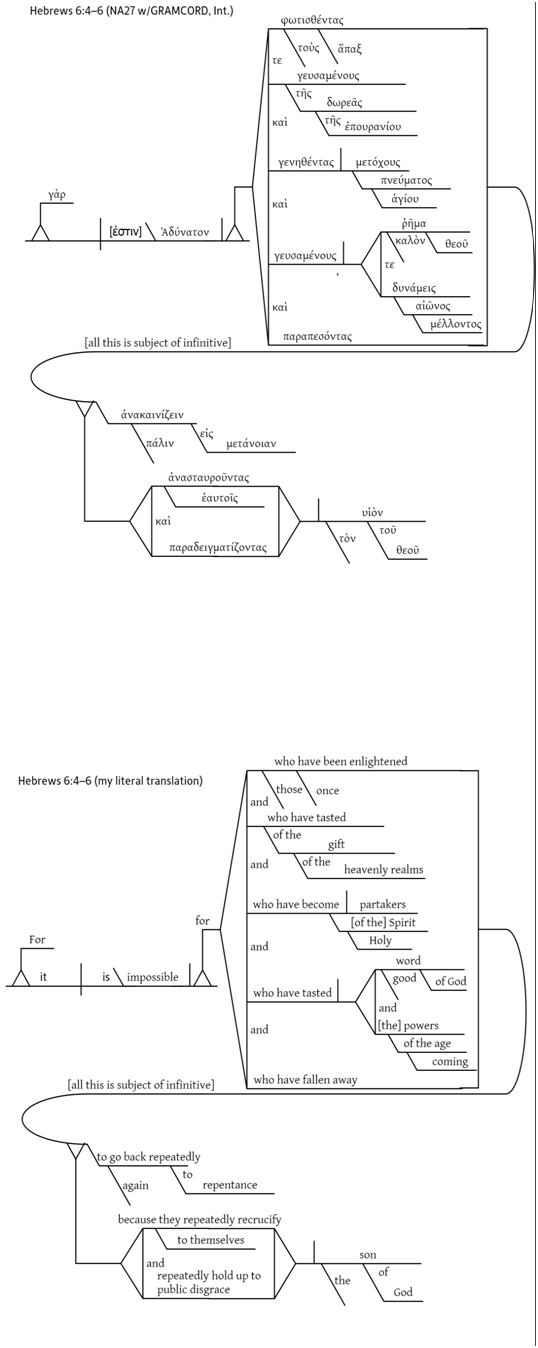
Hebrews 6:4–6 Sentence Diagram

Did I mention how much I like doing sentence diagrams?

November 18, 2011

“Falling Away” (παραπίπτω parapiptō) in Hebrews 6:6

Hebrews 6 is a scary passage to me. I don’t think those who believe in the doctrine of eternal security (i.e., “once saved, always saved”) have ever taken the warnings in this passage seriously. I will address the full context shortly, but the heart of the passage is found in vv. 4–6: “It is impossible… for those who have fallen away (παραπίπτω parapiptō \pah-rah-PEE-ptoh\) to be renewed to repentance.” The question that has always occupied my mind about this passage is, “How far do you have to fall before you can’t be restored to repentance?”

Context and Contrast

The broader context, Hebrews 5:11–6:12, informs in part the understanding of the warning in verse 6. Verse six also has four words that are only found in that verse in the New Testament, I will break those down later. But first, let me address the context. The author of Hebrews begins this section by chiding the readers for not having obtained a level of maturity they ought to have obtained. In fact, “maturity” is a prominent theme in Hebrews 5–7, which has nine words from the τελειόω (teleioō, \teh-lay-AW-oh\ “I make perfect,” “I complete,” “I become maturity”) family scattered throughout. Hebrews 5:11–6:12 is also bracketed by an inclusio of νωθροὶ γεγόνατε/νωθροὶ γένησθε (nōthroi gegonate/nōthroi genēsthe, \noh-THROI geh-GAW-nah-teh/ noh-THROI GEH-nay-stheh\ “have become lazy”) making the contrast between maturity and laziness even starker.

If that contrast isn’t enough, the author goes on to speak of the need for the Hebrews to go back to baby food (γάλα gala, \GAH-lah\; gen. γάλακτος galaktos, \GAH-lah-ktawss\ “milk”) instead of eating solid food. What I find interesting is what the author of Hebrews considers “elementary” teaching: repentance from dead works, faith in God, teachings about baptism (TNIV: “cleansing rites”), laying on of hands, resurrection from the dead, and eternal judgment. These strike me as pretty important doctrines, but do you notice what is missing? Think 1 Corinthians 13 here, especially where Paul makes the connection between maturity (τελείος) and love. Faithfulness (i.e., acting consistently on faith) and hope are included in the closing verse of 1 Corinthians 13 as well.

The (Neglected) Meat of the Passage

The imagery of “eating” is carried through into the stern warning of 6:4–6. Here is the meat, I believe, the author of Hebrews is talking about: being enlightened, tasting the heavenly gift, sharing in the Holy Spirit, and tasting the goodness of God’s word and the powers/miracles of the coming age. I’m not sure if the structure and syntax here is significant: two different words are used for “and” here, one indicating a strong connection (καὶ kai) and the other (τε te) a weak connection. I present a modified diagram below:

4 It is impossible

    for those who were once enlightened, also (τε) having tasted of the heavenly gift

    and (καὶ) who have been sharers in the Holy Spirit

5    and (καὶ) who have tasted the goodness of the word of God along with (τε) the miracles/power of the coming age

6    and (καὶ) yet have fallen away (παραπίπτω)

for [these people] to renew continually (ἀνακαινίζω anakainizō, \ah-nah-keye-NEE-zoh\) in repentance

because they recrucify (ἀνασταυρόω anastauroō, \ah-nah-stow-RAW-oh\ [\ow\ as in “how”]) the son of God to themselves

and (καὶ) hold him up to public shame (παραδειγματίζω paradeigmatizō \pah-rah-dayg-mah-TEE-zō\).

Allow me to give a brief treatment of each of the four hapax legomena (literally, “once spoken,” referring to words only used once in a text) to better understand what is meant by “falling away” and the other terms.

παραπίπτω

The word παραπίπτω is found six times in the OT, five of which are found in Ezekiel 14–22, referring exclusively to Israel’s unfaithfulness and defilement, from worshipping other gods to just simply living like God couldn’t do anything for them. The other occurrence is in Esther 6:10, where Haman is instructed not to be unfaithful to the words and actions of praise he unwittingly bestowed upon Mordecai. Given that the word is primarily used of the exiled Jews in the OT, I would hazard a guess that the NT usage of the word has a parallel meaning. In other words, this passage isn’t talking about the normal ups and downs of the life of a Christian, but a steady pattern of unfruitfulness, a lack of faith in God, and even idolatry. (We still have idolatry today, lest we think we’re off the hook.) Judah had to fall pretty far to be removed from the Promised Land and exiled to Babylon. I hope that none of you reading this have fallen that far yet, but if you have, hang on, because all hope is not yet lost.

ἀνακαινίζω

The ἀνα- prefix of this word and the next word below means “again,” and often times will simply be translated as “re-” plus the base word meaning. The NT doesn’t have a verb for “newing” something, but the -καινίζω part comes from the adjective καινός (kainos, \keye-NAWSS\ “new”). The word is found three times in the LXX, twice in the Psalms (103:5, 104:30) and once at the end of Lamentations (5:21). In the Lamentations passage, Jeremiah says something that is particularly relevant to the Hebrews passage:

21 Restore us to yourself, Lord, that we may return;

renew our days as of old

22 unless you have utterly rejected us

and are angry with us beyond measure.

We know that Israel was eventually restored to the Promised Land, so even the Exile was not enough for God to utterly forsake his people for all time. We are, after all, in a covenant relationship with God. Paul tells Timothy in 2 Timothy 2:13, “If we are faithless, God remains faithful, for he cannot deny himself.” Just as we can’t enter heaven by good works alone, so too we cannot lose our salvation simply on the basis of evil works alone. We would pretty much have to tell God ourselves that we want nothing to do with him any more for him to grant that desire and remove the blessing of salvation.

A question from my friend Eric Weiss in the comments after I originally posted this prompted me to expand on this particular word. I had originally translated the word in the passive voice, “to be renewed,” admittedly because I wasn’t paying attention to the parsing of the verb. It is a present tense active infinitive. As an infinitive, the subject is “those who have fallen away.” As an active voice, it should be translated “to renew” (many translations have “brought back,” but I think “renew” is a better translation). As present tense, the focus of the action is not on the time of action so much as it is on the aspect of the action, that is, it is continuous action. The implication of this goes back to the author’s statement in 6:1 about not returning to repentance. In other words, if you want to advance in the Christian life, repenting over and over again is not the way to go. At some point, you have to decide to grow up and move on to maturity.

Since I’m on the subject of tense, the other two verbs I deal with below are also in the present tense, so the focus there is also on continuous action. If you’re continually repenting, it’s like you’re continually crucifying Christ and continually holding him up to public shame.

ἀνασταυρόω

Protestants often give Catholics a bad rap about their view of the Eucharist, that the elements actually turn into the body and blood of Christ (the fancy word for that is transubstantiationism). Christ is recrucified in the Mass each week, so the Protestants complain. I don’t want to debate that point, because I don’t think it is profitable, and I don’t know that it is a completely accurate characterization. My point is, the only time “recrucify” is mentioned in Scripture is here in this passage, and it has nothing to do with Eucharistic theology. Those who have fallen so far so as to warrant exile (if we borrow the OT meaning of the word) after having known the enlightenment and blessings of God, must recrucify Christ to restore their salvation. But Christ, let alone anyone else, can only be crucified once. It’s impossible for him to be crucified again. But is that the author’s point here? I’ll come back to that in a moment.

παραδειγματίζω

The final hapax legomenon refers to holding Christ up to public shame. If you think about it, though, this is exactly what the original crucifixion was. Hebrews 12:2b (NIV) says, “For the joy set before him he endured the cross, scorning its shame, and sat down at the right hand of the throne of God.” The word for “shame” in Hebrews 12:2 is the more common word (a noun) for “shame” (αἰσχύνη aischynē \eye-SCHOO-nay\), but the idea is the same. In the LXX, παραδειγματίζω is found in Numbers 25:4 in reference to the capital punishment delivered to the men seduced by Moabite women, in Jeremiah 13:22 in reference to those destined for exile, and in Ezekiel 28:17 in the prophecy against the king of Tyre (which some mistakenly take to imply Satan). A related word (δειγματίζω) is found in Matthew 1:19, where Joseph decides he wants to hide Mary so as not to expose her to public shame.

The Author’s Intent

I think the author of Hebrews here uses the hapax legomena because he is using a literary device known as hyperbole. We all know that in spite of the Jews’ idolatry and apostasy (falling away) that got them exiled, God led them back into the Promised Land to rebuild their nation, their religious traditions, and their faith. They never had a problem with idolatry again after the exile, so they learned their lesson. The author is saying it’s a pretty serious thing to trash Christ or trash your faith. In fact, he repeats this warning in even sterner language at the end of chapter 10, which forms an inclusio with this Hebrews 6 passage. The author realizes it is an impossibility to recrucify Christ. His purpose here is to say that Christ’s crucifixion the first time around should have been enough, and they need to get back to living out the implications of that. They could lose their salvation, but it would seem that they had not reached that point yet.

But the author doesn’t think the Hebrews have fallen that far yet. He (they?) says, “We are convinced (πείθω peithō \PAY-thoh\) of better things in your case.” This same confidence is repeated in Hebrews 10 (note the connection to that chapter again) when he reminds them how they endured persecution and exposure to shame and insult, and in Hebrews 13:17–18 with respect to the leaders (NIV: “Have confidence in your leaders” is a better translation in my opinion than “Obey your leaders”).

Faith

The author’s remedy for the danger of falling away is to continue meeting together (Hebrews 10:25). The word ἐγκαταλείπω (enkataleipō \en-kah-tah-LAY-poh\; if you’ve been picking up on the Greek, the gamma-kappa γκ is pronounced \nk\) is translated “giving up” (NIV), “forsaking” (NASB), or “neglect” (NLT). This is the same word Jesus quotes from Psalm 22:1 on the cross when he cries out, “My God, my God, why have you forsaken me?” That is how important the author views “meeting together” (ἐπισυναγωγή episynagōgē \eh-pee-soo-nah-goh-GAY\; see a familiar word?) as the body of Christ on a regular basis. Don’t give up. Don’t make excuses. Make it a priority, because it’s for your own strengthening and encouragement as well as for those who attend with you.

Hebrews 11 provides the encouragement for Christ-followers to remain faithful and endure hardships. This is what the author is building to in Hebrews 6–10, especially since he praises them twice for their character, in 6:9–12 and 10:32–39. The patriarchs endured similar struggles, and although they were not perfect, they persevered faithfully even though they never saw the ultimate promise of the Savior.

Conclusion

The bottom line here is the author of Hebrews is puts it in the strongest words he can muster to emphasize it is possible to “lose” your salvation. But he also seems to use language that suggests his readers have not progressed to that point yet. Indeed, it seems to take a pretty serious act of apostasy to lose your salvation (e.g., Matthew 10:32–33; 1 John 2:23). But I think the real message in Hebrews 6–10 is not the author’s warning, but the author’s call to perseverance and faithfulness in the face hardship and persecution. The Jews, after all, spent 70 years in exile, but they eventually returned to their Promised Land. In the last part of Hebrews 9, the author lifts up the blood of Christ, which purifies us from all uncleanness and prepared the way for us to live with our Savior eternally.

Peace,

Scott Stocking

This post was revised from the original on 11/19/11, adding additional material to the ἀνακαινίζω section and additional material on Hebrews 11.

August 21, 2011

Doing What I Don’t Desire to Do (Romans 7:13–25)

Anyone who has ever read Romans has come across the interesting, seemingly repetitive passage in 7:13–25 (specifically vv. 15–21) where Paul says “I do not do what I want to do.” The TNIV has the word “do” (or a form of it) 24 times in those seven verses, and 6 of those come in verse 15! I would hazard a guess that the verb “do” in English is used almost as much as the “to be” verb. Perhaps a better comparison would be to the use of the verb “have” when forming the perfect tense in English. Just as in those cases “have” does not mean “to possess,” so the modal function of “do” doesn’t necessarily mean “to act”. So we shouldn’t be surprised to find the word used numerous times in any English text. But such a high concentration in the current text suggests that something is up.

When I read through this passage this week, I was surprised to find that Paul used not one, but three words that have been translated as “do” (modal uses aside) in many English Bible versions. In order to set this up, I think it will be beneficial to review those words and see how they impact the meaning of the passage. If we can “undo” the multiple uses of “do” to some extent, we might see a slightly different view of the passage emerge.

The Word Studies

κατεργάζομαι

The first word for “do” Paul uses is κατεργάζομαι (katergazomai, \kat air GAH zaw my\). This word is found 22 times in the New Testament: eleven of those occurrences are in Romans; six are in chapter 7, and five are in the immediate context of this passage. In this context, the word carries the implication of the results of what is “done.” In 7:8, for example, Paul says that “sin…produced in me every kind of covetousness” (TNIV). Later, in verse 13 (which is the beginning of the paragraph in the Greek text), Paul says that sin’s purpose was “to produce death in me” (my translation). If it weren’t for these two uses, I was almost ready to translate the other 4 occurrences in this passage as “motivate” or even “influence,” because that seems to be what the context implies. By “produce”, I mean “accomplish” or “result in” (see, for example, Louw & Nida 13.9).1 However, I will defer to the primacy factor here and go with the translation “produce” when I give my version of the passage below.

I do want to lay out for you how this word is used in its other four occurrences in this passage so you can compare them for yourselves.

A 15: I know not what I am producing. (Perhaps another way to render this is, “I don’t know what the end result is,” or “I don’t know what I’m accomplishing.”)

B 17: For I myself am no longer producing it, but the sin living in me is. (This is where I get the idea of “motivation” in the word.)

C 18: For my desire is present, but my production is not honorable. (This may be the crux verse. Paul uses a different word for “good” here: καλός instead of ἀγαθός; more on that later.)

B′ 20: (same as 17): For I myself am no longer producing it, but the sin living in me is.

πράσσω

The second word for “do” we come across is πράσσω (prassō, \PRAHSS soh\). Those of you who know something of Greek roots may recognize this as the root from which “practice,” “praxis,” and “pragmatic” are all derived. This word is found 39 times in the NT, with 10 of those occurrences in Romans, and even more in Acts. By a factor of about 7 to 1, the word is used in a negative or neutral context rather than referring to anything good, that is, practicing sin, evil, or wickedness. For example, Paul uses the word twice in Romans 1:32 to describe the practice of those who have given themselves over to their base desires. Christian Maurer, in his article on the word in the TDNT (summarized in the TDNTA, “Little Kittel”), says that the word “denotes the activity rather than the outcome,”2 which I contrast with κατεργάζομαι above. The word is used twice in near parallel construction in vv. 15 and 19, but there is one significant difference, and here, the Greek word order is important:

15: οὐ γὰρ ὃ θέλω τοῦτο πράσσω (E), ἀλλʼ ὃ μισῶ τοῦτο ποιῶ (F). (“For I practice not the thing that I desire, but I do the thing that I hate.”

19: οὐ γὰρ ὃ θέλω ποιῶ (F′) ἀγαθόν, ἀλλὰ ὃ οὐ θέλω κακὸν τοῦτο πράσσω (E′). (“For I do not the good thing that I desire, but I practice the evil thing I desire not.” Notice he adds the moral qualifiers in vs. 19 as well.)

(I realize my translations sound like Yoda’s “Do or do not, there is no try,” but I’m trying to be literal and not use “do” more than necessary.) These two phrases serve as a chiastic inclusio for the passage. If you don’t remember what a chiasm is, that’s when a series of items is repeated in reverse order, a common structural feature of the biblical text in both testaments. “I don’t practice the thing I desire…I practice the evil thing I don’t desire”; “I do the thing that I hate…I don’t do the good thing that I desire.” I find it interesting that in vs. 15, he breaks from using the word for “desire” (θέλω thelō, \THEH loh\; used 7 times in this passage) and uses the word for “hate” (μισέω miseō, \miss EH oh\), telegraphing how he feels about doing the thing he doesn’t desire to do (compare with the first phrase of vs. 16).

ποιέω

The Greek word most frequently used for “do” or “make” in the NT (568 times) is the third word we encounter here: ποιέω (poieō, \poi EH oh\). This word is found five times in this passage. Verses 15, 16, and 20 are nearly parallel: “I do the thing that I hate. If I do the thing that I do not desire….” Verse 19 is slightly different, as already seen above. Verse 21 is the only place in this passage where this word is connected with doing something “honorable,” but its use throughout the NT is widely varied as you might guess. There is nothing unusual about the translation of the word in this passage, so in my translation of the passage, I will render it as “do”.

ἀγαθός and καλός

One final bit of word study should be added to this discussion as well. Paul goes back and forth between using the typical Greek word for morally good (ἀγαθός agathos \ah gah THAWSS\) and the typical Greek word for aesthetically good (καλός kalos \kah LOSS\). There is some overlap of meaning between the two words (both words are contrasted with κακός kakos “evil”, the former in vs. 19, the latter in vs. 21), but καλός tends to be slightly more abstract and doesn’t have quite the moral load that ἀγαθός does. For the purposes of my translation, where ἀγαθός is used, I will use “good,” but where καλός is used, I will use “honorable.”

My Translation

To this point, I’ve given very stiff, literal translations of the Greek text, and I’m guessing some of you who don’t have a Greek background are scratching your heads. But I want to try to give a dynamic equivalence (which will probably sound more like something out of The Message) of this passage, focusing on vv. 15–21. So here it goes:

I don’t understand what this battle between good and evil is going to produce in me in the end or why I’m even going through it. For I don’t practice what I really want to do: please God. Instead, I just blindly do the thing I hate. And if I blindly do what I really don’t want to do, I agree with the law that it is honorable in pointing out the sinfulness of my thoughtless deed. But now it’s no longer I myself producing the action I didn’t want to do, but it’s the unwelcome, indwelling sin that’s doing it. For I know that good doesn’t dwell in me, that is, in my sinful, fleshly nature; my desire to do a good thing is there in my mind, but my sinful, fleshly nature produces nothing honorable. I don’t do the good thing I want to do; instead, I practice the evil thing I really don’t want to do. If I blindly do what I don’t really want to do, it’s no longer I myself producing the action I didn’t want to do, but it’s the unwelcome, indwelling sin that’s doing it. Consequently, I find the law that evil is present with me when I desire to do what is honorable.

Paul goes on to talk about how his mind and inner man (are they one and the same?) are sold-out to God, but his sinful, fleshly nature still has a strong pull on him. He, like the rest of us, understands the daily struggle with sin. But here’s the kicker: even though this passage is written in the first person, Paul really isn’t speaking of himself here. The “I” of the passage must be discerned from vs. 14, where Paul says “I am unspiritual/fleshly.” He’s really putting on a persona of “everyman” or a man who still finds himself enslaved to sin or trying to be justified by the law. Craig Keener, in his IVP Bible Background Commentary: New Testament, says that Paul is using a rhetorical method here known as “diatribe style,” which employs a fictitious speaker (“I”) and poses numerous rhetorical questions.3 He’s not writing about himself, at least not in the present. He could, however, be referring to his own struggle following the law prior to his conversion.

The reality is, if we have the Holy Spirit, we’ve put to death the persona that Paul has put on here. In chapter 6, Paul says we died with Christ in immersion (baptism) and were raised up with him in newness of life, so how can we live any longer in sin? The very first verse of chapter 8 can’t be ignored either, because it falls right on the heels of this section: “Therefore, there is now no condemnation for those who are in Christ Jesus.” And the rest of chapter 8 bears out how God has once and for all dealt with the sinful nature that wars against our desire to do good. The Holy Spirit, the one who empowers us to live victoriously over sin, will not leave us wanting in the battle with sin, “because through Christ Jesus, the law of the Spirit who gives life has set you free from the law of sin and death” (Romans 8:2, TNIV).

Well, I think that’s enough for now. I’ve spent all day on this, so it looks like I’m going to have to start writing Saturday night if I want to get these published on Sunday mornings. Peace to you. Have a great week!


[1] Louw, Johannes P., and Eugene Albert Nida. 1996. In Greek-English Lexicon of the New Testament: Based on Semantic Domains, electronic ed. of the 2nd edition., 1:150. New York: United Bible Societies.

[2] Kittel, Gerhard, Gerhard Friedrich, and Geoffrey William Bromiley. 1985. In Theological Dictionary of the New Testament, Abridged in One Volume, 927. Grand Rapids, MI: W.B. Eerdmans.

[3] Keener, Craig S. 1993. The IVP Bible Background Commentary: New Testament. Downers Grove, IL: InterVarsity Press.

Scott Stocking

April 24, 2011

Lost and Found

Filed under: Greek,Luke Gospel of,New Testament,Repentance — Scott Stocking @ 7:42 am

God never has accidents. This is not to say that God “controls” everything in such a way as to make free will a farce. Nor does this imply that God necessarily chooses to know all the free will choices everyone will make in the future: if he did, this would also bring free will into question, because nothing then could happen contrary to his knowledge of the future. (If C.S. Lewis is correct in Screwtape Letters, God sees past, present, and future in his “Now.”) All this to say that I think it is no accident that my reading this Resurrection Sunday is the Parable of the Lost Son (Luke 15:11–32). With apologies to the Olympic speed skating champion of the same name, I’m going to call this lost son Apollo, from the Greek ἀπόλλυμι (apollumi /ah POL loo mee/ ‘I destroy’, ‘I lose’).

To set the background of the story, I noticed a few things as I was reading. The one thing that sticks out most prominently to me is that there are three different Greek words used for the workers in the story:

  1. μίσθιος (misthios /MISS thee os/ [/th/ as in “thin”; always this way in Greek]), which means ‘hired hand’ (similar to the Greek word μίσθος (misthos /MISS thoss/ ‘pay’, ‘reward’)
  2. δοῦλος (doulos /DOO loss/) and its related verb δουλεύω (douleuō /doo LYOO oh/), ‘slave’ or ‘servant’ and ‘I slave’ or ‘I serve’.
  3. παῖς (pais /piess/ [like the word “pie” with an /s/ instead of a /z/ sound]) ‘servant’, ‘child’, ‘boy’, ‘girl’.

I can relate to the story of the Prodigal Son all too well, but not in the way you might think. In my adult life, I have known several times when God was calling me to do something or warning me not to do something, but did not always recognize what he was trying to tell me. In 1981, after I graduated from high school, I knew God wanted me at the University of Nebraska-Lincoln. God brought several people into my life in my four years there who helped solidify my foundation in the faith. However, in 1983, as I was loading up to move back to UNL for the school year, I felt an incredible pull to stay in Omaha and not return to UNL for that school year. There is a part of me that still wishes I would have heeded that call: I wound up in one of the worst relationships of my life that caused me (and her) great heartache. However, out of the ashes of that failure to discern God’s will, I also met a man who would become one of my best friends and mentors, and who still is today. Through him and his wife at the time, I was encouraged to attend Lincoln (Illinois) Christian Seminary. In 1987, when I packed up my Chevy S10 with pretty much everything I owned, I knew without a doubt that God wanted me in seminary in Illinois.

But somewhere during my 23 years in Illinois, I got “lost.” I won’t go into details, because the choices I made were intensely personal. Yet God has blessed me and prepared me in so many ways for where I am today, that I cannot imagine my life having taken another course. (Well, I can, but like Aslan said in the Chronicles of Narnia [I think it was in The Horse and His Boy], “It’s not permitted for you to know what might have been,” or something to that effect.) At one point, perhaps five or six years ago, I started feeling the tug to come back to Nebraska. I attributed it to homesickness, but I know now that God had indeed begun the process of calling me home. I was not “spending my possessions on wasteful living,” but I knew I didn’t have my financial priorities in order, going into debt when I had no prospects for a decent job in Illinois.

In the last two years, after my wife filed for divorce from me, I found myself feeling very much like Apollo in a far off land. I had been trying on and off for several years to find full-time employment. The editing work I had became steady, but the pay was woefully late. At every turn, I was turned down for positions for which I was adequately or more than adequately qualified. The best I could do was to maintain some part-time teaching and substitute teaching assignments. In the year or so before moving back to Omaha last September, I began hearing the Nebraska Cornhusker fight song playing in my head, even when my cell phone wasn’t ringing. I was flat broke, and the best job I could come up with was $100/week preaching at a congregation of less than 10 and about $150/week part-time at the IGA. I was broke, at rock bottom, and I felt as Apollo did (and not without cause), that most people were better off than me.

I had become a δοῦλος to my stubbornness to remain in Illinois near my kids. I had no money, no vehicle, and no prospects for gainful employment. I fought tooth and nail to find employment (some weeks submitting more than a dozen résumés for professional jobs, not to mention the countless near-minimum-wage jobs) to keep me near my kids, but still, “There Is No Place Like Nebraska” kept ringing in my ears. It was inevitable: I had to return “home.” I knew job prospects were better here, and even though my parents didn’t have a family business that I could jump into as a μίσθιος, I knew I stood a better chance of being a μίσθιος for someone else, and I could stay with my parents until I got back on my feet. And that is exactly what happened: My first full business day back in Omaha, I got hired for a FT temp position at West Corporation. What I learned there directly related to the FT permanent job I have now, a job that pays better than any other job I’ve ever had, and a job that stretches me to use all of my God-given skills and talent. I have truly been blessed by heeding God’s call, even if it means I am separated from my kids by the miles. But I have to trust that God has brought me here for a reason yet undisclosed, and that I am preparing the way for my kids to reunite with me at some point in the future.

Now that you have my testimony, I have a few more comments about the parable itself. One of my favorite songs of all time is “When God Ran,” the story of the Prodigal being greeted joyously by his father, who ran to meet him in the distance. That is what God the Father does when we return to him. Apollo was welcomed back with great fanfare. I have been blessed to have the support of my family here in my months of transition, but I think sometimes we overlook the lessons from the son who stayed home and slaved (his words, δουλεύω) for his father, complaining that he never once got even a goat to celebrate with his friends. In fact, when he heard the celebration coming in from the field, he called one of the “servants” (παῖς) to ask him what was going on. Notice here first of all that the servant does not have a possessive pronoun associated with it, so he probably isn’t the elder son’s servant. He’s not one of the hired hands (μίσθιος) either. However, the word παῖς can also mean ‘child’ (male or female); but again, without the possessive pronoun, we can’t say for sure it was one of the elder son’s children. I tend to think it was a child, though, rather than a slave (δοῦλος), because of the answer (and I embellish here): “Uncle Apollo has come home, and grandpa’s throwing a party!”

The son complains, but the father’s answer I think gets overlooked all too often. No, not the answer about “My son was dead but now is alive; my son was lost but now is found.” I’m talking about the verse before that, verse 31: “My child, you are always with me, and everything that is mine is yours.” If the father in the story represents God the Father, then should we not take this message to heart as well? We have the riches of God at our disposal; all we need to do is ask.

“Praise be to the God and Father of our Lord Jesus Christ, who has blessed us in the heavenly realms with every spiritual blessing in Christ” (Ephesians 1:3, emphasis mine). This Resurrection Sunday, I celebrate my life resurrected, for I had become as dead in Illinois, and now am alive again in Nebraska; I had lost my way in Illinois, but have found it again in Omaha. Even so, my life here is nothing compared to the eternal reward that awaits me in his glorious kingdom.

Εἰρήνη Peace! And have a blessed Resurrection Sunday!

April 10, 2011

Turning, Returning, and Repenting

Filed under: Biblical Studies,Luke Gospel of,New Testament,Repentance — Scott Stocking @ 8:26 am

As I have been reading through Luke 3–9, I have noticed the repetition of words I have not seen or noticed before in the other Gospels. This is not unusual. I blogged earlier about Mark’s use of the word εὐθύς (euthus /yoo THOOS/ ‘immediately’), which occurs more than 40 times in his Gospel. Luke uses the word only once as an adverb, but he chose another word that he uses almost exclusively, παραχρῆμα (parachrēma /pah rah CHRAY mah/), to mean the same thing. Of the 18 occurrences of this word, 16 appear in Luke-Acts, with the other two found in Matthew 2:19–20. So Luke’s emphasis on immediacy is not quite as strong as Mark’s, but significant nonetheless.

Another word that kept popping up over and over again was the word Luke uses (again almost exclusively) for “return,” ὑποστρέφω (hypostrephō /hoo po STREH foe/). By itself, the word is not spectacular in any way. Every time Luke uses the word in Luke-Acts (32 times of 35 total occurrences of the word in the NT), it refers to actual physical movement from one place to another. Only Peter, in 2 Peter 2:21, uses the word in a figurative sense, and that negatively, referring to those who “turn their backs on the sacred command.” Keep that in mind, because this passage becomes important a little later in this discussion. The word is only used three times of Jesus returning; most of the other occurrences refer to people returning home, returning to Jerusalem, or returning to Jesus to give a report or to give thanks. Again, nothing spectacular in any of this, but it does suggest that Jesus and his followers never sat still for too long and that there was a lot of activity around him.

This has something to say about what the ministry of local congregations should look like. Congregations that are buzzing with activity through the week, whether in the church building, in the homes of its members, or in popular meeting places like Panera’s or Starbuck’s, are making a difference in the lives of people. In Luke 9:10, the Gospel writer records that the 12 apostles (as long as we’re talking about frequently used words, the number “12” occurs 6 times in Luke 8–9 referring to 4 different entities) “returned and reported to [Jesus] what they had done.” I’m getting ahead of my reading schedule a bit by citing this next verse, but it reflects the same principle: In Luke 10:17, when the 72 return from their mission (similar to the mission of the 12), they report to Jesus that “the demons obeyed us in your name.” What would Sunday morning or small group be like if, each time we returned, we told what the Lord was doing in and through us? What would the dynamic of your small group look like if you not only did a Bible study, but just shared about the great things God is doing for you? Our congregation occasionally shows video testimonies of how God is working in the lives of his people. That has had a powerful impact on those seekers who are looking for a meaningful connection to the body of Christ. So when you return to church or small group or Sunday school class each week, share something good that God has been doing in your life, not just the prayer requests for your concerns.

The beautiful thing about doing word studies like this is that one can make many serendipitous discoveries along the way. One of the questions I asked myself as I began looking at ὑποστρέφω was, “What other words are used for ‘return’ in the NT?” I checked Louw & Nida’s Greek-English Dictionary Based on Semantic Domains for all the Greek words that carry the idea of “return” in their use in the NT. I found a handful of words that, in a few instances, carried the same idea as ὑποστρέφω and together occurred fewer times in the NT than ὑποστρέφω. But one related word stood out, ἑπιστρέφω (epistrephō /eh pee STREH foe/ ‘turn’, ‘return’, ‘turn back to’). Half of the 36 occurrences of this word in the NT are found in Luke-Acts (he does like to corner the market on word usage!). Of those 36 occurrences, 21 of them refer to “repentance” and turning to God, or in a couple cases just the opposite, turning back to the ways of the world. Of Luke’s 18 uses of the word, 12 (there’s that number 12 again!) have the sense of turning or returning to the Lord, often with the idea of repentance present in the immediate context. I mentioned the lone figurative use of ὑποστρέφω in 2 Peter 2:21 above. One of the negative uses of ἑπιστρέφω follows on the heels of that in 2 Peter 2:22, where Peter quotes Proverbs 26:11: “A dog returns to its vomit.” This exemplifies the acts of negative repentance to which the word refers (see also Galatians 4:9).

So how do I tie this all together? Simple. When we return (ὑποστρέφω) to church or small group each week, let’s tell others about the great things God is doing for us, so the world will see that we don’t just come to have needs met and prayers answered. When the world sees that dynamic relationship that we have with God, and that a relationship with him can be about more than just having needs met, they will return (ἑπιστρέφω) to God and join in the great kingdom experience. How much more vibrant would our service and worship be if we adopt this attitude! And in keeping with the sense of παραχρῆμα, let’s not waste any time getting it done!

Εἰρήνη! (Peace!)

February 21, 2011

Mark 1: More on “For the Forgiveness of Sins”

February 20, 2011

 It seems odd that just a little more than 1/8th of the year is already gone, but I only just finished the first book of the NT. In fact, according to my reading plan, I will be in the Gospels until almost the end of June, and then I won’t be done with Acts until the middle of August. Some of you have sent some special requests, and I will address those as I’m able. School kicks into full gear this week for me. I’m teaching two online classes now, followed by one online class after that.

 (Just in case you missed it, I had a bonus blog entry last Thursday on the “sleeping saints.” Please check it out when you have time.)

 I spent the last two days poring over Mark 1. One of the first things I noticed is how, when Mark begins the story with Jesus’ immersion by John the Immersing One ([ὁ] βαπτίζων, ho baptizōn, a participle verb form), he (through divine inspiration???) uses some of the very language that Matthew used at the end of his story with Jesus.

 Last week’s entry highlighted the phrase εἰς ἄφεσιν ἁμαρτιῶν (eis aphesin hamartiōn ‘into the forgiveness of sins’) and its use in both Matthew 26:28 in connection with the blood of Jesus and Acts 2:38 in connection with repenting and being immersed. Peter did not pull that connection out of his exegetical magic hat.

 Mark 1:4 uses the same phrase in connection with John’s immersion ministry. Mark says that John was “preaching an immersion of repentance for the forgiveness of sins.” In the next verse, Mark says that people were coming to John to be immersed in the Jordan “confessing their sins.” Then in verse 8, Mark makes a statement that has been one of the sources of the debate surrounding the efficacy and signification of immersion. John the Immersing One says, “I am immersing you in water, but he [Jesus] will immerse you in the Holy Spirit.”

I use the word “but” there, because that is how most English translations render it. But this “but” (δε de in Greek) is considered to be a “weak” conjunction. It is not as powerful as καί (kai ‘and’, ‘also’), but when it can be used as a disjunctive, it is not as powerful as ἀλλά (alla ‘but’). The latter usually indicates a complete or emphatic break. But δε is often used to connect actions that happen in sequence. The primary example of this is Matthew’s use of  δε in his opening genealogy: “Abraham was the father of Isaac; then Isaac was the father of Jacob” and so on.

So when Mark records John using δε with respect to the signification of how Jesus will “immerse” us, he is not saying that his own “baptism of repentance” will be null and void once Jesus starts immersing. In some respects, John could be making a play on words here. But John (and Mark) could also be looking forward to Acts 2:38. (We shouldn’t ignore the fact that Peter and Mark were close companions in the early days of the church, so there is most likely some of that influence represented here, but Luke’s objectivity in Acts makes any possibility of collusion for Mark to redact John’s words to support Peter’s message or to match Matthew’s wording unlikely.)

The bottom-line translation or interpretation here is this: John says, “I am immersing you in water, then he [Jesus, when he immerses you] will immerse you in the Holy Spirit.” John 4:1–2 indicates that Jesus’ disciples continued John’s immersion ministry, although Jesus himself apparently never immersed anyone in water. Additionally, John indicates later in his Gospel that Jesus will send the Holy Spirit after his death, so Mark’s words indeed do look forward to Peter’s declaration in Acts 2:38.

Other notes on Mark 1.

The word εὐθὺς (euthys ‘immediately’) occurs 11 times in chapter 1 and 41 times in the entire Gospel. One of the early lessons I learned in seminary was the urgency with which Mark presented the good news: Jesus couldn’t wait to get the word out.

Jesus casts out (ἐκβαλλω ekballō) many demons in Mark 1. But what I found interesting is that this same word describes what the Holy Spirit did to Jesus when he “sent him out” into the wilderness to be tempted (vs. 12). Mark also uses that word later in the chapter when Jesus “sent away” the cleansed leper and warned him not to speak. The point is that the word has diverse usage: it’s not only used to cast off evil things or entities. But it is a little stronger than simply using the more common words for “come” or “go.”

One last point regarding the cleansing of the leper: it is significant, I think, that the word for “cleanse” (καθαρίζω katharizō) is used rather than the word for “heal” (θεραπεύω therapeuō) in Mark 1:40-45. Healing would have only involved the physical or even emotional scars or wounds. But cleansing took healing to a whole new level. Jesus not only healed the leper, but he made the leper socially acceptable by removing the stigma of his uncleanness. (See Leviticus 14:1–32 where Moses describes the procedure for making an offering for being cleansed of leprosy.)

As we go about our respective ministries, may we offer that same cleansing and acceptance to those who need the restorative power of the good news of Jesus.

Matthew 7: Narrow Gates and Good Fruit

From January 9, 2011.

Wow, a great morning in Matthew 7. Here are just a few things I discovered.

Jesus speaks of “the narrow gate” (τῆς στενῆς πύλης, tēs stenēs pulēs) in Matthew 7:13-14. Verse 14 is where things get interesting, however. Jesus uses the same words to describe the gate in vs. 14, but the NIV, TNIV, and, surprisingly, the NAS all cloud the issue here. Additionally, those three versions shift the translation “narrow” to a different word (a verb), θλίβω (thlibō), in vs. 14. That word means “to be hard pressed or persecuted.” I think the ESV, which tends to be more literal, gets closer to the sense: <span>”Enter by the narrow gate. For the gate is wide and the way is easy that leads to destruction, and those who enter by it are many. For the gate is narrow and the way is hard that leads to life, and those who find it are few.” “Hard” still seems a bit too soft, however (note the irony), but I suppose if the translators had said, “the way that leads to life is persecuted,” we would be less inclined to read our Bibles.

The next passage about the tree and its fruit has some interesting features as well. The NIV, TNIV, and NAS all repeat the words “good” and “bad” as if Jesus spoke the same Greek/Aramaic words for their respective occurrences. But when Jesus speaks of the “good” tree, he uses the word ἀγαθός (agathos), which typically, but not always, means “good” with moral implications in the NT. The word used to describe the “good” fruit is καλός (kalos), which can have a moral sense to it, but also has aesthetic implications as well (e.g., “beautiful”). I would say a good translation of the first part of vs. 17 is, “The tree that has been properly tended produces healthy, delicious fruit.”

The second part of that verse has similar issues with the word “bad.” Of the tree, Jesus uses the word σαπρός (sapros), which implies “rotten” or “unwholesome” (see Eph 4:29 for the latter). But of the fruit, Jesus uses the typical word for “evil,” πονηρός (ponēros). There is another word for “bad” in the Greek (κακός, kakos) that seems to be an antonym for agathos, but it is not found in this passage. So the latter half could read, “The rotten tree produces evil fruit.” Jesus doesn’t beat around the bush (or the tree) with this one. He jumps straight to judgment of those who aren’t producing healthy fruit.

Matthew 12:33-34 adds to this teaching as well. In a similar passage there, Jesus uses kalos and sapros to speak of both the tree and the fruit, but in 34, when he applies the analogy to his listeners, he uses agathos and ponēros to describe them.

Scott Stocking, M.Div.

« Previous Page

Website Powered by WordPress.com.