The gospel passage this week is Jesus raising Lazarus from the dead. It is the only one of the seven miracles of Jesus recorded that coincides one of his seven “I am” statements he makes in John’s gospel in the same chapter.\
This passage shows the full range of Jesus’s human and divine natures, especially the human emotions that Jesus expressed. It’s important to emphasize Jesus’s humanity as evidence that he was a high priest able “to empathize with our human weaknesses—yet he did not sin.” (Hebrews 4:15),
Martha is the one trying to hold it all together. It seems as if she’s not even started the grieving process yet. She and Mary are both upset that Jesus didn’t get there in time. But Martha is sure of the resurrection, something many of the disciples, I think, were still trying to wrap their heads around.
Jesus’s response just before he himself weeps is worth noting here. When John says Jesus was “deeply moved…and troubled” (NIV), some commentators have suggested Jesus may have groaned in agony or even anger at death itself. He was doing all he could to control his emotions when he asked, “Where have you laid him?” I’m not so sure he asked that politely. More like, “Let’s get this over with.”
Jesus seems to be in take-charge mode at this point. In vs. 38 we see he is “deeply moved” again, to the “Take away the stone!” command may have sounded like a very frustrated outburst.
We must be careful not to generalize from Jesus’s actions and attitudes in this event any sort of pattern for how you and I respond to the death of a loved one. Each one of us handles grief in our own unique way, but the one generalization we can make is that Jesus was fully relying on God in this moment of earthly existence. The one who came to bring us life had to confront the very thing he came to defeat.
I do hope this will give you some good ideas on how to make this story “come to life” (so to speak) for your congregation. I’ve included a couple links below, one with an audio file of my sermon, and the other that highlights the connections between Jesus’s miracles and his “I am” statements in John.
Lectionary Help for Third Sunday in Lent, March 8, 2026, Year A.
Taking a look at the literary context and historical setting of the account of Jesus speaking to the woman at the well in Samaria can help answer a few questions people may have about this passage. For example, why was Jesus so insistent that he “had” to go through Samaria? Consider the following points.
John begins his gospel by saying Jesus is the light of the world and has been around “from the beginning.”
Jesus shows his earthly authority over the Temple at Jerusalem by overturning the tables of the money changers, yet that doesn’t seem to be enough for him to insist that Jerusalem is the proper (or only) place of worship.
The well where he meets the woman is Jacob’s well. Jacob, of course, is one of Jesus’s earthly ancestors, so Jesus is in the land of his ancestors when he first reveals (at least in John’s gospel) he is the Messiah. That fact shouldn’t be overlooked.
“He establishes Jesus is fully divine and that God is his Father. Since he’s God’s “only begotten” on Earth, Jesus then is the primary authority in the Temple, which the Jews believed was home of God’s presence. Finally, Jesus, having been established as the authority for the Jewish religion, essentially abolishes the long-standing prejudice against Samaria by going to the place where his ancestor Judah’s father, Jacob (renamed Israel) first established himself in the Promised Land after returning from Laban’s home. I think this aspect of the story lends to its credibility and to the principle of worship he puts forth.”
The epistles passage is Romans 5:1–11. This is where Paul makes the point that Christ died for us “while we were still sinners.” This ties in nicely with the woman at the well story, of course, as Jesus is offering the woman living water in spite of her current social and relationship status.
A few Old Testament passages can provide some background for the “living water” Jesus speaks of. Isaiah 49 (esp. vv. 6 & 10) speaks of springs of fresh water, while Jeremiah 2:13 and 17:13 both describe the Lord as the Jews’ “spring of living water.” Of course, we can’t forget Ezekiel’s prophecy in 14:8–9:
“On that day living water will flow out from Jerusalem, half of it east to the Dead Sea and half of it west to the Mediterranean Sea, in summer and in winter. 9 The Lord will be king over the whole earth. On that day there will be one Lord, and his name the only name.”
I pray this helps you prepare this week. I’m updating my previous message, which includes both NT passages, to reflect some of the things I’ve learned or rediscovered in my recent work in Romans.
I presented this message on January 25, 2026, at Mount View Presbyterian Church, Omaha, NE. On the liturgical calendar, it was the third Sunday after the Epiphany, Year A.
Good morning! The Lord be with you!
Much of today’s gospel passage from Matthew is very similar to the events and themes we covered in last week’s Gospel passage from John. As such, I’m not going to spend much time in that passage today and instead want to look at our Old Testament reading, Psalm 27.
However, I will say a just a few words about the Matthew passage because there is a story in Matthew 4 that appears at first blush to disagree with John’s account about a similar encounter. Last week you may remember that Andrew was the first one of the disciples to want to follow Jesus, and he had meet Jesus at the place John the Baptist was baptizing in the Jordan River. He in turn went and got his brother, Simon Peter, to share the news that he had found the Messiah. After Peter met Jesus, John says they went and spent the day with Jesus.
Matthew’s account, as you heard, also has to do with the calling of Andrew and Peter, along with James and John, the sons of Zebedee as they’re fishing in the Sea of Galilee. However, in Matthew’s story, this comes immediately after Jesus spends 40 days fasting, praying, and being tempted in the wilderness. It seems clear then, that one of the things Jesus was praying about was who, among all the people he had met and interacted with during John’s “baptism revival,” would make the best choice for his band of 12 disciples. After all, Jesus had been in the wilderness 40 days, so it’s possible Andrew and Peter may have wondered what happened to him by that point. I’m guessing the four of them were pleasantly surprised to get the call from him, even if they didn’t yet understand the kind of commitment they were making.
The important takeaway for us in the choosing of Matthew is that Jesus wasn’t apparently looking for the well-educated scribes and well-respected, Pharisees, and Sadducees to be his followers. They surely would have argued with him the whole time given what we learn about them in the gospels and Jesus wouldn’t have gotten anything done. Although Jesus did come to preach repentance and a proper understanding of what our relationship to the Law and eventually Grace would look like, he was even more concerned about bringing people eternal hope, love, and joy in the midst of a religious structure that had grown increasingly legalistic and impersonal. The religious leadership of the Jews seemed to have a stranglehold on what the Jewish faith should look like, with hundreds of extra rules in place to keep you from even coming close to breaking the law.
This is where Psalm 27, a psalm of David, comes in. David’s leadership helped establish the nation of Israel as a regional powerhouse after 40 years of wandering in the wilderness and a few hundred years of rule by regional judges. It was during the period of Joshua and Judges where they conquered and in some cases wiped out nations that had “earned” the wrath of God for their wicked practices and animosity toward God’s chosen and beloved people.
Psalm 27 is filled with confident assertions and positive desires from David that he and perhaps the rest of Israel are in a right relationship with God. The Israelites were still adjusting to being a unified “kingdom,” not just scattered tribes ruled by local judges. But the attitude and the joy expressed by David in Psalm 27 seems to reflect a different mind set in his day than what comes across in the gospels. After all, you don’t see any of the Herods writing these kinds of psalms of praise! On the contrary, we get the impression that the Herodian Dynasty, which had descended from the Maccabees who had overthrown Greek rule almost 200 years prior to Jesus’s ministry, had become corrupt and heartless toward their own people in trying to appease their Roman overlords.
Our reading this morning left out a few verses from Psalm 27 this morning, so I would like to read through the whole Psalm a few verses at a time to talk about what it has to say to us this morning. We’ll start with vv. 1–3:
David didn’t have Pharisees and Sadducees telling him how to interpret God’s word and who added a “hedge” around the law. The “hedge” was a set of rules that rabbis had established much later in Israel’s history, probably sometime around 200 B.C. They were not strictly biblical commands, but they were guidelines intended to keep you out of situations that might increase the temptation to sin. It’s sort of like how some denominations today don’t want their members to dance because it might lead to “other things.” One such example from the Bible is when Jesus criticized the Pharisees because they tithed their mint, dill, and cumin—the smallest spices they knew about—but did nothing about justice, mercy, and faithfulness (Matthew 23:23).
David knew where his power and protection came from in Psalm 27: it came straight from God. He is emphatic that he has no need to fear. He knows his enemies will stumble and fall regardless of who comes after him. That is true faith, true confidence in God’s sovereignty. It’s no wonder he was called a man after God’s own heart.
4 One thing I ask from the Lord,
this only do I seek:
that I may dwell in the house of the Lord
all the days of my life,
to gaze on the beauty of the Lord
and to seek him in his temple.
5 For in the day of trouble
he will keep me safe in his dwelling;
he will hide me in the shelter of his sacred tent
and set me high upon a rock.
6 Then my head will be exalted
above the enemies who surround me;
at his sacred tent I will sacrifice with shouts of joy;
These three verses are interesting in that David speaks of God’s dwelling, his temple. Yet at this time, the first Temple had not been built yet. But twice, David references God’s “sacred tent.” This is a reference to the Tabernacle that the Jews had carried around in the wilderness for 40 years and was in use by David and the priests right up to the time Solomon built the Temple (1 Chronicles 6:32; 2 Chronicles 1:5)[3].
David understood the importance of a leader being present at worship regularly as an example to the people. David had brought the Ark of the Covenant back to Jerusalem, so had been in the visible presence of God at least one time in his life. That is how he knows how awesome it is to gaze on the beauty of the Lord.
How does that apply to us today? We know when Christ died that the veil was torn in two, from top to bottom, so God’s presence no longer “hid” behind a thick curtain. God’s new way of working in his people after the death and resurrection of Jesus was to give each of us the Holy Spirit. So we most likely will not see a manifestation of the presence of God inside our four walls here, but we can see how the Holy Spirit is working in each of us as we fellowship, worship, and serve together in his name and for his glory.
David also realized in times of trouble that being in God’s presence allows him to call upon the Lord for mercy, protection, and strength. He asks God to “hear my voice” and for God not to “hid your face from me.” He desires to be taught continually so he is better able to serve God and lead his people away from and protect them from the dangers of the surrounding nations. He knows that people are out to get him. He knows God is the only one who can protect him from those aggressors.
We do this as well on Sunday mornings here, and throughout the week, by praying together for those things that are on our hearts. As a fellowship we can seek support from one another to receive comfort and strength. In all my years as a minister, I’ve lost track of how many people have told me they don’t have to go to church to be a Christian. Technically, that may be true, but it sure makes the Christian walk much easier when you have others around you who share the struggles and joys of human existence.
This is David’s concluding benediction, which seems to serve the same purpose in worship as something like our “Gloria Patri” or the Doxology choruses. David reaffirms the confidence he had in vs. 3. He calls on all the worshipers to “Wait for the Lord.” The most common translation for the Hebrew word translated “wait” [קָוָה qāwā(h)] is “hope.” David is waiting, hoping with confidence that the Lord himself will act to keep him and his people safe in the land of the living. David also calls the worshipers to “be strong and take heart,” something both Joshua and Jesus said in their respective ministries.
Early in Joshua’s account of taking the Promised Land, he writes to his fellow Israelites:
6 Be strong and courageous, because you will lead these people to inherit the land I swore to their ancestors to give them.
7 “Be strong and very courageous. Be careful to obey all the law my servant Moses gave you; do not turn from it to the right or to the left, that you may be successful wherever you go.
……….
9 Have I not commanded you? Be strong and courageous. Do not be afraid; do not be discouraged, for the Lord your God will be with you wherever you go.”[6]
Jesus said in his final instructions to his disciples just before his prayer at the end of the Last Supper:
33 “I have told you these things, so that in me you may have peace. In this world you will have trouble. But take heart! I have overcome the world.”[7]
So I leave you with those words of encouragement this morning. May the peace of God reign in your hearts as you go from this place. Amen.
[3] In 1 Chronicle 23:26, David relieved the Levites of their responsibility to carry the Tabernacle since Israel was permanently settled in Jerusalem.
I’m coming up on the 25th anniversary of my very first full-length article published in Christian Standard, February 4, 2001. When I wrote the article, I had been working with the Paxton (IL) Church of Christ (Instrumental) to help get a new contemporary service going. It was also a time when “worship wars” were prevalent in many denominations as contemporary music was starting to enter the “sacred” Sunday morning service scene. Do we even have worship wars anymore? I’ve been in a large, contemporary church for so long now I’m out of touch with what’s going on in smaller churches that have a mixed demographic.
I’m including a link to the Christian Standard archive site below for the article. If you wish to comment on it, you can do so on this post.
Christian Standard, a once weekly publication for Christian Church (Instrumental) goers of the eponymous publication house, published this article I wrote for their May 26, 2002, issue with the theme “Not the only Christians…” I had been teaching for a Missouri Synod Lutheran high school at the time I wrote it, but I only taught for one year there. I’ve provided the link for it below. If you want to comment on it, you can do so on this page. This has been sort of my life, having taught Bible in the colleges of several different denominations over my teaching career and now preaching half-time at Mount View Presbyterian Church in Omaha where I grew up and where my mom still attends.
I preached this sermon at Mount View Presbyterian Church on November 23, 2025. It was the last Sunday of Year C of the Lectionary Calendar, commonly known as Reign of Christ the King Sunday. It was also the Sunday before Thanksgiving and the Sunday before the first Sunday in Advent. I had not checked the advanced copy of the church bulletin thinking they would have the Lectionary gospel reading for the day printed, but as it turned out, they had a Thanksgiving Service planned (more music), so I hadn’t prepared a message based on the reading. I went ahead preached the message I had prepared, which worked out find, because with more music, the service was a little longer than usual, and my message had been shorter than usual. I’ve also included some links to past Advent messages since the season is upon us.
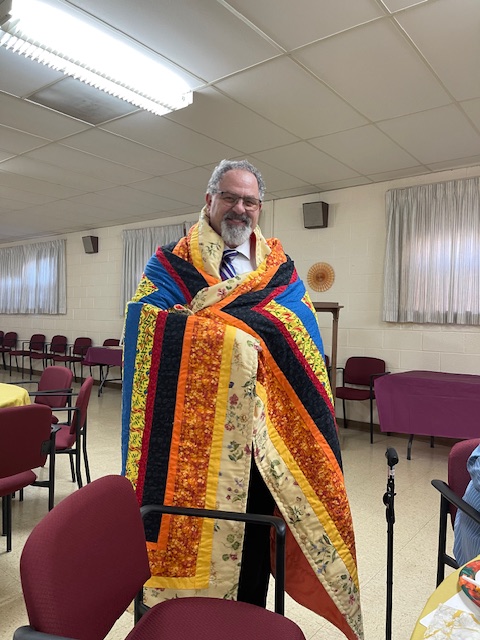
We had a soup lunch afterwards and had a drawing to give away a few of the quilts our ladies had made. I won what I’m calling my Joseph Quilt. It is a nice sized quilt worked on by several of the ladies. My mom provided the stitching/decoration around the border.
Have you ever seen one of those movies where they start with some dramatic scene. In the cop shows, it’s usually a murder or finding someone badly injured in an unexpected place. In a Hallmark movie, it might be a wedding scene or a passionate kiss (we all know that’s coming in the Hallmark movie, so no need to put it off until the end!). But then in the next scene, the graphic pops up: “Six months earlier.” The opening scene has gone by so quickly that you didn’t even get a chance to figure out much about who the characters are, then you’re thrust back in time and have to figure it out all over again.
Today we come to the conclusion of the liturgical calendar: “Reign of Christ the King” Day. It’s hard to believe Advent (and the new liturgical year) starts next week. The Lectionary is kind of like those movies I mentioned earlier. Even though we read about the crucifixion of Jesus this morning, we’re not going to get back to that dramatic event of the Resurrection that kicked off the last eight months of the calendar until Easter next year.
This past year, we’ve journeyed through the gospel of Luke, which has the most material on the life of Jesus. Five months ago, we read in Luke 9:51 that Jesus “resolutely set out for Jerusalem.” The rest of Luke’s gospel from that point on is set in that context of Jesus knowing his life would be cut short. Yet he continued loving, healing, and teaching the masses about God’s true love for them. He also did not shy away from confronting the religious leaders of his day for their abuse of the spiritual authority God had entrusted to them. That violation of God’s trust brings us to where we are today in the gospel, the crucifixion.
Luke has details in this story that the other three gospel writers do not have. Luke is the only one who has Jesus saying “Father, forgive them, for they do not know what they are doing.” He wasn’t just talking about how the Roman soldiers were treating him either. Matthew and Mark tell us that the criminals who were crucified with Jesus were BOTH hurling insults at him, but Luke indicates that one of them must have had a change of heart after hearing Jesus say “Father forgive them” and asked Jesus for forgiveness in his last hour. Jesus, of course, granted it.
The religious leaders were jeering and sneering at him as well. “He saved others, or so he claims! Let him save himself if he’s the Messiah!” One might expect that kind of behavior from criminals, but from those who had presumably dedicated their lives to serving God at the Temple or in the local synagogues? You know you must be getting close to the corruption and hardness of heart when the people who should be on your side are rejecting you for your teachings.
Even though our gospel reading stops just short of the final moments of the crucifixion, we are all familiar enough with that story to finish it from memory. And we know that because Christ defeated death and rose again into his heavenly glory, he lives and reigns as King of Kings and Lord of Lords. While his kingdom is here on earth, it is not of this world. Paul says in Ephesians 1:3 that God has “blessed us [i.e., Christ followers] in the heavenly realms with every spiritual blessing in Christ. It was evident from the moment of Pentecost that God had begun a new work in his people through the empowering of the Holy Spirit sent to us by our risen Savior.
As Christ followers, then, we are by default emissaries of the King of Kings and Lord of Lords. In the rest of the New Testament we see Paul and the other apostles planting and shepherding churches that are growing by leaps and bounds in various places. In many cases, the word of God has already spread to places where Paul had yet to travel because other believers were doing that missionary work as well. In the first chapter of Paul’s letter to the Colossians, we get a glimpse at Paul’s heart for them in the first chapter. Paul praises them for having a faith that is “bearing fruit and growing” in their hearts and around the world. Let’s pick up his praise for them in verse 9:
9 For this reason, since the day we heard about you, we have not stopped praying for you. We continually ask God to fill you with the knowledge of his will through all the wisdom and understanding that the Spirit gives, t10 so that you may live a life worthy of the Lord and please him in every way: bearing fruit in every good work, growing in the knowledge of God, 11 being strengthened with all power according to his glorious might so that you may have great endurance and patience, 12 and giving joyful thanks to the Father, who has qualified you to share in the inheritance of his holy people in the kingdom of light. 13 For he has rescued us from the dominion of darkness and brought us into the kingdom of the Son he loves, 14 in whom we have redemption, the forgiveness of sins. [1]
Paul has incredible respect for the Colossians and wants to ensure they continue on the path of growing in righteousness and faithfulness. This is significant in that Colossae was an incredibly diverse town in south-central Asia Minor. He wants them to be filled “with the knowledge of his will through all the wisdom and understanding that the Spirit gives.” Paul has a similar thought for the Ephesians in the opening of that letter: “18 I pray that the eyes of your heart may be enlightened in order that you may know the hope to which he has called you, the riches of his glorious inheritance in his holy people, 19 and his incomparably great power for us who believe.”[2]
In Colossians 1:6, Paul affirms that the gospel is “bearing fruit and growing through the whole world. He reassures the Colossians are doing their small part to contribute to that in vs. 10.
Being strengthened in all power means that they understand the working of the Holy Spirit in their lives. They do have some challenges, apparently, with some coming among them making “fine sounding arguments” against the gospel. But Paul has confidence that their knowledge will help them discern false teachings and stay the course of the true gospel with patient endurance.
They are also continually giving thanks because they’ve been rescued from darkness. They believed the gospel and have been living it out boldly because they know they’ve been forgiven and redeemed.
After praising them, Paul continues from verse 15 talking about the supremacy of Christ and why he reigns as King of Kings and Lord of Lords:
15 The Son is the image of the invisible God, the firstborn over all creation. 16 For in him all things were created: things in heaven and on earth, visible and invisible, whether thrones or powers or rulers or authorities; all things have been created through him and for him. 17 He is before all things, and in him all things hold together. 18 And he is the head of the body, the church; he is the beginning and the firstborn from among the dead, so that in everything he might have the supremacy. 19 For God was pleased to have all his fullness dwell in him, 20 and through him to reconcile to himself all things, whether things on earth or things in heaven, by making peace through his blood, shed on the cross. [3]
The concept of Jesus being the “firstborn” here seems to have a dual meaning. In verse 15, Paul says Jesus is the firstborn over all creation. That seems to suggest what we learn from John, that Jesus, the light of the world, was the “light” that God created on Day One of creation. A few verses later, in verse 18, Paul calls Jesus “the beginning,” which would seem to confirm the Genesis theory, but the then also calls Jesus “firstborn from the dead.” John also uses the phrase “firstborn from the dead” of Jesus in the opening chapter of Revelation (1:5). This of course is a reference to his resurrection.
Even though there are a few others in the history of the Bible who were raised from the dead, they all came back to life in their original human bodies. Jesus is the first one whose body was raised from the dead AND transfigured into its heavenly version. That earns him the title of head of the church—King of Kings and Lord of Lords—having supremacy over everything. This supremacy is not only for this world, but in the heavenly realms as well as Paul indicates.
Harkening back to Ephesians 3:10, we see that we have a role in proclaiming the gospel not only here but also in the heavenly realms. “10 His intent was that now, through the church, the manifold wisdom of God should be made known to the rulers and authorities in the heavenly realms.”[4] The passage in Ephesians 6 on the armor of God reaffirms our role in fighting the good fight not only against flesh and blood, but against the powers in the heavenly realms. We have the divine protection and strength to stand firm in those battles because of Christ’s victory over death and the redemption he won for us. Not only does he reign as King of Kings and Lord of Lords in our lives, but he has also provided the means for us to walk faithfully in this world.
As we wrap up the liturgical year and look toward Advent and the Christmas season, we can take comfort and courage in having citizenship in the kingdom of Christ. A blessed Thanksgiving to all of you this week, and please join us for the meal after service. Amen.
I left for an eight-day road trip to Houston and then Minneapolis the day after Charlie Kirk was assassinated. With all the travel and spending time with my kids for the first half of the trip and my coworkers the last half, it was difficult to sit down and focus on any serious reflection. This is probably good, because I’ve had a chance to see the reactions of others and witnesses the abomination of those especially on the Left who are mocking or celebrating Charlie’s death before I could finish up what I’m presenting here. The problem is Evil, pure and simple, and Charlie was a warrior fighting against the darkness of that evil in the heart of enemy territory at times. I had done the same thing on a much smaller scale thirty some years ago as a campus minister, so I appreciated Charlie’s courage. Here’s my reflection on how he influenced and emboldened me.
As a former campus minister who, with some fear and trepidation, walked into the offices of the nation’s largest Gay/Lesbian Student Union at Northern Illinois University in the early 90s to try to develop a dialogue with a very militant group (at least their rhetoric against Christians in the school paper made it seem as such), I have looked up to Charlie Kirk ever since he came on the scene in 2012. His approach was similar to mine. Let’s talk about the assumptions you’re making about Christianity and that some Christians are making about homosexuals. AT NIU, I was able to have what I thought were “productive” conversations with the G/LU to show a more compassionate side of Christianity that didn’t hate the sinner a la Westboro Baptist in Topeka, Kansas, back in the day. I earned enough respect to be invited to sit on some panel discussions, and several appreciated the tone I took. (For historical context, keep in mind that “political correctness” was just starting to rear its ugly head in those days.)
Unfortunately, that rhetoric has now reached intolerable levels. The way to counter speech you don’t like should be more speech. That is the Right’s attitude with a few rare exceptions. However, the Left’s attitude has been to cancel, shame, dox, impose fear, name calling, and rename our position as “politically incorrect.” Let’s not forget that they also burned up cities and vilified the police, and even committed open anarchy in places like Seattle all in the name of a criminal drug addict who refused to comply with police. Now you can add deadly violence to that as well. I’m not going to be silenced, and I have never shied away from confronting such things in my blog or from the pulpit.
I don’t think it’s a cop-out to suggest that mental health is part of the problem here, but the bigger problem is just plain evil. If we just say “Violence is wrong regardless of who commits it,” but it misses the point of the larger scope of violence, not just the act of cold-blooded murder. (The echoes of those criticizing “Our thoughts and prayers are with you” is still ringing loudly in my ears.) The moral equivalence would seem to stop there. Charlie Kirk stood for freedom of speech and freedom of peaceably assembling, guaranteed First Amendment rights. As a Christian, I believe those First Amendment rights are also God-given rights based in the Bible. Those First Amendment rights are guaranteed and protected, in part, by the Second Amendment, the right to keep and bear arms. Tyranny seeks to strip those rights from those who are citizens. The Second Amendment should not necessarily be the first response unless danger is imminent, but it can’t be ignored, either.
When you juxtapose what Charlie Kirk stood for against say the Democratic Farm-Labor Party former Speaker of the Minnesota House who was targeted, the moral contrast is stark if not frightening. Charlie stood for free speech, community engagement, and dialogue with those who disagreed with him. He believed in human dignity. That’s the fundamental basis for First Amendment rights. On the other hand, the Minnesota State Legislature, led by Speaker Hortman at the time, passed a law in 2023 that expanded abortion rights and eliminated clear language about NOT classifying pedophilia as a sexual orientation in favor of extremely vague language:[1]
Let the record show that Speaker Hortman voted in the affirmative for that bill (2023 S.F. 2909).[2]
Here’s a Twitter post that gives additional evidence that the bill (now law) is a step toward normalizing pedophilia.[3]
Here’s the finished product after it was enrolled (i.e., the law was updated):[4]
Yet for all these things she supported, she was never targeted by a MAGA loyalist for violence. Nor, apparently, were any of these things the motive for her and her husband’s assassin. Let the record show that their assassin was apparently not a MAGA supporter. He had “No Kings” literature in his vehicle when they caught him, and the “No Kings” rallies in Minnesota were cancelled after that discovery.[5] Those were anti-Trump rallies planned around the time of the 250th anniversary of the Army. Just a few days earlier, Hortman had voted with Republicans in the Minnesota Legislature as the only Democrat in support of a bill stripping State-funded health care benefits from adult illegal aliens (Who Is Vance Boelter? What We Know About Suspect in Democ… – Newsweek). Presumably that is what prompted the assassin to take lethal action (https://x.com/amuse/status/1969070353356820789). That puts the lie to the claim that the Right fostered any kind of culture of violence in this situation. When the violent, dangerous criminal and drug user George Floyd died, the country erupted in violence. No one in the media seemed to condemn that kind of violence. If violence is never okay, then why didn’t anyone make a concerted effort to stop that kind of violence when it spread across the country?
Yet when Charlie Kirk gets murdered by an assassin, Christians come together and pray and do NOT riot in the streets or burn down cities. When a liberal speaker comes to a campus to speak, there’s barely a fuss about security. When someone like Charlie or Ben Shapiro or Candice Owens comes to a campus to speak, there are riots and violent protests and a heightened need for greater security.
The causes of the Left’s violent bent are precisely the kinds of things Hortman and her Leftist colleagues supported. Abortion is the murder of innocents; the blood of the innocent is on the hands of the so-called professionals who perform them AND the politicians who legitimize the procedure. Otherwise, why would Minnesota law have to exempt abortion from the Minnesota criminal Murder statute when it comes to unborn deaths? If violence is never okay, then why do people continue to want to legitimize the violence of abortion against the innocent and helpless unborn?
Transitioning youth is also an act of violence against the human body. It involves bloodshed as well when you start cutting off body parts and making phony structures (glory holes; inflatable penises; etc.) in the body. It involves violence against the body when you start introducing high doses of the opposite-sex hormone into a system that was designed to function on the hormone native to the biological sex of the individual. If violence is never okay, then why is the violence of transitioning youth and making them infertile for life in many cases still tolerated and promoted?
Whether you transition from boy to girl or girl to a boy, pumping opposite-sex hormones into a body not designed for those hormones is like putting motor oil into the fuel tank of a car designed for unleaded gasoline. The body will push back against that. It will try to create what is missing or eliminate what it considers invasive. We’re starting to see what happens with these kinds of procedures, both mentally and physically. That’s why many European countries have started restricting or banning such transition procedures.[6] The individuals often end up in worse mental and physical shape than they were in before the transition. If violence is never okay, then why do we continue the violence of experimental surgeries on vulnerable populations?
In other words, when the Left condemns violence, they should start within their own house. None of these facts justify in any way the assassination of Hortman and her husband. But they do create the contrast between what Hortman stood for and what Charlie stood for.
Charlie Kirk argued against these acts of violence; held peaceful, orderly assemblies where he allowed those who disagreed with him to come to the front of the line; and preached the gospel of peace and salvation in Jesus Christ to a generation in need of hope, yet he was violently assassinated by a left-wing nut who confessed openly to it. If violence is never okay, then why do some on the Left mock, ridicule, and cheer on the death of a man of peace?
If you haven’t already seen it, I would encourage you to watch Erika Kirk’s Address to the Nation on Charlie Kirk’s Assassination she made just two days after his death. I would encourage you to look up the recording of the September 15, 2025, broadcast of the Charlie Kirk Radio Show hosted by Vice President J.D. Vance where he interviews several people from the Trump administration (including Robert F. Kennedy) talking about the influence and character of Charlie Kirk on their own lives.
Let me ask this question of men: Men, are you living the kind of life and loving your wife in such a way that she would praise you as Erika did Charlie? None of us are perfect, of course, but what can each of us do better? Women, do you love and support your husbands in such a way that they know they are appreciated and honored in your home?
Charlie Kirk’s assassination shows that the Left will stop at nothing to try to silence Christians and the political Right. We who believe are ALL in danger and need to be vigilant against such attacks. But we must also pray and allow God to be the one to take revenge in his time, not in our own. This is not to say we can’t act to protect ourselves or others from an immediate threat like an active shooter situation or an out-of-control individual flailing a knife around. The people who kill or try to kill in cold blood like these assassins and would-be assassins have mental health issues. We need to keep cooler heads and immerse ourselves in prayer and service. Get connected with a community of believers if you’re not already. Stay in your community of believers for mutual support and encouragement. Don’t stray from your community and act the lone wolf.
Put on the full armor of God, everyone. We are likely going to need it.
I preached this message at Mount View Presbyterian Church on August 17, 2025. I decided to break from preaching the Lectionary’s Gospel passage for today and went with the Epistles passage from Hebrews 11 & 12. The first question I asked myself when I started thinking about how to preach it was, “Who is in my great cloud of witnesses?” We all stand on the shoulders of those who have gone before us. No sooner had I asked that question then the Holy Spirit replied, “Testimony Time!” I didn’t need anything but a list. These are the people who have influenced my faith (I got on a roll and inadvertently left out my immediate family; sorry guys). Mount View’s 70th anniversary is coming up in October, so I encouraged the congregation to do this exercise for themselves as well.
No sermon text. I delivered the message extemporaneously. I may have mentioned some people from StoneBridge and Christian Campus Ministry (Agape House) at UNL in the 1980s.
Historical context and notes: I preached this message on Father’s Day, June 15, 2025, at Mount View Presbyterian Church. It was also “Trinity Sunday” on the Lectionary calendar, the Sunday after Pentecost. Culturally, this weekend also saw the parade/celebration for the 250th anniversary of the U.S. Army, “No Kings” protests nationwide (thus a few extra references to God as our King), the onset of a conflict between Israel and Iran with the goal of degrading Iran’s nuclear weapons capabilities, and the politically motivated assassination of a Minnesota State representative.
Happy Fathers’ Day, and a blessed Trinity Sunday to all of you. I’ve had a busy three weeks traveling hither and yon. Two weeks ago, my brother and I took our third annual fishing trip to South Dakota and caught our limit of walleye both days. Last weekend, my wife and I went to Branson with our small group and saw the production of David at the Sight and Sound theater. If you ever go to Branson, the Sight and Sound theater is well worth the price of a ticket. The entire operation is a ministry that focuses on telling biblical and patriotic stories. They tie the biblical story to the message of the cross toward the end, and after the show some of the cast make themselves available to pray with people.
Now even though I had a very relaxing few weeks off and feel somewhat refreshed from a busy schedule, I’m not ashamed to admit that it’s been kind of tough to focus on writing a message this week with all the other chaos going on in the world. Nevertheless, I think perhaps the example of Jehoshaphat in the Old Testament can help us deal with the potential chaos some may be experiencing. When Jehoshaphat was faced with a nearly impossible battle in 2 Chronicles 20 against the Moabites, Ammonites, and Meunites, he had the people pray in the temple courtyard. The next morning, he put the men’s choir out in front of the army as they marched toward the Desert of Tekoa. As they sang, God set ambushes, and the three opposing armies wound up destroying each other. Israel never had to lift a finger to fight. God is the true King, and when we put him first, good things can happen.
In our Old Testament reading this morning, the first couple verses of Psalm 8 say this:
1 Lord, our Lord,
how majestic is your name in all the earth!
You have set your glory
in the heavens.
2 Through the praise of children and infants
you have established a stronghold against your enemies,
If those two examples aren’t enough to show the power of praise, consider the story of the walls of Jericho which, by the Jews marching around the city, blowing their trumpets, and lifting up a mighty shout of praise, crumbled as a result of that sonic boom. God is the true King, and when we put him first, good things can happen. Psalm 22:3 in the English Standard Version says, “Yet you are holy, enthroned on the praises of Israel.”[2] If you’re used to the King James Version, that verse is translated, “Thou that inhabitest the praises of Israel.”[3]
This demonstrates the point that our praise is mighty and effective against evil because the God who dwells in that praise as it goes forth from our lips and our lives is mighty. This is God Almighty, God the Father, God the King, the creator of all that is made, even life itself; the giver of breath; the author of wisdom and truth.
We see the might, power, and even the orderliness of God in the creation narrative, for example. On Day One, he begins with the “formless and void” rock we call Earth and creates “light.” We don’t know what that light is, because the things that make or reflect light aren’t created until Day 4. What is this Day One light then? Is it the light that emanates from God because of his spiritual nature? Is it the afterglow of a “big bang” that produced the formless and void Earth and everything else in the universe? Is it meant to have a more metaphorical meaning like moral clarity? Or is it a reference to someone who would later claim that he is the light of the world, and of whom John would make the claim that nothing in this world was made without him? Hmmm. More on that later.
On Day Two, God separated the waters below from the waters above, most likely a vapor canopy that created a greenhouse effect for the new life that was coming. The separation between the waters was called “sky.” On Day Five, he created the creatures that dwell in the air and the creatures that dwell in the sea.
On Day Three, he brought forth dry land and created the diversity of flora that grows on the earth today. I find it interesting that the plants that need the sun to photosynthesize and grow are created the day before the sun is created. Anyone ever notice that? That’s one reason why I think each of the days of creation represent a 24-hour time period. If the vegetation had been created thousands of years before the sun came to exist, it would not have survived. On Day Six, he creates all the creatures that would dwell on land, including his ultimate creation, Mankind.
With each day of creation, not only is God creating people and animals and plants and objects in the solar system, he’s also creating all of the physical, biological, geological, and psychological (and all the other “-logicals”) rules and principles by which all the natural, or created, world operates under. On Day Seven, God rested. He had taken the “formless and void” third rock from the sun and transformed it into a well-formed, orderly creation.
Not only was God mighty and powerful as our king, though. He was also the epitome of righteousness. In him there is no fault, no stain, no sin. Perhaps that is why his “light” is the brightest of all, so bright that no mortal, sinful man can stand in the presence of it. From the Fall to the Flood, God demonstrated great patience with the wickedness of man, but God had a built-in judgment plan. The vapor canopy had worked quite well to ensure the young earth would flourish and grow, but man’s wickedness had become too much for God to bear. He told righteous Noah to build an ark and brought Noah a pair of every kind of animal to rescue them through the Flood.
The Bible says the rain came down and the flood gates of the earth were opened. Sounds to me like a giant meteor pierced the vapor canopy and all that water condensed and fell to the earth. It also may have broken up Pangea, the not-so-hypothetical single continent that once existed on Earth and started what we know today as plate tectonics, the movement of the continents, and all the fun stuff that comes with that, like earthquakes and volcanoes. This shows the enduring power of God’s creation, but it also shows that he is a God who expects the praise we give him for his righteous judgments.
The signature expression of God’s righteousness is the Ten Commandments. The first three commandments are specific to our direct relationship with God: Don’t put anything above God. Don’t make an image of God to worship. Don’t misuse the name of God. I think we all get that. The next two are positive commands that have to do with what God expects from us: Keep the Sabbath day holy. Honor your parents, who represent God’s authority over you on earth.
The final five commands have to do with our relationships with one another. They are prohibitions against committing violent acts. According to Merriam-Webster, “violence” not only means committing a physical act of aggression like murder, assault, or rape, but it can also mean “injury by or as if by distortion, infringement, or profanation” and gives the synonym “outrage.” Even coveting is not just a thought crime about desiring someone else’s property. When Jesus summarizes the Ten Commandments in Mark 10:19, he uses the Greek word translated “defraud,” “cheat,” or “rob” in the New Testament (ἀποστερέω apostereō). Coveting is violence, because its goal is to obtain something by illicit means.
Because the Ten Commandments are God’s foundational laws, and because they addressed fundamental issues of our relationships with God and with others, a violation of any of them could have resulted in the death penalty, were it not for the provisions in the law for blood sacrifice and the forgiveness of sin. But God knew from the time of the Fall he would need another way to address mankind’s sin. That’s where the second person of the trinity is introduced to the world.
Of course, this is Jesus, the son of God, conceived by the Holy Spirit, born of the virgin Mary. He would come to walk among us as a human being and learn, through his fully divine nature and insight”, what it was like to live as a mortal among mortals. Hebrews 4:15 says: “For we do not have a high priest who is unable to empathize with our weaknesses, but we have one who has been tempted in every way, just as we are—yet he did not sin.”[4] This Law is good because it shows us what sin is, but the Law itself is not able to provide forgiveness, righteousness, or salvation. Only perfect obedience can do that, but no one is perfect, at least, no one who is fully mortal.
Romans 10:4 says: “Christ is the culmination of the law so that there may be righteousness for everyone who believes.”[5] That word “culmination” (τέλος telos) doesn’t mean the Law is no longer relevant. It means that what the Law was intended to accomplish, imperfect as we are, is now accomplished through the faithfulness of Christ in his death on the cross and our faith in acknowledging Jesus Christ as our risen Savior. This is what John means when he calls Jesus “the word.” What we call “the Ten Commandments” in Hebrew is just simply “Ten Words” (עֲשֶׂ֖רֶת הַדְּבָרִֽים ʿǎśě·rěṯ de·ḇār îm). Jesus’s death on the cross paid the penalty for all time for violating God’s Law. All we need to do is trust in his grace and mercy and live faithfully for him. He is, after all, declared to be Lord of Lords and King of kings in Revelation 19:16.[6]
This is where we meet the third person in the Trinity. I’m not sure what passage your speaker addressed on Pentecost last Sunday, but if it was John 14, you would know that Jesus promised the Holy Spirit would come and teach us what we would need to know to live faithfully for Christ. We do have the Bible, but without the Holy Spirit to help us spiritually understand, discern, and apply the words of the Bible, they are ultimately just words on a page. The Holy Spirit is the divine presence in our lives. The Spirit is the fulfillment of the promise Jesus made at his ascension that he would be with us always even to the end of the age.
The words of our gospel reading this morning bear repeating here:
12 “I have much more to say to you, more than you can now bear. 13 But when he, the Spirit of truth, comes, he will guide you into all the truth. He will not speak on his own; he will speak only what he hears, and he will tell you what is yet to come. 14 He will glorify me because it is from me that he will receive what he will make known to you. 15 All that belongs to the Father is mine. That is why I said the Spirit will receive from me what he will make known to you.”[7]
In a world hounded by chaos and strife in these days, I find it comforting that we have a God who loves us and has provided the way of salvation for us through Jesus’s death and resurrection and the infilling of the Holy Spirit. It is through the Spirit that we can also lift up songs of praise and worship, which brings us full circle this morning. God inhabits the praise of his people by virtue of the Holy Spirit dwelling in our lives. This is our powerful weapon to confront the evil around us. The Spirit also brings comfort, healing, and restoration to our lives.
The words from last week’s gospel passage are appropriate to repeat here, and I’ll close with this.
27 “Peace I leave with you; my peace I give you. I do not give to you as the world gives. Do not let your hearts be troubled and do not be afraid.”[8]
I preached this message at Mount View Presbyterian Church on February 9, 2025. A portion of this message was repurposed and modified from a message I preached on May 1, 2022. –Scott Stocking
Good morning! The Lord be with you!
Most of you remember the story of Jonah, right? God told him to go to Nineveh and “preach against it” and he straightaway and preached a hellfire and brimstone message for the ages, right? No, of course he didn’t. Nineveh must have been a pretty wicked place if Jonah didn’t feel safe going there. Jonah ran the other way and tried to get as far from Judah as possible. He wanted nothing to do with it.
But he didn’t get very far. While he was on his way to Spain or points further west, a huge storm came up, and irony of ironies, the one who was supposed to go fish for men in Nineveh wound up being “fished” himself. He became the bait to save the ship and her crew that he’d been travelling with. The large fish, big enough to swallow a man whole (i.e., it didn’t leave any bite marks that we know about), spat him back up on shore, and Jonah decided he probably shouldn’t waste any more time and headed off for Nineveh.
Contrast this with our gospel account today: Jesus was apparently at a popular fishing spot on the Lake of Gennesaret, otherwise known as the Sea of Galilee, where a decent-sized crowd had managed to gather to hear him teach. It’s not clear why Jesus needed to get into a boat. Perhaps the acoustics would be better from out on the boat. Maybe the crowd had pressed so closely around Jesus that his sandals were getting wet in the sea. Regardless, Jesus had his reasons for going out in the boat.
After he finished preaching, he decided to go fishing, like any good preacher would do, right? So after a brief objection from Peter (“We just fished all night with nothing to show for it!”) they set out. No sooner had Jesus told Peter to let down the nets then they caught more fish than they could handle. Zebedee’s boys had to come over and help them haul it in it was so large. It nearly sank their boats!
Peter was humbled and a little bit afraid of Jesus at that point. In fact, they were all astonished. But Jesus reassured them: “Don’t be afraid; from now on you will fish for people.” Unlike Jonah, Peter hadn’t become “the one that got away.” Instead of being swallowed up or sunk by all those fish, Jesus promised to take Peter and his companions under his wings to be his first disciples.
Before we look a little deeper at the apostles, I want to share a few take-aways from this passage. The first is that Jesus knew he would need help getting his message out. In those days, if you claimed to be a teacher, you needed to have a loyal following, otherwise, no one would give you a second look. That was a cultural reality of that time.
Second, it might be difficult to build a core from four individuals who could have come from four different backgrounds. In two pair of brothers (Peter and Andrew, James and John), he had four vibrant and hard-working young men who were apparently of a very similar mindset and deeply devout Jews to boot. They seemed to work well together too. Perhaps he felt they would already be up to speed with what Jesus wanted to do to get the good news out. Since Jesus was primarily coming for the Jews, these four were “salt of the earth” guys who could relate to the average hard-working Jews Jesus wanted to reach.
Third, Jesus wanted ordinary men to be his disciples. Had he chosen to try to work through the Jewish leadership of the day, I’m certain he would have faced no end of debate and questioning and hints and innuendos of blasphemy, etc. He wanted those who had a simple trust in the truth of his message and who wouldn’t cloud it over with a lot of hoity-toity academic musings.
How did Peter do as Jesus’s top draft pick for apostle? Of all the apostles who traveled with Jesus during his ministry, Peter is certainly the most famous. Throughout the Gospels, we see that Peter was often the first one to open his mouth, the first one to volunteer, or the first one to make a big promise. Of course, this also meant that he was usually the first to eat his words, the first one to be rebuked, or the first one to fail in some way, large or small.
Now Simon Peter, along with his brother Andrew, were the first two apostles to follow Jesus. In John 1:42, Jesus officially gives him the name “Cephas” (Aramaic), which is translated in Greek as “Peter,” both of which mean “rock.” In the lists of the apostles, Simon Peter is always found first, which is certainly a nod to his position in the early church at the time the Gospels were being written.
As I said above, Peter and the other three fishermen probably had a pretty good knowledge of the OT, especially the Psalms, from their time in the Synagogue on Sabbath and the basic education any Hebrew youth would have received. They just didn’t go on any farther in the education to be a pharisee or other religious leader.
In Matthew 14, we have the story of Jesus walking on the water to the boat the apostles were in, which was being buffeted by the waves. Of course, Peter is the first one to speak up about going out to see Jesus. Here’s a man who wants to take charge, take the lead, and show the others what it truly means to follow. Jesus invites Peter out of the boat to walk on the choppy waters, and for a time, Peter does walk on the water. But instead of keeping his eyes on and faith in Jesus, the wind and the waves around him cause him to fear and doubt, and he begins to sink. Jesus catches him, though, and they both get back on the boat.
What’s impressive here is that Peter was the only one who even thought of getting out of the boat, and then he followed through on his thought. None of the other apostles had the courage of Peter to follow their master in this radical way, by trying to muster up the faith to do what no other mortal had ever done.
It wasn’t long after that incident that Peter had the opportunity to say what none of the other apostles were willing to say. In Matthew 16, Jesus asks the apostles, “Who do people say the Son of Man is?” The apostles hem and haw and beat around the bush, but Peter is the first to answer Jesus’s more direct question, “Who do YOU say I am?” Peter responds boldly, proclaiming that “[Jesus] is the Messiah, the Son of the Living God.” Jesus praises Peter for his response. But in the very next paragraph, when Jesus predicts his death, Peter rebukes Jesus for talking like that. Jesus immediately rebukes Peter, saying “Get behind me, Satan.” Talk about going from emotional high to emotional low!
Peter claimed he would never forsake Christ, yet on the night of the illegal trial to condemn Jesus, Peter denies knowing Christ three times. And Jesus had told him he would do that despite Peter’s repeated objections. Peter had to feel like the bottom of the barrel at that point.
In John 21:15–19 we have the story of Jesus reinstating Peter to his leadership role. But why did Jesus ask Peter three times if he loved him? Because Peter denied Jesus three times. Jesus gave Peter a three-fold mission here: “Feed my lambs”; “Take care of my sheep”; and “Feed my sheep.” Again, not much difference between the three, but this was a commission to care for the church, young and old, when it would begin on the Day of Pentecost.
The result? In today’s language, we could probably say that Peter’s Pentecost sermon went viral. Over 3,000 souls were added to the number of believers after that Pentecost sermon. He boldly and passionately called for these would-be converts to repent and be baptized for the forgiveness of sins. He also warned them in Acts 2:40 to “Save yourselves from this corrupt generation.”
A few chapters later, Luke records Peter’s vision of the unclean foods being let down on a blanket for him to eat from. At first he refuses, but then Jesus warned him to “not call anything impure that God has made clean.” This led to Peter being the first apostle to formally take the gospel to the Gentiles, a centurion named Cornelius and his household. After that, the story line transitions to Paul. And let’s not forget that Peter wrote two epistles as well.
So what can we learn from Peter here? First, don’t be afraid to do great things for God. “Great” may not necessarily be fabulous or seen by all. Sometimes the smallest gesture can have a huge impact. Theodore Roosevelt makes the point here: “Far better it is to dare mighty things, to win glorious triumphs, even though checkered by failure, than to take rank with those poor spirits who neither enjoy much nor suffer much, because they lie in the gray twilight that knows not victory nor defeat.”
Second, God can work with whatever level of faith you’re willing to bring to the table. It took incredible faith just for Peter to get out of the boat in those choppy conditions, let walking on water. As Yoda says, “Do or do not. There is no try.”
Third, know that when we mess up, it’s not the end of the road with God. Peter probably thought he had lost his place among the apostles. But as 2 Timothy 2:13 says, “If we are faithless, he remains faithful, for he cannot disown himself,” that is, he can’t disown those who are members of his body, the church.
Peter’s life as an apostle and “fisher of men” is just one example of how the apostles had a profound impact on the beginnings of Christianity. In 1 Corinthians 15:1–11, Paul records that all of the apostles (except for Judas) at some point witnessed the resurrected Christ. That is no small fact to be overlooked, especially in that day when eyewitness accounts were all they had to pass on news. Today, we have people who go out into the world and “plant” churches in places that need more exposure to the Word of God. These men and women, at least in the minds of some, are modern day apostles themselves. They’ve taken on the challenging of spreading God’s word in a place where in some cases it has never been proclaimed before.
You and I have that responsibility as well to share with those who need to hear the gospel. We may not do big things for God, but the little things we do are indeed great when we consider the lasting impact and implications of proclaiming the gospel to the world. Peace to you.



 Sunday Morning Greek Blog