We have a long gospel passage for the fourth Sunday in Lent. In the congregation I preach in, I will typically read the entire gospel passage prior to the message. I have not previously preached on this passage for lent, but three years ago when I preached on John 4 for the third Sunday in Lent, I showed the clip from that scene in The Chosen instead of reading the passage. Here is the YouTube clip of healing of the man born blind from Season 4, Episode 3.
Jesus repeats his “I am the light of the world” statement in 9:5 (originally spoken in 8:12), which seems to close the loop on that description of Jesus and his actions. The miracle of bringing light to the man’s eyes for the first time is definitive proof of that claim. In the broader context of Scripture, this harkens back to Isaiah 9, as I’ve indicated in other passages where light is a significant theme. This also seems to be the final proof that John offers for his opening statements in chapter 1 about Jesus being “light,” especially the “light” of Genesis 1:3, the firstborn of all creation. Jesus would be the physical, visible representation of God’s divine nature in his incarnation.
This passage is unusual in that a large section of it (vv. 13–34) happens apart from the presence of Jesus and his disciples. This only happens a couple times in John (the other occurrence is in 11:45–57, where the Jews are plotting to kill Jesus after he raised Lazarus from the dead). It would seem reasonable that the healed man would have relayed the story to Jesus or his disciples when Jesus sees him again in 9:35. The greater the miracle, the more intense the religious leaders’ desire to take Jesus out.
This section of the passage gives us some sense of how the Pharisees seemed to operate to protect their legalistic view of the Law. It shows how they participated in the darkness, having important discussions about the nature of sin and the impact of healing on the Sabbath behind closed doors and coercing (unsuccessfully) the healed man to recant his claim of Jesus healing, especially on the Sabbath. Worse yet, they were trying to get him to say something damning about Jesus, but he was too excited and too grateful to turn his back on the savior. You can almost feel the power of the Pharisees draining from their fingertips before their very (blind) eyes.
The healed man’s courage to speak the truth about who Jesus is and what he’s done for him is a testimony for all believers in this day and age where Christian persecution seems to be increasing in the heartland of America and elsewhere. But people are responding with a desire for faithfulness in Christ in great numbers in spite of (or because of?) it.
I’ll close out here with a couple links to my articles on “I Am the Light of the World” if you want to dig deeper into that topic. Peace to you in the next week. May God richly bless your ministry as you proclaim his word to those within your influence.
I’m not looking for a show of hands here, but I want you to think about this for a moment: How many of you can say you have an enemy? Now for myself, I can’t imagine that anyone in this congregation has an enemy, but then, I don’t know everything about your lives or what struggles or challenges you all have overcome throughout your life on God’s green earth. If you have an enemy, do you remember how they became your enemy?
I have had enemies in my life. The usual way I’ve made an enemy is that I’ve spoken an uncomfortable truth to someone and they haven’t wanted to accept it. When I lived in Paxton, Illinois, a local businessman wanted to start what he called a “Raffle House.” We had had issues a few years prior to that with a native American tribe trying to reclaim some land outside the town for a casino. The community successfully rebuffed it, in part because they were able to demonstrate there was very little evidence that the tribe had legitimate historical claim to the area. Because of that opposition, I figured there was still some fire left in the community to oppose a gambling operation in our conservative little town.
To make a long story short (A Tale of Two Photos), I discovered he was essentially offering a Bingo game without a State license to play Bingo and in the process skirting the 5% tax on Bingo required by State law, so I tattled on him in a letter to the editor. The Raffle House only lasted about 8 months before it went belly-up. A few months later, I received a tip from the owner’s disgruntled ex wife (or so it seemed) about a similar operation one of his relatives was running in the large college town 25 miles down the road. I reported it to the police there, and they shut it down almost immediately. The Raffle House owner wound up getting me fired from the church I was serving at the time because he had given money to the church, which he never attended, and demanded I recant. I didn’t recant, so I quit.
I don’t think that guy ever forgave me for the grief I caused him. But I forgave him. In fact, the experience I gained in researching the laws and regulations regarding that story helped land me my first full-time job after I moved back to Omaha a few years later. Did I “love” my enemy by confronting him? I’d had no interaction or relationship with him prior to all this coming up, but I’d heard a lot of things about his character, and very little was positive. Was I doing good to him by warning him about the State laws he seemed to be violating?
The Bible speaks of many different kinds of enemies and different ways we can respond to them. Our enemies can come from anywhere and can range from those who don’t know us at all to members of our own family (Matthew 10:36). They can be people who hate or dislike you for any number of reasons, including your gender or your skin color. They could be people to whom we speak uncomfortable or challenging truths (Galatians 4:16).
This of course is one of the more prominent messianic psalms about Jesus being victorious over his “enemies.” Many Jews in the time of Jesus saw that as a promise that the Messiah would overthrow Roman rule, but God had a different idea. The enemies God had in mind were the Jewish leaders who had imposed a bunch of legalistic requirements on the Jews that weren’t necessary for salvation.
Paul says in his discussion of the resurrection in 1 Corinthians 15 says that Christ “must reign until he has put all his enemies under his feet. 26 The last enemy to be destroyed is death.”[2] So we’ll never really be free of our ultimate enemy, death, until Christ is victorious at the consummation of history.
The New Testament speaks quite a bit about how to deal with our enemies. “Resist the devil and he will flee from you.” “Turn the other cheek,” which in that culture meant don’t give your enemy the opportunity to continue to pummel you unless he wants to disgrace himself. “Carry the soldier’s pack a second mile,” which would by default bring shame upon the soldier. “Lend without expecting anything back.”
I could say much more about what the Bible says about our enemies, but I think we could probably learn a little more dealing with enemies if we take a look at the story of man who had enemies within his own family as well as at the highest levels of the Egyptian government. I’m speaking, of course, about Joseph. Genesis 45:1–15 tells the story about Joseph reconciling with his brothers, and I want to read that first here. But I will go back and highlight some of the other events of his life that reveal how he responded to having and rediscovering his enemies.
Then Joseph could no longer control himself before all his attendants, and he cried out, “Have everyone leave my presence!” So there was no one with Joseph when he made himself known to his brothers. 2 And he wept so loudly that the Egyptians heard him, and Pharaoh’s household heard about it.
3 Joseph said to his brothers, “I am Joseph! Is my father still living?” But his brothers were not able to answer him, because they were terrified at his presence.
4 Then Joseph said to his brothers, “Come close to me.” When they had done so, he said, “I am your brother Joseph, the one you sold into Egypt! 5 And now, do not be distressed and do not be angry with yourselves for selling me here, because it was to save lives that God sent me ahead of you. 6 For two years now there has been famine in the land, and for the next five years there will be no plowing and reaping. 7 But God sent me ahead of you to preserve for you a remnant on earth and to save your lives by a great deliverance. w
8 “So then, it was not you who sent me here, but God. He made me father to Pharaoh, lord of his entire household and ruler of all Egypt. 9 Now hurry back to my father and say to him, ‘This is what your son Joseph says: God has made me lord of all Egypt. Come down to me; don’t delay. 10 You shall live in the region of Goshen and be near me—you, your children and grandchildren, your flocks and herds, and all you have. 11 I will provide for you there, because five years of famine are still to come. Otherwise you and your household and all who belong to you will become destitute.’
12 “You can see for yourselves, and so can my brother Benjamin, that it is really I who am speaking to you. 13 Tell my father about all the honor accorded me in Egypt and about everything you have seen. And bring my father down here quickly.”
14 Then he threw his arms around his brother Benjamin and wept, and Benjamin embraced him, weeping. 15 And he kissed all his brothers and wept over them. Afterward his brothers talked with him.[3]
Those of you who know the story of Joseph, or who have seen Andrew Lloyd Webber’s Joseph and the Amazing Technicolor Dreamcoat, know how Joseph, the first born of Jacob’s first love, Rachel, was his favorite son and had received “a coat of many colors,” or as more recent translations put it, a “richly ornamented” (NIV 1984) or “ornate” (NIV 2011) coat, or as the NRSV puts it, “a long robe with sleeves,” which doesn’t sound nearly as exciting as the other descriptions. The point is it was a special coat that made his brothers extremely jealous. As the apple of Jacob’s eye, Joseph (17 years old at the time) had earned the ire of all his brothers. Not a very good way to enter adulthood!
Add to that his dreams that his whole family, including his father, would one day bow down to him, and it’s not hard to understand the intense jealousy toward him. Although it’s not biblical text, I think the line Joseph’s brothers sing in “Joseph’s Coat” from the musical captures their jealousy quite nicely: “Being told we’re also-rans/does not make us Joseph’s fans.” From that point on, they had it in for Joseph. So they did what any jealous brothers would do: they overpowered him, faked his death, and sold him to some nomadic Ishmaelites, who in turn sold him into slavery in Egypt. That haunted the brothers for the rest of story.
But Joseph, having escaped the enmity of his brothers, found himself as a favorite slave in the house of Potiphar, the captain of the Egyptian guard. However, even in that position, he had an “enemy” in Potiphar’s wife, who repeatedly attempted to seduce him. That eventually cost him his lofty position and landed him in jail. He probably could have been executed on the spot for such things, but I think Potiphar knew the character of his wife and needless to say, he didn’t think too highly of her. My guess is Potiphar knew Joseph hadn’t done anything wrong, but to save face publicly, he had to punish him.
Joseph found himself interpreting the dreams of two other officials of pharaoh, one being favorable and the other proving fatal, and the beneficiary of the favorable interpretation eventually remembered Joseph could interpret dreams and might be able to interpret a couple dreams pharaoh had dreamed. Joseph’s interpretation made sense to pharaoh, so pharaoh made him second in charge of Egypt. That essentially neutralized any of Joseph’s remaining enemies, if there were any left. Nine years later, two years into the famine, Joseph found himself with the perfect opportunity to get revenge on his brothers when they came to Egypt looking for food.
Most of you will remember that Joseph immediately recognized his brothers at this point, but they didn’t have a clue they were looking at their younger brother. So, like any good brother who’d been victimized by the rest of his brothers, he decided to play some head games with them to make them feel some pain. He had to be careful, though, because he was questioning his brothers closely about their intentions and accused them of being spies. They eventually “bought” some grain but had to leave one of their brothers in Joseph’s custody while they went back to Judah to get their youngest brother, Benjamin, whom Joseph may not have known.
The brothers went back to Judah to get Benjamin and discovered all their silver had been returned to them. Not sure how they missed THAT on the long trip. When they returned to Egypt a second time, Joseph kept at it with the mind games by seating his brothers from oldest to youngest and giving Benjamin five times the portions everyone else had.
That brings us to chapter 45. In spite of the fun Joseph must have been having playing these mind games with his brothers, he found he still loved all his brothers and broke down crying in a separate chamber. When he had composed himself, he returned to the dinner table and revealed himself to his brothers. Talk about being blindsided!!!
From this very real story then, what can we learn about dealing with anger or dealing with our enemies? [See also Psalm 37, which was read in the service before the message.] First, Joseph seemed to take much of this in stride. Never once do we read anything in the last fourth of Genesis about Joseph complaining about having been sold into slavery or wrongly accused of crimes against Potiphar’s wife. He knew what his own dreams meant and perhaps even when he was on the right path to fulfill those dreams, so he persevered through the worst conditions.
Second, and related to the first, Joseph never seemed to let anger get the best of him. When others in Joseph’s position found themselves faced with unfairness, they may not have endured with such patience and grace. His cool head landed him in the #2 spot in Egypt, where his dreams finally came through: his father and brothers had to bow down to him to get the food they needed to survive. He trusted God to get him through to the fulfillment of those dreams.
Finally, he made a generous offer to his brothers and their now-large families: they could live in the land of Goshen during the famine so they wouldn’t have to make the longer trips from Judah. You and I may not have land-a-plenty to give away, but we can usually find a way to provide some small gift. There’s nothing wrong with a peace offering, especially if you know it would be accepted and there’s been a genuine attempt at reconciliation.
So what is the way to love your enemies? If you’re not a police officer arresting someone or a mama bear safeguarding her children, maybe you can try killing them with kindness. If God’s kindness leads us to repentance; if God can be kind to the ungrateful and wicked, then I think we can find a way to respond similarly when faced with the actions of our enemies. Kindness and love are always appropriate, and I learned even this past week just how important that is for maintaining peace. But that’s a story for later time. Grace and peace to you. Amen.
This past year was a very good one for Sunday Morning Greek Blog and my own prospects as well. I finished the year with over 49,000 views in over 180 countries (or at least, 180 countries where people were getting their VPN link from), nearly double the 25,000+ I had in 2023. A few years ago, I started posting my sermon audio files along with my sermon text for the messages I preached at Mount View Presbyterian Church. I was three short of 3,600 sermon audio file downloads in 2024. This has been a great encouragement for Mount View’s small congregation to know that their preaching ministry is reaching around the world. I preached the last 10 Sundays of 2024 there and am taking a well-deserved break with a road trip with my daughter to get her back home to SA.
I also ended the year back in the classroom as well. I taught a Biblical Interpretation course for Crown College’s extension program in Omaha at the Christ Community Church campus. It was good to be back in the classroom again, as I felt completely at home in that setting. Crown College is a Christian Missionary Alliance school based in St. Bonifacius, MN.
For the past three years (has it been that long?) now, our Men’s Group at StoneBridge has been reading through the One Year Chronological Bible. They started when I’d taken a short sabbatical from the group after having a few surgeries to get a small but mildly invasive malignant glomus tumor removed from my leg in early 2022. They had started in the New Testament and only read together on Saturdays, so it’s taken this long to make it to the Christmas Eve readings last week. I decided it would be a good idea for me to read the Bible through in a year again, so I started at the Beginning, and I was surprised by something almost immediately in Genesis 2 that I’d like to share with you here.
I was reading Genesis 2 when it struck me what the phrase “they will become one flesh” was referring to. It was so obvious as to slap me in the face and cause me a bit of personal embarrassment that I hadn’t noticed it before, and I’ve read that several times. In 2:21, we read that God caused Adam to go to sleep and basically performed surgery on him to remove a rib and fashion the woman out of it. Was Adam sore after that, or could he at least sense that something was missing? The text isn’t clear, but then, that’s not the point. When Adam sees the woman, he’s so elated he crafts the world’s first love song in vs. 23:
“This is now bone of my bones and flesh of my flesh;
she shall be called ‘woman,’ for she was taken out of man.[1]
In vs. 24, we have the summary statement where the profound point is made: “That is why a man leaves his father and mother and is united to his wife, and they become one flesh.”[2] In other words, when Adam “unites” with his wife, Eve, Adam’s missing part “completes” the imago dei of mankind from Genesis 1:28, and in a more personal sense, the woman “completes” the man. More on that later.
Biology teaches us that it is the man’s “donation” in the reproductive process that ultimately determines the gender (male or female; all other manifestations purported by fallen humans are smoke and mirrors) of the child. Now I could get all sentimental about the woman being taken from the man’s side and being an “equal helper,” and I DO believe that is the case, but I’m looking more at the science of the matter. If God had created woman first, theoretically he could not have taken a rib out of the woman’s side to create a male because she would not have the genetic makeup to provide the male Y sex cell.
By design, then, the male had to come first. Then God miraculously and immaculately created the woman for, in part, the ability to perpetuate the human race. This is not to sell short woman’s other gifts she brings to the relationship, like companionship, nurturing, and emotional and physical support. Nor does this sell short the man’s contribution, as indicated after the fall, of hard labor and toil to provide food for his family and protect them from danger. The relationship ideally is one that is mutually beneficial for both partners.
We find an excellent summary from Paul of this relationship in 1 Corinthians 7:3–5:
3 The husband should fulfill his marital duty to his wife, and likewise the wife to her husband. 4 The wife does not have authority over her own body but yields it to her husband. In the same way, the husband does not have authority over his own body but yields it to his wife. 5 Do not deprive each other except perhaps by mutual consent and for a time, so that you may devote yourselves to prayer. Then come together again so that Satan will not tempt you because of your lack of self-control.[4]
Modern studies suggest that the main thing a woman needs from a relationship is a sense of security, consistent with Maslow’s Hierarchy of Needs. The main thing a man needs is a source of intimacy, which can also be a sense of security and acceptedness, as he doesn’t get that from other men, especially in a competitive workplace.
I do want to say a word here about celibacy, because one of my good friends has never been married. Paul himself was apparently celibate, as he points out a couple verses later in 1 Corinthians 7:
7 I wish that all of you were as I am. But each of you has your own gift from God; one has this gift, another has that.[5]
Paul strongly suggests here that celibacy is a gift. Given the discussion on the Genesis passage then, I would argue that this “gift” is a grace God grants to those who find their lives complete already without a spouse. It’s not our place to judge the motivations of a person who feels that completeness. Paul does go on to say later in 1 Corinthians 7 that the unmarried are able to focus on serving and honoring the Lord; their attention isn’t divided. It is a great gift indeed!
And so concludes my quick thought this third day of the new year. I pray that you all will have a blessed new year and will have the strength of will and the courage to move forward with whatever positive resolutions you’ve made for yourself. May the peace of Christ go with you all. Amen.
For further study on divinely appointed marriage responsibilities, see also the last half of Ephesians 5.
The following article is long overdue, at least from my perspective, because I’ve been stewing on it as I get older and must make decisions about the disposition of my own body upon death. The question I’ve been stewing over is whether cremation is an appropriate final disposition for those who consider themselves Christ followers.
If we only look at the obvious difference between cremation and traditional burial, that is, the rapid reduction of the body and bones to ashes versus the slow decay of the embalmed body over time in a tomb or coffin, one might think the cremation is perhaps more environmentally friendly, and there are certainly antagonists to traditional burial ceremonies.[1] But as with all things that relate to our spiritual lives and disposition, this temporary habitation we call Earth will not survive the final judgment and is thus a secondary concern to the spiritual realities.
Now before I go into my analysis, I want to emphasize that my conclusions should NOT be considered a theological tenet, as the Bible has no explicit “Thou Shalts” or “Thou Shalt Nots” regarding the disposition of the bodies of those who have gone before us. After looking at all the Scriptures that mention “bones” (since that is ultimately the difference in what remains after the different means of disposition), I have discovered that most of those passages are anecdotal at best, but they do seem to reveal a broader worldview about the disposition of the dead. My intention here is not to criticize or condemn those who have chosen cremation for themselves or loved ones, because there is no ultimate biblical basis to do so.
My main purpose here, then, is to let my family know in no uncertain terms what my wishes are for the disposition of my body. I absolutely do NOT want to be cremated. After studying these passages, as you will see in my analysis below, I believe the Judeo-Christian worldview (as well as that of several other Middle Eastern, northern African, and southern European cultures represented in the Scriptures[2]) has a high regard, even sacred view, of the bones of their dead on the one hand. The corollary to this view is that keeping the bones of the dead either intact, or at least collected in an ossuary, sends a signal that there was hope of a resurrection, much as the Egyptians mummified their dead because they believed they had their own journey in the afterlife.
On the other hand, when judgment is involved, especially on the enemies of God’s people, the desecration of their bones serves as insult added to injury. A corollary to this is that the desecration or total destruction (crushing, breaking, etc.) of the bones in conjunction with that declaration of judgment sends a signal that there is no hope of resurrection or redemption of those so judged.
Setting the Tone With the “Clone” of the Bone
Of course, the first reference we have to a bone is in the creation story in Genesis 2:21–22. The Hebrew word for rib (צֵלָע ṣē·lāʿ) in this passage is typically a generic word for “side,” but this is the only time it is understood as “rib,” perhaps based on Adam’s “bone of my bone” (עֶ֚צֶם מֵֽעֲצָמַ֔י ‘eṣem mē‘ăṣămay) comment in vs. 23. I think there is a greater significance to this than just a poetic statement about Adam’s new female human companion, Eve. Without getting too technical, the bone contains marrow, which is responsible for creating a constant supply of red and white blood cells as well as platelets in the body as those cells do their part to carry oxygen, fight infection, and promote healing, respectively.[3] God apparently had distinct medical reasons to use a bone for such a purpose.
If, as Leviticus 17:11 says, “the life of a creature is in the blood,” then the “life” of the blood is in the bones. This would make a bone, with some flesh attached, the perfect primitive source for God to “clone” another human being. Another thing to consider here: only males carry both X and Y sex genes. As such, to create another human of a different gender in the way God did would require a male donor. God could create a female from a male bone, but could he create a male from a female bone? I guess the answer to that questions depends on whether you think God would respect the natural order he created. This doesn’t take away the miracle of creating an adult human being out of a rib. But I do believe it sheds some light on how important God considers the human body even after death. One final thought here: our DNA can survive in our bodies long after we’re dead even with standard embalming practices.[4] DNA can also still be recovered from burnt or cremated remains in the bones or teeth, but not for quite as long a period.[5]
I believe Genesis 2:21–23 confirms, anecdotally at least, why the bones of a person are considered sacred: they constantly produce what the body needs to maintain life when not hindered by disease. We don’t really hear about bones again in Genesis until the very end of chapter 50, where Joseph insists that the Israelites must carry his bones out of Egypt when they return to the Promised Land. We are reminded of that promise in Exodus 13:19 when Moses ensures that the bones of Joseph are among the spoils of the exodus and again in Joshua 24:32 toward the end of the conquering phase in the Promised Land when we learn that Joseph’s bones were buried at Shechem. In the New Testament, the final mention of bones is found in Hebrews 11:22, when we’re again reminded that Joseph’s bones were to be removed from Egypt.
Elsewhere in the Torah, we see that the Passover lamb was not to have any bones broken (Exodus 12:46; Numbers 9:12). The bones could be separated at the joints, but the individual bones themselves were not to be broken. In fact, all sacrificial animals had to be “without blemish,” which included not having any broken bones. This was true of Jesus as well, as prophesied in Psalm 34:20 and fulfilled in John 19:36.
Bones and the Resurrection
The connection of bones to a resurrection motif is found in 2 Kings 13:21, where some Israelites, faced with a band of marauders, hastily threw a body into the tomb of Elisha instead finishing the burial, and the man came to life when his body touched Elisha’s bones. Perhaps the most stunning connection to the resurrection, though, is the valley of dry bones in Ezekiel 37. The Lord commanded Ezekiel to prophesy to the dead bones, and they “reconstituted” themselves into an entire army. Another word of prophecy filled them with the breath of life. The conclusion of that event still speaks to us today, especially when we feel defeated by the world: “These bones are the people of Israel. They say, ‘Our bones are dried up and our hope is gone; we are cut off.’” O, that we would have faith to allow God to renew us with his mighty breath!
There is an interesting translation issue with Ecclesiastes 11:5 that may tie into the sacredness of the bones. Two recent translations have the following:
ESV: 5 As you do not know the way the spirit comes to the bones in the womb of a woman with child, so you do not know the work of God who makes everything.[6]
NRSV: 5 Just as you do not know how the breath comes to the bones in the mother’s womb, so you do not know the work of God, who makes everything.[7]
These are very literal translations of the passage, and the translators see a causal connection between the הָר֔וּחַ (harûaḥ wind/spirit/breath) and the כַּעֲצָמִ֖ים (bones). However, most other translations (as the NIV below) would seem to respect the zāqēp̄ qāṭōn (:) accent over הָר֔וּחַ, which indicates the main break in the first half of a Hebrew sentence:
5 As you do not know the path of the wind, or how the body is formed in a mother’s womb, so you cannot understand the work of God, the Maker of all things.[8]
As such, as much as the NRSV and ESV translations of Ecclesiastes 11:5 may hint at an enhanced sacredness of the bone, I don’t think the Hebrew text supports their translation. This does not, however, negate the fact that “bones” is a metonymy for the precious human fetus.
Other signs of the sacredness of human bones would include Numbers 19:16–18, where touching bones out in the open wilderness caused one to be unclean. Israel apparently had a special class of people (“gravediggers”) who were responsible for handling the bones of the dead, especially in a battlefield (Ezekiel 39:15).
“Bones” in the Poets and Prophets
The poetic and prophetic books in the OT have several figurative uses of the word for “bone.” In many cases, it signifies the inner self or the inner soul, sometimes in a positive sense (Jeremiah 23:9), but many times reflecting angst or pain in the deepest part of our souls. Other times bones visible in the malnourished frames of a starving people reflect the oppression or severe trials of the people (Job 33:21; Proverbs 17:22). Proverbs 15:30 and 16:24 speak of the importance of how good news can strengthen our “bones,” our inner self. Even though the figurative uses of the word “bone” don’t have much bearing on the concept of the disposition of one’s earthly body, this still shows the intimate connection we have with our inner self. I’ll save further discussion of this for another time.
One other aspect of how the OT treats the subject of actual human bones does, however, have a huge bearing on the cremation vs. burial debate. Several times in the OT, we see the refusal to bury human bones (Jeremiah 8:1) or the burning of human bones was used as a means of desecration, shaming, or cursing. In 1 Kings 13:2, there is a prophecy about Josiah burning human bones on pagan altars, which was fulfilled in 2 Kings 23:14–20 (see also 2 Chronicles 34:5), which defiled the pagan altars. I can’t help but make the comparison here to a common practice with cremation: scattering the ashes, typically in some memorable location. The latter practice, however, is not typically done with the intent, but more on this below.
What Is Cremation?
Cremation doesn’t consume the bones. A full skeleton remains after cremation, so the bones are pulverized (“cremains”) such that the whole “collection” fits into the urn or other chosen container.[9] Given what the Bible says about the problem of human bones scattered on the ground (e.g., Ezekiel 6:5), I personally would have to think long and hard about scattering someone’s ashes. But I emphasize that I am only making an educated guess here, not promulgating a theological tenet.[10]
Even with the cremains, there still may be recognizable bone or tooth fragments, so imagine how you might feel hiking in some scenic location and finding a couple partially charred fragments of human teeth. I can understand the sentiment involved in scattering a loved one’s ashes, but how might others feel about that? I can’t answer the question, but I can’t avoid asking the question either: Is scattering someone’s ashes a desecration in the view of the Bible or the biblical worldview? I think people need to decide that for themselves, because as I said at the beginning of the article, there is no “Thus saith the Lord” on that question. My mom had my stepdad cremated a couple years ago, but she just recently had the small wooden casket, if that’s what you call it, buried in his prepurchased burial plot, so his cremains are sealed in one place.
“Bones” and Resurrection in the NT
On the whole, we can learn much more about the significance of how human bones are treated in the OT, but I want to turn to the one significant reference to bones in the NT to wrap up this study. Before looking at this reference, however, I want to cite a couple passages that will help support my argument. John 12:24 says, “Unless a kernel of wheat falls to the ground and dies, it remains only a single seed. But if it dies, it produces many seeds.” Chapter 15 in Paul’s first letter to the Corinthians gives a detailed description of his view of the resurrection. I would encourage you to read that whole chapter, but I think it will do to cite 1 Corinthians 15:42–49:
42 So will it be with the resurrection of the dead. The body that is sown is perishable, it is raised imperishable; 43 it is sown in dishonor, it is raised in glory; it is sown in weakness, it is raised in power; 44 it is sown a natural body, it is raised a spiritual body.
If there is a natural body, there is also a spiritual body. 45 So it is written: “The first man Adam became a living being”; the last Adam, a life-giving spirit. 46 The spiritual did not come first, but the natural, and after that the spiritual. 47 The first man was of the dust of the earth; the second man is of heaven. 48 As was the earthly man, so are those who are of the earth; and as is the heavenly man, so also are those who are of heaven. 49 And just as we have borne the image of the earthly man, so shall we bear the image of the heavenly man.[11]
The two passages above both suggest the idea that burial is akin to “planting” a seed. My question is, then, to what degree should we take that as a metaphor? And if it is a metaphor, to whatever degree, what is the spiritual (or physical?) reality behind it that makes it meaningful? What role do the bones play? Remember what I said above about the purpose bones serve in the body. They create life-giving blood. You can also extract DNA from the bones long after the flesh has begun to deteriorate. Add to that the reverence shown to bones in the OT that I documented above, and I think I can make a pretty strong case that our bones are the “seed” of the spiritual body Paul talks about in 1 Corinthians 15.
Doubts? Look no further than the accounts of Jesus’s resurrection appearances and what he says about himself. What does he say to his disciples at his first appearance?
39 Look at my hands and my feet. It is I myself! Touch me and see; a ghost does not have flesh and bones, as you see I have.
Of course, Jesus had just recently died, so there was no visible deterioration to his body, but he still apparently showed the scars of his crucifixion. Was Jesus’s body the “spiritual” body that Paul speaks of in 1 Corinthians 15? Suppose for a moment Jesus had been cremated? Would his resurrection body have still showed the scars? It’s hard to say. I do believe we will recognize one another in heaven, but we have no way of knowing on this side of eternity what that might look like save for the resurrection appearance of Jesus. Jesus’s whole body was resurrected, and I would expect my remains would be resurrected as well. I believe my coffin will be empty at the resurrection.
Final Questions
Before I get to my conclusion, I want to include here several questions that occurred to me after I finished writing the main article. I let things stew sometimes to see if any other issues arise, and I thought some of these question worth asking, even if they could never be answered. As I said above, I believe the preservation of the bones was a sign of the hope of the resurrection. But after considering the two NT comparisons to “planting,” I’m wondering: Is there something about the bones that may “facilitate” the resurrection in God’s economy?
If the bones contain DNA long after a person’s death, is there something about God’s design in creation where he might use the person’s DNA to facilitate the resurrection? You might think that’s silly but hear me out. If God is all-powerful that he could resurrect us with just a word, would he not also be all-efficient? Does God in fact use what he already created (i.e., our DNA, our skeletal remains) to facilitate the resurrection process, that is, as the “seed that dies”? Does he speak a word and our DNA is “supercharged,” so to speak, to renew our bodies into their eternal spiritual form, similar to how he created Eve from Adam’s rib? Or would our eternal bodies even have DNA? It’s not clear whether Jesus’s post-resurrection appearances are in his final heavenly body or if he’ll be transformed upon his ascension. But what does seem to be clear is that the graves of the faithful will be empty after the resurrection.
Conclusion
My conclusion here is a very simple one. The Jews (and other cultures) believed that preserving the bones was a means of preserving one’s hope for a resurrection, and that worldview carries over to the NT and thus the Christian faith. (In the case of the Egyptians, it was belief in a whole new journey in the afterlife. NOTE: I’m not saying I believe in Egyptian cosmology; I’m only saying that their view of burial and the afterlife is not at odds with the Hebrew worldview.) I have a strong hope in that resurrection, and I want my dead body left intact as an enduring sign of that hope.
I do want to be sensitive here to those who have had loved ones cremated. If God created Adam from the dust of the earth, then I believe he can resurrect us from whatever the final state of our bodies is, whether they are ashes scattered on a mountainside, a corpse at the bottom of the ocean, or a body in a buried coffin. But for me, and again, I’m not claiming this is any sort of gospel truth, the fact that God can resurrect us from ashes doesn’t necessarily mean I should have my body reduced to ashes and pulverized bone fragments. I prefer to follow the pattern of the ancients and keep my body intact in its own coffin. Please don’t cremate me; I don’t want to take a chance that I’ve interrupted God’s divine design for resurrection.
[10] The death of Saul and the disposition of his body should be mentioned here. Saul’s body (and the bodies of his associates) were hung from a wall, so there probably had already been some significant deterioration of their bodies by the time they were recovered. The bodies were burned, most likely because of the deterioration and the difficulty of trying to embalm the bodies in such a condition. But the bones were still buried, twice (1 Samuel 31:12–13, then moved to the tomb of Saul’s father, 2 Samuel 21:12–14).
Who are the “women” Paul is writing about in 1 Timothy 2 & 3? This is an important question to ask and answer if someone is just going to look at the surface text and make unfounded claims about the Bible contradicting itself about the role of women in the faith, as Steve Wells does in The Skeptic’s Annotated Bible. A basic understanding of the context and setting of this epistle will clear up many of the contradictions he alleges. Let’s dive in.
Setting and Context
Paul wrote two letters to Timothy that survived to the time of the codification of the New Testament. If you follow Timothy’s ministry through the New Testament, you will find that Timothy was not only a close companion to Paul, but that he also seems to have been acting in the role of an apostle. Paul has seemingly appointed Timothy to succeed him after 2 years of successful ministry in Ephesus.
Ephesus was a major trade and port city in western Asia Minor (modern-day Turkey) at the time and featured the Temple of Artemis (Greek; in the Roman pantheon, she was equated with Diana), a fertility goddess. The temple was considered one of the seven wonders of the ancient world. According to the Holman Illustrated Bible Dictionary, the Greek goddess Artemis, at least according to the depictions discovered in Ephesus, “was portrayed as a more mature woman. Her robe is draped in such a way as to expose her bosom, which is covered with multiple breasts, depicting her gift of fertility and nurture.[1]” The ceremonies were conducted by eunuch priests and virgin priestesses.
Being a priestess in ancient Greece was one of the few things a woman could do to have power and influence. Otherwise, the women typically had few rights in Greece. These priestesses and the laypeople of Ephesus may have had a lot of knowledge about their goddess, but the tenure of a priestess of Artemis of Ephesus was typically short; they would typically transition from a virgin priestess to wife and mother while they were still young enough to bear children.[2] Although little to no evidence exists of any temple prostitution in Ephesus,[3] the rituals surrounding the worship of a fertility goddess and the attire and adornment of the priestesses may be part of what Paul is addressing in 1 Timothy 2. One must keep in mind, unlike Mr. Wells, that these epistles were written in a specific cultural context to a specific demographic group, so the specific statements may reflect cultural nuances without violating the underlying principles of Scripture.
One other thing to keep in mind here, at least from my perspective. The King James Version was a valuable translation in its day, but with the advent of more source materials and a better understanding of textual transmission principles over the centuries, not to mention the evolution of the English language in the 400+ years since it was first translated, these factors may cause some to misunderstand the nuances of certain terms, because they may not mean the same in 2023 as they did in the late 19th century, when the last update to the official KJV was published. With that in mind, then, let’s look at the text in 1 Timothy 2, specifically in regard to the passages on women.
Parallel Structure of 1 Timothy 2
General Exhortations (2:1–7)
Directed Teachings to Leaders (2:8–15)
1–2a: Paul urges prayer for all
8a: Paul wants men to lift up holy hands in prayer and thanksgiving
2b–3: peaceful and quiet (hēsychios) lives; good (beautiful) and pleasing to God
8b–12: without anger or disputing; modesty, propriety, good (moral) deeds; learn in quietness (hēsychia)
4–6: wants all people to be saved
13–15: analogy: women “saved”/“kept safe” through childbearing
7: Hinge verse describing Paul’s purpose
3:1 Hinge verse to discussion of formal leadership positions
“Women” Generally in 1 Timothy 2 and 3
In 1 Timothy 2:8–10, Paul is giving a parallel set of instructions for men and women generally, and he puts them on the same level by using the adverb ὡσαύτως (hōsautōs, “in the same way”). This adverb typically implies a similarity of position or status, both with the people that are modified in the comparison and the actions or sometimes the settings associated with those people thus compared. So in vs. 8, Paul “desires” or “wishes” that “men in every place” to pray without contention. The use of hōsautōs in vs. 9 compels us to take the indicative verb from vs. 8 (Βούλομαι, boulomai) as governing the predicate in vs. 9. (If there’s any question about this, the same thing happens in the very next chapter for three groups of leaders.) Paul “desires” or “wishes” the women to “adorn” (κοσμέω, kosmeō) themselves in “appropriate [κόσμιος, kosmios] clothing” (notice the similar semantic root for both words). The same adjective is used in 3:2 of the overseer, but is translated “good behavior.”
Another character trait Paul expects of the women in vs. 9 is the noun σωφροσύνη (sōphrosynē), which is translated “sobriety” in the KJV, but “propriety” in the NIV. The word can also mean “sound judgment,” “self-discipline,” or “self-control.” The adjectival form of that word, σώφρων (sōphrōn), is used of the overseer in 3:2. At this point, it’s safe to say Paul had similar expectations of men and women generally that he had of those identified as “overseers,” a seemingly formal leadership designation in the New Testament.[4] Of course, there are certain stereotypical behaviors (at least in Paul’s day) that were thought to be gender specific, so we shouldn’t expect Paul to have the exact same set of behavioral expectations for men and women.
Now that we’ve looked at the terminology, let’s apply this to the cultural situation in Ephesus, specifically with respect to the priestesses who served in the Temple of Artemis. The Ephesians, especially the women, would have most likely looked up to these priestesses as examples of holiness, so it’s reasonable that the women would have wanted to dress like them as well. One only need to search for images of “priestess of Artemis” to see that these priestesses wore braided hair, pearls, and gold jewelry. Paul didn’t want these Christian converts, some of whom may have been former priestesses or temple workers themselves, to appear like pagan religious leaders. In today’s world, Paul might encourage women not to dress like some of the “Real Housewives” or other Hollywood stars who aren’t afraid to flash their flesh and their wealth.
Wells considers verse 9 “misogyny and insults to women” according to the symbol he used, but as I’ve shown, nothing could be further from the truth here. Paul expresses similar standards for men and women, so he’s treating women as equals. This will be further demonstrated as we analyze the next two verses.
Paul Addresses Church Leadership (2:11–12)
Paul follows up these general exhortations to men and women to a particular discussion on how to address the teaching of women in Ephesus. On the surface, the passage admittedly appears to have some misogynistic undertones, but a look into the background of the Greek text considering the cultural setting, we will again see quite the opposite. Let’s look at vv. 11–12, my translation:
A woman must learn in an orderly manner in all subjection; I do not permit a woman to teach, nor to have inappropriate authority over a man, but to behave in an orderly manner.
First, Paul shifts from talking to “women” in the plural in vs. 9 to about “a woman” (anarthrous, i.e., without the definite article) in vs. 11. Is this just a stylistic difference? Perhaps. But I think what is more likely here is that Paul is referring to “a” or “any” woman who wants to learn about the Gospel of Christ, and perhaps even to be a leader in the church at some point in the future (see, for example, 1 Tim 3:11).
These women very likely could have included women who were transitioning out of the Artemisian priesthood into civilian life. They had knowledge of a goddess, but of course this goddess was nothing like Jesus Christ or his father, the one true God. I think a reasonable assumption here is that Paul didn’t want to run the risk of them introducing pagan beliefs into the pure Christian Gospel Timothy was appointed to teach and proclaim. It was about maintaining order and decorum in the educational setting, not turning it into an Athenian Mars Hill philosophers’ debate! It’s also highly likely that these women were being taught by widows or older women already established in the Christian faith, and not by men, so the “subjection” may not have been to men (cf. 1 Timothy 5:9–16; Titus 2:3–4).
You probably noticed in my translation that I didn’t use a form of the word “quiet” for ἡσυχία (hēsychia), but rather used the phrase “in an orderly manner.” (Both times it is a prepositional phrase and is not a command, as some translations make it at the end of vs. 12.) I think this translation better fits the context here.[5] The adjective form of this noun is used in vs. 2 to speak of Paul’s desire that everyone “live peaceful and quiet (or ordered) lives in all godliness and holiness.” Paul doesn’t want these women teaching right away or trying to take over in the educational setting, nor does he want them usurping the authority of the man who is overseeing the teaching. This is the only time in the NT this Greek word (αὐθεντέω authenteō) is used for authority, so it’s apparently the type of authority that Paul himself would never use or claim.
“Saved Through Childbearing” (vv. 13–15) Reconsidered
In the last part of chapter 2, Paul uses the Creation account to make his summary point on what he’s discussed in chapter 2. Verses 13 and 14 give a true account of what happened in Genesis 1–3, but Paul stops short of saying that Adam also ate of the fruit. I admit that this could be a bit of “she did it first” mentality, but Paul is generally not that petty. Why does he point out that Eve was deceived and not Adam? Perhaps the better question to ask is, “Why was Eve deceived when there was a direct command from God not to do what she did?” Is God responsible for Eve’s deception? I think not. In the Creation narrative, Adam received the command from God before Eve was created as his helper. So, is it possible that Adam failed to teach or warn Eve about the forbidden fruit? It’s hard to imagine he didn’t tell her everything. Even so, the point of the passage is that Eve was the one who violated the sacred order, so God’s mitigation was the restoration of that sacred order, that the male would be the head in the relationship. There’s nothing there to indicate the rule was authoritarian or absent of genuine love in any way. The woman only had to endure pain in childbirth. Man’s “rule” came at the expense of doing the hard labor to work the land and provide a living for them both and their descendants.
Adam had given up his place of authority God had established in the created order and followed the woman’s lead instead of God’s lead when it came to the forbidden fruit, and the results were disastrous for all of humanity. Is this the usurpation Paul is talking about in verse 12? It may very well be. Based on that, then, I would like to put forth that Paul’s argument here implies that part of the male’s redemptive task is to recapture the original design for him to be a teacher. This isn’t to say women can’t teach; it’s clear from other Scriptures they can. But again, this may be to counter some of the influence that the (former) priestesses may have had, at least until they could be established in their newfound Christian faith, so that order can be maintained.
The final verse about women being “saved through childbearing” would seem to take on whole new meaning when contrasted with the virgin priestesses of the Temple of Artemis of the Ephesians (see “Additional Note” below). For those women, their virginity was their form of holiness for however many years they served in the temple. It may have been difficult for some of them who were transitioning into married life to adapt to the idea that they could still be considered “holy” and “saved” when they started having children. Verse 15 was Paul’s way of saying that, even in their new lives, they were still important members of the body of Christ. They had traded in a certain degree of autonomy as a priestess for the domestic life of a wife and perhaps a lesser member of Greek society, but Paul’s statement in vs. 15 is intended to elevate them in the Christian society to a critical role in fulfilling the creation mandate to “be fruitful and multiply.”[6]
Additional note (added 3/31/23): I came across the following reference in Apollodorus 1.4 (English translation edited by Sir James George Frazer; Perseus Tufts edition) and an accompanying footnote: “But Latona for her intrigue with Zeus was hunted by Hera over the whole earth, till she came to Delos and brought forth first Artemis, by the help of whose midwifery she afterwards gave birth to Apollo.” The portion of the footnote that is of interest addresses the statement that Artemis was the midwife for the birth of her twin brother! The footnote states, “The quaint legend, recorded by Apollodorus, that immediately after her birth Artemis helped her younger twin brother Apollo to be born into the world, is mentioned also by Serv. Verg. A. 3.73 and the Vatican Mythographers. The legend, these writers inform us, was told to explain why the maiden goddess Artemis was invoked by women in child-bed.” Could it be that Paul’s statement about women being saved through childbirth was meant to ensure that Ephesian women in that culture who may have called on Artemis while giving birth after they converted to Christianity would not be guilty of blasphemy or some other sin?
Conclusion
Now, where was I? Oh, yes, I set out to address some of the alleged contradictions and misogynist statement in Steven Wells poorly researched The Skeptic’s Annotated Bible, especially in the much-debated passage about men’s and women’s roles in 1 Tim 2:8–15. I don’t have space to deal with the petty contradictions where he’s comparing apples to oranges. He identifies three instances of misogyny in 2:9–15, all of which I have addressed above. The issue of modest dress was to contrast with the cult and culture of the priestesses in the pagan Temple of Artemis of Ephesus. The same adjective about propriety is used of both women and the overseer in 3:2. I’ve shown that the “in silence” was not necessarily muteness but has to do with maintaining a proper order in the church, and that it was used of both men and women. The prohibition on teaching is likely a cultural stopgap measure until the Ephesian women, some of whom may have been priestesses of Artemis at one time, are firmly grounded in their newfound Christian faith. The reference to Adam and Eve in chapter 3 is not intended to be a first-century version of keeping the women at home barefoot and pregnant, but a reminder that Adam and Eve both had consequences for violating God’s only commandment. Even though Eve sinned first, Adam got the more strenuous of the two punishments: his “rule” over his wife was accompanied by working the land by the sweat of his brow daily to provide for his family.
I do hope you’ve found this rather lengthy article helpful when it comes to 1 Timothy 2. If you like it, I would encourage you to check my earlier article on 1 Timothy 3 with respect to women in leadership, which I now have to review to see if any of these new thoughts require an update. As always, my thoughts are my own, except where I give credit to those whom I cite. Peace to all.
Pastor Scott Stocking, M.Div.
Reference (added 4/1/23): I just found an excellent series of articles looking at the influence of Artemis Ephesia in 1 Timothy 2. I’m glad I found it after I published my own article, because I consider that independent confirmation I’m on the right track. We have slightly different conclusions, and the author takes into account some Gnostic influences in the article, but overall, we have a very similar take on how to understand 1 Timothy 2 in a way that respects the equality of women in God’s kingdom. https://margmowczko.com/1-timothy-212-in-context-5/. It’s a five-part series, with this link being the final part, but it has links to the first four articles at the end.
[1] Brand, Chad, Charles Draper, Archie England, Steve Bond, E. Ray Clendenen, and Trent C. Butler, eds. 2003. “Artemis.” In Holman Illustrated Bible Dictionary, 121. Nashville, TN: Holman Bible Publishers.
[4] This conclusion is further demonstrated by comparing the terms used to describe the three classes of leaders (overseer, deacons, and women) in 1 Timothy 3:1–11, and even with the terms describing the widows in 1 Timothy 5.
[5] In 2 Thess 3:12, for example, the noun is used in contrast with those who would be “busybodies.”
[6] Paul’s mention of the man being created first here may in fact be a reference to the entire Creation narrative, so he wouldn’t have just the childbearing piece in mind, but everything that comes after that, including the offspring of the woman (Jesus) crushing Satan’s head. This is not uncommon for a NT writer or speaker to “economize” their words. Matthew cites Isaiah 7:14 about the virgin being with child to call to mind the entire Messianic section of Isaiah 6–11; Jesus quotes Psalm 22:1 on the cross to remind people that much of what is written in that psalm is coming true in his crucifixion.
Abstract: In this article, I’ll compare the ancient practice of “exposure” to the modern practice of abortion. Then I’ll take a look at two different forms of gender confusion and argue that they are gross misrepresentations and objectifications of children and women.
The Bible tells us of three major “deliverance” events that had broad-ranging impact on world history. The first was the flood in Noah’s time. God was sorry and “deeply troubled” that he had made man, so he decided to start over again with the one righteous family he could find. God showed no discrimination in that judgment: everyone, young and old, except for the eight people in Noah’s family, died in that flood.
The second was the deliverance of the Israelites from Egypt in the time of Moses. I will deal with that more below, but the point I want to make about this is that the birth of the deliverer was preceded by an edict against children. Pharaoh feared the Jews were becoming numerous enough to overthrow Egypt, so he ordered all male children drowned in the Nile. It was, in effect, a primitive and cruel attempt at population control.
The third major deliverance event was, of course, the coming of the Messiah. When the visit from the wise men spooked Herod about the birth of the Messiah, he ordered all male children under two years of age to be killed. So like pharaoh, he acted out of fear and self-preservation. This prompted Matthew to quote a prophecy from Jeremiah 31:15:
In the prophecy, Rachel represents the nation of Israel, the northern kingdom, because Rachel’s grandsons (sons of Joseph—Ephraim and Manasseh) were the two largest tribes in that kingdom. Israel was weeping for its lost innocence.
When I see the outright abuse and evil foisted upon our most vulnerable population by powerful forces with a gruesome agenda, I must echo Rachel’s sentiment here. Is the current war on children, families, and gender the precursor to another deliverance event? Are we getting to the point again where “every inclination of the thoughts of the human heart [is] only evil all the time….[and] the Lord regret[s] that he had made human beings on the earth”?[2] Has the corruption reached the limits of God’s tolerance? How close are we to the end of this era and possibly to the second coming of Christ and the new creation?
I want to examine the three most egregious, in my mind, attacks on children, the family, and gender in modern society to make my point: abortion, genital mutilation of children, and transgenderism. My goal here is to strip away the politics and agendas that overshadow these things to both shut out dissent and “normalize” this behavior, and to take a look at it for what it really is. As Christians, if we believe these things are not only bad, but evil, we can, if we start taking a stand and pushing against the evil woke, progressive mob, recover our culture and restore righteousness to the earth. I hope and pray this article will give you courage and strength to make that stand.
Abortion
“Exposure”: The Precursor to Abortion
[710] I will give you a pithy proof of this. An oracle came to Laius once—I will not say from Phoebus himself, but from his ministers—saying that he would suffer his doom at the hands of the child to be born to him and me. [715] And Laius—as, at least, the rumor goes—was murdered one day by foreign robbers at a place where the three highways meet. And the child’s birth was not yet three days past, when Laius pinned his ankles together* and had him thrown, by others’ hands, on a remote mountain.[3]
* fastened together by driving a pin through them, so as to maim the child and thus lessen the chance of its being reared if it survived exposure.[4]
The above passage from the English translation of Sophocles’s Oedipus Tyrannus (spoken by Iocasta, the mother of Laius’s exposed son) describes the ancient and often barbaric practice of “exposure.” In ancient times, if a child was unwanted, or in this case, feared because of some prophetic portent, parents or other elders would abandon the child in the wilderness to die alone, exposed to wild animals and the elements. Notice the eerie dispassionate tone she takes when speaking about the fate of her own child, a fate she seems wholly complicit in.
In the Bible, the practice is at least as old as Genesis 16, perhaps partially reflected in Sarai sending away Hagar and Ishmael. At least Sarai allowed the mother to care for the child (the angel of the Lord almost immediately restored them to Abram’s family unit). In Exodus 2, Moses is born to Levite parents under Pharaoh’s order to throw every male child into the Nile. Moses’s mother technically obeyed this command, but had put him in a papyrus basket, where he would be rescued by Pharaoh’s daughter and raised in Pharaoh’s court, with all the accompanying privileges.
The first chapter of Exodus doesn’t seem to indicate Pharaoh was concerned about any kind of prophecy, although pharaoh’s increased demands of their brick making were compelling the Israelites to cry out more to their God. Pharaoh’s fear of the Israelites was that they were becoming too numerous (Exodus 1:9), which prompted his fateful declaration. In other words, it was a form of population control imposed on an unwanted race of people. Kind of sounds like racism, right? Hitleresque? Legalized infanticide? Homicide of the innocent? Dare I say, “post-birth” or perinatal abortion?
Modern History of Abortion and Genocide
Let me preface this section by saying that I would not consider a medically necessary pregnancy termination to save the life of the mother an “abortion,” especially as that term is used today. If you’re terminating your pregnancy because it’s inconvenient or embarrassing for you, that’s the concept of abortion I’m writing about—the premeditated homicide of an infant prior to or around the time of birth with no indication of a medical emergency that threatens the life of health of the mother. If you’re terminating your pregnancy because your health or life is irreparably threatened, that’s not an “abortion” in my mind, and I’m not writing about those situations. If you’ve been in the dreadful situation of being a victim of rape or of a molestation or incest that resulted in pregnancy, I’m not writing about those situations, and it is not my place (nor anyone else’s) to pass judgment on women in those situations.
Margaret Sanger, founder of Planned Parenthood, was an avowed eugenicist and racist. In her twisted mind, it was necessary to leave the procreating to those who had wealth and access. Abortion is just one method the Left promotes to control population under the guise of “women’s rights.” What is even more disturbing are the attempts of the radical Left to promote and glorify abortion. Can we really say a person is “normal” if they’re celebrating the opportunity to kill an innocent child in the womb? What kind of “empowerment” for women is unfettered access to abortion when what they and their abortion doctor are taking power over is a defenseless child in the womb? How did we get here as a culture?
What kind of “empowerment” for women is unfettered access to abortion when what they and their abortion doctor are taking power over is a defenseless child in the womb?
Abortion isn’t just about women’s rights, either. In fact, I would argue that the “antihuman” philosophy has taken over. They have no compassion for the life of the unborn or the mental and physical health of the mother. Their main goal is depopulating the earth. Why? Is it because they want to become some elite group to control all the resources? There’s your eugenics. There are certainly inequities in abortion, with women below the poverty level and women of color getting abortions at a higher rate.[5] So I think it’s fair to ask the question if abortion is being promoted among these demographic groups because of elitist or even racist attitudes.
I also think there’s merit to the idea that the Left just hates the idea of a loving, nuclear family, especially if a child is rescued from an abortion by a loving family. I refuse to believe any child is unwanted. What kind of monsters do these people think the human race is? The Left knows that every child rescued from an abortion by a loving family, regardless of their religious or political affiliation, is potentially a witness against their demand for unfettered abortion access.
All this brings me to my major point about abortion in line with the theme of this article: abortion objectifies the child in the womb. The child becomes an unwanted item when they’re deemed to be an “inconvenience.” The irony of this is that some of these women may have an “unintended” pregnancy because they themselves were objectified by an unscrupulous man who just used them for sex and split the scene. How does it solve a consequence of objectification by objectifying the consequence of objectification?
Gender Confusion
Reassignment or Mutilation?
I am not ashamed of the absolute truths of Scripture, and I hope that my Christ-following brothers and sisters share that boldness. It’s what we need in times like these. When God said “Let us make mankind in our image, in our likeness,” he was talking about individual human beings AND humanity as a collective whole. We, individually and together, reflect the glory and image of God’s creation, because we are the crowning piece of God’s creation. We were created to be stewards over God’s creation. Nothing else in God’s creation was given that status.
Genesis 1:27 speaks of our creation: “So God created mankind in his own image, in the image of God he created them; male and female he created them.” “Mankind” is a singular noun in Hebrew, but it doesn’t necessarily refer to a person’s name. Here, it has the definite article associated with it, so it most likely refers to the human race, or humanity as a concept. The next two lines of the verse bear that out. The first “them” at the end of the second line is singular, and the first two lines are simply a chiasm to emphasize the point that God did the creating. The “them” at the end of the third line is plural, meaning that male and female are separate and the only two genders God created. And each has their own unique sex organs that differentiate based on the possible combinations of the sex genes. The sex organs are analogous: if they’re XX, you get ovaries, labia, and a clitoris; if they’re XY, you get testicles, a scrotum, and a penis.
The current trend of pushing kids—kids, mind you, under 10 years old in some cases—to get so-called “gender reassignment” surgery is absolutely disgusting. This is nothing more than genital mutilation akin to what we rightly condemn in other countries. These surgeries in many cases eliminate the possibility of reproduction because they remove the only sex organs they have. In other words, they’re removing the only phenotypical physical markers of gender and replacing them with a sham. I fail to understand how giving a transgender person parts that have limited functionality can help with gender dysphoria when the person knows their new parts aren’t really genuine. They can never fully realize the physical reality of being the gender they’re not born with.
Not only, then, is this push to get kids to question their gender rather than affirming the gender they were born with an objectification of children, making them pawns in a disturbing practice akin to surgical experimentation on children, it is also an objectification of gender, as if it’s something you can pick and choose or create your own variation thereof. Romans 1:26–27 says:
Because of this, God gave them over to shameful lusts. Even their women exchanged natural sexual relations for unnatural ones. In the same way the men also abandoned natural relations with women and were inflamed with lust for one another. Men committed shameful acts with other men, and received in themselves the due penalty for their error.[6]
Of course, this most likely refers to consenting adult males and females. But isn’t this exactly the evil we’re foisting on children? We have subjected innocent children to a practice that describes the wrath of God. See what you think about this passage if we put it in the context of what these radical cultural thugs are doing to kids with gender dysphoria:
Because of this, God gave the adults over to shameful abuses of power.Adults coerced the young girls to exchange future natural sexual relations for unnatural ones. In the same way, adults also coerced the young boys to also abandon future natural relations with women so they would be inflamed with lust for one another. These men and women committed shameful acts upon boys and girls, abused their power and the trust of the children, and should receive in themselves the due penalty for their error.[7]
Seems pretty harsh, doesn’t it? But when what they’re doing to these kids is essentially legalized child abuse, I think the rebuke should fit the crime. These people are perpetuating a cultural lie and have deceived or convinced many that such treatment of children should be normative. If you’re a parent and concerned about how this is impacting your children, or if others are influencing your children under the guise of “trusted adults,” you must be the ones to advocate for your children if you don’t want this happening to them. My purpose in writing this is not to offer counseling advice, especially since each situation would prevent its own unique set of circumstances.
Drag Queens: Objectifying and Degrading Women
As I was preparing to write this section, Tucker Carlson had a story about “A Drag Queen Christmas” show “for all ages.” Video from the performance shows scenes of what you might see in a strip joint. They have to blur out the (apparently) boxed, oversized “breasts” of a drag queen, and there’s a sketch about “Screwdolph the Red-Nippled Reindeer,” which features two men in reindeer costumes simulating sodomy. Some of the drag queens were interviewing kids(!!) in the front row of the show as young as nine years old! Why is it even legal to expose kids to this? This smacks of grooming through and through. A similar event called “Drag the Kids to Pride” happened in Austin and Dallas this past summer, where kids are encouraged to give tips to the drag dancers. Note the signage that’s hardly appropriate for kids.
Then there’s the Sisters of Perpetual Indulgence. They mock the chastity and poverty of true nuns by their very name, which is nothing more than hate speech against Catholic Christians and especially against Catholic nuns. Many of them paint their faces white. I’m just wondering how that’s any less racist than those who put on black face to mock or imitate black people? Drag is little more than normalized misogyny perpetuated by biological males against genetic females. It is toxic masculinity at the extremes. Why do so many people accept this? This is yet another example of objectifying gender, and especially objectifying women. The trouble is, under so-called diversity, inclusion, and equity, no one ever thinks to look at it for what it is because the wokaholic, “politically correct” (what an oxymoron!) crowd wants to defend their fringe behavior.
Drag is little more than normalized misogyny perpetuated by biological males against genetic females. It is toxic masculinity at the extremes.
Balancing Survival and Compassion
This is going to be hard to take for a lot of people. As Christians, we typically don’t fight by burning down cities, throwing frozen water bottles at the police, or tearing down statues and memorials. We have our words, and we have The Word. The antireligious bigots out there know that, which is why they’re trying so hard to alter the traditional understanding of language, redefine the traditional meaning of words, and hide or rewrite history. This is truly Orwellian. When I read 1984 last year, I could see just about everything that was happening in that forward-looking novel was and still is happening in our world today.
Jesus reserved his harshest words for those religious leaders who oppressed the people by abusing and misusing the cultural power they had as religious leaders. Jesus also treated harshly those who insulted the character of his Father in his Father’s own house by charging a fee to convert Roman coinage into Temple money. Jesus’s kindest and most compassionate words were for those who were oppressed or manipulated by the powerful. I realize there are many people who feel trapped and are doing what they think is best for themselves, not realizing they may be missing a better way or a higher calling because they can’t bring themselves to acknowledge God, or they have a distorted view of who God is and how and why he created the world and each of us to live in it and have dominion over it according to his plan.
My words in this article are intended for those “pharisees” who are arrogant enough to flaunt law and custom to impose a cultural fascism on the rest of us. My words are for those who have willingly “exchanged the truth of God for a lie” and “who freely strut about when what is vile is honored by the human race” (Psalm 12:8). If you’re one of the masses who have been caught up in this because it was popular or trendy or “enlightened,” and you’re just not sensing the satisfaction or peace you were promised, then I urge you to seek out a friendly church where you will be welcomed. As I said, Christians fight with words and ideas, because we know God’s Word never returns void. But we also extend love and compassion to all who desire to know the peace and security of a relationship with a living, loving, forgiving God.
My words and ideas are my own, supplemented with the sources I’ve documented herein.
[5] Dehlendorf C, Harris LH, Weitz TA. Disparities in abortion rates: a public health approach. Am J Public Health. 2013 Oct;103(10):1772-9. doi: 10.2105/AJPH.2013.301339. Epub 2013 Aug 15. PMID: 23948010; PMCID: PMC3780732. Disparities in Abortion Rates: A Public Health Approach – PMC (nih.gov)
Press play to hear the message. I had forgotten to record this the day of the message, so I recorded it at home. My apologies for the cat chiming in. The longer file below was recorded live at Mount View Presbyterian on Palm Sunday, March 29, 2026. I did not include the paragraph on the negative view of donkeys.
Author’s Note: Dr. Wayne Shaw, my preaching professor at Lincoln Christian Seminary in late 1980s, had assigned as one of our textbooks Lake Wobegon Days by Garrison Keillor. He did this so that we as preachers would not just preach exegetical, point-by-point sermons all the time, but to learn how tell stories as well. Every once in a while, I will break from my normal preaching (and writing) style and do just that, tell a story. My message this morning (April 10, 2022) at Mt. View Presbyterian Church in Omaha, Nebraska, was a retelling of the triumphal entry and the events of Holy Week from the perspective of the donkey who carried Jesus into Jerusalem on what we now know as Palm Sunday. I hope you enjoy.
My name is Ḥamor (חֲמוֹר). A silly, almost embarrassing name, really. I mean, why couldn’t my parents just name me Hammer, like the great Judas “the Hammer” Maccabeus. That sounds so much cooler than “Ḥamor.” That guy knew how to take it to the enemy and gain Jewish independence 200 years ago. But I digress.
I said my name is almost embarrassing. In fact, it really is quite embarrassing unless you know the history of my ancestors and how they’ve played an important role in the spiritual history of my people. Wait, what? You say you don’t know what the name Ḥamor means? Ohhh, that’s right, most of you probably don’t speak Hebrew, do you. Well, this is embarrassing then, because in your language, my name really doesn’t have a good reputation at all. In the language of the Romans, Latin, I’m known as Equus asinus (AH see noose). The Greeks would call me ὄνος (onos). That came over into the King James Version of the Bible as, well, uh—this is so embarrassing—(whisper) “ass.” Whew, there, I said it. Let me say it again (with confidence): “I am an ass.” Feels good to get that out. Yes, I say it proudly: I am a donkey! Go ahead, get it out of your system. Laugh if you want, “heehaw” and all that. I’m used to it. But be careful: I’m not just any donkey. I am THE donkey. Yep, I’m the one the prophets talked about as far back as the time of Jacob and his sons in Egypt. I’m the one the Messiah rode into Jerusalem last week.
Now you may think I’m just a dumb…donkey, a beast of burden to carry your stuff around and pull your plows. But what you don’t know is that, just like every Hebrew mother thought her son would be the Messiah, every donkey mom thought her little colt would be the one who’d fulfill the donkey prophecies in what you call the Old Testament. What? You’re not familiar with those prophecies? Well, we donkeys are taught them from the time we’re born. I guess if you’re not a donkey, it might be hard to appreciate the stories about donkeys. But it really is a fascinating story, and I hope by the end, you’ll have a new appreciation of donkeys, and maybe you’ll stop using that other word as a bad word, because I’m proud of our history and heritage.
Before we get too far into those stories, let me give you a little history of donkeys, especially as they relate to this part of the world. We donkeys have a bit of a mixed reputation throughout history. Let me start with the bad news first: some Christian traditions later on will associate us with absurdity, obstinacy, and slothfulness, and at some point, a red donkey becomes the symbol of Satan. I really don’t know how we got connected with that evil accuser, but I do admit that we can sometimes be a bit stubborn and slow starters. Plato called us “perverse” for whatever reason, and another Roman writer said we were the meanest of all animals. Not sure where he got that one from. Maybe he was thinking of our half-breed cousins, the mules.
But the good news is, there were plenty of cultures that had very high opinions of donkeys, so much so that they were always included in royal ceremonies. The Ugarits have artwork showing their gods riding donkeys, while the Muslims would call some of their heroes “donkey-riders.” One ancient Christian tale (Vita Sanctae Pelagiae Meretricis) even suggests that a woman riding on a donkey represents the height of beauty. Generally speaking, if someone with a lot of power and clout was riding a donkey, it usually meant that they were coming in peace.[1]
As far as the Bible itself goes, however, we seem to get a pretty fair shake. It all started with Jacob when, on his deathbed, he was blessing all his children, and pronounced this regarding Judah (Genesis 49:8‒12):
8 “Judah, your brothers will praise you;
your hand will be on the neck of your enemies;
your father’s sons will bow down to you.
9 You are a lion’s cub, Judah;
you return from the prey, my son.
Like a lion he crouches and lies down,
like a lioness—who dares to rouse him?
10 The scepter will not depart from Judah,
nor the ruler’s staff from between his feet,
until he to whom it belongs shall come
and the obedience of the nations shall be his.
11 He will tether his donkey to a vine,
his colt to the choicest branch;
he will wash his garments in wine,
his robes in the blood of grapes.
12 His eyes will be darker than wine,
his teeth whiter than milk.
All the Hebrews knew that the Messiah would come from the tribe of Judah based on this prophecy. And all the donkeys knew that this ruler, the Lion of Judah, would eventually choose one of us for the most important mission in history. It seems like God is saying that he’s already got a plan to put all the players in place for when this ruler comes, even though the Hebrews had never had a king to this point. But one thing we’ve never been able to figure out about that prophecy is the bit about washing his garments in wine and his robes in the blood of grapes. Seems like they’d come out sticky and disgusting if we did that. One day we’ll know, though, I guess, right?
It’s not really a prophecy, but there is that story about Balaam in Numbers when he got a little too eager to help Moab out against the Hebrews. Keep in mind that Balaam probably wasn’t a Hebrew, but just a pagan prophet for hire. When the mama donkey (אָתוֹן, ʾāṯôn) he was riding (yes, she was female!) saw the angel of the Lord trying to stop him three times, she stopped and got a beating each time from Balaam. When mama donkey had finally had enough of that, she became a mama bear and chewed Balaam’s…, I mean scolded Balaam for his misplaced eagerness. Wouldn’t you have loved to see Balaam’s face when that mama bear voice started reading the riot act to him? He must have been white as a ghost. Mama donkey saved our reputation that day. She’s definitely one of our heroes.
Then there was that time that David had his son Solomon ride David’s own mule (פִּרְדָּה, pirdā(h); in case you don’t know, a mule is a cross between a horse and a donkey) to name him as successor to his throne. That must have been quite a day of celebration, pomp, and circumstance. I wish I could have been there.
But the ultimate prophecy that impacts us donkeys is the one in Zechariah 9. All of us have to learn this one.
9 Rejoice greatly, Daughter Zion!
Shout, Daughter Jerusalem!
See, your king comes to you,
righteous and victorious,
lowly and riding on a donkey,
on a colt, the foal of a donkey.
10 I will take away the chariots from Ephraim
and the warhorses from Jerusalem,
and the battle bow will be broken.
He will proclaim peace to the nations.
His rule will extend from sea to sea
and from the River to the ends of the earth.
11 As for you, because of the blood of my covenant with you,
I will free your prisoners from the waterless pit.
12 Return to your fortress, you prisoners of hope;
even now I announce that I will restore twice as much to you.
13 I will bend Judah as I bend my bow
and fill it with Ephraim.
I will rouse your sons, Zion,
against your sons, Greece,
and make you like a warrior’s sword.
Oh, how I love this prophecy, especially now, because I’m realizing I’m living in the midst of it. Verse 13 refers to Judas Maccabeus, you know, the Hammer guy I mentioned at the beginning of my story. He and his followers were able to overcome the Greek Seleucids and bring independence to Judah for a long time. It was from them that the Herod dynasty arose in Judah. They were okay at first, as most new rulers are, but they’re just sniveling little Roman puppets now. Nobody likes them. In fact, one of them tried to have the Messiah killed after he was born, and another one had John the Baptist beheaded. They’re just puppet kings; they’re not real kings, and they’re certainly not on the Messiah’s side. But, that was exactly the situation God needed to send the Messiah.
I’m pretty sure the current Herodian wouldn’t have ridden into town on a donkey. He’s too full of himself to go near us donkeys. But about a week ago, we started to hear the buzz around Jerusalem: Jesus and his disciples were on their way. He’d already earned quite a reputation with his miracles and his teaching, and it was obvious he was doing something right because the religious rulers were having a really hard time accepting him. Our donkey spy network, if you want to call it that, had been hearing troubling conversations, even to the point of the religious rulers wanting to crucify the Messiah. We were scared and excited at the same time.
We had been noticing that the crowds coming to Jerusalem for Passover were a lot bigger than in recent years, so my person thought we ought to get a jump on the day last Sunday, even though my hometown of Bethphage was only a few miles away. My mom and I were tied up outside, waiting to get loaded up and leave, when these two guys who looked like they’d been traveling forever came up, scratched my nose, and started to untie me. Now you’d think my mom would have started braying and kicking up a storm when that happened, but instead, she gave them both a gentle nuzzle. My person came out and asked, “Why are you untying the colt?” The older of the two just smiled and said, “The Lord needs it.” That was good enough for my person. Mom gave me a knowing look and kind of nudged me, as if to say, “It’s okay. Go with them. It’s time.”
So they led me a little way toward Jerusalem, and who do think was at their camp waiting for me? It was Jesus!!! There were so many people around, I was a little scared, but I realized this must be the time that Zechariah and Jacob had talked about in their prophecies. People put their cloaks on me and on the road ahead of me, waved palm branches, and Jesus himself sat on me! What an honor! A whole crowd of people were so happy to see him and were shouting all kinds of praises to him. But I saw a couple grumpy Pharisees trying to get Jesus to quiet the crowd. Yeah, right. Good luck with that, Pharisees. I imagine Rome was getting pretty nervous as well.
Even though the crowd was cheering, as we got closer to Jerusalem, Jesus started crying and pronounced a sad, scary prophecy about the city. That kind of took me by surprise. Why was he so sad and so gloomy about Jerusalem when most everyone else seemed so excited and joyful?
Well, it didn’t take too long to find out. Our huge parade went into the city, and the first place we went, as you might imagine, was the Temple. I couldn’t go in, but Jesus was really upset at those who were taking advantage of the poor who were coming in for the Passover and overturned their tables and chased them out of the Temple courts. Something about making his father’s house a den of robbers. That just seemed like quite a turn of events at that point, and it seems to have set the stage for what happened the rest of the week.
Now I did stay in Jerusalem after that Temple incident, but I didn’t go everywhere Jesus went. However, I had begun to hear stories of Jesus confronting the Pharisees, prophesying against the Temple, and other stuff like that. When I did see Jesus, he was resolute, like a man on a mission who could not be deterred. On Thursday night, a few of the disciples loaded me up with some Passover food and we headed to a house in town. The meal was upstairs, so I had to stay outside. It was a quiet night because it was the Passover meal, so I was able to hear bits and pieces of the conversation coming through the windows. Something about washing their feet, body and blood, and even a betrayer. It wasn’t long after that conversation that I saw Judas running out of the house and headed toward the Temple.
After that is when things get a little confusing. Jesus and the rest of the disciples sang a hymn and came down from the meal. We all went to the Garden of Gethsemane, but by that time we were all getting pretty tired and the sun had set. I lay down there to try to sleep, and I heard Jesus say something to Peter and John about staying awake. All of the sudden, everyone started shouting, because Judas had come to the garden with soldiers. They were arresting Jesus!!! Things got really confusing then. I heard a couple swords drawn, someone got hurt but Jesus healed him, and then all the disciples scattered, forgetting about me.
I managed to follow Jesus back to Jerusalem without being too obvious and was just able to slip through the city gate before they closed it again. I heard someone say they were going to the high priest’s house. We got there, and there was quite a crowd for that late at night. I heard a lot of shouting and arguing coming from the house, and eventually Jesus came out, still tied up. It was weird. Right when he came out, a rooster crowed, and I could see Jesus was looking straight at Peter, who was in the crowd. Peter looked sad, but the crowd surged at that point, and I lost sight of him.
It’s hard for me to describe what happened the next day, because it was so gruesome and ugly and I’m still pretty shaken by it. The pharisees turned Jesus over to the Romans, who whipped him, then he was brought to Pilate, who wanted to release him. But the Pharisees were stirring up the crowd, shouting “Crucify him!” I couldn’t bear it anymore. I just wanted to go home. Here, I thought I was the donkey of the prophecies, yet the “king” was going to be crucified instead. As I was exiting the city, I saw three poles on a hill nearby. It looked like there were already several Roman soldiers there and a crowd gathering. Then I heard behind me a mob approaching. I went down the road a little bit where I could get off to the side and still watch the hill. In the midst of the mob, I saw Jesus, whipped, bleeding, struggling to carry the horizontal beam of the cross. Oh, wait, maybe that’s what the prophecy meant about his garments washed in wine. Eww (shudder). It couldn’t be. I watched the rest of that scene unfold in utter disbelief. I watched as they hung Jesus from the cross between two other criminals. I could see that Jesus was shouting something as best he could, but I couldn’t make it out. I saw a soldier poke him in the side. Then the sky went dark. Yeah, that seems to fit the way this day is going.
As I was watching all this, I remembered that along with the donkey prophecies, my parents had taught me an Isaiah passage as well: “He was pierced for our transgressions, he was crushed for our iniquities. The punishment that brought us peace was on him, and by his wounds, we are healed.” How could all that pain and suffering bring healing? Then I made the connection: I realized I have a cross on my back; most donkeys do. Could it be that God made us beasts of burden with a cross on our backs because one of us would one day bear the one who would be burdened with the sin of mankind on a cross? As much as I wanted to go home, my eyes and my soul were captivated by the horror of what I was seeing. I had to get closer. I watched as they took his limp body down from the cross. I could see the general direction they were headed, so I tried to get to where they seemed to be headed. I’m glad I did. When I got to the place where they would bury him, I watched as they took his body, wrapped in linen cloths, into the tomb, rolled the stone in front of it, and put the Roman seal on it. And then I saw two people I recognized: Mary and John. I went up and nudged them gently, and they recognized me. But it was getting close to sundown, and they had to get home before the Sabbath started. They tried to get me to come, but I put on my stubbornness and wouldn’t budge. I wanted to stay near the tomb.
As much as I wanted to go home, my eyes and my soul were captivated by the horror of what I was seeing. I had to get closer. I watched as they took his limp body down from the cross.
That Sabbath yesterday was the worst day of my young life. I was still in shock. I couldn’t even move, let alone eat. I just hid out in some nearby trees and kept guard as best I could. I dozed off and on all day (just like the Roman guards!), until I finally realized I had slept through most of the night. Just before daybreak on the morning after the Sabbath, I felt the ground shake and heard the Roman guards yelling as they ran away. Then I saw them at the tomb, two angels rolling the stone away! I saw Jesus come to the opening of the tomb. He looked straight at me, winked, and disappeared. Could I be dreaming?
Just then Jesus’s mother, Mary, and Mary Magdalene came running up to the tomb, only to find the stone rolled away. I hadn’t been dreaming! I wanted to approach them, but before they noticed me, the angels appeared to them and told them what had happened. It was true then, Jesus was alive! The women never saw me, but turned and ran back toward Jerusalem, presumably to tell the rest of the disciples.
After the women ran off, one of the angels looked at me and said, “Well done, faithful Ḥamor. You may return home.” I had done my part that the prophets had predicted so long ago. I was indeed THE donkey that gave the king a ride into Jerusalem, and now I knew just what kind of king he would be. I headed home to tell my mom, and I can’t wait to see what happens next.
[1] Ryken, Leland, Jim Wilhoit, Tremper Longman, Colin Duriez, Douglas Penney, and Daniel G. Reid. 2000. In Dictionary of Biblical Imagery, electronic ed., 215. Downers Grove, IL: InterVarsity Press.
Sermon preached at Wheeler Grove Rural Church May 16, 2021. All opinions are my own.
It seems work has been on everyone’s minds lately, one way or the other. Will I be able to go back to the office, if ever? Will it be safe if I do? If you’re in the hospitality industry, you wonder if things will ever be the same again? When will we get back to the prepandemic “normal”? Such questions have been on my mind as well.
For my own situation, my full-time employer, based in Minneapolis, has let us know they’re closing our Omaha office building and everyone who previously worked from that location will continue to work from home indefinitely. Now on the one hand, I can understand why they’re doing that: I work for a pharmacy benefits manager, so we make sure people get the medication they need to feel better. We’re essentially in the information industry, so we’re not coming together to build buildings or manufacture cars, home appliances, or clothing, industries where it’s helpful to have people around to perform and look after the processes. We can do our jobs from home; people in those industries typically can’t.
But on the other hand, I fear that working from home with no one else around you (except needy pets in many cases) may threaten what some of have come to call the “culture” of a company. We no longer have others around us physically who share the same goals and objectives from a work perspective. And we lose the connectedness we have on a social level, especially with those we interact with who share the same values or likes and dislikes that we have outside of the work environment.
How many people do you know who’ve made a close friend at work who’s added value to each other’s lives. Even in the Creation story, which we’ll look at in a moment, God says it’s not good for Adam to be alone, so he provides a “helper,” one who shares his human nature but from the perspective of the opposite sex; equals in many ways in personhood, but different in their gifts, callings, and innate abilities. Together, they shared one primary purpose in the beginning: tend to the garden.
When God created male and female, he also created “work.” As we dive into the message this morning, I do want to give you my main point up front so you can get a feel for where I’m going with the topic. Here it is: Work produces Order, and Order produces Rest. Again, Work produces Order, and Order produces Rest. Thus the title of my message: “Work: The ‘Rest’ of the Story.” See what I did there?
I also want to give a couple disclaimers as well: Many of the Scriptures we’re looking at this morning aren’t just about the work we do for a paycheck. At times, they have more to do with how we interact with our families and those around us, or more to do with our relationship with God and his kingdom, than they do with our employer. The second disclaimer is, if you’re retired, you have my permission to tune out if I’m talking about an employer. You’ve already given your time to “the man” and have earned your earthly rest from that.
Let’s roll up our sleeves and look at Genesis 1:1–2 and 2:1–3.
In the beginning God created the heavens and the earth. 2 Now the earth was formless and empty, darkness was over the surface of the deep, and the Spirit of God was hovering over the waters.
Then for six days, God begins speaking creation into existence.
Thus the heavens and the earth were completed in all their vast array. 2 By the seventh day God had finished the work he had been doing; so on the seventh day he rested from all his work. 3 Then God blessed the seventh day and made it holy, because on it he rested from all the work of creating that he had done.
Day 0: “In the beginning”—Chaos
Day 1: Light
Day 4: The lighted bodies
Day 2: Sky and water
Day 5: Air and water creatures
Day 3: Dry ground
Day 6: Land-dwelling creatures; Man
Day 7: “God rested from his work.”—Order
A couple things about the text first before taking a deeper dive into Genesis 1. Genesis 1 has some unique features as a written text. Several key words are found 7 or 10 times throughout the passage. This shows some intentionality in writing, even if the writer wasn’t aware of it, if you know what I mean. The phrase “formless and empty,” tohu vebohu in Hebrew (how poetic!), is found in a couple other places in the Old Testament, namely Isaiah and Jeremiah, where it refers to the utter destruction of the land coming on those nations that have forsaken God. [See https://sundaymorninggreekblog.wordpress.com/2012/04/19/work-the-rest-of-the-story-ecclesiastes-3/ for in-depth look at chart.]
Genesis conclusion
So you can see that in the very act of Creation, God created a theology of work. On this alone, I think I’ve made my main point that Work produces Order, and Order produces Rest. But that would be a very short sermon! I do think it’s important to take a look at how that theology of work plays out in Scripture. As such, I have a sampling of verses, especially from the Wisdom Literature of Ecclesiastes and Proverbs, about the benefits of work and the consequences of neglecting our responsibility to work.
The Rest of the OT
Of all the books in the Bible, Ecclesiastes has the most practical wisdom and theology about life in general, and work in particular, than all the other Bible books combined. Solomon’s wisdom really shines through in Ecclesiastes, even as the cry of “Meaningless” echoes through the text. I think the key passage here is Ecclesiastes 3:9–15. Let’s hear that again:
9 What do workers gain from their toil? 10 I have seen the burden God has laid on the human race. 11 He has made everything beautiful in its time. He has also set eternity in the human heart; yet no one can fathom what God has done from beginning to end. 12 I know that there is nothing better for people than to be happy and to do good while they live. 13 That each of them may eat and drink, and find satisfaction in all their toil—this is the gift of God. 14 I know that everything God does will endure forever; nothing can be added to it and nothing taken from it. God does it so that people will fear him. 15 Whatever is has already been, and what will be has been before; and God will call the past to account.
[For “beautiful,” see Eccl 5:18, where the Hebrew word is translated “appropriate.”]
18 This is what I have observed to be good: that it is appropriate for a person to eat, to drink and to find satisfaction in their toilsome labor under the sun during the few days of life God has given them—for this is their lot.
Think of all the “toil” we do each and every day. How do we make things beautiful? How do we find satisfaction? What are the tasks that bring you satisfaction? Let me run a few by you.
Around the house or the farm:
• A freshly cut lawn.
• A freshly tilled field ready for planting.
• A sparkling bathroom after cleaning it (including getting that nasty whatever out of the drain).
• Big ripe tomatoes on the tomato plants.
• Making your bed first thing in the morning. (Navy Seal Admiral McRaven: Bed inspected every morning at training. Accomplishing the first task of the day leads to getting more tasks completed.)
In the kitchen:
• King’s Hawaiian rolls with honey butter.
• A perfectly grilled thick pork chop or steak.
• A scrumptious chocolate cake. (Are you hungry yet?)
In the workplace:
• Crisp new copies of a dynamite proposal.
• Seeing the finished product at the end of your assembly line.
• Finding extra money in the budget for upgraded computers.
• Landing that big account.
At school:
• A pristine science project.
• An A+ on your history research paper.
• Hitting a walk-off home run to win the game.
I think we all know how good it feels at the end of a day’s work, regardless of whether it was physically, mentally, or emotionally challenging, to finally get to the (made) bed and lay our heads down knowing we’ve accomplished something important, bringing order out of the disparate parts of our experience, a finished product out of the many different parts that compose it, or adding beauty where there was barrenness. And even if in all your work you didn’t get the outcome you wanted, you can still have the satisfaction of knowing you gave it your best shot, and that tomorrow will bring another opportunity.
Now up to this point, I’ve kept it pretty upbeat, but to understand the contrast, we need to acknowledge the elephant (or is it a sloth?) in the room: all those verses in Proverbs and elsewhere about not owning up to one’s responsibility to work. Staying in Ecclesiastes, we find this relevant passage in chapter 10 verse 18:
18 Through laziness, the rafters sag; because of idle hands, the house leaks.
Proverbs has several verses about laziness or a general malaise about working. Proverbs 26:13–16 focuses on the topic with a bit of sarcasm to boot:
13 A sluggard says, “There’s a lion in the road, a fierce lion roaming the streets!”
14 As a door turns on its hinges, so a sluggard turns on his bed.
15 A sluggard buries his hand in the dish; he is too lazy to bring it back to his mouth.
16 A sluggard is wiser in his own eyes than seven people who answer discreetly.
You have to wonder, with four verses like that in a row, if Solomon himself had had a bad day when he wrote this. It wouldn’t surprise me if Solomon had witnessed each of these during his day, and that last sarcastic remark was accompanied by Solomon throwing up his hands in resignation!
New Testament
In the book of Acts, we see some of these contrasts as well. For example, in Chapter 5, we see how Ananias and Sapphira got together to conspire a plot to cheat the church and get ahead. Most of us know what happened to them. By contrast in chapter 6, we see the apostles take up a thorny issue of distributing food to needy Greek widows. They appointed 7 men full of the Holy Spirit to address the matter. They worked hard to earn the new believers’ respect in this matter, and it paid off with more and more people being brought into the kingdom.
Paul himself, later in Acts, reminded the Ephesian elders about his hard work among in the nearly 18 months he spent ministering there. Acts 20:33–35 says:
33 I have not coveted anyone’s silver or gold or clothing. 34 You yourselves know that these hands of mine have supplied my own needs and the needs of my companions. 35 In everything I did, I showed you that by this kind of hard work we must help the weak, remembering the words the Lord Jesus himself said: ‘It is more blessed to give than to receive.’ ”
The Thessalonians must have had a problem with not wanting to carry their weight. Paul has to warn them in both letters about laziness in the strongest terms. Paul says in 1 Thess 5:12–15:
12 Now we ask you, brothers and sisters, to acknowledge those who work hard among you, who care for you in the Lord and who admonish you. 13 Hold them in the highest regard in love because of their work. Live in peace with each other. 14 And we urge you, brothers and sisters, warn those who are idle and disruptive, encourage the disheartened, help the weak, be patient with everyone. 15 Make sure that nobody pays back wrong for wrong, but always strive to do what is good for each other and for everyone else.
And in 2 Thess 3:6–13, he says something similar:
6 In the name of the Lord Jesus Christ, we command you, brothers and sisters, to keep away from every believer who is idle and disruptive and does not live according to the teaching you received from us. 7 For you yourselves know how you ought to follow our example. We were not idle when we were with you, 8 nor did we eat anyone’s food without paying for it. On the contrary, we worked night and day, laboring and toiling so that we would not be a burden to any of you. [skip vs. 9] 10 For even when we were with you, we gave you this rule: “The one who is unwilling to work shall not eat.”
Our modern English translation needs two words and a conjunction to translate one Greek word about shirking your responsibility to work, whether it be at your job, at home, or for the kingdom. “Idle and disruptive.” This particular Greek word is only found in the letters to the Thessalonians, which emphasizes the point that something was wrong with the Thessalonians work ethic. In other contexts outside the Bible, the word has to do with being out of military formation or just general disorder and chaos. “Without form and empty.”
Paul continues from there in vv. 11–13, and emphasizes that word again, and transitions us back to a positive thought as we begin to wrap up the message:
11 We hear that some among you are idle and disruptive. They are not busy; they are busybodies. 12 Such people we command and urge in the Lord Jesus Christ to settle down and earn the food they eat. 13 And as for you, brothers and sisters, never tire of doing what is good. Hear it again: “Never tire of doing what is good.”
Ephesians 2:8–10 (author’s translation; contrast with “walk” in 2:2) says:
8 For it is by grace you have been saved, through faithfulness—and this is not from yourselves, it is the gift of God—9 not by works, so that no one can boast. 10 For we are God’s handiwork, created in Christ Jesus to walk in good works, which God prepared in advance for us to do.
As if to emphasize the point, he says in Ephesians 4:28
28 Anyone who has been stealing must steal no longer, but must work, doing something useful with their own hands, that they may have something to share with those in need.
Hebrews 4:6–11 (Sabbath rest)
6 Therefore since it still remains for some to enter that rest, and since those who formerly had the good news proclaimed to them did not go in because of their disobedience, 7 God again set a certain day, calling it “Today.” This he did when a long time later he spoke through David, as in the passage already quoted: “Today, if you hear his voice, do not harden your hearts.” 8 For if Joshua had given them rest, God would not have spoken later about another day. 9 There remains, then, a Sabbath-rest for the people of God; 10 for anyone who enters God’s rest also rests from their works, just as God did from his. 11 Let us, therefore, make every effort to enter that rest, so that no one will perish by following their example of disobedience.
Conclusion
I hope you’ve seen to day how Work produces Order, and Order produces Rest. In a world around us that seems to be trending toward disruption and disorder, it is good to know we have a God who is working hard to hold it together, and to know that there are saints among us who are working hard to support, promote, and uphold God’s kingdom. And now you know the ‘rest’ of the story.
Pastor Scott Stocking, M.Div.
All Scriptures, unless otherwise indicated, are (c) 2011 New International Version, Zondervan Publishing.
I was catching up on my Men’s Fraternity videos the other day when Robert Lewis said something that kind of shocked me: Most people never hear a sermon on the theology of work. He went back through his church’s tape catalog for 27 years worth of sermons and found only one sermon devoted to the topic of work. I had wrestled with that subject several times and have come to my own conclusions, but I’ve never really devoted a blog post to it. Our Dave Ramsey FPU session a couple weeks ago was about work as well, so the topic is fresh on my mind. Since I’ve been in a bit of a dry spell lately, I thought this topic would be just the thing to break my writer’s block.
The Genesis of Work
God himself originated the idea of work when he decided to create all that exists. “The earth was tohu webohu,” says Genesis 1:2, “formless and empty,” “nothing but chaos.” The creation account is one of bringing order to that chaos. The account itself reflects a definite order to it, as I show in Table 1.
Day 0: “In the beginning”—Chaos
Day 1: Light
Day 4: The lighted bodies
Day 2: Sky and water
Day 5: Air and water creatures
Day 3: Dry ground
Day 6: Land-dwelling creatures; Man
Day 7: “God rested from his work.”—Order
This reveals, then, one of God’s purposes for work, even though it is not expressly stated in the Genesis account: Work brings order out of chaos. You don’t have to think about that too long to realize it’s true. Look at a mechanic’s garage when he’s rebuilding an engine. All of the parts—pistons, heads, crankshaft, gaskets, bolts, etc.—are (to the untrained eye) scattered, and the unlearned don’t have a clue how it all goes together. But the mechanic has the ability to bring order to that apparent chaos. The mechanic, however, does not have the ability to “speak” order to those parts as God did, but through hard work, he can reassemble the engine into a functional device. This is not to say that God’s speech isn’t “work”, either. When God spoke the universe into existence, he also, by default, spoke into existence all the laws of physics, chemistry, geology, plate tectonics, etc. You and I just can’t create, alter, or suspend natural laws. We have to work within those foundational laws.
The Work of Freedom
When God finished the work of creation, he rested on the seventh day. Here’s the irony in my mind. Not only does God create work, he also creates rest. Work and rest are both good aspects of God’s creation. That concept of rest became so important that God included it in the Ten Commandments. Not only couldn’t the Israelites work, but they couldn’t make their servants work either. It was a day of rest initially, but Jesus turned the conventional view of the Sabbath on it’s head. In Luke 13, he healed a crippled woman on the Sabbath. The synagogue ruler complained that Jesus healed on the Sabbath, but Jesus put him and his opponents in their place. Jesus brought “rest” to this woman on the Sabbath, freeing her from her bondage.
So here, I think, is another principle of work, and a seemingly paradoxical one at that: work brings freedom. Jesus ignored a long-held myth about the Sabbath in order to bring physical freedom to this woman. I think that’s also behind Dave Ramsey’s oft-repeated maxim: “If you will live like no one else, later you can live like no one else.”™ I know the pain of being “slave to the lender,” and it is not pleasant. Some days I was burning the candle at both ends, and I still have trouble shaking that exhaustion. But God has been faithful to see me through it.
The Old Testament Concept
The Old Testament has what seems to be a radically different concept of “work” than what we are used to in the modern day. But a closer look reveals that perhaps the differences aren’t so stark. In the OT, you had your land, and you worked it to grow your food, raise your animals, and provide for your family. The male often had a trade and could barter his services for things his family needed that he couldn’t produce himself. However, if someone got to a point where he couldn’t provide for himself or his family, he had to sell himself (and possibly his family) to the lender. Back then, they called that slavery. Today, we call it “employment.” Think about it: Unless you’re an entrepreneur and can create or contract for your own work, you have to go to someone who can pay you to help with their work. You have to follow their rules, their procedures, their codes of conduct. You’re a “slave” to the “man” (or in my case, the “woman” J).
Sadly, I think we’ve come to rely too much on companies to hire us or even worse, for the government to send us a monthly check (unless we’re otherwise disabled or retired), and we’ve lost much of the entrepreneurial spirit that made America the great land of opportunity. I spent years piecing together a meager income at odd jobs (mostly teaching in various venues and editing, my strengths) so I could be at home with the kids when they were younger. But now that life has forced me, or rather, God has led me, to a regular 8–5 (or now 7–4) job, I have seen work from a different perspective. Sure, I still have an independent spirit that wants to break free and branch out on my own, but I’m kind of sold on the benefits that go along with working for someone who can actually provide benefits!
I think the hardest lesson for me so far is that of teamwork. Setting aside my independence was a difficult thing to do, but I’ve reaped great rewards. I have the added benefit of an employer who has allowed me to work in my strengths and try new things that have both expanded my skill set and produced success I’ve never experienced before. I think this is where the “rest” of work is most evident: Satisfaction in a job well done. Solomon sums it up nicely in Ecclesiastes 3:9–13 (NIV):
What do workers gain from their toil? I have seen the burden God has laid on the human race. He has made everything beautiful in its time. He has also set eternity in the human heart; yet no one can fathom what God has done from beginning to end. I know that there is nothing better for people than to be happy and to do good while they live. That each of them may eat and drink, and find satisfaction in all their toil—this is the gift of God.
Whatever you do, I pray that you do it for the glory of God. I wish you wild success in the things you put your hands and minds to.
(Note: The first part of this was originally posted as Genesis Timeline.)
The Evidence from Genesis
Table 1 is a work in progress. As I was reading through Genesis, I took note of all the ages of the patriarchs and the timing of the significant events in their lives, when known. In some places, I had to make an educated guess (e.g., the birth of Jacob’s 12 sons, and especially of Joseph and of his sons), but I’m fairly confident I got close. I did not check this against anyone else’s chronology, but I’m open to comments or input on any data I may have missed. Years are given a.c., after creation, and I assume the years are literal and that there are no gaps, although I’m sure some would argue that point with me. At some point, I intend to do the backward chronology and put in the b.c. years, but I want to do a little more study on that first. I hope you find the chart useful.
I ordered the columns by year of death, year of birth, and year of birth of descendant so I could use Excel’s “high-low-close” graph feature to create a timeline (Figure 1). You will easily see that after the flood, age spans decrease dramatically. This is because the flood was a result, in part, of the protective vapor canopy around the earth condensing. That canopy allowed the new earth to flourish and blocked the harmful radiation of the sun, thus allowing longer life (and bigger dinosaurs). But more about that in a future post!
Table 1: Genesis Timeline: Years of birth, death, and significant events in the lives of the Patriarchs.
Figure 1: Genesis Timeline Chart
Figure notes: The y-axis represents years after creation. The bottom number with the red mark indicates the year of birth of the descendant to the right. The top number indicates the year of death of the father to the left.
[Added 1/27/2012]
The Evidence from Exodus and Beyond
I said this was a work in progress, so I’m going to keep adding to it. It shouldn’t surprise me that right after I post this, I run across something that throws a wrench in the works. I realize that patriarchal genealogies may not be comprehensive (usually only the sons are listed), but I have trouble believing that there are gaps, because the point was to show an unbroken line of descent. So what am I talking about here?
I was reading in Exodus 6 this morning (6:16–20 is what caught my attention) where the ages of Levi and his descendants are given. Levi lived 137 years, his son Kohath lived 133 years (LXX has 130), and Kohath’s son Amram, Moses’s father, lived 137 years (LXX has 132). The genealogy at 1 Chronicles 6 agrees with Exodus 6:16–20 with no additions. We don’t know the ages of the fathers when their sons were born, but working from the assumption that they were 60ish (since that seemed to be the pattern toward the end of the Genesis timeline above; we know Moses didn’t have kids until he was closer to 80; see Exodus 4:19–26 cf. 7:6) when their respective key descendants were born, and assuming Levi was born about 10 years before Joseph (ca. 2156 a.c.), there’s no way you can stretch out the chronology in 6:16–20 to fill the 430 years of Exodus 12:40! Table 2 is a proposed addition to the Excel sheet above.
Table 2: From Levi to Moses (hypothetical; revised in Table 3)
Notice that this hypothetical data puts Moses’s birth at 2336, a full 250 years before my proposed date above! What is going on here?
The key may lie in a closer look at the textual history of Exodus 12:40. The Hebrew text says that the Israelites were in Egypt 430 years. But the LXX and the Samaritan Pentateuch say they lived in Egypt and Canaan 430 years. Could it be that the mention of living in Egypt symbolized the fact that the Israelites did not yet have a permanent home anywhere, and so in Moses’s mind, that included the years from Abram’s settlement in Canaan to Jacob’s move to Egypt? If this is intended to imply 430 years from the time Abram settled in Canaan, where does that leave us? Here’s the math: Genesis 12:4 says Abram was 75 years old when set out from Harran. If Abram was born in 1946 a.c., 1946 + 75 = 2021. Add 430 to that, and you get 2451 a.c. for the date of the exodus, when Moses is 80 years old. Are you following me so far? Subtract 80 from that, and you get Moses’s birth year in 2371 a.c. So if I make Moses’s ancestors slightly older when they have their kids, I can make the chronology work a little better. Table 3 shows the revision.
Table 3: From Levi to Moses: final
At this point, I may as well bring in the other major chronological statement from the Old Testament and try to put everything into the more familiar B.C. years. Solomon began building the temple in the fourth year of his reign, 480 years (LXX has 440) after the Israelites came out of Egypt. Solomon’s reign is dated circa 971–931 B.C. (working from the chronology in William LaSor, David Hubbard, & Frederic Bush, Old Testament Survey [Grand Rapids: Eerdmans, 1972] p. 293), so Solomon began building the temple roughly 967 B.C. Adding 480 years to that puts the Exodus at 1447 B.C. So 1447 B.C. = 2451 a.c. That would put creation at 3898 B.C., give or take about 100 years depending on how you deal with the unknowns.
However, LaSor et al. suggest (p. 127) that the 480 years is a rounding, of sorts: 12 generations times 40 years/generation. But they significantly shorten that number, almost cutting it in half, and suggest that the exodus happened in the early thirteenth century B.C. rather than the mid fifteenth century B.C. I will have to save that debate for another time, though.
Conclusion
The puzzle of biblical chronolgy is fascinating, if only because I love to play with numbers. I realize I’ve made some “educated guesses” here, but as for the genealogies, I would have a difficult time believing there are any gaps in such detailed records. If you compare Matthew’s genealogy with the corresponding text in 1 Chronicles, it is clear that Matthew does leave out a few generations toward the end, but he’s certainly given enough information to connect us to his primary source material.
I believe in a recent creation, but I’m not so sure the earth itself is that new. After all, Genesis 1:1 says something was here before God made something out of it (“the earth was without form and void” doesn’t mean it didn’t exist at the time).
Peace
Pastor Scott Stocking, M.Div.
My views are my own.
Revision Note (01/30/2026): I had to redo the tables because this was originally created in an older version of the WordPress native editor and had some issues with extra columns.
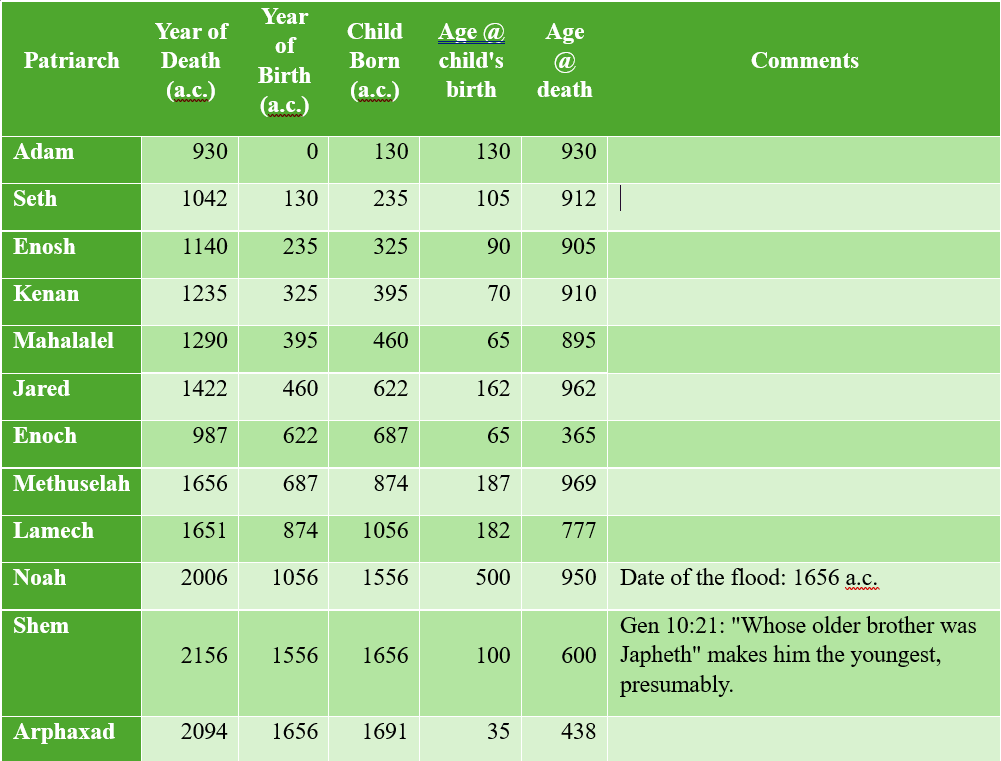
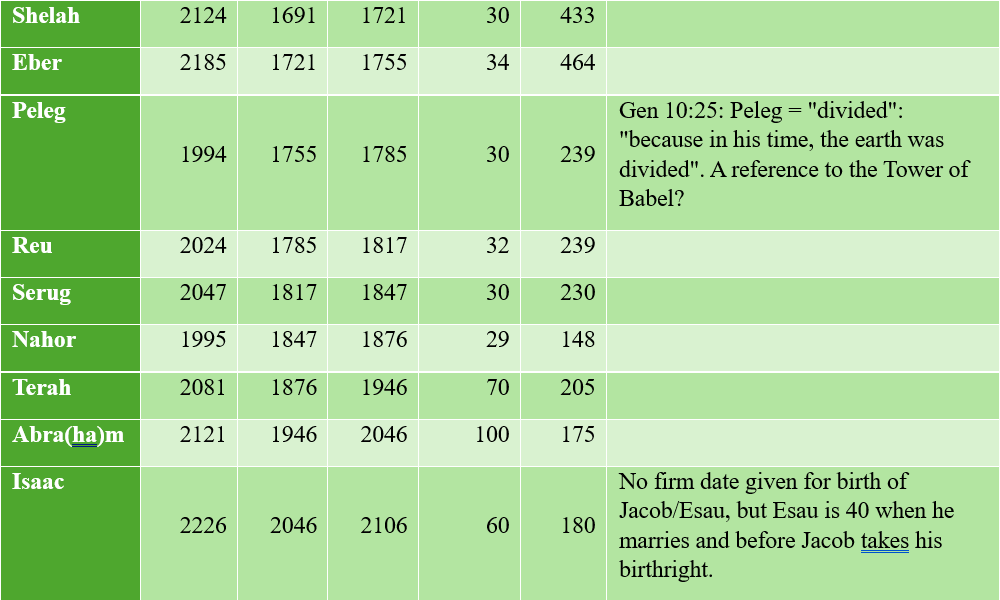
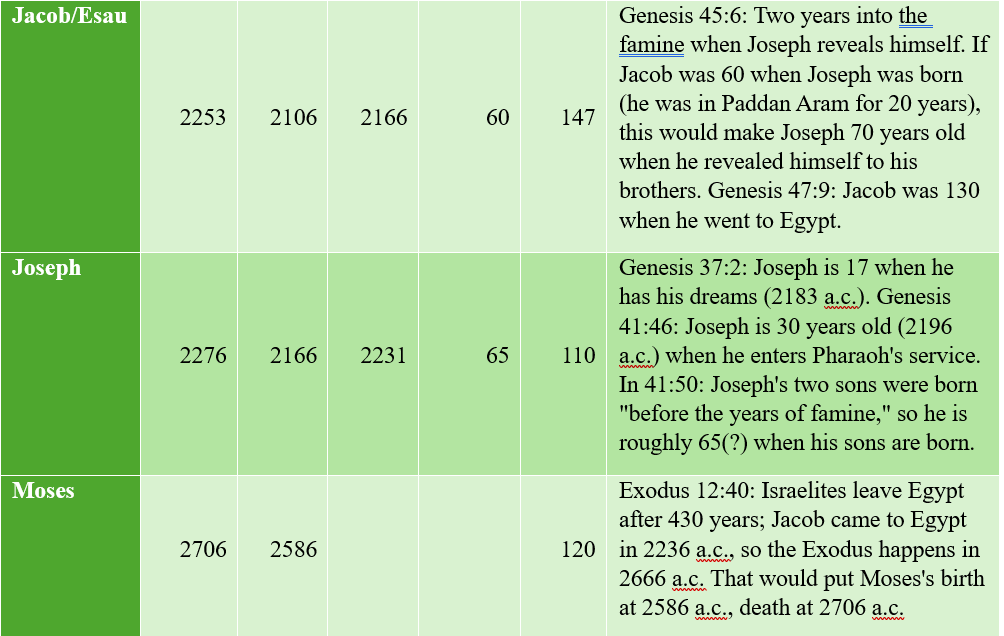

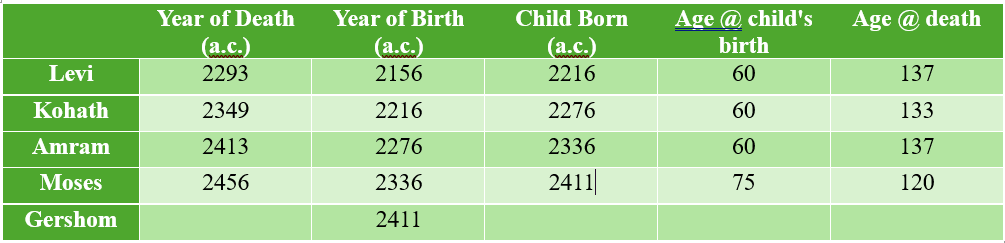

 Sunday Morning Greek Blog