Sunday Morning Greek Blog

October 21, 2025

Practicing Persistence (Luke 18:1–8; 2 Timothy 3:14–4:5)

I preached this message October 19, 2025, one week after Mount View’s 70th Anniversary celebration.

The Lord be with you.

In the late fifth century BC, Athens successfully defended its right to govern itself as a democracy in the Peloponnesian War. In the Funeral Oration of Pericles, its author Thucydides says this about freedom to the Athenians: “For you now it remains to rival what they [Pericles and the soldiers who died in the first year of the Peloponnesian War] have done and, knowing the secret of happiness to be freedom and the secret of freedom a brave heart, not idly to stand aside from the enemy’s onset” (Per Bartlett’s Quotations; alternate translation: “These take as your model, and judging happiness to be the fruit of freedom and freedom of valor, never decline the dangers of war”[1]). In other words, freedom required everyone to defend it as a matter of lifestyle.

About 800 years before that, about 2,000,000 newly freed slaves found themselves at the foot of Mount Sinai ready to receive their document of freedom from Egypt and self-governance: the Ten Commandments. But just before that happened, Moses had a visit from his father-in-law Jethro. Up to that point, Moses had been the sole judge and leader of Israel through the early days of wilderness wandering. Jethro realized what a huge task Moses had before him and suggested he might want to delegate some of the responsibility to capable men to help ease his burden. Jethro gave him this advice in Exodus 18:21–22a:

Select capable men from all the people—men who fear God, trustworthy men who hate dishonest gain—and appoint them as officials over thousands, hundreds, fifties and tens. 22 Have them serve as judges for the people at all times, but have them bring every difficult case to you.”[2]

For our gospel passage this morning, it’s important to note what the qualifications are for the first judges ever appointed for the Hebrews: “Men who fear God, trustworthy men who hate dishonest gain.” Contrast that with the description of the judge in our gospel passage this morning: “A judge who neither feared God nor respected man.”[3]

As we’ve been going through Luke gospel, we’ve seen quite a few parables, and a few of them have featured some rather questionable characters. In the Parable of the Lost Son, we saw the son who wasted his inheritance on riotous. Immediately after that parable, we looked at the parable of the shrewd manager who did some sneaky stuff to make himself and his master look good. Then we saw the rich man who ignored the invalid Lazarus at his gate. So it shouldn’t surprise us to find an unscrupulous judge in this parable who has no regard for the law of God or the human condition.

But we also have a persistent widow in our passage today, and some of these same parables we’ve looked at had a persistence theme in them as well. Just before the Parable of the Lost Son, we have two parables about a woman who swept her whole house to look for a lost coin and a shepherd who left his 99 sheep unattended in the pen while he went off to search for one lost sheep. We also have the story of the ten lepers who cried out to Jesus to heal them, and of course, he did.

And one more thing before we get to our passage this morning: Jesus has just finished answering the pharisees’ question about when the end would come. He addresses them only briefly by telling them “The kingdom of God is in the midst of you.” Jesus turns to his disciples and paints a rather bleak picture of what the end will look like. Not only does he compare the end of days to the fire and brimstone of Sodom and Gomorrah, but he also speaks of separation from their loved ones.

So you can see why Luke introduces the Parable of the Persistent Widow with “He told them a parable to the effect that they ought always to pray and not lose heart.”

So we come to the high point of the story here: the faithful persistence of a poor widow who had no family, apparently, to help her versus a heartless, uncompassionate, and corrupt judge who only looked out for himself. Who will win this showdown?

Now even though this is a parable, some might think Jesus has a particular judge in mind when he starts this parable. It’s interesting that Jesus begins this parable with the words (according to most English translations) “In a certain city….” What most English translations don’t let you know that the word translated “certain” is also used to describe the judge: “In a certain city there was a certain judge….” Now it gets more intriguing.

Based on Jesus’s final statement in verse 8, he could also be referring to the general state of justice in Israel. It’s like he’s saying to his audience: “You know how it is. Wherever you go, there’s always that one judge. Yeah, you know the type: corrupt as a three drachma coin!” In spite of the judge being a scoundrel, the woman peacefully (that’s important to note) but repeatedly came to the judge to request protection from her “adversary.” It’s not clear who her adversary was or why they were her adversary; that’s not important to the story. And it’s not clear what sort of “attack” the judge feared from the woman. It’s doubtful it would have been a physical attack; more likely an accusation about the judge’s integrity and ability to be a fair judge.

The end result in the parable is that the judge does grant the woman relief. Jesus goes on to give the lesson of the parable: We need to be persistent in prayer. “Pray continually” as Paul puts it in 1 Thessalonians 5:17. Jesus throws in a rhetorical question, however, at the end of the passage: “When the Son of Man comes, will he find faith on the earth?” The implication here is that the kind of faith that prompts people to pray at all, let alone continually, may be extremely rare in the last days.

I was at my home church’s annual men’s retreat on Friday and Saturday. I think I’m the only one left with perfect attendance at the retreats since they started in 2013. I was encouraged to see a lot of younger men come out this time, many new faces, who were excited about their faith and the opportunity to fellowship and develop that deeper connection to God. God is on the move to bring revival again, especially with the assassination of Charlie Kirk, and I think if Jesus came back today, he could answer the question about finding faith on earth a resounding yes.

But it will take more than just persistent prayer to maintain that faith. The power of prayer is supported by the foundational truths of the faith as written in Scripture. The other New Testament passage in the Lectionary today focuses on that: 2 Timothy 3:14–4:5:

14 But as for you, continue in what you have learned and have become convinced of, because you know those from whom you learned it, 15 and how from infancy you have known the Holy Scriptures, which are able to make you wise for salvation through faith in Christ Jesus. 16 All Scripture is God-breathed and is useful for teaching, rebuking, correcting and training in righteousness, 17 so that the servant of God p may be thoroughly equipped for every good work.

4 In the presence of God and of Christ Jesus, who will judge the living and the dead, and in view of his appearing and his kingdom, I give you this charge: Preach the word; be prepared in season and out of season; correct, rebuke and encourage—with great patience and careful instruction. For the time will come when people will not put up with sound doctrine. Instead, to suit their own desires, they will gather around them a great number of teachers to say what their itching ears want to hear. They will turn their ears away from the truth and turn aside to myths. But you, keep your head in all situations, endure hardship, do the work of an evangelist, discharge all the duties of your ministry. [4]

The last part of chapter 3 we just read emphasizes the need for continuing in and continually learning from God’s word by diligent study. Timothy himself had been steeped in the study of God’s word from early on in his life; he probably knew more about scripture than most of the apostles, and so he had, seemingly, a greater responsibility for taking the lead in spreading the good news.

We also see here the familiar passage about God’s word being fully inspired, that is, “God-breathed.” The original “written” word would most likely have been considered 100% accurate in spite of being first written by the hands of men. While Paul’s statement here primarily refers to the Old Testament scripture, we do get a hint in 2 Peter 3:16 that Paul’s letters seem to be quickly attaining the status of Scripture as well. Scripture is “profitable” (ὠφέλιμος ōphelimos) for “teaching, rebuking, correcting, and training in righteousness”; dedication to studying Scripture helps solidify it in our hearts and minds.

Paul ordains Timothy in the opening verses of chapter 4, most likely for taking over the leadership of the church at Ephesus. Paul wants Timothy to make sure the church in Ephesus will stay strong in their faith. His primary charge to Timothy is to “Preach the word!” The tradition of the Christian university where I attended seminary referred to a young man sponsored by his home church to go to Bible college as a “Timothy.” The rallying cry of that school when it was founded just after the end of WWII was “The Preachers Are Coming!” Note that this preaching included the very things that chapter three said about the word of God: “Correct, rebuke, and encourage—with great patience and careful instruction.”

The current revival we’re seeing especially of young people either returning to or for the first time checking out church reveals that we have been in a time that Paul describes in 4:3: people are concocting and promoting crazy ideas about God, Christianity, and faith. We are a family of people who love our brothers and sisters in the faith deeply, yet the world tries to make a caricature of that by projecting their own shortcomings onto believers broadly.

Like Lyle said last week, if we want to have another 70 years of fruitful ministry, we need to trust “the man with the plan,” Jesus. We can certainly pray for more people to come but we also have to be willing to take some action steps as well to get the word out. We have to let people know that we’re here for them by going out and meeting them where they’re at. We can plant and we can water. We can serve and persuade. We can invite and enroll. But ultimately, as Paul says in Corinthians, it is God who causes the growth. He sends just what and who is needed to accomplish his will and purposes for the kingdom, and he does it in his good timing.

I think Paul says it best in Romans 10:14–15: 14 How, then, can they call on the one they have not believed in? And how can they believe in the one of whom they have not heard? And how can they hear without someone preaching to them? 15 And how can anyone preach unless they are sent? As it is written: “How beautiful are the feet of those who bring good news!”[5] In other words, we need a spiritual pedicure. Now I thought I was the only one with an odd enough sense of humor who could come up with the phrase “spiritual pedicure,” but when I searched the phrase, I found a sermon by Josh Cardwell from Revolution Church in Crossville, Tennessee entitled “Time for a Spiritual Pedicure.” I’m gonna have to meet this guy.

I am proud of this congregation and I am grateful that I got to share in the 70th anniversary celebration last Sunday of your “beautiful feet,” the ministry you’ve sustained during that time. It’s kind of wild for me to realize that I was born within the first 10 years of this congregation. My how time flies. My hope and prayer is that Mount View will continue to be a vital presence in this community and neighborhood. We have a rich tradition and experience to offer those seeking to get reconnected with the kingdom of God. I pray that we continue to be a bright and shining light in a dark world. Amen.


[1] Thucydides. 1910. The Peloponnesian War. Medford, MA: London, J. M. Dent; New York, E. P. Dutton.

[2] The New International Version. 2011. Grand Rapids, MI: Zondervan.

[3] The Holy Bible: English Standard Version. 2016. Wheaton, IL: Crossway Bibles.

[4] The New International Version. 2011. Grand Rapids, MI: Zondervan.

[5] The New International Version. 2011. Grand Rapids, MI: Zondervan.

August 31, 2025

In Defense of “Thoughts and Prayers”: (Psalm 81:10–16; Jeremiah 2:9–13)

I preached this message August 31, 2025, the Sunday after the school shooting in Minneapolis. This was a rough one to preach, as I tried not to get too political. But I’ve also had a long history of interacting with the LGBT community and promoting a compassionate response from Christians even in the face of sometimes harsh disagreements. The congregation received it well.

Jesus says this in Luke 12:8–10:

“I tell you, whoever publicly acknowledges me before others, the Son of Man will also acknowledge before the angels of God. But whoever disowns me before others will be disowned before the angels of God. 10 And everyone who speaks a word against the Son of Man will be forgiven, but anyone who blasphemes against the Holy Spirit will not be forgiven.[1]

The events of this week compel me to address a completely different subject than what is suggested by the texts we read in the bulletin today. But other passages from today’s Lectionary readings are completely on target for what I’m addressing today, so I will work those in as I go along.

With each school shooting or other mass casualty event perpetrated by those who seem to have lost their moral compass, the common-courtesy sentiment of “Our thoughts and prayers are with you” seems to come under increasing attack by those who rarely, if ever, have expressed any modicum of faith God. As a Christ-follower, I find this attitude incredibly difficult to understand. When a loved one dies, many of us will say something like, “I’m sorry for your loss” and perhaps follow that up with “My thoughts and prayers are with you.” How long before “I’m sorry for your loss” becomes a target of those who have no faith in God?

Now most of you, I think, can attest to the fact that I have been extremely cautious about addressing politics in my messages. For me to address something that might even come close to a political position, I would need to lay out a clear biblical principle for which I think we have some common ground as Christ-followers. Our salvation does NOT depend on our politics: who we voted for; what platform we support, and so forth. Our salvation depends completely on what Jesus accomplished on the cross and in his resurrection. Period. This morning is one of those mornings where the spiritual and faith issues outweigh whatever political concerns may be.

This issue of people who perceive themselves to have a certain amount of power and influence criticizing our “thoughts and prayers” is insulting to Christ-followers in more ways than one. That sentiment is NOT political, but spiritual, and it’s a spiritual act of warfare against those who may only have thoughts and prayers to offer. First, it calls into question the sincerity of those who express “thoughts and prayers.” It is an act of arrogant judgment against well-meaning people who are in fact more likely to pray and think about those affected than their self-absorbed critics are. Do they really expect that everyone has something more actionable to offer up? It’s almost as if they’re saying, “Just keep your mouth shut about God and let us handle it.

Second, those who have a critical attitude about “thoughts and prayers” have probably crossed over the line of the unforgiveable sin of blasphemy against the Holy Spirit by denying the power of our thoughts and prayers. The cultural, societal, psychological, and political issues raised by tragic events are extremely complicated many times and as such can be overwhelming to the average person. “My thoughts and prayers are with you” is a simple statement that on the one hand represents “I understand the enormity of the situation,” but on the other hand is a desire to reach out to a power greater than themselves and perhaps try to gain some insight into actionable solutions, especially within their own faith communities.

Third, “thoughts and prayers” is an immediate, courteous response to a tragedy. It’s another way of saying “Let me know how I can help” or “Let me know what specific things I can pray about for you.” It’s an invitation to build community, especially in situations where the victims may have been vulnerable or marginalized. It is an offer to drill down deeper and address the root causes of the symptomatic manifestations of the problems and not just the symptoms themselves. It may be true that actions speak louder than words, but thoughtless actions or actions that fly in the face of God’s divine plan or a Judeo-Christian ethical framework may lead to even more disastrous results. I fear that we may be on the brink of the latter if we as Christ-followers do not act upon God’s prompting to give thoughtful consideration to both how we pray and what we pray for. In fact, this seems to be an age-old problem that the psalmists and the prophets wrestled with thousands of years ago.

Hear these words from the prophet Jeremiah 2:4–13 as he warns Judah of the coming exile:

Hear the word of the Lord, you descendants of Jacob, all you clans of Israel.

This is what the Lord says:

“What fault did your ancestors find in me, that they strayed so far from me?

They followed worthless idols and became worthless themselves.

They did not ask, ‘Where is the Lord, who brought us up out of Egypt and led us through the barren wilderness, through a land of deserts and ravines, a land of drought and utter darkness, a land where no one travels and no one lives?’

I brought you into a fertile land to eat its fruit and rich produce.

But you came and defiled my land and made my inheritance detestable.[2]

The priests did not ask, ‘Where is the Lord?’

Those who deal with the law did not know me; the leaders rebelled against me.

The prophets prophesied by Baal, following worthless idols.[3]

“Therefore I bring charges against you again,” declares the Lord. “And I will bring charges against your children’s children.

10 Cross over to the coasts of Cyprus and look, send to Kedar j and observe closely; see if there has ever been anything like this:

11 Has a nation ever changed its gods?

(Yet they are not gods at all.)

But my people have exchanged their glorious God for worthless idols.

12 Be appalled at this, you heavens, and shudder with great horror,” declares the Lord.

13 “My people have committed two sins:

They have forsaken me, the spring of living water, and have dug their own cisterns, broken cisterns that cannot hold water.[4]

When we look at a school shooting like what happened in Minneapolis this past week or at a Tennessee Christian school a couple years ago or even the one in Uvalde, Texas, we’re dealing with two primary causes in my mind. The first is a mental health issue. Setting the issue of gender dysphoria aside for the moment, which appears to have been a contributing factor in at least two of these instances based on the shooters’ manifestos, I think most of us agree that something went terribly wrong in the minds of those who think they needed to vent whatever anger or hatred they had on soft, easy targets like a grade school. Somewhere along the way, someone missed or intentionally overlooked important clues about a child’s or young person’s possible predisposition toward violence, if it was even there.

The fact that we’re human and NOT omniscient about everyone’s predispositions is, then, one of the primary reasons why we need “thoughts and prayers.” Our thoughts help us to examine a situation or situations we find ourselves in and make judgments about what is going on around us. “See something; say something” is the typical line we use. I would rather be guilty of misjudging a potential problem than ignoring it all together.

The second thing we’re dealing with is the problem of evil. My experience in interacting with people in the LGBT community goes back to the mid-1980s when my pastor asked me to speak with someone my age who was struggling with overcoming his attraction to men. We met a couple times and he even came to a couple of our college-group Bible studies. This was right before I left for seminary in 1987, so I lost touch with him and never found out where he landed.

When I got to seminary, I had a friend in the college who wanted me to talk to another young man about similar issues. If I remember correctly, he was a former student at the Bible college. But then I also had a college friend in the dorm at seminary who was raped by a male seminary student. He was kicked out of the seminary.

When I started as a campus minister in 1989 at Northern Illinois University, I discovered they had the largest “Gay-Lesbian Student Union” in the nation. Their rhetoric in the student paper was extremely hostile to Christianity and the church. But I was undaunted at the time and walked straight into the lion’s den and said I would like to have a productive, public dialogue with them and give them a more positive view of Christianity. I was invited to several forums to discuss the issues and concerns and had earned the respect of some of the panelists and leaders. I was able to present the conservative Christian view of homosexuality at a diversity conference back before DEI was a thing. I was even interviewed for a grad student’s documentary on gays in the military, and my commentary was included in the final production.

In the past ten years the issue has hit closer to home as I have several friends and extended family members who’ve had to navigate these kinds of issues. I am not without compassion when it comes to these issues, but I have strongly held beliefs based on nearly 40 years’ experience.

I say all this not to pat myself on the back, but to show that I’ve got some street cred when I speak about LGBTQ issues and that I’m not just spouting viewpoints from one particular perspective. I’ve done my homework., and I think that’s an important part of the “thoughts” when I say my thoughts and prayers are with the victims of the latest school shooting.

When I say this is a problem of “evil,” then, it is “evil” in the sense that I have developed a firm conviction that ANY sexual activity outside the bonds of heterosexual matrimony, regardless of the gender of those involved, is deemed to be a violation of God’s divine design for humanity. The author of Hebrews says in 13:4: “Marriage should be honored by all, and the marriage bed kept pure, for God will judge the adulterer and all the sexually immoral.”

For whatever reason, the apostle Paul in his treatise on “the obedience that comes from faith,” otherwise known as Romans, feels it’s important in the first chapter to address the issue of “unnatural” relations between women and the “shameful acts” between men (Romans 1:24–32). He makes no bones about having the proper relationship with the opposite sex and keeping that relationship pure.

One more thing before I move on. The word translated “homosexual” in 1 Corinthians 6:9 is translated as “fine clothes” in the gospels, and “soft” in reference to an animal’s coat or a grassy field on which horses train in ancient Greek literature. But when the word is applied to persons in ancient Greek literature, it always takes on a negative connotation. In the Iliad, it is used to describe a ship captain, Hector, who is dead because his body was “softened” with many spears. It also applies to a soldier who does not want to fight bravely. But in 1 Corinthians 6:11, Paul assures his readers that, because of their redemption, they no longer bear that shameful title.

I think it’s important as a church then, no matter how uncomfortable we may be, to address the issue of gender dysphoria. At a very high level, what happens is that a young person somehow develops a certain stereotype of what they think it means to be a boy or a girl, or a young man or a young woman and then decides their mindset somehow better aligns with the opposite sex or that they don’t like the stereotype for themselves.

Now I’m not trained in counseling people with gender dysphoria, so I can’t say for sure what happens to a young person at this point, but I think it’s safe to say that influences on them become more intense and come from a number of different angles and perspectives, some of which may not be honorable or based in a Christian compassionate care model. In other words, it can get really confusing for a young person who isn’t even sure if their initial self-analysis of the stereotype is based in reality. It’s easy to see why they feel anxious about what is going on in their lives. They and their families must be under an incredible amount of pressure given the potential backlash they may encounter.

Compassion must be the key here, and often it’s not. Gender dysphoria is, by definition, a psychological or mental health diagnosis. As such, then, the first method of treatment in many people’s minds should be some form of mental health counseling, and many States have already passed such laws to require that prior to any discussion of transitioning. Providing a physical, surgical “fix” to a person’s gender dysphoria issues is far from a perfect fix, and studies show that it creates a whole new set of mental health issues in many cases, and not a few have desired to be detransitioned. In some respects, it’s like soldering an electrical cord to the two ends of the battery contacts in a battery-operated radio. The radio is designed to run on the voltage of a couple batteries. It’s not designed to take 120 volts straight from the outlet! You need an adapter. But God did not design the human body to undergo such a transition. Great Britain, to their credit, has stopped transition surgeries on youth altogether because they have begun to recognize the solution was worse than the original problem.

I started out by saying I wanted to defend those who say “My thoughts and prayers are with you.” What I’ve given you hear is a sampling of the “thoughts” that I bring into the situation, and no one can accuse me of not having any intention of taking action on this subject consistent with Christian compassion and not in defiance of God’s creative order. This isn’t an empty sentiment with me, and I’m sure it’s not with you either. I’m guessing some of you have these experiences in your own families or among your friends and that you’ve already formed your opinions. I’m speaking from my own perspective here and I don’t expect everyone to agree with me. Jesus died for everyone, and that includes trans people or anyone else in the LGBT community. Regardless of where you fall on this issue, always show compassion and the love of Christ to those who need it most.

As for prayers, this is not an empty sentiment either, especially when we consider what the Bible tells us to pray for. Here’s just a sample: [NOTE: The congregation received a separate list of these verses as a help to guide them in their “thoughts and prayers.” I ran out of time when we got to this point, so I picked a few and said a brief prayer based on each one to close out the message.]

2 Chronicles 7:13–14:

13 “When I shut up the heavens so that there is no rain, or command locusts to devour the land or send a plague among my people, 14 if my people, who are called by my name, will humble themselves and pray and seek my face and turn from their wicked ways, then I will hear from heaven, and I will forgive their sin and will heal their land.[5]

Nehemiah 6:9, as the Jews are being threatened for rebuilding the walls of Jerusalem:

They were all trying to frighten us, thinking, “Their hands will get too weak for the work, and it will not be completed.”

But I prayed, “Now strengthen my hands.” [6]

Acts 2:25–26, 30–31

25 You spoke by the Holy Spirit through the mouth of your servant, our father David:

“ ‘Why do the nations rage and the peoples plot in vain?

26 The kings of the earth rise up and the rulers band together against the Lord and against his anointed one.[7]

30 Stretch out your hand to heal and perform signs and wonders through the name of your holy servant Jesus.”

31 After they prayed, the place where they were meeting was shaken. And they were all filled with the Holy Spirit and spoke the word of God boldly.[8]

Romans 12:9–21, esp. 17–18

17 Do not repay anyone evil for evil. Be careful to do what is right in the eyes of everyone. 18 If it is possible, as far as it depends on you, live at peace with everyone.[9]

Ephesians 3:10–11

His intent was that now, through the church, the manifold wisdom of God should be made known to the rulers and authorities in the heavenly realms, 11 according to his eternal purpose that he accomplished in Christ Jesus our Lord.[10]

Ephesians 6:12

12 For our struggle is not against flesh and blood, but against the rulers, against the authorities, against the powers of this dark world and against the spiritual forces of evil in the heavenly realms.[11]

1 Timothy 2:1–2

I urge, then, first of all, that petitions, prayers, intercession and thanksgiving be made for all people—for kings and all those in authority, that we may live peaceful and quiet lives in all godliness and holiness.[12]

James 5:16b

The prayer of a righteous person is powerful and effective.[13]

Psalm 81:10–16

10 I am the Lord your God, who brought you up out of Egypt.

Open wide your mouth and I will fill it.

11 “But my people would not listen to me; Israel would not submit to me.

12 So I gave them over to their stubborn hearts to follow their own devices.

13 “If my people would only listen to me, if Israel would only follow my ways, 14 how quickly I would subdue their enemies and turn my hand against their foes!

15 Those who hate the Lord would cringe before him, and their punishment would last forever.

16 But you would be fed with the finest of wheat; with honey from the rock I would satisfy you.” [14]


[1] The New International Version. 2011. Grand Rapids, MI: Zondervan.

[2] The New International Version. 2011. Grand Rapids, MI: Zondervan.

[3] The New International Version. 2011. Grand Rapids, MI: Zondervan.

[4] The New International Version. 2011. Grand Rapids, MI: Zondervan.

[5] The New International Version. 2011. Grand Rapids, MI: Zondervan.

[6] The New International Version. 2011. Grand Rapids, MI: Zondervan.
[7] The New International Version. 2011. Grand Rapids, MI: Zondervan. (Quote from Psalm 2:1–2)
[8] The New International Version. 2011. Grand Rapids, MI: Zondervan.

[9] The New International Version. 2011. Grand Rapids, MI: Zondervan.

[10] The New International Version. 2011. Grand Rapids, MI: Zondervan.

[11] The New International Version. 2011. Grand Rapids, MI: Zondervan.

[12] The New International Version. 2011. Grand Rapids, MI: Zondervan.

[13] The New International Version. 2011. Grand Rapids, MI: Zondervan.

[14] The New International Version. 2011. Grand Rapids, MI: Zondervan.

July 13, 2025

Who Is YOUR Neighbor? (Luke 10:25–37)

I preached this message July 13, 2025, at Mount View Presbyterian Church in Omaha, NE.

Good morning. The Lord be with you.

I imagine that most of us either grew up watching Mr. Rogers’ Neighborhood or had young children who watched that show. (It’s okay to admit it if you watched it with your kids.) As a kid, one of my favorite parts of the show was when he sang “Who Are the People in Your Neighborhood?” He would usually find someone who could demonstrate their talents or skills. When I watched it with my kids later on, that had become a visit to a factory where something was made. I was fascinated by the episode on how aluminum foil was made.

Of course, being a train lover, my other favorite part of the show was when Trolley went to the Magic Kingdom. I never thought much about it as a kid, but as a parent it dawned on me, spoiler alert here, that Mr. Rogers was doing most if not all of the puppet voices.

As a kid, it was just a fun show to watch. But as I watched it as an adult with my kids, especially in the small rural town we lived in in Illinois and where I served as a pastor, I began to broaden my concept of who my “neighbors” were. I used to think “neighbors” were just the people who lived in the houses around us. But as I would go for walks with the kids or go to the park with them, we would meet people we didn’t know or I would meet the parents of my kids’ classmates.

If I said hi to someone in passing, my kids sometimes asked, “Who was that?” If I didn’t know their name, I would usually say, “That’s one of our Paxton neighbors.” After all, they may have been neighbors to people in our congregation, so I wanted to make sure they knew that the newcomer to the town wanted to fit in.

In Mediterranean culture, the concept of neighbor had a slightly different nuance. Their culture was steeped in the concept of “in-group” vs. “out-group.” The concept of neighbor went much further than just people who live near you. Bruce Malina, a Theology professor who taught for 48 years at Creighton before his death in 2017, defined “neighbor” in the Bible this way:

“The term refers to a social role with rights and obligations that derive simply from living close with others—the same village or neighborhood. Neighbors of this sort are an extension of one’s kin group.”[1]

In other words, neighbors were family and were to be treated like family. Along with that, being considered family meant you had a certain degree of honor in the community as well. But that wasn’t a hard-and-fast rule for Jews. If you did something to violate the honor or trust you had in the community, you would most likely be shamed or even ostracized. If you got drunk and embarrassed yourself or got in a fight or damaged someone else’s property, the community would not excuse or overlook such behavior. If you stole from your neighbor or committed adultery, you got more than a slap on the wrist. You would find yourself in the out-group.

These concepts of honor and shame, in-group and out-group, have lost their force in modern culture. Malina documents that in one of his other books.[2] In fact, in some respects, this has been flipped on its head. The in-groups value law and order in their communities and have certain expectations about what good behavior looks like, while the out-groups, something that used to carry shame and guilt, are now intentionally and sometimes violently trying to disrupt the law and order and care little about good behavior or even trying to be restored to an in-group.

It’s not that there’s only one in-group for everybody either. Several in-groups peacefully coexisted in neighboring communities and were distinguished by any number or combination of cultural and ethnic characteristics. But they all had the overarching concept of honor and shame and could peacefully interact with other in-groups when they acted honorably and without malice. If anyone acted with malice or violence toward another in-group, the gloves were off at that point.

This is some of the cultural background that was assumed by the authors of the Bible when they wrote. We in America tend to read the Bible through our 21st-century cultural lens and will sometimes get a little uncomfortable with the way the Bible describes a certain scenario. That’s because the scenario is set in a time and place with a completely different worldview. This Mediterranean worldview is the lens through which we should view the Parable of the Good Samaritan.

One caveat, I’m not excusing anyone’s behavior in the story. Jesus clearly expects the expert in the law to come up with the only right answer to the question he asked after Jesus finishes the story. Yet we’re somewhat uncomfortable with the fact that servants of God bypassed the wounded man in the parable.

First off in the story, we notice that the man is not identified by any ethnic or cultural features. In the story, he’s just a man. He also appears to be traveling alone. The path from Jerusalem to Jericho was a bit of a challenge, a descent of nearly 3,400 feet over 17 miles, so that’s a 200-foot change in elevation every mile through rocky terrain. Plenty of places for bandits to hide.

Priests and Levites were generally respected in that day, and they were easily recognizable as well by the garments they wore. As such, many people would have looked up to them, even those people who were not Jewish, so they would not have typically been targeted by bandits. It’s not that the bandits cared about their reputation with any one group; they just knew that the civil and legal penalties for them would have probably been a lot more severe.

For the priest and Levite, those jobs were their livelihood and gave them a certain social standing within their “in-groups.” When each of them walked by the bloodied-up man on the side of the road, their first thought wasn’t to help. There’s no indication in the story that either of them even bothered to check if the man was Jewish himself. No, their first thought was, “If this man is dead, I’m going to be unclean and not able to do my job.” They had a legalistic view of the law that they thought they could use to protect their “status” in their in-groups, but we all know by now that Jesus wasn’t interested in the legalistic interpretation.

The people hearing the story, including the expert in the law who asked the question, probably expected that would be the behavior of the priest and the Levite. But then Jesus throws a twist into the story that the expert may not have been expecting. He says a Samaritan came along and helped the man thoroughly, even using his own money to pay for his care until he could return. Now Samaritans were definitely not part of the Jews’ in-group. So when Jesus asks the expert to identify which one was the neighbor, you can imagine that the expert must have gulped a bit and tugged at his collar uncomfortably.

Since the Jews were known for walking around Samaria rather than going through it, which was the more direct route, one could say here that the priest and the Levite treated the wounded man like a Samaritan, even though they probably didn’t know if the man was a Samaritan. If the man was a Jew, then they actually violated a cultural norm that was probably considered to be on the same level with the Law.

Meanwhile, the Samaritan, who doesn’t hate the Jews as much as the Jews hate them, chose to treat the man like he would treat his own family, without concern for whether the man was Samaritan, Jew, or some other ethnic background. In other words, as the law expert correctly discerned, the Samaritan treated the man like a neighbor.

What Jesus is obviously getting at here then is that being a neighbor or showing a stranger the same level of respect as a neighbor isn’t a noun or an adjective, it’s a verb. It doesn’t matter what your background is; you’re considered a neighbor by the way you treat those you come in contact with. That doesn’t mean you’ve abandoned your primary in-group and joined the stranger’s in-group, nor does it mean you’ve adopted or supported any beliefs or customs of the stranger’s in-group contrary to your own. When you act like a neighbor, you’re not “guilty by association,” at least not from Jesus’s perspective.

In verse 29, Luke tells us the legal expert wanted to “justify himself” by asking the question. Do you suppose the legal expert accomplished that? I’m guessing not, but we’ll never know. Just because Jesus tweaked the definition of neighbor here doesn’t mean he overturned the idea of one’s own “kinship” in-group, though. The question each of us must ask, then, is the same question Mr. Rogers sang in his show: “Who are the people in YOUR neighborhood?” Not only that, but “How are you loving the people in your neighborhood?” You may have guessed by now that when I say “neighborhood,” I don’t just mean inside these four walls.

In an age where we’re personally and increasingly isolated by either technology or mobility, it’s important that we have a neighborhood to connect with so we can feel the support, love, and encouragement that comes from those associations. I pray that you might get to know a new neighbor this week and share the love of the savior with them. Peace to you. Amen.

One-Time
Monthly
Yearly

Please consider a one-time tip. All funds go directly to me for the maintenance of this blog site and are NOT tax-deductible. Thank you.

Make a monthly donation

Make a yearly donation

Choose an amount

$5.00
$15.00
$100.00
$5.00
$15.00
$100.00
$5.00
$15.00
$100.00

Or enter a custom amount

$

Your contribution is appreciated.

Your contribution is appreciated.

Your contribution is appreciated.

DonateDonate monthlyDonate yearly

[1] Malina, Bruce J. Windows on the World of Jesus: Time Travel to Ancient Judea. Westminster/John Knox Press, Louisville, KY, 1993, p. 52.

[2] Malina, Bruce J. The New Testament World: Insights from Cultural Anthropology. Revised Edition. Westminster/John Knox Press, Louisville, KY, 1993, pp. 82–86.

My opinions are my own, except where otherwise cited.

Scott Stocking

May 19, 2025

Monuments of Our Faith

A Testimony by Scott Stocking (my views are my own).

Last week, I had the opportunity to see some of Nebraska’s unique monuments and historical sites. I have already written about my experience at Fort Robinson last weekend and how impactful that was to my spiritual well-being. The Sunday after that, I decided I would get a couple places in my National Parks Passport book checked off, essentially since they were relatively close by and no more than a reasonable detour for my trip home.

From Fort Robinson, I headed west on US 20 to Harrison, Nebraska, and from there, I took Nebraska State Highway 29 south toward Mitchell, Nebraska. (I don’t think there’s any hidden meaning in the fact that I had begun my trip west on State Highway 92.) The sign I saw when leaving Harrison said, “No services next 56 miles.” That should let you know just how remote that part of Nebraska is. I saw more tumbleweeds blow across the highway between Harrison and the outskirts of Mitchell than I did residences!

I did find some relief, however, at the Agate Fossil Beds National Monument about halfway between Harrison and Mitchell. The visitor center is about three miles off the highway and was modern and welcoming. I watched a 12-minute movie about the ancient history of the site revealed by the fossil finds, as well as the more recent history of the Native Americans who dwelt in the region. If I had had more time, I would have loved to venture off to one of the dig sites, with the fossil display and the James Cook Gallery (James Cook is the rancher who discovered the fossils).

My next stop was Scotts Bluff National Monument. This is an impressive geological feature along the historic Oregon Trail that served as milestone for travelers along that trail. I had not known that you could drive to the top of the bluff, so I took advantage of that opportunity as well (you can see about 80 miles from the top barring any terrain obstructions). At the top is the placard to Hiram Scott (links to NPS history), who had been abandoned by his employer and died in the vicinity around 1828. The details of his demise are uncertain as we have a few post-mortem accounts of his death up to six years later from various sources that do not agree on every detail. He doesn’t appear to have done anything remarkable or noteworthy other than having been a fur trader, yet his legend was significant enough to ascribe his name to the area, which later became a national monument. In fact, it occurred to me that the sheer face of the bluff is shaped like a giant tombstone.

My final stop at a national monument site on the way home was Chimney Rock National Historic Site (U.S. National Park Service). This has long been an iconic symbol of Nebraska, having the privilege of being the image on the obverse side of the State’s quarter dollar coin. The first thought of most, I think, is that it is the inert remnant of a volcano, given the “chimney” is made of different stuff than the rock it rises from.

According to the NPS Web page, Chimney Rock is the most-referenced geographical feature in pioneer diaries. One quote about it compares it to an ancient pyramid. I bought a T-shirt there that suggests maybe there’s a flying saucer hidden under the structure and the spire is its antenna! I think it would have been a much better site for filming Close Encounters of the Third Kind! While I’m waxing fancifully about conspiracy theories, I might as well speculate that maybe Sasquatch has a secret hideout there as well!

None of these fanciful theories detract from the beauty and majesty of single cone surviving in that region amongst all the giant bluffs and buttes one sees to the west of that location along the historic pioneer trails. For those early pioneers, it was a sign that they were on the right track and had some hope of making it to points further west.

Monumental Lessons

I suppose one could make any number of subjective spiritual connections to these monument sites depending on their life experiences. Many years ago, I wrote about my own “exodus” from Egypt that was Illinois, governed primarily by corrupt Chicago-machine politics with an unemployment rate twice that of Nebraska. If ever there was an argument for a governor of a State to be elected by an electoral college (and Chicago only gets one elector!!) instead of the popular vote, it would be Illinois. In that article (A Tale of Two Photos | Sunday Morning Greek Blog), I wrote about the fiery red sky I’d taken a picture of, with the clouds moving west (usually they would move east).

After the fact, I interpreted that as God calling me back to Nebraska (a Big Red cloud bank moving west, get it?). It was around that time I started hearing the Nebraska fight song in my ears, and it was NOT the ring tone on my flip phone. When I remarried in 2014, my wife and I made annual trips to her family’s cabin in Poudre Canyon. We would fly along I-80 at 75+ mph toward Cheyenne, but I always wished that we’d had a little more time to take the long way around to see Chimney Rock and Scotts Bluff, places I hadn’t seen since my childhood.

Seeing Chimney Rock especially reaffirms the decision I made 15 years ago to follow that “Big Red” cloud west back to Omaha, where I grew up. But I also knew I needed to eventually get to Chimney Rock, that signature geographic wonder in my home State, to have a fuller experience of what it means to be a proud son of Nebraska.

Although Scotts Bluff is named after someone who was just doing his job as a fur trader and had the misfortune to die in the valley near the bluff (the monument to him is on top of the bluff, but the legend says he died somewhere along the North Platte River), I think I can find a more suitable spiritual lesson for myself. The sheer face of the bluff is probably not suitable for rock climbing, that doesn’t mean you can’t get to the top. If I’d had the time and a way to protect myself from rattlesnakes, I might have walked the short trail up to the top. Instead, I took the easy way, a road that winds up to the top traversing through three tunnels along the way.

For me the lesson is simple, and perhaps overly simple enough to be a bit cheesy, but ascending to the top reminds me that I should never stop reaching for new heights in my spiritual journey. One thing I learned on this trip, both at Scotts Bluff and traversing Sow Belly Canyon in NW Nebraska, when you reach new heights, you have a better view of who you are in God’s creation. We humans are “fearfully and wonderfully made,” but to view the vast expanse and beauty of his creation he’s entrusted us with is indeed humbling.

I am grateful that I’m not living in a Matrix-like cocoon (or a Paradise-like underground city) where some sophisticated software engineer has created a simulation for us to live for who-knows-what purpose. It is good to touch and see and smell and feel and hear the wonders of God’s creation all around. No simulation could ever hope to capture the incredible diversity God has granted us in his creation. With views like I witnessed on my swing through western Nebraska, it’s easy to see how the psalmist could write Psalm 148 NIV | Bible Gateway.

Finally, I think I can even draw a spiritual lesson from the Agate Fossil Beds. I’m a young-earth creationist, so I don’t for a moment believe the fossils of ancient animals are 19 million years old. A global flood or a massive caldera explosion (like the one in Yellowstone that’s due!) would have buried those animals rapidly and given the appearance of great age, at least in the modern scientific paradigm.

I wish I could say all my old man behaviors have become extinct, but I know I still struggle from time to time. The good news is, God has not left me alone to deal with behaviors and attitudes that could lead to my untimely extinction. He’s given me life and hope in Jesus for a brighter future and a resurrection from the dead, one that will NOT leave my old bones in the grave, but like Jesus himself experienced, one that is a complete transition from our earthly bodies to our heavenly bodies. And unlike the Visitor Center there at Agate, I do not need a museum display to remind me of my past sins. God has separated them from me as far as the east is from the west.

Agate, Scotts Bluff, and Chimney Rock are all monuments of my faith, and my Fort Robinson trip (Sowbelly Elegy: The Majesty of God in Exegesis | Sunday Morning Greek Blog) reflects, in part, my community of fellowship at this time in my life. They remind me where I’ve come from and what I can look forward to; what I’ve lost and what I’ve gained; who I am and whose I am. I look forward to taking the trip again next year and mixing up the trip home to see more of the beauty of this great State I live in. I trust and pray that you have some special places you can go to have your own “Sabbath Rest” and reconnect with yourself and with God’s son, Jesus, the resurrected one.

Peace!

Communion as a Call to Action (John 13:31–35)

I preached this message May 18, 2025, at Mount View Presbyterian Church, Omaha, NE. Fifth Sunday after Easter, Year C.

I find it interesting that in the weeks after Easter, the gospel passages in the Lectionary are revisiting Jesus’s Holy Week events. That probably shouldn’t surprise us with John’s gospel, though, as the last half of his gospel deals with the events of Holy Week. One explanation for this, I think, is that Jesus taught his disciples so much in that last week, and much of it occurred, apparently, immediately after the “Last Supper.” Given what happened in the 24 hours that followed that last supper, I think it’s safe to say that the apostles probably didn’t remember too much of that teaching. It’s a good thing John wrote it down, then! This gives them the opportunity to revisit those precious final moments with Jesus and to review his teachings to see what they missed about his death and resurrection.

Since we’re going back to Holy Week, and especially since today’s passage comes after John’s unique account of the Last Supper, I think it’s worth it to take a look at his account, especially, and add in the details that Matthew, Mark, and Luke provide. At the beginning of John 13, we see that the meal is already in progress, but we don’t get the “ritual” language we’ve become accustomed to from the other three gospels.

There’s no “This is my body” or “This cup is the new covenant in my blood poured out for the forgiveness of sins” in John’s gospel. That’s not to say there’s a contradiction here in the storyline: John focuses on a more radical form of demonstrating the forgiveness that would come from the shed blood of the Messiah. He tells us that the Messiah himself washes the feet of ALL the disciples. When Jesus gets to Peter, we find out a little more about Jesus’s motivation for doing this: “Unless I wash you, you have not part with me.” Jesus turns this act of service into a living, “practical” memorial that his disciples would not soon forget. Not only has he said his blood would bring forgiveness; he touches each one of the disciples, even Judas, who he knows will sell him and out, and Peter the denier, to give them “muscle memory” of forgiveness.

Matthew, Mark, and Luke all say something about the bread and the cup. Matthew and Mark both say simply: “This is my body,” while Luke adds two extra phrases: “This is my body given for you; do this in remembrance of me” (Luke 22:19). Notice that none of the gospel writers ever say, “This is my body broken for you,” although the piece of unleavened bread in this part of the ceremony was the only one formally broken. The church through history almost naturally added in that bit about “broken for you” to parallel what happens to the bread. Note also the references to the cup in the three synoptic Gospel accounts have Jesus saying that the wine is “the new covenant in my blood” or “the blood of my covenant.” Matthew is the only one who connects the blood with the forgiveness of sins.

One thing that Jesus says in all three gospel accounts may get overlooked: “I will not drink from this fruit of the vine from now on until that day when I drink it new with you in my Father’s kingdom.”[1] Jesus here is looking far beyond his own time with this statement: he’s looking ahead to his second coming where we will share in the glorious feast of the Lamb with him in heaven. It’s also worth noting here that Jesus still considers what he’s drinking is “the fruit of the vine” and NOT blood at all.

But this also begs the question: what does Jesus mean when he says, “This IS my body” and “This IS the new covenant in my blood”? I think as Presbyterians we can agree there is not some mystical transubstantiation of the wine into Jesus’s blood. Nor is there a mystical transubstantiation of the bread into the flesh of Christ. But I also don’t think the cup and the bread are merely “symbols” either. I prefer to use the word “signify” to describe the elements because they do have significance for my faith.

In this way, communion is akin to baptism. What does Paul say about baptism in Romans 6:3? “Don’t you know that all of us who were baptized into Christ Jesus were baptized into his death?”[2] Baptism signifies (there’s that word again) that we have come in contact with blood of Christ, which Matthew affirms is for the forgiveness of sins. That is our “initiation” rite, a marker or monument, if you will, that God has done something special in our lives and that we are set apart for something special. The water doesn’t become the blood of Christ when we’re baptized. But in a way that only God knows, the waters of baptism are infused with the power of spiritual cleansing and renewal.

Communion, then, is our regular connection with our baptism, because in communion, as we’ve said, we also encounter the blood of Christ, or what it signifies, in the cup at the communion table. The bread reminds us of the physical suffering Christ endured on the cross. But it also reminds us that we are all part of the body of Christ as well—that’s why we take it together, whether it’s monthly, weekly, or whenever we gather in his name. Out of all the different denominations out there, communion reminds us what we have in common: faith in Christ.

I’ve been studying what the Bible says about communion for quite a long time. It was the topic of one of my early blog posts. In my home church, we take it every Sunday, because that seems to be the practice of the early church in Acts. But my church also typically qualifies it when giving the communion meditation: “If you’re a believer in Christ, we invite you to participate.” There’s no official check for membership or a communicant’s card. Just a simple question to be answered on your honor. Some denominations or branches of mainline denominations require you to be a member of the church. Others may even suggest you’re committing heresy or blasphemy if you take communion in a church where you’re not a member.

The variety in how communion or the eucharist is handled in the modern church concerns me. Communion should be about what Jesus accomplished on the cross, not about your personal affiliation with a particular church. In that early blog article, A Truly Open Communion?, I asked the question this way:

If Jesus calls sinners to himself and eats with them; if Jesus broke bread at the Last Supper with a table full of betrayers and deserters; if Jesus can feed 5,000 men in addition to the women and children with just a few loaves of bread and some fish; why do many churches officially prohibit the Lord’s Table (communion, Eucharist) from those who are not professed Christ-followers, or worse, from those professed Christ-followers who are struggling with sin or divorce or other problems?

Should we really be denying or discouraging those who come to church looking for forgiveness and a connection to the body of Christ the very elements that Jesus uses to signify those things—the bread and the cup? Author John Mark Hicks says this in talking about communion as a “missional table”:

The table is a place where Jesus receives sinners and confronts the righteous; a place where Jesus extends grace to seekers but condemns the self-righteous. Jesus is willing to eat with sinners in order to invite them into the kingdom, but he points out the discontinuity between humanity’s tables…and the table in the kingdom of God.[3]

The implication here is that Jesus is in our midst in a special way, I think, not just because “two or three are gathered in his name,” but because we are doing this “in remembrance” of Jesus. The Old Testament concept of “remembering” is what is key here. In the Old Testament, when the writer says something like, “Then God remembered his promise to Abraham” or “Then God remembered his covenant with Israel,” this not God just calling a set of facts to mind. When God remembers like this, he also acts, and usually in a mighty way.

So when we remember, I believe it is also a call to action on our part, to be empowered by the presence of the Holy Spirit in that moment to make a commitment to action for the days that follow. It’s similar to what Jesus says in the Sermon on the Mount (Matthew 5:23–24): “Therefore, if you are offering your gift at the altar and there remember that your brother or sister has something against you, leave your gift there in front of the altar. First go and be reconciled to them; then come and offer your gift.”[4] By his blood we are forgiven and cleansed to start afresh. By remembering Christ, we are empowered to go out and serve.

As we come to today’s gospel passage again, we find ourselves at the end of the dining part of the Last Supper gathering. Jesus wants this time to be memorable for his disciples, because he tells them this is the last time they’re going to have any meaningful contact with him, at least in his earthly form. John makes a point of saying “When [Judas] was gone,” Jesus began delivering his final instructions, his “action plan” if you will, to give them assurance that they will have the guidance of the Holy Spirit after his death, burial, resurrection, and ascension. All of the elements leading up to his crucifixion have been set in motion, and there’s no turning back now.

That is why Jesus can say, “Now the Son of Man is glorified and God is glorified in him.” He knows what is about to happen. Although Jesus will experience many strong emotions, including betrayal, abandonment, and those associated with excruciating pain, he knows the end result will benefit all mankind for eternity. It’s the day he prepared for but perhaps had hoped would never come, or at least had hoped he would not have to endure alone. He knows the days ahead will be difficult, so he gives them a new command.

“Love one another. As I have loved you, so you must love one another” (John 13:34).

That word “as” carries a huge load with it. It’s not the regular word for “as” in Greek, which is also a two-letter word. The word John uses is a compound word that has the sense of its root words: “love one another according to the way I loved you.” The theme of this new command is found in a few other verses in this part of John, as well as in Luke 6:31: “Treat others according to the way you want to be treated.” “Love” is less about a feeling and more about action. Earlier in John 13, Jesus says, “I have set you an example that you should act toward others according to the way I have acted toward you.” In 15:9, he says, “I have loved you according to the way the Father has loved me,” and then repeats the command from John 13 a few verses later.

Showing this radical, sacrificial, agape kind of love that expects nothing in return is how we show the world we are Jesus followers. It calls us in some cases to reach out beyond our comfort zones and to be hospitable and welcoming to strangers. The author of Hebrews exhorts us in this way in 13:1: “Keep on loving one another as brothers and sisters. Do not forget to show hospitality to strangers, for by so doing some people have shown hospitality to angels without knowing it.”[5] We could all use an angel in our lives from time to time, right? The first chapter of Hebrews (1:14) mentions the function of angels: “Are not all angels ministering spirits sent to serve those who will inherit salvation?”[6] God uses angels, in conjunction with the Holy Spirit, to empower and enable us to show love to others. But I digress just a bit.

God demonstrated his great love for us in Jesus through his life among us, his crucifixion, and his resurrection. I want to bring in the last couple verses of our reading from Psalm 148 this morning, because it is one of the foundational prophecies that show us what the Israelites expected of the Messiah, and Jesus proved faithful to that promise:

13 Let them praise the name of the Lord,

for his name alone is exalted;

his splendor is above the earth and the heavens.

14 And he has raised up for his people a horn, k

the praise of all his faithful servants,

of Israel, the people close to his heart.

Praise the Lord. [7]

Jesus is our horn, the strength that we need to endure each day. Let us continue to hold fast to our Savior so that the world will know him, his salvation, and the power and love of God Almighty. Amen!


[1] The New International Version. 2011. Grand Rapids, MI: Zondervan.

[2] The New International Version. 2011. Grand Rapids, MI: Zondervan.

[3] Hicks, John Mark. “The Lord’s Supper as Eschatological Table” in Evangelicalism and the Stone-Campbell Movement, Volume 2: Engaging Basic Christian Doctrine. William R. Baker, ed. Abilene: ACU Press, 2006.

[4] The New International Version. 2011. Grand Rapids, MI: Zondervan.

[5] The New International Version. 2011. Grand Rapids, MI: Zondervan.

[6] The New International Version. 2011. Grand Rapids, MI: Zondervan.

[7] The New International Version. 2011. Grand Rapids, MI: Zondervan.

May 7, 2025

Sowbelly Elegy: The Majesty of God in Exegesis

With apologies to VP JD Vance for mimicking his title.

I do not do much personal reflection in this blog. I’m mostly about exegesis (studying the text of the Bible in its original languages), hermeneutics (applying the results of exegesis to the understanding and meaning of the Bible), and lately homiletics (declaring the understanding and meaning of the Bible, especially as a sermon or homily, or in this case, a blog post). This ties in with the taglines for my blog that I put on my “business” card: “Dig deeper. Read Smarter. Draw Closer.” This past weekend, I took the opportunity to go to Fort Robinson State Park in northwest Nebraska to share in a fly fishing expedition with several guys (and the wife of one of them) from our church, including our pastor. The Fort Robinson area has several excellent fishing areas, including several streams and creeks; the first ten miles or so of the White River, which ultimately runs through the Badlands in South Dakota and empties into the Missouri River; and several ponds. Many of these locations are stocked by the State fisheries with trout and other popular species of freshwater fish.

I had never done fly fishing before, but the chance to get away and spend some time with friends old and new outweighed any anxiety I may have had about that. I only spent a few hours fishing at a couple ponds and in the White River, but it was long enough for me to observe others doing it, and I got pretty good at the casting part. I had a few curious little fish check out my fly, but never did land anything, which was okay by me. I was just grateful to be there.

Putting the Pieces Together

Part 1: Reflecting on Exegesis

The timing of the trip was divinely appointed for me as it coincided with some serious reflection I’ve been doing about the relationship between the depth of Bible study I typically do (“Dig Deeper”) and what I expect from the small groups I attend or help lead. That reflection was prompted by a recent post from one of the other pastor-bloggers on WordPress, Veritas Domain, and his short article about his “simplified” exegetical method. His method is similar to mine in that there is a heavy focus on the text itself, which is not unusual. I’m trained in Greek and Hebrew, so I start with those texts first, or at least have them open in parallel with the English translation so I can take note of key words (“Read Smarter”). If I’ve done those first two steps, the “Draw Closer” principle usually follows quite nicely.

In my comment back to “SlimJim,” I mentioned that my method was similar, but along with that, I’m finding that my experience with the two small groups I’m connected with at my church and even with my preaching is that having the knowledge that comes from that kind of in-depth study may not always go over well with those who don’t have that specialized training. In our men’s group, I can typically get away with sharing that when I feel it adds something to the discussion, but even then, one of my friends in the group (who happens to be a preacher’s kid) will sometimes say “All that is nice to know, but I want to know what makes me a better Christian, a better man of God.” That is, he wants to get to the “Draw Closer” part.

This brought to mind an article I read a number of years ago (a 1997 issue of Leadership magazine) by Haddon Robinson, in which he’s quoted as saying, “More heresy is preached in application than in exegesis.” In other words, some of us preachers may be pretty good at exegeting and interpreting God’s word, but how are we doing about translating that into action for our respective audiences? Does it really matter if a divine command is in the aorist tense versus the perfect tense if we don’t follow the command ourselves or encourage our audiences to follow the command, or worse, manipulate the command with malicious intent?

Part 2: The Fort Robinson Retreat

I had decided I would drive to Fort Robinson from my Omaha, where I live, by way of Nebraska State Highways 92 (first half) and 2 (second half). Together, those two routes take you through the heart of the State, east to west. In addition, Highway 2 runs through the heart of the Sandhills. If you look at a satellite view of Earth along Highway 2, you’ll see that these Sandhills look like a bunch of sand dunes, but they all have grass growing on them, and several small ponds or lakes are scattered throughout. As I was driving through the Sandhills and listening to Rich Mullins and the Passion CDs (yeah, those date me), I began to understand what the Holy Spirit was trying to teach me. But he was only getting started.

I arrived at Fort Robinson State Park after dark, but not so late that I didn’t get to connect with my church friends who had already been there for a full day. We had breakfast the next morning at a small café in nearby Crawford, then struck out to fish. I went with a friend who had been in my small group when I moved back to Nebraska in 2010 and two of his (now grown) sons whom I hadn’t seen in quite some time. It was my first time fly fishing, so my goal was to get the hang of casting and extending my line. We tried the Ice House pond and then walked about a mile to couple bends in the White River (only about 10 miles from its headwater at that point, so no more than about eight feet wide if that. I had a few nibbles at the pond, but nothing in the river. From there we went back to the Grabel ponds, where I finished out the morning having developed a pretty good technique to cast and extend my line, even landing it on top of a 12-inch fish and spooking it away for a moment.

While I was at the section of the White River, I couldn’t help but think and marvel about how God created a means for distributing life-giving water throughout a continent (I knew the term “hydrology,” but I had to look up “limnology” as I was writing this paragraph), especially since, at the end of this month, my brother and I will be at the other end of the White River in South Dakota where it flows through the Badlands (and earns the name “White” from its sediment) and into the Missouri River south of Chamberlain for another fishing trip. God’s creation is an amazing and wonderful thing. That was what the Holy Spirit was continuing to show me, but not for the reason you might think.

Part 3: Sowbelly Canyon Road

One of the sights I had heard about from the guys who had gone up the previous year was Sowbelly Canyon, just north of Harrison, Nebraska. I had no idea what to expect from a “canyon” in Nebraska; certainly nothing like Poudre River Canyon in Colorado where my wife’s family has a cabin. Poudre Canyon is about 50 miles long, and the Poudre River is relatively wide in the canyon. Sow Belly is unique in its own way and was surprisingly beautiful and “cool” in more ways than one. I wish my wife would have been able to come along on this trip.

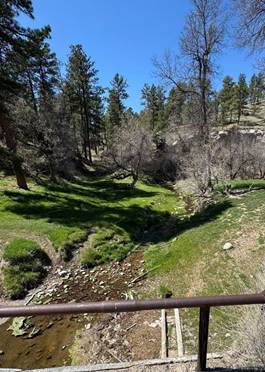
As you’re driving west on US 20 toward Harrison, you see nothing but a bunch of gently rolling hills on either side of the highway. One would never expect a place of such beauty was just beyond those rolling hills. Even as you crest the top of the canyon, you see an amazing sight below: a single lane dirt road running under a canopy of trees, with unusual rock formations atop the buttes, some of which have formed at right angles. The descent is moderately steep, and at times you have a wall of the canyon on your right (descending) and your left (ascending). At the bottom of the canyon is a small, babbling brook that must have taken a few centuries to form the canyon.

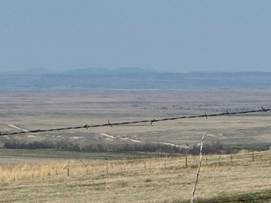
Just before you get to the end of Sowbelly Road on the east end (where it joins Pants Butte Road; no, I’m not making that name up), there’s a spot where you can see at least 80 miles to the north to the Black Hills in South Dakota (the dark mound in the far horizon). Something special happened between God and me via the Holy Spirit on that road, and especially with this particular view. I gained a whole new appreciation for the beauty, majesty, and grandeur of God’s creation. I’d expect something like that in Colorado; I never expected that in seemingly plain old northwestern Nebraska. Boy, was I wrong. What God had started teaching me in the Sandhills came to full fruition at the top of Sowbelly Road.

Part 4: Worldview, Wonder, and Wisdom

So let me bring this all together now. You might remember I started out talking about exegetical methods, methods that were heavily focused on the textual features like grammar, syntax, verb mood and tense, etc. Then it hit me: nothing in my exegetical method intentionally accounts for the majesty and glory of God and his creation. I knew I had to work that in somehow. But God still had one more piece to show me, and it hit me last night at our last small group of the season. Our senior pastor had been with us on this trip, but Sunday morning, one of the teaching pastors was preaching on the trauma Job experienced. I had tried to listen to it Sunday morning while driving through the remotest part of western Nebraska, but just couldn’t get a steady signal.

Fortunately, our Tuesday night group covered it in the study last night, and it was when we were talking about the ending of the book of Job that everything God had been teaching my finally made sense. Job had been arguing with God and his friends about how righteous he was and how he had always given God glory and so on, but God put him in his place. God recounts for Job all that He did by questioning Job: Did you lay the foundations of the earth? Did you create Leviathan and Behemoth? Who are you to tell me how I should act toward you?

That’s when I realized that I’m like Job in that moment. I think I have such a great exegetical method that will keep my doctrine sound and shred every stronghold that tries to set itself against God Almighty, but God’s word is more than the text and the grammar and verb moods and tenses and the participles and the conditional clauses. Those things are static, unchanging. But what does Hebrews 4:12 say? “For the word of God is alive and active. Sharper than any double-edged sword, it penetrates even to dividing soul and spirit, joints and marrow; it judges the thoughts and attitudes of the heart.”[1] Can grammar and syntax do that? I think not.

The other thing that occurred to me is the backstory of how the Jews would understand God’s word versus us gentile Christians. I’ll use just one example here: Communion, or as some call it, the Lord’s Supper or the Eucharist. When we look at the elements (“substantiational” leanings aside), we are meant to experience Christ in some way by “remembering” him. We see one man crucified and risen. But what do Jews remember at Passover? Not one man dying, but ALL the firstborn dying who weren’t protected by the blood of the lamb that they themselves applied to their doorways. They remember God parting the Red Sea so the Israelites could escape the oncoming Egyptians. The disciples didn’t understand immediately that Christ’s death had won them forgiveness and freedom. The Jews DID understand that immediately, with hearts pounding witnessing the very miracles of God at work to rescue them, even as they would tell the stories year after year to their descendants.

Conclusion

In other words, when I exegete and interpret Scripture, I need to look beyond the text and the grammar and all the other “in-the-weeds” details to comprehend a grand vision of a great God and all that he has done and made. That’s where the “draw closer” takes place, as it did for me this past weekend, when I understand who I am in God’s kingdom and that in spite of his greatness and grandeur, he looks with love at the least of us, at the humblest of us, at our faithfulness. He looks with compassion at those who are lost and searching and even at those who may be angry with him or agnostic toward him, prompting us to share God’s “living and active” word with those who have not yet comprehended that greater vision.

From this point forward, then, I’m adding a couple permanent elements of my “principlizing bridge” (to use Grasping God’s Word’s language) will be to ask first, “How does this passage reveal the glory and majesty and mystery of God to the world?” and second, “How is this passage ‘alive and active’ not only to me but to those I encounter as well?” I feel like I drew a little closer to God this weekend. I pray that my testimony here will do the same for you.

Scott Stocking

All contents herein are the creative and intellectual property of this author unless otherwise attributed.


[1] The New International Version. 2011. Grand Rapids, MI: Zondervan.

April 6, 2025

Giving Our Best for the Savior (John 12:1–8)

I preached this message on April 6, 2025, which was also National Tartan Day. I wore the standard Gordon family kilt (great-great-grandfather through the maternal line) and the necktie is Gordon Red (purchased in Scotland). I’ve included a few pictures. Now I can say I’ve preached in a kilt! :-)

The Lord be with you.

Before I get to my main message, I want to go back a few months when I preached on Psalm 126, our Old Testament reading this morning, because it was also our reading on October 27. At that time I said that we should consider verse 4 a prayer for this congregation: “Restore our fortunes, Lord, like streams in the Negev.” That continues to be my prayer for this congregation today, and I hope it is yours as well. I heard recently that church attendance is starting to pick up again, so I pray we can take the opportunity to tap into that resurgence.

Our gospel passage this morning, John 12:1–8, is one of the few stories of Jesus’s ministry that all four gospel authors included, probably because Matthew and Mark both said that what she’d done would be told wherever the gospel was preached. Matthew and Mark both include the story after the time of Jesus’s triumphal entry into Jerusalem and two days before the Last Supper. Luke places it much earlier in his gospel, and he emphasizes that the woman’s sins were forgiven because of what she’d done. We can’t be sure why Luke has the story so much earlier. He may be “borrowing” it from the future in his gospel so he can tie it in with the story of the response to forgiveness based on the depth of one’s sins.

But in our passage this morning from John, he places the story just before Jesus’s triumphal entry into Jerusalem. This event may serve to bring to mind the anointings that the Israelites were commanded to do for their priests and kings. Listen to what David says in the very short Psalm 133:

How good and pleasant it is

when God’s people live together in unity!

It is like precious oil poured on the head,

running down on the beard,

running down on Aaron’s beard,

down on the collar of his robe.

It is as if the dew of Hermon

were falling on Mount Zion.

For there the Lord bestows his blessing,

even life forevermore.[1]

This refers to Leviticus 8, where not only was the oil poured on Aaron’s head for consecration, it was also used to consecrate everything in the newly assembled tabernacle. Matthew and Mark do not name the woman who brings in the alabaster jar. Nothing in those accounts suggests they know who the woman is. Luke says the woman lived a sinful life and suggests she shouldn’t even be there.

John is the only one who names the woman in his gospel. The woman is Mary, Lazarus’s sister. We do know a bit more about Mary and Martha than other people mentioned in passing in the Gospels. At the end of Luke 10, Martha is frustrated with Mary because she is sitting at Jesus’s feet listening to his teaching while Martha is busy preparing a meal. This probably isn’t the meal John mentions, and it’s nowhere near Luke’s account of the foot anointing. In the previous chapter of John, Jesus had raised Lazarus from the dead to prove he was the “resurrection and the life.” Lazarus’s death seems to have hit Mary the hardest in that story, as she is the one who seems most disturbed by Jesus’s delay in coming to see Lazarus. It makes sense, then, that Mary would be the one who wanted to anoint Jesus’s feet for resurrecting her beloved brother.

John is the only one who doesn’t indicate that the container for the nard was an alabaster jar, but the alabaster jar was considered the most appropriate container for nard or perfume at that time, so I think we’re safe to assume it was. Alabaster was made from gypsum, so it was somewhat delicate and finely textured. Breaking the seal probably meant that the neck of the jar had to be broken to pour the thick nard out and apply it. It wasn’t a very big jar either. We know it was about a pint, and it would have all had to have been used at that moment; otherwise it would spoil or lose its aroma. Matthew and Mark say the woman poured the nard on Jesus’s head, much like it would have been for the OT priests mentioned above, while Luke and John say the woman poured it on Jesus’s feet, perhaps an acknowledgment of Jesus’s servant attitude.

Although the details of this story vary among the gospel accounts, a couple themes of the story do stand out across the board. Many of those present at the dinner, especially Judas Iscariot in John’s account, view this as a wasteful act. This perfume was not cheap; Judas, along with other players in the parallel account, are concerned that such a valuable commodity could have been sold so the money would be given to the poor. John reminds us though that Judas’s concern was more selfish than compassionate. Judas had been helping himself to the till.

What this tells us, I think, for our walk with Christ today is that it’s okay to be a little extravagant when giving to the Lord’s work. Now obviously we don’t need to prepare Jesus for another crucifixion as the woman was doing in that day. But just as Jesus turned the water into the best wine served at the wedding at Cana for his first miracle, so we too can dedicate our excellence in whatever we do for or offer to the body of Christ and the work of the kingdom.

A second principle at work here is that, while the work of helping the poor is noble and a never-ending ministry of the church, there will be times when we have to take care of our own, and I’m not necessarily referring to when we die. It’s not selfish when we do that. It’s a necessary part of taking care of our family. While our loved ones are alive, we buy thoughtful gifts for them. When they pass, we pick out a nice coffin or urn. The ancient Jews used an ossuary, basically a stone box, to store the bones of a loved one once the flesh had decayed and often would put some sort of inscription on it. When the Jews brought Joseph’s bones out of Egypt, it was most likely in an Egyptian mummy case. That’s a little odd for us to think in those terms today, though, so we find other ways to memorialize our loved ones.

Unlike the pharisees and Judas Iscariot then, we should not look with judgment on those who do nice things for their loved ones at death. How we choose to remember a loved one is an important part of the grieving process. But I have to wonder here: Mary had already witnessed Jesus raise her brother Lazarus from the dead. Did she, or any of the other disciples for that matter, have any inkling that Jesus’s impending crucifixion might be followed up by his own resurrection? Judging from the disciples’ reaction in the gospels when Jesus spoke of his death, I’m pretty sure they hadn’t put two and two together yet.

Our gospel passage this morning has focused on what Mary did to prepare Jesus for his death. But what was Jesus doing to prepare his disciples for his death? We’ll address some of this after Easter in the Sundays leading up to Pentecost, but for now I think it’s important to see that, although he was speaking somewhat figuratively at times, he did not leave his disciples without reason for hope after his death.

The next event after our gospel passage this morning is Jesus’s triumphal entry into Jerusalem: Palm Sunday as we’ve come to know it. Chapter 13 is the Last Supper, where Jesus imparts his final teachings to his disciples before his arrest and crucifixion. John recorded five chapters worth of Jesus’s words, longer than the Sermon on the Mount. In those final hours he has with his disciples, he:

  • Models servanthood by washing their feet
  • Predicts Peter’s denial
  • Reassures them that he’ll come back to take them to the place he’s preparing for them
  • Promises the Holy Spirit will dwell in them and guide them in all truth
  • Encourages them to stay connected to the vine, to Jesus, so they can bear fruit
  • Reaffirms the coming, indwelling power of the Holy Spirit
  • Predicts that they will be scattered, but they will also eventually know peace
  • Prays for their unity so that the kingdom can move forward and their faith will be unshakable.

That must have been quite the emotional and gut-wrenching after-seder gathering. Most of what John records in those chapters was unique to his gospel. None of the other Gospel come close to the depth of this teaching. Luke and Matthew have passing references to receiving the Holy Spirit without too much detail to describe it. As a gospel writer, John seems to have had special dispensation to capture these final teachings. He, after all, was the only one who shows up at the cross on crucifixion day.

This is not to discount the other teachings of Jesus prior to his triumphal entry. His whole ministry was about preparing you and me for the new way God would work among his people. The Sermon on the Mount and the parables in Matthew; Luke’s sermon on the plain; and Mark’s emphasis on the urgency of Jesus’s ministry are all signs in their own way that Jesus was preparing ordinary people to extraordinary things for the kingdom of God.

Isaiah looked forward to this new time in 43:18–19:

18 “Forget the former things;

do not dwell on the past.

19 See, I am doing a new thing!

Now it springs up; do you not perceive it?

I am making a way in the wilderness

and streams in the wasteland.[2]

The final two verses from our OT reading this morning hint at a future sorrow that will end with joy as well:

Those who sow with tears

will reap with songs of joy.

Those who go out weeping,

carrying seed to sow,

will return with songs of joy,

carrying sheaves with them.[3]

As we continue toward Easter, you and I know how the story ends. We do not need to fret like those first disciples. We know we have the victory. We know we have forgiveness. We know we have the empowerment of the Holy Spirit. Let us go forth from here boldly and confidently in that knowledge and be shining lights for the Savior! Amen.


[1] The New International Version. 2011. Grand Rapids, MI: Zondervan.

[2] The New International Version. 2011. Grand Rapids, MI: Zondervan.

[3] The New International Version. 2011. Grand Rapids, MI: Zondervan.

March 23, 2025

Bearing Fruit…and the Cross (Luke 13:1–9; Psalm 63)

I preached this message on Sunday, March 23, 2025, at Mount View Presbyterian Church. I dealt with all four passages for the Lectionary for this Sunday.

Bearing Fruit…and the Cross

Lent is typically thought of in the Christian world as a time of sacrifice. Some people give up meat only to crowd into the numerous fish fries around town. Others might give up chocolate or coffee or caffeinated beverages or shopping or any number of other things that we might consider “vices” personally, but most of those things are not innately spiritual and may in fact make us a bit more difficult at times to live with if we haven’t had our morning cup of Joe. I’m teasing you a bit, of course. But if Lent is supposed to bring us some spiritual benefit, then shouldn’t we be giving up things that can damage our relationship with God? Why not give up greed, pride, selfishness, and other such things?

That seems to be the underlying theme behind our passages today. They might be summed up by John’s exhortation when he was preaching in the wilderness in Luke 3:8: “Produce fruit in keeping with repentance.” In other words, bear fruit while you’re bearing the cross. In our passage from Luke 13 this morning, Jesus seems to be addressing the thought that some had that bad things only happened to bad people. But the circumstances of our demise do not determine our eternal destiny. In spite of the untimely and unfortunate deaths of the Galileans and those in the tower of Siloam, Jesus says the important thing is to repent and be ready.

Jesus switches to talking about the fig tree that won’t bear fruit in the next few verses. The owner of the fig tree wants to cut it down because it’s unproductive. But the vineyard manager said “Give me another year and I’ll have it bearing fruit.” But the connection here with the previous verses and John’s statement about producing fruit in keeping with repentance is unmistakable. If we’re not bearing fruit, that could affect our salvation and our relationship with our Savior. Jesus said in Matthew 7:20: “By their fruit you will recognize them.”

Paul talks about the quality of our works in 1 Corinthians 3:12–15, but he doesn’t use the language of “fruit.”

12 If anyone builds on this foundation using gold, silver, costly stones, wood, hay or straw, 13 their work will be shown for what it is, because the Day will bring it to light. It will be revealed with fire, and the fire will test the quality of each person’s work. 14 If what has been built survives, the builder will receive a reward. 15 If it is burned up, the builder will suffer loss but yet will be saved—even though only as one escaping through the flames.[1]

God, being full of grace and mercy, leaves us a way out when we fall short. That’s what he accomplished through Jesus in his death on the cross and his resurrection from the dead. But instead of focusing on these warnings for the rest of my message this morning, I want to turn the focus around to the theme I mentioned earlier: How do we bear fruit while bearing the cross? That would have been my sermon title in the bulletin if I had remembered to click send on my e-mail to Judy!

I want us then to look at the other three passages from the lectionary today in addition to our gospel passage I touched on at the beginning. In Psalm 63, we’ll look at seeking God in worship. In Isaiah 55, we’ll look at seeking God for our wellbeing. And finally in 1 Corinthians 10, we’ll look at standing firm in our faith to recognize the way out of temptations that can drag us down.

Let’s look at Psalm 63. For a long time our country has been turning away from church attendance and, by implication, from God altogether. A trusted, unbiased Web site called Statista has this summary of church attendance: “According to a 2022 survey, 31 percent of Americans never attend church or synagogue, compared to 20 percent of Americans who attend every week. Despite only about a fifth of Americans attending church or synagogue on a weekly basis, almost 40 percent consider themselves to be very religious.” A 2024 survey by Gallup puts the number of weekly attenders at 20%, with another 9% at “almost every week.” On the flip side, 31% NEVER attend church or other religious service. We could talk about the reasons for this 24/7 for a week, but we’d probably never get anywhere. Psalm 63 tells us why this shouldn’t be, though.

We should be able to come to church to find God. Granted David, who wrote this psalm, had a special relationship with God that enabled and empowered him to be a great leader of his people, but this doesn’t mean that you and I don’t have access to this same relationship in the New Covenant era. David claims to have seen God’s power “in the sanctuary.” It’s not clear exactly what he “saw,” whether it was some physical manifestation of light, a divine presence, or if he’s using the word “see” to describe what he experienced in worship. Regardless, it was clear at least in David’s day, one of the best places to be to encounter God was the sanctuary in the Temple.

In the New Covenant era, God has given his Holy Spirit to each of us who believe. You don’t have to be a king or a prophet any more to have exclusive access to the Holy Spirit. When we come together to worship, to sing praises and hymns, to read God’s word and hear it explained in such a way that it’s relevant to our live and our situations, the Holy Spirit works among us to build and shepherd that unity we have in body of Christ. When we pray together as a congregation, we let God know that we still trust in him to work in our lives and provide for our needs while at the same time letting those whom we’re praying for know that we will support them however we can. When we come together as a worshipping community for projects and collection for the poor, we show and shower God’s love upon those who are truly in need.

But our worship doesn’t just happen in the church building. Verse implies that wherever David is at, he is earnestly seeking God. Later in vs. 6, he say he remembers God in his bed and while he’s keeping watch on the battlefield at night. He sings to God and he clings to God, knowing that God’s presence is always with him through the Holy Spirit. We have that same assurance. Jesus even promised that at his ascension: “I am with you always, even to the end of the age.” Seek God and you will find him, and as you draw closer to him, others will come to see him at work in your lives as well.

As we seek God, we can also know he will provide for our basic needs and do so generously. That is the message of Isaiah 55. Verses 1 & 2 go like this:

“Come, all you who are thirsty,

come to the waters;

and you who have no money,

come, buy and eat!

Come, buy wine and milk

without money and without cost.

Why spend money on what is not bread,

and your labor on what does not satisfy?

Listen, listen to me, and eat what is good,

and you will delight in the richest of fare. [2]

God wants to richly bless us. God’s goodness is genuine and original. God isn’t giving us yesterday’s leftovers. Jeremiah says “His compassions never fail. They are new every morning; great is your faithfulness!” (Lamentations 3:22b–23). Sometimes we spend a lot of effort and money pursuing things that don’t bring lasting or eternal satisfaction. God wants us to focus on him and what he provides for us. Later on in Isaiah 55, the prophet says this:

Seek the Lord while he may be found;

call on him while he is near.

Let the wicked forsake their ways

and the unrighteous their thoughts.

Let them turn to the Lord, and he will have mercy on them,

and to our God, for he will freely pardon.[3]

You heard in that passage the idea I suggested earlier about giving up the things that tempt us to turn from God. But Isaiah also says we need to get rid of the “stinkin’ thinkin’” as well. This is complete repentance: not just changing our behavior but changing our minds and our ways of thinking as well. That’s were the worship comes in from Psalm 63: setting our hearts on Christ.

One of my favorite passages occurs a few verses later in Isaiah 55:

My word that goes out from my mouth…

will not return to me empty,

but will accomplish what I desire

and achieve the purpose for which I sent it.

12 You will go out in joy

and be led forth in peace;[4]

I believe this is one of the greatest passages on evangelism. I love that it says God’s word accomplishes the purpose for which he sent it. When I was preaching early in my career, I was never in a church that followed the lectionary or the liturgical calendar. I could preach on what I wanted or I could pick out a theme or a particular book and prepare a sermon series.

But following the lectionary puts these two verses from Isaiah in a new light for me. Now I don’t know who decided on the three cycle of passages to read, but the lectionary is a “reading plan” adopted by many churches and denominations around the world, so it carries a lot of weight and, aside from the denominational differences and nuances that work their way into sermons on these passages, many churches are on the same page when it comes to what their congregations are presented with each Sunday. Because so many churches have agreed to use it, I believe it’s something that God honors. I think there’s something divine about the spiritual foresight those responsible for developing it, so I honor that.

Occasionally I’ll look at the passage for the day and wonder, “How am I going to preach on that?!” But I trust that there’s some component of God’s timing there, that is, some spiritual benefits he has in mind for sending out his word in this way, and I want to be faithful to communicate that in a way that’s relevant to you and my larger audience on the blog. I genuinely believe the lectionary is one way that God’s word gets from his mouth to our ears and that preachers who follow the lectionary are in many and diverse ways fulling the purposes for which God sends it out in that structure.

Finally, I want to look briefly at 1 Corinthians 10. Paul concludes in the first half of chapter 10 that that the written history of God’s people is intended for our encouragement and exhortation to faithfulness. Here’s what vv. 11–13 say:

11 These things happened to them as examples and were written down as warnings for us, on whom the culmination of the ages has come. 12 So, if you think you are standing firm, be careful that you don’t fall! 13 No temptation has overtaken you except what is common to mankind. And God is faithful; he will not let you be tempted beyond what you can bear. But when you are tempted, he will also provide a way out so that you can endure it.[5]

Paul warns us that we shouldn’t rest on our laurels. Faithfulness is an active, ongoing process in the life of the Christian. There is nothing passive about it. Continue seeking God in worship; continue reading his words to hide them in your heart. Continue loving your neighbor as yourself so they too can see the love of God. Continue putting on the armor of God each and every day so you can take your stand against the devil’s schemes.

May the power of the Holy Spirit go with you this week as you serve our Lord and Savior. Amen.


[1] The New International Version. 2011. Grand Rapids, MI: Zondervan.

[2] The New International Version. 2011. Grand Rapids, MI: Zondervan.

[3] The New International Version. 2011. Grand Rapids, MI: Zondervan.

[4] The New International Version. 2011. Grand Rapids, MI: Zondervan.

[5] The New International Version. 2011. Grand Rapids, MI: Zondervan.

March 16, 2025

Approaching the Cross (Psalm 27; Luke 13:31–35)

I presented this message on March 16, 2025, at Mount View Presbyterian Church in Omaha, Nebraska. In studying the two passages, I discovered several thematic connections between Psalm 27 and the central part of Luke’s gospel, especially from 9:51 through Christ’s triumphal entry into Jerusalem in Luke 19.

I had attended StoneBridge (my home church) for the worship part of their service before going to preach, and they did a version of St. Patrick’s Breastplate. I started my message with that this morning (the 15 lines toward the end of the longer prayer).

May the Lord be with you.

Have you ever thought about how you read certain types of literature? If you’re reading a fictional novel, or perhaps a true historical account of real event or someone’s life, it’s probably best to start at the beginning and read through to the end. It’s important to have all the details of the story because some of those details will be important throughout or later in the book. If you’re reading a history book or a historical biography, you may want to focus on a certain topic or certain era covered in the book to get the specific information you’re looking for, but you might miss some important background information that gives more context to events of that period. When you read a newspaper, you look for the headlines that interest you. If you’re looking for a specific answer on something like “How do I change a tire,” “Where do the Sandhill Cranes migrate to,” or “How do I calculate the area of a circle,” you typically wouldn’t have to read an entire reference book relevant to the subject. You’d go to the index or table of contents and look up where to find the information you’re looking for.

The Bible is sort of all these types of literature wrapped up in one collection that contains all these things, from the fictional, but true-to-life parables to the priestly “Chronicles” of the kings to the history of the patriarchs and the gospels, right up to the fantastical imagery of Revelation. Because of this, it’s important that we don’t lock ourselves into one way of reading the Bible. While it’s good to sit down and read large sections of the Bible in one sitting from time to time, we can still miss “the big picture” if we don’t understand or know the historical setting in which it was written.

Even when you read the gospels, if you have a Bible with footnotes, you’ll see that there are all sorts of references to passages in both the Old and New Testament where the gospel writer is either quoting the Old Testament or the editor perceives a connection to another New Testament author’s writings. That’s something you don’t typically get in a fictional novel, but would be helpful, I think.

Our two passages today, Psalm 27[1] and Luke 13, have a thematic connection, but it’s important to recognize that this connection compels us to look at the larger context of Luke’s gospel. Luke 13 is a little more than halfway through Luke’s 24-chapter gospel, but more importantly for our purposes, it’s about halfway between Luke 9:51 and Luke 19:28, which is the beginning of the story of Jesus’s triumphal entry into Jerusalem. Why is 9:51 an important marker? Luke says this: “As the time approached for him to be taken up to heaven, Jesus resolutely set out for Jerusalem.”[2] Luke isn’t even halfway through his gospel and he’s already talking about Jesus getting ready for the cross!

Luke frames the rest of his gospel from 9:51 on in the context of Jesus approaching the cross and preparing himself and his disciples for the implications of that seminal event. In fact, the footnote on this verse in my NIV Bible lists the references to this in the story line along the way: Luke 13:22, 17:11, 18:31, and 19:28.

So let’s take a look at the thematic comparisons between Luke and Psalm 27. Psalm 27:1 is the initial confidence builder for David as he pens this psalm: The Lord is his light, his salvation, and his stronghold, so David has nothing to fear as he leads his people. This confidence is paralleled in Luke 9:51 with his statement that Jesus “resolutely” set out for Jerusalem. The phrase here literally means to “set your face” (or by extension, “set your eyes”) upon Jerusalem. This ties in with Psalm 27:4 as well, when David speaks of dwelling in the house of the Lord and gazing on his beauty in the temple. The temple, of course, was in Jerusalem. In today’s gospel passage, Jesus seems to hint that he’s only three days away from Jerusalem and needs to press on.

In Psalm 27:2–3, David says that in spite of his enemies advancing against him, he will remain confident of the Lord’s help. As Jesus journeys toward Jerusalem in Luke, he encounters his own opposition along the way. In 9:53, the Samaritan village he was near wanted nothing to do with him because he was headed for Jerusalem. In chapter 11, we see opposition from the pharisees and experts in the law as he’s working miracles and teaching about the kingdom. By the end of chapter 11, Luke says this after delivering a list of “woes” to his critics: “53 When Jesus went outside, the Pharisees and the teachers of the law began to oppose him fiercely and to besiege him with questions, 54 waiting to catch him in something he might say.”[3] No love lost there between Jesus and that group of elitists.

Just like David, though, Jesus’s confidence doesn’t wane. He continues on his journey gathering an ever-larger following warning them about the opposition they themselves would face for being his followers and encouraging them to be ready when his time does come. In chapter 13, he faces opposition from a synagogue leader who is upset because Jesus healed someone on the Sabbath! Imagine that! In our passage this morning, the Pharisees seem to think they’re doing Jesus a favor by telling him to leave the region because Herod wants to kill him. But Jesus presses on, even with a bit of sarcasm, or so it seems, when he says in so many words that Jerusalem is the only place for a prophet to die.

The rest of Luke up to the point where he reaches Jerusalem gives us several more examples of this opposition, but we can save that for another time. I mentioned earlier about Psalm 27:4–5 hinting at the importance of temple. For Jesus, the temple was the true home of his family: after all, it was his father’s house. If he knows he’s going to die, he wants to be as close to his family home as possible. His statement in Luke 13:35 about “Blessed is he who comes in the name of the Lord” looks forward to his triumphal entry into Jerusalem. I believe Jesus takes a sense of pride and ownership in the temple, even though it is a structure made by human hands.

We saw after Christmas how Jesus as a boy stayed at the temple and impressed the religious leaders with his knowledge of and wisdom about God’s law. His first order of business after arriving in Jerusalem at the end of Luke 19 is to clear out the corruption in his father’s house. Even as he knew this would be one of his last weeks to experience the earthly temple, he wanted to leave it in better condition than he found it by restoring it to a place of prayer and genuine worship. He knew he would be the sacrificial lamb, and there would be no more need to sell lambs and birds in the temple for the sacrifices. It would be restored to a purer state. In the book of Acts, we see that his followers have been meeting regularly at the temple since his crucifixion, and it is there that the church is born on the day of Pentecost. That was the “Garden of Eden” for Christ followers.

The last half of Psalm 27 is one of David’s most heartfelt prayers for protection against his enemies and for the security of God’s presence with and acceptance of David as his chosen ruler for God’s people. Jesus taught his disciples to pray in Luke 11, the shorter version of the Lord’s prayer. In that prayer, we hear some of the same themes of praise, provision, and forgiveness. He understands the goodness of God’s provision.

But we also hear in that Psalm the foreshadowing of the cross. In verse 12, David asks not to be turned over to his enemies, which sounds very much like Jesus’s plea in the Garden of Gethsemane to have the cup of suffering removed from him. David’s pleas in verse 9 sound very much like Jesus’s words on the cross, “Why have you forsaken me?” Those words come from Psalm 22, where many of the aspects of Jesus’s crucifixion are foretold.

Just as David in the last two verses of Psalm 27 affirms his confidence in the goodness of the Lord and can encourage the worshipers to “be strong and take heart,” so Jesus has confidence in his dying moments to selflessly tell the thief on the cross that he too will join him in paradise when they die. I don’t believe that David intended Psalm 27 to be a messianic psalm, nor do I think Luke intended the central part of his gospel to mirror the themes of Psalm 27, but the parallels are striking and certainly worth noting.

But these parallels are academic. What does all this mean for you and me as we walk with our savior?

First, when we run up against roadblocks or challenges to our faith or we find that doubts are creeping in, we can remain confident that our light, our stronghold, surrounds us with his protection. We need not fear or doubt, but if we wait on the Lord and strengthen our hearts by abiding in God’s word, we can be confident we will see the goodness of the Lord, just as David was. We can walk in the victory of the cross in the overcoming resurrection of our savior.

Second, we can heed the exhortation of Hebrews 10:19–25, which sums up these three themes concisely:

19 Therefore, brothers and sisters, since we have confidence to enter the Most Holy Place by the blood of Jesus, 20 by a new and living way opened for us through the curtain, that is, his body, 21 and since we have a great priest over the house of God, 22 let us draw near to God with a sincere heart and with the full assurance that faith brings, having our hearts sprinkled to cleanse us from a guilty conscience and having our bodies washed with pure water. 23 Let us hold unswervingly to the hope we profess, for he who promised is faithful. 24 And let us consider how we may spur one another on toward love and good deeds, 25 not giving up meeting together, as some are in the habit of doing, but encouraging one another—and all the more as you see the Day approaching.[4]

Worshiping together as a church family, whether we’re a family of 20 or 200 or 2,000, provides a powerful sense of belonging to each of us. We know we have a place to call our spiritual home, just as Jesus considered the temple his spiritual home. We can feel safe here with one another.

Finally, the power of praying together as a church family cannot be overstated. Our prayers, whether in our own closets at home or corporately in our liturgy here, keep us connected to and in constant communication with our heavenly father. We can be assured that he hears us and works to respond to our prayers according to his will and his love for us.

As we go through this Lenten season, let us not forget the forgiveness we have from God and not forget to offer forgiveness and grace to those who need to hear that message. Peace to all of you. Amen.


[1] Psalm 27 parallels Psalm 31 with similar themes. Psalm 31 will figure prominently in the Lectionary beginning the Sunday before Palm Sunday next month.

[2] The New International Version. 2011. Grand Rapids, MI: Zondervan.

[3] The New International Version. 2011. Grand Rapids, MI: Zondervan.

[4] The New International Version. 2011. Grand Rapids, MI: Zondervan.

February 16, 2025

Those Beautiful Beatitudes—Luke Style (Luke 6:17–26)

I preached this message at Mount View Presbyterian Church, Omaha, Nebraska, on February 16, 2025.

In Luke 10:25ff, an “expert in the law” asked Jesus how to inherit eternal life. Jesus turned the question back to him to see what he would say. The expert in the law answered correctly with the two greatest commandments: “Love God with all your heart, soul, strength, and mind” and “Love your neighbor as yourself.” But it seems the expert wanted to nitpick about the second greatest commandment: “Who is my neighbor?” he asked. Jesus then proceeded to tell the story of the Good Samaritan.

So let’s think about this for a minute: Of the two greatest commandments the expert cited, which one would you expect to be the more difficult one to follow? This isn’t a trick question, so don’t think too hard about it. Of course, it’s the first and greatest commandment, right? If it were not the most difficult one to keep, it would not be the greatest, right? The expert didn’t have a problem with the “love” part of that command. He was, perhaps, attempting to limit the scope of the command by trying to get Jesus to narrowly define “neighbor.” I’m not sure why that expert thought the “love your neighbor as yourself” was so difficult to understand. Be kind to everyone, right? Then you don’t have to worry whether you’re living near them or not!

These days, I think the “loving your neighbor” part is so much easier than it used to be, or at least it should be. We’ve got “GoFundMe” accounts for emergency needs; TikTok for advertising your small business (at least, that’s what the commercial says); Venmo, Zelle, and CashApp for a quick “donation”; FaceTime and Skype for virtual “in-person” live calls; and of course all the social media apps out there, yet somehow many feel so much more isolated than before. So many ways to “reach out and touch someone.” So much for Big Tech!

Although the Greek word for “neighbor” (πλησίον plēsion) simply means “someone who lives near you” in the New Testament, and the Hebrew word (רֵעַ rēaʿ) is often simply translated “friend,” Jesus redefines—perhaps a better way to say it is “adds to”—the meaning of neighbor to include “one to whom you show mercy.” So it’s not just people in your “in-group” or immediate community, but anyone you encounter who needs a helping hand.

Enter the beatitudes, Luke-style. The Beatitudes are an expression of where the rubber meets the road in showing love to our neighbor, just like the parable of the sheep and goats in Matthew 25, but I believe they also answer the question we probably should ask of the greatest commandment: “How do we love God with all our heart, soul, mind, and strength?” especially in a world that has all of the distractions I just mentioned above. Matthew 25:40 answers that question for us, at least in part: “Whatever you did for one of the least of these brothers and sisters of mine, you did for me.” Luke’s passage this morning puts more meat on the bone for us. Our two readings from the Old Testament today help shed light on that answer as well.

I want to get to a couple details of the passage first, especially in comparison with the Beatitudes in Matthew 5. Notice the location first: in Matthew, Jesus goes up on a mountainside to get a better vantage point for speaking. He has just picked his first four disciples as we talked about last week. In Luke, just before this morning’s passage, we see that Jesus went up on a mountainside to pray and picked twelve of his disciples to be apostles, and then Luke 6:17 says “He went down with [the disciples/apostles] and stood on a level place.” It’s entirely possible Jesus delivered similar messages in different places, so this shouldn’t be seen as some kind of contradiction.

Luke adds the extra note here of Jesus having “power…coming from him and healing them all,” which is not part of Matthew’s account of this teaching. This enhances Jesus’s authority with all those who were following him. In that regard, he had a bit of an edge than other teachers of his day when it came to attracting a crowd.

Now that we’ve got the background out of the way, let’s look at the four aspects of life Jesus teaches (and warns) about in Luke 6: wealth, hunger, joy, and reputation. I’ll deal with the natural contrasts Jesus makes between the “Blessed are you” and “Woe to you” statements in parallel. Along the way, I’ll tie that in with the relevant verses from our OT passages this morning. So if you’ve got a Bible open, get ready for some serious page turning!

The first pair we’ll look at is “Blessed are you who are poor” versus “Woe to you who are rich.” You may notice right off the bat here that Luke doesn’t have Jesus saying “poor in spirit.” This may reflect a different audience that needs to hear a different aspect of the message. But the reward is the same in both Matthew and Luke: “For yours is the kingdom of heaven.”

This contrast is important for a couple reasons. The gospels reveal an underlying cultural view that the rich are the ones who are blessed and have the favor of God to enter heaven. Some of them made sure the poor knew that, too. The parable of the rich man and Lazarus (Luke 16:19ff) is one such story in the gospels. Jesus counters that cultural view in Matthew 19:21–24 when he says, “It is easier for a camel to go through the eye of a needle than for someone who is rich to enter the kingdom of God.”[1] That’s the same passage where Jesus tells the rich young ruler, “Sell all your possessions and give to the poor.” Jesus, and the Jewish community in general, expected the rich to bring comfort and relief to the poor. The Romans didn’t have much of a welfare program for the poor, if at all.

It’s for those reasons that Jesus can turn around and in the same teaching say “Woe to you are rich.” He’s talking about the rich man’s seemingly uncompassionate attitude toward poor Lazarus at his gate and why the rich young ruler went away sad. Following Jesus meant a radical change in the concept of generosity. It wasn’t just about the tithe anymore; he was calling for good stewardship of all your resources.

Psalm 1 affirms this: The one who walks with the Lord and delights in the law is the one who is better off in the end. Verse 3 says “whatever they do prospers,” while vs. 4 says the wicked “are like chaff that the wind blows away.” In other words, the fleeting riches of this present world, the stuff you can’t take with you won’t last. Jeremiah 17:8 repeats the thought from Psalm one about the righteous being “like a tree planted by the water.”

The second contrast is the most straightforward of the four pairs. If you’re hungry, you’ll be satisfied. If you’re well fed, you’ll go hungry. Jesus is obviously using hyperbole here. He doesn’t expect a complete transfer of food stores from the rich to the poor. Jeremiah says that those who trust in their own ability to provide for themselves (and no one else) will end up in a parched, barren wasteland, while those who trust in the Lord will have a never-ending supply of fruit. Psalm 1:6 says, “The way of the wicked leads to destruction.”

We see this in other places in scripture as well. Jesus tells the woman at the well in John 4 that if she drinks of the water he provides, she will never thirst again. Jesus fed the 5,000 and the 4,000 with a few loaves and fish, a real-life example of the promise in Luke 6. In Exodus, God provided manna for the Israelites as they wandered through the wilderness.

The third contrast is just as straightforward as the second: If you’re weeping, that will change to laughter. If you’re laughing it up, that will change to weeping and mourning. Jeremiah 17:9 says, “The heart is deceitful above all things and beyond cure. Who can understand it?” Psalm 1:1 says you’re blessed if you don’t “sit in the company of mockers.” Psalm 30:11–12 says this:

11       You have turned for me my mourning into dancing;

you have loosed my sackcloth

and clothed me with gladness,

          12        that my glory may sing your praise and not be silent.

O Lord my God, I will give thanks to you forever! [2]

The final contrast may seem a bit odd to us. Why, after all, should we be woeful about someone speaking well of us? Proverbs 22:1 says: “A good name is to be chosen rather than great riches, and favor is better than silver or gold.”[3] Ecclesiastes 7:1 says something similar: “A good name is better than precious ointment.”[4] The comparison with how the false prophets (an important distinction here) were treated gives us the context though. The books of Kings and Chronicles are filled with examples of prophets who pretended to speak for God but were only trying to prop up the king so they could stay in his good graces. Kings didn’t like bad news from the real prophets. The “speaking well of you” in Luke is nothing more than lip service. They like those who puff them up, even if they can see the writing on the wall, so to speak.

It’s difficult to speak the truth at times, like a true prophet (see vs. 23), because we know that brings on criticism. People don’t like to be told they’re wrong or are on the wrong path. Notice the reward here and the further contrast: We have a great reward in heaven! Psalm 1 says we’re blessed if we don’t “walk in step with the wicked or stand in the way that sinners take.”[5] Jeremiah 17:5 says, “Cursed is the one who trusts in man, who draws strength from mere flesh and whose heart turns away from the Lord.”[6]

Luke’s version of the Beatitudes here drives home the point that loving God with all our heart, soul, strength, and mind means living counter to the way the world expects us to live. They show us what it means to radically love our neighbor and how to handle the trials that come our way with grace and dignity. The benediction, so to speak, of Jeremiah 17:10 brings home the point most clearly to us: God is watching over us, and the blessings he gives are, at times, rewards for our deeds. This doesn’t deny that sometimes God blesses us when we don’t deserve it: that’s grace, and we should be grateful for those times. Hear the words of Jeremiah 17:10 one more time as I close my message today:

I the Lord search the heart and examine the mind,

to reward each person according to their conduct,

according to what their deeds deserve.[7]


[1] The New International Version. 2011. Grand Rapids, MI: Zondervan.

[2] The Holy Bible: English Standard Version. 2016. Wheaton, IL: Crossway Bibles.

[3] The Holy Bible: English Standard Version. 2016. Wheaton, IL: Crossway Bibles.

[4] The Holy Bible: English Standard Version. 2016. Wheaton, IL: Crossway Bibles.

[5] The New International Version. 2011. Grand Rapids, MI: Zondervan.

[6] The New International Version. 2011. Grand Rapids, MI: Zondervan.

[7] The New International Version. 2011. Grand Rapids, MI: Zondervan.

My opinions are my own.

Scott Stocking

One-Time
Monthly
Yearly

Make a one-time donation

Make a monthly donation

Make a yearly donation

Choose an amount

$5.00
$15.00
$50.00
$5.00
$15.00
$100.00
$5.00
$15.00
$100.00

Or enter a custom amount

$

Your contribution is appreciated. Your contribution is not tax deductible. All income will be reported according to Federal self-employed income tax laws.

Your contribution is appreciated.

Your contribution is appreciated.

DonateDonate monthlyDonate yearly
Next Page »

Website Powered by WordPress.com.