Sunday Morning Greek Blog

April 13, 2023

Some Thoughts on Inerrancy

He humbled you, causing you to hunger and then feeding you with manna, which neither you nor your ancestors had known, to teach you that man does not live on bread alone but on every word that comes from the mouth of the Lord.[1]

Your word is a lamp for my feet, a light on my path.[2]

Heaven and earth will pass away, but my words will never pass away.[3]

Again Jesus said, “Peace be with you! As the Father has sent me, I am sending you.” And with that he breathed on them and said, “Receive the Holy Spirit. If you forgive anyone’s sins, their sins are forgiven; if you do not forgive them, they are not forgiven.”[4]

For I am not ashamed of the gospel, because it is the power of God that brings salvation to everyone who believes: first to the Jew, then to the Gentile. For in the gospel the righteousness of God is revealed—a righteousness that is by faith from first to last, just as it is written: “The righteous will live by faith.”[5]

All Scripture is God-breathed and is useful for teaching, rebuking, correcting and training in righteousness, so that the servant of God p may be thoroughly equipped for every good work.[6]

For the word of God is alive and active. Sharper than any double-edged sword, it penetrates even to dividing soul and spirit, joints and marrow; it judges the thoughts and attitudes of the heart.[7]

Bear in mind that our Lord’s patience means salvation, just as our dear brother Paul also wrote you with the wisdom that God gave him. He writes the same way in all his letters, speaking in them of these matters. His letters contain some things that are hard to understand, which ignorant and unstable people distort, as they do the other Scriptures, to their own destruction.[8]

The other night, just before I was ready to turn in, a long-time acquaintance and friend, Terry, IM’d me and asked me about biblical inerrancy. I hadn’t really given that much thought since seminary because I’ve been pretty settled on the issue for some time, but I thought I’d put down a few of my thoughts that came to mind as he and I briefly chatted.

  1. I believe 2 Timothy 3 that God’s word is inspired, that is, God-breathed. However, I also believe he speaks it both directly and through his fallible servants in a fallen world. He did this through his prophets in an authoritative way, but I don’t doubt that they may have added “local color” to their prophecies.
  2. I believe Jesus commissioned his apostles (and perhaps a few of their successors) with an ex cathedra authority, tempered by mutual accountability, to establish the primitive structure of the early Christian communities, the core doctrines of the faith, and vital practices to share and spread that faith. I do not believe this ex cathedra authority survived past the first or second generation of believers.
  3. I believe the historical books of the OT, from Genesis through Kings and Chronicles, were collated from extant copies of original writings and official journals. Some of these texts have obvious signs of an editor long after the recorded events took place (e.g., 2 Chronicles 20:26).
  4. I believe the Hebrews had in place a diligent process to copy their texts to ensure their accuracy and fidelity from one generation of texts to the next.
  5. I believe the NT autographs (original letters and Gospels) were without error doctrinally and textually. However, since we can be relatively certain that none of these have survived the ravagees of time, this statement has qualified significance. As the letters were copied in scriptoriums, human error inevitably made its way into the successive copies.
  6. I believe the science of the study of textual transmission is more than sufficient in most cases to identify when and where these errors entered into the text and which of the variant readings are the most reliable. I do not believe any of the disputed variations affect any doctrine of Scripture, especially since most doctrines do not rely solely on any one single text. The eclectic Greek text is the best modern version to use, as it takes into account the opinions and research of several qualified scholars.
  7. I believe “the Church of Christ on earth is essentially, intentionally, and constitutionally one”[9]; the differences we see among and within denominational traditions are reflections of the diversity of God’s kingdom. If we can appreciate the diversity in God’s creation, with hundreds of different varieties within each species, then why should we expect that the local manifestations of the church be copycats? I do not believe that such diversity, by itself, disqualifies the Scriptures in any way.
  8. I believe that anyone who can hear or read the Word of God translated into their own language, regardless of version, can understand and respond to the Gospel at its most basic level. The study of the Word of God in its original languages adds depth and color to the story and may convince some who think the principles taught therein are archaic, pedantic, or irrelevant.
  9. I believe that above all else, love for one another founded in the love God has shown and is still showing us is the highest virtue for the Christ-follower at least, and for all humanity generally, regardless of their belief. Love is necessary for the survival of the human race; faith and faithfulness are necessary for salvation; hope is necessary for our security in the faith and our strength to love one another. All other arguments pale in comparison to the power and testimony of faith, hope, and love.

Of course, this list is nowhere close to exhaustive, but I pray that it gets you, the reader, thinking about what you believe about Scripture and the testimony you bear as Christ-followers. Peace to all!

My thoughts are my own, and annotated when borrowed from elsewhere.

NOTE: If you have some other Scriptures you’d like to add on the reliability of God’s word, feel free to add them in the Comments section. I’d love to hear from you!

Pastor Scott Stocking, M.Div.


[1] Deuteronomy 8:3. The New International Version. 2011. Grand Rapids, MI: Zondervan.

[2] Psalm 119:105. The New International Version. 2011. Grand Rapids, MI: Zondervan.

[3] Luke 21:33. The New International Version. 2011. Grand Rapids, MI: Zondervan.

[4] John 20:21–23. The New International Version. 2011. Grand Rapids, MI: Zondervan.

[5] Romans 1:16–17. The New International Version. 2011. Grand Rapids, MI: Zondervan.

[6] 2 Timothy 3:16–17. The New International Version. 2011. Grand Rapids, MI: Zondervan.

[7] Hebrews 4:12. The New International Version. 2011. Grand Rapids, MI: Zondervan.

[8] 2 Peter 3:15–16. The New International Version. 2011. Grand Rapids, MI: Zondervan.

[9] Campbell, Thomas. Declaration and Address.

January 2, 2022

2021 Reflection and Summary

I wanted to take a moment and thank the readers of Sunday Morning Greek Blog (SMGB) for tripling the number of views from 2019 to 2021! I went from 2,856 views in 2019 to 9,130 views (across 130 countries) in 2021. The theme of my blog has always been “Dig deeper, read smarter, draw closer.” I hope that whichever one of those goals brought you to my site will continue to be something I am able to meet for you. And, if you ever have a request or a question about a biblical topic, I would be happy to research it for you. I’m always excited to dig deeper into God’s Word to help others understand it better.

Having said that, the blog was also a blessing to me as well this year. As 2021 kicked off and more churches started to resume in-person services, I was called to preach at a couple smaller churches that lost pastors during the pandemic through attrition (thankfully not to COVID). One is the (now) inner-city church I grew up in and which some of my family still attend, and the other is a rural country church in Iowa. For me, the blog turned out to be (way-in-advance) sermon prep! This blog was helpful in that I still have been working my full-time day job, so it was nice not to have to a lot of new research for sermons. What sermons I did write this past year wound up as new blog posts.

Top 5 Posts

My top post for 2021 surprised me, because it was a little more academically technical than my typical posts, but it must have struck a chord with some. I had written “Indignant Jesus: The Variant Reading of Mark 1:41” in January 2019 in part because I wanted to know for myself why the NIV translators had changed the translation from “compassion” to “indignant” The other reason is that I wanted to provide an example of how translators use internal and external clues to determine the quality or genuineness of a textual variant. I figured with all the NIV readers out there, many of them would be curious about an “indignant Jesus,” so I wanted to provide what I hope was an explanation of the thought process in layman’s terms.

“Indignant Jesus” had 86 views that year. In 2020, it saw a 360% increase to 310 views. In 2021, it nearly had another 360% increase to 1,106 views! That was over 12% of total blog post views for 2021. Judging from the access peaks, I’d say it wound up on a few recommended reading lists for college syllabi. If you happen to know who used it on a syllabus, I’d love to thank them. I don’t want any royalties; I’d just like to know what they found redeeming about it, or even if they thought it needed some work.

The second most popular post was “Seer” in the Old Testament. This has been a perennial favorite, having been the number one article for at least 6 years through 2018, again, most likely because it appeared on someone’s college syllabus. Obviously, it’s not a Greek word study, but a Hebrew word study, and it was one I had sent out in an e-mail thread long before blogs were a thing. I never expected much from it on the blog, primarily because I had been looking for something different to post and pulled that one out of the archives. I’m both surprised and pleased that it continues to generate great interest.

My third most popular post (just 23 views behind #2) was 2020’s top post: “Take Heart!” That had slowly been growing in popularity, but it really caught hold in 2020, most likely due to the pandemic. I got one comment from a reader who said they had shared it with several health care workers at the time. They of all people had and continue to have a need for encouragement and endurance in the face of COVID and (if I may) the current lack of gratitude and sympathy from those at the highest levels of government for those hardworking heroes.

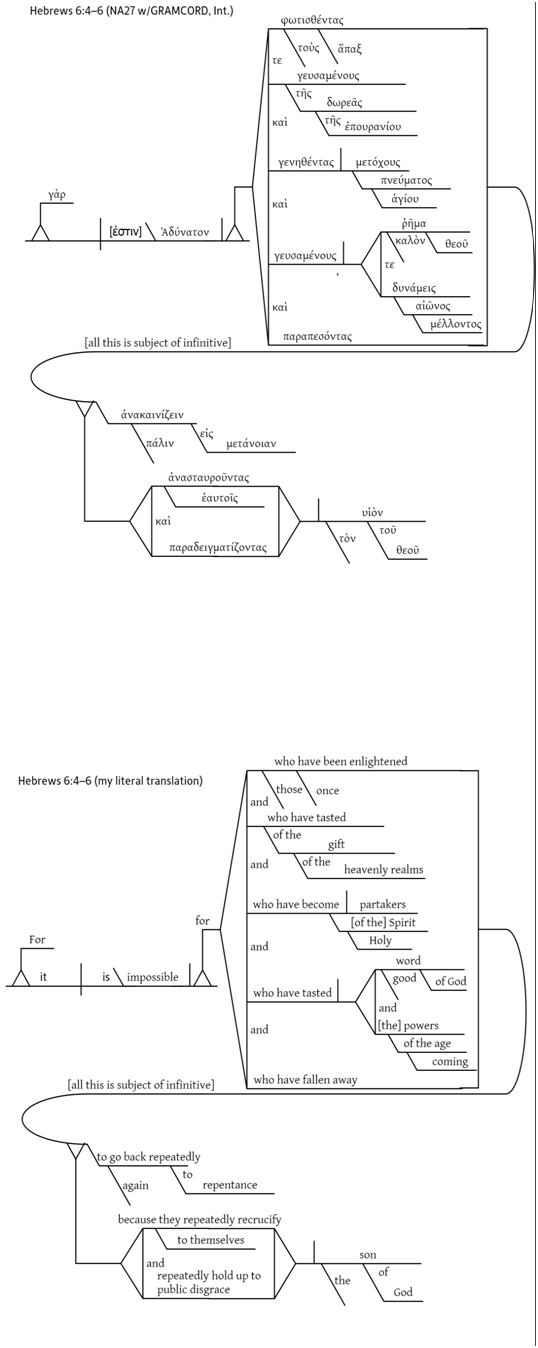
Number 4 is one that has steadily grown in popularity, but really began to take off in 2019, having three times the views in 2017. “Falling Away” tackles the difficult section of Hebrews 6 that at first glance seems to address the concept of losing your salvation. But a closer look at the text, grammar, and sentence structure (yes, there’s a classic sentence diagram attached; also an epilog post) shows the passage has quite a different meaning that isn’t so harsh theologically. Monthly views jumped dramatically in beginning in mid 2020, which makes me think the article also wound up on someone’s syllabus. I recently had a lively exchange with one reader who was asking for some clarification on a couple points, which also helped me sharpen my thinking and conclusions on the passage.

The fifth one was a total shocker to me. “Speaking in Tongues” averaged 49 views per year in the first 10 years it was online. In 2021, the post had 691 views, averaging over 57 views per month! Again, I’m not sure what sparked the sudden interest, but as with the other posts, the only thing I can think of is someone put it on their syllabus or perhaps cited it in a widely read paper.

Looking Forward

For 2022, I anticipate preaching about once every month, so I’ll continue to post sermon texts to the blog. I’d also like to break into the podcast sphere and start posting some videos or audios that can generate some ad revenue for me. I’m not really set up for that yet, and I’ll have to seek out some technical help most likely, but I’m pretty sure that won’t be a difficult learning curve.

I also have a blog called “Sustainable America,” which is my outlet for the intersection of politics, ethics, and faith in my life. That has never really taken off, although it has seen some modest growth. I’ve had just over 100 views the last two years, and 2020’s views (106) were a little more than double 2019’s views. Although it hasn’t really had many views, I do find it personally therapeutic as an outlet for what I’m thinking and feeling on such subjects. The founding fathers didn’t put “separation of Church and State” in the Constitution because they understood instinctively people’s politics derive from their religious and moral convictions (or lack thereof). The purpose of Sustainable America, however, is to analyze cultural and political issues and apply Scripture to them, while SMGB is all about analyzing the biblical text and discerning how it should affect and inform our lives all around, not just in the political or cultural spheres.

My most-viewed post on Sustainable America was “Why I’d Rather Not Work from Home Full Time.” After having spent much of my early career either working from home or working in a ministry setting where I was the only staff member, I found it quite enjoyable to transition to working in an office setting with lots of interesting people around. When the pandemic hit, all of that was defenestrated. I do miss working around other people. Somewhere along the way, I lost my introversion.

As such, one final goal for me for 2022 is to get back into the adjunct professor space, or full-time college instruction nearby, if someone wants to take a chance on my M.Div. degree with OT & NT concentrations. I found it ironic that, in 2020, the third-party supplier through whom I had been teaching Biblical Studies courses at St. Louis Christian College was bought out, and the acquiring company dropped the online adjunct service at a time when everything was moving online. Teaching Biblical Studies is really my first love, but it’s been tough landing positions without a Ph.D.

I wish you, my readers and blog followers, a happy and prosperous new year. Thank you for continuing to read, interact with, and spread the word about Sunday Morning Greek Blog!

Pastor Scott Stocking, M.Div.

My opinions are my own.

May 19, 2021

Work: The ‘Rest’ of the Story (Sermon)

Sermon preached at Wheeler Grove Rural Church May 16, 2021. All opinions are my own.

It seems work has been on everyone’s minds lately, one way or the other. Will I be able to go back to the office, if ever? Will it be safe if I do? If you’re in the hospitality industry, you wonder if things will ever be the same again? When will we get back to the prepandemic “normal”? Such questions have been on my mind as well.

For my own situation, my full-time employer, based in Minneapolis, has let us know they’re closing our Omaha office building and everyone who previously worked from that location will continue to work from home indefinitely. Now on the one hand, I can understand why they’re doing that: I work for a pharmacy benefits manager, so we make sure people get the medication they need to feel better. We’re essentially in the information industry, so we’re not coming together to build buildings or manufacture cars, home appliances, or clothing, industries where it’s helpful to have people around to perform and look after the processes. We can do our jobs from home; people in those industries typically can’t.

But on the other hand, I fear that working from home with no one else around you (except needy pets in many cases) may threaten what some of have come to call the “culture” of a company. We no longer have others around us physically who share the same goals and objectives from a work perspective. And we lose the connectedness we have on a social level, especially with those we interact with who share the same values or likes and dislikes that we have outside of the work environment.

How many people do you know who’ve made a close friend at work who’s added value to each other’s lives. Even in the Creation story, which we’ll look at in a moment, God says it’s not good for Adam to be alone, so he provides a “helper,” one who shares his human nature but from the perspective of the opposite sex; equals in many ways in personhood, but different in their gifts, callings, and innate abilities. Together, they shared one primary purpose in the beginning: tend to the garden.

When God created male and female, he also created “work.” As we dive into the message this morning, I do want to give you my main point up front so you can get a feel for where I’m going with the topic. Here it is: Work produces Order, and Order produces Rest. Again, Work produces Order, and Order produces Rest. Thus the title of my message: “Work: The ‘Rest’ of the Story.” See what I did there?

I also want to give a couple disclaimers as well: Many of the Scriptures we’re looking at this morning aren’t just about the work we do for a paycheck. At times, they have more to do with how we interact with our families and those around us, or more to do with our relationship with God and his kingdom, than they do with our employer. The second disclaimer is, if you’re retired, you have my permission to tune out if I’m talking about an employer. You’ve already given your time to “the man” and have earned your earthly rest from that.

Let’s roll up our sleeves and look at Genesis 1:1–2 and 2:1–3.

In the beginning God created the heavens and the earth. 2 Now the earth was formless and empty, darkness was over the surface of the deep, and the Spirit of God was hovering over the waters.

Then for six days, God begins speaking creation into existence.

Thus the heavens and the earth were completed in all their vast array. 2 By the seventh day God had finished the work he had been doing; so on the seventh day he rested from all his work. 3 Then God blessed the seventh day and made it holy, because on it he rested from all the work of creating that he had done.

Day 0: “In the beginning”—Chaos

Day 1: Light Day 4: The lighted bodies
Day 2: Sky and water Day 5: Air and water creatures
Day 3: Dry ground Day 6: Land-dwelling creatures; Man

Day 7: “God rested from his work.”—Order

A couple things about the text first before taking a deeper dive into Genesis 1. Genesis 1 has some unique features as a written text. Several key words are found 7 or 10 times throughout the passage. This shows some intentionality in writing, even if the writer wasn’t aware of it, if you know what I mean. The phrase “formless and empty,” tohu vebohu in Hebrew (how poetic!), is found in a couple other places in the Old Testament, namely Isaiah and Jeremiah, where it refers to the utter destruction of the land coming on those nations that have forsaken God. [See https://sundaymorninggreekblog.wordpress.com/2012/04/19/work-the-rest-of-the-story-ecclesiastes-3/ for in-depth look at chart.]

Genesis conclusion

So you can see that in the very act of Creation, God created a theology of work. On this alone, I think I’ve made my main point that Work produces Order, and Order produces Rest. But that would be a very short sermon! I do think it’s important to take a look at how that theology of work plays out in Scripture. As such, I have a sampling of verses, especially from the Wisdom Literature of Ecclesiastes and Proverbs, about the benefits of work and the consequences of neglecting our responsibility to work.

The Rest of the OT

Of all the books in the Bible, Ecclesiastes has the most practical wisdom and theology about life in general, and work in particular, than all the other Bible books combined. Solomon’s wisdom really shines through in Ecclesiastes, even as the cry of “Meaningless” echoes through the text. I think the key passage here is Ecclesiastes 3:9–15. Let’s hear that again:

9 What do workers gain from their toil? 10 I have seen the burden God has laid on the human race. 11 He has made everything beautiful in its time. He has also set eternity in the human heart; yet no one can fathom what God has done from beginning to end. 12 I know that there is nothing better for people than to be happy and to do good while they live. 13 That each of them may eat and drink, and find satisfaction in all their toil—this is the gift of God. 14 I know that everything God does will endure forever; nothing can be added to it and nothing taken from it. God does it so that people will fear him. 15 Whatever is has already been, and what will be has been before; and God will call the past to account.

[For “beautiful,” see Eccl 5:18, where the Hebrew word is translated “appropriate.”]

18 This is what I have observed to be good: that it is appropriate for a person to eat, to drink and to find satisfaction in their toilsome labor under the sun during the few days of life God has given them—for this is their lot.

Think of all the “toil” we do each and every day. How do we make things beautiful? How do we find satisfaction? What are the tasks that bring you satisfaction? Let me run a few by you.

Around the house or the farm:

• A freshly cut lawn.

• A freshly tilled field ready for planting.

• A sparkling bathroom after cleaning it (including getting that nasty whatever out of the drain).

• Big ripe tomatoes on the tomato plants.

• Making your bed first thing in the morning. (Navy Seal Admiral McRaven: Bed inspected every morning at training. Accomplishing the first task of the day leads to getting more tasks completed.)

In the kitchen:

• King’s Hawaiian rolls with honey butter.

• A perfectly grilled thick pork chop or steak.

• A scrumptious chocolate cake. (Are you hungry yet?)

In the workplace:

• Crisp new copies of a dynamite proposal.

• Seeing the finished product at the end of your assembly line.

• Finding extra money in the budget for upgraded computers.

• Landing that big account.

At school:

• A pristine science project.

• An A+ on your history research paper.

• Hitting a walk-off home run to win the game.

I think we all know how good it feels at the end of a day’s work, regardless of whether it was physically, mentally, or emotionally challenging, to finally get to the (made) bed and lay our heads down knowing we’ve accomplished something important, bringing order out of the disparate parts of our experience, a finished product out of the many different parts that compose it, or adding beauty where there was barrenness. And even if in all your work you didn’t get the outcome you wanted, you can still have the satisfaction of knowing you gave it your best shot, and that tomorrow will bring another opportunity.

Now up to this point, I’ve kept it pretty upbeat, but to understand the contrast, we need to acknowledge the elephant (or is it a sloth?) in the room: all those verses in Proverbs and elsewhere about not owning up to one’s responsibility to work. Staying in Ecclesiastes, we find this relevant passage in chapter 10 verse 18:

18 Through laziness, the rafters sag; because of idle hands, the house leaks.

Proverbs has several verses about laziness or a general malaise about working. Proverbs 26:13–16 focuses on the topic with a bit of sarcasm to boot:

13 A sluggard says, “There’s a lion in the road, a fierce lion roaming the streets!”

14 As a door turns on its hinges, so a sluggard turns on his bed.

15 A sluggard buries his hand in the dish; he is too lazy to bring it back to his mouth.

16 A sluggard is wiser in his own eyes than seven people who answer discreetly.

You have to wonder, with four verses like that in a row, if Solomon himself had had a bad day when he wrote this. It wouldn’t surprise me if Solomon had witnessed each of these during his day, and that last sarcastic remark was accompanied by Solomon throwing up his hands in resignation!

New Testament

In the book of Acts, we see some of these contrasts as well. For example, in Chapter 5, we see how Ananias and Sapphira got together to conspire a plot to cheat the church and get ahead. Most of us know what happened to them. By contrast in chapter 6, we see the apostles take up a thorny issue of distributing food to needy Greek widows. They appointed 7 men full of the Holy Spirit to address the matter. They worked hard to earn the new believers’ respect in this matter, and it paid off with more and more people being brought into the kingdom.

Paul himself, later in Acts, reminded the Ephesian elders about his hard work among in the nearly 18 months he spent ministering there. Acts 20:33–35 says:

33 I have not coveted anyone’s silver or gold or clothing. 34 You yourselves know that these hands of mine have supplied my own needs and the needs of my companions. 35 In everything I did, I showed you that by this kind of hard work we must help the weak, remembering the words the Lord Jesus himself said: ‘It is more blessed to give than to receive.’ ”

The Thessalonians must have had a problem with not wanting to carry their weight. Paul has to warn them in both letters about laziness in the strongest terms. Paul says in 1 Thess 5:12–15:

12 Now we ask you, brothers and sisters, to acknowledge those who work hard among you, who care for you in the Lord and who admonish you. 13 Hold them in the highest regard in love because of their work. Live in peace with each other. 14 And we urge you, brothers and sisters, warn those who are idle and disruptive, encourage the disheartened, help the weak, be patient with everyone. 15 Make sure that nobody pays back wrong for wrong, but always strive to do what is good for each other and for everyone else.

And in 2 Thess 3:6–13, he says something similar:

6 In the name of the Lord Jesus Christ, we command you, brothers and sisters, to keep away from every believer who is idle and disruptive and does not live according to the teaching you received from us. 7 For you yourselves know how you ought to follow our example. We were not idle when we were with you, 8 nor did we eat anyone’s food without paying for it. On the contrary, we worked night and day, laboring and toiling so that we would not be a burden to any of you. [skip vs. 9] 10 For even when we were with you, we gave you this rule: “The one who is unwilling to work shall not eat.”

Our modern English translation needs two words and a conjunction to translate one Greek word about shirking your responsibility to work, whether it be at your job, at home, or for the kingdom. “Idle and disruptive.” This particular Greek word is only found in the letters to the Thessalonians, which emphasizes the point that something was wrong with the Thessalonians work ethic. In other contexts outside the Bible, the word has to do with being out of military formation or just general disorder and chaos. “Without form and empty.”

Paul continues from there in vv. 11–13, and emphasizes that word again, and transitions us back to a positive thought as we begin to wrap up the message:

11 We hear that some among you are idle and disruptive. They are not busy; they are busybodies. 12 Such people we command and urge in the Lord Jesus Christ to settle down and earn the food they eat. 13 And as for you, brothers and sisters, never tire of doing what is good. Hear it again: “Never tire of doing what is good.”

Ephesians 2:8–10 (author’s translation; contrast with “walk” in 2:2) says:

8 For it is by grace you have been saved, through faithfulness—and this is not from yourselves, it is the gift of God—9 not by works, so that no one can boast. 10 For we are God’s handiwork, created in Christ Jesus to walk in good works, which God prepared in advance for us to do.

As if to emphasize the point, he says in Ephesians 4:28

28 Anyone who has been stealing must steal no longer, but must work, doing something useful with their own hands, that they may have something to share with those in need.

Hebrews 4:6–11 (Sabbath rest)

6 Therefore since it still remains for some to enter that rest, and since those who formerly had the good news proclaimed to them did not go in because of their disobedience, 7 God again set a certain day, calling it “Today.” This he did when a long time later he spoke through David, as in the passage already quoted: “Today, if you hear his voice, do not harden your hearts.” 8 For if Joshua had given them rest, God would not have spoken later about another day. 9 There remains, then, a Sabbath-rest for the people of God; 10 for anyone who enters God’s rest also rests from their works, just as God did from his. 11 Let us, therefore, make every effort to enter that rest, so that no one will perish by following their example of disobedience.

Conclusion

I hope you’ve seen to day how Work produces Order, and Order produces Rest. In a world around us that seems to be trending toward disruption and disorder, it is good to know we have a God who is working hard to hold it together, and to know that there are saints among us who are working hard to support, promote, and uphold God’s kingdom. And now you know the ‘rest’ of the story.

Pastor Scott Stocking, M.Div.

All Scriptures, unless otherwise indicated, are (c) 2011 New International Version, Zondervan Publishing.
January 12, 2019

Mystery of Immersion (Baptism), Part Two

In my post from 6.5 years ago (has it been that long!), The Mystery of Immersion (Baptism), I argued that there is a “mystery” (in the classical sense) in immersion (a more accurate translation of the Greek word typically translated “baptism”) akin to what the Catholics attribute to the Eucharist (Communion or the Lord’s Supper to us Protestants). In reading through Romans this time around, I still believe immersion must have a special place in the life of a Christ-follower, but I am even more convinced of the efficacy (and practicality) of immersion to bond us to Christ.

The Blood of Christ

Many Christ followers know Romans 3:23: “For all have sinned and fall short of the glory of God.” But the real hope is found in the two verses that follow: “and all are justified freely by his grace through the redemption that came by Christ Jesus. God presented Christ as a sacrifice of atonement, through the shedding of his blood—to be received by faith.” Christ’s faithfulness to death on the cross, that is, to submitting to the shedding of blood, is the foundation for our forgiveness. As Hebrews 9:22 says, “Without the shedding of blood, there is no forgiveness.”

Throughout Romans, Paul makes contrasts between death and life. Romans 5:9–10 is quite striking in this contrast: “Since we have now been justified by his blood, how much more shall we be saved from God’s wrath through him! For if, while were God’s enemies, we were reconciled to him through the death of his Son, how much more, having been reconciled, shall we be saved through his life!” [Note the “how” statements are NOT questions!]

I have argued elsewhere that Christ’s complete, unfailing obedience to the Law qualifies him as “the Righteous one.” It is because he is righteous that his sacrifice can impart righteousness to us. Paul says as much in Romans 7:4: “So, my brothers and sisters, you also died to the law through the body of Christ, that you might belong to another, to him who was raised from the dead, in order that we might bear fruit for God.” Hebrews 9:14 says it in a different way: “How much more, then, will the blood of Christ, who through the eternal Spirit offered himself unblemished to God, cleanse our consciences from acts that lead to death, so that we my serve the living God!”

The Waters of Immersion

I believe the centerpiece of Romans 1–11 is chapter 6, Paul’s discussion about immersion. Romans 1–11 is an intense theological statement on how God, through Christ’s shed blood, not only purchased salvation for us, but also restores us to a right relationship with God and with our brothers and sisters in the faith. When Paul says in Romans 6:3: “Or don’t you know that all of us who were immersed into Christ Jesus were immersed into his death?” he’s making a solid connection between the blood of Christ and the waters of immersion. It is almost as if Paul is declaring the act of immersion to be a reverse typology.

Typology, in the biblical sense anyway, looks at an event in the past and shows how that points to Christ. Here, Christ’s death has already happened, and the significance of that requires a significant event in our own lives to make the connection. Immersion, then, is not merely (not even?) a symbolic act that we can dismiss as merely a “work of the flesh,” as some try to do, but it is an event oozing with meaning and purpose, so much so that it is foolish for a Christ-follower to ignore it or think it’s not for them. Setting aside for a moment the debate about whether immersion is a sine qua non event for salvation, let’s look at what else we glean about immersion from this section of Scripture. These gleanings fall into two categories: how Christ’s death benefits us spiritually, and how Christ’s resurrection benefits us practically.

United with Christ’s Death (Romans 6:5a)

Justified by his blood: Romans 5 is truly amazing in that it demonstrates beyond a shadow of doubt what God’s grace is. In 5:6, Paul says “When we were still powerless, Christ died for the ungodly.” Rewind. Repeat. Yes, we had absolutely nothing to do with it. We were powerless, Paul says. We couldn’t effect any spiritual benefit to ourselves if we tried. But not only that, and this is the real kicker, Christ died for the ungodly. What? He says it again in a different way (v. 8b): “While we were still sinners, Christ died for us!” You mean we don’t have to “get right with God” first before Christ’s death becomes effectual for us? Now that is grace! Weak and undeserving as we were, enemies of God (v. 10), Christ still died for us. And the end result of that is we are justified; “just as if I’d” never sinned. Christ grants us his right standing—a result of his perfect obedience to the Law—before God

Reconciled to God: In 5:10, Paul speaks of being reconciled to God. This means that our relationship with God is mended, restored. We’re no longer enemies, no longer slaves to sin, no longer considered ungodly; God looks at us and sees Christ.

Dead to the Law: The Law is good because it makes us aware of sin, but it is also the source of condemnation. As I said above, because Christ fulfilled the Law, those of us in Christ have the full credit of fulfilling the Law through him. As Romans 8:1 says, “There is now no condemnation for those who are in Christ Jesus.”

Dead to sin: In 7:14ff, Paul speaks of the hypothetical “I” who is “unspiritual.” Without the Spirit, Paul has little to no control over the sinful nature. The law of sin wages war against God’s law. But as with the previous point, Paul clears this up in Romans 8:2: “Through Christ Jesus the law of the Spirit who gives life has set your free from the law of sin and death.” You can live for God unencumbered!

Cleanse our conscience: Hebrews 9:14a reemphasizes these points from Romans. “The blood of Christ… [will] cleanse our consciences from acts that lead to death.” The author of Hebrews further brings home the point in 10:22: “Let us draw near to God with a sincere heart and with the full assurance that faith brings, having our hearts sprinkled to cleanse us from a guilty conscience and having our bodies washed with pure water.” Could that be the waters of immersion?

United in Christ’s Resurrection (Romans 6:5b)

Bear fruit for God: Along with the benefits linked to the death of Christ in Romans 5–7 and elsewhere, we also see benefits linked to the resurrection. Romans 7:4 sounds a bit like Ephesians 2:10 and the good works God prepared in advance for us to do: “That [we] might belong…to him who was raised from the dead, in order that we might bear fruit for God.”

Death has no power over us: Romans 5:9 and 10 tell us we are saved from God’s wrath and saved through Christ’s life (post-resurrection). In 6:8–9, Paul emphasizes that death no longer has mastery over Christ, and since Christ-followers are united with Christ in his resurrection, they also share that victory over death.

Seated with Christ in the heavenly realms (Ephesians 2:6): The first part of Ephesians is a glorious picture of our position in Christ in the heavenly realms. Not only are we made alive with Christ (even when dead in transgression!), but we are raised up with him and seated with him in the heavenly realms. And if there was any doubt how that happens, the grace of God pervades that passage of Scripture as it does through the first three chapters of Ephesians.

Serve the living God (Hebrews 9:14b): Most of us, regardless of our age, heard or have heard JFK’s quote: “Ask not what your country can do for you; ask what you can do for your country.” Just change “country” to “God” and you’ve got the idea of Hebrews 9:14b. What a glorious privilege to serve in the courts of the eternal, living, gracious God. Can you think of any service that would lead to any greater eternal reward or greater feeling of satisfaction and personal fulfillment?

Living Sacrifice

Because Romans 1–11 ends with a glowing doxology, we can safely assume that Paul is closing out his theological argument and moving into the realm of practical application in 12–16. The “therefore” in 12:1, then, refers back to the entire argument, especially with immersion as the centerpiece. When Paul says: “I urge you, brothers and sisters, in view of God’s mercy, to offer your bodies as a living sacrifice, holy and pleasing to God—this is your true and proper worship,” it becomes quite clear that he’s making an altar call to immersion and all that goes with it, as I have just described above.

Paul begins and ends Romans with a curious phrase: “the obedience of faithfulness” (1:5, 16:26; for more on this, see my Obedience in Romans post). But in 5:19, right before Paul launches into his treatise on baptism, he seems to revisit that idea, giving us a clue that he has reached the point where he’s delivering the main thrust of his argument. “For just as through the disobedience of the one man the many were made sinners, so also through the obedience of the one man the many will be made righteous.” Jesus is that one man who was obedient to God’s law, and as a result, his death and resurrection purchased our forgiveness and salvation, and our unity with those two events in immersion absolutely solidifies our connection with the Savior.

Conclusion

When you examine the context around Paul’s treatise on immersion in Romans 6, you begin to see that chapter 6 is not an isolated excursus on one theological point, but that immersion is the glue that ties the two “pillars” of the faith (Christ’s death and his subsequent resurrection) together in a neat theological “type.” Not only that, but the many blessings that Christ-followers experience are linked to immersion by virtue of their inclusion in the broader context of chapters 5–7. Immersion, then, is not something to be taken lightly, or sluffed off as a mere work of the flesh, but it is a near-complete picture of who we are and what we have in Christ. When the implications of immersion are rightly understood, there can be no doubt that it is an essential event in the life of a Christian, not just a reference point for salvation, but an expression that we’re all-in for Christ.

Pastor Scott Stocking, M.Div.

My views are my own.

Unless otherwise indicated, all Scripture quotations are from the 2011 version of the NIV.


September 15, 2018

Men of Honor: 2018

Note: This was my workshop at our 2018 Men’s Retreat.

When things break, what do we guys do? I would guess many of us would find a way to fix it, right? Now some of us are naturals at that kind of thing. Whether its our cars, our homes, our motorcycles, lawn mowers, we’d like to think we can take a stab at fixing these things. For some of us, the rule is not “necessity is the mother of invention,” but “necessity is the motivation for self-education.” We’re not afraid to find that video on YouTube that shows us how to do a complete brake job, how to fix a broken pipe, change a blown circuit breaker, or install a ceiling fan. We dive right in and give it the old college try. If it goes right and we don’t burn the house down, it’s a success. But when the inevitable problem you never saw coming rears its head, that’s when things can get ugly, and expensive.

Now when things break, we generally need to know what the original looked like, or what a complete, functional version of the thing looks like. In other words, we need a model or a manual from the manufacturer (that is, a source of truth) to show us the right way. If we can fix it ourselves with the model or manual, great! But if we don’t have the right tools, the tools are too expensive, or we just don’t have the resources or skill to fix it, we need to call the experts. They have the experience, the knowledge, and the tools to not only get the job done right, but to anticipate and work through those problems you never saw coming. And when whatever it is gets fixed, it looks right, works right, and is a source of joy or pride instead of frustration to its owner.

Now fixing material things is relatively easy. But how do we fix things that we can’t put our hands on? How do we fix an irreconcilable break in our marriage? How do we overcome PTSD after experiencing military conflict, violence, or a bad accident? How do we repair a relationship with a child who’s taken the wrong path, and how do we help repair that child? These problems are much bigger than ourselves, and we typically need more than a YouTube video to find the answers. When our hearts and our minds are troubled by things larger than ourselves, we can turn to the maker of our hearts and minds, God, to begin the healing process.

On a personal level, this is what salvation is. God created a perfect world with a perfect couple and gave them only one simple warning to heed in order to maintain that perfection, and Adam and Eve blew it. That one act of disobedience forever broke mankind’s relationship with God. Because that relationship was bigger than any human could fathom, God needed a big solution to fix it: one man who was fully human and fully God, so that he understood completely and intimately within himself what our relationship with God should be like. This God-man, this Son of God/Son of Man, of course, is Jesus. He is the only one who can fix our broken lives so that we can live as he intended us to in this world and be a source of joy not only for God, but for those around us.

Personal side of salvation

Ephesians 2:1–10: Break it down:

We were worldly, but God loved us enough to reunite us with Christ

  • Made alive
  • Raised us up
  • Seated us with him

Grace used three times in this passage

Grace through the faithfulness of Jesus (compare Romans 3:23–24 here)

  • Jesus’s life and death
  • Faithfulness to go to the cross
  • One sacrifice for sin (Hebrews 9:15; 10:12–13)

Created to do good works

Personal response to salvation

Mental Assent: Belief

Romans 1:16–17: Break it down

God’s righteousness revealed; Jesus lived for God faithfully so we could know the salvation he brings.

Physical Assent: Baptism & Communion

So if we have a savior who laid down his very life for us on the cross, a physical sacrifice, can we accept such a great act of love without a response? The blood of Jesus cleanses us from all sin, so it makes sense that our response to that should be something that puts us in contact with, figuratively speaking, the blood of Christ. This is where baptism, or more accurately, immersion, and communion come in.

Romans 6:1–14: Break it down (read at least through 7 if time is short)

Word means immerse; derives from the sound of something or someone going into the water: /Bahpt/. Βαπτω = dip, but βαπτίζω = dip completely, immerse. It’s more intense than just dipping.

Connects us not only with the blood of Jesus, but also his resurrection, so can have assurance as well.

Christ is our new master; no longer slaves to sin

Communion: Our weekly reminder of and connection to Christ’s sacrifice.

The Big Picture of Salvation: Saved from our enemies

Luke 1:68–75: Read it and explain briefly that God’s salvation is also deliverance from our enemies

Who are our “enemies”? Not just those who don’t like us personally, but those in the world who reject Christianity, who call us bigots and a host of other pejoratives for taking a stand against things out of whack with God’s created order, who reclassify our fellowship as isolationism. Maybe 30 years ago, we didn’t feel this way; but more and more, it feels like the end is getting nearer as persecution begins to ramp up.

Assurance

1 John 5:1–15: Break it down

We KNOW we’re God’s children

We overcome the world, our enemies, the hostile attitudes toward us, with God’s love.

Action

Titus 2:11–14 is nice little compact “formula” for what salvation is and isn’t. Let’s close by looking at those verses (read them)

Premise: The saving grace of God has appeared to all people

Reason: Teaching us to live self-controlled, righteous, and godly lives

Condition: While denying ungodliness and worldly passions in this present age.

Hope: Waiting for the glorious appearing of our great God and Savior Jesus Christ.

Xenophon, one of Socrates’s students, wrote about the three ways to live in his own polytheistic context, using these same words or synonyms:

Godliness: Right conduct toward God (Socrates: can only be godly if the gods think, or in our case, if God thinks, you are)

Righteous: Right conduct toward others

Self-controlled: Right conduct toward self

Conclusion/Invitation

Your action items:

  • Talk to someone here about getting immersed if you haven’t been already, then do it!
  • Write out your own testimony about being saved
  • Invite another person to hear your testimony, and have him share his
  • Make a list of any lingering questions you may have about salvation. Talk to one of the leaders or pastors here about them
  • Make a list of areas you need to work on for right conduct toward God, others, and self.

Pastor Scott Stocking, M.Div.

November 27, 2011

Adulteresses (μοιχαλίδες) in James 4:4; Excursus on Authorship of Hebrews and James

Filed under: Authorship,Biblical Studies,Greek,Hebrews,Hosea,James,New Testament — Scott Stocking @ 9:15 pm

James is my next-favorite NT book/epistle, second only to Ephesians. James is often dubbed “The Proverbs of the New Testament,” and after having read through the first four chapters this week, it is easy to see why. Although it lacks the strict parallelism of most of the text of Proverbs in the OT, I have noticed a substantial number of word pairings in James. Some of them happen in the same verse or within one or two verses (e.g. 2:2–3), while others serve as inclusios for certain sections (e.g., 2:14–16). James is probably best known for its practical wisdom on controlling the tongue.

Adulteresses

What caught my attention while reading this morning was James’s use of the feminine plural noun for “adulteresses,” μοιχαλίδες, in James 4:4. Throughout the letter, James addresses his readers as “my brothers,” which is intended to be a generic reference to all believers regardless of gender, as was customary in those days. So when he addresses his readers with a feminine noun, he is undoubtedly trying to get their attention. What may escape some here, though, is the implied Old Testament connection. (See Table 1 for the way this is translated in different versions.)

Table 1: Translations of μοιχαλίδες in Several Logos Versions, with Footnotes and Cross References

Version

Translation of μοιχαλίδες

Footnotes and X-refs

KJV 1769

Ye adulterers and adulteresses (!)

Note that the translators didn’t exclude males in 1769!

ASV 1901

Ye adulteresses


RSV 1971

Unfaithful creatures!


NIV 1984

You adulterous people


NRSV 1989

Adulterers!


NASB 1995

You adulteresses

Jer 2:2; Ezek 16:32

ESV 2001

You adulterous people!

Isa. 54:5; Jer. 2:2; Greek: “You adulteresses!”

TNIV 2005

You adulterous people

Isa 54:5; Jer 3:20; Hos 2:2–5; 3:1; 9:1

NLT 2007

You adulterers!

Greek: “You adulteresses!”

NIV 2011

You adulterous people

Isa 54:5; Jer 3:20; Hos 2:2–5; 3:1; 9:1; An allusion to covenant unfaithfulness; see Hosea 3:1.

Of course, if you have a good study Bible at hand, you may have seen some of these verses in the cross-reference apparatus (whatever study Bibles I have are still buried in my boxes). The imagery of Israel as an unfaithful wife or adulterous woman in the OT is certainly prominent. Ezekiel 23 has a graphic (dare I say X-rated) description of Oholah and Oholibah, the two adulterous sisters, who respectively were symbols for Samaria’s (northern kingdom) and Jerusalem’s (southern kingdom) religious promiscuity with other gods. Hosea lived the parable, so to speak, by marrying a woman whom he knew was a prostitute, and God told him to do it! (See specifically Hosea 3:1, which is the only time this word is used in the LXX text of Hosea.) By calling his readers “adulteresses,” James minces no words and makes no friends. He cuts to the chase and puts the fear of God into his hearers by comparing them to their faithless ancestors who were exiled.

Did James Write Hebrews?

Several years ago, I heard Larry Pechawer (at least, I recollect it was Pechawer) do a somewhat tongue-in-cheek paper on the authorship of Hebrews. Pechawer postulated that Hebrews had been written by Paul, because three of the first four words in Hebrews begin with a Paul-like sound (Πολυμερῶς καὶ πολυτρόπως πάλαι). That’s not exactly an exegetically sound method of determining authorship, but to his credit, he did offer some other substantive evidence for Paul’s authorship, although it was admittedly weak.

The reason I mention this is that James, in 1:2, has three successive π-words: πειρασμοῖς περιπέσητε ποικίλοις. Now as with Pechawer’s theory on Hebrews, such alliteration may be just that: alliteration. In my college days, I had argued that Hebrews had been written by Luke, because the Greek is high quality, and the author claims to have written a short (βραχύς) letter, which is true when Hebrews is compared to Luke and Acts.

But perhaps there is something to the theory of James’s authorship of Hebrews. James, after all, was the half-brother of Jesus, so he certainly has the knowledge of the Jewish sacrificial system inherent in Hebrews in his favor. James also held a leadership position in the Jerusalem church, so he certainly would have known the individuals mentioned in the final greetings in Hebrews, including Timothy. “Those who come from Italy” could refer to visitors from Italy to Jerusalem, as opposed to the letter originating from Italy, as one might expect if it had been written by Luke or Paul. As the church father Origen said, only God knows who really wrote Hebrews, so my musings here won’t solve that eternal question, but it is an interesting conjecture to me nonetheless.

Hebrews 13:17–18: A Less-Authoritarian Translation

If you followed the posts when I was teaching the How to Understand the Bible class at the beginning of the fall, you may have seen the link to the word study on πείθω. Most translations render the word “obey” with respect to the leaders, but that is not a common translation for the word in the NT. More often than not, the word has the idea of “confidence.” That’s why I like the TNIV and NIV (2011) translation of the verse: “Have confidence in your leaders.” I believe this translation puts more responsibility on the leaders to be men and women of high character. This doesn’t mean that Christ-followers shouldn’t be obedient to leaders, but that obedience should come from a relationship based on trust, not just obligation. You want to follow leaders who have impeccable, reliable character.

The same word is used in vs. 18 and is usually translated “we are sure”, so translating it as “confidence” in vs. 17 is completely consistent with the context. For other occurrences of the word, click the link at the beginning of this section to open the PowerPoint presentation on the word study.

Peace to all this Christmas (with a capital C) season.

Scott Stocking

By the way, the new NIV (2011) Study Bibles are available now. If you are shopping for a study Bible and prefer the updated translation of the NIV (essentially the TNIV repackaged), make sure you look for the cover you see here. There are many study Bibles based on the NIV, but not all have adapted to the updated translation. If you’re in doubt, check the “front matter” and look for the copyright date of the Bible text (as opposed to the copyright date of the study Bible itself). If the study Bible uses the new NIV, it will show a copyright date of 2011 for the Bible text, and no earlier than 2011 for copyright date of the study Bible itself. The older NIV was copyrighted in 1984, so that would be the latest copyright date for the biblical text found on that page.

November 23, 2011

Hebrews 6:4–6 Sentence Diagram

Did I mention how much I like doing sentence diagrams?

November 22, 2011

Hebrews 6:4–6: Wrapping It Up

Filed under: Biblical Studies,Greek,Hebrews,New Testament,Soteriology — Scott Stocking @ 9:40 pm

For those of you who didn’t follow the comment thread on the latest SMGB post, I wanted to sum things up. My friend Eric Weiss and I tossed around a few ideas on the passage, and my cousin-in-law Micheal added some comments about context and audience.

I had always looked at that passage as primarily having to do with the threat of losing your salvation. I have never held to a “once-saved-always-saved” theology, and I still don’t. But after diving into this passage and some fruitful discussion, I see that the passage isn’t about the danger of losing your salvation, but about the futility of trying to be a mature Christian when all you ever dine on is milk and baby food. The author (the “I” of 13:22–23; I think it is Luke, but no one knows for sure) has a steady argument building from the opening chapter of the epistle, but it takes on a full head of steam beginning in 5:11. It is the flow of that argument that is key to understanding the author’s intention in the broader context of Hebrews 5–10.

The immediate passage of 5:11 through 6:12 is bracketed by the author’s warning about laziness. In vs. 11, he says (my translations) “You have become lazy listeners”, but in 6:11–12, he exhorts them to diligence, “in order that you do not become lazy.” He says in 5:12 that instead of the Hebrews being teachers, “you are needing someone to teach you continually the word of God all over again” (note verb tense is present continuous). Then he switches to the perfect tense: “You have become needful of milk.”

In 6:1, the author says that “repentance from acts that lead to death” (TNIV), among other things, is milk. He wants them to move on. But here is where the present tense infinitive of 6:4 becomes significant: “If you want to move onto maturity, don’t repeatedly go back to repentance thinking that that is all you need. You moved past that, because you were enlightened and you tasted the heavenly gift, the Word of God, and the Holy Spirit. But then you fell away. So repentance won’t cut it now. It’s time for you to get back to a meat-and-potatoes diet by diligently persevering in the faith” (see 5:14 “constant use” and 6:11 “show this same diligence”).

So the “falling away” is not an irrevocable apostasy. It suggests in this context that the readers have backslidden and need to pull themselves up by their bootstraps and get down to the business of being sold out for Christ. The author goes on in the rest of Hebrews 6 to assure the believers of God’s promise, “this hope as an anchor for the soul” (6:19).

Peace,

Scott Stocking

November 18, 2011

“Falling Away” (παραπίπτω parapiptō) in Hebrews 6:6

Hebrews 6 is a scary passage to me. I don’t think those who believe in the doctrine of eternal security (i.e., “once saved, always saved”) have ever taken the warnings in this passage seriously. I will address the full context shortly, but the heart of the passage is found in vv. 4–6: “It is impossible… for those who have fallen away (παραπίπτω parapiptō \pah-rah-PEE-ptoh\) to be renewed to repentance.” The question that has always occupied my mind about this passage is, “How far do you have to fall before you can’t be restored to repentance?”

Context and Contrast

The broader context, Hebrews 5:11–6:12, informs in part the understanding of the warning in verse 6. Verse six also has four words that are only found in that verse in the New Testament, I will break those down later. But first, let me address the context. The author of Hebrews begins this section by chiding the readers for not having obtained a level of maturity they ought to have obtained. In fact, “maturity” is a prominent theme in Hebrews 5–7, which has nine words from the τελειόω (teleioō, \teh-lay-AW-oh\ “I make perfect,” “I complete,” “I become maturity”) family scattered throughout. Hebrews 5:11–6:12 is also bracketed by an inclusio of νωθροὶ γεγόνατε/νωθροὶ γένησθε (nōthroi gegonate/nōthroi genēsthe, \noh-THROI geh-GAW-nah-teh/ noh-THROI GEH-nay-stheh\ “have become lazy”) making the contrast between maturity and laziness even starker.

If that contrast isn’t enough, the author goes on to speak of the need for the Hebrews to go back to baby food (γάλα gala, \GAH-lah\; gen. γάλακτος galaktos, \GAH-lah-ktawss\ “milk”) instead of eating solid food. What I find interesting is what the author of Hebrews considers “elementary” teaching: repentance from dead works, faith in God, teachings about baptism (TNIV: “cleansing rites”), laying on of hands, resurrection from the dead, and eternal judgment. These strike me as pretty important doctrines, but do you notice what is missing? Think 1 Corinthians 13 here, especially where Paul makes the connection between maturity (τελείος) and love. Faithfulness (i.e., acting consistently on faith) and hope are included in the closing verse of 1 Corinthians 13 as well.

The (Neglected) Meat of the Passage

The imagery of “eating” is carried through into the stern warning of 6:4–6. Here is the meat, I believe, the author of Hebrews is talking about: being enlightened, tasting the heavenly gift, sharing in the Holy Spirit, and tasting the goodness of God’s word and the powers/miracles of the coming age. I’m not sure if the structure and syntax here is significant: two different words are used for “and” here, one indicating a strong connection (καὶ kai) and the other (τε te) a weak connection. I present a modified diagram below:

4 It is impossible

    for those who were once enlightened, also (τε) having tasted of the heavenly gift

    and (καὶ) who have been sharers in the Holy Spirit

5    and (καὶ) who have tasted the goodness of the word of God along with (τε) the miracles/power of the coming age

6    and (καὶ) yet have fallen away (παραπίπτω)

for [these people] to renew continually (ἀνακαινίζω anakainizō, \ah-nah-keye-NEE-zoh\) in repentance

because they recrucify (ἀνασταυρόω anastauroō, \ah-nah-stow-RAW-oh\ [\ow\ as in “how”]) the son of God to themselves

and (καὶ) hold him up to public shame (παραδειγματίζω paradeigmatizō \pah-rah-dayg-mah-TEE-zō\).

Allow me to give a brief treatment of each of the four hapax legomena (literally, “once spoken,” referring to words only used once in a text) to better understand what is meant by “falling away” and the other terms.

παραπίπτω

The word παραπίπτω is found six times in the OT, five of which are found in Ezekiel 14–22, referring exclusively to Israel’s unfaithfulness and defilement, from worshipping other gods to just simply living like God couldn’t do anything for them. The other occurrence is in Esther 6:10, where Haman is instructed not to be unfaithful to the words and actions of praise he unwittingly bestowed upon Mordecai. Given that the word is primarily used of the exiled Jews in the OT, I would hazard a guess that the NT usage of the word has a parallel meaning. In other words, this passage isn’t talking about the normal ups and downs of the life of a Christian, but a steady pattern of unfruitfulness, a lack of faith in God, and even idolatry. (We still have idolatry today, lest we think we’re off the hook.) Judah had to fall pretty far to be removed from the Promised Land and exiled to Babylon. I hope that none of you reading this have fallen that far yet, but if you have, hang on, because all hope is not yet lost.

ἀνακαινίζω

The ἀνα- prefix of this word and the next word below means “again,” and often times will simply be translated as “re-” plus the base word meaning. The NT doesn’t have a verb for “newing” something, but the -καινίζω part comes from the adjective καινός (kainos, \keye-NAWSS\ “new”). The word is found three times in the LXX, twice in the Psalms (103:5, 104:30) and once at the end of Lamentations (5:21). In the Lamentations passage, Jeremiah says something that is particularly relevant to the Hebrews passage:

21 Restore us to yourself, Lord, that we may return;

renew our days as of old

22 unless you have utterly rejected us

and are angry with us beyond measure.

We know that Israel was eventually restored to the Promised Land, so even the Exile was not enough for God to utterly forsake his people for all time. We are, after all, in a covenant relationship with God. Paul tells Timothy in 2 Timothy 2:13, “If we are faithless, God remains faithful, for he cannot deny himself.” Just as we can’t enter heaven by good works alone, so too we cannot lose our salvation simply on the basis of evil works alone. We would pretty much have to tell God ourselves that we want nothing to do with him any more for him to grant that desire and remove the blessing of salvation.

A question from my friend Eric Weiss in the comments after I originally posted this prompted me to expand on this particular word. I had originally translated the word in the passive voice, “to be renewed,” admittedly because I wasn’t paying attention to the parsing of the verb. It is a present tense active infinitive. As an infinitive, the subject is “those who have fallen away.” As an active voice, it should be translated “to renew” (many translations have “brought back,” but I think “renew” is a better translation). As present tense, the focus of the action is not on the time of action so much as it is on the aspect of the action, that is, it is continuous action. The implication of this goes back to the author’s statement in 6:1 about not returning to repentance. In other words, if you want to advance in the Christian life, repenting over and over again is not the way to go. At some point, you have to decide to grow up and move on to maturity.

Since I’m on the subject of tense, the other two verbs I deal with below are also in the present tense, so the focus there is also on continuous action. If you’re continually repenting, it’s like you’re continually crucifying Christ and continually holding him up to public shame.

ἀνασταυρόω

Protestants often give Catholics a bad rap about their view of the Eucharist, that the elements actually turn into the body and blood of Christ (the fancy word for that is transubstantiationism). Christ is recrucified in the Mass each week, so the Protestants complain. I don’t want to debate that point, because I don’t think it is profitable, and I don’t know that it is a completely accurate characterization. My point is, the only time “recrucify” is mentioned in Scripture is here in this passage, and it has nothing to do with Eucharistic theology. Those who have fallen so far so as to warrant exile (if we borrow the OT meaning of the word) after having known the enlightenment and blessings of God, must recrucify Christ to restore their salvation. But Christ, let alone anyone else, can only be crucified once. It’s impossible for him to be crucified again. But is that the author’s point here? I’ll come back to that in a moment.

παραδειγματίζω

The final hapax legomenon refers to holding Christ up to public shame. If you think about it, though, this is exactly what the original crucifixion was. Hebrews 12:2b (NIV) says, “For the joy set before him he endured the cross, scorning its shame, and sat down at the right hand of the throne of God.” The word for “shame” in Hebrews 12:2 is the more common word (a noun) for “shame” (αἰσχύνη aischynē \eye-SCHOO-nay\), but the idea is the same. In the LXX, παραδειγματίζω is found in Numbers 25:4 in reference to the capital punishment delivered to the men seduced by Moabite women, in Jeremiah 13:22 in reference to those destined for exile, and in Ezekiel 28:17 in the prophecy against the king of Tyre (which some mistakenly take to imply Satan). A related word (δειγματίζω) is found in Matthew 1:19, where Joseph decides he wants to hide Mary so as not to expose her to public shame.

The Author’s Intent

I think the author of Hebrews here uses the hapax legomena because he is using a literary device known as hyperbole. We all know that in spite of the Jews’ idolatry and apostasy (falling away) that got them exiled, God led them back into the Promised Land to rebuild their nation, their religious traditions, and their faith. They never had a problem with idolatry again after the exile, so they learned their lesson. The author is saying it’s a pretty serious thing to trash Christ or trash your faith. In fact, he repeats this warning in even sterner language at the end of chapter 10, which forms an inclusio with this Hebrews 6 passage. The author realizes it is an impossibility to recrucify Christ. His purpose here is to say that Christ’s crucifixion the first time around should have been enough, and they need to get back to living out the implications of that. They could lose their salvation, but it would seem that they had not reached that point yet.

But the author doesn’t think the Hebrews have fallen that far yet. He (they?) says, “We are convinced (πείθω peithō \PAY-thoh\) of better things in your case.” This same confidence is repeated in Hebrews 10 (note the connection to that chapter again) when he reminds them how they endured persecution and exposure to shame and insult, and in Hebrews 13:17–18 with respect to the leaders (NIV: “Have confidence in your leaders” is a better translation in my opinion than “Obey your leaders”).

Faith

The author’s remedy for the danger of falling away is to continue meeting together (Hebrews 10:25). The word ἐγκαταλείπω (enkataleipō \en-kah-tah-LAY-poh\; if you’ve been picking up on the Greek, the gamma-kappa γκ is pronounced \nk\) is translated “giving up” (NIV), “forsaking” (NASB), or “neglect” (NLT). This is the same word Jesus quotes from Psalm 22:1 on the cross when he cries out, “My God, my God, why have you forsaken me?” That is how important the author views “meeting together” (ἐπισυναγωγή episynagōgē \eh-pee-soo-nah-goh-GAY\; see a familiar word?) as the body of Christ on a regular basis. Don’t give up. Don’t make excuses. Make it a priority, because it’s for your own strengthening and encouragement as well as for those who attend with you.

Hebrews 11 provides the encouragement for Christ-followers to remain faithful and endure hardships. This is what the author is building to in Hebrews 6–10, especially since he praises them twice for their character, in 6:9–12 and 10:32–39. The patriarchs endured similar struggles, and although they were not perfect, they persevered faithfully even though they never saw the ultimate promise of the Savior.

Conclusion

The bottom line here is the author of Hebrews is puts it in the strongest words he can muster to emphasize it is possible to “lose” your salvation. But he also seems to use language that suggests his readers have not progressed to that point yet. Indeed, it seems to take a pretty serious act of apostasy to lose your salvation (e.g., Matthew 10:32–33; 1 John 2:23). But I think the real message in Hebrews 6–10 is not the author’s warning, but the author’s call to perseverance and faithfulness in the face hardship and persecution. The Jews, after all, spent 70 years in exile, but they eventually returned to their Promised Land. In the last part of Hebrews 9, the author lifts up the blood of Christ, which purifies us from all uncleanness and prepared the way for us to live with our Savior eternally.

Peace,

Scott Stocking

This post was revised from the original on 11/19/11, adding additional material to the ἀνακαινίζω section and additional material on Hebrews 11.

October 4, 2011

πείθω A Word Study (PowerPoint)

This is the substance of what we dealt with in HUB for Week 5. We will finish our discussion of the passage in Hebrews 13:17-18 this Wednesday.

HUConcordance

If you want another example of a word study, although rather in depth, please see this week’s post on tongues.

Scott Stocking

« Previous Page

Website Powered by WordPress.com.