Christian Standard, a once weekly publication for Christian Church (Instrumental) goers of the eponymous publication house, published this article I wrote for their May 26, 2002, issue with the theme “Not the only Christians…” I had been teaching for a Missouri Synod Lutheran high school at the time I wrote it, but I only taught for one year there. I’ve provided the link for it below. If you want to comment on it, you can do so on this page. This has been sort of my life, having taught Bible in the colleges of several different denominations over my teaching career and now preaching half-time at Mount View Presbyterian Church in Omaha where I grew up and where my mom still attends.
As you know, today is the third Sunday of Advent, where we focus on the Joy for what Christ brings to our lives. I’m sure most of you know that there’s a difference between joy and happiness. Happiness comes from the things that happen around us. The word comes to us through the Middle English word hap, which in that time meant luck, fortune, fate, or one’s lot in life. The word had either a positive sense (“good fortune”) or a negative sense (“hard times” or a “hard lot” in life) depending on context. In modern English, of course, it’s been entirely infused with the positive meaning “happy as a lark.” It may be more of a surface feeling as well. It’s a feeling that can come and go depending on life’s circumstances.
Joy, on the other hand, is happiness on steroids if you will, at least according to Merriam-Webster. Their dictionary defines it as “a feeling of great happiness or pleasure; delight”; “a state of great happiness”; and “a source or cause of delight.” It comes from a Latin word that means “rejoice.” No surprise there. It does imply something much deeper than happiness, as the definitions suggest, something intangible, something you can’t quite put your finger on.
I experienced this feeling of joy recently, and I’d like to share it with you. Jill’s daughter Rebecca moved in with us almost three years ago when she was struggling trying to find her way in the COVID mess. Within about a year, she managed to land a job working for the Hilton Hotel downtown scheduling reservations for large events at the hotel or downtown. As it turned out, she found her niche. This past year, one of her biggest projects was working with teams and large fan groups coming for the College World Series. She was feeling the success.
In the meantime, she also rekindled her love for singing and performing by auditioning for and joining the River City Mixed Chorus, the largest chorus of its kind in the Omaha area. Last Saturday they had their annual Christmas/Holiday concert at the Holland. After the concert I paid attention to how family and friends of the chorus were excited about the evening. That really touched me to witness that. The evening was extra special in that Rebecca found out just before the concert that her bid on a house was accepted. That was the icing on the cake for the evening.
As you might imagine, when Jill and I first got together 12 years ago, it was a bit of a rough go for me and for her two teenage girls at the time. But as a man of God, I was determined to prove my mettle and stay the course by showing them just how much I loved their mom and how willing I was to support her girls in their various pursuits. Today, I have a great relationship with her grown-up and fully employed daughters. I told Rebecca last Saturday night how proud I was of her success, and I got choked up trying to get the words out of my mouth. To me, that was true joy. I felt in my heart, and I could see it in Rebecca as well. For me, that was a real moment of joy.
In our gospel passage this morning, Jesus’s cousin John the Baptizer was looking for a “sign” or a reason to be joyful in the midst of his struggles in prison. He already knew Jesus was the Messiah but he still, apparently, didn’t understand what that would look like. He sent his own messengers to ask Jesus if he was the Messiah, and Jesus’s answer did not disappoint. John may have had the same expectation others had about the Messiah when he came, that he would overthrow Roman rule and restore the theocracy.
But when Jesus offers up the “evidence” that he wants John’s disciples to take back to John, none of it has to do with political power. It has to do with restoring joy and hope to oppressed people or those gravely impacted by life’s circumstances. Think about the emotional reaction of the people who benefited from Jesus’s ministry.
The blind receive their sight: Imagine not being able to see anything, then all of the sudden one day, Jesus shows up in your town and gives you back your sight. This would be more than just a “happy” moment: you would be filled with joy to discover all that you’ve been missing: the blue sky; the beauty of the human form; the colors of flowers and birds; and so forth. You would be leaping for joy! Our neighbor when we lived in Aksarben had a color-blind son. A company called Pilestone developed a series of lenses that allow color-blind people to better distinguish colors, and he happened to get the glasses. His mom posted a video of him experiencing the vividness of color for the first time wearing these glasses. That was truly a joyful moment for that young man and his family.
How about the lame walking? A few chapters earlier in Matthew, we see Jesus tell a lame man that his sins are forgiven, and to prove that he has the power to forgive sins, Jesus also heals the man and tells him to pick up his bed and walk away free of his disability. Not only was the man overjoyed, but the text in Matthew 9 indicates “the crowd was filled with awe; and they praised God, who had given such authority to man.” We see this early in the book of Acts as well, when the apostles effectuate God’s healing: Peter speaks healing to a lame beggar in Acts 3, and the man “jumped to his feet and began to walk. Then he went with them into the temple courts, walking and jumping, and praising God.”[1]
Jesus had healed 10 people with leprosy at one point. The Bible commanded that people healed of leprosy show themselves to the priest to be declared clean. The 10 did that, but for whatever reason, only one was joyful enough to return to Jesus and give him thanks. This story is certainly relevant today: how many of us miss out on joy by failing to realize or acknowledge that God himself is the source of that joy. Even joy, though it tends to affect us deeper in our souls and lasts longer, can fade if we don’t recognize the everlasting joy we can have from our heavenly father.
The deaf hear. Just like the blind man; being able to experience any of your senses for the first time as an adult. Imagine being able to hear and understand words you’ve only experienced by sight on a page. Think about that for a minute: if you were completely deaf and suddenly could hear someone speaking for the first time, how would know what sounds go with each letter? If you can read lips, that might help you make the connection. That challenge would pale, I think, when compared next to the joy of hearing again.
The dead are raised. Lazarus wasn’t the only dead person Jesus brought back to life. He also raised Jairus’s daughter. I’ve come close to experiencing that several times in the past few years. My friend Jim contracted hepatitis at a family Thanksgiving meal a few years ago and his liver began to fail. He had gotten to the point where he was asking me to do his funeral. But something divine happened to him to change his mind about getting a liver transplant, and he’s still with us today. My sister Lindee recovered from her complicated liver issues after a liver transplant as well this year. She still has a couple challenges left to navigate, but she’s well on the road to full recovery. Another Jim who’s a good friend was at death’s door in the first year of COVID. His wife had talked to me about funeral arrangements. But he’s recovered now and still leads our men’s group study today. I and the families of these friends are glad to still have them around. Each in their own way represents what joy is all about.
The final thing Jesus mentions to John’s disciples is that the good news, the gospel, is preached to the poor. All these things are a direct reference to the Messianic prophecy in Isaiah 35:4–6:
John the Baptist understood why Jesus responded the way he did. The passage from Isaiah is the precursor to the messianic sections of Isaiah that speak of a suffering servant. John was beginning to understand what Jesus certainly already did: Jesus would ultimately die for the sins of the whole human race. Jesus didn’t come to break the power of Rome. He came to break the power of a corrupted religion that enslaved people to a legalistic, punitive view of God. The power of religious leadership was in holding this threat of the judgment of God over the heads of the people.
But Jesus turned that on its head. John realized that Jesus came so people could have their sins forgiven, not to be judged for them. The “vengeance” Isaiah speaks of is not against all mankind generally, but against those who had corrupted the message of the Bible. God loves us. That was Jesus’s message as well. But not only that God loves us, but that God wants us to spend eternity with him in a glorified state. He wants us to experience true healing and true joy for all eternity.
In the last part of our gospel passage this morning, Jesus asks the crowd about John the Baptist: why did you come out to see him? What did you expect? The answer was straightforward. John the Baptist wasn’t a sharp-dressed man who gave pep talks. He was the one who preceded Jesus to prepare the way for him. He was the first prophet in 400 years, except instead of prophesying to and about the kings of Judah and Israel, he was prophesying about the Pharisees and the Sadducees. The people flocked to him because John had the courage to stand up to them and tell them what many Jews to that time had been harboring in their hearts: “Your ways, O Pharisees, sap our strength and rob us of hope. Someone is coming who has a much better way than yours.”
Let me flip this question around and ask it in the context of our world today, December 14, 2025. Many people come to church at Christmas (and Easter) that don’t come to church regularly. What are they looking for when they come to church? Being with family may be part of that, but are they perhaps coming because they want to hear that message of hope and joy for themselves? Are they coming because they think Jesus as a baby and the whole manger scene is cute and not in the least bit threatening? Or are they coming because they want to experience awesome, transformative power of forgiveness from a risen Savior who has conquered death? Are they coming out of a sense of obligation, or are they coming because they want to experience a vibrant and encouraging fellowship with other Christ-followers? The Christmas season isn’t the only time of the year where we consider why and how Jesus came to dwell among us. Many Christians look for that weekly and practice that weekly year-round. Why? Because they find a continuous source of joy, help, hope, and strength in their church communities.
This Christmas season, reach out to those who need to know and experience the fellowship of the body of Christ. Let us go forth from here and be beacons of hope and light. May God richly bless you this Christmas season, and merry Christmas to all! Amen.
I left for an eight-day road trip to Houston and then Minneapolis the day after Charlie Kirk was assassinated. With all the travel and spending time with my kids for the first half of the trip and my coworkers the last half, it was difficult to sit down and focus on any serious reflection. This is probably good, because I’ve had a chance to see the reactions of others and witnesses the abomination of those especially on the Left who are mocking or celebrating Charlie’s death before I could finish up what I’m presenting here. The problem is Evil, pure and simple, and Charlie was a warrior fighting against the darkness of that evil in the heart of enemy territory at times. I had done the same thing on a much smaller scale thirty some years ago as a campus minister, so I appreciated Charlie’s courage. Here’s my reflection on how he influenced and emboldened me.
As a former campus minister who, with some fear and trepidation, walked into the offices of the nation’s largest Gay/Lesbian Student Union at Northern Illinois University in the early 90s to try to develop a dialogue with a very militant group (at least their rhetoric against Christians in the school paper made it seem as such), I have looked up to Charlie Kirk ever since he came on the scene in 2012. His approach was similar to mine. Let’s talk about the assumptions you’re making about Christianity and that some Christians are making about homosexuals. AT NIU, I was able to have what I thought were “productive” conversations with the G/LU to show a more compassionate side of Christianity that didn’t hate the sinner a la Westboro Baptist in Topeka, Kansas, back in the day. I earned enough respect to be invited to sit on some panel discussions, and several appreciated the tone I took. (For historical context, keep in mind that “political correctness” was just starting to rear its ugly head in those days.)
Unfortunately, that rhetoric has now reached intolerable levels. The way to counter speech you don’t like should be more speech. That is the Right’s attitude with a few rare exceptions. However, the Left’s attitude has been to cancel, shame, dox, impose fear, name calling, and rename our position as “politically incorrect.” Let’s not forget that they also burned up cities and vilified the police, and even committed open anarchy in places like Seattle all in the name of a criminal drug addict who refused to comply with police. Now you can add deadly violence to that as well. I’m not going to be silenced, and I have never shied away from confronting such things in my blog or from the pulpit.
I don’t think it’s a cop-out to suggest that mental health is part of the problem here, but the bigger problem is just plain evil. If we just say “Violence is wrong regardless of who commits it,” but it misses the point of the larger scope of violence, not just the act of cold-blooded murder. (The echoes of those criticizing “Our thoughts and prayers are with you” is still ringing loudly in my ears.) The moral equivalence would seem to stop there. Charlie Kirk stood for freedom of speech and freedom of peaceably assembling, guaranteed First Amendment rights. As a Christian, I believe those First Amendment rights are also God-given rights based in the Bible. Those First Amendment rights are guaranteed and protected, in part, by the Second Amendment, the right to keep and bear arms. Tyranny seeks to strip those rights from those who are citizens. The Second Amendment should not necessarily be the first response unless danger is imminent, but it can’t be ignored, either.
When you juxtapose what Charlie Kirk stood for against say the Democratic Farm-Labor Party former Speaker of the Minnesota House who was targeted, the moral contrast is stark if not frightening. Charlie stood for free speech, community engagement, and dialogue with those who disagreed with him. He believed in human dignity. That’s the fundamental basis for First Amendment rights. On the other hand, the Minnesota State Legislature, led by Speaker Hortman at the time, passed a law in 2023 that expanded abortion rights and eliminated clear language about NOT classifying pedophilia as a sexual orientation in favor of extremely vague language:[1]
Let the record show that Speaker Hortman voted in the affirmative for that bill (2023 S.F. 2909).[2]
Here’s a Twitter post that gives additional evidence that the bill (now law) is a step toward normalizing pedophilia.[3]
Here’s the finished product after it was enrolled (i.e., the law was updated):[4]
Yet for all these things she supported, she was never targeted by a MAGA loyalist for violence. Nor, apparently, were any of these things the motive for her and her husband’s assassin. Let the record show that their assassin was apparently not a MAGA supporter. He had “No Kings” literature in his vehicle when they caught him, and the “No Kings” rallies in Minnesota were cancelled after that discovery.[5] Those were anti-Trump rallies planned around the time of the 250th anniversary of the Army. Just a few days earlier, Hortman had voted with Republicans in the Minnesota Legislature as the only Democrat in support of a bill stripping State-funded health care benefits from adult illegal aliens (Who Is Vance Boelter? What We Know About Suspect in Democ… – Newsweek). Presumably that is what prompted the assassin to take lethal action (https://x.com/amuse/status/1969070353356820789). That puts the lie to the claim that the Right fostered any kind of culture of violence in this situation. When the violent, dangerous criminal and drug user George Floyd died, the country erupted in violence. No one in the media seemed to condemn that kind of violence. If violence is never okay, then why didn’t anyone make a concerted effort to stop that kind of violence when it spread across the country?
Yet when Charlie Kirk gets murdered by an assassin, Christians come together and pray and do NOT riot in the streets or burn down cities. When a liberal speaker comes to a campus to speak, there’s barely a fuss about security. When someone like Charlie or Ben Shapiro or Candice Owens comes to a campus to speak, there are riots and violent protests and a heightened need for greater security.
The causes of the Left’s violent bent are precisely the kinds of things Hortman and her Leftist colleagues supported. Abortion is the murder of innocents; the blood of the innocent is on the hands of the so-called professionals who perform them AND the politicians who legitimize the procedure. Otherwise, why would Minnesota law have to exempt abortion from the Minnesota criminal Murder statute when it comes to unborn deaths? If violence is never okay, then why do people continue to want to legitimize the violence of abortion against the innocent and helpless unborn?
Transitioning youth is also an act of violence against the human body. It involves bloodshed as well when you start cutting off body parts and making phony structures (glory holes; inflatable penises; etc.) in the body. It involves violence against the body when you start introducing high doses of the opposite-sex hormone into a system that was designed to function on the hormone native to the biological sex of the individual. If violence is never okay, then why is the violence of transitioning youth and making them infertile for life in many cases still tolerated and promoted?
Whether you transition from boy to girl or girl to a boy, pumping opposite-sex hormones into a body not designed for those hormones is like putting motor oil into the fuel tank of a car designed for unleaded gasoline. The body will push back against that. It will try to create what is missing or eliminate what it considers invasive. We’re starting to see what happens with these kinds of procedures, both mentally and physically. That’s why many European countries have started restricting or banning such transition procedures.[6] The individuals often end up in worse mental and physical shape than they were in before the transition. If violence is never okay, then why do we continue the violence of experimental surgeries on vulnerable populations?
In other words, when the Left condemns violence, they should start within their own house. None of these facts justify in any way the assassination of Hortman and her husband. But they do create the contrast between what Hortman stood for and what Charlie stood for.
Charlie Kirk argued against these acts of violence; held peaceful, orderly assemblies where he allowed those who disagreed with him to come to the front of the line; and preached the gospel of peace and salvation in Jesus Christ to a generation in need of hope, yet he was violently assassinated by a left-wing nut who confessed openly to it. If violence is never okay, then why do some on the Left mock, ridicule, and cheer on the death of a man of peace?
If you haven’t already seen it, I would encourage you to watch Erika Kirk’s Address to the Nation on Charlie Kirk’s Assassination she made just two days after his death. I would encourage you to look up the recording of the September 15, 2025, broadcast of the Charlie Kirk Radio Show hosted by Vice President J.D. Vance where he interviews several people from the Trump administration (including Robert F. Kennedy) talking about the influence and character of Charlie Kirk on their own lives.
Let me ask this question of men: Men, are you living the kind of life and loving your wife in such a way that she would praise you as Erika did Charlie? None of us are perfect, of course, but what can each of us do better? Women, do you love and support your husbands in such a way that they know they are appreciated and honored in your home?
Charlie Kirk’s assassination shows that the Left will stop at nothing to try to silence Christians and the political Right. We who believe are ALL in danger and need to be vigilant against such attacks. But we must also pray and allow God to be the one to take revenge in his time, not in our own. This is not to say we can’t act to protect ourselves or others from an immediate threat like an active shooter situation or an out-of-control individual flailing a knife around. The people who kill or try to kill in cold blood like these assassins and would-be assassins have mental health issues. We need to keep cooler heads and immerse ourselves in prayer and service. Get connected with a community of believers if you’re not already. Stay in your community of believers for mutual support and encouragement. Don’t stray from your community and act the lone wolf.
Put on the full armor of God, everyone. We are likely going to need it.
I preached this message August 31, 2025, the Sunday after the school shooting in Minneapolis. This was a rough one to preach, as I tried not to get too political. But I’ve also had a long history of interacting with the LGBT community and promoting a compassionate response from Christians even in the face of sometimes harsh disagreements. The congregation received it well.
Jesus says this in Luke 12:8–10:
8 “I tell you, whoever publicly acknowledges me before others, the Son of Man will also acknowledge before the angels of God. 9 But whoever disowns me before others will be disowned before the angels of God. 10 And everyone who speaks a word against the Son of Man will be forgiven, but anyone who blasphemes against the Holy Spirit will not be forgiven.[1]
The events of this week compel me to address a completely different subject than what is suggested by the texts we read in the bulletin today. But other passages from today’s Lectionary readings are completely on target for what I’m addressing today, so I will work those in as I go along.
With each school shooting or other mass casualty event perpetrated by those who seem to have lost their moral compass, the common-courtesy sentiment of “Our thoughts and prayers are with you” seems to come under increasing attack by those who rarely, if ever, have expressed any modicum of faith in God. As a Christ-follower, I find this attitude incredibly difficult to understand. When a loved one dies, many of us will say something like, “I’m sorry for your loss” and perhaps follow that up with “My thoughts and prayers are with you.” How long before “I’m sorry for your loss” becomes a target of those who have no faith in God?
Now most of you, I think, can attest to the fact that I have been extremely cautious about addressing politics in my messages. For me to address something that might even come close to a political position, I would need to lay out a clear biblical principle for which I think we have some common ground as Christ-followers. Our salvation does NOT depend on our politics: who we voted for; what platform we support, and so forth. Our salvation depends completely on what Jesus accomplished on the cross and in his resurrection. Period. This morning is one of those mornings where the spiritual and faith issues outweigh whatever political concerns may be.
This issue of people who perceive themselves to have a certain amount of power and influence criticizing our “thoughts and prayers” is insulting to Christ-followers in more ways than one. That sentiment is NOT political, but spiritual, and it’s a spiritual act of warfare against those who may only have thoughts and prayers to offer. First, it calls into question the sincerity of those who express “thoughts and prayers.” It is an act of arrogant judgment against well-meaning people who are in fact more likely to pray and think about those affected than their self-absorbed critics are. Do they really expect that everyone has something more actionable to offer up? It’s almost as if they’re saying, “Just keep your mouth shut about God and let us handle it.
Second, those who have a critical attitude about “thoughts and prayers” have probably crossed over the line of the unforgiveable sin of blasphemy against the Holy Spirit by denying the power of our thoughts and prayers. The cultural, societal, psychological, and political issues raised by tragic events are extremely complicated many times and as such can be overwhelming to the average person. “My thoughts and prayers are with you” is a simple statement that on the one hand represents “I understand the enormity of the situation,” but on the other hand is a desire to reach out to a power greater than themselves and perhaps try to gain some insight into actionable solutions, especially within their own faith communities.
Third, “thoughts and prayers” is an immediate, courteous response to a tragedy. It’s another way of saying “Let me know how I can help” or “Let me know what specific things I can pray about for you.” It’s an invitation to build community, especially in situations where the victims may have been vulnerable or marginalized. It is an offer to drill down deeper and address the root causes of the symptomatic manifestations of the problems and not just the symptoms themselves. It may be true that actions speak louder than words, but thoughtless actions or actions that fly in the face of God’s divine plan or a Judeo-Christian ethical framework may lead to even more disastrous results. I fear that we may be on the brink of the latter if we as Christ-followers do not act upon God’s prompting to give thoughtful consideration to both how we pray and what we pray for. In fact, this seems to be an age-old problem that the psalmists and the prophets wrestled with thousands of years ago.
Hear these words from the prophet Jeremiah 2:4–13 as he warns Judah of the coming exile:
4 Hear the word of the Lord, you descendants of Jacob, all you clans of Israel.
5 This is what the Lord says:
“What fault did your ancestors find in me, that they strayed so far from me?
They followed worthless idols and became worthless themselves.
6 They did not ask, ‘Where is the Lord, who brought us up out of Egypt and led us through the barren wilderness, through a land of deserts and ravines, a land of drought and utter darkness, a land where no one travels and no one lives?’
7 I brought you into a fertile land to eat its fruit and rich produce.
But you came and defiled my land and made my inheritance detestable.[2]
8 The priests did not ask, ‘Where is the Lord?’
Those who deal with the law did not know me; the leaders rebelled against me.
The prophets prophesied by Baal, following worthless idols.[3]
9 “Therefore I bring charges against you again,” declares the Lord. “And I will bring charges against your children’s children.
10 Cross over to the coasts of Cyprus and look, send to Kedar j and observe closely; see if there has ever been anything like this:
11 Has a nation ever changed its gods?
(Yet they are not gods at all.)
But my people have exchanged their glorious God for worthless idols.
12 Be appalled at this, you heavens, and shudder with great horror,” declares the Lord.
13 “My people have committed two sins:
They have forsaken me, the spring of living water, and have dug their own cisterns, broken cisterns that cannot hold water.[4]
When we look at a school shooting like what happened in Minneapolis this past week or at a Tennessee Christian school a couple years ago or even the one in Uvalde, Texas, we’re dealing with two primary causes in my mind. The first is a mental health issue. Setting the issue of gender dysphoria aside for the moment, which appears to have been a contributing factor in at least two of these instances based on the shooters’ manifestos, I think most of us agree that something went terribly wrong in the minds of those who think they needed to vent whatever anger or hatred they had on soft, easy targets like a grade school. Somewhere along the way, someone missed or intentionally overlooked important clues about a child’s or young person’s possible predisposition toward violence, if it was even there.
The fact that we’re human and NOT omniscient about everyone’s predispositions is, then, one of the primary reasons why we need “thoughts and prayers.” Our thoughts help us to examine a situation or situations we find ourselves in and make judgments about what is going on around us. “See something; say something” is the typical line we use. I would rather be guilty of misjudging a potential problem than ignoring it all together.
The second thing we’re dealing with is the problem of evil. My experience in interacting with people in the LGBT community goes back to the mid-1980s when my pastor asked me to speak with someone my age who was struggling with overcoming his attraction to men. We met a couple times and he even came to a couple of our college-group Bible studies. This was right before I left for seminary in 1987, so I lost touch with him and never found out where he landed.
When I got to seminary, I had a friend in the college who wanted me to talk to another young man about similar issues. If I remember correctly, he was a former student at the Bible college. But then I also had a college friend in the dorm at seminary who was raped by a male seminary student. He was kicked out of the seminary.
When I started as a campus minister in 1989 at Northern Illinois University, I discovered they had the largest “Gay-Lesbian Student Union” in the nation. Their rhetoric in the student paper was extremely hostile to Christianity and the church. But I was undaunted at the time and walked straight into the lion’s den and said I would like to have a productive, public dialogue with them and give them a more positive view of Christianity. I was invited to several forums to discuss the issues and concerns and had earned the respect of some of the panelists and leaders. I was able to present the conservative Christian view of homosexuality at a diversity conference back before DEI was a thing. I was even interviewed for a grad student’s documentary on gays in the military, and my commentary was included in the final production.
In the past ten years the issue has hit closer to home as I have several friends and extended family members who’ve had to navigate these kinds of issues. I am not without compassion when it comes to these issues, but I have strongly held beliefs based on nearly 40 years’ experience.
I say all this not to pat myself on the back, but to show that I’ve got some street cred when I speak about LGBTQ issues and that I’m not just spouting viewpoints from one particular perspective. I’ve done my homework., and I think that’s an important part of the “thoughts” when I say my thoughts and prayers are with the victims of the latest school shooting.
When I say this is a problem of “evil,” then, it is “evil” in the sense that I have developed a firm conviction that ANY sexual activity outside the bonds of heterosexual matrimony, regardless of the gender of those involved, is deemed to be a violation of God’s divine design for humanity. The author of Hebrews says in 13:4: “Marriage should be honored by all, and the marriage bed kept pure, for God will judge the adulterer and all the sexually immoral.”
For whatever reason, the apostle Paul in his treatise on “the obedience that comes from faith,” otherwise known as Romans, feels it’s important in the first chapter to address the issue of “unnatural” relations between women and the “shameful acts” between men (Romans 1:24–32). He makes no bones about having the proper relationship with the opposite sex and keeping that relationship pure.
One more thing before I move on. The word translated “homosexual” in 1 Corinthians 6:9 is translated as “fine clothes” in the gospels, and “soft” in reference to an animal’s coat or a grassy field on which horses train in ancient Greek literature. But when the word is applied to persons in ancient Greek literature, it always takes on a negative connotation. In the Iliad, it is used to describe a ship captain, Hector, who is dead because his body was “softened” with many spears. It also applies to a soldier who does not want to fight bravely. But in 1 Corinthians 6:11, Paul assures his readers that, because of their redemption, they no longer bear that shameful title.
I think it’s important as a church then, no matter how uncomfortable we may be, to address the issue of gender dysphoria. At a very high level, what happens is that a young person somehow develops a certain stereotype of what they think it means to be a boy or a girl, or a young man or a young woman and then decides their mindset somehow better aligns with the opposite sex or that they don’t like the stereotype for themselves.
Now I’m not trained in counseling people with gender dysphoria, so I can’t say for sure what happens to a young person at this point, but I think it’s safe to say that influences on them become more intense and come from a number of different angles and perspectives, some of which may not be honorable or based in a Christian compassionate care model. In other words, it can get really confusing for a young person who isn’t even sure if their initial self-analysis of the stereotype is based in reality. It’s easy to see why they feel anxious about what is going on in their lives. They and their families must be under an incredible amount of pressure given the potential backlash they may encounter.
Compassion must be the key here, and often it’s not. Gender dysphoria is, by definition, a psychological or mental health diagnosis. As such, then, the first method of treatment in many people’s minds should be some form of mental health counseling, and many States have already passed such laws to require that prior to any discussion of transitioning. Providing a physical, surgical “fix” to a person’s gender dysphoria issues is far from a perfect fix, and studies show that it creates a whole new set of mental health issues in many cases, and not a few have desired to be detransitioned. In some respects, it’s like soldering an electrical cord to the two ends of the battery contacts in a battery-operated radio. The radio is designed to run on the voltage of a couple batteries. It’s not designed to take 120 volts straight from the outlet! You need an adapter. But God did not design the human body to undergo such a transition. Great Britain, to their credit, has stopped transition surgeries on youth altogether because they have begun to recognize the solution was worse than the original problem.
I started out by saying I wanted to defend those who say “My thoughts and prayers are with you.” What I’ve given you hear is a sampling of the “thoughts” that I bring into the situation, and no one can accuse me of not having any intention of taking action on this subject consistent with Christian compassion and not in defiance of God’s creative order. This isn’t an empty sentiment with me, and I’m sure it’s not with you either. I’m guessing some of you have these experiences in your own families or among your friends and that you’ve already formed your opinions. I’m speaking from my own perspective here and I don’t expect everyone to agree with me. Jesus died for everyone, and that includes trans people or anyone else in the LGBT community. Regardless of where you fall on this issue, always show compassion and the love of Christ to those who need it most.
As for prayers, this is not an empty sentiment either, especially when we consider what the Bible tells us to pray for. Here’s just a sample: [NOTE: The congregation received a separate list of these verses as a help to guide them in their “thoughts and prayers.” I ran out of time when we got to this point, so I picked a few and said a brief prayer based on each one to close out the message.]
2 Chronicles 7:13–14:
13 “When I shut up the heavens so that there is no rain, or command locusts to devour the land or send a plague among my people, 14 if my people, who are called by my name, will humble themselves and pray and seek my face and turn from their wicked ways, then I will hear from heaven, and I will forgive their sin and will heal their land.[5]
Nehemiah 6:9, as the Jews are being threatened for rebuilding the walls of Jerusalem:
9 They were all trying to frighten us, thinking, “Their hands will get too weak for the work, and it will not be completed.”
25 You spoke by the Holy Spirit through the mouth of your servant, our father David:
“ ‘Why do the nations rage and the peoples plot in vain?
26 The kings of the earth rise up and the rulers band together against the Lord and against his anointed one.[7]
…
30 Stretch out your hand to heal and perform signs and wonders through the name of your holy servant Jesus.”
31 After they prayed, the place where they were meeting was shaken. And they were all filled with the Holy Spirit and spoke the word of God boldly.[8]
Romans 12:9–21, esp. 17–18
17 Do not repay anyone evil for evil. Be careful to do what is right in the eyes of everyone. 18 If it is possible, as far as it depends on you, live at peace with everyone.[9]
Ephesians 3:10–11
His intent was that now, through the church, the manifold wisdom of God should be made known to the rulers and authorities in the heavenly realms, 11 according to his eternal purpose that he accomplished in Christ Jesus our Lord.[10]
Ephesians 6:12
12 For our struggle is not against flesh and blood, but against the rulers, against the authorities, against the powers of this dark world and against the spiritual forces of evil in the heavenly realms.[11]
1 Timothy 2:1–2
I urge, then, first of all, that petitions, prayers, intercession and thanksgiving be made for all people—2 for kings and all those in authority, that we may live peaceful and quiet lives in all godliness and holiness.[12]
James 5:16b
The prayer of a righteous person is powerful and effective.[13]
Psalm 81:10–16
10 I am the Lord your God, who brought you up out of Egypt.
Open wide your mouth and I will fill it.
11 “But my people would not listen to me; Israel would not submit to me.
12 So I gave them over to their stubborn hearts to follow their own devices.
13 “If my people would only listen to me, if Israel would only follow my ways, 14 how quickly I would subdue their enemies and turn my hand against their foes!
15 Those who hate the Lord would cringe before him, and their punishment would last forever.
16 But you would be fed with the finest of wheat; with honey from the rock I would satisfy you.” [14]
I preached this message at Mount View Presbyterian Church on August 17, 2025. I decided to break from preaching the Lectionary’s Gospel passage for today and went with the Epistles passage from Hebrews 11 & 12. The first question I asked myself when I started thinking about how to preach it was, “Who is in my great cloud of witnesses?” We all stand on the shoulders of those who have gone before us. No sooner had I asked that question then the Holy Spirit replied, “Testimony Time!” I didn’t need anything but a list. These are the people who have influenced my faith (I got on a roll and inadvertently left out my immediate family; sorry guys). Mount View’s 70th anniversary is coming up in October, so I encouraged the congregation to do this exercise for themselves as well.
No sermon text. I delivered the message extemporaneously. I may have mentioned some people from StoneBridge and Christian Campus Ministry (Agape House) at UNL in the 1980s.
I preached this message July 13, 2025, at Mount View Presbyterian Church in Omaha, NE.
Good morning. The Lord be with you.
I imagine that most of us either grew up watching Mr. Rogers’ Neighborhood or had young children who watched that show. (It’s okay to admit it if you watched it with your kids.) As a kid, one of my favorite parts of the show was when he sang “Who Are the People in Your Neighborhood?” He would usually find someone who could demonstrate their talents or skills. When I watched it with my kids later on, that had become a visit to a factory where something was made. I was fascinated by the episode on how aluminum foil was made.
Of course, being a train lover, my other favorite part of the show was when Trolley went to the Magic Kingdom. I never thought much about it as a kid, but as a parent it dawned on me, spoiler alert here, that Mr. Rogers was doing most if not all of the puppet voices.
As a kid, it was just a fun show to watch. But as I watched it as an adult with my kids, especially in the small rural town we lived in in Illinois and where I served as a pastor, I began to broaden my concept of who my “neighbors” were. I used to think “neighbors” were just the people who lived in the houses around us. But as I would go for walks with the kids or go to the park with them, we would meet people we didn’t know or I would meet the parents of my kids’ classmates.
If I said hi to someone in passing, my kids sometimes asked, “Who was that?” If I didn’t know their name, I would usually say, “That’s one of our Paxton neighbors.” After all, they may have been neighbors to people in our congregation, so I wanted to make sure they knew that the newcomer to the town wanted to fit in.
In Mediterranean culture, the concept of neighbor had a slightly different nuance. Their culture was steeped in the concept of “in-group” vs. “out-group.” The concept of neighbor went much further than just people who live near you. Bruce Malina, a Theology professor who taught for 48 years at Creighton before his death in 2017, defined “neighbor” in the Bible this way:
“The term refers to a social role with rights and obligations that derive simply from living close with others—the same village or neighborhood. Neighbors of this sort are an extension of one’s kin group.”[1]
In other words, neighbors were family and were to be treated like family. Along with that, being considered family meant you had a certain degree of honor in the community as well. But that wasn’t a hard-and-fast rule for Jews. If you did something to violate the honor or trust you had in the community, you would most likely be shamed or even ostracized. If you got drunk and embarrassed yourself or got in a fight or damaged someone else’s property, the community would not excuse or overlook such behavior. If you stole from your neighbor or committed adultery, you got more than a slap on the wrist. You would find yourself in the out-group.
These concepts of honor and shame, in-group and out-group, have lost their force in modern culture. Malina documents that in one of his other books.[2] In fact, in some respects, this has been flipped on its head. The in-groups value law and order in their communities and have certain expectations about what good behavior looks like, while the out-groups, something that used to carry shame and guilt, are now intentionally and sometimes violently trying to disrupt the law and order and care little about good behavior or even trying to be restored to an in-group.
It’s not that there’s only one in-group for everybody either. Several in-groups peacefully coexisted in neighboring communities and were distinguished by any number or combination of cultural and ethnic characteristics. But they all had the overarching concept of honor and shame and could peacefully interact with other in-groups when they acted honorably and without malice. If anyone acted with malice or violence toward another in-group, the gloves were off at that point.
This is some of the cultural background that was assumed by the authors of the Bible when they wrote. We in America tend to read the Bible through our 21st-century cultural lens and will sometimes get a little uncomfortable with the way the Bible describes a certain scenario. That’s because the scenario is set in a time and place with a completely different worldview. This Mediterranean worldview is the lens through which we should view the Parable of the Good Samaritan.
One caveat, I’m not excusing anyone’s behavior in the story. Jesus clearly expects the expert in the law to come up with the only right answer to the question he asked after Jesus finishes the story. Yet we’re somewhat uncomfortable with the fact that servants of God bypassed the wounded man in the parable.
First off in the story, we notice that the man is not identified by any ethnic or cultural features. In the story, he’s just a man. He also appears to be traveling alone. The path from Jerusalem to Jericho was a bit of a challenge, a descent of nearly 3,400 feet over 17 miles, so that’s a 200-foot change in elevation every mile through rocky terrain. Plenty of places for bandits to hide.
Priests and Levites were generally respected in that day, and they were easily recognizable as well by the garments they wore. As such, many people would have looked up to them, even those people who were not Jewish, so they would not have typically been targeted by bandits. It’s not that the bandits cared about their reputation with any one group; they just knew that the civil and legal penalties for them would have probably been a lot more severe.
For the priest and Levite, those jobs were their livelihood and gave them a certain social standing within their “in-groups.” When each of them walked by the bloodied-up man on the side of the road, their first thought wasn’t to help. There’s no indication in the story that either of them even bothered to check if the man was Jewish himself. No, their first thought was, “If this man is dead, I’m going to be unclean and not able to do my job.” They had a legalistic view of the law that they thought they could use to protect their “status” in their in-groups, but we all know by now that Jesus wasn’t interested in the legalistic interpretation.
The people hearing the story, including the expert in the law who asked the question, probably expected that would be the behavior of the priest and the Levite. But then Jesus throws a twist into the story that the expert may not have been expecting. He says a Samaritan came along and helped the man thoroughly, even using his own money to pay for his care until he could return. Now Samaritans were definitely not part of the Jews’ in-group. So when Jesus asks the expert to identify which one was the neighbor, you can imagine that the expert must have gulped a bit and tugged at his collar uncomfortably.
Since the Jews were known for walking around Samaria rather than going through it, which was the more direct route, one could say here that the priest and the Levite treated the wounded man like a Samaritan, even though they probably didn’t know if the man was a Samaritan. If the man was a Jew, then they actually violated a cultural norm that was probably considered to be on the same level with the Law.
Meanwhile, the Samaritan, who doesn’t hate the Jews as much as the Jews hate them, chose to treat the man like he would treat his own family, without concern for whether the man was Samaritan, Jew, or some other ethnic background. In other words, as the law expert correctly discerned, the Samaritan treated the man like a neighbor.
What Jesus is obviously getting at here then is that being a neighbor or showing a stranger the same level of respect as a neighbor isn’t a noun or an adjective, it’s a verb. It doesn’t matter what your background is; you’re considered a neighbor by the way you treat those you come in contact with. That doesn’t mean you’ve abandoned your primary in-group and joined the stranger’s in-group, nor does it mean you’ve adopted or supported any beliefs or customs of the stranger’s in-group contrary to your own. When you act like a neighbor, you’re not “guilty by association,” at least not from Jesus’s perspective.
In verse 29, Luke tells us the legal expert wanted to “justify himself” by asking the question. Do you suppose the legal expert accomplished that? I’m guessing not, but we’ll never know. Just because Jesus tweaked the definition of neighbor here doesn’t mean he overturned the idea of one’s own “kinship” in-group, though. The question each of us must ask, then, is the same question Mr. Rogers sang in his show: “Who are the people in YOUR neighborhood?” Not only that, but “How are you loving the people in your neighborhood?” You may have guessed by now that when I say “neighborhood,” I don’t just mean inside these four walls.
In an age where we’re personally and increasingly isolated by either technology or mobility, it’s important that we have a neighborhood to connect with so we can feel the support, love, and encouragement that comes from those associations. I pray that you might get to know a new neighbor this week and share the love of the savior with them. Peace to you. Amen.
One-Time
Monthly
Yearly
Please consider a one-time tip. All funds go directly to me for the maintenance of this blog site and are NOT tax-deductible. Thank you.
[1] Malina, Bruce J. Windows on the World of Jesus: Time Travel to Ancient Judea. Westminster/John Knox Press, Louisville, KY, 1993, p. 52.
[2] Malina, Bruce J. The New Testament World: Insights from Cultural Anthropology. Revised Edition. Westminster/John Knox Press, Louisville, KY, 1993, pp. 82–86.
My opinions are my own, except where otherwise cited.
I preached this sermon on June 29, 2025, at Mount View Presbyterian Church. This is “Proper 8” (third Sunday after Pentecost) for Year C of the Lectionary. For future reference, the next time these passages will appear in the Lectionary together is July 2, 2028.
Good morning! The Lord be with you!
How do you follow a man who says he’s going to die? Some might ask, “What kind of man would ask someone to follow him knowing that he’s going to die?” But is that the right question? I mean, we’re all going to die at some point, and we don’t know when. Maybe the question should be, “What does the man who’s going to die think about the person he’s asking to follow him?”
I’m sure the would-be follower would have questions for Jesus as well. “Why would you choose me? I’m just a fisherman.” “What can I expect from following you? You don’t look like you have much.” Or maybe the question is a little more self-reflective: “What does he see in me that I don’t see in myself?”
These types of questions are, to a certain extent, somewhat academic or rhetorical. I think most of us realize, and can see plainly in the gospels, that Jesus taught like no other and that he worked miracles like no other. These two features of his life on earth were undoubtedly the most attractive features of his ministry. They were also the focus of Luke’s gospel from the account of his miraculous birth and the miracles that surrounded that up to the point of our gospel passage this morning.
Note what Luke says about Jesus’s mind set in the first part of vs. 51: “When the days drew near for him to be taken up.” Jesus knew he was going to die in Jerusalem at the hands of the chief priests and religious leadership. But Luke suggests Jesus also knew here that whatever that death entailed, he would defeat it and win victory over the grave, because his resolve, apparently, comes from his divine knowledge that he would defeat death and be resurrected to return to God.
Our reading in the bulletin this morning from the New Revised Standard Version gives the literal translation of the Greek in the last part of verse 51: “Jesus set his face to go to Jerusalem.” Other translations are more descriptive with that idiom. The New International Version says, “Jesus resolutely set out for Jerusalem,” while the New American Standard Version says, “He was determined to go to Jerusalem.” This is remarkable since Jesus twice predicts his death in the earlier verses of Luke 9—once before his transfiguration and once after it. Jesus knows the end result and is still steadfast to his ultimate mission.
It is interesting, then, that in the context of Jesus showing such resolve that Luke tells us about several others who want to follow Jesus as well. His disciples were already on board with all this, except perhaps for Judas. But as much as Jesus wants people to follow him, now is not the time for the feeble of heart or the weak-willed to be following a man who is resolutely going toward his death. I would imagine Luke picks a few representative samples out of the dozens, if not hundreds, who want to follow him at this point. His answers may seem a bit terse or harsh to us, but he wants any potential followers to understand just what they’re getting themselves into. There is no turning back once you’ve decided to put the hand to the plow.
Our reading from Psalm 16 this morning seems to fit the bill as encouragement for someone who is determined to follow Jesus. David calls this psalm a miktam. Only five other psalms have that designation—Psalms 56–60—and most of them have to do with the author appealing for refuge or deliverance from their enemies. David expresses a great deal of confidence in his relationship with God in this psalm. From God’s guidance and instruction to his provision of joy and even, it would seem, to the promise of resurrection from the dead: “You will not abandon me to the realm of the dead.”
We can break this Psalm down into three parts, at least that’s how my NIV interprets it. After an opening plea for refuge, the next three verses reveal that David has confidence in those who are holy, that is, in his own community. Because of his confidence in them, not only can he praise God, but he can also confidently assert he has no intention of following other gods. He knows that following other gods would only bring pain and suffering to him and leave him without hope.
In the next four verses, David praises the Lord for being his provider and defender. David feels secures because he has three things from God in this regard: boundaries, instruction, and a focal point. Boundaries are good for us, because they tell us what the limits are and where we need to be to stay safe. A study many years ago showed that children felt more freedom and security to explore and move around a playground when it was fenced in. If a ball got away from them, they were less afraid to chase it to a hard boundary, especially if such a boundary was next to a busy street or other potential hazard. A boundary can work both ways as well. A playground fence also helps to keep stray animals and people with malicious intent from easy access to the area.
Jill and I were in the mountains last week in Colorado. Of course there are boundaries everywhere there. And not just physical boundaries. The twisty road through the canyon had guard rails at places to prevent vehicles from going into the river. We had to observe the speed limit signs for tight and blind curves so we wouldn’t run into the big horn sheep or the bicyclists we encountered on the road. A double yellow stripe down the middle of the road with a rumble strip let us know if we were straying into the other lane.
God’s boundaries are found in the instructions we have in Scripture, namely the Ten Commandments, and the two greatest commandments Jesus reminded us of: love God with all your heart, soul, strength, and mind; love your neighbor as yourself. Following those boundaries can keep us from all kinds of evil consequences. More on this in a moment.
Verse 8 reminds us of Hebrews 12:1–3:
Therefore, since we are surrounded by such a great cloud of witnesses, let us throw off everything that hinders and the sin that so easily entangles. And let us run with perseverance the race marked out for us, 2 fixing our eyes on Jesus, the pioneer and perfecter of faith. For the joy set before him he endured the cross, scorning its shame, and sat down at the right hand of the throne of God. 3 Consider him who endured such opposition from sinners, so that you will not grow weary and lose heart.[1]
When we keep our eyes fixed on the risen savior, we can always see the end result: our resurrection and eternal home with him in glory. In spite of the boundaries and instruction God gives us, we also know there will be times when our faith is challenged: the loss of a loved one, a critical medical diagnosis, broken relationships, etc. But as David says, we can stand firm and not be shaken.
In the last three verses, David speaks of his confidence as he considers his own future death. Even before he has the example of our risen savior he seems to understand the concept of resurrection: “You will not abandon me to the realm of the dead, nor will you let your faithful one see decay.” We too can have this confidence when we follow Jesus and honor him as Lord of our lives. Eternal rewards await us, and God has graciously made that available to us through the death and resurrection of his son.
We are not without a more practical example in the New Testament of the principles David laid out in Psalm 16. The other New Testament passage from the lectionary today is from Galatians 5. Paul talks about the difference between living a life without boundaries and a living a life bound to the Holy Spirit that Jesus imparts to all believers.
It is for freedom that Christ has set us free. Stand firm, then, and do not let yourselves be burdened again by a yoke of slavery.[2]
…
13 You, my brothers and sisters, were called to be free. But do not use your freedom to indulge the flesh; rather, serve one another humbly in love. 14 For the entire law is fulfilled in keeping this one command: “Love your neighbor as yourself.” k15 If you bite and devour each other, watch out or you will be destroyed by each other.
16 So I say, walk by the Spirit, and you will not gratify the desires of the flesh. 17 For the flesh desires what is contrary to the Spirit, and the Spirit what is contrary to the flesh. They are in conflict with each other, so that you are not to do whatever you want. 18 But if you are led by the Spirit, you are not under the law.
19 The acts of the flesh are obvious: sexual immorality, impurity and debauchery; 20 idolatry and witchcraft; hatred, discord, jealousy, fits of rage, selfish ambition, dissensions, factions 21 and envy; drunkenness, orgies, and the like. I warn you, as I did before, that those who live like this will not inherit the kingdom of God.
22 But the fruit of the Spirit is love, joy, peace, forbearance, kindness, goodness, faithfulness, 23 gentleness and self-control. Against such things there is no law. 24 Those who belong to Christ Jesus have crucified the flesh with its passions and desires. 25 Since we live by the Spirit, let us keep in step with the Spirit. 26 Let us not become conceited, provoking and envying each other.[3]
Notice the contrast Paul makes here: He speaks of the “acts of the flesh,” which refer to behaviors without boundaries. He warns that theses kinds of behaviors can lead to us “biting, devouring, and destroying” each other. Not only that, Paul also warns that people who live wantonly without boundaries “will not inherit the kingdom of God.” There’s no wishy-washy language here. You’re either in or out.
Contrast the “acts of the flesh,” then, with the “fruit of the Spirit.” Paul doesn’t mention behaviors here but rather a mindset by which to live. They are boundaries that come from being filled with the Holy Spirit. They put a check on our behavior and keep us from flying off the handle when we get angry or unduly criticizing someone without understanding the background of a situation. They help us to remember that God loves people first and foremost, regardless of where they’re at in their faith journey. But they do not absolve us of the responsibility to share the good news either.
As a preacher, I could craft a whole nine-week sermon series on the fruit of the Spirit, so I don’t even want to try to expound on that here. I’m sure most of you have been around long enough that you understand those character qualities quite well. Titus 2:11–14 gives a nice summary, however, and I’ll wrap things up with this passage this morning:
11 For the grace of God has appeared that offers salvation to all people. 12 It teaches us to say “No” to ungodliness and worldly passions, and to live self-controlled, upright and godly lives in this present age, 13 while we wait for the blessed hope—the appearing of the glory of our great God and Savior, Jesus Christ, 14 who gave himself for us to redeem us from all wickedness and to purify for himself a people that are his very own, eager to do what is good.[4]
Let me return to my original questions, “How do you follow a man who says he is going to die?” You follow him, Jesus, because you know he won victory over death and the grave and wants to share that victory with you. “What does God see in me that I don’t see in myself that he wants me to follow him?” He knows and sees the power of transformation the Holy Spirit can work in those who choose to follow Jesus. If you need a reminder of that, just pray and ask God to refresh and renew your experience with him. He desires all to be saved; any excuse you may have to not follow is not enough for God to give up on you. May God strengthen your faith and refresh your hope as you go from here today. Amen!
A Testimony by Scott Stocking (my views are my own).
Last week, I had the opportunity to see some of Nebraska’s unique monuments and historical sites. I have already written about my experience at Fort Robinson last weekend and how impactful that was to my spiritual well-being. The Sunday after that, I decided I would get a couple places in my National Parks Passport book checked off, essentially since they were relatively close by and no more than a reasonable detour for my trip home.
From Fort Robinson, I headed west on US 20 to Harrison, Nebraska, and from there, I took Nebraska State Highway 29 south toward Mitchell, Nebraska. (I don’t think there’s any hidden meaning in the fact that I had begun my trip west on State Highway 92.) The sign I saw when leaving Harrison said, “No services next 56 miles.” That should let you know just how remote that part of Nebraska is. I saw more tumbleweeds blow across the highway between Harrison and the outskirts of Mitchell than I did residences!
I did find some relief, however, at the Agate Fossil Beds National Monument about halfway between Harrison and Mitchell. The visitor center is about three miles off the highway and was modern and welcoming. I watched a 12-minute movie about the ancient history of the site revealed by the fossil finds, as well as the more recent history of the Native Americans who dwelt in the region. If I had had more time, I would have loved to venture off to one of the dig sites, with the fossil display and the James Cook Gallery (James Cook is the rancher who discovered the fossils).
My next stop was Scotts Bluff National Monument. This is an impressive geological feature along the historic Oregon Trail that served as milestone for travelers along that trail. I had not known that you could drive to the top of the bluff, so I took advantage of that opportunity as well (you can see about 80 miles from the top barring any terrain obstructions). At the top is the placard to Hiram Scott (links to NPS history), who had been abandoned by his employer and died in the vicinity around 1828. The details of his demise are uncertain as we have a few post-mortem accounts of his death up to six years later from various sources that do not agree on every detail. He doesn’t appear to have done anything remarkable or noteworthy other than having been a fur trader, yet his legend was significant enough to ascribe his name to the area, which later became a national monument. In fact, it occurred to me that the sheer face of the bluff is shaped like a giant tombstone.
My final stop at a national monument site on the way home was Chimney Rock National Historic Site (U.S. National Park Service). This has long been an iconic symbol of Nebraska, having the privilege of being the image on the obverse side of the State’s quarter dollar coin. The first thought of most, I think, is that it is the inert remnant of a volcano, given the “chimney” is made of different stuff than the rock it rises from.
According to the NPS Web page, Chimney Rock is the most-referenced geographical feature in pioneer diaries. One quote about it compares it to an ancient pyramid. I bought a T-shirt there that suggests maybe there’s a flying saucer hidden under the structure and the spire is its antenna! I think it would have been a much better site for filming Close Encounters of the Third Kind! While I’m waxing fancifully about conspiracy theories, I might as well speculate that maybe Sasquatch has a secret hideout there as well!
None of these fanciful theories detract from the beauty and majesty of single cone surviving in that region amongst all the giant bluffs and buttes one sees to the west of that location along the historic pioneer trails. For those early pioneers, it was a sign that they were on the right track and had some hope of making it to points further west.
Monumental Lessons
I suppose one could make any number of subjective spiritual connections to these monument sites depending on their life experiences. Many years ago, I wrote about my own “exodus” from Egypt that was Illinois, governed primarily by corrupt Chicago-machine politics with an unemployment rate twice that of Nebraska. If ever there was an argument for a governor of a State to be elected by an electoral college (and Chicago only gets one elector!!) instead of the popular vote, it would be Illinois. In that article (A Tale of Two Photos | Sunday Morning Greek Blog), I wrote about the fiery red sky I’d taken a picture of, with the clouds moving west (usually they would move east).
After the fact, I interpreted that as God calling me back to Nebraska (a Big Red cloud bank moving west, get it?). It was around that time I started hearing the Nebraska fight song in my ears, and it was NOT the ring tone on my flip phone. When I remarried in 2014, my wife and I made annual trips to her family’s cabin in Poudre Canyon. We would fly along I-80 at 75+ mph toward Cheyenne, but I always wished that we’d had a little more time to take the long way around to see Chimney Rock and Scotts Bluff, places I hadn’t seen since my childhood.
Seeing Chimney Rock especially reaffirms the decision I made 15 years ago to follow that “Big Red” cloud west back to Omaha, where I grew up. But I also knew I needed to eventually get to Chimney Rock, that signature geographic wonder in my home State, to have a fuller experience of what it means to be a proud son of Nebraska.
Although Scotts Bluff is named after someone who was just doing his job as a fur trader and had the misfortune to die in the valley near the bluff (the monument to him is on top of the bluff, but the legend says he died somewhere along the North Platte River), I think I can find a more suitable spiritual lesson for myself. The sheer face of the bluff is probably not suitable for rock climbing, that doesn’t mean you can’t get to the top. If I’d had the time and a way to protect myself from rattlesnakes, I might have walked the short trail up to the top. Instead, I took the easy way, a road that winds up to the top traversing through three tunnels along the way.
For me the lesson is simple, and perhaps overly simple enough to be a bit cheesy, but ascending to the top reminds me that I should never stop reaching for new heights in my spiritual journey. One thing I learned on this trip, both at Scotts Bluff and traversing Sow Belly Canyon in NW Nebraska, when you reach new heights, you have a better view of who you are in God’s creation. We humans are “fearfully and wonderfully made,” but to view the vast expanse and beauty of his creation he’s entrusted us with is indeed humbling.
I am grateful that I’m not living in a Matrix-like cocoon (or a Paradise-like underground city) where some sophisticated software engineer has created a simulation for us to live for who-knows-what purpose. It is good to touch and see and smell and feel and hear the wonders of God’s creation all around. No simulation could ever hope to capture the incredible diversity God has granted us in his creation. With views like I witnessed on my swing through western Nebraska, it’s easy to see how the psalmist could write Psalm 148 NIV | Bible Gateway.
Finally, I think I can even draw a spiritual lesson from the Agate Fossil Beds. I’m a young-earth creationist, so I don’t for a moment believe the fossils of ancient animals are 19 million years old. A global flood or a massive caldera explosion (like the one in Yellowstone that’s due!) would have buried those animals rapidly and given the appearance of great age, at least in the modern scientific paradigm.
I wish I could say all my old man behaviors have become extinct, but I know I still struggle from time to time. The good news is, God has not left me alone to deal with behaviors and attitudes that could lead to my untimely extinction. He’s given me life and hope in Jesus for a brighter future and a resurrection from the dead, one that will NOT leave my old bones in the grave, but like Jesus himself experienced, one that is a complete transition from our earthly bodies to our heavenly bodies. And unlike the Visitor Center there at Agate, I do not need a museum display to remind me of my past sins. God has separated them from me as far as the east is from the west.
Agate, Scotts Bluff, and Chimney Rock are all monuments of my faith, and my Fort Robinson trip (Sowbelly Elegy: The Majesty of God in Exegesis | Sunday Morning Greek Blog) reflects, in part, my community of fellowship at this time in my life. They remind me where I’ve come from and what I can look forward to; what I’ve lost and what I’ve gained; who I am and whose I am. I look forward to taking the trip again next year and mixing up the trip home to see more of the beauty of this great State I live in. I trust and pray that you have some special places you can go to have your own “Sabbath Rest” and reconnect with yourself and with God’s son, Jesus, the resurrected one.
With apologies to VP JD Vance for mimicking his title.
I do not do much personal reflection in this blog. I’m mostly about exegesis (studying the text of the Bible in its original languages), hermeneutics (applying the results of exegesis to the understanding and meaning of the Bible), and lately homiletics (declaring the understanding and meaning of the Bible, especially as a sermon or homily, or in this case, a blog post). This ties in with the taglines for my blog that I put on my “business” card: “Dig deeper. Read Smarter. Draw Closer.” This past weekend, I took the opportunity to go to Fort Robinson State Park in northwest Nebraska to share in a fly fishing expedition with several guys (and the wife of one of them) from our church, including our pastor. The Fort Robinson area has several excellent fishing areas, including several streams and creeks; the first ten miles or so of the White River, which ultimately runs through the Badlands in South Dakota and empties into the Missouri River; and several ponds. Many of these locations are stocked by the State fisheries with trout and other popular species of freshwater fish.
I had never done fly fishing before, but the chance to get away and spend some time with friends old and new outweighed any anxiety I may have had about that. I only spent a few hours fishing at a couple ponds and in the White River, but it was long enough for me to observe others doing it, and I got pretty good at the casting part. I had a few curious little fish check out my fly, but never did land anything, which was okay by me. I was just grateful to be there.
Putting the Pieces Together
Part 1: Reflecting on Exegesis
The timing of the trip was divinely appointed for me as it coincided with some serious reflection I’ve been doing about the relationship between the depth of Bible study I typically do (“Dig Deeper”) and what I expect from the small groups I attend or help lead. That reflection was prompted by a recent post from one of the other pastor-bloggers on WordPress, Veritas Domain, and his short article about his “simplified” exegetical method. His method is similar to mine in that there is a heavy focus on the text itself, which is not unusual. I’m trained in Greek and Hebrew, so I start with those texts first, or at least have them open in parallel with the English translation so I can take note of key words (“Read Smarter”). If I’ve done those first two steps, the “Draw Closer” principle usually follows quite nicely.
In my comment back to “SlimJim,” I mentioned that my method was similar, but along with that, I’m finding that my experience with the two small groups I’m connected with at my church and even with my preaching is that having the knowledge that comes from that kind of in-depth study may not always go over well with those who don’t have that specialized training. In our men’s group, I can typically get away with sharing that when I feel it adds something to the discussion, but even then, one of my friends in the group (who happens to be a preacher’s kid) will sometimes say “All that is nice to know, but I want to know what makes me a better Christian, a better man of God.” That is, he wants to get to the “Draw Closer” part.
This brought to mind an article I read a number of years ago (a 1997 issue of Leadership magazine) by Haddon Robinson, in which he’s quoted as saying, “More heresy is preached in application than in exegesis.” In other words, some of us preachers may be pretty good at exegeting and interpreting God’s word, but how are we doing about translating that into action for our respective audiences? Does it really matter if a divine command is in the aorist tense versus the perfect tense if we don’t follow the command ourselves or encourage our audiences to follow the command, or worse, manipulate the command with malicious intent?
Part 2: The Fort Robinson Retreat
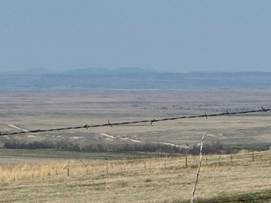
I had decided I would drive to Fort Robinson from Omaha, where I live, by way of Nebraska State Highways 92 (first half) and 2 (second half). Together, those two routes take you through the heart of the State, east to west. In addition, Highway 2 runs through the heart of the Sandhills. If you look at a satellite view of Earth along Highway 2, you’ll see that these Sandhills look like a bunch of sand dunes, but they all have grass growing on them, and several small ponds or lakes are scattered throughout. As I was driving through the Sandhills and listening to Rich Mullins and the Passion CDs (yeah, those date me), I began to understand what the Holy Spirit was trying to teach me. But he was only getting started.
I arrived at Fort Robinson State Park after dark, but not so late that I didn’t get to connect with my church friends who had already been there for a full day. We had breakfast the next morning at a small café in nearby Crawford, then struck out to fish. I went with a friend who had been in my small group when I moved back to Nebraska in 2010 and two of his (now grown) sons whom I hadn’t seen in quite some time. It was my first time fly fishing, so my goal was to get the hang of casting and extending my line. We tried the Ice House pond and then walked about a mile to couple bends in the White River (only about 10 miles from its headwater at that point, so no more than about eight feet wide if that. I had a few nibbles at the pond, but nothing in the river. From there we went back to the Grabel ponds, where I finished out the morning having developed a pretty good technique to cast and extend my line, even landing it on top of a 12-inch fish and spooking it away for a moment.
While I was at the section of the White River, I couldn’t help but think and marvel about how God created a means for distributing life-giving water throughout a continent (I knew the term “hydrology,” but I had to look up “limnology” as I was writing this paragraph), especially since, at the end of this month, my brother and I will be at the other end of the White River in South Dakota where it flows through the Badlands (and earns the name “White” from its sediment) and into the Missouri River south of Chamberlain for another fishing trip. God’s creation is an amazing and wonderful thing. That was what the Holy Spirit was continuing to show me, but not for the reason you might think.
Part 3: Sowbelly Canyon Road
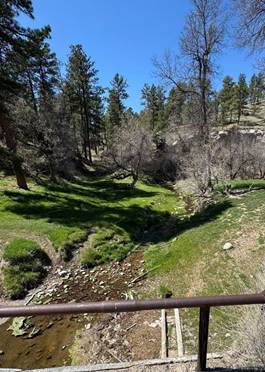
One of the sights I had heard about from the guys who had gone up the previous year was Sowbelly Canyon, just north of Harrison, Nebraska. I had no idea what to expect from a “canyon” in Nebraska; certainly nothing like Poudre River Canyon in Colorado where my wife’s family has a cabin. Poudre Canyon is about 50 miles long, and the Poudre River is relatively wide in the canyon. Sow Belly is unique in its own way and was surprisingly beautiful and “cool” in more ways than one. I wish my wife would have been able to come along on this trip.
As you’re driving west on US 20 toward Harrison, you see nothing but a bunch of gently rolling hills on either side of the highway. One would never expect a place of such beauty was just beyond those rolling hills. Even as you crest the top of the canyon, you see an amazing sight below: a single lane dirt road running under a canopy of trees, with unusual rock formations atop the buttes, some of which have formed at right angles. The descent is moderately steep, and at times you have a wall of the canyon on your right (descending) and your left (ascending). At the bottom of the canyon is a small, babbling brook that must have taken a few centuries to form the canyon.
Just before you get to the end of Sowbelly Road on the east end (where it joins Pants Butte Road; no, I’m not making that name up), there’s a spot where you can see at least 80 miles to the north to the Black Hills in South Dakota (the dark mound in the far horizon). Something special happened between God and me via the Holy Spirit on that road, and especially with this particular view. I gained a whole new appreciation for the beauty, majesty, and grandeur of God’s creation. I’d expect something like that in Colorado; I never expected that in seemingly plain old northwestern Nebraska. Boy, was I wrong. What God had started teaching me in the Sandhills came to full fruition at the top of Sowbelly Road.
Part 4: Worldview, Wonder, and Wisdom
So let me bring this all together now. You might remember I started out talking about exegetical methods, methods that were heavily focused on the textual features like grammar, syntax, verb mood and tense, etc. Then it hit me: nothing in my exegetical method intentionally accounts for the majesty and glory of God and his creation. I knew I had to work that in somehow. But God still had one more piece to show me, and it hit me last night at our last small group of the season. Our senior pastor had been with us on this trip, but Sunday morning, one of the teaching pastors was preaching on the trauma Job experienced. I had tried to listen to it Sunday morning while driving through the remotest part of western Nebraska, but just couldn’t get a steady signal.
Fortunately, our Tuesday night group covered it in the study last night, and it was when we were talking about the ending of the book of Job that everything God had been teaching me finally made sense. Job had been arguing with God and his friends about how righteous he was and how he had always given God glory and so on, but God put him in his place. God recounts for Job all that He did by questioning Job: Did you lay the foundations of the earth? Did you create Leviathan and Behemoth? Who are you to tell me how I should act toward you?
That’s when I realized that I’m like Job in that moment. I think I have such a great exegetical method that will keep my doctrine sound and shred every stronghold that tries to set itself against God Almighty, but God’s word is more than the text and the grammar and verb moods and tenses and the participles and the conditional clauses. Those things are static, unchanging. But what does Hebrews 4:12 say? “For the word of God is alive and active. Sharper than any double-edged sword, it penetrates even to dividing soul and spirit, joints and marrow; it judges the thoughts and attitudes of the heart.”[1] Can grammar and syntax do that? I think not.
The other thing that occurred to me is the backstory of how the Jews would understand God’s word versus us gentile Christians. I’ll use just one example here: Communion, or as some call it, the Lord’s Supper or the Eucharist. When we look at the elements (“substantiational” leanings aside), we are meant to experience Christ in some way by “remembering” him. We see one man crucified and risen. But what do Jews remember at Passover? Not one man dying, but ALL the firstborn dying who weren’t protected by the blood of the lamb that they themselves applied to their doorways. They remember God parting the Red Sea so the Israelites could escape the oncoming Egyptians. The disciples didn’t understand immediately that Christ’s death had won them forgiveness and freedom. The Jews DID understand that immediately, with hearts pounding witnessing the very miracles of God at work to rescue them, even as they would tell the stories year after year to their descendants.
Conclusion
In other words, when I exegete and interpret Scripture, I need to look beyond the text and the grammar and all the other “in-the-weeds” details to comprehend a grand vision of a great God and all that he has done and made. That’s where the “draw closer” takes place, as it did for me this past weekend, when I understood who I am in God’s kingdom and that, in spite of his greatness and grandeur, he looks with love at the least of us, at the humblest of us, at our faithfulness. He looks with compassion at those who are lost and searching and even at those who may be angry with him or agnostic toward him, prompting us to share God’s “living and active” word with those who have not yet comprehended that greater vision.
From this point forward, then, I’m adding a couple permanent elements of my “principlizing bridge” (to use Grasping God’s Word’s language) will be to ask first, “How does this passage reveal the glory and majesty and mystery of God to the world?” and second, “How is this passage ‘alive and active’ not only to me but to those I encounter as well?” I feel like I drew a little closer to God this weekend. I pray that my testimony here will do the same for you.
Pastor Scott Stocking, M.Div.
All contents herein are the creative and intellectual property of this author unless otherwise attributed.
I preached this message on Sunday, March 23, 2025, at Mount View Presbyterian Church. I dealt with all four passages for the Lectionary for this Sunday.
Bearing Fruit…and the Cross
Lent is typically thought of in the Christian world as a time of sacrifice. Some people give up meat only to crowd into the numerous fish fries around town. Others might give up chocolate or coffee or caffeinated beverages or shopping or any number of other things that we might consider “vices” personally, but most of those things are not innately spiritual and may in fact make us a bit more difficult at times to live with if we haven’t had our morning cup of Joe. I’m teasing you a bit, of course. But if Lent is supposed to bring us some spiritual benefit, then shouldn’t we be giving up things that can damage our relationship with God? Why not give up greed, pride, selfishness, and other such things?
That seems to be the underlying theme behind our passages today. They might be summed up by John’s exhortation when he was preaching in the wilderness in Luke 3:8: “Produce fruit in keeping with repentance.” In other words, bear fruit while you’re bearing the cross. In our passage from Luke 13 this morning, Jesus seems to be addressing the thought that some had that bad things only happened to bad people. But the circumstances of our demise do not determine our eternal destiny. In spite of the untimely and unfortunate deaths of the Galileans and those in the tower of Siloam, Jesus says the important thing is to repent and be ready.
Jesus switches to talking about the fig tree that won’t bear fruit in the next few verses. The owner of the fig tree wants to cut it down because it’s unproductive. But the vineyard manager said “Give me another year and I’ll have it bearing fruit.” But the connection here with the previous verses and John’s statement about producing fruit in keeping with repentance is unmistakable. If we’re not bearing fruit, that could affect our salvation and our relationship with our Savior. Jesus said in Matthew 7:20: “By their fruit you will recognize them.”
Paul talks about the quality of our works in 1 Corinthians 3:12–15, but he doesn’t use the language of “fruit.”
12 If anyone builds on this foundation using gold, silver, costly stones, wood, hay or straw, 13 their work will be shown for what it is, because the Day will bring it to light. It will be revealed with fire, and the fire will test the quality of each person’s work. 14 If what has been built survives, the builder will receive a reward. 15 If it is burned up, the builder will suffer loss but yet will be saved—even though only as one escaping through the flames.[1]
God, being full of grace and mercy, leaves us a way out when we fall short. That’s what he accomplished through Jesus in his death on the cross and his resurrection from the dead. But instead of focusing on these warnings for the rest of my message this morning, I want to turn the focus around to the theme I mentioned earlier: How do we bear fruit while bearing the cross? That would have been my sermon title in the bulletin if I had remembered to click send on my e-mail to Judy!
I want us then to look at the other three passages from the lectionary today in addition to our gospel passage I touched on at the beginning. In Psalm 63, we’ll look at seeking God in worship. In Isaiah 55, we’ll look at seeking God for our wellbeing. And finally in 1 Corinthians 10, we’ll look at standing firm in our faith to recognize the way out of temptations that can drag us down.
Let’s look at Psalm 63. For a long time our country has been turning away from church attendance and, by implication, from God altogether. A trusted, unbiased Web site called Statista has this summary of church attendance: “According to a 2022 survey, 31 percent of Americans never attend church or synagogue, compared to 20 percent of Americans who attend every week. Despite only about a fifth of Americans attending church or synagogue on a weekly basis, almost 40 percent consider themselves to be very religious.” A 2024 survey by Gallup puts the number of weekly attenders at 20%, with another 9% at “almost every week.” On the flip side, 31% NEVER attend church or other religious service. We could talk about the reasons for this 24/7 for a week, but we’d probably never get anywhere. Psalm 63 tells us why this shouldn’t be, though.
We should be able to come to church to find God. Granted David, who wrote this psalm, had a special relationship with God that enabled and empowered him to be a great leader of his people, but this doesn’t mean that you and I don’t have access to this same relationship in the New Covenant era. David claims to have seen God’s power “in the sanctuary.” It’s not clear exactly what he “saw,” whether it was some physical manifestation of light, a divine presence, or if he’s using the word “see” to describe what he experienced in worship. Regardless, it was clear at least in David’s day, one of the best places to be to encounter God was the sanctuary in the Temple.
In the New Covenant era, God has given his Holy Spirit to each of us who believe. You don’t have to be a king or a prophet any more to have exclusive access to the Holy Spirit. When we come together to worship, to sing praises and hymns, to read God’s word and hear it explained in such a way that it’s relevant to our live and our situations, the Holy Spirit works among us to build and shepherd that unity we have in body of Christ. When we pray together as a congregation, we let God know that we still trust in him to work in our lives and provide for our needs while at the same time letting those whom we’re praying for know that we will support them however we can. When we come together as a worshipping community for projects and collection for the poor, we show and shower God’s love upon those who are truly in need.
But our worship doesn’t just happen in the church building. Verse implies that wherever David is at, he is earnestly seeking God. Later in vs. 6, he say he remembers God in his bed and while he’s keeping watch on the battlefield at night. He sings to God and he clings to God, knowing that God’s presence is always with him through the Holy Spirit. We have that same assurance. Jesus even promised that at his ascension: “I am with you always, even to the end of the age.” Seek God and you will find him, and as you draw closer to him, others will come to see him at work in your lives as well.
As we seek God, we can also know he will provide for our basic needs and do so generously. That is the message of Isaiah 55. Verses 1 & 2 go like this:
God wants to richly bless us. God’s goodness is genuine and original. God isn’t giving us yesterday’s leftovers. Jeremiah says “His compassions never fail. They are new every morning; great is your faithfulness!” (Lamentations 3:22b–23). Sometimes we spend a lot of effort and money pursuing things that don’t bring lasting or eternal satisfaction. God wants us to focus on him and what he provides for us. Later on in Isaiah 55, the prophet says this:
6 Seek the Lord while he may be found;
call on him while he is near.
7 Let the wicked forsake their ways
and the unrighteous their thoughts.
Let them turn to the Lord, and he will have mercy on them,
You heard in that passage the idea I suggested earlier about giving up the things that tempt us to turn from God. But Isaiah also says we need to get rid of the “stinkin’ thinkin’” as well. This is complete repentance: not just changing our behavior but changing our minds and our ways of thinking as well. That’s were the worship comes in from Psalm 63: setting our hearts on Christ.
One of my favorite passages occurs a few verses later in Isaiah 55:
I believe this is one of the greatest passages on evangelism. I love that it says God’s word accomplishes the purpose for which he sent it. When I was preaching early in my career, I was never in a church that followed the lectionary or the liturgical calendar. I could preach on what I wanted or I could pick out a theme or a particular book and prepare a sermon series.
But following the lectionary puts these two verses from Isaiah in a new light for me. Now I don’t know who decided on the three cycle of passages to read, but the lectionary is a “reading plan” adopted by many churches and denominations around the world, so it carries a lot of weight and, aside from the denominational differences and nuances that work their way into sermons on these passages, many churches are on the same page when it comes to what their congregations are presented with each Sunday. Because so many churches have agreed to use it, I believe it’s something that God honors. I think there’s something divine about the spiritual foresight those responsible for developing it, so I honor that.
Occasionally I’ll look at the passage for the day and wonder, “How am I going to preach on that?!” But I trust that there’s some component of God’s timing there, that is, some spiritual benefits he has in mind for sending out his word in this way, and I want to be faithful to communicate that in a way that’s relevant to you and my larger audience on the blog. I genuinely believe the lectionary is one way that God’s word gets from his mouth to our ears and that preachers who follow the lectionary are in many and diverse ways fulling the purposes for which God sends it out in that structure.
Finally, I want to look briefly at 1 Corinthians 10. Paul concludes in the first half of chapter 10 that that the written history of God’s people is intended for our encouragement and exhortation to faithfulness. Here’s what vv. 11–13 say:
11 These things happened to them as examples and were written down as warnings for us, on whom the culmination of the ages has come. 12 So, if you think you are standing firm, be careful that you don’t fall! 13 No temptation has overtaken you except what is common to mankind. And God is faithful; he will not let you be tempted beyond what you can bear. But when you are tempted, he will also provide a way out so that you can endure it.[5]
Paul warns us that we shouldn’t rest on our laurels. Faithfulness is an active, ongoing process in the life of the Christian. There is nothing passive about it. Continue seeking God in worship; continue reading his words to hide them in your heart. Continue loving your neighbor as yourself so they too can see the love of God. Continue putting on the armor of God each and every day so you can take your stand against the devil’s schemes.
May the power of the Holy Spirit go with you this week as you serve our Lord and Savior. Amen.