Sunday Morning Greek Blog

April 6, 2025

Giving Our Best for the Savior (John 12:1–8)

I preached this message on April 6, 2025, which was also National Tartan Day. I wore the standard Gordon family kilt (great-great-grandfather through the maternal line) and the necktie is Gordon Red (purchased in Scotland). I’ve included a few pictures. Now I can say I’ve preached in a kilt! :-)

The Lord be with you.

Before I get to my main message, I want to go back a few months when I preached on Psalm 126, our Old Testament reading this morning, because it was also our reading on October 27. At that time I said that we should consider verse 4 a prayer for this congregation: “Restore our fortunes, Lord, like streams in the Negev.” That continues to be my prayer for this congregation today, and I hope it is yours as well. I heard recently that church attendance is starting to pick up again, so I pray we can take the opportunity to tap into that resurgence.

Our gospel passage this morning, John 12:1–8, is one of the few stories of Jesus’s ministry that all four gospel authors included, probably because Matthew and Mark both said that what she’d done would be told wherever the gospel was preached. Matthew and Mark both include the story after the time of Jesus’s triumphal entry into Jerusalem and two days before the Last Supper. Luke places it much earlier in his gospel, and he emphasizes that the woman’s sins were forgiven because of what she’d done. We can’t be sure why Luke has the story so much earlier. He may be “borrowing” it from the future in his gospel so he can tie it in with the story of the response to forgiveness based on the depth of one’s sins.

But in our passage this morning from John, he places the story just before Jesus’s triumphal entry into Jerusalem. This event may serve to bring to mind the anointings that the Israelites were commanded to do for their priests and kings. Listen to what David says in the very short Psalm 133:

How good and pleasant it is

when God’s people live together in unity!

It is like precious oil poured on the head,

running down on the beard,

running down on Aaron’s beard,

down on the collar of his robe.

It is as if the dew of Hermon

were falling on Mount Zion.

For there the Lord bestows his blessing,

even life forevermore.[1]

This refers to Leviticus 8, where not only was the oil poured on Aaron’s head for consecration, it was also used to consecrate everything in the newly assembled tabernacle. Matthew and Mark do not name the woman who brings in the alabaster jar. Nothing in those accounts suggests they know who the woman is. Luke says the woman lived a sinful life and suggests she shouldn’t even be there.

John is the only one who names the woman in his gospel. The woman is Mary, Lazarus’s sister. We do know a bit more about Mary and Martha than other people mentioned in passing in the Gospels. At the end of Luke 10, Martha is frustrated with Mary because she is sitting at Jesus’s feet listening to his teaching while Martha is busy preparing a meal. This probably isn’t the meal John mentions, and it’s nowhere near Luke’s account of the foot anointing. In the previous chapter of John, Jesus had raised Lazarus from the dead to prove he was the “resurrection and the life.” Lazarus’s death seems to have hit Mary the hardest in that story, as she is the one who seems most disturbed by Jesus’s delay in coming to see Lazarus. It makes sense, then, that Mary would be the one who wanted to anoint Jesus’s feet for resurrecting her beloved brother.

John is the only one who doesn’t indicate that the container for the nard was an alabaster jar, but the alabaster jar was considered the most appropriate container for nard or perfume at that time, so I think we’re safe to assume it was. Alabaster was made from gypsum, so it was somewhat delicate and finely textured. Breaking the seal probably meant that the neck of the jar had to be broken to pour the thick nard out and apply it. It wasn’t a very big jar either. We know it was about a pint, and it would have all had to have been used at that moment; otherwise it would spoil or lose its aroma. Matthew and Mark say the woman poured the nard on Jesus’s head, much like it would have been for the OT priests mentioned above, while Luke and John say the woman poured it on Jesus’s feet, perhaps an acknowledgment of Jesus’s servant attitude.

Although the details of this story vary among the gospel accounts, a couple themes of the story do stand out across the board. Many of those present at the dinner, especially Judas Iscariot in John’s account, view this as a wasteful act. This perfume was not cheap; Judas, along with other players in the parallel account, are concerned that such a valuable commodity could have been sold so the money would be given to the poor. John reminds us though that Judas’s concern was more selfish than compassionate. Judas had been helping himself to the till.

What this tells us, I think, for our walk with Christ today is that it’s okay to be a little extravagant when giving to the Lord’s work. Now obviously we don’t need to prepare Jesus for another crucifixion as the woman was doing in that day. But just as Jesus turned the water into the best wine served at the wedding at Cana for his first miracle, so we too can dedicate our excellence in whatever we do for or offer to the body of Christ and the work of the kingdom.

A second principle at work here is that, while the work of helping the poor is noble and a never-ending ministry of the church, there will be times when we have to take care of our own, and I’m not necessarily referring to when we die. It’s not selfish when we do that. It’s a necessary part of taking care of our family. While our loved ones are alive, we buy thoughtful gifts for them. When they pass, we pick out a nice coffin or urn. The ancient Jews used an ossuary, basically a stone box, to store the bones of a loved one once the flesh had decayed and often would put some sort of inscription on it. When the Jews brought Joseph’s bones out of Egypt, it was most likely in an Egyptian mummy case. That’s a little odd for us to think in those terms today, though, so we find other ways to memorialize our loved ones.

Unlike the pharisees and Judas Iscariot then, we should not look with judgment on those who do nice things for their loved ones at death. How we choose to remember a loved one is an important part of the grieving process. But I have to wonder here: Mary had already witnessed Jesus raise her brother Lazarus from the dead. Did she, or any of the other disciples for that matter, have any inkling that Jesus’s impending crucifixion might be followed up by his own resurrection? Judging from the disciples’ reaction in the gospels when Jesus spoke of his death, I’m pretty sure they hadn’t put two and two together yet.

Our gospel passage this morning has focused on what Mary did to prepare Jesus for his death. But what was Jesus doing to prepare his disciples for his death? We’ll address some of this after Easter in the Sundays leading up to Pentecost, but for now I think it’s important to see that, although he was speaking somewhat figuratively at times, he did not leave his disciples without reason for hope after his death.

The next event after our gospel passage this morning is Jesus’s triumphal entry into Jerusalem: Palm Sunday as we’ve come to know it. Chapter 13 is the Last Supper, where Jesus imparts his final teachings to his disciples before his arrest and crucifixion. John recorded five chapters worth of Jesus’s words, longer than the Sermon on the Mount. In those final hours he has with his disciples, he:

  • Models servanthood by washing their feet
  • Predicts Peter’s denial
  • Reassures them that he’ll come back to take them to the place he’s preparing for them
  • Promises the Holy Spirit will dwell in them and guide them in all truth
  • Encourages them to stay connected to the vine, to Jesus, so they can bear fruit
  • Reaffirms the coming, indwelling power of the Holy Spirit
  • Predicts that they will be scattered, but they will also eventually know peace
  • Prays for their unity so that the kingdom can move forward and their faith will be unshakable.

That must have been quite the emotional and gut-wrenching after-seder gathering. Most of what John records in those chapters was unique to his gospel. None of the other Gospel come close to the depth of this teaching. Luke and Matthew have passing references to receiving the Holy Spirit without too much detail to describe it. As a gospel writer, John seems to have had special dispensation to capture these final teachings. He, after all, was the only one who shows up at the cross on crucifixion day.

This is not to discount the other teachings of Jesus prior to his triumphal entry. His whole ministry was about preparing you and me for the new way God would work among his people. The Sermon on the Mount and the parables in Matthew; Luke’s sermon on the plain; and Mark’s emphasis on the urgency of Jesus’s ministry are all signs in their own way that Jesus was preparing ordinary people to extraordinary things for the kingdom of God.

Isaiah looked forward to this new time in 43:18–19:

18 “Forget the former things;

do not dwell on the past.

19 See, I am doing a new thing!

Now it springs up; do you not perceive it?

I am making a way in the wilderness

and streams in the wasteland.[2]

The final two verses from our OT reading this morning hint at a future sorrow that will end with joy as well:

Those who sow with tears

will reap with songs of joy.

Those who go out weeping,

carrying seed to sow,

will return with songs of joy,

carrying sheaves with them.[3]

As we continue toward Easter, you and I know how the story ends. We do not need to fret like those first disciples. We know we have the victory. We know we have forgiveness. We know we have the empowerment of the Holy Spirit. Let us go forth from here boldly and confidently in that knowledge and be shining lights for the Savior! Amen.


[1] The New International Version. 2011. Grand Rapids, MI: Zondervan.

[2] The New International Version. 2011. Grand Rapids, MI: Zondervan.

[3] The New International Version. 2011. Grand Rapids, MI: Zondervan.

November 12, 2023

Are You Ready for His Return? (1 Thessalonians 4:13–18; Matthew 25:1–13)

Click the “Play” triangle above to hear the message preached 11/12/23 at Mt. View Presbyterian Church, Omaha, NE.

High school was a very important time for me with respect to my spiritual life. A lot happened in those three years in our family, the most important of which was a change I had begun to see in my mom. Without going into the “why” of what led to her transformation, she got connected with a regular weekly Bible study with other women, and I noticed a positive change in her spirit and her demeanor. That change was amplified by her sharing her renewed faith in Christ with the rest of her family, primarily by leaving little “Jack Chick” comic book tracts around the house for anyone to read.

Many of them were rather simple: short stories about someone looking for God or discovering their need for forgiveness or reconciliation, or even encouraging “right living.” But amongst those more traditional evangelistic topics, there were a few tracts that spoke about the second coming of Christ. That was a totally new concept to me, or so it seemed. I had been pretty regular in my Sunday School attendance here at Mt. View as a kid, and if we ever talked about the second coming of Jesus in Sunday School up through my junior high years, it never stuck. But now I was curious, especially because my mom had a new testimony about her own renewal.

The topic of Jesus’s second coming was the spark that started the fire for my own spiritual renewal, eventually leading up to the summer between my sophomore and junior years at my aunt’s ranch in Wyoming, where I discovered she had a whole collection of these tracts, and several copies of each to boot. That was the summer, summer of 1979, that I made my faith my own. I understood that I had a decision to make to finish the work my parents started when they had me baptized as an infant here, dedicating themselves along with the congregation to raise me in the faith.

Now I’ll admit that, in the first two years after that summer, I made the mistake that the late great preaching professor Fred Craddock warned about: I got so caught up in the second coming of Christ that I ignored his first coming and everything that went along with that. I nearly undid my renewal because I hadn’t focused on growing in my knowledge of Jesus and what he wanted from my life until that day would come. I don’t think I was alone in that, either. I remember finding a bookmark in the Zondervan store that said, “Don’t be so heavenly minded you’re no earthly good.” That kind of hit home for me.

Our passages today bring back a ton of memories from that time in my life. The world is a much different place now than it was 44 years ago. Many so-called prophecy experts or eschatologists of the day thought Russia was the evil empire, Magog of the North from Ezekiel’s prophecies, and China and Iran (remember the hostage crisis?) were the manifestation of “the Kings from the East” of Revelation 16. But it wasn’t bad enough then. Today, it seems we’ve come full circle, only this time it appears to be much worse. Some of the same players have come back to the forefront again, and we should heed the signs of the times. Let’s take a look at our passages today.

Let’s start with our 1 Thessalonians 4 passage that we read this morning. The passage describes what is popularly known as the “rapture,” even though that word never appears in the Bible. It describes a time somewhere in the future (at least from Paul’s perspective, and in line with Jesus’s own words from Matthew 24) when the world will see the Son of Man coming in the clouds, resurrecting his followers first, then “catching up” his followers who are alive to rescue them from the final judgment of the earth.

The first couple verses of 1 Thessalonians 5, if I may borrow them from next week’s passage, tell us that day will come “like a thief in the night.” Now we may be tempted to think that day will be a day like any other day in our lives. As I started writing this section of my sermon, a commercial came on for David Jeremiah’s new book on the rapture, with video clips of people going about their daily lives just “disappearing,” with their clothes on (which I thought was bit odd), with nothing spectacular going on around them. But one of the Old Testament passages for today that we didn’t read, Amos 5:18ff, paints a very different picture of that day, and actually warns against being too excited about its coming:

18 Woe to you who long

for the day of the Lord!

Why do you long for the day of the Lord?

That day will be darkness, not light.

19 It will be as though a man fled from a lion

only to meet a bear,

as though he entered his house

and rested his hand on the wall

only to have a snake bite him.

20 Will not the day of the Lord be darkness, not light—

pitch-dark, without a ray of brightness?[1]

If you’ve studied this topic in the past, you’re probably well aware of the differing opinions about just exactly when this “rapture” happens in the whole scheme of the “end times” and the tribulation. I think this passage from Amos gives a hint about when that might happen if we put some other pieces of the puzzle together as well. I don’t want to dwell on this too much, because as Jesus says, no one knows the day or the hour when that’s going to happen. But we should be wise to the signs of the time and be able to discern at least the beginnings of that final era of our mortal history.

For example, some people think that what Jesus foretold in Matthew 24 has already happened, because he says, “This generation will certainly not pass away until all these things have happened.” The question is, does “this generation” refer to the people he’s speaking to, or is it more broadly referring to the period of the Church? Those who believe it refers to the people he’s speaking to are typically called “Preterists,” which is just a fancy word for historical. For them, the destruction of Jerusalem by the Romans in A.D. 70 marks the final point of judgment on the nation of Israel, and that is what is described in graphic imagery in the Book of Revelation. No rapture for us then! In this view, the age we’re living in now represents the rule of God’s kingdom on earth through the imperfect church, and there will still be a final reckoning of this history when perfection comes for good.

Others think the rapture will come at the beginning or half-way through the tribulation. Some take the phrase “time, times, and half a time” in Daniel 7:25 to say that’s three-and-a-half years, half of the seven years Ezekiel mentions about the last days in 39:9. But if you look a little closer at the Daniel 7 passage, you’ll see that God’s people will be “delivered” into the hands of the enemy for three-and-a-half years before being released. This leads to the very popular “mid-tribulation” speculation about when the rapture will happen. That’s the interpretation I learned as a teenager. But if you’ve been held captive by the evil in the world for three-and-a-half years, things probably aren’t going to be “business as usual” if and when you’re freed. It is nice to think that God wouldn’t want us going through the worst of the tribulation, but I don’t think things will be “bad enough” yet by the half-way point.

The phrase “thief in the night” that both Jesus and Paul use about the second coming of Christ is found in one other place in the New Testament, and it might surprise you where. It’s found in Revelation 16:15, where Jesus says of himself: “Look, I come like a thief! Blessed is the one who stays awake and remains clothed, so as not to go naked and be shamefully exposed.[2]” Now in case you haven’t read Revelation in a while, Jesus makes that statement after the penultimate sixth bowl of wrath is poured out on the Euphrates. Remember, the sequence of sevens is seven seals, seven trumpets, and seven bowls, so if these things represent a linear history, we’re almost at the very end of this final judgment. This begs the question: will Christians still be around through all these judgments up until the point of the final battle? What does the next verse of chapter 16 say? “Then they gathered the kings together to the place that in Hebrew is called Armageddon.[3]” Where is Armageddon, which is Hebrew for the Valley of Megiddo? It’s about halfway between Tel Aviv and the border with Lebanon, just north of the border with the West Bank. And immediately after that, the seventh and final bowl of wrath is poured into the air. Things that make you go “Hmmm.” I base my own personal views on the end times on this then, that the rapture doesn’t happen pre- or mid-tribulation, but at the bitter end of the world to save us from the devastating final wrath and judgment of God. That is our hope.

Now again, I want to emphasize that I don’t have any special knowledge here about these things. I’m just doing some investigative work on how the pieces of the puzzle might fit together and making an educated guess. I’m not trying to make any predictions about when anything is going to happen in the future; I’m just putting forth the facts about what Scripture says, and letting the chips fall where they may. I’m not saying I’m right and anyone who disagrees with me is wrong. I’m not that arrogant about my understanding of the timeline. But the point I’m making is that you can see how this Day of the Lord might be a dark and gloomy time as Amos prophesied. It is kind of scary, but we know for sure that God will win in the end, and in that grand thought and fact, we put our hope.

This is where our Matthew 25 reading comes in. Although on the surface this appears to be a parable about any old wedding banquet, it’s actually a parable about the final wedding banquet we’ll have in heaven when the Church is made the bride of Christ. Because the virgins don’t know when the bridegroom is coming, and they know he could come in the middle of the night, it’s important for them to be ready and have oil for their lamps so when he arrives, they can enter straightaway. If they’re not ready, they’re not getting in. There’s no turning around at that point and trying to get more of what they need to get in. Nor can anyone share their “oil” with them to help them get in, because if they share it, they might not have enough for themselves and may be left out as well.

If that sounds a bit selfish, it is, intentionally so. Each of us can, in the end, only be responsible for our own salvation and readiness, and we’d be foolish to give up that readiness for the sake of someone who wasn’t ready. God wouldn’t allow it anyway, because he judges each of us on our own readiness and faithfulness, as the parable of the sheep and goats at the end of chapter 25 suggests. Those who aren’t ready can’t ride on the coattails of those who are. Those who thought they could make excuses for not doing what God has called them to do won’t get a mulligan. When it’s finished, it’s finished, done, and over. Eternal consequences are locked in.

The Day of the Lord and the end times in general are topics of interest to many believers, and perhaps even more so in today’s climate. Unfortunately, at times they can become topics of debate as well, but we must never make one particular view of the end times a test of faith, because I believe there’s so much more we don’t know about how all that will play out. My encouragement to you, then, is to stand firm in the last days. Be ready. Put on the full armor of God as Ephesians says. Be in a constant state of prayer. Don’t neglect the fellowship with your fellow believers. As I’ve said before, we don’t know when our final day will be. Our last day could be today, tomorrow, or ten or twenty years from now. Jesus is coming! God will ultimately destroy this temporary abode of ours and establish us in his eternal kingdom, a new heaven and a new earth, in our new immortal bodies. It is and will be a place of perfection where there will be no more sorrow or shame, only joy and rest in the light of God’s glory, the light of the Lamb. Amen.


[1] The New International Version. 2011. Grand Rapids, MI: Zondervan.

[2] The New International Version. 2011. Grand Rapids, MI: Zondervan.

[3] The New International Version. 2011. Grand Rapids, MI: Zondervan.

July 22, 2023

Counting the Days: Acts 10 and Jewish Time References

In this post:

  • I address discrepancies between the NIV (2011) and its precursor, the TNIV vs. the NIV (1984), ESV, NLT, and several other translations regarding how many days passed between Cornelius praying for someone to come to his home and Peter’s arrival in Acts 10:30.
  • I also briefly address a couple ridiculous comments on this passage by Steve Wells in his Skeptic’s Annotated Bible (SAB) that smack of cultural insensitivity and reveal that he missed important contextual clues in analyzing the passage.

The Background

Our Saturday morning men’s group at the church I attend has been reading through the New Testament following the scheme in Tyndale’s The One Year Chronological Bible. We’re not reading through it following the calendar; we’re only reading it on Saturday’s together, so it’s been a slow process, but helpful in getting the big picture of Scripture, especially as it related to the parallel accounts in the Gospels.

This morning we were reading in Acts 10, Cornelius’s plea to God for someone to come explain the Gospel more fully to him and his household in Caesarea and Peter’s response to that call. In Acts 10:30, the NIV (2011) says this:

30 Cornelius answered: “Three days ago I was in my house praying at this hour, at three in the afternoon. Suddenly a man in shining clothes stood before me.[1]

No sooner had I finished reading this, several men in the group spoke up and said their version said “Four days ago.” In the grand scheme of things, this little discrepancy doesn’t have a lick of theological impact on the Bible or on any of our lives, for that matter. But it does present itself as a teaching moment on how the first century believers counted time, so I wanted to share a brief insight on this.

The first part of Cornelius’s response in Greek looks like this, followed by my literal translation:

Ἀπὸ τετάρτης ἡμέρας μέχρι ταύτης τῆς ὥρας ἤμην τὴν ἐνάτην[2]

From the fourth day until this hour, being the ninth [i.e., about 3:00 pm]

The phrase in Greek that I have translated “From the fourth day” is somewhat idiomatic, and it does not actually contradict other translations directly, and can in fact be shown to represent the narrative in chapter 10 about the event. I’ll get to that in a moment, but I want to show that the crucifixion story may lend itself to such a discrepancy if we don’t understand how the Jews count.

Counting the Days: Jewish Reckoning of Time Forward

Most of us know that Jesus died on a Friday afternoon and was raised on Sunday morning. His prophecy about himself is consistent that he would die and rise again “three days later.” But if we think about in how we moderns look at that, we might come up with two days. The time period between Jesus death and resurrection was less than 48 hours, that is, less than two full days. But for the Jews, Crucifixion Day was Day 1, even though the day was more than half over by that time. Interestingly enough, Jesus died at 3:00 pm on that Friday according to Mark’s Gospel. The Sabbath (and the next day) would begin at sundown that evening, so all of Saturday is silent to us in the Scriptures. That was Day 2. But by Sunday morning, Day 3, sometime after the sun had set and Sunday had begun, Jesus had risen and was no longer in the tomb. From our perspective, we might say, “But Jesus only died two days before he rose!”

When Jesus speaks of rising again, the Gospel writers are not consistent with the temporal preposition they use, even within the same Gospel. Some have “in (ἐν) three days,” while others have “after (μετὰ) three days.” There was even one occurrence of διὰ (“through”) being translated as “in.” The first preposition, although commonly translated “in,” can also mean “within three days” or “when the third day arrives.” So Jesus rising on Day 3 of his crucifixion and burial fits perfectly in that scheme. The same goes for “after.” “After the third day dawns, I will rise again.” The third preposition, found only in Mark 14:58 in these parallel passages, implies that “during” that three-day period, he will rise, similar to a meaning of “within” from the first preposition. Therefore, there is absolutely no contradiction here with how the events unfolded and Jesus’s prophecies about himself.[3]

Counting the Days: Jewish Reckoning of Past Time

Getting back to the Acts 10:30 passage now, it should be easy to see why the discrepancy exists among the various translations. To make it clear how time transpires in this passage, let me put it in “weekly planner” format, and for ease of argument, we’ll take Day 1 as Monday (thanks to my friend Jerry who pointed the textual clues out during our discussion):

Monday, 3:00 pm. Cornelius is visited by an “angel of God” (Luke’s words) while he’s praying, or at least in a prayerful state of mind. (Acts 10:3; see also 10:22 for the servants’ description as a “holy angel,” and 10:30 for Cornelius’s own statement that he was praying when he had the vision.)

Tuesday, noon. One of Cornelius’s soldiers and two of his servants are approaching the city; Peter goes up to the roof to pray, gets hungry, and sees a vision. (10:9)

            Evening: Cornelius’s men are guests of Peter that afternoon and overnight. (10:23a)

Wednesday morning: “The next day Peter started out with them….” (10:23b)

Thursday, 3:00 pm: “The following day he arrived in Caesarea” (10:24, 30).

In our modern parlance, if we were speaking on Thursday about something that happened on Monday, we would most likely say “Three days ago.” But counting backward in this story follows the same principles as counting forward in the crucifixion story. Thursday is the fourth day since Cornelius had his encounter with “a man in shining clothes,” the being Luke described as an angel in the opening paragraph (I’ll come back to that point in a minute). When the Greek text says “From the fourth day,” Cornelius is counting Thursday as Day 1, and Monday as Day 4 in the past.

The other interesting bit about this opening phrase in vs. 30 is that the participle for “praying” is in the present tense. Because Cornelius uses the “from…until” construction in what he says, it’s quite possible he’s not only saying that he was praying when had the vision on “Monday,” but that he’s continued praying “until” the time Peter arrives, fulfilling his prayers.

Wells’s Absurd Absurdity

For whatever reason, Wells, in his SAB seems to think it’s funny that Cornelius, a Roman gentile described as a devout man of faith and prayer, would receive a visit from an angel telling him how he can learn more about what the death and resurrection of Jesus means. Not only that, he’s told to reach out to Peter, who was the leading apostle at the time. (See his sidebar comments throughout chapter 10.) Cornelius is getting first-class service, and Peter is getting a lesson on what the next step of his ministry will be: reaching out to Gentiles, especially in the area around Jerusalem and Capernaum.

He also seems to think it’s funny that Cornelius refers to the angel as “a man in shining clothes.” In context, Luke knows what Cornelius saw and has the cultural and religious background to interpret it. The servants, who may have been Jewish or at least Samaritan, would have also recognized who Cornelius saw. But as a Roman Centurion, Cornelius may not have had the frame of reference to comprehend what he had seen. Additionally, the story about Paul’s encounter with a bright, heavenly light and the voice of Jesus on the road to Damascus may have reached his ears already, so perhaps Cornelius thought this was something similar. Maybe he didn’t know if it was an angel or Jesus himself, so he offers Peter a “just-the-facts” description of what he witnessed. Such cultural insensitivity toward a man who came from a pagan background into faith is just downright mean and nasty on Wells’s part.

Conclusion

As I said above, the issue of whether the passage should be translated “three days ago” or “four days ago” is extremely minor in the grander scheme of biblical inerrancy and translation fidelity. But I do hope you found the discussion enlightening. I’d love to hear your comments.

Peace to all!

Scott Stocking

My opinions are my own.


[1] The New International Version. 2011. Grand Rapids, MI: Zondervan.

[2] Aland, Kurt, Matthew Black, Carlo M. Martini, Bruce M. Metzger, Maurice A. Robinson, and Allen Wikgren. 1993; 2006. The Greek New Testament, Fourth Revised Edition (with Morphology). Deutsche Bibelgesellschaft.

[3] This also debunks Steve Wells’s contradiction #384 in his SAB. The “false witnesses” are not “false” because they supposedly made up something Jesus never said; they’re false because Jesus wasn’t speaking literally of the physical Temple made of stones and timber, but of the temple of his own body. They’re false because they tried to twist his words.

March 4, 2023

Life Lessons From a Year Through the Lectionary (Isaiah 58–61)

Background

I’m in the midst of a few weeks off from preaching, so I’ve had some time to reflect on the past 14 months of preaching through the Lectionary/Liturgical Calendar[1] at the behest of my childhood home church, Mt. View Presbyterian in Omaha. At the beginning of 2022, they had asked me to follow the Revised Common Lectionary, because that makes it easy for their small church to plan out bulletins and coordinate with other guest preachers.

It’s kind of like being back in seminary, having a different assignment due every two weeks or so, and because I’m not afraid of any challenge when it comes to preaching the Bible, I wholeheartedly agreed. I will admit as well that it’s beneficial to me, because I don’t have to think about topics in advance. Lincoln (IL) Christian Seminary taught me some great skills when it comes to hermeneutics (the science of interpretation) and homiletics (the skills for preaching), so I already know how to go through the motions to prepare.

Although I was raised in the Presbyterian faith and went through my church’s confirmation process, not much of that stuck as a sixth grader (or however old I was at the time). By the time I got to high school, I had begun to form my own ideas about my faith, and I started to look for something that was grounded more directly in Scripture and less reliant on the “traditions of men.” I found that home in the Restoration Movement (independent Christian Church) when I went to college.

The Restoration Movement traces its roots to the frontier Midwest (Kentucky, Pennsylvania, Ohio areas) where a group of preachers decided the best way to “do” church was to primarily stick to what the Bible said and not make manmade creeds or religious rules a test of faith or fidelity. “No creed but Christ; no book but the Bible”; “Where Scripture speaks, we speak; where they are silent there’s freedom” or “we’re silent.” Accordingly, things like the Liturgical Calendar or traditional Holy Days were downplayed, unless there was biblical precedent (e.g., the birth of Christ announced by angels). Historically, we’ve operated under the principle that the operations of God’s grace are not dictated by the Liturgical Calendar or any other calendar.

The operations of God’s grace are not dictated by the Liturgical Calendar or any other calendar.

While I still generally operate under that principle, I have come to discover the biblical underpinnings of many of the Holy Days or Seasons. In addition to that, I have come to see how important some of these traditions are to the Mt. View congregation as currently constituted. I have been refreshed and uplifted in my faith in God and my knowledge of his word by the work I’ve had to do to prepare messages based on the Lectionary readings for a particular Sunday. As such, I want to take the opportunity of this article to share what I’ve discovered about some of the lesser-known Holy Days and Seasons, at least among those in the Restoration Movement tradition, and perhaps encourage my brothers and sisters in the Restoration Movement to consider a more intentional approach to them.

Advent: Preparing for the Coming Messiah

As with most things, it’s best to start at the beginning, so I want to take a look at Advent first. The Lectionary cycles through three years (Years A, B, and C) of readings, and Advent marks the beginning of the new liturgical year.[2] As you might imagine, Advent is the most familiar to me. I have fond memories of getting the Advent calendars with chocolate or other goodies in them (maybe even a Bible verse?) and especially of lighting the Advent candles in church service with my family. I know our family got to do it at least one Advent Sunday when I was growing up.

What I had forgotten was that each Sunday in Advent had its own special theme. This may vary among the traditions, but the four common themes are usually Hope, Peace, Joy, and Love. For Advent 2022 (Year A of the new cycle), the OT passages focused on Isaiah.[3] What I find interesting is that many of these passages could have dual fulfillment, referring both to the first coming of the Messiah and the second coming of the Messiah. For example, Isaiah 2:3 (Year A, first Sunday) mentions going to the temple where God will teach his ways, while 2:4 speaks of beating swords into plowshares, which is typically associated with the second coming.

Isaiah 11:1–2 (second Sunday) speaks of Jesus as the one upon whom the Spirit of the Lord will rest, while 11:4 says “He will strike the earth with the rod of his mouth.” Isaiah 35 (third Sunday) appears to reference much of Jesus’s healing ministry, but vs. 4 speaks God coming with vengeance. Isaiah 7:14 (fourth Sunday) is the prophecy Matthew quotes about the virgin birth of Christ, even though it has a partial fulfillment in the immediate chapters of Isaiah following that. Isaiah 9 (“For unto us a Child is born”) is the annual passage for Christmas Eve service.

It’s easy to see, then, why many of the Jews at the time of Jesus’s ministry were looking for a Messiah that would overthrow Roman rule. This led me to an important realization: God’s people have never lived in a time where they had no expectation of a coming Messiah, except perhaps for those who were close to the Messiah during his earthly ministry. Even though scholars are fairly certain that Jesus was not born in the month of December, the celebration of Advent along with Christmas not only as a retrospective on Jesus’s birth and first coming and all the heavenly fanfare that went along with that, but also as a prospective look at the second coming of Christ is still highly relevant to Christians today, especially in our current culture and climate.

God’s people have never lived in a time where they had no expectation of a coming Messiah.

Epiphany

I recently posted my Epiphany message, A Pastor’s Epiphany About Epiphany (Matthew 2:1–12; Isaiah 60:1–6; Psalm 72), so I won’t say too much about that here. The title pretty much sums it up. Epiphany focuses on the visit of the magi to Jesus, which, if you read the Gospel account closely, seems to come a few days after the birth of Christ (historically 12 days after, but there’s no biblical text to suggest that time frame); Jesus’s family was in a house by that time. Focusing on the Isaiah passage here, which is the same every year in the Lectionary, reveals some interesting clues to where the magi came from.

As I was preparing the Epiphany message, I realized that I’d never really heard anyone in the Restoration Movement talk about where these magi had come from. That seemed pretty odd to me given that we’re supposed to focus on examining the Scriptures to figure out the truth. I’d heard about David Longnecker’s Mystery of the Magi in a news report. The book gives a detailed analysis of where these magi may have lived and what their connection was to Jewish history and prophecy. As it turns out, these magi were probably not from Persia, because Persia was in decline at the time. Rather, they were probably from some diaspora Jews that never made it to Babylon and settled in communities east of the Jordan river and Dead Sea, and perhaps as far south as Midian. They were known as Nabateans. They would have had a more intimate knowledge of Messianic prophecy and seem to fit the demographic and economic descriptions in the Isaiah 60 passage, as I explain in my message. Isaiah 60:1 may refer to the star they followed; they were at the crossroads of several prominent trade routes; and “Nebaioth” is mentioned, which may well be the root of the name of the Nabateans.

If there’s any application to this knowledge, I think it’s that we need to learn to recognize the signs of the times to anticipate the second coming of Christ, which ties in to the secondary theme of Advent. The Nabateans appear to have been diligently searching the skies and paying attention to the signs, because they did not want to miss the coming of the Messiah they had hoped for as well.

“Jesus would probably laugh at us for giving up things like chocolate, beer, coffee…all the things that actually bring us joy and make us happy.”

Lent

In the past couple weeks since Lent began, I’ve had one friend ask whether I observe Ash Wednesday, and another ask me what I thought about a Facebook post about one person’s unique take on Lent. Here’s a quote cited in the post from a priest he’d heard:

“Jesus would probably laugh at us for giving up things like chocolate, beer, coffee…all the things that actually bring us joy and make us happy.

What He might suggest is giving up the things that make us miserable in God’s Paradise.

Things like self doubt, insecurities, jealousy, greed, and gossip and anger.

The things that move us away from The Light.

Honor His sacrifice by giving up The Darkness in your Life.”

Now I’ve never given up anything for Lent, because I don’t observe it. And I’ve never had ashes placed on my forehead to initiate a Lenten fast. But I thought what this priest he’s quoting said made a lot of sense. But here’s where my initial principle comes into play: the operation of God’s grace isn’t limited to a calendar or a season. Shouldn’t we always be giving up the darkness in our lives so we can more fully know God? That’s a good way to live to be sure, and I commend anyone who can do that, but if it’s something we should give up permanently, then is it really a fast? Is it really a sacrifice to give up something that’s bad for us?

Before I even looked at the Lectionary for what passage is assigned for Lent, I knew Isaiah 58 was really the best definition of fasting we have in the Bible. As it turns out, that is the evergreen passage for Lent. The problem as I see it with concept of Lent as a personal fast is that it is somewhat self-centered. Sure, the presumed motivation is to get closer to God, but how does giving up a food item or certain activity actually accomplish that? And again, if it’s something that you know is bad for you anyway, why do you need the backdrop of a religious Holy Season to accomplish it?

If we look at Isaiah’s description of fasting, though, there’s really nothing selfish about how it should be. There’s no talk of personal sacrifice or personal wellbeing. In fact, Isaiah (58:5) scolds his readers for thinking of fasting in just such a way:

5 Is this the kind of fast I have chosen,

only a day for people to humble themselves?

Is it only for bowing one’s head like a reed

and for lying in sackcloth and ashes?

Is that what you call a fast,

a day acceptable to the Lord?[4]

Isaiah then goes on to describe what the Lord expects from our fasting, and there’s nothing selfish about it, except that when we do the hard things, then we have a reward waiting for us. What are the hard things (vv. 6–7, 9b–10a)?

  • Loose the chains of injustice
  • Untie the cords of the yoke
  • Set the oppressed free and satisfy their needs
  • Break every yoke
  • Share your food with the hungry by spending yourself on their behalf
  • Provide the poor wanderer with shelter
  • Clothe the naked
  • Not turn away from our own flesh and blood
  • Do away with the blame game and malicious talk

What are the resulting rewards? They’re commensurate with the degree to which we work toward accomplishing the hard stuff! This isn’t legalism, though. This is what it means to show our faith by what we do, not just by what we say. We talk the talk AND walk the walk. Integrity.

  • Your light will break forth like the dawn
  • Your healing will appear quickly
  • Your righteousness will go before you
  • The glory of the LORD will be your rear guard
  • You will call, and the LORD will answer
  • You will cry for help, and he will be there for you
  • Your light will rise in the darkness, like the noonday sun
  • The LORD will always guide you, satisfy you, and strengthen you.

And so on and so on and so on.

In the Old Testament, most references to fasting are about a community fasting, not individuals. When it occurs in the books of pre-exilic history, it often refers to a prebattle ritual. David fasted for his first child with Bathsheba, but to no avail. In the post-exilic history, fasting is mentioned in connection with restoring Jerusalem to a semblance of its pre-exilic state (e.g., compare Isaiah 58:12 to Isaiah 61:4). In the New Testament, most references to fasting are about what to do when you fast. There’s very little mention of its purpose, although the reference to John’s disciples fasting most likely indicates they were waiting for the Messiah.

In the Old Testament, most references to fasting are about a community fasting, not individuals.

Above, I made a parenthetical reference to Isaiah 61 with respect to rebuilding ancient ruins. Nehemiah fasted before taking on the project to rebuild the walls of Jerusalem. But do you know what else is significant about Isaiah 61? That is the passage Jesus uses for his own ministry in Luke’s account, immediately after Jesus spends 40 days fasting in the wilderness. His words sound very much like the purpose of fasting in Isaiah 58. Jesus fasted for 40 days in the wilderness because he knew he had big things, Isaiah 58 big things, to accomplish in his ministry, so he did it right. Check out Isaiah 61:1–3a and see if that doesn’t sound a lot like Isaiah 58:

The Spirit of the Sovereign Lord is on me,

because the Lord has anointed me

to proclaim good news to the poor.

He has sent me to bind up the brokenhearted,

to proclaim freedom for the captives

and release from darkness for the prisoners,

to proclaim the year of the Lord’s favor

and the day of vengeance of our God,

to comfort all who mourn,

3           and provide for those who grieve in Zion—

to bestow on them a crown of beauty instead of ashes,

the oil of joy instead of mourning,

and a garment of praise instead of a spirit of despair.[5]

So fasting is for the big things; the big decisions. The Gospels do hint that fasting had taken on a more individual application in some cases, but I don’t think its purpose, as outlined in Isaiah 58, was ever diminished. Jesus set the standard for fasting. Another interesting aspect of fasting in the NT: it’s never mentioned after Acts, and only twice in Acts 13:2–3 around a decision about whom to send out to the Gentiles.

The application for the modern church seems clear, then. While there does seem to be something to be gained by fasting personally, the more important goal the Scriptures (and Jesus) have in fasting is justice, especially for the poor and oppressed. The Scriptures also seem clear, both in the OT and especially with John’s disciples in the NT, that corporate fasting is much more powerful and effective in God’s kingdom economy.

Conclusion (for now)

This post is already pretty long, so I’ll forego discussing Easter through Passover, which makes up the last of the Holy Seasons in the Liturgical Calendar. The rest of the Sundays in the Liturgical Calendar after Passover are identified as “Propers,” 29 of them for the remainder of 2023. That seems kind of unusual to me to have the major church Holy Days packed into five months of the year. Do we need 22 weeks a year to get ready for the other 30 weeks? Is the liturgical year intended to be a microcosm of the Christian life: we educate ourselves about who Christ is and what he’s done for us early on so that we can walk faithfully for the rest of our lives?

I’d love to hear your stories about how these Holy Days or Holy Seasons have impacted you. As I said before, I’d never really given them much thought until this last year, so I’ve tried to look at them from an outsider’s perspective, since I have little to no historical experience with these things. I do hope my brothers and sisters in the Restoration Movement will consider my words here and how they can present these Holy Days and Seasons in a fresh new way to reach those who may have lost their way for whatever reasons. I think the body of Christ will benefit greatly if we can discover a new appreciation for the Liturgical Calendar.

My opinions are my own.

Scott Stocking


[1] The Liturgical Calendar is the order of the Holy Days and Seasons. The Lectionary represents the assigned Scripture texts for each day that are used in the worship service or as the basis for the message on any given day of the Liturgical Calendar. My focus here is primarily on those events that happen on Sundays.

[2] The new liturgical year formally begins on the Thursday before the first Sunday in Advent. This is usually the last Thursday of November, so this is typically Thanksgiving Day, unless November has five Thursdays.

[3] For some Holy Days, the passages are different from year to year in the cycle, but are the same in the respective years of each cycle. So year A has the same passages for Advent in 2019, 2022, 2025, etc.; Year B for 2020, 2023, 2026, etc.. For other Holy Days, Epiphany and Lent, for example, the passages are the same for all three years in the cycle and thus across all cycles.

[4] The New International Version. 2011. Grand Rapids, MI: Zondervan.

[5] The New International Version. 2011. Grand Rapids, MI: Zondervan.

April 24, 2022

The Coming King: An Exegesis of Revelation 1:1–8

Listen to “An Exegesis of Revelation”

In the past four months, I’ve explored much about the life of Jesus with you in the Gospels, especially as it relates to the fulfillment of prophecies about Jesus. At Christmas time, of course, we looked at his birth. A couple weeks ago, we looked at some of the prophecies surrounding his triumphal entry and final week up to the crucifixion and resurrection. The Old Testament prophets also told us he would teach in parables (Psalm 78:2||Matthew 13:35).

Variety of Interpretations

Now if you’ve spent much time reading and studying the book of Revelation or the end times in general, you probably know that there are many different views about how to interpret the book, especially as how it relates to the calendar. Views range from the preterists, who believe the end-time prophecies have already been fulfilled, perhaps when the Romans conquered Jerusalem in AD 70, to the postmillennialists, who think Christ will return after a literal 1,000-year reign of the church on earth. Then there are those who think there will be a 7-year period of tribulation prior to Christ’s return and millennial reign, with varying views on when the “rapture,” the transformation of God’s living saints into heaven, happens. And the last major view I’ll mention is that of the amillennialists, who see the church’s current presence on earth as a figurative expression of the 1,000-year reign of Christ, with Christ coming at the consummation of history and establishing his new heaven and new earth.

These differing views have all been put forth by their respective proponents based on well-intentioned study of and meditation on God’s word and historical theology. As someone who spent a great deal of time studying the end times when I was a renewed believer, I’ve seen some of these proponents use the same Scriptures to support their differing views! Add to that that much of the literature on end times is written from an American or Western perspective, but Christians throughout the world at various times and places have at one time or another experienced intense persecution and interpreted the signs of their own respective times such that they thought their generation would be the one to see the return of Christ. So let’s be honest and face the facts—we really don’t have enough solid information to make any absolute statements about when and how Christ will return. And as such, I’m not here this morning to defend any one of these viewpoints.

Setting the Stage

Instead, I believe that the message of the Revelation to John, when taken at the face value of the printed word, is one that can be easily understood. For example, we don’t have to know who or what the four horsemen of the apocalypse represent (or represented) in the historical context (past, present, or future; although we are called to discern those signs); the important thing to grasp is how the events surrounding these players would impact the church, and how the church should respond to those events. So this article, we’ll take a look at the first few verses of Revelation chapter 1 to see how John is setting the stage for us regarding the revelation he received while imprisoned on Patmos, which he recorded for all posterity.

Prologue

1 The revelation from Jesus Christ, which God gave him to show his servants what must soon take place. He made it known by sending his angel to his servant John, 2 who testifies to everything he saw—that is, the word of God and the testimony of Jesus Christ. 3 Blessed is the one who reads aloud the words of this prophecy, and blessed are those who hear it and take to heart what is written in it, because the time is near.

Greetings and Doxology

4 John,

To the seven churches in the province of Asia:

Grace and peace to you from him who is, and who was, and who is to come, and from the seven spirits l before his throne, 5 and from Jesus Christ, who is the faithful witness, the firstborn from the dead, and the ruler of the kings of the earth.

To him who loves us and has freed us from our sins by his blood, 6 and has made us to be a kingdom and priests to serve his God and Father—to him be glory and power for ever and ever! Amen.

7 “Look, he is coming with the clouds,” 

and “every eye will see him,

even those who pierced him”;

and all peoples on earth “will mourn because of him.”

So shall it be! Amen.

8 “I am the Alpha and the Omega,” says the Lord God, “who is, and who was, and who is to come, the Almighty.” [1]

——Revelation 1:1–8

Defining “Revelation”

First, it helps to know what exactly is a “revelation.” In the biblical sense, a revelation (Gk ἀποκάλυψις apokalypsis) involves making something known that was previously hidden and that could NOT have been known by man prior to its being revealed. In Romans 16:25 and Ephesians 3:3, ἀποκάλυψις refers to a mystery. In Galatians 1:11–12, Paul claims to have received the Gospel not from any human source, but directly from Christ. This lines up with the testimony from Acts 9 when Paul is confronted by the risen Christ on the road to Damascus and his own testimony that he waited at least three years before going fully public with his conversion to Peter and James.

Revelation is a broad category. A revelation may simply be a statement from God about the truth; some sort of physical sign that appears in the natural world; or a “vision,” which in modern technological terms is similar to a 3-D interactive hologram, except some of the people and things in the vision may have some physical substance to them that the person actually experiences. Usually a vision is limited to one person, and is almost always accompanied by a messenger or angel, as in the current text. This helps give credence to John’s testimony, as he would have otherwise been alone when he received the revelation.

Location and Occasion

The book of Revelation is a very long epistle written to seven churches on or near the western coast of Asia Minor, what we know today as western Turkey. Because it was so long and John needed to get the word out quickly “because the time is near,” verse 3 has the instruction that the entire book be read out loud to the seven churches rather than have separate copies made and delivered to each of the churches. The order of the churches in vs. 10 (and their corresponding letters in chapters 2–3) would have been a typical circuit for anyone who traveled regularly through that region. What probably happened is once the book was read at Ephesus, someone would have travelled to Smyrna to pass it off to the next church, and so on.

What we don’t seem to know, at least, no one in the several commentaries I reviewed knew, is why these seven churches. There were other churches nearby who had already had letters from Paul: Colossae was just a few miles to the east of Laodicea, and the region of Galatia was just east of there. A simple answer, and the one I’ll assume here, is that John functioned as some sort of overseer for these churches, and so he “stays in his lane” and focuses on those churches. With these cities being on an established circuit, we can make an educated guess that there may have been some strategic considerations as well for eventually distributing the message to the rest of the Mediterranean region and beyond. At least one commentator suggested this area could have had the highest concentration of Christians at the time.

Many commentators focus on the number of churches, seven, because that symbolizes completeness, and as such, each in their own way may represent established churches elsewhere in the world. But there are local details that only the believers in the respective churches could have related to, so that might lessen a broader appeal to other churches. At the very least, if other churches besides those mentioned received this letter, they surely would have been able to discern broader principles that applied to their situation, and the grand visions of Revelation in chapter 4 and beyond would have had universal significance to the church as it existed at the time. For now, though, we can set the question of “Why these seven churches” aside and still discern some meaningful truths from the passage.

The OT Connection

Many early– to mid–20th-century versions of our English Bibles do not indicate that the book of Revelation has many, if any, direct quotations or allusions to the Old Testament. But as scholars and translators have studied the book in more detail, and the use of computers facilitated better text comparisons between the Old and New Testaments, they’ve come to discover the book’s extensive connections to the OT.

Verses 4 and 5 are at the heart of what I hope to communicate to you this morning. Not only do they speak to who Christ is, but to our relationship with Christ as well and how he views us in his eternal plan. After greeting the seven churches, Paul opens with a pretty standard greeting formula: “Grace and peace to you.” The word “grace” was rarely used in the OT, and when it was, it usually referred to adornment, graceful speech, or a graceful appearance. Only a couple uses of the word in the NIV could be considered to come close to the NT understanding of grace as a free gift from God, especially for salvation. “Peace” was the more common OT greeting, so John and the other epistle writers use this formula to tie together the new and old covenants when addressing a mixed audience. “Peace” is not just the absence of conflict in the OT context, but a sense of security and acceptance as well.

The next phrase, which is also repeated in vs. 8, tells us who the sources of grace and peace are: “The one who is, and who was, and who is to come” is, of course, God himself, the father. The phrase is a direct reference to the Greek translation of God’s divine name in Exodus 3:14, when he reveals it to Moses at the burning bush: “I am who I am,” or perhaps better “I will be who I will be” (Hebrew: אֶֽהְיֶ֖ה אֲשֶׁ֣ר אֶֽהְיֶ֑ה; [ehyeh asher ehyeh] Greek LXX: Ἐγώ εἰμι ὁ ὤν [egō eimi ho ōn]). In Hebrew, we know that name to be Yahweh, which as a word, is nothing more than a glorified form of the “to be” verb in Hebrew. This refers to the timeless, eternal, self-sustaining nature of God. One other interesting fact about this description: The phrase “who is to come” sounds like it might be a future tense, right? But in Greek, it’s actually a present tense verb. Why is this little bit of grammar important? Because in Greek, the present tense usually implies an action is in process and is not a one-and-done event. God is saying that, even now, he is actively working on coming to us to redeem us once and for all and finally put an end to Satan’s power. We can always count on God’s presence and involvement in the affairs of our lives and in the world around us.

The next source for grace and peace is the “seven spirits before his throne.” This is a little trickier to discern, because John describes the seven spirits differently in each context he mentions them. In 3:1, when addressing the church of Sardis, Jesus says, “These are the words of him who holds the seven spirits of God….” In 4:5, John says the seven lamps blazing in front of the throne of God are the seven spirits of God. In 5:6, John says the “seven eyes” of the Lamb “are the seven spirits of God sent out into all the earth.” At the very least, then, it would seem like these spirits represent a special group of divine beings, perhaps archangels, who have some authority to carry out God’s will on the earth, especially with respect to the judgment events later in the book. However, this may in fact be an expanded way of referring to the Holy Spirit, because then we would have an expression of the Trinity in vss. 4–5: Father, Spirit, Jesus.

If you’re following along in your Bibles, some of you may have a footnote with an alternate translation: “the seven-fold Spirit.” This may refer to a seven-fold description of the Holy Spirit in Isaiah 11:2 about the shoot that comes up from the stump of Jesse, and thus support the idea this is in fact a statement about the Trinity:

The Spirit of the Lord will rest on him—

the Spirit of wisdom and of understanding,

the Spirit of counsel and of might,

the Spirit of the knowledge and fear of the Lord

If this is the case, it would seem these seven spirits (or the seven-fold Spirit) may have a role to play in preparing and protecting believers in the tribulation that John will describe. However we interpret the phrase “seven spirits,” we at least can be assured that God is working in our best interests to bring us grace and peace.

Moving on, we see the final source of our grace and peace is Jesus himself. We’re reminded of who he is and what he’s done for us. He’s first called a “faithful witness” here, which brings us back to Isaiah again, 55:4:

See, I have made him a witness to the peoples,

a ruler and commander of the peoples.

He is the faithful witness because he did all that his father commanded him to, even accepting death on a cross for our sins. This is also why he’s called here “the firstborn from the dead,” because God raised him from the dead and proved once for all that death could in fact be defeated (Psalm 89:27; Colossians 1:18). It’s important here that John reminds his readers of this hope of the resurrection because of the intense suffering some of them may face based on the revelation John is proclaiming.

The final piece in the first part of vs. 5 here is that Jesus is “the ruler of the kings of the earth.” This again hearkens back to the last part of Isaiah 55:4 I read a moment ago. Jesus is King of Kings and Lord of Lords.

In response to the grace and peace of the blessing from the Father, Holy Spirit, and Jesus, John returns thanks to Jesus and acknowledges what the Father, Jesus, and the Holy Spirit have done not just for him, but for all believers everywhere. First off, he loves us. I think we all know the passage from John 3:16: “For God so loved the world that he gave his one and only Son, that whoever believes in him shall not perish, but have eternal life.” He’s also “freed us from our sins by his blood.” The death of the perfect Lamb of God was powerful enough to cleanse us and make us holy in his sight. Finally, John mentions a promise that goes all the way back to their release from captivity in Egypt and before God gives Moses the Ten Commandments. Exodus 19:5–6 says:

Now if you obey me fully and keep my covenant, then out of all nations you will be my treasured possession. Although the whole earth is mine, 6 you will be for me a kingdom of priests and a holy nation.

What a blessing to know that we have power, authority, and hope in our Savior to face whatever may come our way! And because of that, John can conclude that God deserves all glory and power for who he is and what he’s done for us.

Verse 7 isn’t so much a vision but a mash-up of several OT verses that confirm that God is indeed all powerful and worthy of all glory. Let’s hear it again before breaking it down:

“Look, he is coming with the clouds,” 

and “every eye will see him,

even those who pierced him”;

and all peoples on earth “will mourn because of him.”

So shall it be! Amen.

“He’s coming with the clouds” is a direct quote from Daniel’s vision in 7:13. The gospels use this description of Christ’s return as well. The next few lines about being pierced and the people mourning come straight from Zechariah 12:10. The Jews always recognized these two passages as Messianic from the time they were published after the exile. John is confirming that here.

Verse 8 closes out this passage with God himself saying he is the Alpha and Omega. This also hearkens back to a passage in Isaiah 41:4:

4 Who has done this and carried it through,

calling forth the generations from the beginning?

I, the Lord—with the first of them

and with the last—I am he.”

Long before this, Jewish writers were referring to God as the ‘’Aleph and Tau,’ the first and last letters of the Hebrew alphabet. Some Jewish writers went even further and added the middle letter of the Hebrew alphabet between the first and last, which made the Hebrew word ’emeth, which means “truth.” So God calling himself “Alpha and Omega” is nothing new to Jewish Christians who spoke Greek. A few verses later, in Revelation 1:17, Jesus calls himself “the First and the Last.” In Revelation 21:6, God again calls himself Alpha and Omega, only this time he also adds “the Beginning and the End.” In the final chapter, 22:13, we see Jesus taking on both those titles as well, only this time he adds in “the First and the Last” from 1:17. In other words, Jesus affirms that he is part of the Trinity with God the Father and the Holy Spirit. Jesus is God, not “a” god little g, but the one and only “God” big G.

Conclusion

Revelation can be a difficult book to navigate. It’s full of strange and sometimes bizarre images of multihorned beasts, horses of different colors, and terrible cosmic events. But even if you don’t understand all that, the important thing to understand is what we’ve talked about here this morning. Here’s what I hope you’ll take away from today’s message:

  1. God is in control even in the most difficult times, and his presence is always with you.
  2. God loves you and has freed you from your sins. With that kind of freedom, you can and will do great things for God’s kingdom.
  3. No matter how bad things get around us, we have the absolute assurance that God and his church will win in the end. We don’t know how much of the bad stuff we’re going to have to go through, but we can be sure God will rescue us in the end and bring us safely home to his eternal kingdom.

Go in peace today with the assurance that your sins are forgiven, and that God is preparing a place for you.


[1] Scripture quotations taken from The Holy Bible, New International Version® NIV®
Copyright © 1973, 1978, 1984, 2011 by Biblica, Inc.™
Used by permission. All rights reserved worldwide.

Scott Stocking

My opinions are my own.

January 24, 2012

Old Testament Timeline

Filed under: 1 Chronicles,Chronology,Genesis,Old Testament,Septuagint — Scott Stocking @ 7:29 am

(Note: The first part of this was originally posted as Genesis Timeline.)

The Evidence from Genesis

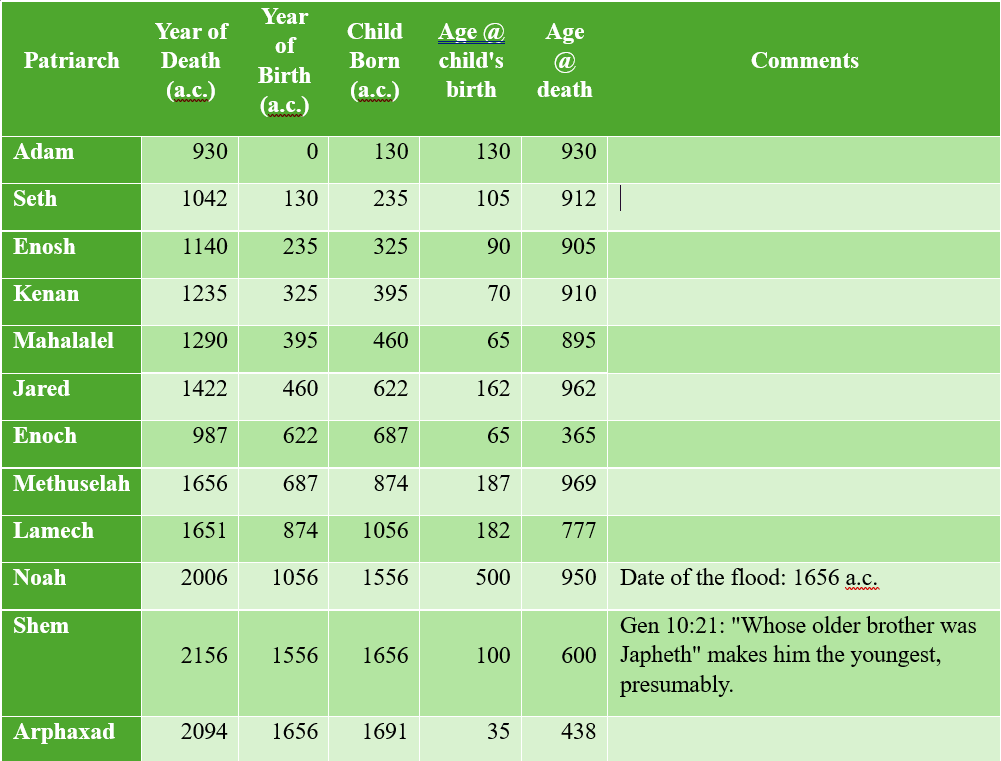
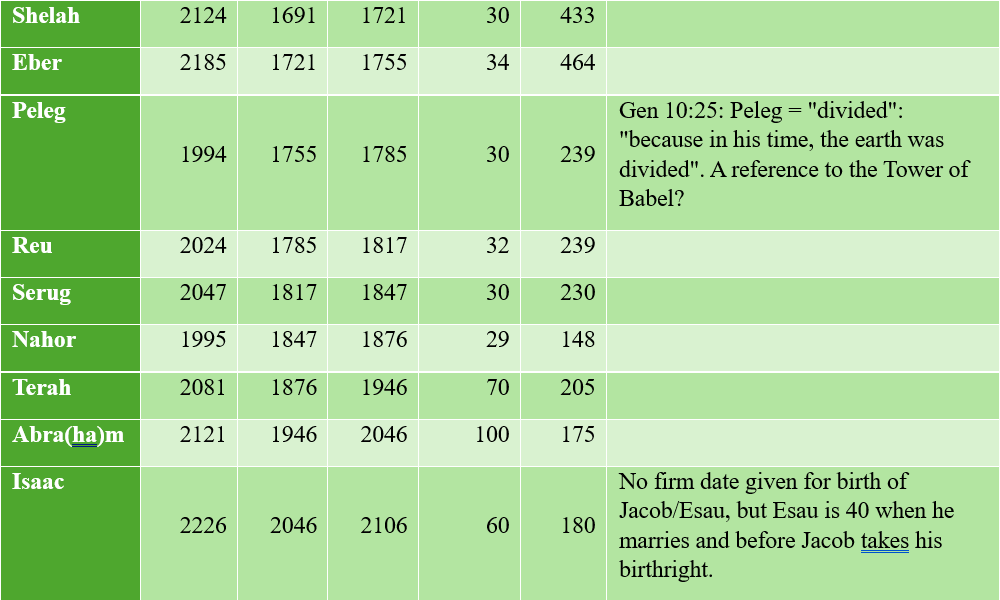
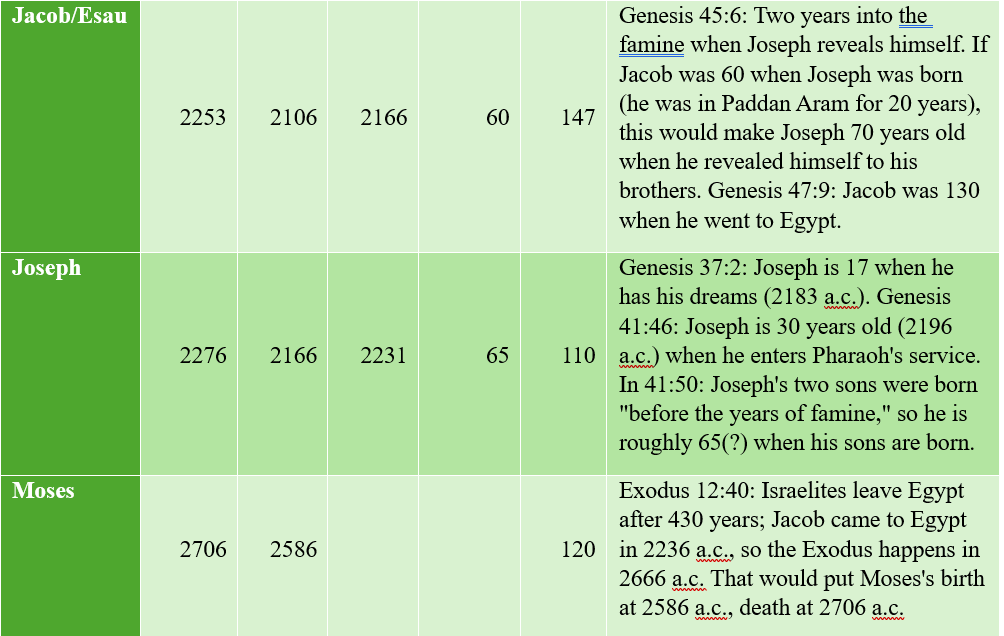
Table 1 is a work in progress. As I was reading through Genesis, I took note of all the ages of the patriarchs and the timing of the significant events in their lives, when known. In some places, I had to make an educated guess (e.g., the birth of Jacob’s 12 sons, and especially of Joseph and of his sons), but I’m fairly confident I got close. I did not check this against anyone else’s chronology, but I’m open to comments or input on any data I may have missed. Years are given a.c., after creation, and I assume the years are literal and that there are no gaps, although I’m sure some would argue that point with me. At some point, I intend to do the backward chronology and put in the b.c. years, but I want to do a little more study on that first. I hope you find the chart useful.

I ordered the columns by year of death, year of birth, and year of birth of descendant so I could use Excel’s “high-low-close” graph feature to create a timeline (Figure 1). You will easily see that after the flood, age spans decrease dramatically. This is because the flood was a result, in part, of the protective vapor canopy around the earth condensing. That canopy allowed the new earth to flourish and blocked the harmful radiation of the sun, thus allowing longer life (and bigger dinosaurs). But more about that in a future post!

Table 1: Genesis Timeline: Years of birth, death, and significant events in the lives of the Patriarchs.

Patriarch

Year of Death (a.c.)

Year of Birth (a.c.)

Child Born (a.c.)

Age @ child’s birth

Age @ death

Comments

Adam

930

0

130

130

930

Seth

1042

130

235

105

912

Enosh

1140

235

325

90

905

Kenan

1235

325

395

70

910

Mahalalel

1290

395

460

65

895

Jared

1422

460

622

162

962

Enoch

987

622

687

65

365

Methuselah

1656

687

874

187

969

Lamech

1651

874

1056

182

777

Noah

2006

1056

1556

500

950

Date of the flood: 1656 a.c.
Shem

2156

1556

1656

100

600

Gen 10:21: “Whose older brother was Japheth” makes him the youngest, presumably.
Arphaxad

2094

1656

1691

35

438

Shelah

2124

1691

1721

30

433

Eber

2185

1721

1755

34

464

Peleg

1994

1755

1785

30

239

Gen 10:25: Peleg = “divided”: “because in his time, the earth was divided”. A reference to the Tower of Babel?
Reu

2024

1785

1817

32

239

Serug

2047

1817

1847

30

230

Nahor

1995

1847

1876

29

148

Terah

2081

1876

1946

70

205

Abra(ha)m

2121

1946

2046

100

175

Isaac

2226

2046

2106

60

180

No firm date given for birth of Jacob/Esau, but Esau is 40 when he marries and before Jacob takes his birthright.
Jacob/Esau

2253

2106

2166

60

147

Genesis 45:6: Two years into the famine when Joseph reveals himself. If Jacob was 60 when Joseph was born (he was in Paddan Aram for 20 years), this would make Joseph 70 years old when he revealed himself to his brothers. Genesis 47:9: Jacob was 130 when he went to Egypt.
Joseph

2276

2166

2231

65

110

Genesis 37:2: Joseph is 17 when he has his dreams (2183 a.c.). Genesis 41:46: Joseph is 30 years old (2196 a.c.) when he enters Pharaoh’s service. In 41:50: Joseph’s two sons were born “before the years of famine,” so he is roughly 65(?) when his sons are born.
Moses

2706

2586

120

Exodus 12:40: Israelites leave Egypt after 430 years; Jacob came to Egypt in 2236 a.c., so the Exodus happens in 2666 a.c. That would put Moses’s birth at 2586 a.c., death at 2706 a.c.

Figure 1: Genesis Timeline Chart

Figure notes: The y-axis represents years after creation. The bottom number with the red mark indicates the year of birth of the descendant to the right. The top number indicates the year of death of the father to the left.

[Added 1/27/2012]

The Evidence from Exodus and Beyond

I said this was a work in progress, so I’m going to keep adding to it. It shouldn’t surprise me that right after I post this, I run across something that throws a wrench in the works. I realize that patriarchal genealogies may not be comprehensive (usually only the sons are listed), but I have trouble believing that there are gaps, because the point was to show an unbroken line of descent. So what am I talking about here?

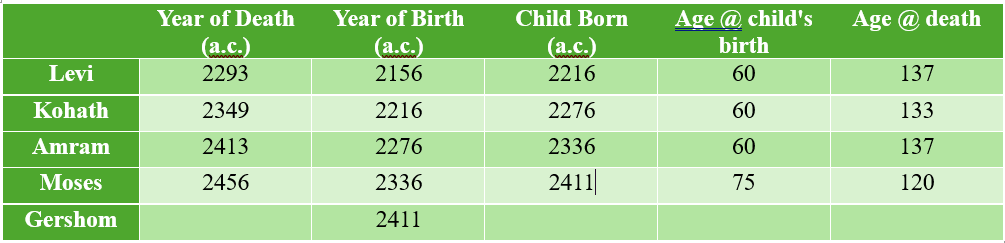
I was reading in Exodus 6 this morning (6:16–20 is what caught my attention) where the ages of Levi and his descendants are given. Levi lived 137 years, his son Kohath lived 133 years (LXX has 130), and Kohath’s son Amram, Moses’s father, lived 137 years (LXX has 132). The genealogy at 1 Chronicles 6 agrees with Exodus 6:16–20 with no additions. We don’t know the ages of the fathers when their sons were born, but working from the assumption that they were 60ish (since that seemed to be the pattern toward the end of the Genesis timeline above) when their respective key descendants were born, and assuming Levi was born about 10 years before Joseph (ca. 2156 a.c.), there’s no way you can stretch out the chronology in 6:16–20 to fill the 430 years of Exodus 12:40! Table 2 is a proposed addition to the Excel sheet above.

Table 2: From Levi to Moses (hypothetical; revised in Table 3)

Year of Death (a.c.)

Year of Birth (a.c.)

Child Born (a.c.)

Age @ child’s birth

Age @ death

Levi

2293

2156

2216

60

137

Kohath

2349

2216

2276

60

133

Amram

2413

2276

2336

60

137

Moses

2456

2336

2396

60

120

Gershon

2396

2396

2396

Notice that this hypothetical data puts Moses’s birth at 2336, a full 250 years before my proposed date above! What is going on here?

The key may lie in a closer look at the textual history of Exodus 12:40. The Hebrew text says that the Israelites were in Egypt 430 years. But the LXX and the Samaritan Pentateuch say they lived in Egypt and Canaan 430 years. Could it be that the mention of living in Egypt symbolized the fact that the Israelites did not yet have a permanent home anywhere, and so in Moses’s mind, that included the years from Abram’s settlement in Canaan to Jacob’s move to Egypt? If this is intended to imply 430 years from the time Abram settled in Canaan, where does that leave us? Here’s the math: Genesis 12:4 says Abram was 75 years old when set out from Harran. If Abram was born in 1946 a.c., 1946 + 75 = 2021. Add 430 to that, and you get 2451 a.c. for the date of the exodus, when Moses is 80 years old. Are you following me so far? Subtract 80 from that, and you get Moses’s birth year in 2371 a.c. So if I make Moses’s ancestors slightly older when they have their kids, I can make the chronology work a little better. Table 3 shows the revision.

Table 3: From Levi to Moses: final

Year of Death (a.c.)

Year of Birth (a.c.)

Child Born (a.c.)

Age @ child’s birth

Age @ death

Levi

2293

2156

2226

70

137

Kohath

2359

2226

2301

75

133

Amram

2438

2301

2371

70

137

Moses

2491

2371

2431

60

120

Gershon

2431

2431

2431

At this point, I may as well bring in the other major chronological statement from the Old Testament and try to put everything into the more familiar B.C. years. Solomon began building the temple in the fourth year of his reign, 480 years (LXX has 440) after the Israelites came out of Egypt. Solomon’s reign is dated circa 971–931 B.C. (working from the chronology in William LaSor, David Hubbard, & Frederic Bush, Old Testament Survey [Grand Rapids: Eerdmans, 1972] p. 293), so Solomon began building the temple roughly 967 B.C. Adding 480 years to that puts the Exodus at 1447 B.C. So 1447 B.C. = 2451 a.c. That would put creation at 3898 B.C., give or take about 100 years depending on how you deal with the unknowns.

However, LaSor et al. suggest (p. 127) that the 480 years is a rounding, of sorts: 12 generations times 40 years/generation. But they significantly shorten that number, almost cutting it in half, and suggest that the exodus happened in the early thirteenth century B.C. rather than the mid fifteenth century B.C. I will have to save that debate for another time, though.

Conclusion

The puzzle of biblical chronolgy is fascinating, if only because I love to play with numbers. I realize I’ve made some “educated guesses” here, but as for the genealogies, I would have a difficult time believing there are any gaps in such detailed records. If you compare Matthew’s genealogy with the corresponding text in 1 Chronicles, it is clear that Matthew does leave out a few generations toward the end, but he’s certainly given enough information to connect us to his primary source material.

I believe in a recent creation, but I’m not so sure the earth itself is that new. After all, Genesis 1:1 says something was here before God made something out of it (“the earth was without form and void” doesn’t mean it didn’t exist at the time).

Peace

Scott Stocking

Website Powered by WordPress.com.