Sunday Morning Greek Blog

February 27, 2012

Deciphering the Mark 1:4 Variants

Details matter. Acts 28:13 and 1 Corinthians 13:3 each have variant readings that differ by only one letter each. Those differences make a huge difference in how the respective passages should be translated. Mark 1:4 is a little more complicated than that. Two small words are part of the variant readings for this passage: the one-letter definite article and a three-letter conjunction. Such small words only seem small, however. In reality, there is a big difference in how the passage is translated. Do we call John “the Baptizer” or just John in this passage?

Illustrating the Issue

I have listed the variant readings in Table 1 (only up to the word after the variant), with literal translations below each word. I put it in table form so those of you not familiar with what “variants” are can visualize the issue. The lexical forms of the individual words are the column headings for the verse, and each is linked the Strong’s entry on www.blueletterbible.org.

Table 1: Three Best-Attested Variant Readings of Mark 1:4a (as ordered in the UBS 3 apparatus)

Eclectic Greek Text

Primary Ancient Witness

γίνομαι

Ἰωάννης

βαπτίζω

ἐν

ἔρημος

καὶ

κηρύσσω

UBS Text

א (Sinaiticus)

ἐγένετο

Ἰωάννης

ὁ*

βαπτίζων

ἐν

τῇ

ἐρήμῳ

καὶ

κηρύσσων

It was

John

the

one baptizing

in

the

wilderness

and

[the] one preaching

[none]

B (Vaticanus)

ἐγένετο

Ἰωάννης

βαπτίζων

ἐν

τῇ

ἐρήμῳ

κηρύσσων

was

John

the

Baptizer

in

the

wilderness

preaching

Stephen’s Textus Receptus

A (Alexandrinus)

ἐγένετο

Ἰωάννης

βαπτίζων

ἐν

τῇ

ἐρήμῳ

καὶ

κηρύσσων

was

John

baptizing

in

the

wilderness

and

preaching

*This is in the ancient text (Sinaiticus), but the UBS 3rd/4th editions have it in brackets with a grade of C indicating uncertainty it was in the autograph.

At the end of this post, I have included sentence diagrams (Figure 1) illustrating these variant readings.

The two main issues are:

  1. Was the definite article (ὁ) originally in the text before the participle βαπτίζων?
  2. Was the conjunction καὶ originally in the text before the participle κηρύσσων?

Textus Receptus (A Alexandrinus)

I will start with the Textus Receptus reading, because that seems to be the easiest to explain to English readers. A participle in English is a verb that usually adds –ing for the present participle or –ed for the past participle. They are usually used with a helping verb in the perfect tense (I have waited; I have been waiting) or passive voice (I was waited on by the butler; I am being waited on by the butler). Essentially in this reading, Mark uses the long form of the perfect tense (called periphrastic) instead of using a perfect tense verb. Here is how the King James renders the passage from the Textus Receptus:

John did baptize in the wilderness, and preach the baptism of repentance for the remission of sins.

Notice that without the definite article, the participles are seen to function as verbs that complete the past-tense helping verb ἐγένετο. The helping verb is translated various ways in English depending on context. The KJV phrasing sounds a bit archaic to 21st-century ears, but a more contemporary way to put it might be “John was baptizing…and preaching.” In other words, the translators don’t see this as a title for John. It’s neither “John the Baptist” nor “John the Baptizer”; it’s just “John” with a double predicate. Two of the three “preferences” used when deciding between two or more variants are prefer the shorter reading and prefer the more difficult reading. This passage is shorter than the UBS text, but is not as difficult as that text or the B text. Another poorly attested variant based on the D text is similar to A but changes the order of the text. I don’t detail that in the text of this post. It is diagrammed in Figure 1, however.

B (Vaticanus)

The B (Vaticanus) text has the definite article with βαπτίζων, and the passage can then be read like “John the Baptizer” is a title, especially without the καὶ (“and”; I will cover why that is important in the discussion of the א [Sinaiticus] text). The lack of a καὶ suggests that the two participles should not be taken as a compound predicate, as in the A text. The second participle describes what John was doing in the wilderness and functions very much like an adverb, as anarthrous (=without the definite article) participles often do. So the B passage could be translated like this:

John the Baptizer was in the wilderness preaching baptism of repentance for the forgiveness of sins.

or

In the wilderness, John the Baptizer was preaching baptism of repentance for the forgiveness of sins.

This would be an acceptable translation if the B variant were not so poorly attested.

א (Sinaiticus)

I think that the reading of the א (Sinaiticus) text is the more difficult reading, but perhaps not for the reasons you think. For the most part, the καὶ is accepted as original to the text. If this is so, then it makes perfect sense to have the definite article before βαπτίζων. How are the two words related? It’s a rule I’ve discussed before in the blog, the Granville Sharp rule. If two singular, personal, non-proper nouns or substantives (words that can function as nouns; in this case βαπτίζων and κηρύσσων) are joined by καὶ, and only the first noun has the definite article, then the two nouns refer to the same person. This reading is slightly more difficult than the A text reading, because the construction is a bit more sophisticated. Since the two participles refer to the same person, the definite article would not be out of place. That doesn’t negate the reading of the A text necessarily, but since adding the definite article would not have been necessary to make sense of the text, it would seem to me that someone removed it somewhere along the way to make it a little easier to understand. In this case, the difficult passage is preferred over the shorter passage.

Given Mark’s penchant for shorter statements more to the point, the passage could be rendered like this:

There was John, the one baptizing in the wilderness and preaching baptism of repentance for the forgiveness of sins.

or

There was John, the Baptizer in the wilderness, the Preacher of baptism of repentance for the forgiveness of sins.

The former option isn’t much different from the A text reading above, but instead of just doing a straight noun/verb translation, I assumed Mark was using the participles to explain which John he intended (“There was John, you know, the guy who baptizing and preaching”). Note that the last option, for consistency, treats both “Baptizer” and “Preacher” as titles, because the definite article before βαπτίζων governs κηρύσσων as well. Mark does use the phrase Ἰωάννης ὁ βαπτίζων in 6:14 as well, so there is precedence for the phrase as a title. My translation of 1:4 with the titles sounds a little bit awkward to our English ears, but Greek speakers would have understood the construction immediately.

Nominative Absolute?

On a more technical note, it is entirely possible that the entire verse was intended as a nominative absolute. That’s basically a phrase in the subject case that stands apart as a separate clause and serves as the antecedent for a pronoun. The first four words of vs. 5 give the verb and the pronoun for John (καὶ ἐξεπορεύετο πρὸς αὐτὸν “and [everyone] went out to him”) before Mark states the subjects of the verb, so that’s a good clue that 1:4 might be functioning as a nominative absolute. If that is so, the editors of the Greek New Testament should put a comma instead of a period at the end of verse 4. This would further support the reading of the א text.

Conclusion

Talking about textual variants may not be the most exciting topic in the world for a blog, but I think it is important that people understand the care scholars take to restore the original text of Scripture. I hope that I have made this understandable for most audiences, but if you have any questions, please don’t hesitate to contact me through the comments or e-mail link. Thank you for reading!

Peace

Scott Stocking

Appendix

Figure 1: Sentence Diagrams for Mark 1:4 Variants

February 5, 2012

Does the Structure of Exodus 21:1–27 Tell the Patriarchs’ Story?

Filed under: Biblical Studies,Exodus,Hebrew,Old Testament,Theology, Biblical — Scott Stocking @ 8:40 am

I really enjoyed my Old Testament exegesis classes in seminary with Dr. Gary Hall, who is retiring from Lincoln Christian Seminary this year. Each week, we had a passage to dissect, and we always followed the same pattern. The systematic method he taught us has stuck with me all these years, which is one reason why I love teaching hermeneutics. It has also opened up new depths of understanding to difficult passages, and has helped me discover the eternal principles behind the earthly stories of those who have gone before me.

Exodus 21 Assigned

One such passage that sold me on the value of discerning structure in the Bible is Exodus 21:1–27. I believe we had actually been assigned Exodus 21:12–27, which is set off in the TNIV with the heading “Personal Injuries.” However, when I looked at the passage in the Hebrew Bible that week, I noticed that vv. 1–27 were a complete paragraph. Dr. Hall had taught us to pay attention to such structural clues, so I took it upon myself to expand the assigned passage and see what I could discover from that. I was amazed at what I found, but I was even more amazed when I took into account the literary and historical context of the passage.

Here is the structure of the passage:

1 Introduction

    2–11 Hebrew Slaves

        12–14 Striking a man/conditionality

             15 Physically attacking Father/Mother

                16 Kidnapping

             17 Verbally attacking Father/Mother

        18–25 Striking a man or a pregnant woman

        [18–19 Striking a man]

    [20–21 Striking a Slave]

        [22–25 Striking a pregnant woman]

    26–27 Hebrew Slaves

Exodus 21 Considered

If you’ve read my posts regularly or if you’ve ever taken a class that talks about the structure of a biblical passage, you will instantly recognize this as a chiasm, a passage that presents ideas in one order and repeats them in reverse order. The key point about a chiasm is that whatever is at the center of the chiasm is the focus. So when I discovered this structure, I thought a couple things were unusual:

  1. Why were the two nearly identical laws about parents not together? and
  2. Why was “kidnapping” inserted between the two commands, especially when kidnapping isn’t mentioned in the Ten Commandments?

I need to answer both those questions together, because there is a connection. I do remember when I was looking at this passage in some English texts that one English version (I thought it was my RSV confirmation Bible, but I can’t locate it now to confirm) actually had the chutzpah to flip verses 16 and 17 around, because the translators thought as I did at first glance that they belonged together. The answer to my second question came when I looked at the Hebrew: the word “kidnap” is translated from the Hebrew phrase וְגֹנֵ֨ב אִ֧ישׁ
(wə·ḡō·nēḇ ʾîš, \wuh-goh-nayv eesh\), which literally means “the one stealing a man.” Aha! Stealing: now that is something in the Ten Commandments. Now I’m getting somewhere.

גָּנַב is the same word translated “steal” in the Ten Commandments. “Stealing” a man meant not only removing that man from his covenant community, but also taking away the life he had planned for himself. גָּנַב is often used of stealing things and people. It’s presence here, especially in the center of the structure (see above), indicates the seriousness of the crime of kidnapping. It is on a par with striking or cursing your parents, and the abuse and murder of slaves. All crimes listed here could be punishable by death, especially with the presence of the lex talionis at the end of this passage.

So now I was at least part way to an answer. Kidnapping was the ultimate form of mistreatment of another person. That is why it was at the center of the passage.

Exodus 21 in Context

But there was a larger question to answer. I had only dealt with the central elements, but what about the rest of the paragraph? I asked myself, “What do treatment of slaves, mistreatment of parents, and kidnapping have in common?” The answer stuck out like a sore thumb. Joseph. Joseph’s brothers kidnapped him. Strike one. They sold him into slavery. Strike two. They lied to their father Israel, which would be equivalent to a curse, about what happened to Joseph. Strike three. So the first story out of the gate after hearing the Ten Commandments is like a slap in the face to all of Israel. “You did it to Joseph, which is how you wound up in slavery in Egypt in the first place. Go and sin no more. Even though God intended it for good (Genesis 50:20), don’t let that be an excuse to try it again.”

Conclusion

I hope you can see how important structure and context is in determining the meaning and significance of a passage. Moses brilliantly structured Exodus 21 (or God did so for Moses) not only to communicate his statutes, but to place those in the historical context of God’s people.

Peace!

Scott Stocking

January 29, 2012

“I Am” Statement of Yahweh (Exodus 3–6, esp. Exodus 3:14)

Filed under: "I Am" Statements,Exodus,Hebrew,John Gospel of,Old Testament — Scott Stocking @ 8:33 am

As I was reading through the early chapters of Exodus last week, I was not only reminded of the “I Am” statements of Jesus in John’s gospel, but I gained some new insight into the overall application of those statements. I want to share that with you in this post.

Face to Face at the Bush

Exodus 3 is the story of Moses’s first encounter with God at the burning bush in Midian. This is also the chapter where we have the story of God revealing his personal name to Moses: יְהוָ֖ה “Yahweh” (English texts set in small caps: LORD). But the text leading up to that revelation is a story that deserves the *facepalm* of all *facepalms*! God has been preparing Moses to confront Pharaoh and deliver the Israelites from Egyptian slavery. You’d have to admit, that’s a pretty big task in those days, considering most kings and their subjects wouldn’t give a second thought about having you beheaded or drawn and quartered for merely approaching the king without invitation let alone confronting the king.

But I’m getting ahead of myself. Moses approaches the burning bush when Yahweh calls out to him. He removes his sandals, because he’s on holy ground. Yahweh proceeds to identify himself and his purposes for calling Moses, while Moses does his own reverent version of a facepalm (Exodus 3:6b). Listen to what Yahweh says to Moses in Exodus 3:6–10 (NIV) and see if you detect a pattern:

I am the God of your father, the God of Abraham, the God of Isaac and the God of Jacob.

I have indeed seen the misery of my people in Egypt.

I have heard them crying out because of their slave drivers, and

I am concerned about their suffering. So

I have come down to rescue them from the hand of the Egyptians and to bring them up out of that land…

And now the cry of the Israelites has reached me, and

I have seen the way the Egyptians are oppressing them.

So now, go.

I am sending you to Pharaoh to bring my people the Israelites out of Egypt.

Yahweh makes seven(!) “I” statements here about who he is and what he will do, and he affirms that he has the power to do all this through Moses. I suppose God could have done it without all the pomp and circumstance of the plagues, but then how would anyone ever know what God thinks of kings who exalt themselves to positions of deity? But here’s the facepalm moment: after God affirms that he’s going to do all this through Moses, what does Moses say?

“Who am I that I should go to Pharaoh and bring the Israelites out of Egypt?” (Exodus 3:11).

*FACEPALM!*

Evidently Moses didn’t have Verizon, because he obviously didn’t hear God the first time. The creator of the universe is speaking to Moses, giving him more information about himself than he’s ever given to any other patriarch (except perhaps Abraham), and Moses is worried about himself! Duh, Moses, it’s not about you; God just confirmed that!

Saving Face

Of course, it’s easy for us 3500 years later to look back on this story and be a little critical of Moses. The story does show his human side, and I wonder how many of us would have be willing to saddle up and head out without questioning God further on the matter. God isn’t afraid of having a conversation with us, and he’s big enough to deal with our questions and fears. He’s ever so patient with us as we muddle through life trying to figure out his will and purpose for us. But he also offers reassurance to us in the form of a promise that is repeated time and again in both the Old and New Testaments. He offered that promise to the patriarchs before Moses, and he offers it again to Moses in 3:12: “I will be with you.”

This is where the Hebrew gets very interesting, and most English translations relegate the significant issue to a footnote. The Hebrew word for “I will be” is the standard “to be” verb: הָיָה (hāyāh), but since Hebrew, like Greek, alters the spelling of its verbs based on the person and number of the verb, the form that is used in 3:12 is אֶהְיֶה (first person singular ʾehyeh; notice the letters are the same, except for the aleph א added to the front of the word). This is the exact same form that most English translations render “I AM WHO I AM” in 3:14 when God reveals his name! To their credit, most English translations have a footnote on v. 14 saying that this could be “I WILL BE WHAT I WILL BE,” but in my opinion, that should be the translation in the main text. The form יְהוָ֖ה “Yahweh” that is used regularly throughout the Hebrew Old Testament is probably related to the third person singular form of the verb.

Hebrew verbs don’t have tense in the same way that English verbs do. Hebrew verbs either represent completed action (perfects) or incomplete action (imperfects). The verb form Yahweh uses for his name is imperfect (ironic, I know, but that’s the grammar). What I hear Yahweh saying to Moses here is that he will do whatever it takes, he will be whatever he needs to be, to deliver the Israelites from Egypt. That is a father showing ultimate love for his children: even if it comes to destroying every last trace of the Egyptian people and culture, God will deliver his people.

Facing Up

Once was not enough, though. God has to go back through the I statements again in Exodus 6, but the Israelites were too oppressed to hear it or believe it. So God’s mighty plagues were not just to break Pharaoh’s stubborn heart, but also to show Israel that he meant business about delivering them from the Egyptians. This is emphasized in the latter plagues that have no effect on the land of Goshen where the Israelites lived.

So what does all this have to do with the “I am” statements of Jesus? What occurred to me is that Jesus was doing for his audience what Yahweh did for Moses and the Israelites. His “I am” statements affirm that he is the savior and that he can and will do whatever it takes to deliver people from sin and Satan, even to the point of dying on a cross. Jesus stood up to the religious oppressors of his day and proclaimed the good news of God’s deliverance and love for his creation.

Many of us Christ followers I’m sure have done our own facepalms when friends or family just don’t comprehend the good news. Well, you’re in good company. Be patient and keep at it, because you might have to witness a lot of pain and suffering before the deliverance finally happens. And Christ offers the same assurance to us as Yahweh did to Moses: “Surely I am with you always, to the very end of the age” (Matthew 28:20 TNIV).

Peace,

Scott Stocking

Please check out my friend Eric Weiss’s post on this topic: http://theoblogoumena.blogspot.com/2011/05/exodus-314-and.html.

January 23, 2012

Take Heart! (θαρσέω tharseō, Matthew 9:2, 22)

(Note: All Greek words are linked to www.blueletterbible.com.)

As I begin my fiftieth trip around the sun this year, I’ve determined to make several difficult choices that quite frankly have me scared and stressed. I took our congregation’s “401” class last week on spiritual maturity, which emphasizes acting out of love and faith, only to be confronted with the fact that the first major decision I made in 2012 was one out of sheer desperation, fear, and resignation. I started taking Dave Ramsey’s Financial Peace University this week at our church, which means I’m committed on Sunday afternoons for the next 12 weeks, but the opening session gave me a little hope. Personal relationships are looking up as well, and things at work are on a more or less even keel. In addition, I hope to be able to go see my kids a little more often this year. Still, that first difficult decision overshadows the positives I am anticipating.

Courage!

So when I saw Jesus’s encouragement Θάρσει (“Take heart!”) twice in Matthew 9 the other day, I had to sit up and take notice. Matthew 9 comes in the heart of Jesus dealing with many who come to him or are brought to him for healing. Jesus, of course, meets their physical needs, but he is ever mindful of their spiritual needs as well. In Matthew 9:2, Jesus declares that the paralyzed man’s sins are forgiven, which incites the teachers of the law to accuse him of blasphemy. Unfazed, Jesus proceeds to demonstrate he has the power to forgive sins by healing the paralyzed man. After the woman who suffered from a bleeding disease for 12 years touched Jesus’s garment, she was healed and greeted with the same word of encouragement.

The word is found five other times in the New Testament. Six occurrences are in the Gospels, and one is in Acts. Two of the occurrences are found in story of Jesus walking on the sea (Matthew 14:27, Mark 6:50) when the disciples are so terrified in the storm that they think Jesus is a ghost. John begins a major section of his Gospel with the phrase: “Do no let your hearts be troubled. Trust in God; trust also in me” (14:1 NIV). John teaches in chapters 14–16 on the ministry of the Holy Spirit and the troubles that his followers would face in the world. He ends that section with the word of encouragement: “I have told you these things, so that in me you may have peace. In this world you will have trouble. But take heart! I have overcome the world” (16:33 NIV). The two other occurrences of the word are found in Mark 10:49 and Acts 23:11.

Compassion

But that word by itself was only the tip of the iceberg that day as I was reading Matthew 9. When I got to the end of the chapter, verse 36 really hit home, because I felt like part of the crowd: “When he saw the crowds, he had compassion [σπλαγχνίζομαι] on them, because they were harassed and helpless, like sheep without a shepherd” (NIV). The words for “have compassion” and “compassion” are two of my favorite Greek words, not only because you have to expel about a pint of spit to say them, but because they are so descriptive of the literal meaning: “bowels.” Yes, that is where the phrase “bowels of compassion” originates. Compassion comes from the gut in the Hebrew worldview, much deeper than the heart.

But leaving that word aside, the thing that really struck me was the condition of the people who came to Jesus: “harassed,” “helpless,” “shepherdless.” I’ve not forgotten I have a shepherd, even when I may wander off at times, but I’ve certainly felt the first two in the last few years. The shepherd has guided me through those times, but I often have to wonder what I’m supposed to be learning in the school of hard knocks.

The fact that I have a shepherd was reinforced even more when I came across an OT passage last week as a friend and I were reading through Six Battles Every Man Must Win by Bill Perkins, where he reminds us of the story of another shepherd, David. Before David secured his place on Israel’s throne, he was a fugitive running from Saul. During that time, however, he was not alone. Those who would become David’s “mighty men” gathered around him early in his fugitive life: “All those who were in distress or in debt or discontented gathered around him, and he became their commander. About four hundred men were with him” (1 Samuel 22:2). That sounds very much like the people who were gathering around Jesus in Matthew 9. And it sounds very much like my life currently. My life-résumé is a pretty good match for the “qualifications” of a mighty man.

Contentment

I know I don’t have the strength to dig myself out of my own problems. Some days, I wear my weakness on my sleeve, but only because I know that it is only through my weakness that Christ can perfect his power (2 Corinthians 12:9). I need my shepherd, Jesus, to guide me through. The path is mountainous and treacherous at times, but I know he’s got my back.

I remember going on a horseback ride as a teen through Chadron State Park in NW Nebraska. We had about 15 people riding single file along the trail, and we were going along a high ridge with a 45 degree slope that dropped about a thousand feet to my right (at least, it seemed that steep and deep). My horse decided to take his own route, and instead of staying on the main path, he moved to the right a bit and went between a tree and the slope. The path between the tree and the slope was no wider than the horse, but when I started to panic a bit, my dad reassured me that the horse knew what he was doing. It was only a short little detour, only ten feet or so, but I had to duck a bit to avoid the lower branches of the tree. The horse was sure footed though and got me safely back on the path.

That detour is a microcosm of what I’ve experienced in the past few years, poised precariously on the brink of disaster. But God has seen me through it, and for that, I am grateful. The road ahead still has its challenges, but I can be content knowing that my Savior holds me in the palm of his hand and will put me on the straight path in his own timing.

Conclusion

So my word to you is the same as Christ’s to the paralytic and the bleeding woman: Take heart! Know that his promise that he would never leave us nor forsake us holds true, even when we have trouble seeing the end result.

Peace!

Scott Stocking

January 13, 2012

Who Is, Who Was, and Who Is Coming (Revelation 1:4, 8; 4:8; 16:15; 1 Thessalonians 4:13–5:11)

I’m feeling kind of rusty. It’s been over three weeks since I’ve posted anything, but then, in those three weeks, I had my kids for the holidays, the holidays themselves, three repairs on the car, two round trips to Illinois, my dad and step mom both in the hospital at different times, and a partridge in a pear tree. Life has been pretty hectic. Things are getting back to normal, though, and after getting reacquainted with my Civilization IV game, I’m ready to get back in the blogosphere.

For those of you who aren’t on my Facebook friends’ list, I did in fact accomplish my 2011 resolution: I read through the entire Greek New Testament. I realized I haven’t written anything about Revelation yet, so I think I’ll take the next few posts to do that. In the meantime, I’ve started reading through the Greek NT again, so I will continue to post on other topics as well in the coming year.

There’s No Future Like the Present

One of the things that struck me almost right off the bat in Revelation was the Greek version of the phrase “Who is, who was, and who is to come” (NIV; ὁ ὢν καὶ ὁ ἦν καὶ ὁ ἐρχόμενος). At first glance in the English translation, this looks like a present tense verb (“Who is”), a past tense verb (“Who was”; 4:8 switches the order of the first two), and a future tense verb (“Who is to come”). But ὁ ἐρχόμενος is not future tense! It is actually a present tense participle, so it should imply the continuous aspect, that is, the action is currently underway. While “who is to come” does signal Jesus is coming, it doesn’t reflect the emphasis of the present tense in Greek. A better translation might be “Who is already coming.” Yes, he’s on his way, and he’ll be here soon.

But this isn’t the only place the NIV and many other versions imply a future tense that isn’t there in the Greek. We find the same thing in 1 Thessalonians 5:2, where Paul says, “You know very well that the day of the Lord will come like a thief in the night.” The verb there is ἔρχεται., present tense. So the early church didn’t look at as Jesus’s second coming as something in the distant future. They thought of it as something under way even as they wrote and read the New Testament.

When Is He Coming?

Now I can hear the anticipation out there: What is Scott’s millennial view? Well, I won’t beat around the bush. I lean toward being a post-tribulation amillennialist. (I hope WordPress’s server is ready for the barrage of comments I’ll receive on that little revelation!) When Jesus died and rose again, he established his kingdom, the body of Christ, on earth through the preaching of Peter and subsequent missionary activity of his disciples and other followers. The church represents the “millennial” (I take the term to be figurative for “a long time”) reign of Christ. I also believe we are in the time when Satan has been let loose to deceive the nations and the elect, so I think we’re beyond the millennial period now and waiting for the final consummation of history in Jesus’s triumphant return.

I can hear some of you shouting at your computers and iPhones: “But what about the rapture? Isn’t that supposed to happen before Satan is let loose?” First of all, let me say that the word “rapture” (or any Greek equivalent) is never found in the New Testament. The events described in 1 Thessalonians 4:13–5:11 are commonly referred to as the “rapture.” But these events I think could more appropriately be called a resurrection. After all, the dead bodies are raised first in that passage. Those of us who are alive will be “snatched up” (ἁρπάζω) as a resurrection from our mortal flesh. This is the same word John uses to describe what happens to the child born of the woman in Revelation 12:5. It’s also the word used in Matthew 12:29 (NIV): “Or again, how can anyone enter a strong man’s house and carry off his possessions unless he first ties up the strong man? Then he can plunder his house.”

This makes a nice segue to when I think Jesus’s second coming will happen. The watershed verse in my mind that tells me when Jesus is returning is Revelation 16:15: “Look, I am coming like a thief! Blessed is the one who stays awake and remains clothed, so as not to walk around naked and have others see his shame.” First of all, we have another present tense form of the word for “come,” so that aspect is reemphasized. Second, and more convincing in my mind, is the language of coming like a thief. I think this ties directly in with passages like Matthew 24:43, 1 Thessalonians 5:2, 2 Peter 3:10, and Revelation 3:3. No less than four different New Testament authors (Matthew, Paul, Peter, John) use this imagery of Christ’s return. But also notice when Jesus says he is coming: just before the final bowl of wrath is poured out. Since Paul connects the “coming” with the “snatching” in 1 Thessalonians 4–5, I have to believe that the body of Christ will remain on the earth during the entire tribulation of scrolls, trumpets, and bowls.

If You’ve Got Ears, Listen Up!

Don’t think you’re going to avoid the tribulation just because you’re a Christ follower. I don’t think God has ever let believers off that easily. Noah had to endure a flood; Abraham nearly sacrificed his own son; Moses spent 80 years in the wilderness; David spent years running from Saul. We Christ followers are going to experience (and may already be experiencing) the tribulation. Otherwise, why would Paul and Peter put such emphasis on being found holy, spotless, and blameless (Ephesians 1:4; 2 Peter 3:11–14)? Why the emphasis on “being ready” if we’re not going to live through it (or die in it!)?

Conclusion

Christ is on his way. We don’t know when: no one does. It may be 2012; it may not be until 2512. But we know he is true to his word, patient with the lost, and that he will come at the appointed time to win the final battle over sin and evil. Eternity with him will be glorious to say the least. I’m looking forward to it. I hope you are too.

Peace

Scott Stocking

December 4, 2011

Immersion (Baptism) that Saves: 1 Peter 3:18–22

I have a couple notes for blog readers before I get into the main post today.

  1. For all readers: Instead of customizing the hyperlinks or providing transliterations and pronunciations, I am going to start hyperlinking the first occurrence of each Greek and Hebrew word in my blog to the entry in http://www.blueletterbible.org. That Bible study site has numerous resources available, including a link to hear the Greek or Hebrew word pronounced and the option to get a complete concordance listing of all occurrences of the Greek or Hebrew word. If you’re not already familiar with the site, I trust you will find it useful and engaging. (I am not being compensated for promoting BlueLetterBible at this time.)
  2. For those readers who use the sentence diagrams: At least once a week, it seems like the search engine feature in WordPress lets me know that someone hit on my site by looking for a diagram of a particular verse. I am pleasantly surprised to find I’m not the only one who has an interest in diagramming, in spite of how much I griped about it in junior high. For those of you who use the diagrams, I would appreciate knowing what your interest is in them so that I can get a sense if I need to do anything different with them or provide a different kind of diagram. Are you just curious? Are you a student looking for help on an assignment? (If the latter, I trust you aren’t passing off my work as yours!) Are you a preacher looking to better explain the passage? Whatever your interest, please drop me a short note in the comments. There’s obviously some interest in them, and I’m happy to share the fruit of my labor with you.

Introduction

Growing up as a sprinkled Presbyterian, I was understandably intrigued when I came to understand my need for a personal relationship with Christ and discovered the concept of “believer’s baptism.” It was a completely new concept to me, as I had never been exposed to it before my high school years. In college, when I got involved with the restoration movement, I still had many questions about the practice when I went to that first meeting at 1633 Q Street (now a parking lot) just off the University of Nebraska-Lincoln campus. That night, just a little over 30 years ago, I got shuffled off to the pastor’s office, where I met Terry & Kris Christlieb. I had several questions about baptism, and they answered them to my satisfaction that night, so much so that we invaded Capitol City Christian Church at 9 p.m., where I got immersed. I was sold from that point on.

I’ve had my ups and downs on immersion theology through the years. Is it an absolute necessity? Is it just a “work of the flesh”? When is the right time? Just what is the “effectiveness” of immersion when it comes to salvation? But when I ran across such passages as Romans 6 and 1 Peter 3:18–22, it was hard for me to diminish the importance of immersion in the life of a Christ-follower. And when I discovered the connection between Acts 2:38 and Matthew’s Last Supper account, I was convinced of the efficacy of immersion as part of the salvation and maturing experience of the Christ-follower.

1 Peter 3:18–22

Of all the passages on immersion, or baptism as many call it (βάπτισμα, βαπτίζω), 1 Peter 3:21 is the only one that comes out and says directly that immersion saves. Yet this gets overlooked so much, because those who are not convinced of the efficacy of immersion seem to think it means something other than what is plainly written on the page. But what is the author trying to communicate by connecting it to the Noahic flood? Is the flood what saves us, or the ark? The verse diagram in Figure 1 below places 1 Peter 3:21 in its larger context so that you can see what the connections are.

I want to jump down to 20b, where Peter says (my translation): “In the ark, a few, that is, eight people, were saved through water.” In this case, the water was destructive (see 2 Peter 2:5), but it had the power to save Noah by supporting the ark on its year-and-a-half voyage. The flood destroyed all living creatures except those on the ark and those that could already live in water, but the ark was the vessel that protected Noah, his family, and the other living creatures “through the water.”

Now for verse 21: The word for ark (κιβωτός) is feminine, but the relative pronoun that begins verse 21 is neuter, so it can’t refer to the ark. The most immediate antecedent to the relative pronoun is “water” (ὕδωρ; genitive is ὕδατος), which is neuter, so Peter is referring to the waters of the flood with this pronoun. So in verse 21, Peter says, “This water corresponds to immersion.” The word “corresponds to” (ἀντίτυπος) is actually an adjective in Greek that modifies βάπτισμα, so the phrase might be more accurately rendered, “This water is functional baptism” or more literally, “This water is typical baptism.”

Peter goes on to say that this baptismal water “now also saves you.” The “now also” is relative to the previous verse. Not only does the ark, then, typify salvation, but water does as well. Water is what destroyed sinful humanity, which is exactly what happens when someone is immersed into Christ. Romans 6:3–4 says, “Or don’t you know that all of us who were immersed into Christ Jesus were immersed into his death? We were therefore buried with him through immersion into death in order that, just as Christ was raised from the dead through the glory of the Father, we too may live a new life.”

What I found interesting is that the part that follows “now also saves you” has two nominative case nouns. “Removal” (ἀπόθεσις) and “appeal” (ἐπερώτημα) are both nominative case, agreeing with the nominative case of βάπτισμα, so they are essentially appositives to βάπτισμα. Here’s how a literal translation might look: “This immersion now saves you, not the body-dirt removal immersion, but the clear-conscience-pledge to God immersion.” But this rendition is missing the most important part of the verse, the final phrase.

The last phrase of verse 21 parallels the “through water” at the end of verse 20. “Through the resurrection of Jesus Christ” is the qualifier that gives the water its power to save. Just as the ark saved Noah and his family through the flood waters, the resurrection is what carries us through the act of immersion. Again, I refer you back to Romans 6:3–4, where this is made abundantly clear. So if I complete my literal translation with that phrase, it would look something like this: “This immersion now saves you through the resurrection of Jesus Christ, not the body-dirt removal immersion, but the clear-conscience-pledge to God immersion” (emphasis mine).

So immersion is really a two-way street to God. If we just get immersed for show (the “body-dirt removal immersion”), immersion is ineffective. God is not into rituals without substance. But if we come to the waters of immersion pledging ourselves to live for him with a clear conscience, he effects the power of the resurrection in immersion and destroys the old self. He renews us and rescues us from the wages of sin.

A quick note on βαπτίζω

Some have tried to argue that βαπτίζω does not mean “completely immerse,” because that is what the related word βάπτω means. But the –ίζω ending on βαπτίζω is an intensifier. It is quite similar, in sound and function, to the difference between the musical directions forte (loud) and fortissimo (very loud). So βαπτίζω is an intense form of dipping, or immersion. I don’t have to time to list the many verbs in Greek that indicate a similar pattern, but I assure you, they are quite common in the NT.

Conclusion

So immersion is certainly not just a work of the flesh. Just as the ark supported and sustained Noah and his family through the flood, so too the resurrection sustains us through the act of immersion. But beware of the “dunk ’em and ditch ’em” philosophy. Noah and his family certainly did not sit idly by on the ark for a year and a half. They worked hard daily to keep the animals and themselves fed and healthy. Immersion is not a terminal point in the life of a Christ-follower. On the contrary, it is a watershed moment (pun intended) where we tell God, “I’m sold out for you.”

Peace,

Scott Stocking

Figure 1: Diagram for 1 Peter 3:18–22 (Greek and English)

November 23, 2011

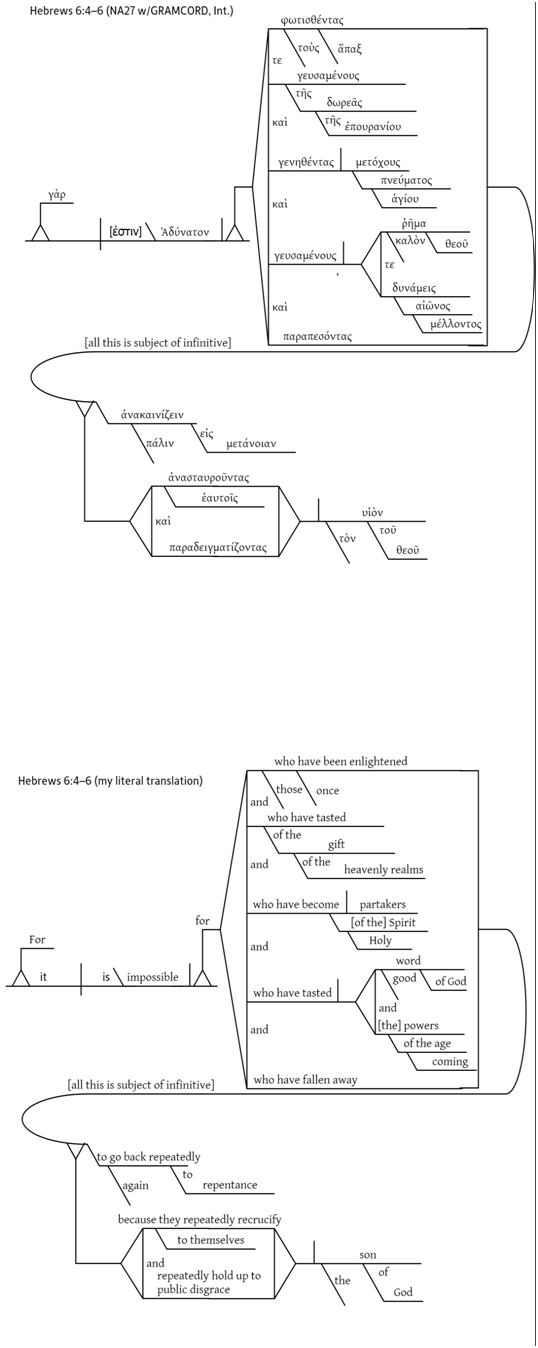
Hebrews 6:4–6 Sentence Diagram

Did I mention how much I like doing sentence diagrams?

November 18, 2011

“Falling Away” (παραπίπτω parapiptō) in Hebrews 6:6

Hebrews 6 is a scary passage to me. I don’t think those who believe in the doctrine of eternal security (i.e., “once saved, always saved”) have ever taken the warnings in this passage seriously. I will address the full context shortly, but the heart of the passage is found in vv. 4–6: “It is impossible… for those who have fallen away (παραπίπτω parapiptō \pah-rah-PEE-ptoh\) to be renewed to repentance.” The question that has always occupied my mind about this passage is, “How far do you have to fall before you can’t be restored to repentance?”

Context and Contrast

The broader context, Hebrews 5:11–6:12, informs in part the understanding of the warning in verse 6. Verse six also has four words that are only found in that verse in the New Testament, I will break those down later. But first, let me address the context. The author of Hebrews begins this section by chiding the readers for not having obtained a level of maturity they ought to have obtained. In fact, “maturity” is a prominent theme in Hebrews 5–7, which has nine words from the τελειόω (teleioō, \teh-lay-AW-oh\ “I make perfect,” “I complete,” “I become maturity”) family scattered throughout. Hebrews 5:11–6:12 is also bracketed by an inclusio of νωθροὶ γεγόνατε/νωθροὶ γένησθε (nōthroi gegonate/nōthroi genēsthe, \noh-THROI geh-GAW-nah-teh/ noh-THROI GEH-nay-stheh\ “have become lazy”) making the contrast between maturity and laziness even starker.

If that contrast isn’t enough, the author goes on to speak of the need for the Hebrews to go back to baby food (γάλα gala, \GAH-lah\; gen. γάλακτος galaktos, \GAH-lah-ktawss\ “milk”) instead of eating solid food. What I find interesting is what the author of Hebrews considers “elementary” teaching: repentance from dead works, faith in God, teachings about baptism (TNIV: “cleansing rites”), laying on of hands, resurrection from the dead, and eternal judgment. These strike me as pretty important doctrines, but do you notice what is missing? Think 1 Corinthians 13 here, especially where Paul makes the connection between maturity (τελείος) and love. Faithfulness (i.e., acting consistently on faith) and hope are included in the closing verse of 1 Corinthians 13 as well.

The (Neglected) Meat of the Passage

The imagery of “eating” is carried through into the stern warning of 6:4–6. Here is the meat, I believe, the author of Hebrews is talking about: being enlightened, tasting the heavenly gift, sharing in the Holy Spirit, and tasting the goodness of God’s word and the powers/miracles of the coming age. I’m not sure if the structure and syntax here is significant: two different words are used for “and” here, one indicating a strong connection (καὶ kai) and the other (τε te) a weak connection. I present a modified diagram below:

4 It is impossible

    for those who were once enlightened, also (τε) having tasted of the heavenly gift

    and (καὶ) who have been sharers in the Holy Spirit

5    and (καὶ) who have tasted the goodness of the word of God along with (τε) the miracles/power of the coming age

6    and (καὶ) yet have fallen away (παραπίπτω)

for [these people] to renew continually (ἀνακαινίζω anakainizō, \ah-nah-keye-NEE-zoh\) in repentance

because they recrucify (ἀνασταυρόω anastauroō, \ah-nah-stow-RAW-oh\ [\ow\ as in “how”]) the son of God to themselves

and (καὶ) hold him up to public shame (παραδειγματίζω paradeigmatizō \pah-rah-dayg-mah-TEE-zō\).

Allow me to give a brief treatment of each of the four hapax legomena (literally, “once spoken,” referring to words only used once in a text) to better understand what is meant by “falling away” and the other terms.

παραπίπτω

The word παραπίπτω is found six times in the OT, five of which are found in Ezekiel 14–22, referring exclusively to Israel’s unfaithfulness and defilement, from worshipping other gods to just simply living like God couldn’t do anything for them. The other occurrence is in Esther 6:10, where Haman is instructed not to be unfaithful to the words and actions of praise he unwittingly bestowed upon Mordecai. Given that the word is primarily used of the exiled Jews in the OT, I would hazard a guess that the NT usage of the word has a parallel meaning. In other words, this passage isn’t talking about the normal ups and downs of the life of a Christian, but a steady pattern of unfruitfulness, a lack of faith in God, and even idolatry. (We still have idolatry today, lest we think we’re off the hook.) Judah had to fall pretty far to be removed from the Promised Land and exiled to Babylon. I hope that none of you reading this have fallen that far yet, but if you have, hang on, because all hope is not yet lost.

ἀνακαινίζω

The ἀνα- prefix of this word and the next word below means “again,” and often times will simply be translated as “re-” plus the base word meaning. The NT doesn’t have a verb for “newing” something, but the -καινίζω part comes from the adjective καινός (kainos, \keye-NAWSS\ “new”). The word is found three times in the LXX, twice in the Psalms (103:5, 104:30) and once at the end of Lamentations (5:21). In the Lamentations passage, Jeremiah says something that is particularly relevant to the Hebrews passage:

21 Restore us to yourself, Lord, that we may return;

renew our days as of old

22 unless you have utterly rejected us

and are angry with us beyond measure.

We know that Israel was eventually restored to the Promised Land, so even the Exile was not enough for God to utterly forsake his people for all time. We are, after all, in a covenant relationship with God. Paul tells Timothy in 2 Timothy 2:13, “If we are faithless, God remains faithful, for he cannot deny himself.” Just as we can’t enter heaven by good works alone, so too we cannot lose our salvation simply on the basis of evil works alone. We would pretty much have to tell God ourselves that we want nothing to do with him any more for him to grant that desire and remove the blessing of salvation.

A question from my friend Eric Weiss in the comments after I originally posted this prompted me to expand on this particular word. I had originally translated the word in the passive voice, “to be renewed,” admittedly because I wasn’t paying attention to the parsing of the verb. It is a present tense active infinitive. As an infinitive, the subject is “those who have fallen away.” As an active voice, it should be translated “to renew” (many translations have “brought back,” but I think “renew” is a better translation). As present tense, the focus of the action is not on the time of action so much as it is on the aspect of the action, that is, it is continuous action. The implication of this goes back to the author’s statement in 6:1 about not returning to repentance. In other words, if you want to advance in the Christian life, repenting over and over again is not the way to go. At some point, you have to decide to grow up and move on to maturity.

Since I’m on the subject of tense, the other two verbs I deal with below are also in the present tense, so the focus there is also on continuous action. If you’re continually repenting, it’s like you’re continually crucifying Christ and continually holding him up to public shame.

ἀνασταυρόω

Protestants often give Catholics a bad rap about their view of the Eucharist, that the elements actually turn into the body and blood of Christ (the fancy word for that is transubstantiationism). Christ is recrucified in the Mass each week, so the Protestants complain. I don’t want to debate that point, because I don’t think it is profitable, and I don’t know that it is a completely accurate characterization. My point is, the only time “recrucify” is mentioned in Scripture is here in this passage, and it has nothing to do with Eucharistic theology. Those who have fallen so far so as to warrant exile (if we borrow the OT meaning of the word) after having known the enlightenment and blessings of God, must recrucify Christ to restore their salvation. But Christ, let alone anyone else, can only be crucified once. It’s impossible for him to be crucified again. But is that the author’s point here? I’ll come back to that in a moment.

παραδειγματίζω

The final hapax legomenon refers to holding Christ up to public shame. If you think about it, though, this is exactly what the original crucifixion was. Hebrews 12:2b (NIV) says, “For the joy set before him he endured the cross, scorning its shame, and sat down at the right hand of the throne of God.” The word for “shame” in Hebrews 12:2 is the more common word (a noun) for “shame” (αἰσχύνη aischynē \eye-SCHOO-nay\), but the idea is the same. In the LXX, παραδειγματίζω is found in Numbers 25:4 in reference to the capital punishment delivered to the men seduced by Moabite women, in Jeremiah 13:22 in reference to those destined for exile, and in Ezekiel 28:17 in the prophecy against the king of Tyre (which some mistakenly take to imply Satan). A related word (δειγματίζω) is found in Matthew 1:19, where Joseph decides he wants to hide Mary so as not to expose her to public shame.

The Author’s Intent

I think the author of Hebrews here uses the hapax legomena because he is using a literary device known as hyperbole. We all know that in spite of the Jews’ idolatry and apostasy (falling away) that got them exiled, God led them back into the Promised Land to rebuild their nation, their religious traditions, and their faith. They never had a problem with idolatry again after the exile, so they learned their lesson. The author is saying it’s a pretty serious thing to trash Christ or trash your faith. In fact, he repeats this warning in even sterner language at the end of chapter 10, which forms an inclusio with this Hebrews 6 passage. The author realizes it is an impossibility to recrucify Christ. His purpose here is to say that Christ’s crucifixion the first time around should have been enough, and they need to get back to living out the implications of that. They could lose their salvation, but it would seem that they had not reached that point yet.

But the author doesn’t think the Hebrews have fallen that far yet. He (they?) says, “We are convinced (πείθω peithō \PAY-thoh\) of better things in your case.” This same confidence is repeated in Hebrews 10 (note the connection to that chapter again) when he reminds them how they endured persecution and exposure to shame and insult, and in Hebrews 13:17–18 with respect to the leaders (NIV: “Have confidence in your leaders” is a better translation in my opinion than “Obey your leaders”).

Faith

The author’s remedy for the danger of falling away is to continue meeting together (Hebrews 10:25). The word ἐγκαταλείπω (enkataleipō \en-kah-tah-LAY-poh\; if you’ve been picking up on the Greek, the gamma-kappa γκ is pronounced \nk\) is translated “giving up” (NIV), “forsaking” (NASB), or “neglect” (NLT). This is the same word Jesus quotes from Psalm 22:1 on the cross when he cries out, “My God, my God, why have you forsaken me?” That is how important the author views “meeting together” (ἐπισυναγωγή episynagōgē \eh-pee-soo-nah-goh-GAY\; see a familiar word?) as the body of Christ on a regular basis. Don’t give up. Don’t make excuses. Make it a priority, because it’s for your own strengthening and encouragement as well as for those who attend with you.

Hebrews 11 provides the encouragement for Christ-followers to remain faithful and endure hardships. This is what the author is building to in Hebrews 6–10, especially since he praises them twice for their character, in 6:9–12 and 10:32–39. The patriarchs endured similar struggles, and although they were not perfect, they persevered faithfully even though they never saw the ultimate promise of the Savior.

Conclusion

The bottom line here is the author of Hebrews is puts it in the strongest words he can muster to emphasize it is possible to “lose” your salvation. But he also seems to use language that suggests his readers have not progressed to that point yet. Indeed, it seems to take a pretty serious act of apostasy to lose your salvation (e.g., Matthew 10:32–33; 1 John 2:23). But I think the real message in Hebrews 6–10 is not the author’s warning, but the author’s call to perseverance and faithfulness in the face hardship and persecution. The Jews, after all, spent 70 years in exile, but they eventually returned to their Promised Land. In the last part of Hebrews 9, the author lifts up the blood of Christ, which purifies us from all uncleanness and prepared the way for us to live with our Savior eternally.

Peace,

Scott Stocking

This post was revised from the original on 11/19/11, adding additional material to the ἀνακαινίζω section and additional material on Hebrews 11.

November 3, 2011

Qualifications of Male and Female Leaders in the Church (1 Timothy)

NOTE: If you like this article, you may also like The Temple of Artemis of the Ephesians as Background for Understanding 1 Timothy 2.

I would have to venture a guess that 1 Timothy 3 is a close second to Ephesians as a section of Scripture to which I have devoted a significant amount of scholarly research through the years. In 1995, I presented my first professional paper at the Fellowship of Professors (now the Stone-Campbell Journal Conference) at St. Louis Christian College on 1 Timothy 3 and 5 and the leadership roles and qualifications Paul assigns to women in those passages. After reading through 1 Timothy 2 and 3 this weekend, I can see that, although my original paper was respectable, I have learned a great deal more about Greek structure, syntax, and semantics in the last 16 years that would greatly enhance my initial offering.

The appendix table at the end of this post catalogs significant word usage in 1 Timothy primarily, but also in the pastoral epistles generally, especially where gender and leadership roles not only are discussed but intersect. A quick glance at the table demonstrates first and foremost the overlapping language applied to men and women, whether the regular saint or the recognized leader. At the very least, being a faithful Christian undoubtedly made one notable as leadership material.

Women in Leadership?

I’ve spent considerable time putting that table together, so let me cut to the chase here, since my main purpose is talking about women in leadership in the body of Christ. In 1 Timothy 3, Paul is addressing the leadership core Timothy was responsible for training. The passage mentions the “elder” (ἐπίσκοπος episkopos \eh PEE skaw pawss\, lit. “overseer” [one who holds the title]; note that the word is singular in this passage) and “deacons” or “ministers” (διάκονος diakonos \dee AH kaw nawss\ also “servant”), but it also mentions “women.” If you look at any Bible with footnotes, you will see there is some significant difference in how the translations understand the reference to “women” in 3:11. I have arranged the following verses (all from Logos versions of the respective Bibles) in the order I consider to be the most literal translation to the freest translation, highlighting the English word translated from γυνή (gynē \goo NAY\, “woman, wife”) and the respective versions’ footnotes under each verse:

‎‎‎‎AV    Even so must their wives be grave, not slanderers, sober, faithful in all things.

‎‎ESV    Their wives likewise must be dignified, not slanderers, but sober-minded, faithful in all things.

Wives likewise must or Women likewise must [i.e. no “Their”]

‎‎NASB95    Women must likewise be dignified, not malicious gossips, but temperate, faithful in all things.

i.e. either deacons’ wives or deaconesses

NIV84    In the same way, their wives are to be women worthy of respect, not malicious talkers but temperate and trustworthy in everything.

deaconesses

‎‎NIV    In the same way, the women are to be worthy of respect, not malicious talkers but temperate and trustworthy in everything.

possibly deacons’ wives or women who are deacons

‎‎‎‎NLT    In the same way, their wives must be respected and must not slander others. They must exercise self-control and be faithful in everything they do.

or the women deacons; the Greek word can be translated women or wives

Message    No exceptions are to be made for women—same qualifications: serious, dependable, not sharp-tongued, not overfond of wine.

You can see right away where the issue lies with this passage: Are the “women” the wives of the leaders mentioned (if “wives” is intended, then “deacons’ wives” is more likely, given that “overseer” is singular in this passage) or any women in the church? In 1 Timothy 2:9–12, Paul seems to address “women” generally, not “wives” specifically. Is there any reason to think he would switch up in this passage? The difference in translations is obvious, but none of the translations are wrong per se in translating the word either “women” or “wives.” What concerns me as a scholar about the translation is the “gloss” (a word added presumably for clarification) of the plural possessive pronoun “their” in some of the versions. (You will notice that I italicized it in the verses, a common practice in more literal translations to indicate the word is not directly translated from a Greek word in the text.) Granted, this is a plausible translation, but not a necessary one. It is also highly interpretive. I’m not saying the Bible translation committees necessarily had agendas or were wrong to add the gloss, but it is something that the savvy Bible student should consider when studying this passage.

A Structure Word

Another word that reveals the structure of the passage is ὡσαύτως (hōsautōs \hoh SOW tohss\ “likewise”). The word is found 17 times in the NT, including four times in 1 Timothy, and implies not only a similarity of action, but a similarity of the subjects of those actions being compared. What is interesting is this word is found three verses earlier, in 1 Timothy 3:8: “Deacons likewise…” The question is, “Like what?” or “Like whom?” The obvious answer is like the elder in vs. 2. This point is even more obvious when one considers that there is no main verb in vv. 8 or 11: the verb is actually borrowed from vs. 2: “It is necessary for the elder [and deacons and women] to be….” The passage has a parallel structure signifying three leadership categories: elder, deacons, and women.

So what does that mean for the role of women specifically? I think it is important at this point to bring in a couple more passages of Scripture so we can have a broader view of the role of women in early church leadership. Titus 1–2 gives further instructions on elders (both the ἐπίσκοπος and the πρεσβῦτ- kind). The role of the “older women” (πρεσβῦτις presbytis \press BOO tihss\) was to teach the younger women to be more Christ-like. I think that is a perfect example of an appropriate role for female leaders in the church: teaching younger women. In 1 Timothy 5, Paul uses similar language to 1 Timothy 3 in describing the widows, especially those who are older, will probably not remarry, and have significant time to devote to serving the Lord and his people (see also 1 Corinthians 7:8, 34b). It would not surprise me to find that Paul’s reference to women leaders in 1 Timothy 3:11 included widows, especially since the larger context of the epistle supports that idea.

Backtracking

Now that I’ve put out there what is sure to be controversial among my more conservative readers, I want to backtrack a bit and talk about the first part of 1 Timothy 3. I mentioned above that the word for “elder” in v. 2 is singular. The passage actually uses a feminine form of the word for elder, which implies the office or the abstract concept of eldership, not necessarily the gender of the person holding the office. The question to ask is, “Why is this term singular when ‘deacons’ (v. 8) and ‘women’ (v. 11) are plural? Don’t most churches have more than one elder?”

A more literal rendering of ἐπίσκοπος may shed some light on the subject. The word is a compound of ἐπί (“over”) and σκοπός (“see, watch” e.g. “scope”), so some literally translate the word “overseer” (see for example 1 Peter 2:25, where Peter describes Jesus as “the Shepherd and Overseer of your souls”), and it eventually made its way into English as “bishop” (Gk episkopos > Latin episcopus > Old English bisceop [Merriam-Webster]), which is how some older English versions render the word. I have run in some circles where the concept of a lead pastor is frowned upon by leadership. One man should not have such authority over a congregation, so they say. But I think we find support for that concept in 1 Timothy 3 and Titus 1–2. Certainly any pastor should have the qualifications of an elder, and I would argue that the pastor should be considered a member of the eldership in whatever church he (or she!) serves. The job of an “overseer” (for I equate “overseer” with “senior” or “lead pastor”) is not to run the whole show alone, but to equip others for works of service to build up the body of Christ (Ephesians 4:11–13). I am quite comfortable with the concept of a senior pastor when the duties and responsibilities of such are rightly understood and when such a person lives up to those responsibilities.

As a side note, when the words for elder are used in the plural (Acts 20:28, Philippians 1:1 for ἐπίσκοπος), I believe they refer to the group of those who lead individual house churches. Titus was instructed to appoint πρεσβυτέρους (plural form, 1:5), but then Paul immediately writes about the ἐπίσκοπος (singular, 1:7).

Conclusion

I think it is important that we have a proper understanding of Scripture, otherwise I wouldn’t write this blog. But it is equally important that we not force one view upon another. As I discussed in the 1 Corinthians post on tongues, love must come first in any doctrinal discussion. Teaching without love and compassion is little more than indoctrination. As a pastor, I wouldn’t impose the concept of women in leadership on a congregation that wasn’t ready for it, but I wouldn’t hesitate to teach the concept whenever the opportunity arose. And I would always make sure the leadership in any church I served understood what I believe about the subject without insisting that they all jump on board. I am presenting the evidence here: it’s up to others whether they choose to be convinced by my reasoning and studies.

If you have stories about how your congregation has handled the role of women in leadership, I would love for you to share them in the comments. Thank you for reading!

Peace,

Pastor Scott Stocking, M.Div.

Appendix: Word Usage by Gender and Office in the Pastoral Epistles

Word

Transliteration/ Pronunciation

Meaning

Mena

Womenb

Eldersc

Deaconsd

Others

ἡσύχιος hēsychios \hay SOO khee awss\ adjective: quiet 1 Ti 2:2 1 Ti 2:2;
1 Pe 3:4*
ἡσυχία, hēsychia
\–KHEE ah\
quietness 1 Ti 2:12(?);
2 Th 3:12e
1 Ti 2:11–12;
2 Th 3:12
εὐσέβειαf eusebeia \you SEH bay ah\ godliness 1 Ti 2:2, 3:16,
4:7–8g; 6:11c Ti 2:12 (εὐσεβῶς)
1 Ti 2:2, 3:16; Ti 2:12 (εὐσεβῶς)
4:7–8; 6:11c 1 Ti 5:4 (εὐσεβέω to widows);
θεοσέβεια theosebeia \theh aw–\ godliness 1 Ti 2:10*
σεμνότης semnotēs \sem NAW tayss\ dignity 1Ti 2:2, 3:4; Ti 2:7 1 Ti 3:4; Ti 2:2
σεμνός semnos
\–NAWSS\
dignified 1 Ti 3:8;
Ti 2:2
1 Ti 3:11 1 Ti 3:8
κόσμιος* kosmios \KAWSS mee awss\ respectable; appropriate 1 Ti 3:2 1 Ti 2:9 1 Ti 3:2
κοσμέω kosmeō \–MEH oh\ I adorn 1 Ti 2:9,
1 Pe 3:5
Ti 2:10 (slaves)
πρέπει prepei \PREH pay\ verb: it is proper for 1 Ti 2:10 Ti 2:1 (sound doctrine)
ὑποταγή hypotagē \hoo paw tah GAY\ submission 1 Ti 2:11 1 Ti 3:4 (children)
ὑποτάσσω hypotassō
\–TAHSS soh\
I submit to 1 Co 14:34
ἐπιτρέπω epitrepō \eh pee TREH poh\ I permit 1 Co 14:34
αὐθεντέω* authenteō \ow then TEH oh\ I usurp authority 1 Ti 2:12
σωφροσύνη* sōphrosynē \soh fraw SOO nay\ sound judgment; moderation 1 Ti 2:9, 15
σωφρόνως* sōphronōs
\–FRAW nohss\
moderately Ti 2:12 Ti 2:12
σωφρονισμός* sōphronismos
\–nee SMOSS\
sound judgment; moderation 2 Ti 1:7h 2 Ti 1:7h
σώφρων* sōphrōn \–frohn\ adjective: moderate Ti 2:2 Ti 2:5 (younger) 1 Ti 3:2; Ti 1:8, 2:2
μιᾶς γυναικὸς ἄνδρα mias gynaikos andra “one-woman man” 1 Ti 3:2, 12 (plural); Ti 1:6
ἑνὸς ἀνδρὸς γυνή henos andros gynē “one-man woman” 1 Ti 5:9 1 Ti 5:9 (widows)
νηφάλιος* nēphalios \nay FAH lee awss\ temperate 1 Ti 3:2; Ti 2:2 1 Ti 3:11 1 Ti 3:2; Ti 2:2
προί̈στημι proistēmi \praw EESS tay mee\ I manage 1 Th 5:12;
1 Ti 3:4–5, 12;
Ti 3:8, 14
1 Th 5:12; Ti 3:8, 14 1 Ti 3:4–5; 5:17 1 Ti 3:12 1 Ti 5:14 (οἰκοδεσποτέω young widows manage home)
πάροινος* paroinos \PAH roy nawss\ addicted to wine 1 Ti 3:3;
Ti 1:7
μὴ οἴνῳ πολλῷ προσέχοντας mē oinō pollō prosechontas not given to much wine 1 Ti 3:8 1 Ti 3:8
διάβολος diabolos \dee AH baw lawss\ devil; slanderer 1 Ti 3:6–7 1 Ti 3:11;
Ti 2:3
1 Ti 3:6–7
ὡσαύτως hōsautōs \hoh SOW tohss\ adverb: likewise 1 Ti 2:9, 3:11 1 Ti 3:8 1 Ti 5:24 (bad & good deeds)
ἀνεπίλημπτος anepilēmptos \ah neh PEE laym ptawss\ blameless 1 Ti 3:2 1 Ti 5:7 1 Ti 3:2 1 Ti 5:7 (widows)

* Indicates that all occurrences of the word in the New Testament are listed here.

a Translated from ἀνήρ (anēr \ah NAYR\, “man, husband”; 1 Ti 2:8, 12; 3:2, 12; 5:9; Ti 1:6; 2:5); πρεσβύτης (presbytēs \press BOO tayss\, “old man, elder [holds title]”; Ti 2:2; and πρεσβύτερος (presbyteros \press BOO teh ross\, comparative adjective “older man, elder [holds title]”; 1 Ti 5:1–2, 17, 19; Ti 1:5; 1 Pet 5:1, 5). The generic word for “human” (ἄνθρωπος anthrōpos \AHN throw pawss\) is presumed to refer to both men and women unless context suggests otherwise.

b Translated from γυνή (gynē \goo NAY\, “woman, wife”; 1 Ti 2:9–12, 14; 3:2, 11–12; 5:9; Ti 1:6); πρεσβῦτις (presbytis \press BOO tihss\ “old woman, elder [holds title(??)]”; Ti 2:3).

c Translated from ἐπισκοπή (episkopē \eh pihss kaw PAY\, “office/function of elder”; 1 Ti 3:1); ἐπίσκοπος (episkopos \eh PIHSS kaw pawss\, “elder” [one who holds the title]; 1 Ti 3:2; Ti 1:7); πρεσβύτης; πρεσβῦτις; and (συμ*)πρεσβύτερος ([sym]presbyteros \[soom] press BOO teh ross\ comparative adjective “older man, [fellow] elder [holds title]”; 1 Ti 5:1–2, 17, 19; Ti 1:5; 1 Pet 5:1*, 5); πρεσβυτέριον (presbyterion press boo TEH ree awn\ noun “council of elders [holds title]”; 1 Ti 4:14).

d Transliterated from διάκονος (diakonos \dee AH kaw nawss\ “servant, deacon”; 1 Ti 3:8, 12; 4:6).

e Part of a command to the disruptive busybodies identified in 2 Th 3:11.

f Generic references or descriptions in 4:8 (1x); 6:3–6 (3x).

g Verb is second person singular, so presumably referring to Timothy only.

h A generalized statement in the midst of specific instructions to Timothy himself.


NOTE: Minor formatting issues were fixed on 11/4, along with clearing up a dangling modifier in the first paragraph. Other minor edits made 1/26/22.

November 1, 2011

“Father, Forgive Them…” (Luke 23:34)

A friend of mine asked me the following question on Facebook and gave me permission to post the question and my response (edited a bit) here.

Here’s a question for you, Scott. Was just reading Luke 23:34 where Jesus says, “Father, forgive them for they do not know what they are doing.” Really? They didn’t know what they were doing? Then can’t we all be absolved on the same basis, that we don’t know what we are doing? Also, didn’t they know in some sense what they were doing? Didn’t they at least know they were murdering an innocent man? They knew they were having to “plot” against him . . . Just wondered.

Some observations:

  1. You are not alone in questioning this statement. It is in double brackets in the Greek text, which means it is of questionable authenticity but was retained given its prominent place in church history and liturgy. (In the UBS 3rd edition of the Greek New Testament, the statement has a C rating on a scale of A to D, with A representing the highest certainty that the original text is restored.) I could not find the statement in any of the other Gospels, so it appears to be unique to Luke.
  2. Who are the “them” he forgives? The immediate context seems to suggest they’re the soldiers, who were only following orders and didn’t have a clue about Jesus being the Son of God and Savior.
  3. John 11:49–52 seems to imply that the leaders really didn’t understand the full implication of what they were doing. Yes, they knew they were plotting, but John’s statement about Caiaphas’s unwitting prophecy seems to imply the Jewish leaders were more or less in the dark about who Jesus really was and is.
  4. We can offer forgiveness to anyone regardless of intent, motivation, etc. Jesus is not declaring that they are forgiven, but rather asking the Father to forgive them. “Ignorant” people sin all the time: ignorance is no excuse for sin (or civic lawbreaking for that matter), but it is not unforgivable. Great question!

[For those of you wondering when something from Thessalonians or Timothy is coming along, please be patient. I’m working on an update of my treatment of women in leadership from 1 Timothy 3 and surrounding contexts. It’s taken on a life of its own, it seems, and I keep learning new truths about the passage.]

Peace!

Scott Stocking

« Previous PageNext Page »

Website Powered by WordPress.com.