Sunday Morning Greek Blog

May 7, 2025

Sowbelly Elegy: The Majesty of God in Exegesis

With apologies to VP JD Vance for mimicking his title.

I do not do much personal reflection in this blog. I’m mostly about exegesis (studying the text of the Bible in its original languages), hermeneutics (applying the results of exegesis to the understanding and meaning of the Bible), and lately homiletics (declaring the understanding and meaning of the Bible, especially as a sermon or homily, or in this case, a blog post). This ties in with the taglines for my blog that I put on my “business” card: “Dig deeper. Read Smarter. Draw Closer.” This past weekend, I took the opportunity to go to Fort Robinson State Park in northwest Nebraska to share in a fly fishing expedition with several guys (and the wife of one of them) from our church, including our pastor. The Fort Robinson area has several excellent fishing areas, including several streams and creeks; the first ten miles or so of the White River, which ultimately runs through the Badlands in South Dakota and empties into the Missouri River; and several ponds. Many of these locations are stocked by the State fisheries with trout and other popular species of freshwater fish.

I had never done fly fishing before, but the chance to get away and spend some time with friends old and new outweighed any anxiety I may have had about that. I only spent a few hours fishing at a couple ponds and in the White River, but it was long enough for me to observe others doing it, and I got pretty good at the casting part. I had a few curious little fish check out my fly, but never did land anything, which was okay by me. I was just grateful to be there.

Putting the Pieces Together

Part 1: Reflecting on Exegesis

The timing of the trip was divinely appointed for me as it coincided with some serious reflection I’ve been doing about the relationship between the depth of Bible study I typically do (“Dig Deeper”) and what I expect from the small groups I attend or help lead. That reflection was prompted by a recent post from one of the other pastor-bloggers on WordPress, Veritas Domain, and his short article about his “simplified” exegetical method. His method is similar to mine in that there is a heavy focus on the text itself, which is not unusual. I’m trained in Greek and Hebrew, so I start with those texts first, or at least have them open in parallel with the English translation so I can take note of key words (“Read Smarter”). If I’ve done those first two steps, the “Draw Closer” principle usually follows quite nicely.

In my comment back to “SlimJim,” I mentioned that my method was similar, but along with that, I’m finding that my experience with the two small groups I’m connected with at my church and even with my preaching is that having the knowledge that comes from that kind of in-depth study may not always go over well with those who don’t have that specialized training. In our men’s group, I can typically get away with sharing that when I feel it adds something to the discussion, but even then, one of my friends in the group (who happens to be a preacher’s kid) will sometimes say “All that is nice to know, but I want to know what makes me a better Christian, a better man of God.” That is, he wants to get to the “Draw Closer” part.

This brought to mind an article I read a number of years ago (a 1997 issue of Leadership magazine) by Haddon Robinson, in which he’s quoted as saying, “More heresy is preached in application than in exegesis.” In other words, some of us preachers may be pretty good at exegeting and interpreting God’s word, but how are we doing about translating that into action for our respective audiences? Does it really matter if a divine command is in the aorist tense versus the perfect tense if we don’t follow the command ourselves or encourage our audiences to follow the command, or worse, manipulate the command with malicious intent?

Part 2: The Fort Robinson Retreat

I had decided I would drive to Fort Robinson from my Omaha, where I live, by way of Nebraska State Highways 92 (first half) and 2 (second half). Together, those two routes take you through the heart of the State, east to west. In addition, Highway 2 runs through the heart of the Sandhills. If you look at a satellite view of Earth along Highway 2, you’ll see that these Sandhills look like a bunch of sand dunes, but they all have grass growing on them, and several small ponds or lakes are scattered throughout. As I was driving through the Sandhills and listening to Rich Mullins and the Passion CDs (yeah, those date me), I began to understand what the Holy Spirit was trying to teach me. But he was only getting started.

I arrived at Fort Robinson State Park after dark, but not so late that I didn’t get to connect with my church friends who had already been there for a full day. We had breakfast the next morning at a small café in nearby Crawford, then struck out to fish. I went with a friend who had been in my small group when I moved back to Nebraska in 2010 and two of his (now grown) sons whom I hadn’t seen in quite some time. It was my first time fly fishing, so my goal was to get the hang of casting and extending my line. We tried the Ice House pond and then walked about a mile to couple bends in the White River (only about 10 miles from its headwater at that point, so no more than about eight feet wide if that. I had a few nibbles at the pond, but nothing in the river. From there we went back to the Grabel ponds, where I finished out the morning having developed a pretty good technique to cast and extend my line, even landing it on top of a 12-inch fish and spooking it away for a moment.

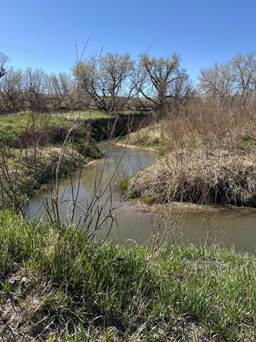
While I was at the section of the White River, I couldn’t help but think and marvel about how God created a means for distributing life-giving water throughout a continent (I knew the term “hydrology,” but I had to look up “limnology” as I was writing this paragraph), especially since, at the end of this month, my brother and I will be at the other end of the White River in South Dakota where it flows through the Badlands (and earns the name “White” from its sediment) and into the Missouri River south of Chamberlain for another fishing trip. God’s creation is an amazing and wonderful thing. That was what the Holy Spirit was continuing to show me, but not for the reason you might think.

Part 3: Sowbelly Canyon Road

One of the sights I had heard about from the guys who had gone up the previous year was Sowbelly Canyon, just north of Harrison, Nebraska. I had no idea what to expect from a “canyon” in Nebraska; certainly nothing like Poudre River Canyon in Colorado where my wife’s family has a cabin. Poudre Canyon is about 50 miles long, and the Poudre River is relatively wide in the canyon. Sow Belly is unique in its own way and was surprisingly beautiful and “cool” in more ways than one. I wish my wife would have been able to come along on this trip.

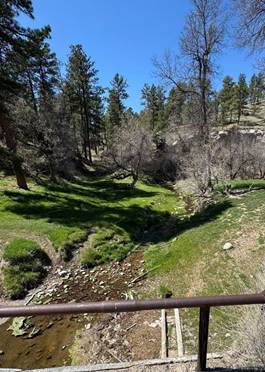
As you’re driving west on US 20 toward Harrison, you see nothing but a bunch of gently rolling hills on either side of the highway. One would never expect a place of such beauty was just beyond those rolling hills. Even as you crest the top of the canyon, you see an amazing sight below: a single lane dirt road running under a canopy of trees, with unusual rock formations atop the buttes, some of which have formed at right angles. The descent is moderately steep, and at times you have a wall of the canyon on your right (descending) and your left (ascending). At the bottom of the canyon is a small, babbling brook that must have taken a few centuries to form the canyon.

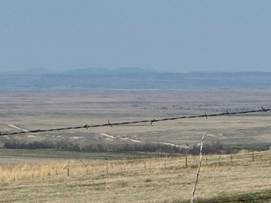
Just before you get to the end of Sowbelly Road on the east end (where it joins Pants Butte Road; no, I’m not making that name up), there’s a spot where you can see at least 80 miles to the north to the Black Hills in South Dakota (the dark mound in the far horizon). Something special happened between God and me via the Holy Spirit on that road, and especially with this particular view. I gained a whole new appreciation for the beauty, majesty, and grandeur of God’s creation. I’d expect something like that in Colorado; I never expected that in seemingly plain old northwestern Nebraska. Boy, was I wrong. What God had started teaching me in the Sandhills came to full fruition at the top of Sowbelly Road.

Part 4: Worldview, Wonder, and Wisdom

So let me bring this all together now. You might remember I started out talking about exegetical methods, methods that were heavily focused on the textual features like grammar, syntax, verb mood and tense, etc. Then it hit me: nothing in my exegetical method intentionally accounts for the majesty and glory of God and his creation. I knew I had to work that in somehow. But God still had one more piece to show me, and it hit me last night at our last small group of the season. Our senior pastor had been with us on this trip, but Sunday morning, one of the teaching pastors was preaching on the trauma Job experienced. I had tried to listen to it Sunday morning while driving through the remotest part of western Nebraska, but just couldn’t get a steady signal.

Fortunately, our Tuesday night group covered it in the study last night, and it was when we were talking about the ending of the book of Job that everything God had been teaching my finally made sense. Job had been arguing with God and his friends about how righteous he was and how he had always given God glory and so on, but God put him in his place. God recounts for Job all that He did by questioning Job: Did you lay the foundations of the earth? Did you create Leviathan and Behemoth? Who are you to tell me how I should act toward you?

That’s when I realized that I’m like Job in that moment. I think I have such a great exegetical method that will keep my doctrine sound and shred every stronghold that tries to set itself against God Almighty, but God’s word is more than the text and the grammar and verb moods and tenses and the participles and the conditional clauses. Those things are static, unchanging. But what does Hebrews 4:12 say? “For the word of God is alive and active. Sharper than any double-edged sword, it penetrates even to dividing soul and spirit, joints and marrow; it judges the thoughts and attitudes of the heart.”[1] Can grammar and syntax do that? I think not.

The other thing that occurred to me is the backstory of how the Jews would understand God’s word versus us gentile Christians. I’ll use just one example here: Communion, or as some call it, the Lord’s Supper or the Eucharist. When we look at the elements (“substantiational” leanings aside), we are meant to experience Christ in some way by “remembering” him. We see one man crucified and risen. But what do Jews remember at Passover? Not one man dying, but ALL the firstborn dying who weren’t protected by the blood of the lamb that they themselves applied to their doorways. They remember God parting the Red Sea so the Israelites could escape the oncoming Egyptians. The disciples didn’t understand immediately that Christ’s death had won them forgiveness and freedom. The Jews DID understand that immediately, with hearts pounding witnessing the very miracles of God at work to rescue them, even as they would tell the stories year after year to their descendants.

Conclusion

In other words, when I exegete and interpret Scripture, I need to look beyond the text and the grammar and all the other “in-the-weeds” details to comprehend a grand vision of a great God and all that he has done and made. That’s where the “draw closer” takes place, as it did for me this past weekend, when I understand who I am in God’s kingdom and that in spite of his greatness and grandeur, he looks with love at the least of us, at the humblest of us, at our faithfulness. He looks with compassion at those who are lost and searching and even at those who may be angry with him or agnostic toward him, prompting us to share God’s “living and active” word with those who have not yet comprehended that greater vision.

From this point forward, then, I’m adding a couple permanent elements of my “principlizing bridge” (to use Grasping God’s Word’s language) will be to ask first, “How does this passage reveal the glory and majesty and mystery of God to the world?” and second, “How is this passage ‘alive and active’ not only to me but to those I encounter as well?” I feel like I drew a little closer to God this weekend. I pray that my testimony here will do the same for you.

Scott Stocking

All contents herein are the creative and intellectual property of this author unless otherwise attributed.


[1] The New International Version. 2011. Grand Rapids, MI: Zondervan.

August 13, 2024

Debunking The Skeptics Annotated Bible (SAB): Romans 1:3

I’m down to preaching on just the last Sunday of the month now, so I thought I’d take a stab at some apologetic articles on my off weeks and make a series out of the posts. I’ve referenced before the work of Steve Wells, The Skeptic’s Annotated Bible (SAB), in which he categorizes several different types of what he considers to be deficiencies in the biblical text like perceived or apparent inconsistencies, worldviews that would not have even been considered in biblical times, and things he thinks are ridiculous or silly. He uses the King James Version of the Bible, which is probably in the public domain at this point, so he didn’t even choose a good modern translation to critique. His criticisms reflect an extremely shallow understanding of Scripture and the nature and character of ancient texts generally, so admittedly, his work is low-hanging fruit for those of us who are Bible ninjas when it comes to defending the faith.

Having said that, then, I’ll tackle Romans 1:3 in this article (≠329)[1], but it will lend itself to debunking some of the other related inconsistencies as well.

The first is Romans 1:3, citing the KJV text he uses:

Concerning his Son Jesus Christ our Lord, which was made of the seed of David according to the flesh;[2]

Here’s the 2011 NIV translation of the same verse:

regarding his Son, who as to his earthly life g was a descendant of David,[3]

And since this is a blog about Greek, I’ll throw in the Greek text for giggles.

3 περὶ τοῦ υἱοῦ αὐτοῦ τοῦ γενομένου ἐκ σπέρματος Δαυὶδ κατὰ σάρκα,[4]

The question Wells asks here about the contradiction is: “Was Joseph the father of Jesus?” Under each entry in the index, he identifies other verses in the Bible that he has labeled with the same number and breaks the list down into the supposed contradictory answers. Interestingly enough, he seems to have his verses mixed up in the index entry, as he lists this particular verse under the “Yes” answer category, while the verses in Gospels for the birth stories of Jesus that explicitly identify Joseph as Jesus’s earthly “father” are under the “No” category.

First of all, basic common sense would leave most people to believe that “seed” is being used metaphorically here, not necessarily in reference to a biological child of the person who produced the “seed,” but more broadly to the concept of “descendant.” In fact, when the word for seed [σπέρμα (sperma), ατος (atos), τό (to)[5]] is not used to mean an actual seed of a plant, it appears in contexts where the concept of having descendants is emphasized (see, for example, Mark 12:20–22, the concept of levirate marriage). So Paul in Romans 1:3 isn’t talking about Jesus’s biological father (bio dad for you young ‘uns), but about Jesus coming from the lineage of David, through which the prophets of the Old Testament declared the Messiah would be born. Pretty straightforward, right?

But let’s not stop there, because if Paul had intended to say David was Jesus’s bio dad, he would have had a perfectly good Greek word to use, and he could have taken it straight from Matthew’s genealogy in Matthew 1:1–17, and as such, I’ll address some other contradictions (≠326 Matthew/Luke genealogy; ≠328 Who was Jesus’s paternal grandfather?; ≠261 Matthew/1 Chronicles genealogies; ≠325 number of generations) Wells identifies, the discrepancy between Matthew’s and Luke’s genealogies. The Greek word γεννάω (gennaō), according to Louw-Nida’s reference, means “the male role in causing the conception and birth of a child—‘to be the father of, to procreate, to beget.’ ”[6] So this is yet another proof that there’s no need to identify a contradiction in Romans 1:3, because Paul didn’t use the same term as Matthew there.

But wait! It gets even better! While Matthew’s genealogy begins with Abraham, the father of God’s covenant people, and ends with Joseph, Luke’s genealogy begins with Joseph and goes backwards to creation and Adam, the first man (of whom Jesus is the archetype, that is, the firstborn of all creation). Matthew’s genealogy probably skips a generation here or there so he can fit it into his three “fourteen generations” pattern (by the way, 3 x 14 = 42, so Jesus is the answer to the question of “What is the meaning of life, the universe, everything?” Some of my readers will get that.). But you can trace the genealogy to a certain historical point from the end of Ruth and in 1 Chronicles 3:10–17.

The standard historical interpretation of Luke’s “alternate” genealogy is that it traces Jesus’s lineage back through Mary and not Joseph. Note that when Luke introduces the genealogy, he says “being (as was supposed) the son of Joseph” (Luke 3:23 KJV). But verse 23 is the only time we see the word for “son” in the Greek text. The rest of the genealogy is just the genitive form of the definite article, so it’s literally “Joseph of Heli of Matthat of Levi…” and so on. “Son of” can be fairly discerned from the context, but it’s possible Luke uses just the definite article to cover his bases in case someone is missing from the genealogy. We know nothing about Jesus’s grandparents on either side, so it’s possible that the simple “of” in the first instance (“of Heli”) is connecting Joseph to Mary’s parents or lineage. After all, in Jewish tradition, the child’s “Jewishness” comes from the mother.

This is just one example of the shallow and rather thoughtless and unscholarly opposition to the truth and integrity of Scripture you’ll find in Wells’ SAB. Your comments made in good faith are always welcome. If you’d like to read more critiques about the SAB, I want to recommend you to my colleague SlimJim’s blog, The Domain for Truth (wordpress.com). He is an outstanding apologist for the faith.

Peace,

Scott Stocking

My views are my own.


[1] NOTE: As I go forward in this series, I will “tag” the index numbers so you can easily search for the contradictions among my blog posts.

[2] The Holy Bible: King James Version. 2009. Electronic Edition of the 1900 Authorized Version. Bellingham, WA: Logos Research Systems, Inc.

[3] The New International Version. 2011. Grand Rapids, MI: Zondervan.

[4] Aland, Kurt, Matthew Black, Carlo M. Martini, Bruce M. Metzger, Maurice A. Robinson, and Allen Wikgren. 1993; 2006. The Greek New Testament, Fourth Revised Edition (with Morphology). Deutsche Bibelgesellschaft.

[5] Swanson, James. 1997. In Dictionary of Biblical Languages with Semantic Domains: Greek (New Testament), electronic ed. Oak Harbor: Logos Research Systems, Inc.; those of you who know Greek will recognize that the noun is neuter, not masculine or feminine.

[6] Louw, Johannes P., and Eugene Albert Nida. 1996. In Greek-English Lexicon of the New Testament: Based on Semantic Domains, electronic ed. of the 2nd edition., 1:256. New York: United Bible Societies.

March 22, 2024

How to Use Electronic Concordance Features

This post updates the “huconcordance” document in an earlier blog post, HUB Week 5: πείθω PowerPoint

The original document will remain available, because it has been my most popular print file download in the past few years. This new document adds features from Logos Bible Software, for which I am now an Affiliate partner. Use the link below for a 10% discount on various Logos packages and five free digital books.

Various Logos packages 10% discount!

Peace to you!

Scott

July 22, 2023

Counting the Days: Acts 10 and Jewish Time References

In this post:

  • I address discrepancies between the NIV (2011) and its precursor, the TNIV vs. the NIV (1984), ESV, NLT, and several other translations regarding how many days passed between Cornelius praying for someone to come to his home and Peter’s arrival in Acts 10:30.
  • I also briefly address a couple ridiculous comments on this passage by Steve Wells in his Skeptic’s Annotated Bible (SAB) that smack of cultural insensitivity and reveal that he missed important contextual clues in analyzing the passage.

The Background

Our Saturday morning men’s group at the church I attend has been reading through the New Testament following the scheme in Tyndale’s The One Year Chronological Bible. We’re not reading through it following the calendar; we’re only reading it on Saturday’s together, so it’s been a slow process, but helpful in getting the big picture of Scripture, especially as it related to the parallel accounts in the Gospels.

This morning we were reading in Acts 10, Cornelius’s plea to God for someone to come explain the Gospel more fully to him and his household in Caesarea and Peter’s response to that call. In Acts 10:30, the NIV (2011) says this:

30 Cornelius answered: “Three days ago I was in my house praying at this hour, at three in the afternoon. Suddenly a man in shining clothes stood before me.[1]

No sooner had I finished reading this, several men in the group spoke up and said their version said “Four days ago.” In the grand scheme of things, this little discrepancy doesn’t have a lick of theological impact on the Bible or on any of our lives, for that matter. But it does present itself as a teaching moment on how the first century believers counted time, so I wanted to share a brief insight on this.

The first part of Cornelius’s response in Greek looks like this, followed by my literal translation:

Ἀπὸ τετάρτης ἡμέρας μέχρι ταύτης τῆς ὥρας ἤμην τὴν ἐνάτην[2]

From the fourth day until this hour, being the ninth [i.e., about 3:00 pm]

The phrase in Greek that I have translated “From the fourth day” is somewhat idiomatic, and it does not actually contradict other translations directly, and can in fact be shown to represent the narrative in chapter 10 about the event. I’ll get to that in a moment, but I want to show that the crucifixion story may lend itself to such a discrepancy if we don’t understand how the Jews count.

Counting the Days: Jewish Reckoning of Time Forward

Most of us know that Jesus died on a Friday afternoon and was raised on Sunday morning. His prophecy about himself is consistent that he would die and rise again “three days later.” But if we think about in how we moderns look at that, we might come up with two days. The time period between Jesus death and resurrection was less than 48 hours, that is, less than two full days. But for the Jews, Crucifixion Day was Day 1, even though the day was more than half over by that time. Interestingly enough, Jesus died at 3:00 pm on that Friday according to Mark’s Gospel. The Sabbath (and the next day) would begin at sundown that evening, so all of Saturday is silent to us in the Scriptures. That was Day 2. But by Sunday morning, Day 3, sometime after the sun had set and Sunday had begun, Jesus had risen and was no longer in the tomb. From our perspective, we might say, “But Jesus only died two days before he rose!”

When Jesus speaks of rising again, the Gospel writers are not consistent with the temporal preposition they use, even within the same Gospel. Some have “in (ἐν) three days,” while others have “after (μετὰ) three days.” There was even one occurrence of διὰ (“through”) being translated as “in.” The first preposition, although commonly translated “in,” can also mean “within three days” or “when the third day arrives.” So Jesus rising on Day 3 of his crucifixion and burial fits perfectly in that scheme. The same goes for “after.” “After the third day dawns, I will rise again.” The third preposition, found only in Mark 14:58 in these parallel passages, implies that “during” that three-day period, he will rise, similar to a meaning of “within” from the first preposition. Therefore, there is absolutely no contradiction here with how the events unfolded and Jesus’s prophecies about himself.[3]

Counting the Days: Jewish Reckoning of Past Time

Getting back to the Acts 10:30 passage now, it should be easy to see why the discrepancy exists among the various translations. To make it clear how time transpires in this passage, let me put it in “weekly planner” format, and for ease of argument, we’ll take Day 1 as Monday (thanks to my friend Jerry who pointed the textual clues out during our discussion):

Monday, 3:00 pm. Cornelius is visited by an “angel of God” (Luke’s words) while he’s praying, or at least in a prayerful state of mind. (Acts 10:3; see also 10:22 for the servants’ description as a “holy angel,” and 10:30 for Cornelius’s own statement that he was praying when he had the vision.)

Tuesday, noon. One of Cornelius’s soldiers and two of his servants are approaching the city; Peter goes up to the roof to pray, gets hungry, and sees a vision. (10:9)

            Evening: Cornelius’s men are guests of Peter that afternoon and overnight. (10:23a)

Wednesday morning: “The next day Peter started out with them….” (10:23b)

Thursday, 3:00 pm: “The following day he arrived in Caesarea” (10:24, 30).

In our modern parlance, if we were speaking on Thursday about something that happened on Monday, we would most likely say “Three days ago.” But counting backward in this story follows the same principles as counting forward in the crucifixion story. Thursday is the fourth day since Cornelius had his encounter with “a man in shining clothes,” the being Luke described as an angel in the opening paragraph (I’ll come back to that point in a minute). When the Greek text says “From the fourth day,” Cornelius is counting Thursday as Day 1, and Monday as Day 4 in the past.

The other interesting bit about this opening phrase in vs. 30 is that the participle for “praying” is in the present tense. Because Cornelius uses the “from…until” construction in what he says, it’s quite possible he’s not only saying that he was praying when had the vision on “Monday,” but that he’s continued praying “until” the time Peter arrives, fulfilling his prayers.

Wells’s Absurd Absurdity

For whatever reason, Wells, in his SAB seems to think it’s funny that Cornelius, a Roman gentile described as a devout man of faith and prayer, would receive a visit from an angel telling him how he can learn more about what the death and resurrection of Jesus means. Not only that, he’s told to reach out to Peter, who was the leading apostle at the time. (See his sidebar comments throughout chapter 10.) Cornelius is getting first-class service, and Peter is getting a lesson on what the next step of his ministry will be: reaching out to Gentiles, especially in the area around Jerusalem and Capernaum.

He also seems to think it’s funny that Cornelius refers to the angel as “a man in shining clothes.” In context, Luke knows what Cornelius saw and has the cultural and religious background to interpret it. The servants, who may have been Jewish or at least Samaritan, would have also recognized who Cornelius saw. But as a Roman Centurion, Cornelius may not have had the frame of reference to comprehend what he had seen. Additionally, the story about Paul’s encounter with a bright, heavenly light and the voice of Jesus on the road to Damascus may have reached his ears already, so perhaps Cornelius thought this was something similar. Maybe he didn’t know if it was an angel or Jesus himself, so he offers Peter a “just-the-facts” description of what he witnessed. Such cultural insensitivity toward a man who came from a pagan background into faith is just downright mean and nasty on Wells’s part.

Conclusion

As I said above, the issue of whether the passage should be translated “three days ago” or “four days ago” is extremely minor in the grander scheme of biblical inerrancy and translation fidelity. But I do hope you found the discussion enlightening. I’d love to hear your comments.

Peace to all!

Scott Stocking

My opinions are my own.


[1] The New International Version. 2011. Grand Rapids, MI: Zondervan.

[2] Aland, Kurt, Matthew Black, Carlo M. Martini, Bruce M. Metzger, Maurice A. Robinson, and Allen Wikgren. 1993; 2006. The Greek New Testament, Fourth Revised Edition (with Morphology). Deutsche Bibelgesellschaft.

[3] This also debunks Steve Wells’s contradiction #384 in his SAB. The “false witnesses” are not “false” because they supposedly made up something Jesus never said; they’re false because Jesus wasn’t speaking literally of the physical Temple made of stones and timber, but of the temple of his own body. They’re false because they tried to twist his words.

April 13, 2023

Some Thoughts on Inerrancy

He humbled you, causing you to hunger and then feeding you with manna, which neither you nor your ancestors had known, to teach you that man does not live on bread alone but on every word that comes from the mouth of the Lord.[1]

Your word is a lamp for my feet, a light on my path.[2]

Heaven and earth will pass away, but my words will never pass away.[3]

Again Jesus said, “Peace be with you! As the Father has sent me, I am sending you.” And with that he breathed on them and said, “Receive the Holy Spirit. If you forgive anyone’s sins, their sins are forgiven; if you do not forgive them, they are not forgiven.”[4]

For I am not ashamed of the gospel, because it is the power of God that brings salvation to everyone who believes: first to the Jew, then to the Gentile. For in the gospel the righteousness of God is revealed—a righteousness that is by faith from first to last, just as it is written: “The righteous will live by faith.”[5]

All Scripture is God-breathed and is useful for teaching, rebuking, correcting and training in righteousness, so that the servant of God p may be thoroughly equipped for every good work.[6]

For the word of God is alive and active. Sharper than any double-edged sword, it penetrates even to dividing soul and spirit, joints and marrow; it judges the thoughts and attitudes of the heart.[7]

Bear in mind that our Lord’s patience means salvation, just as our dear brother Paul also wrote you with the wisdom that God gave him. He writes the same way in all his letters, speaking in them of these matters. His letters contain some things that are hard to understand, which ignorant and unstable people distort, as they do the other Scriptures, to their own destruction.[8]

The other night, just before I was ready to turn in, a long-time acquaintance and friend, Terry, IM’d me and asked me about biblical inerrancy. I hadn’t really given that much thought since seminary because I’ve been pretty settled on the issue for some time, but I thought I’d put down a few of my thoughts that came to mind as he and I briefly chatted.

  1. I believe 2 Timothy 3 that God’s word is inspired, that is, God-breathed. However, I also believe he speaks it both directly and through his fallible servants in a fallen world. He did this through his prophets in an authoritative way, but I don’t doubt that they may have added “local color” to their prophecies.
  2. I believe Jesus commissioned his apostles (and perhaps a few of their successors) with an ex cathedra authority, tempered by mutual accountability, to establish the primitive structure of the early Christian communities, the core doctrines of the faith, and vital practices to share and spread that faith. I do not believe this ex cathedra authority survived past the first or second generation of believers.
  3. I believe the historical books of the OT, from Genesis through Kings and Chronicles, were collated from extant copies of original writings and official journals. Some of these texts have obvious signs of an editor long after the recorded events took place (e.g., 2 Chronicles 20:26).
  4. I believe the Hebrews had in place a diligent process to copy their texts to ensure their accuracy and fidelity from one generation of texts to the next.
  5. I believe the NT autographs (original letters and Gospels) were without error doctrinally and textually. However, since we can be relatively certain that none of these have survived the ravagees of time, this statement has qualified significance. As the letters were copied in scriptoriums, human error inevitably made its way into the successive copies.
  6. I believe the science of the study of textual transmission is more than sufficient in most cases to identify when and where these errors entered into the text and which of the variant readings are the most reliable. I do not believe any of the disputed variations affect any doctrine of Scripture, especially since most doctrines do not rely solely on any one single text. The eclectic Greek text is the best modern version to use, as it takes into account the opinions and research of several qualified scholars.
  7. I believe “the Church of Christ on earth is essentially, intentionally, and constitutionally one”[9]; the differences we see among and within denominational traditions are reflections of the diversity of God’s kingdom. If we can appreciate the diversity in God’s creation, with hundreds of different varieties within each species, then why should we expect that the local manifestations of the church be copycats? I do not believe that such diversity, by itself, disqualifies the Scriptures in any way.
  8. I believe that anyone who can hear or read the Word of God translated into their own language, regardless of version, can understand and respond to the Gospel at its most basic level. The study of the Word of God in its original languages adds depth and color to the story and may convince some who think the principles taught therein are archaic, pedantic, or irrelevant.
  9. I believe that above all else, love for one another founded in the love God has shown and is still showing us is the highest virtue for the Christ-follower at least, and for all humanity generally, regardless of their belief. Love is necessary for the survival of the human race; faith and faithfulness are necessary for salvation; hope is necessary for our security in the faith and our strength to love one another. All other arguments pale in comparison to the power and testimony of faith, hope, and love.

Of course, this list is nowhere close to exhaustive, but I pray that it gets you, the reader, thinking about what you believe about Scripture and the testimony you bear as Christ-followers. Peace to all!

My thoughts are my own, and annotated when borrowed from elsewhere.

NOTE: If you have some other Scriptures you’d like to add on the reliability of God’s word, feel free to add them in the Comments section. I’d love to hear from you!

Scott


[1] Deuteronomy 8:3. The New International Version. 2011. Grand Rapids, MI: Zondervan.

[2] Psalm 119:105. The New International Version. 2011. Grand Rapids, MI: Zondervan.

[3] Luke 21:33. The New International Version. 2011. Grand Rapids, MI: Zondervan.

[4] John 20:21–23. The New International Version. 2011. Grand Rapids, MI: Zondervan.

[5] Romans 1:16–17. The New International Version. 2011. Grand Rapids, MI: Zondervan.

[6] 2 Timothy 3:16–17. The New International Version. 2011. Grand Rapids, MI: Zondervan.

[7] Hebrews 4:12. The New International Version. 2011. Grand Rapids, MI: Zondervan.

[8] 2 Peter 3:15–16. The New International Version. 2011. Grand Rapids, MI: Zondervan.

[9] Campbell, Thomas. Declaration and Address.

Website Powered by WordPress.com.