Sunday Morning Greek Blog

July 5, 2011

“I Am the Resurrection and the Life” (John 11:25)

The next two weeks will be busier than usual for me, as I have my three kids for their opportunity to live with me. I am glad they are here, and I look forward to our time together. It took a 19-hour round trip to get them here, and we all slept in Sunday (they more than I), but it was worth it to be able to attend the evening service at StoneBridge Christian Church with them, then head out to my aunt and uncle’s cabin near Fremont to watch some professional and not-so-amateur fireworks displays. As my daughter said in her Facebook post, “‎1 good thing about driving at night on 4th of July weekend is never ending fireworks!”

I have made my way through Stephen’s “fatal” testimony in Acts 7 in my reading schedule, and his summary of Israel’s history has many mnemonic elements to it, almost as if Stephen had developed a primitive version of the popular “Walk Thru the Bible” events, where you learn motions to go along with the biblical story. Key words are repeated two or three times in each section, and a few inclusios stick out as well.

However, before I am too far removed from John’s Gospel, I want to tackle one of the two remaining “I am” statements I have not yet covered. “I am the resurrection and the life” (Ἐγώ εἰμι ἡ ἀνάστασις καὶ ἡ ζωή egō eimi hē anastasis kai hē zōē, John 11:25) is almost certainly the heart of John’s Gospel. It is the middle chapter of the book for starters. It is also the “I am” statement that is most closely associated with the historical event that prompted the statement, at least in terms of proximity in the biblical text. Finally, it is the one that reveals the power Jesus has over death and that looks forward to his own victory over death.

Once again, we should not be surprised that John has brought us to the point where this statement becomes significant. To keep it simple, a search of the phrase “eternal life” (ζωὴ αἰώνιός zōē aiōnios, usually used in accusative ζωὴν αἰώνιόν zōēn aiōnion) in the TNIV reveals 43 occurrences. John uses the phrase 17 times in his Gospel, more than twice that of the Synoptic authors combined. If 1 John is figured into the picture, John has over half the occurrences of the phrase in his writings. John had used the phrase 13 times up through chapter 10, but not at all in chapter 11 where we find our text.

In the Synoptic Gospels, the primary use of the phrase is in the three parallel passages where Jesus is asked what must be done to inherit eternal life. But John doesn’t record anyone asking that question. John (or Jesus’ words in John) is always forthright about declaring eternal life. In fact, three of the passages that have figured prominently in this discussion of the “I am” statements contain teaching about eternal life (John 4—woman at the well; John 6—”I am the bread of life”; John 10—”I am the door of the sheep”/”I am the good shepherd”; John 14:6, “I am the way and the truth and the life,” should also be included, because the last part is a restatement of 11:25).

Eternal life does not mean life forever on this earth in our current bodies. Eventually, the earth would run out of room to hold everyone. Death is in the offing for all of us; but if we are Christ followers, we also know death is not the end. The NT writers use several words for “resurrection” (noun) or “raise up (to life),” but the main ones are the noun ἀνάστασις (anastasis, the word found in Jesus’ “I am” statement) and the verbs ἐγείρω (egeirō) and ἀνίστημι (anistēmi). The verb ἐγείρω is by far the most popular of the two; John uses it 13 times as opposed to 8 times for ἀνίστημι. (Note: Because both the nouns and the verbs can refer to “standing up from being seated” or “rising up from a reclined position” as well as “rising from the dead,” I used Logos Bible Software to search for the Louw & Nida semantic domain numbers for each word when they specifically refer to “rising from the dead”; if you use a regular concordance to look these up, make sure you note the distinctions in usage.)

In the immediate context of the passage at hand (John 11:23–25), we find five occurrences of words that mean “come back to life.” Martha believes in the resurrection in the last day, but she also seems to hold out some hope that Jesus could restore Lazarus to them even at that time, even after he has been dead four days. Broadening the context, these resurrection words appear three times in John 6:39–40. But the occurrences that should make us sit up and take notice is that in John 2:20–22, where right from the start, Jesus predicts his own resurrection. John even points out in vs. 22 that the disciples remembered Jesus had said that after he rose from the dead (see John 20:9). Putting it all together, the resurrection and eternal life permeate John’s Gospel, while in the Synoptic Gospels, such discussion is limited to a few pericopes, the most significant being the Sadducees discussion with Jesus about marriage and the resurrection and Jesus’ own repeated predictions of his resurrection.

John develops this concept more completely than the other Gospel writers, especially by providing a living, breathing example, Lazarus, of someone raised from the dead other than Jesus. Matthew does mention the “sleeping saints” who came out of their tombs that resurrection weekend (27:51–53), but we’re never really told if that was an enduring earthly resurrection as we are with Lazarus (John 12:1, 9, 17). This is not to say John’s Gospel is better than the Synoptic Gospels. But it does reveal that John was not so much into telling a chronological story like the Synoptic authors; his focus is theology, or more specifically, Christology and eschatology. (I suppose technically I could use the words “anastasiology” [ἀνάστασις] and “zoology” [ζωή], but the first one’s not in the dictionary [which has never stopped me before!], and the second one is used primarily of nonhuman living beings.)

In 1 Corinthians 15, Paul develops even further the theology and centrality of the resurrection. I think it is safe to assume he had been influenced by John on this point. On the one hand, Paul says that it is futile to be a Christ follower if Jesus has not been raised from the dead. On the other hand, he talks about the spiritual realities of the resurrection: it’s not the earthly resurrection that Lazarus experienced. It is a transformation of our mortal bodies into an immortal substance that can never die. That is the substance of our “eternal life.”

Peace!

Pastor Scott Stocking, M.Div.

June 26, 2011

The Nature of “the Fellowship” (κοινωνία koinōnia) in Acts 2:42

Filed under: Acts,Biblical Studies,Ecclesiology,Greek,New Testament,Theology, Biblical — Scott Stocking @ 8:29 am

My Logos-generated Bible reading schedule does some odd things at times. Yesterday, I was scheduled to read Acts 2:1–42 (42 verses) followed by verses 43–47 today (5 verses). What’s up with that? So since yesterday was Saturday and I had some extra time, I decided to read all of chapter 2 and get ahead a little bit in my reading schedule. But this is a good thing, because Acts 2 really should be taken as a whole unit. Peter preaches to the crowd, recounting David’s Messianic prophecies in the Psalms, with the entire message coming to a climax in 2:37–38: “Those who heard this were pierced [κατανύσσομαι katanyssomai /kah-tah-NOOSE-ȯ-my/] to the heart and said to Peter and the rest of the apostles, ‘What shall we do, Men of the Brothers?’ And Peter to them, ‘Repent!’ [saying] ‘And let each one of you who does [italics my gloss] be immersed upon the name of Jesus Messiah into the forgiveness of your sins, and you will receive the gift of the Holy Spirit.'”

Now I have already dealt with Acts 2:38, specifically the phrase “into the forgiveness of your sins” (click link in verse above), but I want to deal with the results of that call to repentance. In Acts 2:41, we learn that over 3000 were added to the number of Christ-followers on that day. Verse 42 is my focus today: ἦσαν δὲ προσκαρτεροῦντες τῇ διδαχῇ τῶν ἀποστόλων καὶ τῇ κοινωνίᾳ, τῇ κλάσει τοῦ ἄρτου καὶ ταῖς προσευχαῖς (ēsan de proskarterountes tē didachē tōn apostolōn kai tē koinōvia, tē klasei tou artou kai tais proseuchais, ‘And they devoted themselves to the apostles’s teaching and to the fellowship, to the breaking of bread and to the prayers’). This is how the verse appears in most modern Greek texts of the New Testament and subsequently translated into most English versions.

Much Ado about a Comma

You may have noticed that in the verse, I highlighted the comma after the word κοινωνίᾳ. I can hear you now: “Come on, Scott! A comma? Really? Give me some filet mignon I can savor, not a dinky little baby-carrot comma!” But fasten your seatbelts, because the presence or absence of this comma has a huge impact on how this verse is understood. A few years ago, I presented a paper in a professional conference on this verse, and my personal joke is that it was my 25-page paper about a comma. Read on and see why this comma is so important (and no, I’m not reproducing the entire 25-page paper here!).

First of all, I must say that the original manuscripts of Scripture did not have punctuation as we know it today. Not only did they not have punctuation, they did not have spaces between words, either. Just look at an image of the Rosetta Stone to see what I mean. So how does a comma (or any punctuation, for that matter) end up in today’s versions of the Greek New Testament (GNT)? Because the modern-day editors of the GNT put it there in an effort to help translators see the presumed syntax of the text.

But a good translator knows that the placement of a punctuation mark in the Greek text can be just as interpretive as how one translates a particular Greek word into English (or into whatever receptor language). As such, there are a couple reasons to question this comma here. The first reason is that in the history of the transmission of the text, someone decided that καί (kai ‘and’) needed to be inserted in that spot at some point. The variant is not well attested, but it did make it into the textus receptus, the Greek manuscript that has been the foundation for all versions of the King James Bible. Thus, the KJV renders the middle part of the passage: “and fellowship, and in breaking of bread.” Modern eclectic texts do not have the καί, but replace it with the comma. The 3rd edition of the UBS GNT does not even reference the variant reading.

The second reason to question the comma is that it is possible to make a sensible translation of the verse without it, if the translator does his or her homework. I have done that homework, and I present to you here my understanding of Acts 2:42. To be fair, I will offer four possibilities of translation, but my study leads me to believe that one of the last two possibilities is more probable, with Option 4 being my personal preference.

Four Possible Translations

1. Four individual manifestations, reflecting an implied or variant medial καί, with each dative case noun functioning as a direct object of the main verb:

“They devoted themselves to the apostles’ teaching, and to the fellowship, and to the breaking of the bread, and to the prayers;” or
“They devoted themselves to the apostles’ teaching and fellowship [i.e., apostles’ modifies both teaching and fellowship, which seems to be the gist of the KJV translation], and to the breaking of the bread, and to the prayers.”

2. Two complementary pairs of manifestations, rejecting the implied or extant medial καί and acknowledging Luke intended a comma break between the two pairs:

“They devoted themselves to the apostles’ teaching and to the fellowship, to the breaking of the bread and to the prayers.”

3. Two manifestations, with the second (“fellowship”) qualified by the following couplet (double appositive, explains lack of καί, no comma necessary in Greek text):

“They devoted themselves to the apostles’ teaching and to the fellowship, [which includes] the breaking of the bread and the prayers” (see 1 Corinthians 10:16).

4. Three individual manifestations (lack of καί before “breaking of bread”):

“They devoted themselves to the apostles’ teaching, [and] to the fellowship of/participation in the breaking of the bread, and to the prayers” (again, see 1 Corinthians 10:16; because we have the serial comma in English, we wouldn’t need to translate the first καί).

Four Sentence Diagrams

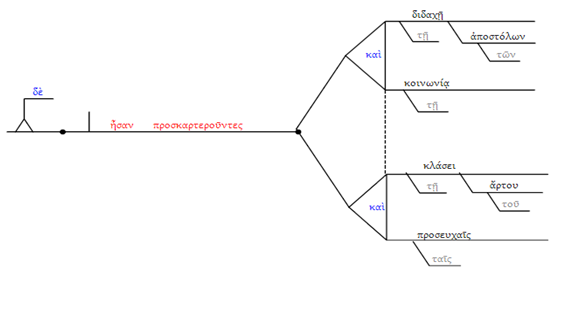
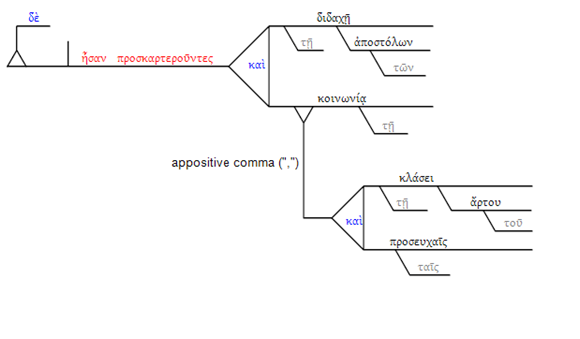
Anybody remember sentence diagramming from junior high English? How fun was that, right? Well, for my part, I’m glad I half-way paid attention to that, because it comes in quite handy in this analysis. I hope my English teachers approve. Note Figures 1 through 4 below. [NOTE TO READERS: If for whatever reason you don’t see the diagrams, please let me know. They show up in my browser (IE9), but I’m not sure how they’d work in other browsers.]

Figure 1: Sentence Diagram for Options 1 and 2: Acts 2:42.

Two pairs separated by a comma (Option One; as in the USB 4th Edition), or, if the variant reading with καί is accepted (textus receptus), four individual manifestations of their devotion (Option Two).


Figure 2: Sentence diagram for Option 3: Acts 2:42

The first or both of the latter two dative nouns are in an appositive relationship to κοινωνίᾳ. No comma is necessary.


Figure 3: Sentence diagram for Option 4: Acts 2:42

Three manifestations of the believers’ devotion, with τῇ κλάσει in a genitive relationship to τῇ κοινωνίᾳ; or alternately, with τῇ κλάσει as the direct object of the verbal action of τῇ κοινωνίᾳ, that is, “the sharing/participation in the breaking of bread.” See 1 Corinthians 10:16 for support for this latter option. Accepting either reading would mean neither the Greek nor English texts should have a comma after τῇ κοινωνίᾳ/”fellowship.”


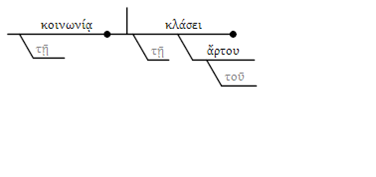
Figure 4: Partial sentence diagram for the translation “participation in the breaking of the bread”: Acts 2:42

The alternate reading would look like this (akin to 1 Corinthians 10:16), with κλάσει as the dative case direct object of the verbal action of κοινωνίᾳ:


Option 4 actually follows the Vulgate (Latin) translation, which has “the breaking of the bread” in genitive case (case of possession) rather than in dative case (object case), as in Greek. But if the two nouns are essentially the same thing, they can take the same case in Greek even if they have a genitive relationship. This actually seems quite common in the opening chapters of Acts, especially in the phrase ἄνδρες Ἰουδαῖοι/Ἰσραηλῖται/ἀδελφοί (andres Ioudaioi/Israēlitai/adelphoi, ‘men of Judah/Israel/brothers’): ἄνδρες is nominative/vocative plural, as is the relational noun. Alternately, the phrase could be translated “fellow Judeans, Israelites, brothers [and sisters].”

And All This to Say What?

The point of this whole study was really to find out just what κοινωνίᾳ (koinōnia ‘fellowship’) embraced in the early church. I believe the reference to “the breaking of the bread,” because both nouns have the definite article in Greek, is more specific than just a general meal. I believe the reference is to the Last Supper (the Lord’s Table, my preferred term for “communion”), where Jesus commanded his disciples to “do this in remembrance of me.” So fellowship is not just a potluck or a gathering of believers for whatever purpose, but as 1 Corinthians 10:16 says, a “participation [κοινωνίᾳ] in the body and blood of Christ.”

Those of us in the Restoration Movement (Christian Churches/Churches of Christ) as well as the Catholic Christ-followers instinctively understand the centrality of participating in communion/the Lord’s Table/Eucharist on a weekly basis, even if we have differing theologies about the elements. If there are other denominations or congregations out there that practice a weekly as opposed to an erstwhile communion, they are to be commended for showing the same devotion to this “fellowship” as the early Christ-followers.

So whenever you partake of the Lord’s Table, remember that the elements are not just bread and juice, but an intimate connection to the sacrifice of Jesus and a sharing with one another, regardless of denominational background, in the historical events that should be foundational to all Christ-followers, the death, burial, and resurrection of Jesus.

Peace!

June 19, 2011

“I Am the Door of the Sheep”; “I Am the Good Shepherd” (John 10:7, 11)

Well, the summer solstice is just around the corner, and so is the end of my time reading through the Gospels. I read the first part of the crucifixion story this morning in John 19, and that has some interesting tidbits I may come back to:

  • Barabbas’s name is Aramaic for “Son of the Father,” or more colloquially, “Daddy’s Boy” (בַּר bar ‘son’ + אַבָּא abba ‘father, daddy’, perhaps with definite article); Jesus is the “Son of God [the Father]”: irony at its finest!
  • Three times, Pilate said he could find no charge against Jesus, and he seems to work tirelessly (and with concern for his own integrity) to try to release Jesus, even justifying his innocense to the Jewish leaders and the crowd, to no avail;
  • Jesus tries to ease Pilate’s worries about handing him over to be crucified by telling him, “The one who handed me over to you is guilty of a greater sin.” Note that Jesus cannot be accusing the God the Father here, but either Judas or the high priest.

But I digress from my intentions this morning. I want to tackle two more of the “I am” statements of Jesus found within a few verses of each other in chapter 10: “I am the Door of the Sheep” (v. 7) and “I am the good shepherd” (v. 11). The two statements are obviously closely related, but I will deal with each one separately, even though there will be some overlap.

“I Am the Door of the Sheep” (John 10:7)

I’m going to reproduce here my table (Table 1) from an earlier post that shows the connections between the seven “I am” statements of Jesus and the seven signs he performed, with today’s two statements highlighted: (2/13/2012: You can click the “I Am” statement to open the blog post for that statement.)

Table 1: Linking the “I Am” Statements with Jesus’ Miracles

“I Am” Statement

Sign/Miracle

John 6:35: I Am the Bread of Life John 6:1–15: Jesus Feeds the 5000+
John 8:12: I Am the Light of the World John 9:1–12: Jesus Heals a Man Born Blind
John 10:7: I Am the Door of the Sheep John 5:1–15: Healing of the Invalid at Bethesda [Sheep Gate]
*John 10:11: I Am the Good Shepherd John 6:16–24: Jesus Walks on Water
John 11:25: I Am the Resurrection and the Life John 11:38–44: Jesus Raises Lazarus from the Dead
*John 14:6: I Am the Way, the Truth, and the Life John 4:43–54: Healing of the Official’s Son
John 15:1: I Am the True Vine John 2:1–11: Water into Wine

One of the first connections to note out of the gate (pun intended) is that Jesus’ third sign is healing a man at the pool by the Sheep Gate (προβατικῇ probatikē, literally “of the sheep”; the feminine form is elliptical or shorthand because the word for “gate”, which is feminine, is not in the text there) in the walls of Jerusalem (John 5:1–15). This is the city gate through which the sheep entered when being brought to town for the market or the Temple. I will grant that Jesus’ statement, “I am the door of the sheep” (ἐγώ εἰμι ἡ θὑρα τῶν προβάτων egō eimi hē thura tōn probatōn) is more agrarian and rural than it is commercial and political, but the connection is significant nonetheless, because chapter 5 is the only time the Sheep Gate is mentioned in the Gospels. The Sheep Gate is mentioned three times in Nehemiah in connection with rebuilding the wall. It is probably not coincidence, then, that the high priest and his fellow priests had the responsibility to rebuild that section of the wall and rehang the gates (Nehemiah 3:1; cf. Hebrews 4:14, where Jesus is called our “great high priest”).

This “I am” statement has a connection to John 14:6 as well. In John 10:9, Jesus repeats the “I am” statement, this time without the sheep (“I am the door”), and the salvific connection is obvious (TNIV modified to reflect Greek word order): “Through me, whoever enters will be saved.” The phrase “through me” (διʼ ἐμοῦ di’ emou; the emphatic form of the pronoun is used) comes first in 10:9, even before the conjunction, which is a grammatical tool for emphasizing a phrase. The same phrase is found in John 14:6 (“no one comes to the Father except through me“) at the end. (Don’t ask me why, but Greek scholars say that an element of a Greek sentence can be emphasized at the beginning or the ending of a sentence; just one of those quirky things about Greek.) Here’s the beautiful part: normally you might think a prepositional phrase like “through me” should be common enough, right? Want to guess how many times it occurs in John? If you said “twice,” you are exactly right! Because it appears at the beginning of the phrase in 10:9 and at the end of the phrase in 14:6, I would say we have an inclusio here. Was it intentional by John? Perhaps not. Did God have a hand in ordering the text that way? I certainly think so.

Now if we have an inclusio, we need to look at the text in between and see what’s going on. Jesus does make his other statement about being a good shepherd two verses later in 10:11, but two other significant events are bracketed by the “through me” statements. The first is the resurrection of Lazarus from the dead and Jesus’ accompanying “I am the resurrection and the life” statement. More on that in a future post. The other significant event is the Last Supper, in which Jesus washes his disciples’ feet. In 13:8, Jesus makes another statement about his exclusivity as the Savior: after Peter objects to Jesus washing his feet, Jesus replies (my translation, emphasizing the present continuous aspect of the verbs), “Unless I am washing your feet, you are not having any part with me [μετʼ ἐμοῦ met’ emou].” This act of washing the feet is the act of a good shepherd who cares for his sheep, so we now turn to that “I am” statement.

“I Am the Good Shepherd” (John 10:11, 14)

In Table 1 above, I make a tentative link between “I am the good shepherd” (Ἐγώ εἰμι ὁ ποιμὴν ὁ καλός egō eimi ho poimēn ho kalos) and Jesus walking on the water in John 6. Here’s the connection, but again, it is tentative: Only Matthew records that Jesus called Peter to walk on the water (14:28–31); perhaps John doesn’t record this because he doesn’t want to call attention to Peter’s lack of faith in that instance. The connection has its “degrees of separation,” but it’s more than just about feet and water.

Jesus had stayed behind when his disciples set out in the boat in John 6. But when he saw the disciples were having trouble managing the boat in the strong winds, Jesus left whatever shelter he had sought out and walked out onto the raging sea to get to those he loved. He was looking out for his sheep. This reminds of the parable of the wandering sheep in Matthew 18:10–14, only in the walking on the water pericope, the wilderness is the sea itself. I can imagine that even for the son of God, walking on the water was not the safest thing to do, let alone doing it in a storm, yet Jesus says in the latter part of John 10:11: “The good shepherd lays down his life for the sheep” (repeated in vv. 15, 17, 18).

The concept of the good shepherd has its roots in the Old Testament. King David, of course, was a shepherd himself, and Psalm 23 is a popular treatise on how the Lord shepherds us on a daily basis. Ezekiel 34 is an extended treatise on the bad shepherds of Israel, who had led the nation on the path of exile. A few relevant passages from Ezekiel make the connection between Jesus’ “I am the good shepherd” statement and Jesus’ walking on water even more pronounced (all excerpts from the TNIV):

For this is what the Sovereign Lord says: I myself will search for my sheep and look after them. As shepherds look after their scattered flocks when they are with them, so will I look after my sheep. I will rescue them from all the places where they were scattered on a day of clouds and darkness (34:11–12).

As for you, my flock, this is what the Sovereign Lord says: I will judge between one sheep and another, and between rams and goats (34:17; note parallel to Matthew 25:32–33).

I will place over them one shepherd, my servant David, and he will tend them; he will tend them and be their shepherd. I the Lord will be their God, and my servant David will be prince among them. I the Lord have spoken (34:23–24).

They will live in safety, and no one will make them afraid…. Then they will know that I, the Lord their God, am with them and that they, the house of Israel, are my people, declares the Sovereign Lord. You are my sheep, the sheep of my pasture, and I am your God, declares the Sovereign Lord (34:28b, 30–31)

Live It Out

I find no shortage of irony that the one John called “The Lamb of God, who takes away the sin of the world!” (1:29b) is also the door (or gate) for the sheep and the good shepherd. Both of these statements emphasize Jesus’ compassion for his flock. He protects us from thieves and bandits who would rob us of our joy. He is a refuge for us in times of storm and disaster. And he is the only one through whom we can be saved and have the promise of eternal life.

In John 21:15, Jesus has an emotional exchange with Peter to restore him to service after his denial. Three times, Jesus asks Peter, “Do you love me?” Twice Jesus uses ἀγαπάω (agapaō) and once φιλέω (phileō), but Peter always responds with φιλέω. I don’t think much can made of the difference in the different words used for “love” as some have, but that’s not my point here. Jesus responds, “Feed my lambs” or “Feed my sheep.” Can we model the shepherding of the Savior? Some days it’s easier than others, but if Peter was forgiven for his triple-denial and went on to be instrumental in commencing the church, what great things can we do for God?

I had a stormy period this past month. Last month would have been my 19th anniversary with my (now ex-)wife, and I found myself craving the intimacy I once had with her. It was a struggle to get through that, but God, who is never unfaithful, continued to be faithful to me as I worked through my issues. I’ve come out on the other side now, but as much as I know I’m forgiven for the past, I still find that it haunts me at times. I need to trust that my shepherd is watching out for me in those times when I wander into the wilderness and know that as I “bleat” for his presence, protection, and love, he will hear me and come running to me to give me the only comfort that matters.

Peace!

Scott Stocking

June 12, 2011

“I Am the Way and the Truth and the Life” (John 14:6)

My reading schedule landed me in John 14 today, so I will go ahead and expound on Jesus’ sixth “I am” statement. I realize this is out of order, but I want to cover this while it is fresh in my mind.

More Connections with John 4

When Jesus says, “I am the way and the truth and the life” (John 14:6; ἐγώ εἰμι ἡ ὁδὸς καὶ ἡ ἀλήθεια καὶ ἡ ζωή egō eimi hē hodos kai hē alētheia kai hē zōē), his disciples should not have been surprised by this. This is another statement where the life, ministry, and words of Jesus should have prepared the disciples to understand this claim. In my chart in the Bread of Life post, I made a tentative connection between this “I am” statement and the healing of the royal official’s son in Cana of Galilee (John 4:43–54). Jesus does tell the official that his son will live (ζάω zaō), but that is the only significant verbal connection that I could discern. However, if the whole context of chapter 4 is taken into consideration, then the connection becomes less tenuous. In his discussion about living water with the woman at the well, Jesus makes the statement “God is spirit, and his worshipers must worship in the Spirit and in truth” (4:24; TNIV, as for all Scripture quotations herein, unless I indicate otherwise). This thought certainly parallels Jesus’ follow-up statement in 14:6b: “No one comes to the Father except through me.” In 14:16–17, Jesus promises to give “the Spirit of truth.”

But the parallels between these two chapters don’t end there. After the Samaritan woman in chapter 4 brings her friends back to see Jesus and talk to him for two days, her Samaritan friends make this remarkable statement: “We no longer believe just because of what you said; now we have heard for ourselves, and we know that this man really is the Savior of the world” (4:42; emphasis mine). The Samaritans, the people most hated by the Jews, know that Jesus is the Messiah! But look at the context in John 14 surrounding Jesus’ “I am” statement:

  • In verse 5, Thomas says, “We don’t know where you are going, so how can we know the way?”
  • In verse 7, Jesus says, “If you really know me, you will know my Father as well. From now on, you do know him and have seen him.”
  • In verse 9, Jesus responds to Philip’s request, “Don’t you know me, Philip, even after I have been among you such a long time?”
  • In verse 10, Jesus continues: “Don’t you believe that I am in the Father, and the Father is in me?”

His disciples still don’t get it! I think they had warmed up to the idea that Jesus is the Messiah by this time, but they still don’t seem to understand the implications of it all. Some of the disciples did come to this realization before the Last Supper (see Peter’s response to Jesus in Matthew 16:16, for example), but most Gospel accounts reveal that the disciples don’t come to a full realization of Jesus’ power and authority until after his death and resurrection.

“Where I Am Going…”

In chapter 6, after the discussion surrounding Jesus’ “I am the bread of life” statement, and especially after he has spoken about eating his flesh and drinking his blood, several of his early disciples desert him, because they don’t understand what he is saying. Jesus makes a statement in verse 62 that is the precursor to his “I am the way and the truth and the life” statement, especially the part about being “the way.” Jesus says, “What if you see the Son of Man ascend to where he was before?” (Recall that in 1:51, Jesus alluded to Jacob’s dream in Genesis 28:12 when he said, “Very truly I tell you, you will see ‘heaven open, and the angels of God ascending and descending on’ the Son of Man.”) In 7:34, then, we have the first of several statements of Jesus recorded by John, where Jesus says (my translation), “Where I am, you are not able to come” (ὅπου εἰμὶ ἐγὼ ὑμεῖς οὐ δύνασθε ἐλθεῖν hopou eimi egō hymeis ou dunasthe elthein; 30 of the 82 occurrences of ὅπου hopou, ‘where’ in the NT are found in John’s Gospel). In 8:21, Jesus changes verbs: “Where I am going, you are not able to come.” But in 12:26, Jesus turns this to the positive with a condition: “If anyone would serve me, he must follow me, and where I am there also my servant will be.”

In chapter 13, Jesus returns to the negative, but not without some hope: in vs. 33 he repeats his words of 8:21, but then in 13:36, Jesus opens the door a bit (my translation): “Where I am going, you are not now able to follow me, but you will follow me later.” In 14:3–4, Jesus returns to a positive statement: “If I go and prepare a place for you, I am coming back again (note present tense) and I will receive you (note future tense) to myself, in order that where I am you may also be. And where I [myself] am going, you know the way.” In Jesus’ prayer in John 17, we find the last of these types of statements (my translation): “Father, I desire the ones you have given to me, in order that where I am they also may be with me.” In his final earthly prayer, Jesus expresses his longing that his disciples, the twelve men closest to him on earth (and yes, I think he included Judas Iscariot in that group), be with him both in his final struggle on earth and in his glorious eternal kingdom with the Father.

That desire extends to all who come after the disciples as well. Jesus longs for each of us to be with him in eternity, because he shed his own blood for our salvation. That’s how much he loved us. That’s how much he desires us, because he knew there could be no other way by which men and women could come to him.

“The One Who Sent Me”

Related to the discussion of where Jesus is going is the recurring theme of “the one who sent me.” Of the 27 times John uses the participle for πέμπω (pempō ‘I send’; the participle form used as a noun is translated as “the one who sends” [present tense] or “the one who sent” [aorist/past tense]), 24 of them in are attributed to Jesus, referring to the Father who sent him; one of the key passages where this connection is made is 8:14–18: In verse 14, Jesus says (TNIV): “Even if I testify on my own behalf, my testimony is valid, for I know where I came from and where I am going. But you have no idea where I come from or where I am going.” Then in verse 18, Jesus closes his argument with, “I am one who testifies for myself; my other witness is the Father, who sent me.”

Peace!

PS: One of my favorite Rich Mullins songs is “Where I Am, There You May Also Be,” released posthumously on his “Jesus Record.” Here is a link to the Ragamuffin Band performing the song live in Nashville in 2002. I hope you enjoy it as much as I do.

June 5, 2011

The “I Am” Statements of Jesus

These last two weeks have been challenging to say the least. I have moved into an apartment, and my body is stiff and sore from carrying my stuff up two flights of stairs several times a day. I went to Illinois last weekend to see my kids—we had a great time in Chicago attending a damp but entertaining Kane County Cougars baseball game (single A team for the Royals), then waited two hours in a thunderstorm to get into Shedd Aquarium the next morning. We were wetter than the aquatic creatures by the time we got in there. I am also in the process of switching second jobs, which has taken considerably more time than I anticipated. And as I have come to the heart of John’s gospel with the seven “I am” statements of Jesus, Satan has ramped up his attacks on me, and some days, I have been too tired to think spiritually enough to resist. But I praise God that he has strengthened me in the past few days, and I’m feeling a renewed vigor and resolve to press forward.

Overview of “I Am” Statements in John

Some of you may already know that Jesus makes seven key “I am” statements about himself in John’s gospel. They usually take the form “Ἐγω εἰμι [predicate nominative case definite article and noun] [(genitive case definite article and noun translated “of X”) or (predicate nominative case definite article with adjective) or, in the absence of the latter two, (one or more additional nominative case noun descriptions]. (Nominative case is the “subject” case in Greek; predicate nominative means it comes after the “to be” verb; genitive case implies possession or source.) In some cases, the “I am” statements are repeated in various forms. Jesus makes other “I am” or “I am not” statements in John’s gospel that I will address below, but to begin, here are the seven main “I am” statements of Jesus, giving the first occurrence of each if there are multiple similar statements (taken from Nestle-Aland Greek NT, 27th edition, with McReynold’s Interlinear):

John 6:35

Ἐγώ εἰμι ὁ ἄρτος τῆς ζωῆς

egō eimi ho artos tēs zōēs

I am the bread of the life

(see also 6:41, 48, 51)

John 8:12

Ἐγώ εἰμι τὸ φῶς τοῦ κόσμου

egō eimi to phōs tou kosmou

I am the light of the world

John 10:7

Ἐγώ εἰμι ἡ θύρα τῶν προβάτων

egō eimi hē thyra tōn probatōn

I am the door of the sheep

(see also 10:9)

John 10:11

Ἐγώ εἰμι ὁ ποιμὴν ὁ καλός

Egō eimi ho poimēn ho kalos

I am the shepherd the good (= “the good shepherd”)

(see also John 10:14)

John 11:25

Ἐγώ εἰμι ἡ ἀνάστασις καὶ ἡ ζωή

egō eimi hē anastasis kai hē zōē

I am the standing up (= “resurrection”) and the life

John 14:6

ἐγώ εἰμι ἡ ὁδὸς καὶ ἡ ἀλήθεια καὶ ἡ ζωή

egō eimi hē hodos kai hē alētheia kai hē zōē

I am the way and the truth and the life

John 15:1

Ἐγώ εἰμι ἡ ἄμπελος ἡ ἀληθινὴ

Egō eimi hē ampelos hē alēthinē

I am the vine the true (= “the true vine”)

(see also John 15:5).

Background

I need to mention one bit of grammatical background here: Greek verbs are “parsed” (that is, their spelling changes) depending on the “person” and “number” of the subject of the verb. As such, if the subject of the verb is a simple pronoun (first person: I, we; second person: you, y’all; third person: he, she, it, they), then Greek does not typically require an actual pronoun to accompany the verb. The subject is implied by the way the verb is spelled. So if I wanted to say “I am a sinner” in Greek, I would render it Εἰμί ἁμάρτωλος. When a pronoun is used as the subject of the verb, then it is considered emphatic. So if I said Ἐγώ εἰμί ἁμάρτωλος, I would be saying in effect, “I myself am a sinner.” So the fact that Jesus uses ἐγώ here means that he is calling attention to himself in a special way. He is not just saying, “I am hungry” or “I am thirsty.” He is making people sit up and take notice about who he really is.

The most obvious significance of Jesus making these “I am” statements is the direct connection to Exodus 3:14, where God reveals his name to Moses. In Hebrew, that name is usually rendered יְהוָ֞ה (yəh WAH, or commonly rendered in English as Yahweh /YAH way/, with the vowels corresponding to the Hebrew word for Lord, adonai, which Jews often spoke in its place because speaking the actual name Yahweh is considered taboo to them; NOTE: “Jehovah” is not a proper Hebrew or English rendering of this word). The Septuagint (LXX = Koine Greek translation of the OT) uses Ἐγω εἰμι to translate the Hebrew in Exodus 3:14, but whenever the Tetragrammaton (fancy name for the four Hebrew letters of Yahweh) appears in Hebrew, the LXX usually translates it κύριος (kyrios /KOO ree oss/ ‘lord’). In English texts, the name is printed with an initial full capital and small caps: LORD. All this background is necessary to understand that when Jesus says “I am” in these contexts, he is making theological truth claims about his very nature.

The Other “I Am” Statements

John’s gospel has ten “I am” statements apart from the ones mentioned above that usually serve as identifiers (“I am he”) in response to a question (e.g., 4:26) or that say something about his purpose or person (e.g., 13:19). The most significant of these, and one that could arguably be added to the seven statements above, is John 8:58: “Before Abraham was, I am.”

John also records six “Where I am” statements of Jesus. They either say something to the effect that “Where I am, you cannot come” (7:34), but later change to a promise (14:3; “That where I am you may also be”) and a prayer (17:24). Four additional times, Jesus indicates where he is and is not from: “I am from above, I am not of this world” (8:23). He repeats the last half of that in 17:14, 16.

Conclusion and a Promise

As is usually the case, time has passed by quickly here and I am not able to start unpacking the “I am” statements this morning. However, in the days and weeks to come, I will dedicate subsequent posts to unpacking each of these “I am” statements as time allows. These statements are so crucial to John’s Christology, and they always come at the appropriate point in the text to make the greatest impact on the conscientious reader. Have a great Sunday morning in worship, and have a great week to come. Rest in the promise of Jesus from Matthew 28:20: “I am with you always.”

Peace!

Scott Stocking

This post was updated 11/8/2011 to add hyperlinks to the “I Am” Scriptures for the respective blog posts on those Scriptures.

May 22, 2011

Honoring Galilee

Filed under: Biblical Studies,Greek,John Gospel of,New Testament,Theology, Biblical — Scott Stocking @ 7:43 am

Note: Second paragraph edited on 12/26/21 to clarify I’m speaking of chapters in John’s gospel.

Isaiah 9:1–2 [TNIV; MT & LXX 8:23–9:1] says:

Nevertheless, there will be no more gloom for those who were in distress. In the past he humbled the land of Zebulun and the land of Naphtali, but in the future he will honor Galilee of the nations, by the Way of the Sea, beyond the Jordan—

2The people walking in darkness
have seen a great light;
on those living in the land of deep darkness
a light has dawned.

Let me start by recapping John chapters 2–4, because the whole context is important for what I have to say about the last part of chapter 4. In chapter 2, Jesus goes to Cana in Galilee, where, at a wedding celebration, he turns water into wine. Then he returns to Jerusalem, where he gets everyone mad at him by overturning the tables of the money changers. Nicodemus, however, in chapter 3, seems to understand who Jesus really is, and comes to Jesus asking about eternal life. Some debate whether Jesus’ words end after John 3:15, but setting that debate aside for a moment, John closes out chapter 3 with a discourse on who Jesus is and what his relationship is to the Father. In chapter 4, Jesus “needs” to go through Samaria to get to Cana again, and encounters the woman at the well. There he speaks to her of living water, and in the end, he spends a few days ministering to those whom the woman had brought to Jesus to hear his words. In the last part of John 4, Jesus is back in Cana, and he’s ready for another miracle.

Four times in John 4:43–54, John mentions that Jesus has gone “into Galilee” (εἰς τὴν Γαλιλαίαν eis tēn Galilaian /ace tayn gah lee LIE ahn/). In v. 44, John says that Jesus had mentioned that a prophet was without honor in his hometown. Cana was not his hometown (Matthew indicates his home town was Capernaum), so some think he may be referring to those who were against him in Jerusalem (see Craig Blomberg’s commentary in The Historical Reliability of the John’s Gospel, p. 105). He also says in v. 46 that Jesus specifically went back to Cana of Galilee, where he had performed his first sign of turning water into wine. In this pericope, Jesus heals a royal official’s son at a distance; he doesn’t even lay hands on or see the son, but simply speaks the word at the pleading of the distraught father.

So why the emphasis on Galilee here? If you read the opening quote from Isaiah, you’ve probably figured it out already. John is demonstrating that Jesus is the light to the Gentiles, Samaritans and Galileans alike (John’s excursus on God’s purposes for Jesus in chapter 3 is further evidence of this). Jerusalem (= the leaders of Israel) is rejecting him (see also the first part of chapter 5 where the Jewish leaders want to kill Jesus for healing on the Sabbath), but the Gentiles receive him with joy, wonder, and extraordinary faith. Chapters 2–4 form a unit that validates the fulfillment of prophecy from Isaiah 7–11. Matthew used the first verse of the prophecy (Isaiah 7:14: “The virgin will conceive and give birth to a son and will call him Immanuel.”) to indicate fulfillment of the whole prophecy; John takes a different route to show the same prophecy is fulfilled.

Sorry this is so short today, but between a leaky ceiling, a watery mess in the basement, and trying to move into my own place myself this weekend, time is short.

Peace!

May 16, 2011

It Comes in Threes, Part β (John 4 and Patterns in Ephesians)

Okay, so maybe there is something more to this pattern of threes. I am sure I only hit “Publish” once to submit my “It Comes in Threes” blog post this morning, yet somehow it wound up posting three times. Hard to believe that is any kind of coincidence.

Here is what I am thinking on all this. As Jesus kicks off his ministry here in John’s gospel, the disciples must have thought they had it pretty good. After all, this man was going to be king of the Jews (or so they thought) and would overthrow Rome and Herod and anyone else who stood in the way of reestablishing a theocracy in Israel. Now I know I am spiritualizing here, but it seems rather obvious that whatever good things the world has to offer, Jesus offers more, and that more is so much better than anything we could ask or imagine. The water-turned-wine is better than the first stuff the steward brought out. God’s creation is great, but heaven is that much greater.

In keeping with the theme of water, I happened to look up the word for “draw” (ἀντλέω antleō), as in “draw the water out of the jar.” It occurs four times total, all in John—twice here in chapter 2 and twice (you shouldn’t be surprised) in chapter 4 with the woman at the well, where he speaks of drawing “living water.”

One more thing about threes: Paul and John both spent a considerable amount of time in Ephesus. Paul’s letter to the Ephesians has numerous patterns of three in it, so I guess it shouldn’t surprise me that John has patterns of three as well. Did Paul learn that from John, or John from Paul? What is it about Ephesus and the number three?

  • “Grace” (χάρις charis) appears three times Ephesians 1, three times in Ephesians 2, and three times in Ephesians 3.
  • “To the praise of his glory” (εἰς ἔπαινον δόξης eis epainon doxēs) appears three times in Ephesians 1:1–14.
  • Paul prays for three things for the Ephesians in 1:18–19, and the letter is divided into three sections around those themes.
    • “that you may know the hope to which he has called you,
    • the riches of his glorious inheritance in the saints,
    • and his incomparably great power for us who believe”
  • God has done three things for us in Christ in 2:5–6:
    • Made us alive with Christ;
    • Raised us up with Christ;
    • Seated us with him in the heavenly realms.
  • Similar patterns of three threes occur in 2:12, 19, and 3:6.
  • Two sets of three pairs each appear in Ephesians 5:15–6:9.

I have Ephesians memorized, so I’ve spent a lot of time there (figuratively speaking) myself. So what is the number three going to mean for me? Well, I just got approved for a third floor apartment that I’ll be moving into on the third Saturday of this month. Does that mean I made the right choice? I have three kids. I hope and pray they are safe. I’m pretty sure I’m going to be tossing and turning tonight wondering about the significance of all this.

Peace! Εὶρήνη! Shalom!

Pastor Scott Stocking, M.Div.

My views are my own.

It Comes in Threes

I wanted to write just a quick note to follow up on one of my brief musings yesterday about τῇ ἐπαύριον (tē epaurion ‘on the next day’) occurring three times in chapter 1 and then chapter 2 beginning with “On the third day.”

The cardinal number “two” (δύο dyo) appears three times in chapter 1. The cardinal number “three” (τρεῖς treis) appears three times in chapter 2, which is introduced by a phrase with the ordinal for three: “On the third day.” Granted, John did not form his chapter divisions, so again, there’s not too much exegetical significance in how many times a number occurs in a chapter. But what is more than mere coincidence in my mind is that the word for the “banquet-master” (ἀρχιτρίκλινος architriklinos /ar khee TREE klee nos/; /kh/ sounds like German ch in Bach) occurs three times in the story of the wedding at Cana. Why is this more than coincidence? The word derives from three Greek words that mean, literally, “ruler of three beds,” according to the Enhanced Strong’s Lexicon and the NASB Hebrew-Aramaic and Greek Dictionary. To prepare a large banquet table, a host would place three beds (κλίνη klinē; the verb form of this word means “recline”) together to make a large enough table for the guests. Of course, the number of beds would have varied depending on the size of the feast, but that’s not really the point here.

In 2:19, after Jesus cleanses the Temple, Jesus says, “destroy this temple, and in three days I will rise again.” Just as God signaled the coming of the Messiah as early as Genesis 3:15 with the Protoevangelion (“And I will put enmity between you and the woman, and between your offspring and hers; he will crush your head, and you will strike his heel.”), so John here is signaling to his readers early on the significance of the third day. I don’t have time to explore this more in depth on a Monday morning, but I wanted to get it out there before it slipped my mind.

Peace!

It Comes in Threes

Filed under: Biblical Studies,Greek,John Gospel of,New Testament — Scott Stocking @ 6:46 am

I wanted to write just a quick note to follow up on one of my brief musings yesterday about τῇ ἐπαύριον (tē epaurion ‘on the next day’) occurring three times in chapter 1 and then chapter 2 beginning with “On the third day.”

The cardinal number “two” (δύο dyo) appears three times in chapter 1. The cardinal number “three” (τρεῖς treis) appears three times in chapter 2, which is introduced by a phrase with the ordinal for three: “On the third day.” Granted, John did not form his chapter divisions, so again, there’s not too much exegetical significance in how many times a number occurs in a chapter. But what is more than mere coincidence in my mind is that the word for the “banquet-master” (ἀρχιτρίκλινος architriklinos /ar khee TREE klee nos/; /kh/ sounds like German ch in Bach) occurs three times in the story of the wedding at Cana. Why is this more than coincidence? The word derives from three Greek words that mean, literally, “ruler of three beds,” according to the Enhanced Strong’s Lexicon and the NASB Hebrew-Aramaic and Greek Dictionary. To prepare a large banquet table, a host would place three beds (κλίνη klinē; the verb form of this word means “recline”) together to make a large enough table for the guests. Of course, the number of beds would have varied depending on the size of the feast, but that’s not really the point here.

In 2:19, after Jesus cleanses the Temple, Jesus says, “destroy this temple, and in three days I will rise again.” Just as God signaled the coming of the Messiah as early as Genesis 3:15 with the Protoevangelion (“And I will put enmity between you and the woman, and between your offspring and hers; he will crush your head, and you will strike his heel.”), so John here is signaling to his readers early on the significance of the third day. I don’t have time to explore this more in depth on a Monday morning, but I wanted to get it out there before it slipped my mind.

Peace!

It Comes in Threes

Filed under: Biblical Studies,Greek,John Gospel of,New Testament — Scott Stocking @ 6:46 am

I wanted to write just a quick note to follow up on one of my brief musings yesterday about τῇ ἐπαύριον (tē epaurion ‘on the next day’) occurring three times in chapter 1 and then chapter 2 beginning with “On the third day.”

The cardinal number “two” (δύο dyo) appears three times in chapter 1. The cardinal number “three” (τρεῖς treis) appears three times in chapter 2, which is introduced by a phrase with the ordinal for three: “On the third day.” Granted, John did not form his chapter divisions, so again, there’s not too much exegetical significance in how many times a number occurs in a chapter. But what is more than mere coincidence in my mind is that the word for the “banquet-master” (ἀρχιτρίκλινος architriklinos /ar khee TREE klee nos/; /kh/ sounds like German ch in Bach) occurs three times in the story of the wedding at Cana. Why is this more than coincidence? The word derives from three Greek words that mean, literally, “ruler of three beds,” according to the Enhanced Strong’s Lexicon and the NASB Hebrew-Aramaic and Greek Dictionary. To prepare a large banquet table, a host would place three beds (κλίνη klinē; the verb form of this word means “recline”) together to make a large enough table for the guests. Of course, the number of beds would have varied depending on the size of the feast, but that’s not really the point here.

In 2:19, after Jesus cleanses the Temple, Jesus says, “destroy this temple, and in three days I will rise again.” Just as God signaled the coming of the Messiah as early as Genesis 3:15 with the Protoevangelion (“And I will put enmity between you and the woman, and between your offspring and hers; he will crush your head, and you will strike his heel.”), so John here is signaling to his readers early on the significance of the third day. I don’t have time to explore this more in depth on a Monday morning, but I wanted to get it out there before it slipped my mind.

Peace!

« Previous Page — Next Page »

Website Powered by WordPress.com.