Sunday Morning Greek Blog

May 7, 2025

Sowbelly Elegy: The Majesty of God in Exegesis

With apologies to VP JD Vance for mimicking his title.

I do not do much personal reflection in this blog. I’m mostly about exegesis (studying the text of the Bible in its original languages), hermeneutics (applying the results of exegesis to the understanding and meaning of the Bible), and lately homiletics (declaring the understanding and meaning of the Bible, especially as a sermon or homily, or in this case, a blog post). This ties in with the taglines for my blog that I put on my “business” card: “Dig deeper. Read Smarter. Draw Closer.” This past weekend, I took the opportunity to go to Fort Robinson State Park in northwest Nebraska to share in a fly fishing expedition with several guys (and the wife of one of them) from our church, including our pastor. The Fort Robinson area has several excellent fishing areas, including several streams and creeks; the first ten miles or so of the White River, which ultimately runs through the Badlands in South Dakota and empties into the Missouri River; and several ponds. Many of these locations are stocked by the State fisheries with trout and other popular species of freshwater fish.

I had never done fly fishing before, but the chance to get away and spend some time with friends old and new outweighed any anxiety I may have had about that. I only spent a few hours fishing at a couple ponds and in the White River, but it was long enough for me to observe others doing it, and I got pretty good at the casting part. I had a few curious little fish check out my fly, but never did land anything, which was okay by me. I was just grateful to be there.

Putting the Pieces Together

Part 1: Reflecting on Exegesis

The timing of the trip was divinely appointed for me as it coincided with some serious reflection I’ve been doing about the relationship between the depth of Bible study I typically do (“Dig Deeper”) and what I expect from the small groups I attend or help lead. That reflection was prompted by a recent post from one of the other pastor-bloggers on WordPress, Veritas Domain, and his short article about his “simplified” exegetical method. His method is similar to mine in that there is a heavy focus on the text itself, which is not unusual. I’m trained in Greek and Hebrew, so I start with those texts first, or at least have them open in parallel with the English translation so I can take note of key words (“Read Smarter”). If I’ve done those first two steps, the “Draw Closer” principle usually follows quite nicely.

In my comment back to “SlimJim,” I mentioned that my method was similar, but along with that, I’m finding that my experience with the two small groups I’m connected with at my church and even with my preaching is that having the knowledge that comes from that kind of in-depth study may not always go over well with those who don’t have that specialized training. In our men’s group, I can typically get away with sharing that when I feel it adds something to the discussion, but even then, one of my friends in the group (who happens to be a preacher’s kid) will sometimes say “All that is nice to know, but I want to know what makes me a better Christian, a better man of God.” That is, he wants to get to the “Draw Closer” part.

This brought to mind an article I read a number of years ago (a 1997 issue of Leadership magazine) by Haddon Robinson, in which he’s quoted as saying, “More heresy is preached in application than in exegesis.” In other words, some of us preachers may be pretty good at exegeting and interpreting God’s word, but how are we doing about translating that into action for our respective audiences? Does it really matter if a divine command is in the aorist tense versus the perfect tense if we don’t follow the command ourselves or encourage our audiences to follow the command, or worse, manipulate the command with malicious intent?

Part 2: The Fort Robinson Retreat

I had decided I would drive to Fort Robinson from Omaha, where I live, by way of Nebraska State Highways 92 (first half) and 2 (second half). Together, those two routes take you through the heart of the State, east to west. In addition, Highway 2 runs through the heart of the Sandhills. If you look at a satellite view of Earth along Highway 2, you’ll see that these Sandhills look like a bunch of sand dunes, but they all have grass growing on them, and several small ponds or lakes are scattered throughout. As I was driving through the Sandhills and listening to Rich Mullins and the Passion CDs (yeah, those date me), I began to understand what the Holy Spirit was trying to teach me. But he was only getting started.

I arrived at Fort Robinson State Park after dark, but not so late that I didn’t get to connect with my church friends who had already been there for a full day. We had breakfast the next morning at a small café in nearby Crawford, then struck out to fish. I went with a friend who had been in my small group when I moved back to Nebraska in 2010 and two of his (now grown) sons whom I hadn’t seen in quite some time. It was my first time fly fishing, so my goal was to get the hang of casting and extending my line. We tried the Ice House pond and then walked about a mile to couple bends in the White River (only about 10 miles from its headwater at that point, so no more than about eight feet wide if that. I had a few nibbles at the pond, but nothing in the river. From there we went back to the Grabel ponds, where I finished out the morning having developed a pretty good technique to cast and extend my line, even landing it on top of a 12-inch fish and spooking it away for a moment.

While I was at the section of the White River, I couldn’t help but think and marvel about how God created a means for distributing life-giving water throughout a continent (I knew the term “hydrology,” but I had to look up “limnology” as I was writing this paragraph), especially since, at the end of this month, my brother and I will be at the other end of the White River in South Dakota where it flows through the Badlands (and earns the name “White” from its sediment) and into the Missouri River south of Chamberlain for another fishing trip. God’s creation is an amazing and wonderful thing. That was what the Holy Spirit was continuing to show me, but not for the reason you might think.

Part 3: Sowbelly Canyon Road

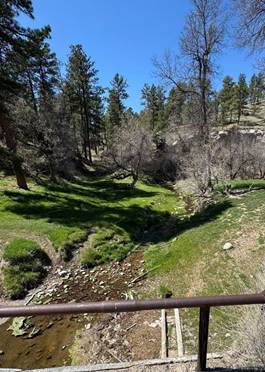
One of the sights I had heard about from the guys who had gone up the previous year was Sowbelly Canyon, just north of Harrison, Nebraska. I had no idea what to expect from a “canyon” in Nebraska; certainly nothing like Poudre River Canyon in Colorado where my wife’s family has a cabin. Poudre Canyon is about 50 miles long, and the Poudre River is relatively wide in the canyon. Sow Belly is unique in its own way and was surprisingly beautiful and “cool” in more ways than one. I wish my wife would have been able to come along on this trip.

As you’re driving west on US 20 toward Harrison, you see nothing but a bunch of gently rolling hills on either side of the highway. One would never expect a place of such beauty was just beyond those rolling hills. Even as you crest the top of the canyon, you see an amazing sight below: a single lane dirt road running under a canopy of trees, with unusual rock formations atop the buttes, some of which have formed at right angles. The descent is moderately steep, and at times you have a wall of the canyon on your right (descending) and your left (ascending). At the bottom of the canyon is a small, babbling brook that must have taken a few centuries to form the canyon.

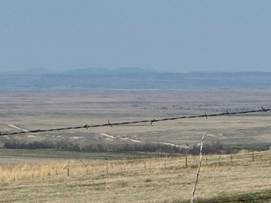
Just before you get to the end of Sowbelly Road on the east end (where it joins Pants Butte Road; no, I’m not making that name up), there’s a spot where you can see at least 80 miles to the north to the Black Hills in South Dakota (the dark mound in the far horizon). Something special happened between God and me via the Holy Spirit on that road, and especially with this particular view. I gained a whole new appreciation for the beauty, majesty, and grandeur of God’s creation. I’d expect something like that in Colorado; I never expected that in seemingly plain old northwestern Nebraska. Boy, was I wrong. What God had started teaching me in the Sandhills came to full fruition at the top of Sowbelly Road.

Part 4: Worldview, Wonder, and Wisdom

So let me bring this all together now. You might remember I started out talking about exegetical methods, methods that were heavily focused on the textual features like grammar, syntax, verb mood and tense, etc. Then it hit me: nothing in my exegetical method intentionally accounts for the majesty and glory of God and his creation. I knew I had to work that in somehow. But God still had one more piece to show me, and it hit me last night at our last small group of the season. Our senior pastor had been with us on this trip, but Sunday morning, one of the teaching pastors was preaching on the trauma Job experienced. I had tried to listen to it Sunday morning while driving through the remotest part of western Nebraska, but just couldn’t get a steady signal.

Fortunately, our Tuesday night group covered it in the study last night, and it was when we were talking about the ending of the book of Job that everything God had been teaching me finally made sense. Job had been arguing with God and his friends about how righteous he was and how he had always given God glory and so on, but God put him in his place. God recounts for Job all that He did by questioning Job: Did you lay the foundations of the earth? Did you create Leviathan and Behemoth? Who are you to tell me how I should act toward you?

That’s when I realized that I’m like Job in that moment. I think I have such a great exegetical method that will keep my doctrine sound and shred every stronghold that tries to set itself against God Almighty, but God’s word is more than the text and the grammar and verb moods and tenses and the participles and the conditional clauses. Those things are static, unchanging. But what does Hebrews 4:12 say? “For the word of God is alive and active. Sharper than any double-edged sword, it penetrates even to dividing soul and spirit, joints and marrow; it judges the thoughts and attitudes of the heart.”[1] Can grammar and syntax do that? I think not.

The other thing that occurred to me is the backstory of how the Jews would understand God’s word versus us gentile Christians. I’ll use just one example here: Communion, or as some call it, the Lord’s Supper or the Eucharist. When we look at the elements (“substantiational” leanings aside), we are meant to experience Christ in some way by “remembering” him. We see one man crucified and risen. But what do Jews remember at Passover? Not one man dying, but ALL the firstborn dying who weren’t protected by the blood of the lamb that they themselves applied to their doorways. They remember God parting the Red Sea so the Israelites could escape the oncoming Egyptians. The disciples didn’t understand immediately that Christ’s death had won them forgiveness and freedom. The Jews DID understand that immediately, with hearts pounding witnessing the very miracles of God at work to rescue them, even as they would tell the stories year after year to their descendants.

Conclusion

In other words, when I exegete and interpret Scripture, I need to look beyond the text and the grammar and all the other “in-the-weeds” details to comprehend a grand vision of a great God and all that he has done and made. That’s where the “draw closer” takes place, as it did for me this past weekend, when I understood who I am in God’s kingdom and that, in spite of his greatness and grandeur, he looks with love at the least of us, at the humblest of us, at our faithfulness. He looks with compassion at those who are lost and searching and even at those who may be angry with him or agnostic toward him, prompting us to share God’s “living and active” word with those who have not yet comprehended that greater vision.

From this point forward, then, I’m adding a couple permanent elements of my “principlizing bridge” (to use Grasping God’s Word’s language) will be to ask first, “How does this passage reveal the glory and majesty and mystery of God to the world?” and second, “How is this passage ‘alive and active’ not only to me but to those I encounter as well?” I feel like I drew a little closer to God this weekend. I pray that my testimony here will do the same for you.

Pastor Scott Stocking, M.Div.

All contents herein are the creative and intellectual property of this author unless otherwise attributed.


[1] The New International Version. 2011. Grand Rapids, MI: Zondervan.

March 23, 2025

Bearing Fruit…and the Cross (Luke 13:1–9; Psalm 63)

I preached this message on Sunday, March 23, 2025, at Mount View Presbyterian Church. I dealt with all four passages for the Lectionary for this Sunday.

Bearing Fruit…and the Cross

Lent is typically thought of in the Christian world as a time of sacrifice. Some people give up meat only to crowd into the numerous fish fries around town. Others might give up chocolate or coffee or caffeinated beverages or shopping or any number of other things that we might consider “vices” personally, but most of those things are not innately spiritual and may in fact make us a bit more difficult at times to live with if we haven’t had our morning cup of Joe. I’m teasing you a bit, of course. But if Lent is supposed to bring us some spiritual benefit, then shouldn’t we be giving up things that can damage our relationship with God? Why not give up greed, pride, selfishness, and other such things?

That seems to be the underlying theme behind our passages today. They might be summed up by John’s exhortation when he was preaching in the wilderness in Luke 3:8: “Produce fruit in keeping with repentance.” In other words, bear fruit while you’re bearing the cross. In our passage from Luke 13 this morning, Jesus seems to be addressing the thought that some had that bad things only happened to bad people. But the circumstances of our demise do not determine our eternal destiny. In spite of the untimely and unfortunate deaths of the Galileans and those in the tower of Siloam, Jesus says the important thing is to repent and be ready.

Jesus switches to talking about the fig tree that won’t bear fruit in the next few verses. The owner of the fig tree wants to cut it down because it’s unproductive. But the vineyard manager said “Give me another year and I’ll have it bearing fruit.” But the connection here with the previous verses and John’s statement about producing fruit in keeping with repentance is unmistakable. If we’re not bearing fruit, that could affect our salvation and our relationship with our Savior. Jesus said in Matthew 7:20: “By their fruit you will recognize them.”

Paul talks about the quality of our works in 1 Corinthians 3:12–15, but he doesn’t use the language of “fruit.”

12 If anyone builds on this foundation using gold, silver, costly stones, wood, hay or straw, 13 their work will be shown for what it is, because the Day will bring it to light. It will be revealed with fire, and the fire will test the quality of each person’s work. 14 If what has been built survives, the builder will receive a reward. 15 If it is burned up, the builder will suffer loss but yet will be saved—even though only as one escaping through the flames.[1]

God, being full of grace and mercy, leaves us a way out when we fall short. That’s what he accomplished through Jesus in his death on the cross and his resurrection from the dead. But instead of focusing on these warnings for the rest of my message this morning, I want to turn the focus around to the theme I mentioned earlier: How do we bear fruit while bearing the cross? That would have been my sermon title in the bulletin if I had remembered to click send on my e-mail to Judy!

I want us then to look at the other three passages from the lectionary today in addition to our gospel passage I touched on at the beginning. In Psalm 63, we’ll look at seeking God in worship. In Isaiah 55, we’ll look at seeking God for our wellbeing. And finally in 1 Corinthians 10, we’ll look at standing firm in our faith to recognize the way out of temptations that can drag us down.

Let’s look at Psalm 63. For a long time our country has been turning away from church attendance and, by implication, from God altogether. A trusted, unbiased Web site called Statista has this summary of church attendance: “According to a 2022 survey, 31 percent of Americans never attend church or synagogue, compared to 20 percent of Americans who attend every week. Despite only about a fifth of Americans attending church or synagogue on a weekly basis, almost 40 percent consider themselves to be very religious.” A 2024 survey by Gallup puts the number of weekly attenders at 20%, with another 9% at “almost every week.” On the flip side, 31% NEVER attend church or other religious service. We could talk about the reasons for this 24/7 for a week, but we’d probably never get anywhere. Psalm 63 tells us why this shouldn’t be, though.

We should be able to come to church to find God. Granted David, who wrote this psalm, had a special relationship with God that enabled and empowered him to be a great leader of his people, but this doesn’t mean that you and I don’t have access to this same relationship in the New Covenant era. David claims to have seen God’s power “in the sanctuary.” It’s not clear exactly what he “saw,” whether it was some physical manifestation of light, a divine presence, or if he’s using the word “see” to describe what he experienced in worship. Regardless, it was clear at least in David’s day, one of the best places to be to encounter God was the sanctuary in the Temple.

In the New Covenant era, God has given his Holy Spirit to each of us who believe. You don’t have to be a king or a prophet any more to have exclusive access to the Holy Spirit. When we come together to worship, to sing praises and hymns, to read God’s word and hear it explained in such a way that it’s relevant to our live and our situations, the Holy Spirit works among us to build and shepherd that unity we have in body of Christ. When we pray together as a congregation, we let God know that we still trust in him to work in our lives and provide for our needs while at the same time letting those whom we’re praying for know that we will support them however we can. When we come together as a worshipping community for projects and collection for the poor, we show and shower God’s love upon those who are truly in need.

But our worship doesn’t just happen in the church building. Verse implies that wherever David is at, he is earnestly seeking God. Later in vs. 6, he say he remembers God in his bed and while he’s keeping watch on the battlefield at night. He sings to God and he clings to God, knowing that God’s presence is always with him through the Holy Spirit. We have that same assurance. Jesus even promised that at his ascension: “I am with you always, even to the end of the age.” Seek God and you will find him, and as you draw closer to him, others will come to see him at work in your lives as well.

As we seek God, we can also know he will provide for our basic needs and do so generously. That is the message of Isaiah 55. Verses 1 & 2 go like this:

“Come, all you who are thirsty,

come to the waters;

and you who have no money,

come, buy and eat!

Come, buy wine and milk

without money and without cost.

Why spend money on what is not bread,

and your labor on what does not satisfy?

Listen, listen to me, and eat what is good,

and you will delight in the richest of fare. [2]

God wants to richly bless us. God’s goodness is genuine and original. God isn’t giving us yesterday’s leftovers. Jeremiah says “His compassions never fail. They are new every morning; great is your faithfulness!” (Lamentations 3:22b–23). Sometimes we spend a lot of effort and money pursuing things that don’t bring lasting or eternal satisfaction. God wants us to focus on him and what he provides for us. Later on in Isaiah 55, the prophet says this:

Seek the Lord while he may be found;

call on him while he is near.

Let the wicked forsake their ways

and the unrighteous their thoughts.

Let them turn to the Lord, and he will have mercy on them,

and to our God, for he will freely pardon.[3]

You heard in that passage the idea I suggested earlier about giving up the things that tempt us to turn from God. But Isaiah also says we need to get rid of the “stinkin’ thinkin’” as well. This is complete repentance: not just changing our behavior but changing our minds and our ways of thinking as well. That’s were the worship comes in from Psalm 63: setting our hearts on Christ.

One of my favorite passages occurs a few verses later in Isaiah 55:

My word that goes out from my mouth…

will not return to me empty,

but will accomplish what I desire

and achieve the purpose for which I sent it.

12 You will go out in joy

and be led forth in peace;[4]

I believe this is one of the greatest passages on evangelism. I love that it says God’s word accomplishes the purpose for which he sent it. When I was preaching early in my career, I was never in a church that followed the lectionary or the liturgical calendar. I could preach on what I wanted or I could pick out a theme or a particular book and prepare a sermon series.

But following the lectionary puts these two verses from Isaiah in a new light for me. Now I don’t know who decided on the three cycle of passages to read, but the lectionary is a “reading plan” adopted by many churches and denominations around the world, so it carries a lot of weight and, aside from the denominational differences and nuances that work their way into sermons on these passages, many churches are on the same page when it comes to what their congregations are presented with each Sunday. Because so many churches have agreed to use it, I believe it’s something that God honors. I think there’s something divine about the spiritual foresight those responsible for developing it, so I honor that.

Occasionally I’ll look at the passage for the day and wonder, “How am I going to preach on that?!” But I trust that there’s some component of God’s timing there, that is, some spiritual benefits he has in mind for sending out his word in this way, and I want to be faithful to communicate that in a way that’s relevant to you and my larger audience on the blog. I genuinely believe the lectionary is one way that God’s word gets from his mouth to our ears and that preachers who follow the lectionary are in many and diverse ways fulling the purposes for which God sends it out in that structure.

Finally, I want to look briefly at 1 Corinthians 10. Paul concludes in the first half of chapter 10 that that the written history of God’s people is intended for our encouragement and exhortation to faithfulness. Here’s what vv. 11–13 say:

11 These things happened to them as examples and were written down as warnings for us, on whom the culmination of the ages has come. 12 So, if you think you are standing firm, be careful that you don’t fall! 13 No temptation has overtaken you except what is common to mankind. And God is faithful; he will not let you be tempted beyond what you can bear. But when you are tempted, he will also provide a way out so that you can endure it.[5]

Paul warns us that we shouldn’t rest on our laurels. Faithfulness is an active, ongoing process in the life of the Christian. There is nothing passive about it. Continue seeking God in worship; continue reading his words to hide them in your heart. Continue loving your neighbor as yourself so they too can see the love of God. Continue putting on the armor of God each and every day so you can take your stand against the devil’s schemes.

May the power of the Holy Spirit go with you this week as you serve our Lord and Savior. Amen.


[1] The New International Version. 2011. Grand Rapids, MI: Zondervan.

[2] The New International Version. 2011. Grand Rapids, MI: Zondervan.

[3] The New International Version. 2011. Grand Rapids, MI: Zondervan.
[4] The New International Version. 2011. Grand Rapids, MI: Zondervan.
[5] The New International Version. 2011. Grand Rapids, MI: Zondervan.

March 16, 2025

Approaching the Cross (Psalm 27; Luke 13:31–35)

I presented this message on March 16, 2025, at Mount View Presbyterian Church in Omaha, Nebraska. In studying the two passages, I discovered several thematic connections between Psalm 27 and the central part of Luke’s gospel, especially from 9:51 through Christ’s triumphal entry into Jerusalem in Luke 19.

I had attended StoneBridge (my home church) for the worship part of their service before going to preach, and they did a version of St. Patrick’s Breastplate. I started my message with that this morning (the 15 lines toward the end of the longer prayer).

May the Lord be with you.

Have you ever thought about how you read certain types of literature? If you’re reading a fictional novel, or perhaps a true historical account of real event or someone’s life, it’s probably best to start at the beginning and read through to the end. It’s important to have all the details of the story because some of those details will be important throughout or later in the book. If you’re reading a history book or a historical biography, you may want to focus on a certain topic or certain era covered in the book to get the specific information you’re looking for, but you might miss some important background information that gives more context to events of that period. When you read a newspaper, you look for the headlines that interest you. If you’re looking for a specific answer on something like “How do I change a tire,” “Where do the Sandhill Cranes migrate to,” or “How do I calculate the area of a circle,” you typically wouldn’t have to read an entire reference book relevant to the subject. You’d go to the index or table of contents and look up where to find the information you’re looking for.

The Bible is sort of all these types of literature wrapped up in one collection that contains all these things, from the fictional, but true-to-life parables to the priestly “Chronicles” of the kings to the history of the patriarchs and the gospels, right up to the fantastical imagery of Revelation. Because of this, it’s important that we don’t lock ourselves into one way of reading the Bible. While it’s good to sit down and read large sections of the Bible in one sitting from time to time, we can still miss “the big picture” if we don’t understand or know the historical setting in which it was written.

Even when you read the gospels, if you have a Bible with footnotes, you’ll see that there are all sorts of references to passages in both the Old and New Testament where the gospel writer is either quoting the Old Testament or the editor perceives a connection to another New Testament author’s writings. That’s something you don’t typically get in a fictional novel, but would be helpful, I think.

Our two passages today, Psalm 27[1] and Luke 13, have a thematic connection, but it’s important to recognize that this connection compels us to look at the larger context of Luke’s gospel. Luke 13 is a little more than halfway through Luke’s 24-chapter gospel, but more importantly for our purposes, it’s about halfway between Luke 9:51 and Luke 19:28, which is the beginning of the story of Jesus’s triumphal entry into Jerusalem. Why is 9:51 an important marker? Luke says this: “As the time approached for him to be taken up to heaven, Jesus resolutely set out for Jerusalem.”[2] Luke isn’t even halfway through his gospel and he’s already talking about Jesus getting ready for the cross!

Luke frames the rest of his gospel from 9:51 on in the context of Jesus approaching the cross and preparing himself and his disciples for the implications of that seminal event. In fact, the footnote on this verse in my NIV Bible lists the references to this in the story line along the way: Luke 13:22, 17:11, 18:31, and 19:28.

So let’s take a look at the thematic comparisons between Luke and Psalm 27. Psalm 27:1 is the initial confidence builder for David as he pens this psalm: The Lord is his light, his salvation, and his stronghold, so David has nothing to fear as he leads his people. This confidence is paralleled in Luke 9:51 with his statement that Jesus “resolutely” set out for Jerusalem. The phrase here literally means to “set your face” (or by extension, “set your eyes”) upon Jerusalem. This ties in with Psalm 27:4 as well, when David speaks of dwelling in the house of the Lord and gazing on his beauty in the temple. The temple, of course, was in Jerusalem. In today’s gospel passage, Jesus seems to hint that he’s only three days away from Jerusalem and needs to press on.

In Psalm 27:2–3, David says that in spite of his enemies advancing against him, he will remain confident of the Lord’s help. As Jesus journeys toward Jerusalem in Luke, he encounters his own opposition along the way. In 9:53, the Samaritan village he was near wanted nothing to do with him because he was headed for Jerusalem. In chapter 11, we see opposition from the pharisees and experts in the law as he’s working miracles and teaching about the kingdom. By the end of chapter 11, Luke says this after delivering a list of “woes” to his critics: “53 When Jesus went outside, the Pharisees and the teachers of the law began to oppose him fiercely and to besiege him with questions, 54 waiting to catch him in something he might say.”[3] No love lost there between Jesus and that group of elitists.

Just like David, though, Jesus’s confidence doesn’t wane. He continues on his journey gathering an ever-larger following warning them about the opposition they themselves would face for being his followers and encouraging them to be ready when his time does come. In chapter 13, he faces opposition from a synagogue leader who is upset because Jesus healed someone on the Sabbath! Imagine that! In our passage this morning, the Pharisees seem to think they’re doing Jesus a favor by telling him to leave the region because Herod wants to kill him. But Jesus presses on, even with a bit of sarcasm, or so it seems, when he says in so many words that Jerusalem is the only place for a prophet to die.

The rest of Luke up to the point where he reaches Jerusalem gives us several more examples of this opposition, but we can save that for another time. I mentioned earlier about Psalm 27:4–5 hinting at the importance of temple. For Jesus, the temple was the true home of his family: after all, it was his father’s house. If he knows he’s going to die, he wants to be as close to his family home as possible. His statement in Luke 13:35 about “Blessed is he who comes in the name of the Lord” looks forward to his triumphal entry into Jerusalem. I believe Jesus takes a sense of pride and ownership in the temple, even though it is a structure made by human hands.

We saw after Christmas how Jesus as a boy stayed at the temple and impressed the religious leaders with his knowledge of and wisdom about God’s law. His first order of business after arriving in Jerusalem at the end of Luke 19 is to clear out the corruption in his father’s house. Even as he knew this would be one of his last weeks to experience the earthly temple, he wanted to leave it in better condition than he found it by restoring it to a place of prayer and genuine worship. He knew he would be the sacrificial lamb, and there would be no more need to sell lambs and birds in the temple for the sacrifices. It would be restored to a purer state. In the book of Acts, we see that his followers have been meeting regularly at the temple since his crucifixion, and it is there that the church is born on the day of Pentecost. That was the “Garden of Eden” for Christ followers.

The last half of Psalm 27 is one of David’s most heartfelt prayers for protection against his enemies and for the security of God’s presence with and acceptance of David as his chosen ruler for God’s people. Jesus taught his disciples to pray in Luke 11, the shorter version of the Lord’s prayer. In that prayer, we hear some of the same themes of praise, provision, and forgiveness. He understands the goodness of God’s provision.

But we also hear in that Psalm the foreshadowing of the cross. In verse 12, David asks not to be turned over to his enemies, which sounds very much like Jesus’s plea in the Garden of Gethsemane to have the cup of suffering removed from him. David’s pleas in verse 9 sound very much like Jesus’s words on the cross, “Why have you forsaken me?” Those words come from Psalm 22, where many of the aspects of Jesus’s crucifixion are foretold.

Just as David in the last two verses of Psalm 27 affirms his confidence in the goodness of the Lord and can encourage the worshipers to “be strong and take heart,” so Jesus has confidence in his dying moments to selflessly tell the thief on the cross that he too will join him in paradise when they die. I don’t believe that David intended Psalm 27 to be a messianic psalm, nor do I think Luke intended the central part of his gospel to mirror the themes of Psalm 27, but the parallels are striking and certainly worth noting.

But these parallels are academic. What does all this mean for you and me as we walk with our savior?

First, when we run up against roadblocks or challenges to our faith or we find that doubts are creeping in, we can remain confident that our light, our stronghold, surrounds us with his protection. We need not fear or doubt, but if we wait on the Lord and strengthen our hearts by abiding in God’s word, we can be confident we will see the goodness of the Lord, just as David was. We can walk in the victory of the cross in the overcoming resurrection of our savior.

Second, we can heed the exhortation of Hebrews 10:19–25, which sums up these three themes concisely:

19 Therefore, brothers and sisters, since we have confidence to enter the Most Holy Place by the blood of Jesus, 20 by a new and living way opened for us through the curtain, that is, his body, 21 and since we have a great priest over the house of God, 22 let us draw near to God with a sincere heart and with the full assurance that faith brings, having our hearts sprinkled to cleanse us from a guilty conscience and having our bodies washed with pure water. 23 Let us hold unswervingly to the hope we profess, for he who promised is faithful. 24 And let us consider how we may spur one another on toward love and good deeds, 25 not giving up meeting together, as some are in the habit of doing, but encouraging one another—and all the more as you see the Day approaching.[4]

Worshiping together as a church family, whether we’re a family of 20 or 200 or 2,000, provides a powerful sense of belonging to each of us. We know we have a place to call our spiritual home, just as Jesus considered the temple his spiritual home. We can feel safe here with one another.

Finally, the power of praying together as a church family cannot be overstated. Our prayers, whether in our own closets at home or corporately in our liturgy here, keep us connected to and in constant communication with our heavenly father. We can be assured that he hears us and works to respond to our prayers according to his will and his love for us.

As we go through this Lenten season, let us not forget the forgiveness we have from God and not forget to offer forgiveness and grace to those who need to hear that message. Peace to all of you. Amen.

Pastor Scott Stocking, M.Div.


[1] Psalm 27 parallels Psalm 31 with similar themes. Psalm 31 will figure prominently in the Lectionary beginning the Sunday before Palm Sunday next month.

[2] The New International Version. 2011. Grand Rapids, MI: Zondervan.

[3] The New International Version. 2011. Grand Rapids, MI: Zondervan.

[4] The New International Version. 2011. Grand Rapids, MI: Zondervan.

February 23, 2025

Family Feud: Joseph Forgives His Brothers (Genesis 45)

The Lord be with you.

I’m not looking for a show of hands here, but I want you to think about this for a moment: How many of you can say you have an enemy? Now for myself, I can’t imagine that anyone in this congregation has an enemy, but then, I don’t know everything about your lives or what struggles or challenges you all have overcome throughout your life on God’s green earth. If you have an enemy, do you remember how they became your enemy?

I have had enemies in my life. The usual way I’ve made an enemy is that I’ve spoken an uncomfortable truth to someone and they haven’t wanted to accept it. When I lived in Paxton, Illinois, a local businessman wanted to start what he called a “Raffle House.” We had had issues a few years prior to that with a native American tribe trying to reclaim some land outside the town for a casino. The community successfully rebuffed it, in part because they were able to demonstrate there was very little evidence that the tribe had legitimate historical claim to the area. Because of that opposition, I figured there was still some fire left in the community to oppose a gambling operation in our conservative little town.

To make a long story short (A Tale of Two Photos), I discovered he was essentially offering a Bingo game without a State license to play Bingo and in the process skirting the 5% tax on Bingo required by State law, so I tattled on him in a letter to the editor. The Raffle House only lasted about 8 months before it went belly-up. A few months later, I received a tip from the owner’s disgruntled ex wife (or so it seemed) about a similar operation one of his relatives was running in the large college town 25 miles down the road. I reported it to the police there, and they shut it down almost immediately. The Raffle House owner wound up getting me fired from the church I was serving at the time because he had given money to the church, which he never attended, and demanded I recant. I didn’t recant, so I quit.

I don’t think that guy ever forgave me for the grief I caused him. But I forgave him. In fact, the experience I gained in researching the laws and regulations regarding that story helped land me my first full-time job after I moved back to Omaha a few years later. Did I “love” my enemy by confronting him? I’d had no interaction or relationship with him prior to all this coming up, but I’d heard a lot of things about his character, and very little was positive. Was I doing good to him by warning him about the State laws he seemed to be violating?

The Bible speaks of many different kinds of enemies and different ways we can respond to them. Our enemies can come from anywhere and can range from those who don’t know us at all to members of our own family (Matthew 10:36). They can be people who hate or dislike you for any number of reasons, including your gender or your skin color. They could be people to whom we speak uncomfortable or challenging truths (Galatians 4:16).

The gospel writers love to cite Psalm 110:1:

“ ‘The Lord said to my Lord:

“Sit at my right hand

until I put your enemies

under your feet.” ’[1]

This of course is one of the more prominent messianic psalms about Jesus being victorious over his “enemies.” Many Jews in the time of Jesus saw that as a promise that the Messiah would overthrow Roman rule, but God had a different idea. The enemies God had in mind were the Jewish leaders who had imposed a bunch of legalistic requirements on the Jews that weren’t necessary for salvation.

Paul says in his discussion of the resurrection in 1 Corinthians 15 says that Christ “must reign until he has put all his enemies under his feet. 26 The last enemy to be destroyed is death.”[2] So we’ll never really be free of our ultimate enemy, death, until Christ is victorious at the consummation of history.

The New Testament speaks quite a bit about how to deal with our enemies. “Resist the devil and he will flee from you.” “Turn the other cheek,” which in that culture meant don’t give your enemy the opportunity to continue to pummel you unless he wants to disgrace himself. “Carry the soldier’s pack a second mile,” which would by default bring shame upon the soldier. “Lend without expecting anything back.”

I could say much more about what the Bible says about our enemies, but I think we could probably learn a little more dealing with enemies if we take a look at the story of man who had enemies within his own family as well as at the highest levels of the Egyptian government. I’m speaking, of course, about Joseph. Genesis 45:1–15 tells the story about Joseph reconciling with his brothers, and I want to read that first here. But I will go back and highlight some of the other events of his life that reveal how he responded to having and rediscovering his enemies.

Then Joseph could no longer control himself before all his attendants, and he cried out, “Have everyone leave my presence!” So there was no one with Joseph when he made himself known to his brothers. And he wept so loudly that the Egyptians heard him, and Pharaoh’s household heard about it.

Joseph said to his brothers, “I am Joseph! Is my father still living?” But his brothers were not able to answer him, because they were terrified at his presence.

Then Joseph said to his brothers, “Come close to me.” When they had done so, he said, “I am your brother Joseph, the one you sold into Egypt! And now, do not be distressed and do not be angry with yourselves for selling me here, because it was to save lives that God sent me ahead of you. For two years now there has been famine in the land, and for the next five years there will be no plowing and reaping. But God sent me ahead of you to preserve for you a remnant on earth and to save your lives by a great deliverance. w

“So then, it was not you who sent me here, but God. He made me father to Pharaoh, lord of his entire household and ruler of all Egypt. Now hurry back to my father and say to him, ‘This is what your son Joseph says: God has made me lord of all Egypt. Come down to me; don’t delay. 10 You shall live in the region of Goshen and be near me—you, your children and grandchildren, your flocks and herds, and all you have. 11 I will provide for you there, because five years of famine are still to come. Otherwise you and your household and all who belong to you will become destitute.’

12 “You can see for yourselves, and so can my brother Benjamin, that it is really I who am speaking to you. 13 Tell my father about all the honor accorded me in Egypt and about everything you have seen. And bring my father down here quickly.”

14 Then he threw his arms around his brother Benjamin and wept, and Benjamin embraced him, weeping. 15 And he kissed all his brothers and wept over them. Afterward his brothers talked with him.[3]

Those of you who know the story of Joseph, or who have seen Andrew Lloyd Webber’s Joseph and the Amazing Technicolor Dreamcoat, know how Joseph, the first born of Jacob’s first love, Rachel, was his favorite son and had received “a coat of many colors,” or as more recent translations put it, a “richly ornamented” (NIV 1984) or “ornate” (NIV 2011) coat, or as the NRSV puts it, “a long robe with sleeves,” which doesn’t sound nearly as exciting as the other descriptions. The point is it was a special coat that made his brothers extremely jealous. As the apple of Jacob’s eye, Joseph (17 years old at the time) had earned the ire of all his brothers. Not a very good way to enter adulthood!

Add to that his dreams that his whole family, including his father, would one day bow down to him, and it’s not hard to understand the intense jealousy toward him. Although it’s not biblical text, I think the line Joseph’s brothers sing in “Joseph’s Coat” from the musical captures their jealousy quite nicely: “Being told we’re also-rans/does not make us Joseph’s fans.” From that point on, they had it in for Joseph. So they did what any jealous brothers would do: they overpowered him, faked his death, and sold him to some nomadic Ishmaelites, who in turn sold him into slavery in Egypt. That haunted the brothers for the rest of story.

But Joseph, having escaped the enmity of his brothers, found himself as a favorite slave in the house of Potiphar, the captain of the Egyptian guard. However, even in that position, he had an “enemy” in Potiphar’s wife, who repeatedly attempted to seduce him. That eventually cost him his lofty position and landed him in jail. He probably could have been executed on the spot for such things, but I think Potiphar knew the character of his wife and needless to say, he didn’t think too highly of her. My guess is Potiphar knew Joseph hadn’t done anything wrong, but to save face publicly, he had to punish him.

Joseph found himself interpreting the dreams of two other officials of pharaoh, one being favorable and the other proving fatal, and the beneficiary of the favorable interpretation eventually remembered Joseph could interpret dreams and might be able to interpret a couple dreams pharaoh had dreamed. Joseph’s interpretation made sense to pharaoh, so pharaoh made him second in charge of Egypt. That essentially neutralized any of Joseph’s remaining enemies, if there were any left. Nine years later, two years into the famine, Joseph found himself with the perfect opportunity to get revenge on his brothers when they came to Egypt looking for food.

Most of you will remember that Joseph immediately recognized his brothers at this point, but they didn’t have a clue they were looking at their younger brother. So, like any good brother who’d been victimized by the rest of his brothers, he decided to play some head games with them to make them feel some pain. He had to be careful, though, because he was questioning his brothers closely about their intentions and accused them of being spies. They eventually “bought” some grain but had to leave one of their brothers in Joseph’s custody while they went back to Judah to get their youngest brother, Benjamin, whom Joseph may not have known.

The brothers went back to Judah to get Benjamin and discovered all their silver had been returned to them. Not sure how they missed THAT on the long trip. When they returned to Egypt a second time, Joseph kept at it with the mind games by seating his brothers from oldest to youngest and giving Benjamin five times the portions everyone else had.

That brings us to chapter 45. In spite of the fun Joseph must have been having playing these mind games with his brothers, he found he still loved all his brothers and broke down crying in a separate chamber. When he had composed himself, he returned to the dinner table and revealed himself to his brothers. Talk about being blindsided!!!

From this very real story then, what can we learn about dealing with anger or dealing with our enemies? [See also Psalm 37, which was read in the service before the message.] First, Joseph seemed to take much of this in stride. Never once do we read anything in the last fourth of Genesis about Joseph complaining about having been sold into slavery or wrongly accused of crimes against Potiphar’s wife. He knew what his own dreams meant and perhaps even when he was on the right path to fulfill those dreams, so he persevered through the worst conditions.

Second, and related to the first, Joseph never seemed to let anger get the best of him. When others in Joseph’s position found themselves faced with unfairness, they may not have endured with such patience and grace. His cool head landed him in the #2 spot in Egypt, where his dreams finally came through: his father and brothers had to bow down to him to get the food they needed to survive. He trusted God to get him through to the fulfillment of those dreams.

Finally, he made a generous offer to his brothers and their now-large families: they could live in the land of Goshen during the famine so they wouldn’t have to make the longer trips from Judah. You and I may not have land-a-plenty to give away, but we can usually find a way to provide some small gift. There’s nothing wrong with a peace offering, especially if you know it would be accepted and there’s been a genuine attempt at reconciliation.

So what is the way to love your enemies? If you’re not a police officer arresting someone or a mama bear safeguarding her children, maybe you can try killing them with kindness. If God’s kindness leads us to repentance; if God can be kind to the ungrateful and wicked, then I think we can find a way to respond similarly when faced with the actions of our enemies. Kindness and love are always appropriate, and I learned even this past week just how important that is for maintaining peace. But that’s a story for later time. Grace and peace to you. Amen.


[1] The New International Version. 2011. Grand Rapids, MI: Zondervan.

[2] The New International Version. 2011. Grand Rapids, MI: Zondervan.

[3] The New International Version. 2011. Grand Rapids, MI: Zondervan.

January 19, 2025

The Abundance of God’s Gifts (Psalm 36:5–10)

Good morning and happy new year! The Lord be with you! The big question of the morning is, “How are you doing at keeping your New Year’s resolutions?” Whatever resolutions you made, I do hope that one of them was drawing closer to God. Advent, Christmas, and Epiphany give those of us who are Christ-followers a unique opportunity to reflect on why the Savior came to earth to be a living testimony of how one can live for God in a fallen world. Our Psalms passage today, Psalm 36:5–10, gives us the upbeat side of our relationship with God. Let’s hear it again:

Your love, Lord, reaches to the heavens,

your faithfulness to the skies.

Your righteousness is like the highest mountains,

your justice like the great deep.

You, Lord, preserve both people and animals.

How priceless is your unfailing love, O God!

People take refuge in the shadow of your wings.

They feast on the abundance of your house;

you give them drink from your river of delights.

For with you is the fountain of life;

in your light we see light.

10 Continue your love to those who know you,

your righteousness to the upright in heart.

11 May the foot of the proud not come against me,

nor the hand of the wicked drive me away.

12 See how the evildoers lie fallen—

thrown down, not able to rise![1]

Before I get into talking about the positive stuff in Psalm 36, I think it’s important to place this psalm in the context of the psalms around it. Psalm 36 is in the middle of four psalms that were grouped together with a similar theme, Psalms 34–37. I don’t think anyone knows for sure why these psalms are grouped, but the introduction to Psalm 34 says David wrote it “When he pretended to be insane before Abimelek, who drove him away, and he left.”[2] It’s possible these four psalms may refer to that event in David’s life.

Psalms 34 and 37 are both acrostic psalms, that is, each verse begins with a successive letter of the Hebrew alphabet. Acrostics tend to make things easier to memorize. This makes a nice little set of bookends for this group. These two psalms “contain wisdom-like instruction in godliness and related warnings concerning the fate of the wicked—instruction and warnings that reinforce the key themes” of the middle two “prayer” psalms, 35 and 36.[3]

Psalm 36 begins with a warning to the wicked, setting the context for the prayer that we read above:

I have a message from God in my heart

concerning the sinfulness of the wicked: s

There is no fear of God

before their eyes.

In their own eyes they flatter themselves

too much to detect or hate their sin.

The words of their mouths are wicked and deceitful;

they fail to act wisely or do good.

Even on their beds they plot evil;

they commit themselves to a sinful course

and do not reject what is wrong. [4]

Examples of the warnings from Psalm 34 and 37 are plentiful, but I’ll give a few examples here that are relevant to our passage today. One of the promises from 34:15–16 says this, which is what prompts the boldness of the prayers that follow:

15 The eyes of the Lord are on the righteous,

and his ears are attentive to their cry;

16 but the face of the Lord is against those who do evil,

to blot out their name from the earth. [5]

The remainder of Psalm 34 goes on to speak of how the Lord will hear the righteous when they cry out in prayer; deliver the righteous from their oppressors and their troubles; and spare them from the ultimate condemnation reserved for the wicked.

In Psalm 35, David opens with a prayer to the Lord to fight against his enemies, making it personal to his own situation. In a culture that values honor, David understands the impact of the additional humiliation he wants his enemies to suffer. “May those who seek my life be disgraced and put to shame” (vs. 4). In vs. 26, David repeats his prayer: “May all who gloat over my distress be put to shame and confusion; may all who exalt themselves over me be clothed with shame and disgrace.”[6]

It’s not enough to just win a battle; David wants to win so handily that his enemies will be a fleeting memory to the surrounding nations. This not only will affect their reputation, but their economic security as well, as nations would be less likely to trade with a “shamed” nation.

In Psalm 37, David reassures the worshippers that these wicked will in fact be brought down and made irrelevant:

12 The wicked plot against the righteous

and gnash their teeth at them;

13 but the Lord laughs at the wicked,

for he knows their day is coming. [7]

But enough about the bad news for the wicked and those who have no regard for God. Let’s look at some of the positives these four chapters of Psalms have to offer. The passage we read at the beginning today focuses on God’s love, God’s provision, and God’s righteousness.

In this Psalm, David’s words tell us several things about God’s love and the other gifts he gives us. First, we see that God’s love is infinite and everywhere present, just like the sky. We see it all around us and yet we can never fully comprehend the extent of his love.

Paul’s instruction about love in 1 Corinthians 13 reflects the depths of God’s love as well. We could go to the highest mountain or even farther than that to where the Psalmist says God’s love reaches, but if we don’t grasp that love for ourselves and to share with others, we are nothing. Psalm 34 opens with David expressing his love for God in the form of praise: “I will extol the Lord at all times; his praise will always be on my lips.”[8]

God’s love is so reliable and so real that David can assure the worshippers that they can “take refuge in the shadow of [his] wings.” That “refuge” is mentioned several times in the context of Psalms 34–37 and indeed throughout the Psalms. Psalm 34:8 says, “Taste and see that the Lord is good; blessed is the one who takes refuge in him.”[9]  Verse 22 affirms this: “The Lord will rescue his servants; no one who takes refuge in him will be condemned.”[10]

Second, God has given us great gifts as we walk through a fallen world that often cannot understand the reason for our hope. His provision is boundless. David says that we will feast on the abundance of God’s house and that God gives us access to the “fountain of life” (36:8, 9). Psalm 34:9–10 says:

Fear the Lord, you his holy people,

for those who fear him lack nothing.

10 The lions may grow weak and hungry,

but those who seek the Lord lack no good thing.[11]

I mentioned 1 Corinthians 13 above. The other NT passage from the lectionary today is 1 Corinthians 12 about the gifts of the Spirit. God shows his love to us by empowering us through the Holy Spirit. Jesus promised in John 14 that if he went away, he would send another advocate, the Holy Spirit, and Paul explains in 1 Corinthians 12 how that works. The Spirit provides us with one or more of the gifts mentioned: word of wisdom, word of knowledge, healing, prophecy, discernment, and so forth. It would be rare for any one Christian to have them all, which is one reason why we gather as a body. As Ephesians 1 says, we are “blessed in the heavenly realms with every spiritual blessing in Christ.” This is body-of-Christ talk, not individual-believer talk. And while we’re in Ephesians, let’s not forget about God’s armor that he makes available to us so “we can take our stand against the devil’s schemes.”

God’s love and provision for and gifting of us is truly amazing. But we cannot forget that God’s righteousness and justice are of the highest standards and are deeply rooted and incorruptible in the depths of the earth. “Your righteousness is like the highest mountains, your justice like the great deep” (36:6). “Vindicate me in your righteousness” says David in Psalm 35:24. A few verses later (v. 28), David concludes that Psalm with “My tongue will proclaim your righteousness, your praises all day long.” In 37:5–6, if we commit to and trust in the Lord, “He will make [our] righteous reward shine like the dawn, [our] vindication like the noonday sun.”[12]

I think a fitting close to this message is the last two verses of Psalm 37, and I think they speak for themselves:

39 The salvation of the righteous comes from the Lord;

he is their stronghold in time of trouble.

40 The Lord helps them and delivers them;

he delivers them from the wicked and saves them,

because they take refuge in him. [13]

Peace to you. Amen.

Pastor Scott Stocking, M.Div.


[1] The New International Version. 2011. Grand Rapids, MI: Zondervan.

[2] The New International Version. 2011. Grand Rapids, MI: Zondervan.

[3] Barker, Kenneth, gen. ed. The NIV Study Bible (2011 edition; commentary note on “Ps 34–37,” p. 891). Grand Rapids, MI: Zondervan

[4] The New International Version. 2011. Grand Rapids, MI: Zondervan.

[5] The New International Version. 2011. Grand Rapids, MI: Zondervan.

[6] The New International Version. 2011. Grand Rapids, MI: Zondervan.

[7] The New International Version. 2011. Grand Rapids, MI: Zondervan.

[8] The New International Version. 2011. Grand Rapids, MI: Zondervan.

[9] The New International Version. 2011. Grand Rapids, MI: Zondervan.

[10] The New International Version. 2011. Grand Rapids, MI: Zondervan.

[11] The New International Version. 2011. Grand Rapids, MI: Zondervan.

[12] The New International Version. 2011. Grand Rapids, MI: Zondervan.

[13] The New International Version. 2011. Grand Rapids, MI: Zondervan.

November 25, 2024

Don’t Worry; Be Faithful (Matthew 6:25–34; Acts 22:23–29)

America is one of the wealthiest countries in the world. Even in the last four years with inflation being what it’s been, the COVID pandemic and our faltering response to it, and the culture wars that have divided our nation, there really is no other place to go where we could have the guarantees of freedom in our Constitution to give us hope to overcome bad times and look forward to even better times and to renewed prosperity.

America is really the best place to live, I think anyway, where we don’t have to spend much time “worrying about our lives, what we will eat or drink, or about our bodies and what to wear.” Even the poorest among us have access to safety nets to provide basic needs like health care, affordable shelter, and food. It is true, as Jesus said, that we will always have the poor among us. Some either by their own choice or by circumstances beyond their control, may find themselves in desperate need from time to time.

Our governments, both federal and local should be good stewards of the “resources” we “contribute” to address these situations and other affairs of City and State. Sometimes that works, and I think most of us can agree that sometimes the greedy get in the way and misappropriate these resources. When that happens, people rightly get angry and demand accountability. We have charities and churches working hard to mitigate and alleviate these situations, and they often do much better than the government.

Even with the presumed good intentions of the government and ministries of churches and charities alike, I do hope we realize that these earthly institutions are fallible because they comprise fallible, fallen humans in their ranks. But on this Sunday, Christ the King Sunday, the last Sunday of the liturgical year (can you believe Advent starts next week!), I hope we recognize that the only one in whom we can put our unfailing trust is God Almighty, the heavenly father, who has as much concern for “the least of these” as he does for all the rest.

When we look at God’s amazing creation, we see that the birds and the bees and the flowers and the trees all manage to survive from one year to the next and they don’t have near the intelligence that you and I have. We recognize the beauty of the works of God’s creation in nature; awe at the way the complex interactions of our ecosystems work in harmony most of the time; and marvel at the complexity of the design of each unique, tangible human body along with the capacities of its intangible mind and soul. And yet Jesus says that “Solomon in all his splendor was dressed like one of these” and that we cannot “add a single hour to our lives” by worrying or counting how we might feed and clothe ourselves.

Jesus closes out this passage by saying, in so many words, take things one day at a time. Don’t worry about tomorrow, tomorrow will come soon enough. Jesus makes a promise that many of us have taken to heart: “Seek first his kingdom and his righteousness, and all these things will be given to you as well.” In other words, “Don’t Worry, Be Faithful.” Sorry, I haven’t written the words to that spoof song yet.

As I said above, we who live in America typically don’t have to worry about persecution coming from our government, although there have been some well-publicized exceptions to that targeting Catholics in the past few years. But in other countries around the world, many Christians do have to be concerned about such things.

My friend shared a newsletter from C2CMinistries, based in Hong Kong, that tells the inside story, the story you won’t get from typical media outlets, about the recent news out of Hong Kong about the sentencing of the Hong Kong 47, a group of pro-democracy advocates tried for sedition because they attempted to gain a pro-democracy majority on the legislative council in Hong Kong, something that had been allowed until the Communist Chinese forcibly altered Hong Kong’s “Basic Law” to prohibit such actions. Many of them have been in jail for nearly four years now.

But a couple interesting stories have come out of this persecution (and prosecution) that should make those of us in the free world sit up and notice and lift up prayers for the Chinese, and especially for these 47 prisoners. According to the mission’s newsletter:

One of them, an evangelist, has been faithfully preaching the Gospel every Sunday from his prison cell for the past three years. His courage is a profound reminder of the cost of faith in places where freedom is restricted. This also highlights the reality that Hong Kong is now fully under the control of China’s Communist Party leadership. How long before Hong Kong churches may face the same restrictions as those in China, potentially being forced to join the state-controlled Three-Self Patriotic Movement or go underground?[1]

This month’s newsletter from the ministry has other stories of the bravery of Chinese Christians not publicly affiliated with the pro-democracy movement who meet together for worship even in the face of close and contentious scrutiny from Chinese political and law-enforcement authorities. These believers are keenly aware of the promises of this morning’s gospel passage and trust God daily not to become victims of Chinese suppression.

Given these two stark contrasts between the relative ease we American believers have of gathering to worship and to freely speak versus the suppression and oppression of Chinese believers, this raises an important question for believers we don’t often discuss: “What does the Bible say about believers’ relationship with government?” How should we as Christ-followers live our lives whether in a relative state of freedom or facing oppression? On this Sunday, since we’ve got a patriotic theme today, I think it’s a good time to talk about this.

But first, just a brief history of the political situation in the Bible. We know that in the OT, much of the history of the Jews revolves around the monarchy that began under Saul and lasted over 400 years until the exile to Babylon in 586 B.C. After the exile, when they returned to the land, they seem to have been governed by religious leaders or governors for a time, until the OT goes silent around 400 B.C. We know Alexander the Great conquered the area late in the fourth century B.C., and controlled it until the Roman Republic conquered it in the second century B.C. By the time Jesus is born, the Roman republic had devolved into a monarchy with a perfunctory senate, and that is the government that rules Rome during the time of Jesus and the historical period covered by the New Testament.

Rome respected the Jewish religion and their independence. Herod, descended from the Jewish Maccabean family, was the regional King for Judea, but he was considered a Roman puppet. Rome’s primary concern was maintaining order and peace in the empire, so they typically had a hands-off approach when it came to the Jews, unless they sensed unrest among the masses. At the worst, it was a tentative peace, but we see signs in the gospels that some were looking for the Messiah to overthrow Roman rule and return them the glory days of the Davidic monarchy.

When it comes to how we should interact with government, then, I find it interesting that, in spite of the prevailing attitudes of the Jews toward Roman rule, Jesus never once says anything bad about the Roman government or about the way it operated in Judea and Galilee. In fact, in Luke 20:25, Jesus says “Give back to Caesar what is Caesar’s, and to God what is God’s.”[2] Yet the mob that would have him crucified three chapters later accuses him of opposing the payment of taxes to Caesar. When Jesus stands before Pilate, he asks him if he’s the king of the Jews, and Jesus replies: “You have said so,” perhaps acknowledging (in a snarky way) that Pilate has the authority to proclaim him as such.

We’ll come back to Acts in a moment, but I first want to look at Romans 13, where Paul gives the clearest explanation of the what the believers’ relationship with government should be:


Paul used his natural-born citizen status to his advantage! He knew that Roman citizens had certain privileges and rights when it came to potential criminal charges, and the soldiers themselves seemed fearful that they had almost flogged a Roman citizen. I wonder if our political officials truly fear the citizenry and the power of our voices and our votes?


Let everyone be subject to the governing authorities, for there is no authority except that which God has established. The authorities that exist have been established by God. Consequently, whoever rebels against the authority is rebelling against what God has instituted, and those who do so will bring judgment on themselves. For rulers hold no terror for those who do right, but for those who do wrong. Do you want to be free from fear of the one in authority? Then do what is right and you will be commended. For the one in authority is God’s servant for your good. But if you do wrong, be afraid, for rulers do not bear the sword for no reason. They are God’s servants, agents of wrath to bring punishment on the wrongdoer. Therefore, it is necessary to submit to the authorities, not only because of possible punishment but also as a matter of conscience.

This is also why you pay taxes, for the authorities are God’s servants, who give their full time to governing. Give to everyone what you owe them: If you owe taxes, pay taxes; if revenue, then revenue; if respect, then respect; if honor, then honor. [3]

Although Paul was speaking under a monarchy, his exhortation here seems to apply generally regardless of the form of government. Greece had democracies prior to Roman rule, but they were quite different from our democracies today. In our times, each State is a “laboratory” of democracy, as Supreme Court Justice Louis Brandeis said in a 1932 decision. Our federal government is organized as a republic comprising the 50 democracies we call “States.” As citizens of a democracy, then, under a federal constitution that gives us significant personal freedoms, we have the right to speak, act, and vote to contribute to the good of the democracy. We should feel free to get involved at any level, if we’re so inclined. That could mean anything from speaking at or serving on a local governing board (city, school, planning, etc.) to working for the government in a civil position to serving as a State or U.S. Representative or Senator.

Most of us probably learned that our three branches of government serve as “checks and balances” so that no one branch of government gains too much power or influence. But our involvement in various levels of government, whether as citizens, public servants, or governing officials, can serve as a fourth means of checks and balances, especially if we’re not afraid to bring our Christian values to the table when appropriate.

Paul seems to have understood this in the book of Acts when he faces arrest and a potential beating at the hands of Roman soldiers. Here’s the exchange in Acts 22:23–29:

23 As they were shouting and throwing off their cloaks and flinging dust into the air, 24 the commander ordered that Paul be taken into the barracks. He directed that he be flogged and interrogated in order to find out why the people were shouting at him like this. 25 As they stretched him out to flog him, Paul said to the centurion standing there, “Is it legal for you to flog a Roman citizen who hasn’t even been found guilty?”

26 When the centurion heard this, he went to the commander and reported it. “What are you going to do?” he asked. “This man is a Roman citizen.”

27 The commander went to Paul and asked, “Tell me, are you a Roman citizen?”

“Yes, I am,” he answered.

28 Then the commander said, “I had to pay a lot of money for my citizenship.”

“But I was born a citizen,” Paul replied.

29 Those who were about to interrogate him withdrew immediately. The commander himself was alarmed when he realized that he had put Paul, a Roman citizen, in chains.[4]

Did you see what happened there? Paul used his natural-born citizen status to his advantage! He knew that Roman citizens had certain privileges and rights when it came to potential criminal charges, and the soldiers themselves seemed fearful that they had almost flogged a Roman citizen. I wonder if our political officials truly fear the citizenry and the power of our voices and our votes?

Paul wasn’t finished, though, upon his arrest. Perhaps the perceived threat from the Jews who wanted to kill him (some had taken a vow to do so!), so instead of being released, as he could have been, he chose to appeal to Caesar. Under Roman law, this put several things into motion. First, Paul was assured the protection of Roman soldiers throughout his various trials. Second, he was assured of being able to proclaim the gospel before Roman rulers in each of his trial appearances. This fulfilled the words of Jesus to Ananias when he was told to go minister to Paul after his conversion experience: “This man is my chosen instrument to proclaim my name to the Gentiles and their kings and to the people of Israel. 16 I will show him how much he must suffer for my name”[5] (Acts 9:15b–16).

The third thing that his appeal to Caesar does is assure him time to see that the Christian faith is well established in perhaps the largest city in the Mediterranean region. We know at the end of the book of Acts that Paul is essentially under house arrest in his own rented house, not in a jail, and he had the opportunity to meet and discuss the faith “with all boldness and without hindrance.”

As citizens of this great nation, then, we have innumerable freedoms available to us to proclaim the gospel and act faithfully, generally without fear of retribution. But even in a nation like China, we see those who are persecuted for their faith and the belief in freedom still find ways to proclaim the gospel even from prison. How much more then should we be so bold. I pray that we would use our freedoms to proclaim the gospel and work for freedom for the captives. Amen.


[1] C2C Update: November 2024

[2] The New International Version. 2011. Grand Rapids, MI: Zondervan.

[3] The New International Version. 2011. Grand Rapids, MI: Zondervan.

[4] The New International Version. 2011. Grand Rapids, MI: Zondervan.

[5] The New International Version. 2011. Grand Rapids, MI: Zondervan.

November 20, 2024

How Near the End (Mark 13)

I preached this message on November 17, 2024, at Mount View Presbyterian Church in Omaha, NE.

“THE END IS NEAR!!!”

We heard that quite a bit in the last six months, didn’t we? Anybody miss that? What’s amazing is that once election day was over, we switched from doom-and-gloom political ads to “happy-happy-joy-joy” nonstop Christmas ads and Hallmark Christmas movies in a heartbeat. How is it that we as a culture can make such a radical switch from one extreme to another and not seemingly bat an eye?

I don’t have an answer to that question, and I’m sure no one else does either. If they think they do, run away! Jesus’s ministry in the gospels seems to be going the opposite direction of the way things have been going for us of late. Jesus’s ministry begins with joy. In John’s gospel, his first miracle is to turn the water into wine at the wedding in Cana. Matthew’s Gospel begins with the joy of the birth of the savior and the stories of how wise men and shepherds alike rejoiced at his birth. We see healings and miracles aplenty early in the gospel stories

But as Jesus got closer to his crucifixion, his teaching and actions began to get a little darker. Just after his triumphal entry in Mark 11, we see him overturning the tables of the moneychangers and throwing them out of his Father’s house. We see sharper confrontations with the Pharisees and Sadducees. The disciples begin to wonder why he’s talking about his death and about going away and sending another in his place. It culminates with talk of betrayal at the Last Supper and his arrest in the Garden of Gethsemane. The disciples are coming to the realization that what they thought would be an overthrow of Roman rule and reestablishment of the Jewish monarchy or theocracy wasn’t going to happen.

In our gospel text this morning, we’re about half-way through the last week of Jesus’s ministry on earth. Jesus begins to speak about the time of the end. We only get the introduction to his monologue about the end times: his warnings extend through the whole chapter. He begins by telling them not to be deceived. In other gospel accounts of this story, we find out that Satan will be hard at work in those days deceiving even the believers. He’s trying to get them to turn away from God.

If that’s not bad enough, he starts talking about wars, rumors of wars, earthquakes, famine, pestilence, death, and worse, if at all possible, and those things are just the beginning! Of course, he started all this by saying all the magnificent buildings in Jerusalem would be utterly destroyed, without one stone left on top of the other.

Before we look any further into this, I think it’s okay to jump to the end of the story, because most of us know what that is: “You will see the Son of Man coming in clouds with great power and glory” (vs. 26). When I was in high school in the ‘70s, mom started leaving a bunch of Christian comic book tracts around the house for us to read. Now I’d grown up going to Sunday School here pretty regularly, but those tracts talked about the “second coming of Jesus.” If I had heard that in Sunday school here, it must have gone right over my head. That was kind of exciting to me. I wanted to know more. I read everything I could get my hands on about the subject. It ultimately led to me make, affirm, and take ownership of my own confession of faith.

Little did I know I was stepping into the middle of a huge debate about just how and when that second coming would take place. The predominant view of the tracts was that Jesus would “rapture” or “call up to heaven” the church at the beginning of a seven-year tribulation period alluded to in Daniel 7:25 and again at the end of his prophecy in 12:7. An alternate view said that Christians would not be raptured until half-way through this seven-year period. These were perhaps the most popular views among many Christians in that day.

The idea behind these is that the church would escape the tribulation of the end times, or at least the worst of it in the mid-tribulation perspective, because the thought was that the church had never in history experienced persecution. But a quick review of history would prove that belief false. The early church in Acts experienced persecution at the hands of the Jews at first. Initially, Rome tried to stay out of apparently. It wasn’t until Nero and the destruction of Jerusalem did that persecution reach its height early on. But eventually, Constantine would adopt Christianity as a “State” religion a couple centuries later.

The problem with the pretribulation view for some scholars is that it wasn’t ever articulated with any sort of clarity or consistency until the early 19th century, not even the so-called rapture. The early church fathers may have some snippets here and there that hint at it, but nothing solid. That’s not to say those hints weren’t accurate. The mid-tribulation view developed even later than that. It is possible that the church up to that point in history didn’t make a big deal about the “when” because they knew they didn’t know when. Jesus even admits in Mark 13:32 that he doesn’t know when. I think the only fair thing we can say about it is that we don’t know when and the early church didn’t really care when, even though many tried to discern the signs.

The view that was popular when I was in seminary is called the “amillennial” position. This view sees the “millennium,” or thousand-year binding of Satan in Revelation 20:2, as “code” for the reign of the church on earth. “Millennium” in that view simply represents a very long period of time. At the end of that thousand-year reign (figuratively speaking), Satan is released from those chains to “go out to deceive the nations.” Some think we might be in those times now.

Another support for that view is a biblical passage suggesting the rapture comes at the end of the tribulation period, between the sixth and the seventh (final) bowls of wrath in Revelation 16:15: Jesus says: “Look, I come like a thief! Blessed is the one who stays awake and remains clothed, so as not to go naked and be shamefully exposed.” It’s almost as if that time of persecution was intended to purify the church and prepare her as the bride of Christ in the final consummation of human history. That phrase “Look, I come like a thief,” is the language used in 1 Thessalonians 4 and 5 (specifically, 5:2) to describe that moment when we are all “changed” in the twinkling of an eye into our heavenly bodies for the rapture of the living and the resurrection of the dead.

Other views exist but have limited exposure or are not widely accepted. But whatever you believe about if and when the rapture occurs or when the tribulation starts or anything like that has nothing to do with your eternal salvation. Jesus said we wouldn’t know the day or hour, so how can he judge us on such a thing? So what is the point of Mark and the other gospel writers of telling us about what is to come? I think we all know the answer to that: HOPE!

Getting back to Mark 13, Jesus goes on to say that he wants us to be ready for that day, and he gives us some warning signs to look out for it and tons of encouragement to endure it. After warning us about wars and rumors of wars (plenty of those going around these days) and other civil and political unrest, he tells us to be on our guard. It’s almost as if he’s talking about the apostle Paul’s experience (Acts 21:27ff; compare Acts 20:31 with Mark 13:9) in the next few verses. Paul was arrested in the temple, beaten by the Jews, and from there he was subjected to a series of trials before several Roman rulers because he appealed to Rome. One might say after his first three missionary journeys, he was embarking on a fourth missionary journey, this time as a prisoner of Rome. What a way to be a missionary, eh?

Paul may have been the exemplar of the persecution described in Mark 13:9–13, but he would not be the only one who would face trials, persecution, and even death. Legend has it that Peter was crucified upside down on a cross because he didn’t deserve to be crucified upright as Jesus was. In Acts 12:2, we know Herod had James, the brother of John, put to death with the sword. Many Christians through history would suffer similar fates for their profession of faith.

We are no longer immune to this in America, either. We’ve numerous examples of our own government going after Christians for their beliefs and for “standing guard” to protect children from influences we wouldn’t have thought possible a generation ago. Jesus warns us that there will be false messiahs everywhere (our political leaders are NOT messiahs!) trying to deceive us. We will see dreadful signs in the heavens. But in his mercy, the Lord will cut those days short. Is the end near? It’s closer than it was yesterday.

So again, regardless of how these events play out, we can be certain that they will play out at some point. So how do we get ready? If indeed we as Christians are going to experience the persecution, and Jesus’s statement in Mark 13:13 about “the one who stands firm to the end will be saved” seems to hint at that in some respects, then how can we get ourselves prepared for what will come?

My concern here is not to address the physical and material components of “getting ready.” We have an abundance of “preppers” out there that can speak to those things, assuming we will experience a significant part of the tribulation. My concern for us as believers is how do we get our souls and our friends and family ready for the return of Christ.

Jesus says in Mark 13:10 that “the gospel must first be preached to all nations.” That is the missionary function of the church. This doesn’t just mean that we send missionaries overseas. We’ve seen in the last few years that the world is coming to us. As concerning as some aspects of that might be, it does present us with opportunities to share the gospel with those who are truly hungry for that and who want a better life for themselves. But it also presents us with opportunities for more difficult tasks for those who have “certain skills” to address the more sinister evils of human trafficking and abuse. Our prayers to end such evils will not be ignored.

We should also continue to meet together as a body of believers and keep focused on God’s word as much as possible. The more we dig into God’s word, the more we will be able to recognize the signs of times, as Jesus would have us do. Paul says in 1 Thessalonians 5:4–5: “But you, brothers and sisters, are not in darkness so that this day should surprise you like a thief. You are all children of the light and children of the day. We do not belong to the night or to the darkness.”

Paul goes on from there to encourage believers to put on the full armor of God in verse 8. Of course, he details the armor of God, that is, the armor that God himself is said to wear in the Old Testament, in Ephesians 6. He wants us to be able to stand in those last days and stand firmly. He doesn’t want us leaving anything to chance.

In our small corner of the world here at Mount View, we do have a vital and thriving ministry relevant to the size of the congregation. Rejoice in the opportunities you have to share the gospel with others, but don’t be afraid to look for or take on new opportunities as they may come your way. God would not send those opportunities your way if he didn’t think you could handle them. Whatever that is might be easy, or it might take some courage and a step of faith. But I’ve seen your faith and your dedication to this ministry, and I know you will find ways to help strengthen your faith and broaden your outreach to our little corner of the word and beyond. The end is getting nearer every day, and the urgency to share God’s word with those who need to hear it grows as well. Take courage! Have faith! Let us all stand firm as we await the blessed appearance of our Lord Jesus Christ. Amen!

Pastor Scott Stocking, M.Div.

My views are my own.

The Greatest Gifts (Mark 12:38–44)

This message was preached at Mount View Presbyterian Church in Omaha, NE, on November 10, 2024.

My favorite stories of all time are told by J.R.R. Tolkien in The Hobbit and The Lord of the Rings trilogy. The main characters in the two stories, Bilbo Baggins in The Hobbit and his nephew Frodo Baggins in the Lord of the Rings, are from a race of people called “Hobbits.” They were a short people, too short to mount and ride a standard horse, who lived in a tranquil, almost Edenic part of the fictional land known as “Middle Earth” called “The Shire.” They were a peaceful race enjoying fine tobacco in their pipes, several meals a day (including second breakfast), and well-tended gardens. They were relatively untouched by the evils and political strife in faraway lands like the Misty Mountains, Mirkwood Forest (where there are spiders), and the dark fortress of Sauron in Mordor. They are however fascinated by the Elves who live in those faraway places, as they will sometimes pass through the Shire on their way to the Sea.

They are the quintessential “home bodies,” with a great distaste for adventure and conflict. In spite of this, Bilbo and Frodo are destined to become legends in the great battles against the evil forces that want to take over, dominate, and pillage Middle Earth in their greed and desire for power. Fourteen dwarves show up at Bilbo’s “hole-home” in the Shire one evening and hire him to be their “burglar,” who’s job would be to go into the dragon Smaug’s lair under The Lonely Mountain and retrieve their most prized possession and recapture their home under the mountain. Along the way, Bilbo finds a ring, which happens to be THE ring of power that would be passed on to Frodo, who would after an arduous journey, destroy the ring of power in Mount Doom and thus rid Middle Earth of the Evil Sauron forever.

I love these stories because they show how “the least of us” can have a powerful impact for good in a world seemingly dominated by the wealthy, the politically powerful, and those with great military might or cunning. Many brave, strong, and noble men, elves, and dwarves longed to destroy this power. The problem for Sauron was, he only feared the collective strength of these mighty men, so he was always ready to confront and attack the armies of good. He never suspected that two little Hobbits from the Shire would carry that ring of power right into the heart of his kingdom and cast that ring into the fiery lava of Mount Doom where it was forged.

In our Gospel passage today, we see a stark contrast between the wealthy, self-righteous people, including the religious leaders, and a poor widow who gives two copper coins. For whatever reason, the religious leaders in Jesus’s day had fallen into the “social-status” trap, and they were oppressing the people with a legalistic and inflated “tithe” (two- to three-times a regular tithe), which in some cases may have forced widows to sell their homes just to pay this inflated tithe along with the Roman taxes. In our day, some politicians might call that a “wealth tax,” or a “tax on unrealized gains.” But the religious leaders apparently didn’t care whether you had the cash to cover it. They just wanted their cut, and if they had to “devour widows’ houses” to do it, sobeit.

Herod’s Temple in that day seems to have been an ostentatious place with extravagant decorations. One later tradition claims there were 13 receptacles in the Court of Women where male and female visitors could place their offerings. I do find it to be a bit “curmudgeony” of Mark (and Jesus) to tell us that Jesus sat opposite the tithe collection area while the rich walked around making a big show about their giving and perhaps even their judging about how much certain people might be putting in. He certainly was NOT in a seat of honor; he was just hanging out with his disciples people-watching.

Amidst all the finery the temple and the religious leaders were adorned with, Jesus is looking out for something quite the opposite. What catches his eye? A widow, humbly dressed in old, probably slightly worn clothing (perhaps her best outfit) who approaches one of the fancy offering receptacles, probably worth more than all that woman’s earthly possessions, who deposits two of the smallest coins available, barely worth a nickel. Was she thinking about how the religious leaders seemed to be spending more on themselves than they did the poor? Was she worried about what others who saw her might think about her and her seemingly meager contribution? Was she even worried about her future if she was giving all she had?

My guess is no, she wasn’t concerned about any of that. Her only thought in that moment, at least as Jesus implies, is that she was putting her whole trust in God. Just like the woman with the bleeding condition who reached out just to touch the hem of Jesus’s garment and was healed, this woman reasoned that God would provide for her needs. When you’re down to nothing, the only thing left is faith or despair. She chose faith. We don’t know anything else about this woman’s history, but I’m guessing she must have had an amazing story to part with whatever worldly wealth she had left. She must have some life experience that affirmed her faith. This was the greatest gift she could have given within her means.

This woman understood the concern for the poor in the Old Testament. She knew the promise of Psalm 23:1: “The Lord is my shepherd, I have everything I need.” She understood that God “satisfies the thirsty and fills the hungry with good things (Psalm 107:9) when “they cry out to the Lord in their trouble” (vs. 6). She counted on the faithfulness of others who practiced the principles of Isaiah 58:7: to “Share [their] food with the hungry and provide the poor wanderer with shelter.” That chapter in Isaiah may be the basis for the passage in Matthew about not hiding your lamp under a basket but putting it on a stand to give light to the whole world.

Our OT passage this morning, Psalm 146, is pretty clear that caring for the poor and needy is the primary responsibility of the people of God. The psalmist says, “Don’t put your trust in princes…who cannot save.” Like Jehoshaphat in the OT who put the choir out in front of the army as that went out to battle, and in so doing threw the enemy into such confusion that they destroyed themselves, so here in Psalm 146 the psalmist puts praise first: “Praise the Lord! Praise the Lord, my soul. I will praise the Lord all my life; I will sing praise to my God as long as I live.” The power of praise is immeasurable.

The woman in the gospel story saw her giving, her gift, as a means of praising God. She was expressing thanks with a monetary gift, but I don’t doubt that she knew the psalms of praise as well. She knew how singing or reciting those psalms made her feel in her spirit. She knew how God supported those who felt oppressed or beaten down by a system corrupted by greedy leaders who cared more about rules than about the people they demanded obedience from.

This woman may have heard of Jesus at the time, but she may not have had the same level of knowledge or understanding of who Jesus is or what he came to accomplish as his disciples. After the resurrection the author of Hebrews describes Jesus’s ministry in this way:

24 For Christ did not enter a sanctuary made with human hands that was only a copy of the true one; he entered heaven itself, now to appear for us in God’s presence. 25 Nor did he enter heaven to offer himself again and again, the way the high priest enters the Most Holy Place every year with blood that is not his own. 26 Otherwise Christ would have had to suffer many times since the creation of the world. But he has appeared once for all at the culmination of the ages to do away with sin by the sacrifice of himself. 27 Just as people are destined to die once, and after that to face judgment, 28 so Christ was sacrificed once to take away the sins of many; and he will appear a second time, not to bear sin, but to bring salvation to those who are waiting for him.[1]

Giving is an act of worship. When we give to the work of the kingdom of God, we participate in the work of the kingdom of God. We give because Christ has given his all. It’s not that we could ever give enough to repay him for that. We can’t. There’s not enough money in the world. That’s what this passage from Hebrews says. Christ went ahead of us to prepare a place for us in heaven. Christ is interceding for us even now as we minister for him on earth.

Christ’s death and resurrection is central to two of the sacraments we hold most dear: Communion and baptism. Communion brings us to the table at Christ’s invitation to remember his body and the covenant in his blood. Baptism connects us to the body and blood of Christ through the symbolism of death, burial, and resurrection. Giving keeps the ministry of the local church and the church at large “solvent” so we can continue to share the good news of Jesus in our communities and around the world.

The author of Hebrews emphasizes that Christ’s sacrifice was once for all. That was his greatest gift to us. Earlier in Hebrews 6, the author warns about recrucifying Christ if we try to “repent” again. The point the author is making that we only need to repent once. In other words, we only need to admit Christ is Lord once. After that, the goal of the Christian life should be to grow into a mature relationship with Christ where you’re not stuck eating “baby food” all the time. At some point, the author of Hebrews expects you get into the meat and potatoes of the Christian walk and become mature. In other words, the answer for backsliding or falling away from living a faithful Christian life is not to repent again, but recommit yourself to maturity.

Part of this maturity is recognizing the second time Jesus comes, not to be put on a cross again, but win the final victory over sin and death and usher us into his eternal home. What a glorious day that will be. Of course, we don’t know when that will happen. Some days lately it seems like that event may be closer than we think. The other days not so much. Our job isn’t to figure out when: our job is to be ready for when it does happen.

Like Bilbo and Frodo, we must walk the walk with courage, strength, and trust in God, all gifts that he imparts to us, especially in the more difficult times. Our ministry of giving is just as important as our ministry of sharing the gospel, of taking communion together as a body, and of baptizing and welcoming new members of the kingdom into our midst. We want that final day to see large throngs welcoming us into our eternal home. May God forever be praised. Amen.


[1] The New International Version. 2011. Grand Rapids, MI: Zondervan.

September 23, 2024

Losing the “Greatest” Argument (Mark 9:30–37; James 4)

Preached Sunday, September 22, 2024, at Mount View Presbyterian Church.

We know Jesus. Amen

We know Jesus wept.

We know Jesus prayed.

We know Jesus healed.

We know Jesus preached the Word of God.

We know Jesus fed 5,000 men and their families.

We know Jesus walked on stormy waters later that evening

We know Jesus raised Lazarus from the dead.

We know Jesus…caused arguments.

Bet you didn’t see that one coming. At least eight times in Mark 8 and 9, we see some kind of confrontation between people about who Jesus is, and sometimes they say it to his face! Now that takes some real chutzpah to argue with the Savior of the world. Our gospel passage comes at the end of a couple chapters in Mark where arguing plays a prominent role.

Now “arguing” may be too strong a term where the Greek words that translate to it occur. In some cases, the words might be translated “discussing vigorously,” “debating,” or simply “talking.” One of the words implies seeking knowledge together. Another term found a few times in these two chapters is “rebuke,” which suggests a different kind of confrontational discussion. But Jesus seems to be a First Amendment kind of guy: he doesn’t try to shut down their discussion. He’s actually curious about the discussions going on around him.

In 8:17, Jesus asks his disciples why they are arguing about not having bread after just having fed 4,000 people in the previous chapters. They must have given all that extra bread from the feeding to those who were fed. If I’d just fed thousands of people, I think I’d know why I didn’t have any bread! But as usual, the disciples just hadn’t put two and two together yet and missed the big picture of Jesus being the bread of life.

A little later in chapter 8, Peter tries to argue with Jesus (the NIV says he “began to rebuke [Jesus]”) for saying he’d be killed and rise again in three days. Jesus would go on from there and talk about how each one of us must take up our cross and follow him. Not exactly all sunshine and roses. But the reward is priceless.

After the Transfiguration, Jesus continues to speak about his death and resurrection, and of course, the disciples continue to discuss and maybe even argue about what all that means. Then Jesus comes across a group of people arguing about how to help a man’s possessed son. Jesus casts out the demon, and they continue on to Capernaum. Again, Jesus asks them what they were arguing about but they don’t want to fess up. They weren’t arguing about Jesus rising from the dead anymore. Evidently such a feat didn’t seem to suggest any greatness about Jesus in their minds because they were arguing among themselves about which one of them was greatest.

Talk about being clueless! Having that kind of argument given what they’d heard from Jesus recently is like someone telling Abraham Lincoln they brought about the end of slavery because they moved north of the Mason-Dixon line.

So how did Jesus solve the problem? How did he put an end to the silly argument about who was the greatest when Jesus himself was the GOAT? No, he didn’t bring his mother in to set them straight. He put a little child on his knee and said, in so many words, when you welcome the defenseless, the small and seemingly insignificant, the ones who have no power or influence—in other words, “the least”—you welcome Christ and his heavenly father into your life.

James talks about fights and quarrels in chapter 4. Let’s listen to what he says:

What causes fights and quarrels among you? Don’t they come from your desires that battle within you? You desire but do not have, so you kill. You covet but you cannot get what you want, so you quarrel and fight. You do not have because you do not ask God. When you ask, you do not receive, because you ask with wrong motives, that you may spend what you get on your pleasures.

You adulterous people, don’t you know that friendship with the world means enmity against God? Therefore, anyone who chooses to be a friend of the world becomes an enemy of God. Or do you think Scripture says without reason that he jealously longs for the spirit he has caused to dwell in us? But he gives us more grace. That is why Scripture says:

“God opposes the proud

but shows favor to the humble.”[1]

While the disciples’ arguments about rising from the dead were more about “how can this be” and thus more noble and inquisitive discussions, their arguments about who was the greatest are borne out of selfishness, as James alludes to here. I think the key word in the James passage is “covet.” “Thou shalt not covet” seems like an unusual command, because all of the other commands have some tangible object or involve an intentional act against someone. But coveting at first glance almost sounds like a thought crime. The truth is, though, that coveting involves much more than just desiring something.

Coveting involves desiring something that isn’t legally yours or that you can’t legally (or morally) have (taboo) and plotting how you might obtain such a thing or person, often by illicit, litigious, or questionable means. Sometimes those means can be obvious: “I’m going to find a wet spot in the grocery store where I can slip and fall and sue the store.” “I’m going to slam on the brakes so the car behind me rear-ends me and I can get a new car.” “I’m going to buy a hot coffee at McDonald’s and put it between my legs so it burns me.”

Other ways are more subtle. Someone might linger longer talking to the neighbor’s opposite-sex spouse. Or you might borrow something from your neighbor and “conveniently” forget to return it. You can see how James’s words here play out in our modern lives. We get stuck in the rut of thinking first about ourselves—what we want, what we think about someone, what we think things should be like.

Now let’s return to our Gospel text for a minute: We looked at two things they were arguing about in Mark 8–9: Jesus rising from the dead and who was the greatest. But do you notice what other dynamic is playing out here? It may be so obvious as to escape notice. As they’re arguing amongst themselves about what Jesus meant when he said he would rise from the dead, who’s there with them? Jesus! Peter doesn’t bother to ask Jesus what he meant by that; he, and most likely the other disciples, had apparently already come to the conclusion that Jesus was not going to die, at least not any time soon. What is Jesus’s response in Mark 8:33–34? “But when Jesus turned and looked at his disciples, he rebuked Peter. ‘Get behind me, Satan!’ he said. ‘You do not have in mind the concerns of God, but merely human concerns.’”[2] Why did Jesus look at the disciples first and then rebuke Peter? My guess is the disciples had probably put him up to say something to Jesus.

Maybe that was enough to scare the disciples into continuing to talk about Jesus rising from the dead amongst themselves a little later in chapter 9. Again, Jesus is with them, but for whatever reason, they can’t bring themselves to ask Jesus what he meant‽ Isn’t this exactly what James said? “You do not have because you do not ask God.” When you think about it, it’s kind of bewildering that they wouldn’t ask the guy who said that when they’ve been hanging out with him for months.

That’s what makes the argument about “Who’s the greatest?” so odd in our gospel passage today. They get busted by Jesus twice, probably in the space of a few days to a week, for not thinking through the implications of Jesus dying and rising again, so instead of saying, “If Jesus can do that, he must be greatest,” they argue about who amongst themselves is the greatest, as if any of them could lay claim to foreknowledge of their own death and resurrection!

Jesus settles the argument using the example of little child in the crowd. “God opposes the proud, but shows favor to the humble,” as James quoted from Proverbs 3:34: “He mocks proud mockers but shows favor to the humble and oppressed.”[3]

In our deeply divided culture today, it seems like more and more we see arguments on any number of cultural, religious, and social hot-button issues. In some cases, we even see people being shamed, cancelled, or ostracized for believing or not believing a certain way. But this was not Jesus’s way when people did not believe him or fell short in some way. When Jesus told the rich young ruler he’d have to sell everything and follow him, the ruler walked away sad, but Jesus never followed that up with any condemnation for that person individually. When Jesus looked at Peter at the moment Peter denied knowing him for the third time the night before the crucifixion, Jesus didn’t shout across the courtyard “You’re fired!” He never gave any hint of starting a revolt against Roman rule, even though that’s what most Jews were expecting. Jesus saved his harshest words for the religious leaders who were abusing their power and misleading the people.

What can we take away from this today? The Bible does not leave us without solutions. James 4:7–10 gives us a good start:

Submit yourselves, then, to God. Resist the devil, and he will flee from you. Come near to God and he will come near to you. Wash your hands, you sinners, and purify your hearts, you double-minded. Grieve, mourn and wail. Change your laughter to mourning and your joy to gloom. 10 Humble yourselves before the Lord, and he will lift you up.[4]

In a nutshell, focus on God, resist the devil, and humble ourselves. Some scholars have called James the “Proverbs” of the New Testament. If you read the whole chapter of Proverbs 3, you’ll see that James’s words here are a summary of the wisdom in that chapter. “Trust in the Lord with all your heart” (vs. 5). “Don’t let wisdom and understanding out of your sight; preserve sound judgment and discretion” (vs. 21). “Do not withhold good from those to whom it is due when it is in your power to act” (vs. 27).

Our reading from Psalm 1 today ties in as well: “Blessed is the one…whose delight is in the law of the Lord….That person is like a tree planted by streams of water.”

The bottom line is, the most important thing we can do for our spiritual maturity and sanity is keep our eyes on Jesus. I say that to myself as much as I’m saying it to you. In my day job, I have the “privilege,” if you want to call it that, of reading and reviewing all the government rules and laws that come out regarding healthcare, so I’ve come to have a pretty strong opinion of some of those policies, and I do actually enjoy that at times. But all of that pales in comparison when I hold it up to the greatness of God and the grace of the Lord Jesus Christ. Politics and government won’t save anybody in the end. The uncertainty of what’s to come in the next few months is mitigated by Psalm 2 and the fact that we have an eternal home waiting for us, and I want keep my eyes on that prize above all else.

Peace to you all as we dive into autumn! Amen.


[1] The New International Version. 2011. Grand Rapids, MI: Zondervan.

[2] The New International Version. 2011. Grand Rapids, MI: Zondervan.

[3] The New International Version. 2011. Grand Rapids, MI: Zondervan.

[4] The New International Version. 2011. Grand Rapids, MI: Zondervan.

August 25, 2024

Courage for the Battle (John 6:56–69; Ephesians 6:10–20)

Historical Note: Preached at Mount View Presbyterian Church on August 25, 2024, Omaha, NE.

Related Articles:

I Am the Bread of Life

Take Heart! (θαρσέω tharseō, Matthew 9:2, 22)

Helmet of Salvation (Isaiah 59:17; Ephesians 6:17)

Spiritual Warfare in Ephesians

When I was here last month, I spoke about the feeding of the 5,000, one of the seven miracles that John records Jesus performed during his ministry to go along with the seven foundational “I am” statements that Jesus makes about himself. It is interesting that another one of those seven miracles, Jesus walking on water, which apparently has nothing to do with bread, interrupts John’s account of the miraculous provision of bread at the beginning of John 6 and Jesus’s testimony “I am the bread of life” and what that means for his followers.

There are some “clues,” let’s call them, in John 6 that I want to highlight, because they will be important when we look at the other New Testament reading from the lectionary this morning, Ephesians 6, in a few minutes. The highlight of Jesus’s walking on water, which appears in three of the four gospels, is not Peter getting out of the boat and walking on water himself to Jesus, which only Matthew records, but Jesus’s own comforting words to his frightened disciples as they see him walking across the stormy sea: “Take Heart!” “Take Courage!” “I am. Don’t be afraid!”

This is the second time in John’s gospel where Jesus declares “I am.” The first was with the woman at the well in John 4, his first formal declaration (at least in John’s gospel) of who he is. In that context, that simple declaration, that he was the Messiah, brought incredible freedom to a woman who was haunted by and ashamed of her own past, which in turn gave her the courage to run back to her village and declare that she had indeed discovered the Messiah.

There is no doubt that Peter experienced that same kind of freedom when Christ reached out to him and saved him from his lack of faith as he began to sink into the stormy sea, perhaps a type of what Paul would later say about baptism in Romans 6, that the old man is buried and the new is raised up in the life of Jesus.

This leads into the context of the Gospel passage today. Jesus begins to discuss what it is the disciples are really looking for: food that endures to eternal life. In other words, just as Jesus walking on the water was a supernatural miracle; just as Jesus’s knowledge of the history of the woman at the well was supernatural, so too will our relationship with him have a supernatural quality. In 6:35, Jesus makes the first of his seven foundational “I am” statements that describe who he is: “I am the bread of life,” and he begins to “flesh” that out, some might say literally, as he continues to teach his disciples the significance of that statement.

He connects that statement with the miraculous provision of manna in the desert while the Jews were wandering in the wilderness (v. 41): “I am the bread that came down from heaven.” He is the one who will sustain us if we “feast” on him. He drills down even deeper (v. 51): “I am the living bread that came down from heaven.” The manna sustained them for day. Jesus, as the bread of life, sustains us eternally, something he demonstrated in the feeding of the 5,000. Now I think we all understand that when Jesus starts to sound a bit like a cannibal here, we understand he’s speaking figuratively of himself. He is eternal; therefore he’ll never dry up; he won’t melt away with the morning dew when the heat of the day beats down on the wilderness. He’ll keep providing continuously.

It’s pretty obvious at this point that Jesus is setting the stage for the Last Supper, which is only a few chapters later in John’s gospel. At that supper, Jesus will take the bread and say, “This is my body.” He’ll take the cup and say, “This is my blood.” That’s the zero hour. The next day, day one if you will, Jesus will have his body beaten and shredded with a cat-of-nine-tails before being hung on a cross and crucified for our sins. On the third day, he rises again and fulfills what he said in John 6: “I am the living bread that came down from heaven.” He can say this because of the resurrection.

Now a few weeks ago when I took a quick look at the passages for today in the lectionary, I saw this passage and the Ephesians 6 passage. I knew immediately I wanted to preach on Ephesians 6, because that’s my favorite book in the Bible. At first glance, it was difficult to see an immediate connection between these two passages. But as I started to write out my thoughts and analysis of the gospel passage, I began to see more clearly what the connection was, and it comes from Jesus’s words as he walked on the stormy sea: “Take Heart!” It’s easy to say that, but Ephesians 6:10–20 puts meat on the bones of those encouraging words. Listen to the words of Paul:

10 Finally, be strong in the Lord and in his mighty power. [In other words, “Take Heart!”] 11 Put on the full armor of God, so that you can take your stand against the devil’s schemes. 12 For our struggle is not against flesh and blood, but against the rulers, against the authorities, against the powers of this dark world and against the spiritual forces of evil in the heavenly realms. 13 Therefore put on the full armor of God, so that when the day of evil comes, you may be able to stand your ground, and after you have done everything, to stand. 14 Stand firm then, with the belt of truth buckled around your waist, with the breastplate of righteousness in place, 15 and with your feet fitted with the readiness that comes from the gospel of peace. 16 In addition to all this, take up the shield of faith, with which you can extinguish all the flaming arrows of the evil one. 17 Take the helmet of salvation and the sword of the Spirit, which is the word of God.

18 And pray in the Spirit on all occasions with all kinds of prayers and requests. With this in mind, be alert and always keep on praying for all the Lord’s people. 19 Pray also for me, that whenever I speak, words may be given me so that I will fearlessly make known the mystery of the gospel, 20 for which I am an ambassador in chains. Pray that I may declare it fearlessly, as I should. [1]

The world around us is pretty crazy right now. Almost like being in a ship that’s getting tossed around by the waves. But the living bread who came down from heaven has granted us power and authority “in the heavenly realms” to “stand” (Paul says this four times) and stand firm in the power of God that dwells in us by virtue of the Holy Spirit. Peter warns us that “Your enemy the devil prowls around like a roaring lion looking for someone to devour. Resist him, standing firm in the faith.”[2] As we break this down, we’ll see that the armor of God is the armor that God is said to “wear” (as if he needs to wear any) in the Old Testament. It’s not a copy; it’s the armor that belongs to God.

So here we go. The first piece mentioned is the belt of truth. Isaiah says of God in 11:5, “Righteousness will be his belt and faithfulness the sash around his waist.”[3] The primary use of the belt in the Old Testament was for holding up your tunic or robe so you could run into battle or run to get help. Having the belt of truth around our waist helps us move more efficiently in the battle. Since they didn’t have “pants” in the OT, we could make the analogy in today’s world that without the belt of truth, some of us might get caught with our pants down!

Jeremiah speaks of a linen belt that God told him to buy in chapter 13 of his prophecy. At first he wears it around his waist as a belt should be worn, and God commands that it should never touch water. But a few days later, God tells him to take the belt and hide it in the crevice in the rocks near the Euphrates river. Several days later, God told him to go dig it up, but by that time, the linen belt was ruined and good for nothing. We’ve been given God’s truth in his word, the Bible, and if we neglect it, if we fail to “gird up our loins” with it, if we fail to proclaim it when we know we should, it has no value to us. Just as God’s truth holds this world and this universe together, so his word in our lives through the Holy Spirit holds us together and helps us to stand firm.

Let’s look at the breastplate of righteousness and the helmet of salvation together, because Isaiah speaks of both in the same verse in chapter 59 of his prophecy, a chapter about sin, confession, and redemption, but also about the justice of God, which was so rarely practiced in his day. Hear his words beginning in the last half of vs. 15:

The Lord looked and was displeased

that there was no justice.

16 He saw that there was no one,

he was appalled that there was no one to intervene;

so his own arm achieved salvation for him,

and his own righteousness sustained him.

17 He put on righteousness as his breastplate,

and the helmet of salvation on his head;

he put on the garments of vengeance

and wrapped himself in zeal as in a cloak. [4]

This passage is the transition that Isaiah makes from talking about our life on earth to revealing to his readers what the future will look like from chapter 60 on. The language in those last seven chapters of Isaiah at times reminds us of the Book of Revelation, almost as if John had copied sections verbatim into that final book in the Bible. It’s important to note in this context, God is ready to go on the offense.

The breastplate and the helmet are arguably the two most important pieces of the soldier’s protective gear, because they protect the heart and the head, respectively. The heart is the vault of God’s truth in our spirits; the head is where we experience and recognize God’s presence in our lives and distinguish evil from good. We use our minds to speak God’s healing and encouraging words and to cry out for justice. We use our hearts to love and show compassion for the poor, the oppressed, and the downtrodden.

You will also notice that Paul mentions “the sword of the Spirit, which is the word of God” in conjunction with the helmet at the end of the description of the heavenly armor. The helmet no doubt has its defensive function, but it, along with the rest of God’s armor, give us the confidence to advance against the gates of hell that Jesus promised would not be able to withstand God’s army of faithful followers (Matthew 16:18). The sword looks back to Isaiah 49:2, where the prophet says, “He made my mouth like a sharpened sword, in the shadow of his hand he hid me.” Hide his word in your heart so that when times of trouble come, you can recall it with ease.

Finally, we look at the shoes and the shield. The one who had to gird up his loins and run to spread the news of victory needed a good pair of shoes to make the difficult run to spread good news or to call for more help. Isaiah 52:7 puts it best: “How beautiful on the mountains are the feet of those who bring good news.”

The shield of faith is the final piece of armor to look at. A Roman shield typically had a leather cover, and the soldier would soak it in water for the express purpose having some defense against real flaming arrows the enemy would use to attack. But the shield also had an offensive purpose as well in that if the Roman soldiers stood side-by-side with their shields touching, it made a nearly impenetrable moving wall that could push the enemy back or circle and surround them. Psalm 91, the one about God being our refuge and fortress, says that God’s “faithfulness will be your shield and rampart” (vs. 4).

In the final part of the Ephesians text, Paul uses a “pray” word five times. It’s as if Paul is saying that everything he’s just been encouraging his readers to do in the last three chapters must be undergird with prayer. A few weeks ago, the pastor at my home church had a pretty convicting message about prayer, and it really got to me, especially with all the family stuff we’ve had going on lately. I needed to be more intentional with my prayer life. Needless to say, it’s been amazing. I can’t go into detail, but I started with some small stuff, at least it seemed small to me, but I started to see answers, mostly positive answers, happening more frequently. Prayer connects us to the “heavenly realms” where the spiritual battle is being fought. When we fight on our knees, or for those of us with bad knees, in whatever position, by asking God to meet our needs and heal our loved ones and give hope to the lost, God moves mightily.

So let me close with a prayer for Mount View this morning, because that’s what ties all this together. Lord, open our hearts to welcome those who are seeking hope and healing in this world and the next; open our hands to be a giving and generous congregation that demonstrates the love of God in our service to others; and open the eyes of those around us to see how mightily you are moving in this congregation and in the lives of the faithful who call this home. In Jesus’s name, amen!


[1] The New International Version. 2011. Grand Rapids, MI: Zondervan.

[2] The New International Version. 2011. Grand Rapids, MI: Zondervan.

[3] The New International Version. 2011. Grand Rapids, MI: Zondervan.

[4] The New International Version. 2011. Grand Rapids, MI: Zondervan.

Pastor Scott Stocking, M.Div.

My views are my own.

« Previous PageNext Page »

Website Powered by WordPress.com.