Sunday Morning Greek Blog

January 24, 2012

Old Testament Timeline

Filed under: 1 Chronicles,Chronology,Genesis,Old Testament,Septuagint — Scott Stocking @ 7:29 am

(Note: The first part of this was originally posted as Genesis Timeline.)

The Evidence from Genesis

Table 1 is a work in progress. As I was reading through Genesis, I took note of all the ages of the patriarchs and the timing of the significant events in their lives, when known. In some places, I had to make an educated guess (e.g., the birth of Jacob’s 12 sons, and especially of Joseph and of his sons), but I’m fairly confident I got close. I did not check this against anyone else’s chronology, but I’m open to comments or input on any data I may have missed. Years are given a.c., after creation, and I assume the years are literal and that there are no gaps, although I’m sure some would argue that point with me. At some point, I intend to do the backward chronology and put in the b.c. years, but I want to do a little more study on that first. I hope you find the chart useful.

I ordered the columns by year of death, year of birth, and year of birth of descendant so I could use Excel’s “high-low-close” graph feature to create a timeline (Figure 1). You will easily see that after the flood, age spans decrease dramatically. This is because the flood was a result, in part, of the protective vapor canopy around the earth condensing. That canopy allowed the new earth to flourish and blocked the harmful radiation of the sun, thus allowing longer life (and bigger dinosaurs). But more about that in a future post!

Table 1: Genesis Timeline: Years of birth, death, and significant events in the lives of the Patriarchs.
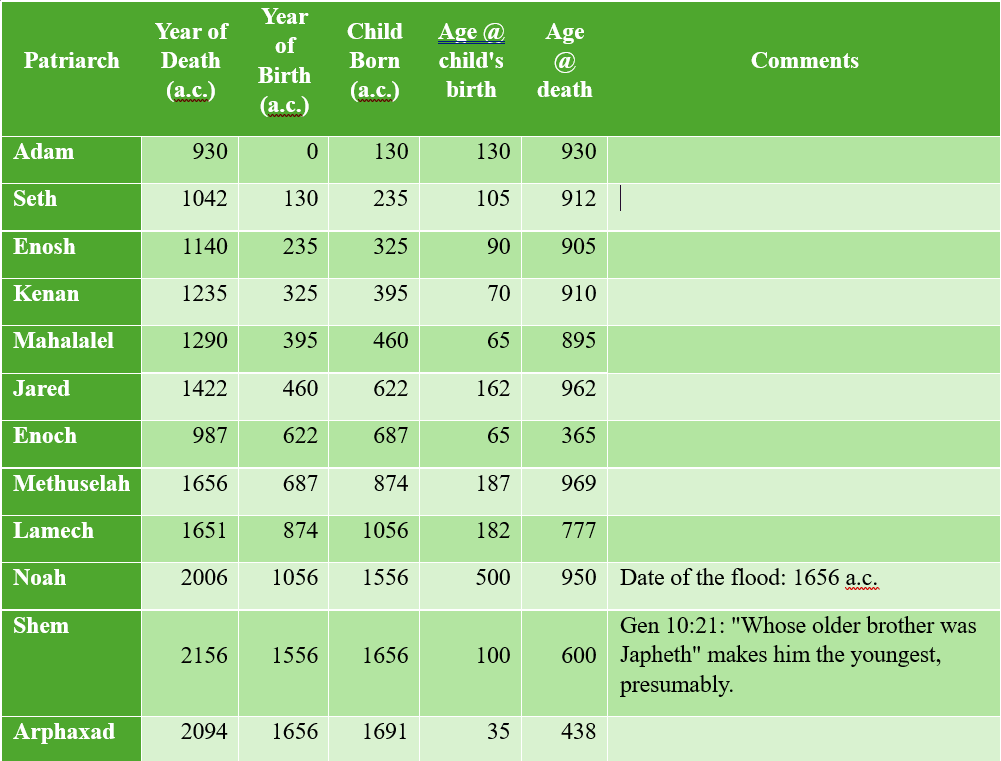
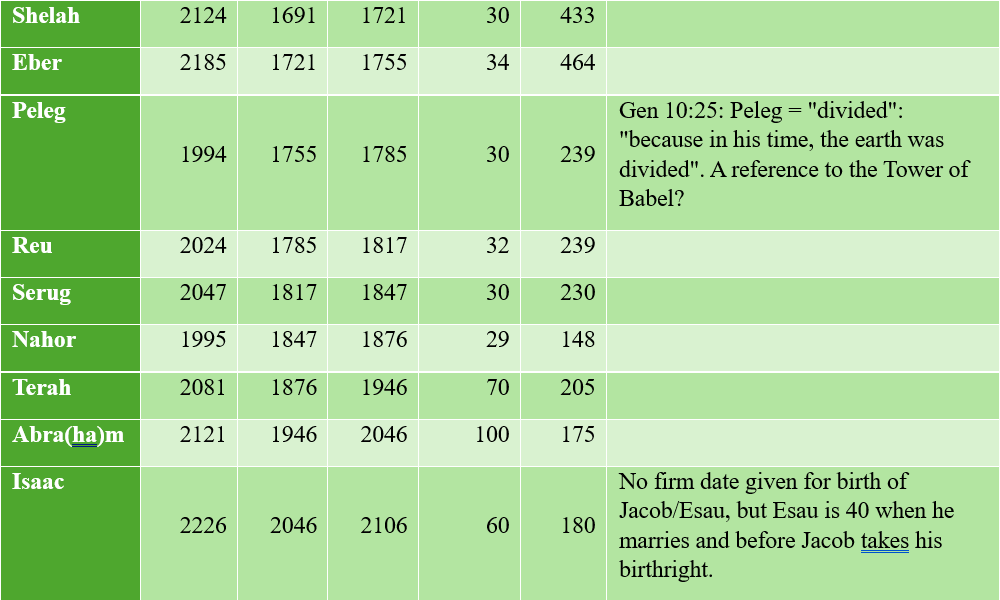
Figure 1: Genesis Timeline Chart

Figure notes: The y-axis represents years after creation. The bottom number with the red mark indicates the year of birth of the descendant to the right. The top number indicates the year of death of the father to the left.

[Added 1/27/2012]

The Evidence from Exodus and Beyond

I said this was a work in progress, so I’m going to keep adding to it. It shouldn’t surprise me that right after I post this, I run across something that throws a wrench in the works. I realize that patriarchal genealogies may not be comprehensive (usually only the sons are listed), but I have trouble believing that there are gaps, because the point was to show an unbroken line of descent. So what am I talking about here?

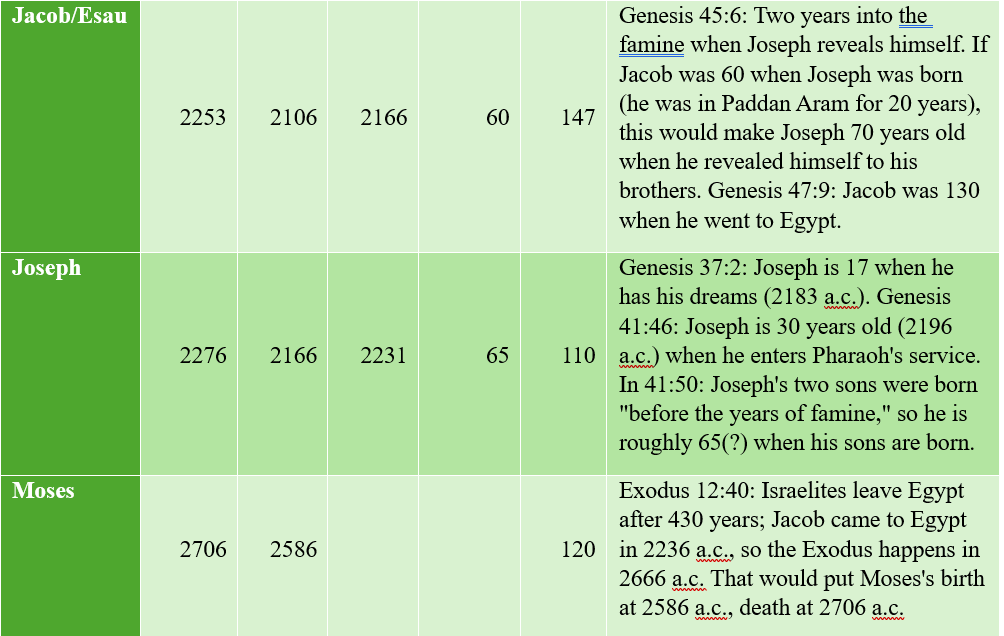
I was reading in Exodus 6 this morning (6:16–20 is what caught my attention) where the ages of Levi and his descendants are given. Levi lived 137 years, his son Kohath lived 133 years (LXX has 130), and Kohath’s son Amram, Moses’s father, lived 137 years (LXX has 132). The genealogy at 1 Chronicles 6 agrees with Exodus 6:16–20 with no additions. We don’t know the ages of the fathers when their sons were born, but working from the assumption that they were 60ish (since that seemed to be the pattern toward the end of the Genesis timeline above; we know Moses didn’t have kids until he was closer to 80; see Exodus 4:19–26 cf. 7:6) when their respective key descendants were born, and assuming Levi was born about 10 years before Joseph (ca. 2156 a.c.), there’s no way you can stretch out the chronology in 6:16–20 to fill the 430 years of Exodus 12:40! Table 2 is a proposed addition to the Excel sheet above.

Table 2: From Levi to Moses (hypothetical; revised in Table 3)
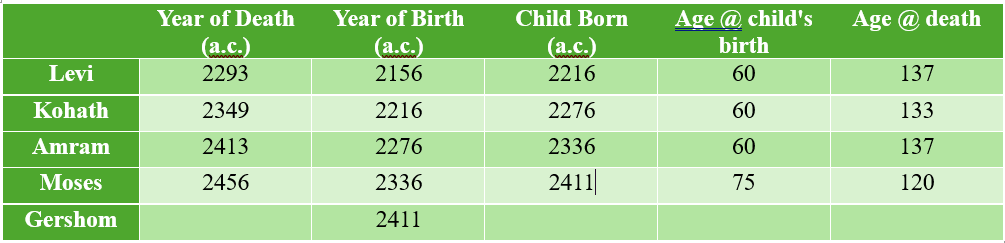
Notice that this hypothetical data puts Moses’s birth at 2336, a full 250 years before my proposed date above! What is going on here?

The key may lie in a closer look at the textual history of Exodus 12:40. The Hebrew text says that the Israelites were in Egypt 430 years. But the LXX and the Samaritan Pentateuch say they lived in Egypt and Canaan 430 years. Could it be that the mention of living in Egypt symbolized the fact that the Israelites did not yet have a permanent home anywhere, and so in Moses’s mind, that included the years from Abram’s settlement in Canaan to Jacob’s move to Egypt? If this is intended to imply 430 years from the time Abram settled in Canaan, where does that leave us? Here’s the math: Genesis 12:4 says Abram was 75 years old when set out from Harran. If Abram was born in 1946 a.c., 1946 + 75 = 2021. Add 430 to that, and you get 2451 a.c. for the date of the exodus, when Moses is 80 years old. Are you following me so far? Subtract 80 from that, and you get Moses’s birth year in 2371 a.c. So if I make Moses’s ancestors slightly older when they have their kids, I can make the chronology work a little better. Table 3 shows the revision.

Table 3: From Levi to Moses: final

At this point, I may as well bring in the other major chronological statement from the Old Testament and try to put everything into the more familiar B.C. years. Solomon began building the temple in the fourth year of his reign, 480 years (LXX has 440) after the Israelites came out of Egypt. Solomon’s reign is dated circa 971–931 B.C. (working from the chronology in William LaSor, David Hubbard, & Frederic Bush, Old Testament Survey [Grand Rapids: Eerdmans, 1972] p. 293), so Solomon began building the temple roughly 967 B.C. Adding 480 years to that puts the Exodus at 1447 B.C. So 1447 B.C. = 2451 a.c. That would put creation at 3898 B.C., give or take about 100 years depending on how you deal with the unknowns.

However, LaSor et al. suggest (p. 127) that the 480 years is a rounding, of sorts: 12 generations times 40 years/generation. But they significantly shorten that number, almost cutting it in half, and suggest that the exodus happened in the early thirteenth century B.C. rather than the mid fifteenth century B.C. I will have to save that debate for another time, though.

Conclusion

The puzzle of biblical chronolgy is fascinating, if only because I love to play with numbers. I realize I’ve made some “educated guesses” here, but as for the genealogies, I would have a difficult time believing there are any gaps in such detailed records. If you compare Matthew’s genealogy with the corresponding text in 1 Chronicles, it is clear that Matthew does leave out a few generations toward the end, but he’s certainly given enough information to connect us to his primary source material.

I believe in a recent creation, but I’m not so sure the earth itself is that new. After all, Genesis 1:1 says something was here before God made something out of it (“the earth was without form and void” doesn’t mean it didn’t exist at the time).

Peace

Pastor Scott Stocking, M.Div.

My views are my own.

Revision Note (01/30/2026): I had to redo the tables because this was originally created in an older version of the WordPress native editor and had some issues with extra columns.

January 23, 2012

Take Heart! (θαρσέω tharseō, Matthew 9:2, 22)

(Note: All Greek words are linked to www.blueletterbible.com.)

As I begin my fiftieth trip around the sun this year, I’ve determined to make several difficult choices that quite frankly have me scared and stressed. I took our congregation’s “401” class last week on spiritual maturity, which emphasizes acting out of love and faith, only to be confronted with the fact that the first major decision I made in 2012 was one out of sheer desperation, fear, and resignation. I started taking Dave Ramsey’s Financial Peace University this week at our church, which means I’m committed on Sunday afternoons for the next 12 weeks, but the opening session gave me a little hope. Personal relationships are looking up as well, and things at work are on a more or less even keel. In addition, I hope to be able to go see my kids a little more often this year. Still, that first difficult decision overshadows the positives I am anticipating.

Courage!

So when I saw Jesus’s encouragement Θάρσει (“Take heart!”) twice in Matthew 9 the other day, I had to sit up and take notice. Matthew 9 comes in the heart of Jesus dealing with many who come to him or are brought to him for healing. Jesus, of course, meets their physical needs, but he is ever mindful of their spiritual needs as well. In Matthew 9:2, Jesus declares that the paralyzed man’s sins are forgiven, which incites the teachers of the law to accuse him of blasphemy. Unfazed, Jesus proceeds to demonstrate he has the power to forgive sins by healing the paralyzed man. After the woman who suffered from a bleeding disease for 12 years touched Jesus’s garment, she was healed and greeted with the same word of encouragement.

The word is found five other times in the New Testament. Six occurrences are in the Gospels, and one is in Acts. Two of the occurrences are found in story of Jesus walking on the sea (Matthew 14:27, Mark 6:50) when the disciples are so terrified in the storm that they think Jesus is a ghost. John begins a major section of his Gospel with the phrase: “Do no let your hearts be troubled. Trust in God; trust also in me” (14:1 NIV). John teaches in chapters 14–16 on the ministry of the Holy Spirit and the troubles that his followers would face in the world. He ends that section with the word of encouragement: “I have told you these things, so that in me you may have peace. In this world you will have trouble. But take heart! I have overcome the world” (16:33 NIV). The two other occurrences of the word are found in Mark 10:49 and Acts 23:11.

Compassion

But that word by itself was only the tip of the iceberg that day as I was reading Matthew 9. When I got to the end of the chapter, verse 36 really hit home, because I felt like part of the crowd: “When he saw the crowds, he had compassion [σπλαγχνίζομαι] on them, because they were harassed and helpless, like sheep without a shepherd” (NIV). The words for “have compassion” and “compassion” are two of my favorite Greek words, not only because you have to expel about a pint of spit to say them, but because they are so descriptive of the literal meaning: “bowels.” Yes, that is where the phrase “bowels of compassion” originates. Compassion comes from the gut in the Hebrew worldview, much deeper than the heart.

But leaving that word aside, the thing that really struck me was the condition of the people who came to Jesus: “harassed,” “helpless,” “shepherdless.” I’ve not forgotten I have a shepherd, even when I may wander off at times, but I’ve certainly felt the first two in the last few years. The shepherd has guided me through those times, but I often have to wonder what I’m supposed to be learning in the school of hard knocks.

The fact that I have a shepherd was reinforced even more when I came across an OT passage last week as a friend and I were reading through Six Battles Every Man Must Win by Bill Perkins, where he reminds us of the story of another shepherd, David. Before David secured his place on Israel’s throne, he was a fugitive running from Saul. During that time, however, he was not alone. Those who would become David’s “mighty men” gathered around him early in his fugitive life: “All those who were in distress or in debt or discontented gathered around him, and he became their commander. About four hundred men were with him” (1 Samuel 22:2). That sounds very much like the people who were gathering around Jesus in Matthew 9. And it sounds very much like my life currently. My life-résumé is a pretty good match for the “qualifications” of a mighty man.

Contentment

I know I don’t have the strength to dig myself out of my own problems. Some days, I wear my weakness on my sleeve, but only because I know that it is only through my weakness that Christ can perfect his power (2 Corinthians 12:9). I need my shepherd, Jesus, to guide me through. The path is mountainous and treacherous at times, but I know he’s got my back.

I remember going on a horseback ride as a teen through Chadron State Park in NW Nebraska. We had about 15 people riding single file along the trail, and we were going along a high ridge with a 45 degree slope that dropped about a thousand feet to my right (at least, it seemed that steep and deep). My horse decided to take his own route, and instead of staying on the main path, he moved to the right a bit and went between a tree and the slope. The path between the tree and the slope was no wider than the horse, but when I started to panic a bit, my dad reassured me that the horse knew what he was doing. It was only a short little detour, only ten feet or so, but I had to duck a bit to avoid the lower branches of the tree. The horse was sure footed though and got me safely back on the path.

That detour is a microcosm of what I’ve experienced in the past few years, poised precariously on the brink of disaster. But God has seen me through it, and for that, I am grateful. The road ahead still has its challenges, but I can be content knowing that my Savior holds me in the palm of his hand and will put me on the straight path in his own timing.

Conclusion

So my word to you is the same as Christ’s to the paralytic and the bleeding woman: Take heart! Know that his promise that he would never leave us nor forsake us holds true, even when we have trouble seeing the end result.

Peace!

Scott Stocking

December 4, 2011

Immersion (Baptism) that Saves: 1 Peter 3:18–22

I have a couple notes for blog readers before I get into the main post today.

  1. For all readers: Instead of customizing the hyperlinks or providing transliterations and pronunciations, I am going to start hyperlinking the first occurrence of each Greek and Hebrew word in my blog to the entry in http://www.blueletterbible.org. That Bible study site has numerous resources available, including a link to hear the Greek or Hebrew word pronounced and the option to get a complete concordance listing of all occurrences of the Greek or Hebrew word. If you’re not already familiar with the site, I trust you will find it useful and engaging. (I am not being compensated for promoting BlueLetterBible at this time.)
  2. For those readers who use the sentence diagrams: At least once a week, it seems like the search engine feature in WordPress lets me know that someone hit on my site by looking for a diagram of a particular verse. I am pleasantly surprised to find I’m not the only one who has an interest in diagramming, in spite of how much I griped about it in junior high. For those of you who use the diagrams, I would appreciate knowing what your interest is in them so that I can get a sense if I need to do anything different with them or provide a different kind of diagram. Are you just curious? Are you a student looking for help on an assignment? (If the latter, I trust you aren’t passing off my work as yours!) Are you a preacher looking to better explain the passage? Whatever your interest, please drop me a short note in the comments. There’s obviously some interest in them, and I’m happy to share the fruit of my labor with you.

Introduction

Growing up as a sprinkled Presbyterian, I was understandably intrigued when I came to understand my need for a personal relationship with Christ and discovered the concept of “believer’s baptism.” It was a completely new concept to me, as I had never been exposed to it before my high school years. In college, when I got involved with the restoration movement, I still had many questions about the practice when I went to that first meeting at 1633 Q Street (now a parking lot) just off the University of Nebraska-Lincoln campus. That night, just a little over 30 years ago, I got shuffled off to the pastor’s office, where I met Terry & Kris Christlieb. I had several questions about baptism, and they answered them to my satisfaction that night, so much so that we invaded Capitol City Christian Church at 9 p.m., where I got immersed. I was sold from that point on.

I’ve had my ups and downs on immersion theology through the years. Is it an absolute necessity? Is it just a “work of the flesh”? When is the right time? Just what is the “effectiveness” of immersion when it comes to salvation? But when I ran across such passages as Romans 6 and 1 Peter 3:18–22, it was hard for me to diminish the importance of immersion in the life of a Christ-follower. And when I discovered the connection between Acts 2:38 and Matthew’s Last Supper account, I was convinced of the efficacy of immersion as part of the salvation and maturing experience of the Christ-follower.

1 Peter 3:18–22

Of all the passages on immersion, or baptism as many call it (βάπτισμα, βαπτίζω), 1 Peter 3:21 is the only one that comes out and says directly that immersion saves. Yet this gets overlooked so much, because those who are not convinced of the efficacy of immersion seem to think it means something other than what is plainly written on the page. But what is the author trying to communicate by connecting it to the Noahic flood? Is the flood what saves us, or the ark? The verse diagram in Figure 1 below places 1 Peter 3:21 in its larger context so that you can see what the connections are.

I want to jump down to 20b, where Peter says (my translation): “In the ark, a few, that is, eight people, were saved through water.” In this case, the water was destructive (see 2 Peter 2:5), but it had the power to save Noah by supporting the ark on its year-and-a-half voyage. The flood destroyed all living creatures except those on the ark and those that could already live in water, but the ark was the vessel that protected Noah, his family, and the other living creatures “through the water.”

Now for verse 21: The word for ark (κιβωτός) is feminine, but the relative pronoun that begins verse 21 is neuter, so it can’t refer to the ark. The most immediate antecedent to the relative pronoun is “water” (ὕδωρ; genitive is ὕδατος), which is neuter, so Peter is referring to the waters of the flood with this pronoun. So in verse 21, Peter says, “This water corresponds to immersion.” The word “corresponds to” (ἀντίτυπος) is actually an adjective in Greek that modifies βάπτισμα, so the phrase might be more accurately rendered, “This water is functional baptism” or more literally, “This water is typical baptism.”

Peter goes on to say that this baptismal water “now also saves you.” The “now also” is relative to the previous verse. Not only does the ark, then, typify salvation, but water does as well. Water is what destroyed sinful humanity, which is exactly what happens when someone is immersed into Christ. Romans 6:3–4 says, “Or don’t you know that all of us who were immersed into Christ Jesus were immersed into his death? We were therefore buried with him through immersion into death in order that, just as Christ was raised from the dead through the glory of the Father, we too may live a new life.”

What I found interesting is that the part that follows “now also saves you” has two nominative case nouns. “Removal” (ἀπόθεσις) and “appeal” (ἐπερώτημα) are both nominative case, agreeing with the nominative case of βάπτισμα, so they are essentially appositives to βάπτισμα. Here’s how a literal translation might look: “This immersion now saves you, not the body-dirt removal immersion, but the clear-conscience-pledge to God immersion.” But this rendition is missing the most important part of the verse, the final phrase.

The last phrase of verse 21 parallels the “through water” at the end of verse 20. “Through the resurrection of Jesus Christ” is the qualifier that gives the water its power to save. Just as the ark saved Noah and his family through the flood waters, the resurrection is what carries us through the act of immersion. Again, I refer you back to Romans 6:3–4, where this is made abundantly clear. So if I complete my literal translation with that phrase, it would look something like this: “This immersion now saves you through the resurrection of Jesus Christ, not the body-dirt removal immersion, but the clear-conscience-pledge to God immersion” (emphasis mine).

So immersion is really a two-way street to God. If we just get immersed for show (the “body-dirt removal immersion”), immersion is ineffective. God is not into rituals without substance. But if we come to the waters of immersion pledging ourselves to live for him with a clear conscience, he effects the power of the resurrection in immersion and destroys the old self. He renews us and rescues us from the wages of sin.

A quick note on βαπτίζω

Some have tried to argue that βαπτίζω does not mean “completely immerse,” because that is what the related word βάπτω means. But the –ίζω ending on βαπτίζω is an intensifier. It is quite similar, in sound and function, to the difference between the musical directions forte (loud) and fortissimo (very loud). So βαπτίζω is an intense form of dipping, or immersion. I don’t have to time to list the many verbs in Greek that indicate a similar pattern, but I assure you, they are quite common in the NT.

Conclusion

So immersion is certainly not just a work of the flesh. Just as the ark supported and sustained Noah and his family through the flood, so too the resurrection sustains us through the act of immersion. But beware of the “dunk ’em and ditch ’em” philosophy. Noah and his family certainly did not sit idly by on the ark for a year and a half. They worked hard daily to keep the animals and themselves fed and healthy. Immersion is not a terminal point in the life of a Christ-follower. On the contrary, it is a watershed moment (pun intended) where we tell God, “I’m sold out for you.”

Peace,

Scott Stocking

Figure 1: Diagram for 1 Peter 3:18–22 (Greek and English)

November 27, 2011

Adulteresses (μοιχαλίδες) in James 4:4; Excursus on Authorship of Hebrews and James

Filed under: Authorship,Biblical Studies,Greek,Hebrews,Hosea,James,New Testament — Scott Stocking @ 9:15 pm

James is my next-favorite NT book/epistle, second only to Ephesians. James is often dubbed “The Proverbs of the New Testament,” and after having read through the first four chapters this week, it is easy to see why. Although it lacks the strict parallelism of most of the text of Proverbs in the OT, I have noticed a substantial number of word pairings in James. Some of them happen in the same verse or within one or two verses (e.g. 2:2–3), while others serve as inclusios for certain sections (e.g., 2:14–16). James is probably best known for its practical wisdom on controlling the tongue.

Adulteresses

What caught my attention while reading this morning was James’s use of the feminine plural noun for “adulteresses,” μοιχαλίδες, in James 4:4. Throughout the letter, James addresses his readers as “my brothers,” which is intended to be a generic reference to all believers regardless of gender, as was customary in those days. So when he addresses his readers with a feminine noun, he is undoubtedly trying to get their attention. What may escape some here, though, is the implied Old Testament connection. (See Table 1 for the way this is translated in different versions.)

Table 1: Translations of μοιχαλίδες in Several Logos Versions, with Footnotes and Cross References

Version

Translation of μοιχαλίδες

Footnotes and X-refs

KJV 1769

Ye adulterers and adulteresses (!)

Note that the translators didn’t exclude males in 1769!

ASV 1901

Ye adulteresses


RSV 1971

Unfaithful creatures!


NIV 1984

You adulterous people


NRSV 1989

Adulterers!


NASB 1995

You adulteresses

Jer 2:2; Ezek 16:32

ESV 2001

You adulterous people!

Isa. 54:5; Jer. 2:2; Greek: “You adulteresses!”

TNIV 2005

You adulterous people

Isa 54:5; Jer 3:20; Hos 2:2–5; 3:1; 9:1

NLT 2007

You adulterers!

Greek: “You adulteresses!”

NIV 2011

You adulterous people

Isa 54:5; Jer 3:20; Hos 2:2–5; 3:1; 9:1; An allusion to covenant unfaithfulness; see Hosea 3:1.

Of course, if you have a good study Bible at hand, you may have seen some of these verses in the cross-reference apparatus (whatever study Bibles I have are still buried in my boxes). The imagery of Israel as an unfaithful wife or adulterous woman in the OT is certainly prominent. Ezekiel 23 has a graphic (dare I say X-rated) description of Oholah and Oholibah, the two adulterous sisters, who respectively were symbols for Samaria’s (northern kingdom) and Jerusalem’s (southern kingdom) religious promiscuity with other gods. Hosea lived the parable, so to speak, by marrying a woman whom he knew was a prostitute, and God told him to do it! (See specifically Hosea 3:1, which is the only time this word is used in the LXX text of Hosea.) By calling his readers “adulteresses,” James minces no words and makes no friends. He cuts to the chase and puts the fear of God into his hearers by comparing them to their faithless ancestors who were exiled.

Did James Write Hebrews?

Several years ago, I heard Larry Pechawer (at least, I recollect it was Pechawer) do a somewhat tongue-in-cheek paper on the authorship of Hebrews. Pechawer postulated that Hebrews had been written by Paul, because three of the first four words in Hebrews begin with a Paul-like sound (Πολυμερῶς καὶ πολυτρόπως πάλαι). That’s not exactly an exegetically sound method of determining authorship, but to his credit, he did offer some other substantive evidence for Paul’s authorship, although it was admittedly weak.

The reason I mention this is that James, in 1:2, has three successive π-words: πειρασμοῖς περιπέσητε ποικίλοις. Now as with Pechawer’s theory on Hebrews, such alliteration may be just that: alliteration. In my college days, I had argued that Hebrews had been written by Luke, because the Greek is high quality, and the author claims to have written a short (βραχύς) letter, which is true when Hebrews is compared to Luke and Acts.

But perhaps there is something to the theory of James’s authorship of Hebrews. James, after all, was the half-brother of Jesus, so he certainly has the knowledge of the Jewish sacrificial system inherent in Hebrews in his favor. James also held a leadership position in the Jerusalem church, so he certainly would have known the individuals mentioned in the final greetings in Hebrews, including Timothy. “Those who come from Italy” could refer to visitors from Italy to Jerusalem, as opposed to the letter originating from Italy, as one might expect if it had been written by Luke or Paul. As the church father Origen said, only God knows who really wrote Hebrews, so my musings here won’t solve that eternal question, but it is an interesting conjecture to me nonetheless.

Hebrews 13:17–18: A Less-Authoritarian Translation

If you followed the posts when I was teaching the How to Understand the Bible class at the beginning of the fall, you may have seen the link to the word study on πείθω. Most translations render the word “obey” with respect to the leaders, but that is not a common translation for the word in the NT. More often than not, the word has the idea of “confidence.” That’s why I like the TNIV and NIV (2011) translation of the verse: “Have confidence in your leaders.” I believe this translation puts more responsibility on the leaders to be men and women of high character. This doesn’t mean that Christ-followers shouldn’t be obedient to leaders, but that obedience should come from a relationship based on trust, not just obligation. You want to follow leaders who have impeccable, reliable character.

The same word is used in vs. 18 and is usually translated “we are sure”, so translating it as “confidence” in vs. 17 is completely consistent with the context. For other occurrences of the word, click the link at the beginning of this section to open the PowerPoint presentation on the word study.

Peace to all this Christmas (with a capital C) season.

Scott Stocking

By the way, the new NIV (2011) Study Bibles are available now. If you are shopping for a study Bible and prefer the updated translation of the NIV (essentially the TNIV repackaged), make sure you look for the cover you see here. There are many study Bibles based on the NIV, but not all have adapted to the updated translation. If you’re in doubt, check the “front matter” and look for the copyright date of the Bible text (as opposed to the copyright date of the study Bible itself). If the study Bible uses the new NIV, it will show a copyright date of 2011 for the Bible text, and no earlier than 2011 for copyright date of the study Bible itself. The older NIV was copyrighted in 1984, so that would be the latest copyright date for the biblical text found on that page.

September 5, 2011

Guide to Selecting a Bible

Learning Outcomes

After taking this class, the participant will be able to:

  • Explain the differences, benefits, and disadvantages of the three major translation theories;
  • Describe the source and purpose of the tools included in a study Bible;
  • Use different versions in personal Bible study based on personal needs and preferences.

Step 1 of the Bible study method we’ll be discussing is “Get a Bible.” Sounds simple enough, right? Go to Parable or Divine Truth, grab one off the shelf, pay for it, and be on your way. But what do you find when you get there?

So how do you decide? It depends on what you want.

Translation Theories

Literal translations try to stay as close to the word order and standard meaning of the words as possible. These sometimes seem very choppy to read and they tend translate idiom literally rather than translating the meaning of the idiom. If you want technical accuracy, try a literal or word-for-word translation like the New American Standard Bible (NASB), English Standard Version (ESV), or the King James Version (KJV).Note the translation of Psalm 1:1–2 from the English Standard Version:

Blessed is the man
who walks not in the counsel of the wicked,
nor stands in the way of sinners,
nor sits in the seat of scoffers;
    2 but his delight is in the law of the Lord,
and on his law he meditates day and night.

Paraphrase or free translations are on the opposite end of the spectrum. Examples of paraphrases would be The Message (Eugene Peterson) and The Living Bible (Kenneth Taylor). These tend to take great liberty with the original text (when the original text is consulted!) or work from another English version and attempt to rewrite the text in contemporary, colloquial language. Here is Psalm 1:1–2 from The Message, translated and paraphrased by Eugene Peterson (note: Eugene Peterson has consulted the original texts in Hebrew, Aramaic, and Greek):

(The Message)

How well God must like you—
you don’t hang out at Sin Saloon,
you don’t slink along Dead-End Road,
you don’t go to Smart-Mouth College.
2 Instead you thrill to God’s Word,
you chew on Scripture day and night.

Dynamic equivalent translations take a middle-of-the-road approach between literal and paraphrase. They arrange the word order so it sounds more natural to the reader, like reading a newspaper or popular novel. Here is Psalm 1:1–2 from both the new edition of the NIV (©2011) and the New Living Translation, which we usually place on the screen for Mark’s sermons:

(NIV: tends to be a little closer to the literal)
Blessed is the one
who does not walk in step with the wicked
or stand in the way that sinners take
or sit in the company of mockers,
but whose delight is in the law of the Lord,
and who meditates on his law day and night.

(NLT, second edition, a little closer to the paraphrase)
Oh, the joys of those who do not
follow the advice of the wicked,
or stand around with sinners,
or join in with mockers.
But they delight in the law of the Lord,
meditating on it day and night.

Study Bibles

A study Bible is not a translation theory like the three described above, but a tool that combines the insights of a number of different resources in order to give you a broader picture of the context, meaning, and application of Scripture. Keep in mind that the notes in a study Bible represent someone else’s interpretation of the passage or verse. These notes should not be considered “Scripture,” but scriptural helps. Study Bibles come in every shape and size, for any number of demographic categories you can conjure up, and for most major versions of the Bible.

Some good study Bibles are The Life Application Bible (available with different Bible versions), The Archaeological Study Bible (with 1984 NIV), and the 1984 NIV Study Bible. Study Bibles may also have cross-references to parallel passages or to similar wording in other verses. Following these cross-references in your study time may serve to enrich your understanding of Scripture and help you see its interconnectedness.

Comparing Translations

Most online and app-based Bible Web sites will give you the opportunity to compare translations of a verse or passage. This is often helpful in Bible study when you have a passage who’s meaning may not be quite clear or that speaks to a difficult concept.

Note on the New International Version (NIV)

The New International Version underwent an update for 2011. The previous version of the NIV was published in 1984, over a quarter century ago. In 2001, Today’s New International Version (TNIV) was published, which included gender-neutral language where the original author was addressing both men and women. The 2011 edition of the NIV is essentially the TNIV with some minor adjustments. The TNIV is no longer being published. The new NIV Study Bibles have now gone through a couple versions since the 2011 update. Personally, I’m using the Zondervan NIV Study Bible edited by Kenneth Barker, the first one to come out after the update.

Since I first published this guide, I have also had the opportunity to contribute study notes to the Jeremiah Study Bible, available with the NIV, NKJV, and ESV.
Here is a comparison of Hebrews 13:17–18 in the NIV 1984, TNIV, and NIV 2011 editions.

NIV 1984

TNIV

NIV 2011

17 Obey your leaders and submit to their authority. They keep watch over you as men who must give an account. Obey them so that their work will be a joy, not a burden, for that would be of no advantage to you.

18 Pray for us. We are sure that we have a clear conscience and desire to live honorably in every way.

17Have confidence in your leaders and submit to their authority, because they keep watch over you as those who must give an account. Do this so that their work will be a joy, not a burden, for that would be of no benefit to you.

18Pray for us. We are sure that we have a clear conscience and desire to live honorably in every way.

17 Have confidence in your leaders and submit to their authority, because they keep watch over you as those who must give an account. Do this so that their work will be a joy, not a burden, for that would be of no benefit to you.

18Pray for us. We are sure that we have a clear conscience and desire to live honorably in every way.

Peace!
Scott Stocking

September 2, 2011

HUB: How to Understand Your Bible: Week 1

Filed under: Biblical Studies,New Testament,Old Testament,Psalms — Scott Stocking @ 6:15 pm

Here is a synopsis of what we covered Wednesday night. We had nine people in class. What a great start! I hope you all come back next week.

Week 1 Learning Outcomes: After this week’s lesson, the class member should be able to:

  • Discuss with others what the Bible says about itself by citing key passages;
  • Recall the main reason for reading the Bible;
  • Describe the dual roles of love as they relate to the main reason for reading the Bible; and
  • List the five “big-picture” themes of the overall biblical story.

The following is adapted from Jake Christian’s curriculum

Read the following Scripture passages to prepare for class:

  • Psalm 119
  • 2 Timothy 3, especially verses 14–17
  • Matthew 22:37–40
  • 1 John 2:3–6
  • 1 John 3:16–18
  • Ephesians 4:11–16

The Big Picture:

  • Created for Oneness
  • Otherness Introduced
  • Otherness Expanded
  • Otherness Abated (I modified this from the handout)
  • Redeemed into Oneness

Some questions to consider (no right or wrong answers; just reflection):

  • What words or concepts come to mind when you think about the Bible?
  • What have been your successes in reading and studying the Bible?
  • Where do you want to experience some growth in reading and studying the Bible?
  • What does the Bible say about itself?
  • Who has had the most influence on your understanding of the Bible?

Next Week’s Topic: Introducing the Bible Study Method:

  • Get a Bible
  • Read it.
  • Think about how it applies to your life.

June 19, 2011

“I Am the Door of the Sheep”; “I Am the Good Shepherd” (John 10:7, 11)

Well, the summer solstice is just around the corner, and so is the end of my time reading through the Gospels. I read the first part of the crucifixion story this morning in John 19, and that has some interesting tidbits I may come back to:

  • Barabbas’s name is Aramaic for “Son of the Father,” or more colloquially, “Daddy’s Boy” (בַּר bar ‘son’ + אַבָּא abba ‘father, daddy’, perhaps with definite article); Jesus is the “Son of God [the Father]”: irony at its finest!
  • Three times, Pilate said he could find no charge against Jesus, and he seems to work tirelessly (and with concern for his own integrity) to try to release Jesus, even justifying his innocense to the Jewish leaders and the crowd, to no avail;
  • Jesus tries to ease Pilate’s worries about handing him over to be crucified by telling him, “The one who handed me over to you is guilty of a greater sin.” Note that Jesus cannot be accusing the God the Father here, but either Judas or the high priest.

But I digress from my intentions this morning. I want to tackle two more of the “I am” statements of Jesus found within a few verses of each other in chapter 10: “I am the Door of the Sheep” (v. 7) and “I am the good shepherd” (v. 11). The two statements are obviously closely related, but I will deal with each one separately, even though there will be some overlap.

“I Am the Door of the Sheep” (John 10:7)

I’m going to reproduce here my table (Table 1) from an earlier post that shows the connections between the seven “I am” statements of Jesus and the seven signs he performed, with today’s two statements highlighted: (2/13/2012: You can click the “I Am” statement to open the blog post for that statement.)

Table 1: Linking the “I Am” Statements with Jesus’ Miracles

“I Am” Statement

Sign/Miracle

John 6:35: I Am the Bread of Life John 6:1–15: Jesus Feeds the 5000+
John 8:12: I Am the Light of the World John 9:1–12: Jesus Heals a Man Born Blind
John 10:7: I Am the Door of the Sheep John 5:1–15: Healing of the Invalid at Bethesda [Sheep Gate]
*John 10:11: I Am the Good Shepherd John 6:16–24: Jesus Walks on Water
John 11:25: I Am the Resurrection and the Life John 11:38–44: Jesus Raises Lazarus from the Dead
*John 14:6: I Am the Way, the Truth, and the Life John 4:43–54: Healing of the Official’s Son
John 15:1: I Am the True Vine John 2:1–11: Water into Wine

One of the first connections to note out of the gate (pun intended) is that Jesus’ third sign is healing a man at the pool by the Sheep Gate (προβατικῇ probatikē, literally “of the sheep”; the feminine form is elliptical or shorthand because the word for “gate”, which is feminine, is not in the text there) in the walls of Jerusalem (John 5:1–15). This is the city gate through which the sheep entered when being brought to town for the market or the Temple. I will grant that Jesus’ statement, “I am the door of the sheep” (ἐγώ εἰμι ἡ θὑρα τῶν προβάτων egō eimi hē thura tōn probatōn) is more agrarian and rural than it is commercial and political, but the connection is significant nonetheless, because chapter 5 is the only time the Sheep Gate is mentioned in the Gospels. The Sheep Gate is mentioned three times in Nehemiah in connection with rebuilding the wall. It is probably not coincidence, then, that the high priest and his fellow priests had the responsibility to rebuild that section of the wall and rehang the gates (Nehemiah 3:1; cf. Hebrews 4:14, where Jesus is called our “great high priest”).

This “I am” statement has a connection to John 14:6 as well. In John 10:9, Jesus repeats the “I am” statement, this time without the sheep (“I am the door”), and the salvific connection is obvious (TNIV modified to reflect Greek word order): “Through me, whoever enters will be saved.” The phrase “through me” (διʼ ἐμοῦ di’ emou; the emphatic form of the pronoun is used) comes first in 10:9, even before the conjunction, which is a grammatical tool for emphasizing a phrase. The same phrase is found in John 14:6 (“no one comes to the Father except through me“) at the end. (Don’t ask me why, but Greek scholars say that an element of a Greek sentence can be emphasized at the beginning or the ending of a sentence; just one of those quirky things about Greek.) Here’s the beautiful part: normally you might think a prepositional phrase like “through me” should be common enough, right? Want to guess how many times it occurs in John? If you said “twice,” you are exactly right! Because it appears at the beginning of the phrase in 10:9 and at the end of the phrase in 14:6, I would say we have an inclusio here. Was it intentional by John? Perhaps not. Did God have a hand in ordering the text that way? I certainly think so.

Now if we have an inclusio, we need to look at the text in between and see what’s going on. Jesus does make his other statement about being a good shepherd two verses later in 10:11, but two other significant events are bracketed by the “through me” statements. The first is the resurrection of Lazarus from the dead and Jesus’ accompanying “I am the resurrection and the life” statement. More on that in a future post. The other significant event is the Last Supper, in which Jesus washes his disciples’ feet. In 13:8, Jesus makes another statement about his exclusivity as the Savior: after Peter objects to Jesus washing his feet, Jesus replies (my translation, emphasizing the present continuous aspect of the verbs), “Unless I am washing your feet, you are not having any part with me [μετʼ ἐμοῦ met’ emou].” This act of washing the feet is the act of a good shepherd who cares for his sheep, so we now turn to that “I am” statement.

“I Am the Good Shepherd” (John 10:11, 14)

In Table 1 above, I make a tentative link between “I am the good shepherd” (Ἐγώ εἰμι ὁ ποιμὴν ὁ καλός egō eimi ho poimēn ho kalos) and Jesus walking on the water in John 6. Here’s the connection, but again, it is tentative: Only Matthew records that Jesus called Peter to walk on the water (14:28–31); perhaps John doesn’t record this because he doesn’t want to call attention to Peter’s lack of faith in that instance. The connection has its “degrees of separation,” but it’s more than just about feet and water.

Jesus had stayed behind when his disciples set out in the boat in John 6. But when he saw the disciples were having trouble managing the boat in the strong winds, Jesus left whatever shelter he had sought out and walked out onto the raging sea to get to those he loved. He was looking out for his sheep. This reminds of the parable of the wandering sheep in Matthew 18:10–14, only in the walking on the water pericope, the wilderness is the sea itself. I can imagine that even for the son of God, walking on the water was not the safest thing to do, let alone doing it in a storm, yet Jesus says in the latter part of John 10:11: “The good shepherd lays down his life for the sheep” (repeated in vv. 15, 17, 18).

The concept of the good shepherd has its roots in the Old Testament. King David, of course, was a shepherd himself, and Psalm 23 is a popular treatise on how the Lord shepherds us on a daily basis. Ezekiel 34 is an extended treatise on the bad shepherds of Israel, who had led the nation on the path of exile. A few relevant passages from Ezekiel make the connection between Jesus’ “I am the good shepherd” statement and Jesus’ walking on water even more pronounced (all excerpts from the TNIV):

For this is what the Sovereign Lord says: I myself will search for my sheep and look after them. As shepherds look after their scattered flocks when they are with them, so will I look after my sheep. I will rescue them from all the places where they were scattered on a day of clouds and darkness (34:11–12).

As for you, my flock, this is what the Sovereign Lord says: I will judge between one sheep and another, and between rams and goats (34:17; note parallel to Matthew 25:32–33).

I will place over them one shepherd, my servant David, and he will tend them; he will tend them and be their shepherd. I the Lord will be their God, and my servant David will be prince among them. I the Lord have spoken (34:23–24).

They will live in safety, and no one will make them afraid…. Then they will know that I, the Lord their God, am with them and that they, the house of Israel, are my people, declares the Sovereign Lord. You are my sheep, the sheep of my pasture, and I am your God, declares the Sovereign Lord (34:28b, 30–31)

Live It Out

I find no shortage of irony that the one John called “The Lamb of God, who takes away the sin of the world!” (1:29b) is also the door (or gate) for the sheep and the good shepherd. Both of these statements emphasize Jesus’ compassion for his flock. He protects us from thieves and bandits who would rob us of our joy. He is a refuge for us in times of storm and disaster. And he is the only one through whom we can be saved and have the promise of eternal life.

In John 21:15, Jesus has an emotional exchange with Peter to restore him to service after his denial. Three times, Jesus asks Peter, “Do you love me?” Twice Jesus uses ἀγαπάω (agapaō) and once φιλέω (phileō), but Peter always responds with φιλέω. I don’t think much can made of the difference in the different words used for “love” as some have, but that’s not my point here. Jesus responds, “Feed my lambs” or “Feed my sheep.” Can we model the shepherding of the Savior? Some days it’s easier than others, but if Peter was forgiven for his triple-denial and went on to be instrumental in commencing the church, what great things can we do for God?

I had a stormy period this past month. Last month would have been my 19th anniversary with my (now ex-)wife, and I found myself craving the intimacy I once had with her. It was a struggle to get through that, but God, who is never unfaithful, continued to be faithful to me as I worked through my issues. I’ve come out on the other side now, but as much as I know I’m forgiven for the past, I still find that it haunts me at times. I need to trust that my shepherd is watching out for me in those times when I wander into the wilderness and know that as I “bleat” for his presence, protection, and love, he will hear me and come running to me to give me the only comfort that matters.

Peace!

Scott Stocking

June 11, 2011

“I Am the Light of the World” (John 8:12)

 I used the last part of this for our Christmas Eve 2024 service at Mount View Presbyterian Church. The audio recording is below.

What does a primitive tent have to do with Jesus being the light of the world? Read on and find out!

Jesus at the Feast of Tabernacles (John 7)

Before diving into Jesus’ statement, “I am the light of the world,” some background information is crucial to understand both the context of the statement and the connection to other “I am” statements and some of Jesus’ seven signs that John records. In this case, John 7 provides the setting for Jesus’ statement. Seven times in chapter 7, John mentions the “Feast” (or “Festival” in some translations), referring to the Feast of Tabernacles or Feast of Booths (7:2; ἡ ἑορτὴ… ἡ σκηνοπηγία hē heortē… hē skēnopēgia /hay heh-or-TAY hay skay-nȯ-pay-GEE-ah/ [g as in girl]). This feast originated in the days of Israel’s wilderness wanderings before entering the Promised Land (Leviticus 23:33–44; חַ֥ג הַסֻּכּ֖וֹת hăg hăssǔkkōth /hag hass-sook-KOATH/, ‘Feast of Tabernacles’ or ‘Succoth’), when the Israelites had to live in temporary shelters to remember their desert sojourn. Deuteronomy 16:16 says that the Feast of Tabernacles is one of the three feasts at which all Israelite males must present themselves every year.

There is no definitive mention of the festival after Deuteronomy until the time of Ezra and Nehemiah, when the Israelites returned from exile. In Ezra 3, Joshua and Zerubbabel rebuild the altar, begin offering sacrifices, and command that the Feast of Tabernacles be restored once again, all eight days of it. In Nehemiah, the celebration of the Feast is reinforced when, as Ezra was reading the law (Nehemiah 8), the people hear the instructions for the Feast and waste no time building booths wherever they could find a spot: on their roofs, in the Temple courts, and especially by the Water Gate. The law of God was read during the eight days of the Feast in Nehemiah, and the text said the people celebrated it as none had since the days of Joshua, son of Nun, when the Israelites had entered the Promised Land some 800 years earlier.

The fact that the people dwelt near the Water Gate is significant, and provides continuity with and a connection to the first “I am” statement and its connection to Jesus’ “living water” statement in John 4. According to Craig Keener, in the section on John 7 in his IVP Bible Background Commentary: New Testament, one of the rituals of the Feast, at least as it had developed in Jesus’ day, was for the priest to take water from the Pool of Siloam and pour it out at the base of the altar each day of the feast. Two of the Scripture passages that had become important for the Feast were Zechariah 14 and Ezekiel 47. Consider Ezekiel 47 first, where a river of life flows out of Ezekiel’s temple (one that has never been constructed in history as far as we know, if the dimensions are to be taken literally) toward the Dead Sea, thus transforming it into a fresh-water lake teeming with life. Add to that Zechariah 14:8 (TNIV), which says: “On that day living water will flow out from Jerusalem, half of it east to the Dead Sea and half of it west to the Mediterranean Sea, in summer and in winter,” and one understands the significance of pouring out the water at the base of the altar. Finally, Zechariah 14:16–19 speaks of the Israelites once again celebrating the Feast of Tabernacles (three mentions).

It is important here to note the connection with John 4: Jesus gets into a discussion with a Samaritan woman about the appropriate place to worship. Jesus says he is the living water. In other words, Jesus is the river flowing from Ezekiel’s yet-to-be-built temple! Jesus makes the claim that it is only through him that God can be worshiped (perhaps looking forward to another “I am” statement in John 14:6), and the geographical location doesn’t matter. In the Bread of Life post, I made the connection between John 4 and 6, so we have the beginning of some insight into John’s organizational scheme (I told you I was working these things out as I go along!).

Another interesting feature of John 7 is that Jesus initially tells his disciples to go to the feast without him, and they do. But Jesus is not far behind. He already knows the Jewish leaders are out to kill him, so he’s trying to be low key, but there is nothing low key about Jesus. He always attracts a crowd. John even makes a point of saying that the crowd was expecting him to be there. Jesus shows up in the middle of Feast week and begins teaching in the Temple. John 7:37–38 is a key passage here, and I use Keener’s suggested translation: “On the last and greatest day of the Feast, Jesus stood and said in a loud voice, ‘If anyone thirsts, let this one come to me; and let whoever believes in me drink.‘” (Because the ancient manuscripts did not have any original punctuation, this is an acceptable means of exegeting a passage.) Jesus once again calls attention to himself, this time to a huge crowd, as the living water. Those who drink of him will never thirst again.

Jesus, the Light of the World (John 8:12)

But there is one more feature of the “last and greatest day of the Feast” that relates directly to Jesus’ “I am the light of the world” (Ἐγώ εἰμι τὸ φῶς τοῦ κόσμου egō eimi to phōs tou kosmou) declaration in 8:12. On that last night, the entire city was lit up with torches. Streets, houses, temples, market places, and even the walls of the city were not exempt from being lit up brightly. What is problematic for biblical scholars at this point is the debated insertion of the story of the woman caught in adultery in John 7:53–8:11. (What is interesting about this insertion is that Zechariah 14:4 says that God will stand on the Mount of Olives and fight for Jerusalem, while the spurious passage in John 7:53 says that Jesus spent the night on the Mount of Olives before returning to the Temple the next morning. Something else to make me go “hmm”.) If 7:53–8:11 is not original to John (and what I am about to say here makes me think it is not), then Jesus’ statement “I am the light of the world” is a direct reference to this lighting ritual of the Feast of Tabernacles.

The moniker “light of the world” was not unique to Jesus. Keener says that it was applied to the law, the patriarchs, Israel, Jerusalem, famous rabbis, and, of course, the Messiah. But for Jesus himself to declare “I am the light of the world” was a bold statement indeed (see the Pharisees’ reaction in 8:13 and Jesus’ response in the following verses). But John has been setting his readers up for this from the very first chapter. Six times in John 1:1–14 and five times in 3:19–21, John describes Jesus as the light (φως phōs) that has come into the world and shattered the darkness. I wrote previously about the connection to Isaiah 9 in my Honoring Galilee post, that Jesus was the light to those walking in darkness. What is even more fascinating is that in chapter 12, the last chapter before Jesus’ passion begins in earnest with the Last Supper, the word for light appears another six times, forming an obvious inclusio with chapter 1 and leaving the reader no doubt that Jesus is in fact the light of the world sent from the Father himself.

But Jesus is not satisfied to draw on the imagery of the Feast for his own testimony. The rest of chapter 8 records a debate about who Jesus is and about whose children the unbelievers are. So if the Feast imagery and the light inclusio still isn’t enough, Jesus puts the pièce de résistance on the whole event in chapter 9: he heals a man born blind. [Added 6/19/2011: Note especially Jesus’ words in John 9:5: “While I am in the world, I am the light of the world,” just before the man receives his sight.] He proves for all eternity (at least for those smart enough and willing enough to believe it) that he is the light of the world because he gives the ability to see light to someone who’s never had a visual sensation of it. And if you thought the Pharisees were fussing in chapter 8, you should see their attempts to twist this spectacular sign into a work of the devil. But Jesus puts them in their place at the end of chapter 9: “For judgment I have come into this world, so that the blind will see and those who see will become blind.” Jesus has the power to give and take light, both natural light and spiritual light. He truly is the light of the world.

The Practical Side of Being Children of Light

Paul and John both spent a considerable amount of time in Ephesus, and as I have alluded to before, Ephesians seems to have some traces of a Johannine influence. In no place is that more apparent than Ephesians 5:8ff. Not only does Paul tell us to “live as children of light,” but he also exhorts us to expose “the fruitless deeds of darkness.” As such, we have an active role in living as Christ-followers, and we also have an obligation to be proactive in turning the tide of evil. There is nothing passive about walking in the light of Christ! We could not navigate through the evils of this world without the light of Christ, and that is why he gives himself to us as light.

One final note: I think the light God created in Genesis 1:3–5 is something more than a concept. We know that the light of those verses can’t come from anything physical, because the sun, moon, and stars had not yet been created. Could it be that when Jesus says, “I am the light of the world,” he is also referring to himself as that first and primary “unmade creation” of God? Obviously, I don’t think Jesus was created or made in the same way everything else was created or made, and the Genesis text doesn’t say God “made” the light. He simply said, “Let there be light”; it is a recognition of what already exists (note that the existence of water is assumed; it is not created or made either, or at least, we are not told directly it is created or made). Light and water, two of the “unmades” of creation and two of the foundations of life, and Jesus calls himself the light of the world and living water. Boy, I’m really hmming now!

Peace!

Pastor Scott Stocking, M.Div.

June 5, 2011

The “I Am” Statements of Jesus

These last two weeks have been challenging to say the least. I have moved into an apartment, and my body is stiff and sore from carrying my stuff up two flights of stairs several times a day. I went to Illinois last weekend to see my kids—we had a great time in Chicago attending a damp but entertaining Kane County Cougars baseball game (single A team for the Royals), then waited two hours in a thunderstorm to get into Shedd Aquarium the next morning. We were wetter than the aquatic creatures by the time we got in there. I am also in the process of switching second jobs, which has taken considerably more time than I anticipated. And as I have come to the heart of John’s gospel with the seven “I am” statements of Jesus, Satan has ramped up his attacks on me, and some days, I have been too tired to think spiritually enough to resist. But I praise God that he has strengthened me in the past few days, and I’m feeling a renewed vigor and resolve to press forward.

Overview of “I Am” Statements in John

Some of you may already know that Jesus makes seven key “I am” statements about himself in John’s gospel. They usually take the form “Ἐγω εἰμι [predicate nominative case definite article and noun] [(genitive case definite article and noun translated “of X”) or (predicate nominative case definite article with adjective) or, in the absence of the latter two, (one or more additional nominative case noun descriptions]. (Nominative case is the “subject” case in Greek; predicate nominative means it comes after the “to be” verb; genitive case implies possession or source.) In some cases, the “I am” statements are repeated in various forms. Jesus makes other “I am” or “I am not” statements in John’s gospel that I will address below, but to begin, here are the seven main “I am” statements of Jesus, giving the first occurrence of each if there are multiple similar statements (taken from Nestle-Aland Greek NT, 27th edition, with McReynold’s Interlinear):

John 6:35

Ἐγώ εἰμι ὁ ἄρτος τῆς ζωῆς

egō eimi ho artos tēs zōēs

I am the bread of the life

(see also 6:41, 48, 51)

John 8:12

Ἐγώ εἰμι τὸ φῶς τοῦ κόσμου

egō eimi to phōs tou kosmou

I am the light of the world

John 10:7

Ἐγώ εἰμι ἡ θύρα τῶν προβάτων

egō eimi hē thyra tōn probatōn

I am the door of the sheep

(see also 10:9)

John 10:11

Ἐγώ εἰμι ὁ ποιμὴν ὁ καλός

Egō eimi ho poimēn ho kalos

I am the shepherd the good (= “the good shepherd”)

(see also John 10:14)

John 11:25

Ἐγώ εἰμι ἡ ἀνάστασις καὶ ἡ ζωή

egō eimi hē anastasis kai hē zōē

I am the standing up (= “resurrection”) and the life

John 14:6

ἐγώ εἰμι ἡ ὁδὸς καὶ ἡ ἀλήθεια καὶ ἡ ζωή

egō eimi hē hodos kai hē alētheia kai hē zōē

I am the way and the truth and the life

John 15:1

Ἐγώ εἰμι ἡ ἄμπελος ἡ ἀληθινὴ

Egō eimi hē ampelos hē alēthinē

I am the vine the true (= “the true vine”)

(see also John 15:5).

Background

I need to mention one bit of grammatical background here: Greek verbs are “parsed” (that is, their spelling changes) depending on the “person” and “number” of the subject of the verb. As such, if the subject of the verb is a simple pronoun (first person: I, we; second person: you, y’all; third person: he, she, it, they), then Greek does not typically require an actual pronoun to accompany the verb. The subject is implied by the way the verb is spelled. So if I wanted to say “I am a sinner” in Greek, I would render it Εἰμί ἁμάρτωλος. When a pronoun is used as the subject of the verb, then it is considered emphatic. So if I said Ἐγώ εἰμί ἁμάρτωλος, I would be saying in effect, “I myself am a sinner.” So the fact that Jesus uses ἐγώ here means that he is calling attention to himself in a special way. He is not just saying, “I am hungry” or “I am thirsty.” He is making people sit up and take notice about who he really is.

The most obvious significance of Jesus making these “I am” statements is the direct connection to Exodus 3:14, where God reveals his name to Moses. In Hebrew, that name is usually rendered יְהוָ֞ה (yəh WAH, or commonly rendered in English as Yahweh /YAH way/, with the vowels corresponding to the Hebrew word for Lord, adonai, which Jews often spoke in its place because speaking the actual name Yahweh is considered taboo to them; NOTE: “Jehovah” is not a proper Hebrew or English rendering of this word). The Septuagint (LXX = Koine Greek translation of the OT) uses Ἐγω εἰμι to translate the Hebrew in Exodus 3:14, but whenever the Tetragrammaton (fancy name for the four Hebrew letters of Yahweh) appears in Hebrew, the LXX usually translates it κύριος (kyrios /KOO ree oss/ ‘lord’). In English texts, the name is printed with an initial full capital and small caps: LORD. All this background is necessary to understand that when Jesus says “I am” in these contexts, he is making theological truth claims about his very nature.

The Other “I Am” Statements

John’s gospel has ten “I am” statements apart from the ones mentioned above that usually serve as identifiers (“I am he”) in response to a question (e.g., 4:26) or that say something about his purpose or person (e.g., 13:19). The most significant of these, and one that could arguably be added to the seven statements above, is John 8:58: “Before Abraham was, I am.

John also records six “Where I am” statements of Jesus. They either say something to the effect that “Where I am, you cannot come” (7:34), but later change to a promise (14:3; “That where I am you may also be”) and a prayer (17:24). Four additional times, Jesus indicates where he is and is not from: “I am from above, I am not of this world” (8:23). He repeats the last half of that in 17:14, 16.

Conclusion and a Promise

As is usually the case, time has passed by quickly here and I am not able to start unpacking the “I am” statements this morning. However, in the days and weeks to come, I will dedicate subsequent posts to unpacking each of these “I am” statements as time allows. These statements are so crucial to John’s Christology, and they always come at the appropriate point in the text to make the greatest impact on the conscientious reader. Have a great Sunday morning in worship, and have a great week to come. Rest in the promise of Jesus from Matthew 28:20: “I am with you always.”

Peace!

Scott Stocking

This post was updated 11/8/2011 to add hyperlinks to the “I Am” Scriptures for the respective blog posts on those Scriptures.

April 18, 2011

Unicorns in the Bible? (Dedicated to my son, Alec)

Filed under: Biblical Animals,Biblical Studies,Greek,Septuagint — Scott Stocking @ 6:40 am

My son and youngest daughter went to the Creation Museum in Kentucky a couple weeks ago. We had gone a few years ago, and although the Noah’s Ark displays were impressive, I was very disappointed in the overall presentation. I was hoping for something a little more scientific and a little less “preachy.” That aside, I still believe in creationism; the diversity of God’s creation always floors me whenever I learn something new and unique about it. But I digress. On the eve of his trip, my son texted me a question about whether unicorns were mentioned in the Bible. Since I had missed a blog post a couple weeks ago while I was visiting my kids, I thought I’d make it up here by honoring my son’s biblical curiosity with a blog post about what I discovered.

I had just read through the entire Bible last year (Today’s New International Version, TNIV), but didn’t remember any mention of unicorns. However, when I commissioned Logos to the task, I found that the King James Version has the word “unicorn” nine times. The English word is found in the following passages, all from the Old Testament (no New Testament or Revelation references) of the Authorized (King James) Version published in 1769 (the 1873 and 1900 versions also have the word):

Num 23:22    God brought them out of Egypt; he hath as it were the strength of an unicorn.

Num 24:8    God brought him forth out of Egypt; he hath as it were the strength of an unicorn: he shall eat up the nations his enemies, and shall break their bones, and pierce them through with his arrows.

Deut 33:17    His glory is like the firstling of his bullock, and his horns are like the horns of unicorns: with them he shall push the people together to the ends of the earth: and they are the ten thousands of Ephraim, and they are the thousands of Manasseh.

Job 39:9    Will the unicorn be willing to serve thee, or abide by thy crib?

Job 39:10    Canst thou bind the unicorn with his band in the furrow? or will he harrow the valleys after thee?

Ps 22:21    Save me from the lion’s mouth: for thou hast heard me from the horns of the unicorns.

Ps 29:6    He maketh them also to skip like a calf; Lebanon and Sirion like a young unicorn.

Ps 92:10    But my horn shalt thou exalt like the horn of an unicorn: I shall be anointed with fresh oil.

Isa 34:7    And the unicorns shall come down with them, and the bullocks with the bulls; and their land shall be soaked with blood, and their dust made fat with fatness.

The Hebrew word in these passages is רְאֵם (reʾēm, /r’ AIM/ Bos primigenius bojanus). Many modern translations render this “wild ox,” which was probably the “aurochs,” now presumed extinct. (I say “presumed,” because how many times of late have scientists found creatures or plants thought to have been extinct for thousands  of years?) [Note added 07/18/21: I just noticed that the NIV Study Bible by Zondervan has a study note on Numbers 23:22 suggesting this may be the “oryx,” an antelope with large, straight, skinny horns; I’m wondering if the author got the homophones confused, because the skinny horns don’t strike me as strong as that of an ox, nor does an antelope itself strike me as strong as an ox.]

The reason the word “unicorn” entered the text is most likely because of the unfortunate Septuagint (LXX) Greek translation of the word, μονόκερως (monokerōs /mo NO kehr rohss/ ‘one-horned’). One need only look up pictures of livestock to find pictures of animals to whom the ancients would have ascribed a name meaning “having one horn.” The most obvious living animal in my mind is the rhinoceros (in modern Greek, ρινόκερος rinokeros—note the similarity; see also Brown-Driver-Briggs Hebrew Lexicon and Dictionary of Biblical Languages with Semantic Domains: Hebrew for this possibility as well). Many other animals appear to have “one” horn, because the points from which the horns originate appear to be a horny (kerototic) mass in the middle of the head, or they come from a pair of originating points as close together as our human nostrils, much like the modern-day musk ox. Whatever this animal was, it is thought to be a clean animal, so that would rule out any horselike creatures such as unicorns and Pegasus.

The Bible authors mention numerous creatures about which we have no modern knowledge. For example, if you look at the list of clean and unclean animals in Leviticus 11, you will most likely see a footnote stating that the identification of many of the animals (especially birds) is uncertain. Job certainly is speaking of dinosaurs when he speaks of the behemoth: “Its tail sways like a cedar; the sinews of its thighs are close-knit. Its bones are tubes of bronze, its limbs like rods of iron” (Job 40:17–18; also see Isaiah 48:4 for a similar description of stubborn Israel). If you’ve ever seen the stringy tail of an elephant or the virtually nonexistent tail of the hippopotamus (see NIV footnote on Job 40:15), I don’t see how you could say it “sways like a cedar.”

So as much of a fan of fantasy literature (and the Irish Rovers) as I am, I would have to conclude that, although there may have been a truly one-horned animal similar to the unicorn, the modern conception of it most likely never existed (not even before the flood; sorry Irish Rovers). It is truly a mythological creature, but one that has sparked the creative imagination of many.

Peace

« Previous PageNext Page »

Website Powered by WordPress.com.