Sunday Morning Greek Blog

November 27, 2011

Adulteresses (μοιχαλίδες) in James 4:4; Excursus on Authorship of Hebrews and James

Filed under: Authorship,Biblical Studies,Greek,Hebrews,Hosea,James,New Testament — Scott Stocking @ 9:15 pm

James is my next-favorite NT book/epistle, second only to Ephesians. James is often dubbed “The Proverbs of the New Testament,” and after having read through the first four chapters this week, it is easy to see why. Although it lacks the strict parallelism of most of the text of Proverbs in the OT, I have noticed a substantial number of word pairings in James. Some of them happen in the same verse or within one or two verses (e.g. 2:2–3), while others serve as inclusios for certain sections (e.g., 2:14–16). James is probably best known for its practical wisdom on controlling the tongue.

Adulteresses

What caught my attention while reading this morning was James’s use of the feminine plural noun for “adulteresses,” μοιχαλίδες, in James 4:4. Throughout the letter, James addresses his readers as “my brothers,” which is intended to be a generic reference to all believers regardless of gender, as was customary in those days. So when he addresses his readers with a feminine noun, he is undoubtedly trying to get their attention. What may escape some here, though, is the implied Old Testament connection. (See Table 1 for the way this is translated in different versions.)

Table 1: Translations of μοιχαλίδες in Several Logos Versions, with Footnotes and Cross References

Version

Translation of μοιχαλίδες

Footnotes and X-refs

KJV 1769

Ye adulterers and adulteresses (!)

Note that the translators didn’t exclude males in 1769!

ASV 1901

Ye adulteresses


RSV 1971

Unfaithful creatures!


NIV 1984

You adulterous people


NRSV 1989

Adulterers!


NASB 1995

You adulteresses

Jer 2:2; Ezek 16:32

ESV 2001

You adulterous people!

Isa. 54:5; Jer. 2:2; Greek: “You adulteresses!”

TNIV 2005

You adulterous people

Isa 54:5; Jer 3:20; Hos 2:2–5; 3:1; 9:1

NLT 2007

You adulterers!

Greek: “You adulteresses!”

NIV 2011

You adulterous people

Isa 54:5; Jer 3:20; Hos 2:2–5; 3:1; 9:1; An allusion to covenant unfaithfulness; see Hosea 3:1.

Of course, if you have a good study Bible at hand, you may have seen some of these verses in the cross-reference apparatus (whatever study Bibles I have are still buried in my boxes). The imagery of Israel as an unfaithful wife or adulterous woman in the OT is certainly prominent. Ezekiel 23 has a graphic (dare I say X-rated) description of Oholah and Oholibah, the two adulterous sisters, who respectively were symbols for Samaria’s (northern kingdom) and Jerusalem’s (southern kingdom) religious promiscuity with other gods. Hosea lived the parable, so to speak, by marrying a woman whom he knew was a prostitute, and God told him to do it! (See specifically Hosea 3:1, which is the only time this word is used in the LXX text of Hosea.) By calling his readers “adulteresses,” James minces no words and makes no friends. He cuts to the chase and puts the fear of God into his hearers by comparing them to their faithless ancestors who were exiled.

Did James Write Hebrews?

Several years ago, I heard Larry Pechawer (at least, I recollect it was Pechawer) do a somewhat tongue-in-cheek paper on the authorship of Hebrews. Pechawer postulated that Hebrews had been written by Paul, because three of the first four words in Hebrews begin with a Paul-like sound (Πολυμερῶς καὶ πολυτρόπως πάλαι). That’s not exactly an exegetically sound method of determining authorship, but to his credit, he did offer some other substantive evidence for Paul’s authorship, although it was admittedly weak.

The reason I mention this is that James, in 1:2, has three successive π-words: πειρασμοῖς περιπέσητε ποικίλοις. Now as with Pechawer’s theory on Hebrews, such alliteration may be just that: alliteration. In my college days, I had argued that Hebrews had been written by Luke, because the Greek is high quality, and the author claims to have written a short (βραχύς) letter, which is true when Hebrews is compared to Luke and Acts.

But perhaps there is something to the theory of James’s authorship of Hebrews. James, after all, was the half-brother of Jesus, so he certainly has the knowledge of the Jewish sacrificial system inherent in Hebrews in his favor. James also held a leadership position in the Jerusalem church, so he certainly would have known the individuals mentioned in the final greetings in Hebrews, including Timothy. “Those who come from Italy” could refer to visitors from Italy to Jerusalem, as opposed to the letter originating from Italy, as one might expect if it had been written by Luke or Paul. As the church father Origen said, only God knows who really wrote Hebrews, so my musings here won’t solve that eternal question, but it is an interesting conjecture to me nonetheless.

Hebrews 13:17–18: A Less-Authoritarian Translation

If you followed the posts when I was teaching the How to Understand the Bible class at the beginning of the fall, you may have seen the link to the word study on πείθω. Most translations render the word “obey” with respect to the leaders, but that is not a common translation for the word in the NT. More often than not, the word has the idea of “confidence.” That’s why I like the TNIV and NIV (2011) translation of the verse: “Have confidence in your leaders.” I believe this translation puts more responsibility on the leaders to be men and women of high character. This doesn’t mean that Christ-followers shouldn’t be obedient to leaders, but that obedience should come from a relationship based on trust, not just obligation. You want to follow leaders who have impeccable, reliable character.

The same word is used in vs. 18 and is usually translated “we are sure”, so translating it as “confidence” in vs. 17 is completely consistent with the context. For other occurrences of the word, click the link at the beginning of this section to open the PowerPoint presentation on the word study.

Peace to all this Christmas (with a capital C) season.

Scott Stocking

By the way, the new NIV (2011) Study Bibles are available now. If you are shopping for a study Bible and prefer the updated translation of the NIV (essentially the TNIV repackaged), make sure you look for the cover you see here. There are many study Bibles based on the NIV, but not all have adapted to the updated translation. If you’re in doubt, check the “front matter” and look for the copyright date of the Bible text (as opposed to the copyright date of the study Bible itself). If the study Bible uses the new NIV, it will show a copyright date of 2011 for the Bible text, and no earlier than 2011 for copyright date of the study Bible itself. The older NIV was copyrighted in 1984, so that would be the latest copyright date for the biblical text found on that page.

November 23, 2011

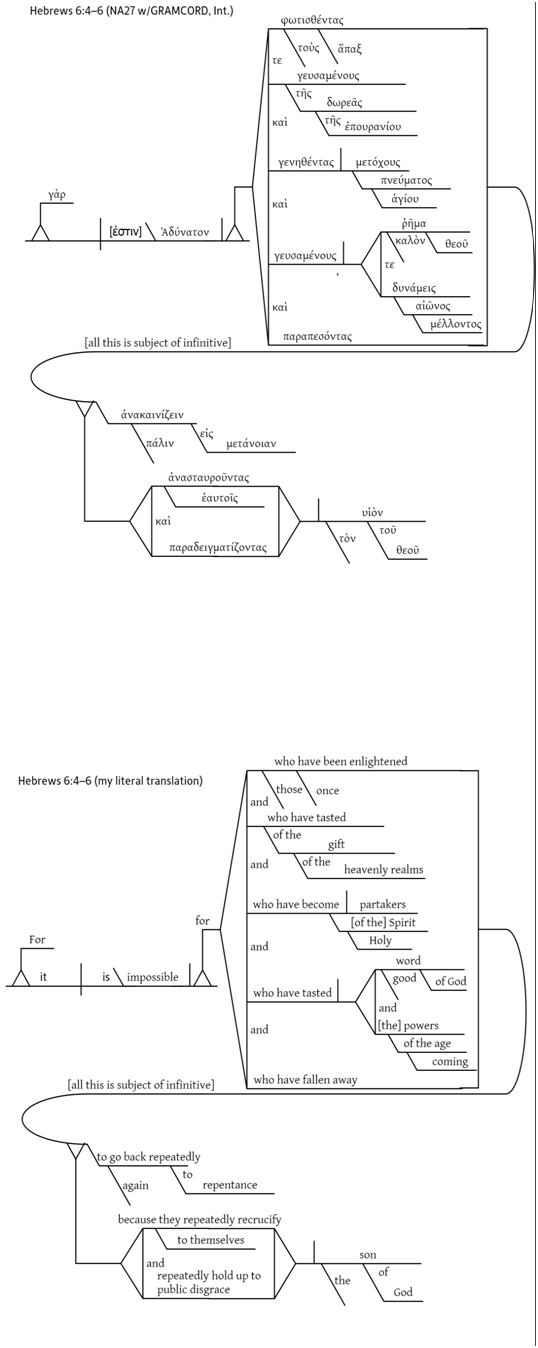
Hebrews 6:4–6 Sentence Diagram

Did I mention how much I like doing sentence diagrams?

November 22, 2011

Hebrews 6:4–6: Wrapping It Up

Filed under: Biblical Studies,Greek,Hebrews,New Testament,Soteriology — Scott Stocking @ 9:40 pm

For those of you who didn’t follow the comment thread on the latest SMGB post, I wanted to sum things up. My friend Eric Weiss and I tossed around a few ideas on the passage, and my cousin-in-law Micheal added some comments about context and audience.

I had always looked at that passage as primarily having to do with the threat of losing your salvation. I have never held to a “once-saved-always-saved” theology, and I still don’t. But after diving into this passage and some fruitful discussion, I see that the passage isn’t about the danger of losing your salvation, but about the futility of trying to be a mature Christian when all you ever dine on is milk and baby food. The author (the “I” of 13:22–23; I think it is Luke, but no one knows for sure) has a steady argument building from the opening chapter of the epistle, but it takes on a full head of steam beginning in 5:11. It is the flow of that argument that is key to understanding the author’s intention in the broader context of Hebrews 5–10.

The immediate passage of 5:11 through 6:12 is bracketed by the author’s warning about laziness. In vs. 11, he says (my translations) “You have become lazy listeners”, but in 6:11–12, he exhorts them to diligence, “in order that you do not become lazy.” He says in 5:12 that instead of the Hebrews being teachers, “you are needing someone to teach you continually the word of God all over again” (note verb tense is present continuous). Then he switches to the perfect tense: “You have become needful of milk.”

In 6:1, the author says that “repentance from acts that lead to death” (TNIV), among other things, is milk. He wants them to move on. But here is where the present tense infinitive of 6:4 becomes significant: “If you want to move onto maturity, don’t repeatedly go back to repentance thinking that that is all you need. You moved past that, because you were enlightened and you tasted the heavenly gift, the Word of God, and the Holy Spirit. But then you fell away. So repentance won’t cut it now. It’s time for you to get back to a meat-and-potatoes diet by diligently persevering in the faith” (see 5:14 “constant use” and 6:11 “show this same diligence”).

So the “falling away” is not an irrevocable apostasy. It suggests in this context that the readers have backslidden and need to pull themselves up by their bootstraps and get down to the business of being sold out for Christ. The author goes on in the rest of Hebrews 6 to assure the believers of God’s promise, “this hope as an anchor for the soul” (6:19).

Peace,

Scott Stocking

November 1, 2011

“Father, Forgive Them…” (Luke 23:34)

A friend of mine asked me the following question on Facebook and gave me permission to post the question and my response (edited a bit) here.

Here’s a question for you, Scott. Was just reading Luke 23:34 where Jesus says, “Father, forgive them for they do not know what they are doing.” Really? They didn’t know what they were doing? Then can’t we all be absolved on the same basis, that we don’t know what we are doing? Also, didn’t they know in some sense what they were doing? Didn’t they at least know they were murdering an innocent man? They knew they were having to “plot” against him . . . Just wondered.

Some observations:

  1. You are not alone in questioning this statement. It is in double brackets in the Greek text, which means it is of questionable authenticity but was retained given its prominent place in church history and liturgy. (In the UBS 3rd edition of the Greek New Testament, the statement has a C rating on a scale of A to D, with A representing the highest certainty that the original text is restored.) I could not find the statement in any of the other Gospels, so it appears to be unique to Luke.
  2. Who are the “them” he forgives? The immediate context seems to suggest they’re the soldiers, who were only following orders and didn’t have a clue about Jesus being the Son of God and Savior.
  3. John 11:49–52 seems to imply that the leaders really didn’t understand the full implication of what they were doing. Yes, they knew they were plotting, but John’s statement about Caiaphas’s unwitting prophecy seems to imply the Jewish leaders were more or less in the dark about who Jesus really was and is.
  4. We can offer forgiveness to anyone regardless of intent, motivation, etc. Jesus is not declaring that they are forgiven, but rather asking the Father to forgive them. “Ignorant” people sin all the time: ignorance is no excuse for sin (or civic lawbreaking for that matter), but it is not unforgivable. Great question!

[For those of you wondering when something from Thessalonians or Timothy is coming along, please be patient. I’m working on an update of my treatment of women in leadership from 1 Timothy 3 and surrounding contexts. It’s taken on a life of its own, it seems, and I keep learning new truths about the passage.]

Peace!

Scott Stocking

October 12, 2011

Called to Suffer? A Quick Word Study of πάσχω in Greek

Filed under: Biblical Studies,Greek,Romans — Scott Stocking @ 8:47 pm

A friend of mine asked me about the Greek words for “suffering” in Romans 8:16–17 and 1 Peter 2:21. I’ll give a brief excursus here on what I found.

Romans 8:16–17 says this in the NIV:

16 The Spirit himself testifies with our spirit that we are God’s children. 17 Now if we are children, then we are heirs—heirs of God and co-heirs with Christ, if indeed we share in his sufferings in order that we may also share in his glory.

The word for “share in [his] sufferings” in vs. 17 is συμπάσχω (sympaschō, \soom PAHSS khoh\), which is only used twice in the entire NT, here and in 1 Corinthians 12:26 with reference to the whole body suffering when one part suffers. This is a compound word from the preposition σύν (syn, \SOON\ “with”) and πάσχω (paschō, \PAHSS khoh\ “suffer”). The σύν- prefix is a favorite tool of Paul’s to indicate “together with,” often in the context of fellowship with other Christ-followers or sharing something with Christ. Ephesians has over 20 σύν-prefixed words that reveal that meaning. Although the gospels and some of the general (=non-Pauline) epistles frequently use the word πάσχω for the suffering and death of Christ, Paul himself only uses the word to reference the suffering of Christ-followers. Romans 8:17 is an exception with his use of the compound.

My friend was concerned that the passage was taken out of context. There is no question that Paul is saying we must share in the sufferings of Christ to share in his glory, but since he never uses either of the words (the root or the compound) elsewhere to refer to those sufferings, what does he mean by the phrase? I think little else can be meant by Christ’s sufferings than his passion and crucifixion. In the context of Romans, however, I believe there is a connection, at least in part, between this passage and the discussion of baptism/immersion in Romans 6. Romans 6 contains several σύν-prefixed words (4 in 11 verses, by my count, plus one occurrence of the preposition itself), and 6:4 has the verbal connection of the word “glory” (a σύν-prefixed form in 8:17). Other verses like Galatians 2:20 (“I have been crucified with Christ”) and Romans 6:6 (“our old self was crucified with him”) confirm in my mind that Paul’s reference in 8:17 refers to our identification with the death of Christ. Paul also speaks of the battle between the law and sinful humanity in Romans 7 and 8 (see esp. 8:3–4), so I think another part of the suffering reference is to that battle we face in the flesh, just as Christ did, even though he never sinned.

I want to quote the larger context of 1 Peter 2:21. Peter uses the word πάσχω 11 times in his first epistle, with 4 of those coming in 1 Peter 2:18–23 (NIV):

18 Slaves, in reverent fear of God submit yourselves to your masters, not only to those who are good and considerate, but also to those who are harsh. 19 For it is commendable if someone bears up under the pain of unjust suffering because they are conscious of God. 20 But how is it to your credit if you receive a beating for doing wrong and endure it? But if you suffer for doing good and you endure it, this is commendable before God. 21 To this you were called, because Christ suffered for you, leaving you an example, that you should follow in his steps.

22 “He committed no sin, and no deceit was found in his mouth.”

23 When they hurled their insults at him, he did not retaliate; when he suffered, he made no threats. Instead, he entrusted himself to him who judges justly.

There is no “call to suffer” here, but only a call to endure, especially if it comes upon us unjustly. The word πάσχω here refers both to our own “suffering” as well as Christ’s suffering, and primarily to the former in the rest of 1 Peter. It’s not something we should seek out, as if suffering is an end unto itself. Paul is just recognizing that suffering happens, and it’s to our credit if we bear up under it and don’t sin.

I hope this helps my friend, and I hope my quick study helps you as well.

Peace!

Scott Stocking

Spiritual Warfare in Ephesians

Paul’s letter to the Ephesian believers is a goldmine of theological truth and practical living. Paul writes about our standing in Christ in the first three chapters, and then makes an obvious switch in tone in the final three chapters to speak about how we should live in Christ (there are 40+ imperative verbs in the last three chapters of Ephesians, as opposed to 1 imperative verb in the first three chapters). As I will show in this post, this letter has a very nice overall chiastic structure, numerous patterns of three, and definite subtheme of spiritual warfare. Ephesians is so eminently practical that I used to joke I couldn’t preach a sermon without referencing Ephesians at some point. I have had the NIV text of Ephesians memorized for almost 20 years now, but with the release of the new NIV this year, I guess I’ll have to upgrade my memory!

The Overall Structure of Ephesians

Many scholars and study Bibles have presented various outlines of Ephesians. Watchman Nee, a prominent Brethren preacher in China in the mid 20thcentury, wrote an excellent treatise on Ephesians called Sit, Walk, Stand. His rough outline is that we have to sit at the feet of Jesus and learn who we are in Christ before we can walk in faith and stand against the powers of darkness. The irony of walking before standing does not escape his treatise either. Several years ago, I discerned the following outline, and this has been my schema for approaching Ephesians.

I.    1:1–14        Introduction and Blessing

II.    1:15–18a    Opening Prayer for Enlightenment

A.    1:18b        The Hope to which he has called you

  B.    1:18c        The Riches of his glorious inheritance in the saints

   C.    1:19a        His incomparably great Power

III.    1:19b-6:24    The Enlightenment Offered

   C.    1:19b–2:10    The Resurrection

  B.    2:11–3:21    Coheirs with Israel (2:12, 19; 3:6)

A.    4:1–6:24    Hopeful Living

    1.    4:1–16        Life empowered by God’s blessing and grace

    2.    4:17–5:21    Life among the pagans

    3.    5:22–6:9    Life in your own household

    4.    6:10–20    “Life” in the heavenly realms

IV.    6:21–24    Conclusion

Power, Riches, and Hope.

What more could a Christ-follower ask out of one epistle? Power, riches, and hope. But the power of the resurrection actually pervades the epistle in Paul’s characterization of the Christ-follower’s life “in the heavenly realms.” Paul uses that phrase (ἐν τοῖς
ἐπουράνιοις en tois epouraniois, \en toyss eh-pooh-RAH-nee-oyss\) five times in Ephesians (1:3, 20; 2:6; 3:10; and 6:12). In the opening verses, Paul assures the believers that they, corporately, have the fullness of God’s spiritual blessing for carrying out his will “on earth as it is in heaven.” We know from the next two verses (1:20; 2:6) that the heavenly realms are where we are “seated together” with Christ. Up through chapter 2, then, it appears that “the heavenly realms” is just another expression for heaven itself; but as we will see in chapters 3 and 6, the concept is much broader.

In chapter 3, there are those in the heavenly realms, identified as rulers (ἀρχή archē, \ar KHAY\; you have to clear your throat a bit to say the KH) and authorities (ἐξουσία exousia, \eks ooh SEE ah\), to whom the “church” (ἐκκλησία ekklēsia, \ek klay SEE ah\, God’s “congregation” on earth) is responsible to reveal the mystery of the gospel. This statement makes it rather obvious that the phrase ἐν τοῖς ἐπουράνιοις does not refer to “heaven” (οὐρανός ouranos, \ooh rah NAWSS\) proper, the eternal dwelling place of God’s holy ones. We know everyone in heaven knows about the gospel, but who are those “in the heavenly realms” that need to know about it? Chapter 6 broadens the scope even more: “For our struggle is not against flesh and blood, but against the rulers, against the authorities, against the powers of this dark world, and against the spiritual forces of evil in the heavenly realms.” So the heavenly realms encompass the entire spectrum from good to evil. But again, who are the inhabitants?

Walter Wink and Language of Power in the New Testament

For the answer to that question, I turn to the man who is probably the world’s leading scholar on the language of power in the New Testament, Walter Wink. If you’re not a pacifist, you might have a little trouble swallowing some of his liberal theology, but if you read his works, keep an open mind, because I believe he has profound insight into the concept of spiritual warfare. (I’m becoming more of a pacifist myself as I get older, but I’m not necessarily opposed to all wars.) His Powers trilogy (Naming the Powers, Unmasking the Powers, Engaging the Powers) is nicely condensed into a very readable volume entitled The Powers That Be (from which I will derive most of the material I present here). To put it simply, the powers and authorities of which the Bible speaks are entities created by God as stewards of various institutions in life (material or abstract), but they are also influenced by the people who inhabit those institutions. The powers are in the same boat as we humans, but on a much larger stage. They are, according to Wink (p. 31):

  • Created good;
  • Fallen; and
  • In need of redemption.

I cannot go into the details of Wink’s description of the powers, but in a nutshell they are the spiritual entities that, in a pure state, watch over human institutions for the common good they were designed to fulfill. Families are one example of an institution. Your own immediate family may have one power (akin to a guardian angel in my own thinking, but I’m not sure Wink would agree), but your extended family has another power that “governs” (or perhaps is governed by) the individual family powers. Do you behave differently at home than you do around your grown brothers and sisters? That may be the powers at work.

Businesses and corporations are also institutions influencing and influenced by powers. If you read the mission statements or core values of most corporations, you will see that they ideally exist to further the common good. However, when corrupt individuals begin to exercise wicked influence within a corporate setting, powers begin to take on the nature of the “corporate culture” and may even be or become the culture itself. If an individual bucks or rebels against the prevailing corporate culture, for good or evil, the corporate culture will generally disenfranchise the rebel. Just look at Enron, for example. Much of what happened there perpetuated itself after a while. Whistleblowers are not well liked when calling a corporation to accountability.

On the other hand, when a corporation does something right, it becomes a win-win situation. The Tylenol scare back in the 80s is a perfect example of this. Tylenol was forced to recall millions of dollars worth of product because of some isolated tampering incidents. Even though the incidents were local, Tylenol’s maker recognized the gravity of the safety issues involved and took the loss. Tylenol is still around today, 30 years later, along with its generic competitors. In doing the right thing, they not only set an example for the employees and their families that they care about integrity, but they also sent a powerful message resounding through the corporate world: “Do the right thing no matter the cost.”

Violence and the Powers

Violence also has a powerful influence on the powers, according to Wink. Violence can include anything from yelling and screaming to bribery to the use of deception and deadly force to obtain one’s ends. Violence breeds more violence and establishes a culture of violence. Wink distinguishes between the legitimate use of force to restrain evildoers and violence, which is the “morally illegitimate or excessive use of force” (p. 159). The ultimate goal, in Wink’s view, is nonviolent conflict resolution regardless of the nature or intensity of the conflict. By extension, you can say the same things about sexuality and pornography, gambling, alcohol abuse, and drug abuse. When any of those abuses of the created order become inappropriately prominent in an institutional culture, the culture becomes corrupt and in need of redemption.

Prayer, the Church, and the Powers

So what does all this have to do with you and me? I return to Ephesians 3:10 and 6:12. The body of Christ has the responsibility to work redemptively in the face of corrupt institutions and corrupt culture. Every time Christ-followers share the gospel with unbelievers, they speak not only to the unbelievers but to the powers and authorities that have influence on the unbeliever. Whenever Christ-followers speak out and act peaceably and redemptively against corporate and societal injustices, they send a powerful message to the powers and authorities behind those institutions. In some respects, it may be a numbers game: the more Christ-followers show they care about justice, peace, and redemption, the more influence that has on the powers.

But Wink takes the whole concept one step further by invoking prayer. Regardless of what you think about his general theology, I think Wink hits the nail on the head when it comes to prayer. A couple quotes from his chapter on “Prayer and the Powers” (p. 180ff) make the point: “Prayer is never a private inner act disconnected from day-to-day realities. It is, rather, the interior battlefield where the decisive victory is won before any engagement in the outer world is even possible….Unprotected by prayer, our social activism runs the danger of becoming self-justifying good works” (p. 181). A little later he writes, “The profound truth of this worldview is that everything visible has an invisible or heavenly dimension. Prayer in this worldview is a matter of reversing the flow of fated events from on high to earth, and initiating a new flow from earth to heaven that causes God’s will to be done ‘on earth as it is in heaven.’…What happens next happens because people pray” (pp. 182–3). So prayer combined with action is at the heart of spiritual warfare. Neither one is sufficient by itself, but of the two, I would argue that prayer is eminently more powerful in opening the doors of opportunity.

Some Examples, Positive and Negative

My brother (who will be back on American soil this week) spent the last year in Afghanistan with his construction unit building infrastructure for the Afghani army. That, in my mind, is a nonviolent means to support the legitimate defense of a sovereign nation. (I’m proud of him and his crew and what they accomplished, and the whole family is anxiously awaiting his return to Omaha.) I taught a course last year in Las Vegas and have a few former students who are working redemptively in the gambling industry. It’s not a concession to the gambling industry, but an opportunity to fight the good fight in the heavenly realms.

On the flip side, Westboro Baptist Church in Topeka, Kansas, has the wrong attitude about spiritual warfare. Whatever one may think about their sincerity, their protests against homosexuality and the military only serve to fuel the violence of the powers. The hate that spews forth from their actions and words comes nowhere close to bringing redemption to the powers in my opinion. In fact, one of the best ways to confront evil is to promote an attitude of love. This doesn’t mean tolerance of sin, but a respect for each person as uniquely human and worthy of respect as a special creation of God. As individual behaviors change, the powers respond. But individual behaviors change not from protests and words of condemnation, but from individual acts of love and service toward one another. If God’s kindness leads us to repentance (Romans 2:4), shouldn’t we expect our own kindness to do the same for those within our sphere of influence?

I myself have had experience on both sides. At one time in my ministry, I wrote passionately against homosexuality. But I also came to realize that if I didn’t get out and actually meet and interact with homosexuals, my words would fall on deaf ears, and I’d only be preaching to the choir. When I began to develop some social relationships with homosexuals, I began to see the impact I could have in making a positive presentation of Christianity. It wasn’t that every homosexual with whom I came in contact became a heterosexual, but some did begin to have a positive attitude toward Christianity where there had only been hatred and vitriol before.

The same can be said for a Christian response to abortion. We have a more powerful impact against abortion by supporting a woman through an unplanned pregnancy, helping her to bring the baby to term, than we ever will with all of our protests and (even worse) the vandalism and bombing of abortion clinics or the murder of abortion doctors.

This is why Paul is able to speak so highly of love in 1 Corinthians 13. Love is the ultimate tool (I refuse to call it a weapon) in the fight against sin, evil, and corruption, and at a minimum, it has to happen one person at a time. Love is superior to all other actions, and when we “live a life of love” (Ephesians 5:2), we speak to the redemption of the spiritual forces at work in the heavenly realms.

Conclusion

Spiritual warfare is a topic that has a lot of craziness around it, as well as a lot of well-intentioned but sadly misguided theology. I hope this post has enlightened you on the concept, and I pray that you will recognize the power that you have to speak and act redemptively as warriors in the battle in the heavenly realms. Put on the whole armor of God, and you will be ready to fight the good fight boldly and victoriously.

Peace!

Pastor Scott Stocking, M.Div.

My views are my own.

October 4, 2011

πείθω A Word Study (PowerPoint)

This is the substance of what we dealt with in HUB for Week 5. We will finish our discussion of the passage in Hebrews 13:17-18 this Wednesday.

HUConcordance

If you want another example of a word study, although rather in depth, please see this week’s post on tongues.

Scott Stocking

September 18, 2011

“We Despaired of Life Itself”: 2 Corinthians 1:8–11; 4:7–10

Filed under: 2 Corinthians,Biblical Studies,Greek — Scott Stocking @ 8:48 am

8We do not want you to be uninformed, brothers and sisters, about the troubles we experienced in the province of Asia. We were under great pressure, far beyond our ability to endure, so that we despaired of life itself. 9Indeed, we felt we had received the sentence of death. But this happened that we might not rely on ourselves but on God, who raises the dead. 10He has delivered us from such a deadly peril, and he will deliver us again. On him we have set our hope that he will continue to deliver us, 11as you help us by your prayers. Then many will give thanks on our behalf for the gracious favor granted us in answer to the prayers of many.

My oldest brother, Neal, and his oldest son, Jeff, have been deployed in Afghanistan for the past year with their respective Guard units. Neal, who has been leading a couple construction units in two different parts of Afghanistan, is due to come home next month. Jeff has been serving as an MP at one of our bases in Afghanistan and will probably be home sometime between Thanksgiving and Christmas. I am proud of both of them and applaud them for their service to and sacrifice for our country. Both of Neal’s kids are grown. Jeff’s residence is in Omaha, and his son Chris lives in Kansas City. Neal’s wife Anne has been an absolute trooper as well, holding down the homestead in Omaha, and we’ve done what we can to support her and keep her engaged with the family in this time. It hasn’t been easy for her, but I hope she knows we have her back. Jeff is “unattached” (so far as we know, anyway!), but he still has his circle of friends whom I’m sure he misses and can’t wait to be reunited with.

My own life in the past year has been a microcosm of Jeff’s and Neal’s experience in the past year. One year ago this week, God “deployed” me back to my hometown of Omaha, Nebraska, to experience some victory over the long battle I fought in Illinois with underemployment. I do not regret that during my underemployment in Illinois, I had the freedom to be there for my kids on a daily basis. I was the “soccer dad”, getting them to school every day (and sometimes subbing for their teachers!) and to their appointments, practices, games, and other events with friends. I was involved in every aspect of their lives.

Divorce wrenched me away from all that. Without full-time work in Illinois, and with zero hits on the countless positions (over two years of daily searching job opportunities; I lost count of how many) I applied for in Chicago and other places close to home, and with no other family nearby, it was impossible for me to support myself there and provide the kind of support for my kids that they deserved. I had distinctly heard God calling me back to Nebraska (“There Is No Place Like Nebraska” kept ringing in my ears), and I knew that’s where God wanted me to go. Upon reflection, I think the homesickness I had been feeling for Nebraska since about 2005 may have been God telling me that I should have gone back then, but uprooting the kids seemed out of the question, and it certainly would have been a battle with my current ex I probably would not have won, or it may have forced her hand to file for divorce then. That’s all speculation and water under the bridge now, and when I had no other choice after the divorce, I went forward with my plans to come back to Nebraska and be a “boomerang child.”

God honored my faithfulness to follow his lead in several ways. I got hired my first full day back in Nebraska for the first FT job I’d had in years. It was a temp job, but I was back on my feet. That led to my current job, the best-paying job I’ve ever held in my life. It’s a great job, and I’m using all my skills, from math to English to writing and editing. I also got reconnected to my former church. Fort Street Christian Church sent me off to seminary 24 years ago, and when I came back last year, Fort Street had become StoneBridge. Attendance had quintupled, and the congregation was as vibrant as any I had ever experienced. I made connections and new friends almost immediately, and I have experienced a great deal of spiritual and personal growth through my involvement there. The church has become my family here; I wasn’t going to sit around and bemoan the lost daily interaction with my kids, and I’ve used my relocation as an opportunity for God get some work done in me that I had neglected as a busy dad and resident home-improvement servant. My brother and nephew get hazard pay for being on foreign soil. My hazard pay has been the spiritual growth I’ve experienced.

But amidst that, I’ve still been struggling with the separation from my kids. It’s been difficult to meet my financial obligations, and as such, I haven’t been able to see my kids as often as I like. My ex refuses to meet me half-way to transfer the kids, so I have to make the 8-hour, one-way trip whenever I want to see them and spring for a hotel room. And if I want to bring them back to Omaha with me, that’s another 8–10 hours in the car. My ex constantly reminds me how that’s a “punishment” for the kids and that pretty much everything else I do is “punishment” for them, taking them away from their friends and activities to come to Omaha to spend time with me, and that it was my choice to move 500 miles from the kids (never mind I’m providing a lot more child support from here than I could have from Illinois; more “hazard pay” for the family). I know it’s not punishment, but sacrifice, but some days the stress of my separation makes me feel like Paul in the 2 Corinthians passage I quoted above.

I know the God of all comfort knew what he was doing when he deployed me to Nebraska. I have already seen some of the fruit he is bearing in my life, as my half-sister and dad have started coming to StoneBridge as well. I have a renewed spiritual vigor and great opportunities for service. But that has been kept in check by the incredible sense of loss I feel at being separated from my kids. Yes, I still have regular contact with them on the phone and through Skype (when the video connection works), but as you might imagine, it’s not the same for me or for my kids. I feel the despair of death some days, the pain is that deep, but I know God and my brothers and sisters in Christ and my family are upholding me.

For those of you looking for the Greek (and I debated whether I should include any at all in this post), here it is. Paul uses the Greek word for “despair” ἐξαπορέομαι (exaporeomai, \eks ah paw REH aw my\) or ἐξαπορέω (exaporeō, \eks ah paw REH oh\) only twice in all his writings (and the only two times in the New Testament). Strong’s Enhanced Lexicon says the word derives from ἐκ (ek, ‘from’ or ‘out of’) + ἀ (a, negative prefix) + πορεύομαι (poreuomai, ‘go’), or in other words, “not go out of” or figuratively “internalize,” thus Paul’s comment about feeling the weight of the pressure he’s under. I can see that, but I also discern another possible etymology: ἐκ (ek, ‘from’ or ‘out of’) + ἀπό (apo, ‘away from’) + ῥέω (rheō, ‘flow’), or “go out of and away from” or figuratively “abandon”. Either etymology is fitting of my own situation. The only other time Paul uses the word is a couple chapters later in 2 Corinthians 4:7–10:

7But we have this treasure in jars of clay to show that this all-surpassing power is from God and not from us. 8We are hard pressed on every side, but not crushed; perplexed, but not in despair; 9persecuted, but not abandoned; struck down, but not destroyed.
10We always carry around in our body the death of Jesus, so that the life of Jesus may also be revealed in our body.

The word for “perplexed” (contrasted with “despair”) in this passage is the same word in Greek without the ἐκ- prefix. As with the passage from chapter 1, this passage also brings me comfort: I’m at my wits’ end, but I haven’t yet given up all hope, although I feel the pressure to give up more and more. And maybe that’s the point of all this. Like 2 Corinthians 1:9 says, all this is happening so that I might not rely on myself (I’m certainly finding out that’s not working), but that I should rely totally and completely on God. After all, he raised the dead; he can certainly see me through my current struggles.

A side note: I know I may have come across a little harsh on my ex-wife here, but that is the reality of my situation. I know she is doing the best she can for the kids, and I’m sure she feels a different kind of pressure dealing with the kids daily without me being in the area to provide regular relief. In spite of our continued arguments about things, I know she’s doing a great job, and I trust that all things will work out for the best for all of us. My kids are strong and doing well, but I know they miss my presence as much as I miss theirs. I would appreciate your prayers for all of us.

Peace to all!

Scott Stocking

September 5, 2011

Body, Love, and the Temple of God: A Summary of Unity in 1 Corinthians

Filed under: 1 Corinthians,Biblical Studies,Ecclesiology,Ephesians,Greek — Scott Stocking @ 9:43 pm

One of the major themes of 1 Corinthians is unity. From the opening chapter, Paul drives home the point that there should be no divisions in the body of Christ (1 Cor 1:10ff). In chapter 3, Paul draws on the imagery of the Temple to make his point about unity. As we will see, this isn’t the only time he uses this imagery, but there are some important points to make here.

1 Corinthians 3:16–17

I want to start with 1 Corinthians 3:16–17 today, because it is a passage often misunderstood and misapplied in very damaging ways. The passage reads as follows:

UBS4 Greek text: οὐκ οἴδατε ὅτι ναὸς θεοῦ ἐστε καὶ τὸ πνεῦμα τοῦ θεοῦ οἰκεῖ ἐν ὑμῖν; εἴ τις τὸν ναὸν τοῦ θεοῦ φθείρει, φθερεῖ τοῦτον ὁ θεός· ὁ γὰρ ναὸς τοῦ θεοῦ ἅγιός ἐστιν, οἵτινές ἐστε ὑμεῖς.

Transliteration: Ouk oidate hoti vaos theou este kai to pneuma tou theou oikei en hymin? Ei tis ton naon tou theou phtheirei, phtherei touton ho theos; ho gar vaos tou theou hagios estin, hoitines este hymeis.

Pronunciation: \oohk OI-dah-teh HOT-tee nah-OSS theh-OOH ess-teh keye taw PNOOH-mah tooh the-OOH oil-KAY en hoo-MIN? EI tihs tawn na-AWN tooh the-OOH PHTHAY-ray, PHTHEH-ray TOOH-ton haw theh-OSS; haw gar nah-AWSS tooh theh-OOH HAH-ghee-oss ess-tin, HOI-tee-nehs ess-teh hooh-MAYSS\

My translation (I use “y’all” to distinguish “you” plural in the Greek, since the English word “you” may either be singular or plural): Don’t y’all know that y’all are the temple of God and the Spirit of God is dwelling in y’all? If someone destoys the temple of God, God will destroy that person. For the temple of God is holy, which y’all yourselves are.

This passage is very close to Ephesians 2:21–22: “In [Christ], the whole building is joined together and rises into a holy temple in the Lord, and in [Christ] y’all are being built together in the Spirit into a dwelling of God.”

The first thing to notice about the 1 Corinthians 3:16–17 passage is that it is stated in the second person plural. Many well-intentioned Christ-followers through the years have seen in this passage a condemnation of suicide, such that a doctrine has developed among some sects that suicide is an unforgivable sin that damns the victim to an eternity in hell. But a doctrine of suicide is not even remotely close to Paul’s thinking when he writes this passage. Quite frankly, anyone who tries to purport the idea that this passage has to do with suicide is bordering on abuse, especially if that person pontificates that misinterpretation to a grieving family that has experienced a suicide.

1 Corinthians 6:19–20

The context of 1 Corinthians is that of unity. When Paul says that all of us who are Christ-followers are collectively the temple of God, he is referring to the body of Christ. In 6:19–20, Paul says essentially the same thing: “Or don’t y’all know that y’all’s body [singular] is a temple [singular] of the Holy Spirit who is in y’all, whom y’all have received from God, and that y’all are not your own? Y’all were bought with a price; therefore y’all glorify God with y’all’s body [singular].”

1 Corinthians 10–12

But Paul is not finished talking about the body in 1 Corinthians. Paul later speaks of the body in his discussion of the Lord’s Table, or communion. But even then, the context is unity and not causing a fellow Christ-follower to stumble: “Is not the cup of thanksgiving for which we give thanks a participation in the blood of Christ? And is not the bread that we break a participation in the body of Christ? Because there is one loaf, we, who are many, are one body, for we all partake of the one loaf” (1 Corinthians 10:16–17).

In the very next chapter, Paul again raises the issue of the body with respect to communion: “So then, whoever eats the bread or drinks the cup of the Lord in an unworthy manner will be guilty of sinning against the body and blood of the Lord. Everyone ought to examine themselves before they eat of the bread and drink of the cup. For those who eat and drink without discerning the body of Christ eat and drink judgment on themselves” (1 Corinthians 11:27–29).

I believe in both chapters 10 and 11 there is a twofold understanding of the “body.” In one respect, it refers to the physical body of Christ as the sacrificial lamb, thus the additional reference to his blood. But Paul also says “we…are one body,” that is, the body of Christ. What is at issue in chapters 10 and 11 is that some of the Christ-followers are causing others to stumble and perhaps even fall away from the faith because of their actions. In chapter 10, some believers are eating meat knowingly offered to idols, then turning around and participating in the Lord’s Table. Paul rightly calls them out on their duplicity: you can’t have it both ways; you have to make a choice.

In chapter 11, some of the wealthier believers are making gluttons of themselves at the agape feast at which the Lord’s Table was offered. The offenders are told to eat at home so everyone else has a chance to eat together. The “unworthy manner” (an adverb, not an adjective in Greek) is not that they’ve sinned and aren’t worthy of the bread and the cup (again, an abusive interpretation of the passage), but it is the failure to uphold Christian unity and the pride of the proud that causes the weak to stumble (see also 1 Corinthians 9:1–12).

Paul continues in 1 Corinthians 12, where he further details the function of the body, not anatomically or physiologically, but spiritually. Each of has a role to play. Some roles receive much attention, and other roles are more behind the scenes. Not everyone has the same role, and we shouldn’t judge those who don’t necessarily fit our idea of what the other’s role should be. Each person is uniquely gifted by the Holy Spirit, and together, the body of Christ produces a beautiful melody.

Application

I think this unity can happen regardless of the size of a local congregation. The body of Christ worldwide, of course, is blessed with every spiritual gift, but not everyone has every spiritual gift. Large congregations are microcosms of the body of Christ as a whole. Small congregations are gifted proportionally to the size of the congregation. Corporately, the small congregation may not manifest every spiritual gift among its members, but it does manifest what the Spirit has determined it needs to glorify God in their midst if the Christ-followers there are obedient to their respective callings.

Paul boils down all this talk of unity into what is arguably the greatest chapter in all of Scripture: 1 Corinthians 13, the Love chapter. You can have all the academic degrees that fit on a sheepskin, but if you don’t have love, they don’t mean squat. You can know all there is know about any and all subjects, but if you don’t have love, it doesn’t mean squat. I’m glad I’m part of a family of Christ-followers that knows how to love and is teaching me how to love as well. Maybe that’s the learning outcome God has for me! I hope it’s the learning outcome he has for all of you.

We are the temple. We have the Holy Spirit dwelling in and among us to unite us to the Savior. We are the body of Christ, and as Thomas Campbell put it in his primary proposition in Declaration and Address, the body of Christ is “essentially, intentionally, and constitutionally one.”

Peace!

Scott Stocking

August 29, 2011

Filed under: Greek — Scott Stocking @ 6:44 am

free counters

« Previous PageNext Page »

Website Powered by WordPress.com.