Did I mention how much I like doing sentence diagrams?
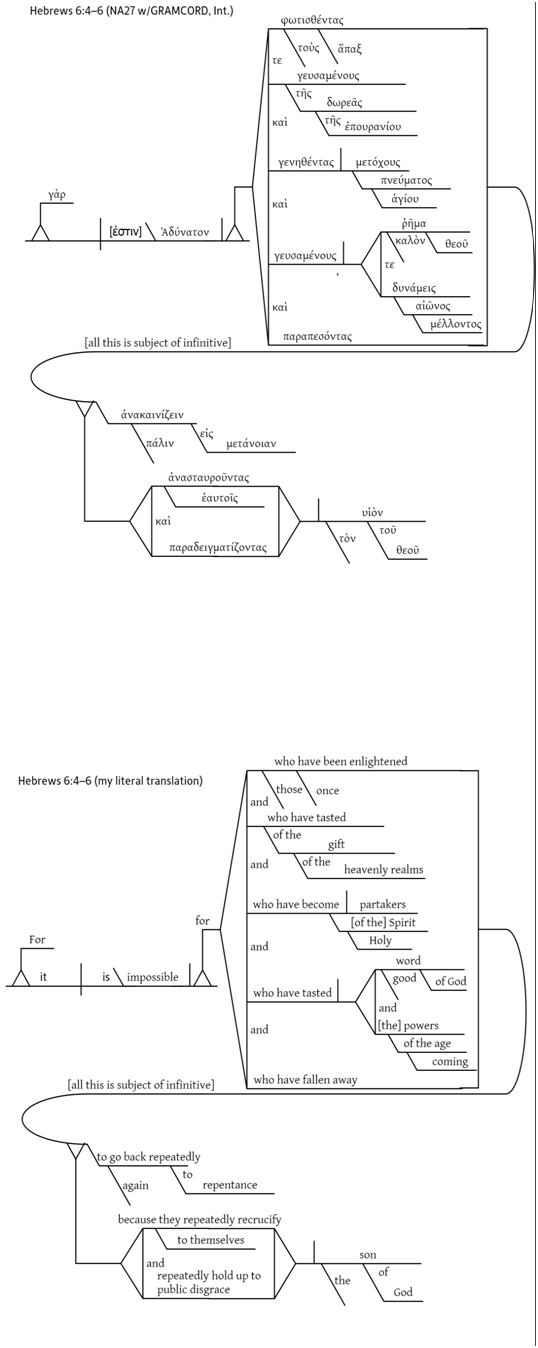
Hebrews 6 is a scary passage to me. I don’t think those who believe in the doctrine of eternal security (i.e., “once saved, always saved”) have ever taken the warnings in this passage seriously. I will address the full context shortly, but the heart of the passage is found in vv. 4–6: “It is impossible… for those who have fallen away (παραπίπτω parapiptō \pah-rah-PEE-ptoh\) to be renewed to repentance.” The question that has always occupied my mind about this passage is, “How far do you have to fall before you can’t be restored to repentance?”
The broader context, Hebrews 5:11–6:12, informs in part the understanding of the warning in verse 6. Verse six also has four words that are only found in that verse in the New Testament, I will break those down later. But first, let me address the context. The author of Hebrews begins this section by chiding the readers for not having obtained a level of maturity they ought to have obtained. In fact, “maturity” is a prominent theme in Hebrews 5–7, which has nine words from the τελειόω (teleioō, \teh-lay-AW-oh\ “I make perfect,” “I complete,” “I become maturity”) family scattered throughout. Hebrews 5:11–6:12 is also bracketed by an inclusio of νωθροὶ γεγόνατε/νωθροὶ γένησθε (nōthroi gegonate/nōthroi genēsthe, \noh-THROI geh-GAW-nah-teh/ noh-THROI GEH-nay-stheh\ “have become lazy”) making the contrast between maturity and laziness even starker.
If that contrast isn’t enough, the author goes on to speak of the need for the Hebrews to go back to baby food (γάλα gala, \GAH-lah\; gen. γάλακτος galaktos, \GAH-lah-ktawss\ “milk”) instead of eating solid food. What I find interesting is what the author of Hebrews considers “elementary” teaching: repentance from dead works, faith in God, teachings about baptism (TNIV: “cleansing rites”), laying on of hands, resurrection from the dead, and eternal judgment. These strike me as pretty important doctrines, but do you notice what is missing? Think 1 Corinthians 13 here, especially where Paul makes the connection between maturity (τελείος) and love. Faithfulness (i.e., acting consistently on faith) and hope are included in the closing verse of 1 Corinthians 13 as well.
The imagery of “eating” is carried through into the stern warning of 6:4–6. Here is the meat, I believe, the author of Hebrews is talking about: being enlightened, tasting the heavenly gift, sharing in the Holy Spirit, and tasting the goodness of God’s word and the powers/miracles of the coming age. I’m not sure if the structure and syntax here is significant: two different words are used for “and” here, one indicating a strong connection (καὶ kai) and the other (τε te) a weak connection. I present a modified diagram below:
4 It is impossible
for those who were once enlightened, also (τε) having tasted of the heavenly gift
and (καὶ) who have been sharers in the Holy Spirit
5 and (καὶ) who have tasted the goodness of the word of God along with (τε) the miracles/power of the coming age
6 and (καὶ) yet have fallen away (παραπίπτω)
for [these people] to renew continually (ἀνακαινίζω anakainizō, \ah-nah-keye-NEE-zoh\) in repentance
because they recrucify (ἀνασταυρόω anastauroō, \ah-nah-stow-RAW-oh\ [\ow\ as in “how”]) the son of God to themselves
and (καὶ) hold him up to public shame (παραδειγματίζω paradeigmatizō \pah-rah-dayg-mah-TEE-zō\).
Allow me to give a brief treatment of each of the four hapax legomena (literally, “once spoken,” referring to words only used once in a text) to better understand what is meant by “falling away” and the other terms.
The word παραπίπτω is found six times in the OT, five of which are found in Ezekiel 14–22, referring exclusively to Israel’s unfaithfulness and defilement, from worshipping other gods to just simply living like God couldn’t do anything for them. The other occurrence is in Esther 6:10, where Haman is instructed not to be unfaithful to the words and actions of praise he unwittingly bestowed upon Mordecai. Given that the word is primarily used of the exiled Jews in the OT, I would hazard a guess that the NT usage of the word has a parallel meaning. In other words, this passage isn’t talking about the normal ups and downs of the life of a Christian, but a steady pattern of unfruitfulness, a lack of faith in God, and even idolatry. (We still have idolatry today, lest we think we’re off the hook.) Judah had to fall pretty far to be removed from the Promised Land and exiled to Babylon. I hope that none of you reading this have fallen that far yet, but if you have, hang on, because all hope is not yet lost.
The ἀνα- prefix of this word and the next word below means “again,” and often times will simply be translated as “re-” plus the base word meaning. The NT doesn’t have a verb for “newing” something, but the -καινίζω part comes from the adjective καινός (kainos, \keye-NAWSS\ “new”). The word is found three times in the LXX, twice in the Psalms (103:5, 104:30) and once at the end of Lamentations (5:21). In the Lamentations passage, Jeremiah says something that is particularly relevant to the Hebrews passage:
21 Restore us to yourself, Lord, that we may return;
renew our days as of old
22 unless you have utterly rejected us
and are angry with us beyond measure.
We know that Israel was eventually restored to the Promised Land, so even the Exile was not enough for God to utterly forsake his people for all time. We are, after all, in a covenant relationship with God. Paul tells Timothy in 2 Timothy 2:13, “If we are faithless, God remains faithful, for he cannot deny himself.” Just as we can’t enter heaven by good works alone, so too we cannot lose our salvation simply on the basis of evil works alone. We would pretty much have to tell God ourselves that we want nothing to do with him any more for him to grant that desire and remove the blessing of salvation.
A question from my friend Eric Weiss in the comments after I originally posted this prompted me to expand on this particular word. I had originally translated the word in the passive voice, “to be renewed,” admittedly because I wasn’t paying attention to the parsing of the verb. It is a present tense active infinitive. As an infinitive, the subject is “those who have fallen away.” As an active voice, it should be translated “to renew” (many translations have “brought back,” but I think “renew” is a better translation). As present tense, the focus of the action is not on the time of action so much as it is on the aspect of the action, that is, it is continuous action. The implication of this goes back to the author’s statement in 6:1 about not returning to repentance. In other words, if you want to advance in the Christian life, repenting over and over again is not the way to go. At some point, you have to decide to grow up and move on to maturity.
Since I’m on the subject of tense, the other two verbs I deal with below are also in the present tense, so the focus there is also on continuous action. If you’re continually repenting, it’s like you’re continually crucifying Christ and continually holding him up to public shame.
Protestants often give Catholics a bad rap about their view of the Eucharist, that the elements actually turn into the body and blood of Christ (the fancy word for that is transubstantiationism). Christ is recrucified in the Mass each week, so the Protestants complain. I don’t want to debate that point, because I don’t think it is profitable, and I don’t know that it is a completely accurate characterization. My point is, the only time “recrucify” is mentioned in Scripture is here in this passage, and it has nothing to do with Eucharistic theology. Those who have fallen so far so as to warrant exile (if we borrow the OT meaning of the word) after having known the enlightenment and blessings of God, must recrucify Christ to restore their salvation. But Christ, let alone anyone else, can only be crucified once. It’s impossible for him to be crucified again. But is that the author’s point here? I’ll come back to that in a moment.
The final hapax legomenon refers to holding Christ up to public shame. If you think about it, though, this is exactly what the original crucifixion was. Hebrews 12:2b (NIV) says, “For the joy set before him he endured the cross, scorning its shame, and sat down at the right hand of the throne of God.” The word for “shame” in Hebrews 12:2 is the more common word (a noun) for “shame” (αἰσχύνη aischynē \eye-SCHOO-nay\), but the idea is the same. In the LXX, παραδειγματίζω is found in Numbers 25:4 in reference to the capital punishment delivered to the men seduced by Moabite women, in Jeremiah 13:22 in reference to those destined for exile, and in Ezekiel 28:17 in the prophecy against the king of Tyre (which some mistakenly take to imply Satan). A related word (δειγματίζω) is found in Matthew 1:19, where Joseph decides he wants to hide Mary so as not to expose her to public shame.
I think the author of Hebrews here uses the hapax legomena because he is using a literary device known as hyperbole. We all know that in spite of the Jews’ idolatry and apostasy (falling away) that got them exiled, God led them back into the Promised Land to rebuild their nation, their religious traditions, and their faith. They never had a problem with idolatry again after the exile, so they learned their lesson. The author is saying it’s a pretty serious thing to trash Christ or trash your faith. In fact, he repeats this warning in even sterner language at the end of chapter 10, which forms an inclusio with this Hebrews 6 passage. The author realizes it is an impossibility to recrucify Christ. His purpose here is to say that Christ’s crucifixion the first time around should have been enough, and they need to get back to living out the implications of that. They could lose their salvation, but it would seem that they had not reached that point yet.
But the author doesn’t think the Hebrews have fallen that far yet. He (they?) says, “We are convinced (πείθω peithō \PAY-thoh\) of better things in your case.” This same confidence is repeated in Hebrews 10 (note the connection to that chapter again) when he reminds them how they endured persecution and exposure to shame and insult, and in Hebrews 13:17–18 with respect to the leaders (NIV: “Have confidence in your leaders” is a better translation in my opinion than “Obey your leaders”).
The author’s remedy for the danger of falling away is to continue meeting together (Hebrews 10:25). The word ἐγκαταλείπω (enkataleipō \en-kah-tah-LAY-poh\; if you’ve been picking up on the Greek, the gamma-kappa γκ is pronounced \nk\) is translated “giving up” (NIV), “forsaking” (NASB), or “neglect” (NLT). This is the same word Jesus quotes from Psalm 22:1 on the cross when he cries out, “My God, my God, why have you forsaken me?” That is how important the author views “meeting together” (ἐπισυναγωγή episynagōgē \eh-pee-soo-nah-goh-GAY\; see a familiar word?) as the body of Christ on a regular basis. Don’t give up. Don’t make excuses. Make it a priority, because it’s for your own strengthening and encouragement as well as for those who attend with you.
Hebrews 11 provides the encouragement for Christ-followers to remain faithful and endure hardships. This is what the author is building to in Hebrews 6–10, especially since he praises them twice for their character, in 6:9–12 and 10:32–39. The patriarchs endured similar struggles, and although they were not perfect, they persevered faithfully even though they never saw the ultimate promise of the Savior.
The bottom line here is the author of Hebrews is puts it in the strongest words he can muster to emphasize it is possible to “lose” your salvation. But he also seems to use language that suggests his readers have not progressed to that point yet. Indeed, it seems to take a pretty serious act of apostasy to lose your salvation (e.g., Matthew 10:32–33; 1 John 2:23). But I think the real message in Hebrews 6–10 is not the author’s warning, but the author’s call to perseverance and faithfulness in the face hardship and persecution. The Jews, after all, spent 70 years in exile, but they eventually returned to their Promised Land. In the last part of Hebrews 9, the author lifts up the blood of Christ, which purifies us from all uncleanness and prepared the way for us to live with our Savior eternally.
Peace,
Scott Stocking
This post was revised from the original on 11/19/11, adding additional material to the ἀνακαινίζω section and additional material on Hebrews 11.
 Sunday Morning Greek Blog