With apologies to VP JD Vance for mimicking his title.
I do not do much personal reflection in this blog. I’m mostly about exegesis (studying the text of the Bible in its original languages), hermeneutics (applying the results of exegesis to the understanding and meaning of the Bible), and lately homiletics (declaring the understanding and meaning of the Bible, especially as a sermon or homily, or in this case, a blog post). This ties in with the taglines for my blog that I put on my “business” card: “Dig deeper. Read Smarter. Draw Closer.” This past weekend, I took the opportunity to go to Fort Robinson State Park in northwest Nebraska to share in a fly fishing expedition with several guys (and the wife of one of them) from our church, including our pastor. The Fort Robinson area has several excellent fishing areas, including several streams and creeks; the first ten miles or so of the White River, which ultimately runs through the Badlands in South Dakota and empties into the Missouri River; and several ponds. Many of these locations are stocked by the State fisheries with trout and other popular species of freshwater fish.
I had never done fly fishing before, but the chance to get away and spend some time with friends old and new outweighed any anxiety I may have had about that. I only spent a few hours fishing at a couple ponds and in the White River, but it was long enough for me to observe others doing it, and I got pretty good at the casting part. I had a few curious little fish check out my fly, but never did land anything, which was okay by me. I was just grateful to be there.
Putting the Pieces Together
Part 1: Reflecting on Exegesis
The timing of the trip was divinely appointed for me as it coincided with some serious reflection I’ve been doing about the relationship between the depth of Bible study I typically do (“Dig Deeper”) and what I expect from the small groups I attend or help lead. That reflection was prompted by a recent post from one of the other pastor-bloggers on WordPress, Veritas Domain, and his short article about his “simplified” exegetical method. His method is similar to mine in that there is a heavy focus on the text itself, which is not unusual. I’m trained in Greek and Hebrew, so I start with those texts first, or at least have them open in parallel with the English translation so I can take note of key words (“Read Smarter”). If I’ve done those first two steps, the “Draw Closer” principle usually follows quite nicely.
In my comment back to “SlimJim,” I mentioned that my method was similar, but along with that, I’m finding that my experience with the two small groups I’m connected with at my church and even with my preaching is that having the knowledge that comes from that kind of in-depth study may not always go over well with those who don’t have that specialized training. In our men’s group, I can typically get away with sharing that when I feel it adds something to the discussion, but even then, one of my friends in the group (who happens to be a preacher’s kid) will sometimes say “All that is nice to know, but I want to know what makes me a better Christian, a better man of God.” That is, he wants to get to the “Draw Closer” part.
This brought to mind an article I read a number of years ago (a 1997 issue of Leadership magazine) by Haddon Robinson, in which he’s quoted as saying, “More heresy is preached in application than in exegesis.” In other words, some of us preachers may be pretty good at exegeting and interpreting God’s word, but how are we doing about translating that into action for our respective audiences? Does it really matter if a divine command is in the aorist tense versus the perfect tense if we don’t follow the command ourselves or encourage our audiences to follow the command, or worse, manipulate the command with malicious intent?
Part 2: The Fort Robinson Retreat
I had decided I would drive to Fort Robinson from Omaha, where I live, by way of Nebraska State Highways 92 (first half) and 2 (second half). Together, those two routes take you through the heart of the State, east to west. In addition, Highway 2 runs through the heart of the Sandhills. If you look at a satellite view of Earth along Highway 2, you’ll see that these Sandhills look like a bunch of sand dunes, but they all have grass growing on them, and several small ponds or lakes are scattered throughout. As I was driving through the Sandhills and listening to Rich Mullins and the Passion CDs (yeah, those date me), I began to understand what the Holy Spirit was trying to teach me. But he was only getting started.
I arrived at Fort Robinson State Park after dark, but not so late that I didn’t get to connect with my church friends who had already been there for a full day. We had breakfast the next morning at a small café in nearby Crawford, then struck out to fish. I went with a friend who had been in my small group when I moved back to Nebraska in 2010 and two of his (now grown) sons whom I hadn’t seen in quite some time. It was my first time fly fishing, so my goal was to get the hang of casting and extending my line. We tried the Ice House pond and then walked about a mile to couple bends in the White River (only about 10 miles from its headwater at that point, so no more than about eight feet wide if that. I had a few nibbles at the pond, but nothing in the river. From there we went back to the Grabel ponds, where I finished out the morning having developed a pretty good technique to cast and extend my line, even landing it on top of a 12-inch fish and spooking it away for a moment.
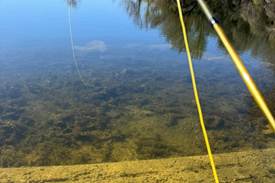
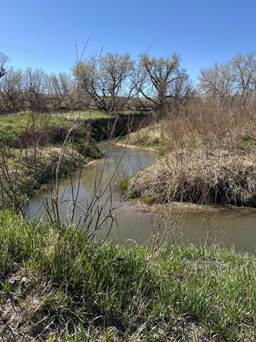
While I was at the section of the White River, I couldn’t help but think and marvel about how God created a means for distributing life-giving water throughout a continent (I knew the term “hydrology,” but I had to look up “limnology” as I was writing this paragraph), especially since, at the end of this month, my brother and I will be at the other end of the White River in South Dakota where it flows through the Badlands (and earns the name “White” from its sediment) and into the Missouri River south of Chamberlain for another fishing trip. God’s creation is an amazing and wonderful thing. That was what the Holy Spirit was continuing to show me, but not for the reason you might think.
Part 3: Sowbelly Canyon Road
One of the sights I had heard about from the guys who had gone up the previous year was Sowbelly Canyon, just north of Harrison, Nebraska. I had no idea what to expect from a “canyon” in Nebraska; certainly nothing like Poudre River Canyon in Colorado where my wife’s family has a cabin. Poudre Canyon is about 50 miles long, and the Poudre River is relatively wide in the canyon. Sow Belly is unique in its own way and was surprisingly beautiful and “cool” in more ways than one. I wish my wife would have been able to come along on this trip.

As you’re driving west on US 20 toward Harrison, you see nothing but a bunch of gently rolling hills on either side of the highway. One would never expect a place of such beauty was just beyond those rolling hills. Even as you crest the top of the canyon, you see an amazing sight below: a single lane dirt road running under a canopy of trees, with unusual rock formations atop the buttes, some of which have formed at right angles. The descent is moderately steep, and at times you have a wall of the canyon on your right (descending) and your left (ascending). At the bottom of the canyon is a small, babbling brook that must have taken a few centuries to form the canyon.
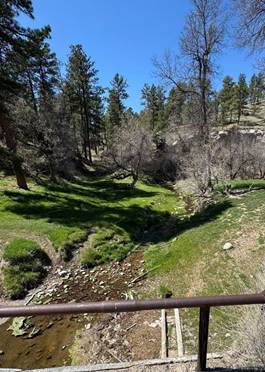
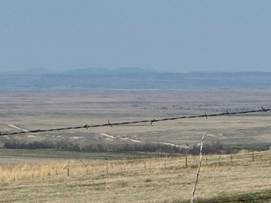
Just before you get to the end of Sowbelly Road on the east end (where it joins Pants Butte Road; no, I’m not making that name up), there’s a spot where you can see at least 80 miles to the north to the Black Hills in South Dakota (the dark mound in the far horizon). Something special happened between God and me via the Holy Spirit on that road, and especially with this particular view. I gained a whole new appreciation for the beauty, majesty, and grandeur of God’s creation. I’d expect something like that in Colorado; I never expected that in seemingly plain old northwestern Nebraska. Boy, was I wrong. What God had started teaching me in the Sandhills came to full fruition at the top of Sowbelly Road.
Part 4: Worldview, Wonder, and Wisdom
So let me bring this all together now. You might remember I started out talking about exegetical methods, methods that were heavily focused on the textual features like grammar, syntax, verb mood and tense, etc. Then it hit me: nothing in my exegetical method intentionally accounts for the majesty and glory of God and his creation. I knew I had to work that in somehow. But God still had one more piece to show me, and it hit me last night at our last small group of the season. Our senior pastor had been with us on this trip, but Sunday morning, one of the teaching pastors was preaching on the trauma Job experienced. I had tried to listen to it Sunday morning while driving through the remotest part of western Nebraska, but just couldn’t get a steady signal.
Fortunately, our Tuesday night group covered it in the study last night, and it was when we were talking about the ending of the book of Job that everything God had been teaching me finally made sense. Job had been arguing with God and his friends about how righteous he was and how he had always given God glory and so on, but God put him in his place. God recounts for Job all that He did by questioning Job: Did you lay the foundations of the earth? Did you create Leviathan and Behemoth? Who are you to tell me how I should act toward you?
That’s when I realized that I’m like Job in that moment. I think I have such a great exegetical method that will keep my doctrine sound and shred every stronghold that tries to set itself against God Almighty, but God’s word is more than the text and the grammar and verb moods and tenses and the participles and the conditional clauses. Those things are static, unchanging. But what does Hebrews 4:12 say? “For the word of God is alive and active. Sharper than any double-edged sword, it penetrates even to dividing soul and spirit, joints and marrow; it judges the thoughts and attitudes of the heart.”[1] Can grammar and syntax do that? I think not.
The other thing that occurred to me is the backstory of how the Jews would understand God’s word versus us gentile Christians. I’ll use just one example here: Communion, or as some call it, the Lord’s Supper or the Eucharist. When we look at the elements (“substantiational” leanings aside), we are meant to experience Christ in some way by “remembering” him. We see one man crucified and risen. But what do Jews remember at Passover? Not one man dying, but ALL the firstborn dying who weren’t protected by the blood of the lamb that they themselves applied to their doorways. They remember God parting the Red Sea so the Israelites could escape the oncoming Egyptians. The disciples didn’t understand immediately that Christ’s death had won them forgiveness and freedom. The Jews DID understand that immediately, with hearts pounding witnessing the very miracles of God at work to rescue them, even as they would tell the stories year after year to their descendants.
Conclusion
In other words, when I exegete and interpret Scripture, I need to look beyond the text and the grammar and all the other “in-the-weeds” details to comprehend a grand vision of a great God and all that he has done and made. That’s where the “draw closer” takes place, as it did for me this past weekend, when I understood who I am in God’s kingdom and that, in spite of his greatness and grandeur, he looks with love at the least of us, at the humblest of us, at our faithfulness. He looks with compassion at those who are lost and searching and even at those who may be angry with him or agnostic toward him, prompting us to share God’s “living and active” word with those who have not yet comprehended that greater vision.
From this point forward, then, I’m adding a couple permanent elements of my “principlizing bridge” (to use Grasping God’s Word’s language) will be to ask first, “How does this passage reveal the glory and majesty and mystery of God to the world?” and second, “How is this passage ‘alive and active’ not only to me but to those I encounter as well?” I feel like I drew a little closer to God this weekend. I pray that my testimony here will do the same for you.

Pastor Scott Stocking, M.Div.
All contents herein are the creative and intellectual property of this author unless otherwise attributed.
[1] The New International Version. 2011. Grand Rapids, MI: Zondervan.
 Sunday Morning Greek Blog