I recognize this is off-topic for my blog, but I love math. And I also discovered that Greek grammar has some features of math properties or laws, so it’s only mostly off-topic.
For expressions and equations that have elements featuring a mix of explicit and implicit operations, implicit operations should be done first without immediate regard to or influence of explicit operational signs. Implicit operations include any form of grouping that involves paired grouping symbols, any juxtapositional grouping or pairing without explicit operational signs implying a particular operation, or a combination of both.
Supporting Evidence for the Bottom Line (added 01/19/24, ~5:45 am CST)
In the .pdf file linked below, the first table describes Implicit Constructions in mathematics and demonstrates that they each have their own unique Syntax and Orientation that leads to an implication (thus the word “implicit”) for how they’re handled in any math expression, specifically that they are given priority in the Order of Operations over explicit (existing) operational signs (+ – x ÷). The second table demonstrates the actual Implicit Operations that take place (e.g., finding a common denominator; converting to an improper fraction, etc.) before addressing explicit operational signs. In ALL cases, implicit operations should be worked prior to explicit operational signs.
I know this is a Greek language blog, but math uses Greek characters sometimes, so there’s at least a tenuous connection. And all truth is God’s truth, even in Mathematics, for which God created the principles, properties, and laws. Being a former high school math teacher myself, I was disappointed at the lack of knowledge of fundamental laws and properties in math that led to many people thinking Expression 1 did not equal 1 in certain viral social media threads. In an effort to restore some truth to people’s mathematical knowledge, I present the following proof that the answer to Expression 1 is ALWAYS AND FOREVER 1.
Expression 1
8 ÷ 2(2 + 2)
Conventions vs. Laws
Many people in the social media chains trying to tackle this problem were claiming that following the order of operations they learned in and impressively remembered from grade school was the correct way to approach the problem:
Parentheses
Exponents
Multiplication/Division LTR
Addition/Subtraction LTR
This order is commonly known in American math as PEMDAS and recalled by the sentence “Please Excuse My Dear Aunt Sally.” I do not deny the importance of PEMDAS, but the reality of the problem is, any basic math problem like this can only have one correct answer. It’s not and never a matter of personal interpretation. Otherwise, the foundations of mathematics would crumble into oblivion, and not even Common Core could save us (not that it ever did anyone any good). This is math; it doesn’t care about and is never affected by your feelings about it.
PEMDAS is only a tool for organizing the operations in the problem, but by itself, it is not sufficient to solve the problem correctly. In fact, PEMDAS isn’t a mathematical law at all. It is merely an agreed-upon convention to work “linear” math problems. Math does have many laws or properties that come into play and must be considered in the PEMDAS process, and PEMDAS is subservient to these laws. Nothing about the correct solution I’m about to show you violates PEMDAS, provided you correctly interpret the forms of the individual expressions within the larger expression and how the various laws and principles apply.
If you think back to your primary school math lessons, you may have a vague memory of a set of laws[1] about the relationships of numbers in certain types of expressions. For example, the Associative Properties of addition and multiplication say that no matter how you group the numbers in their respective equations, the sum (addition) or product (multiplication) will always be the same. The Commutative Properties for these two operations are similar; the order of the order or arrangement of the elements in an expression does not affect the value of either expression. These Associative Properties are represented in Expressions 2 and 3, while the Commutative Properties are in 4 and 5:
Expression 2: Associative Property of Addition:
(a + b) + c = a + (b + c)
Expression 3: Associative Property of Multiplication:
(a * b) * c = a * (b * c)
Expression 4: Commutative Property of Addition
a + b = b + a
Expression 5: Commutative Property of Multiplication.
ab = ba
The expressions on either side of the equal sign in the respective equations above reveal another principle of math, that of identical expressions. They look different, but regardless of the values assigned to each variable, they will always be equal. This is also called an identity.[2]
The other important thing to know is that PEMDAS, unlike the Associative and Commutative Properties, is not a law! It is merely a convention for solving a problem that is subject to these laws. PEMDAS does NOT usurp these laws. This is where people are getting tripped up on solving Expression 1 or similar expressions for that matter. I will demonstrate how the correct application of these laws within the framework of PEMDAS will ALWAYS yield the answer of 1, NOT 16 or some other number.
Solving the Expression
One other law must be brought to the fore to solve this expression: the Distributive Property. This is slightly different from the other four laws, in that it involves both addition and multiplication, and it establishes a common equation form that must be worked the same way every time it is found within an equation. Wolfram Research is considered one of the premier math knowledge platforms in the world, so I will draw on their examples of the Distributive Property to make my point. If anyone wants to challenge me on my conclusions drawn from this source, you’ll have to do better than a cheesy homework help Web site. The Wolfram Web sites have two different ways of writing the Distributive formula. BOTH equations are identical expressions and should be solved the same way every time regardless of where they fall in an equation.
Expression 6: Distributive with intervening multiplication operator
a * (b + c) = ab + ac (and of course, if you’re using all real numbers, combine like terms).[3],[4]
Expression 7: Distributive without intervening multiplication operator
a(b + c) =ab + ac (and of course, if you’re using all real numbers, combine like terms).[5]
Whether the expression has the multiplication operator or not, you would treat both as an expression to be solved BEFORE leaving the P step in PEMDAS. The actions UPON the parenthetical result must be completed BEFORE leaving the P step.
For purposes of demonstration later on, we can also apply the Commutative Property of Multiplication to the Distributive property form. We have two “factors” (the a and the (b + c)), so we can rearrange them and still have the same result. In the case of the current form, if we put the a term to the left as written in Expression 7 above, this form of the expression is said to be left distributive (i.e., the a multiplies through from left to right). If the a term is to the right of the parentheses, then the form is called right distributive.[6] See Expression 8 below. The right distributive form of the expression is an identical expression to the left distributive form. I will use this to demonstrate that PEMDAS is not consistent if you don’t first solve the expression in distributive property form.
Expression 8
(b + c)a = ba + ca (and combine like terms if using all real numbers).
Are you with me so far? Maybe you see where I’m going with this? The expression to the right of the division sign must be processed as and simplified to an individual, inseparable term, because it is in the form of a Distributive Property expression. It has parentheses after all, so it must be dealt with before being divided into 8. So here’s the explanation of solving the equation as written:
This then leaves you with the final expression (Expression 10) to be solved:
Expression 10
8 ÷ (8) = 1
QED
Why the Answer Is NEVER 16 or Any Other Number
I am going to offer several proofs or citations that demonstrate why PEMDAS is not sufficient by itself to solve this problem. The first citation comes from a 1935 textbook for advanced algebra.7 Here is what the authors say:
“If the multiplication of two or more numbers is indicated, as in 4m or 5a2, without any symbol of multiplication, it is customary to think of the multiplication as already performed.
Thus 4m2 ÷ 2m = 4m2/2m, not (4m2/2)m.”
This equation (original to the authors’ text) has the same basic form of Expression 1, with the only difference being all real numbers are used in Expression 1. I’m guessing that all of you agree that the expression to the immediate right of the equal sign in the example above is the correct way to interpret the expression on the Left. And of course, the expression on the right simplifies down to simply 2m. The other form, which you get if you do strict PEMDAS without any other consideration, simplifies to 2m3. You all know the 2m is correct, right? That’s the way we all learned how to process variables with coefficients. So if m = 2, we should expect an answer of 4, not 16. 4(4) ÷ 2(2) = 16 ÷ 4 = 4. If you do it the strict PEMDAS only way, then you get 4(4)/2 * 2 = 16/2 * 2 = 16. Wrong answer, therefore, the wrong method to solve.
[Additional notes and evidence added 08/05/2023 (italicized).]
From Wolfram MathWorld, the following article on Precedence, which you get to from the WolframAlpha description of “Order of Operations,” discusses the concept of “advanced operations” that “bind more tightly.” It then contrasts that with “simple operations.” Although Wolfram does not detail what those two concepts embrace, multiplication by juxtaposition (or “implied multiplication”) would be one of those advanced operations that “bind more tightly” and thus have precedence (what is an exponent or factorial if not implied multiplication?), while a “simple operation” would include any expression with all operational signs extant and leave nothing to be implied.
In Wolfram MathWorld’s discussion of the “solidus,” they confirm that most textbooks teach that an equation in the form of a ÷ bc should be interpreted as a ÷ (bc) and NOT ac ÷ b, and then acknowledge that most computational languages, including Wolfram, treat the expression without parentheses in a strictly linear manner without acknowledging the implied multiplication. They say that in order to solve the problem the way the textbooks teach it, or the way most people who actually use real-world equations where it makes a difference, you MUST enter the parentheses in most computational languages (that is the context of MathWorld), including in most calculators. Here’s the definition:
This is solid evidence that the answer to Expression 1 should be 1 and not 16. I’m not blowing smoke, and I’m not trolling. Those who get the answer 16 should rethink their logic.
[Here ends the addition of new material on 08/05/23]
Let’s make the expression in question look a little more like the example I just gave, and remember, that is from an advanced algebra book written by a couple math professors from Columbia U and the U of Southern California. For the expression in question, let m = (2 + 2) and substitute it into the expression, giving us Expression 11.
Expression 11
8 ÷ 2m
You Sixteeners should see right away the error of your PEMDAS-only ways. We don’t break the coefficient away from the variable, so we wouldn’t break it away from what we substitute into the variable. It works both ways. Just like the problem from the textbook, we can clearly see that the answer to “simplified” expression is not 4m, but 4/m. Since we let m = (2 + 2), 4/(2 + 2) = 4/4 = 1. QED.
If that historical example isn’t enough to convince you that PEMDAS alone isn’t correct, consider the following based on my discussion of right- and left-distributive above. As the original equation is written, I’ve already thoroughly demonstrated that the part of the main expression right of the division sign must be treated as an inseparable expression. But for the sake of argument, let’s consider the contention that PEMDAS alone applies without calling on the Distributive Property. As many Sixteeners have demonstrated, this works out to (8/2) * (2 + 2), or 16. However, if we substitute the right-distributive form of the expression in question for the left distributive form, we get Expression 12. Remember, whether right or left, the two expressions are considered equal, or identical.
Expression 12
8 ÷ (2 + 2)2
Expression 12 is, by definition, identical to Expression 1, so we should expect the same answer, right? However, if you apply the PEMDAS-only method on this form of the equation, you get (8/4) * 2, or 4. This PROVES that PEMDAS alone is not sufficient to solve the whole expression, because you get different answers for identical expressions! That is logically impossible in a first-order math equation with real numbers. NOTE: Because I demonstrated that the expressions are themselves equal or identical before solving them, you can’t turn around and say they’re not identical because they get different answers with PEMDAS-only. Distributive property is a law; PEMDAS is a convention. Law trumps convention.
QED
One-Time
Monthly
Yearly
Make a one-time contribution. You do NOT have to contribute to access the article.
Make a monthly donation
Make a yearly donation
Choose an amount
$5.00
$15.00
$100.00
$5.00
$15.00
$100.00
$5.00
$15.00
$100.00
Or enter a custom amount
$
Your contribution is appreciated. Your contribution is NOT tax deductible. I will report all contributions on the appropriate Federal self-employment income tax form.
Most basic calculators don’t typically recognize the Distributive Property from what I’ve seen. In fact, if you read the manuals of most scientific calculators, you’ll find them admitting that you may need to use parentheses to force it to act according to the laws of mathematics in some instances. (See definition of Solidus above.) So don’t trust your calculators. In fact, I’m willing to bet whoever submitted that problem in the first place most likely knew that about calculators and is rolling on the floor laughing their butts off that many were fooled by the calculator, thus resulting in the social media melee over the problem.
A Comparison to Greek
Since this is primarily a blog about interpreting the Greek New Testament (and occasionally the Hebrew/Aramaic Old Testament), I couldn’t help but notice that the Commutative and Distributive Properties apply to Greek adjectives and nouns. In Greek, if the definite article is with the adjective and the adjective modifies a noun, then it doesn’t matter which comes first. The phrases are still translated the same way (article+adjective+noun = noun+article+adjective). The same goes for the noun. If the article is with the noun, then the noun is the subject of the phrase and the adjective is the predicate: (article+noun+adjective = adjective+article+noun). The grammatical case, number, and gender of the noun (subject, object, possessive, etc.) distribute through the article and any adjectives associated with it. Who knew solving a math problem would lead me to discover that Greek grammar has some mathematical logic to it!
My opinions are my own, but my well-reasoned conclusions are indisputable!
Scott
Addendum (added 5/14/23)
PEMDAS is shortsighted. It ignores mathematical properties (that is, laws), which take precedence over order of operations like PEMDAS (an accepted convention, not a law or property). I would suggest the “P” in PEMDAS should not only stand for Properties first, but secondarily for Parentheses. Properties are to PEMDAS what the U.S. Code is to subregulatory guidance in legislative speak. Subregulatory guidance has no authority without the force of law behind it. PEMDAS has no power without the force of mathematical properties behind it.
If you use strictly PEMDAS without recognizing the Distributive Property, you wind up with the following, as the sixteeners are interpreting this:
8 ÷ 2(2+2)
Becomes
8 ÷ 2(4)
Becomes
8 ÷ 2 * 4
But let’s not stop there. This becomes, using the multiplicative inverse to change from division to multiplication:
(8 * 1/2) * 4
And applying the Associative property of multiplication, this becomes
8 * (1/2 * 4)
Substituting back in the original parenthetical expression
8 * (1/2 * (2+2))
Look at what happens to the last half of the equation: You’re now dividing (2+2) by 2 when the syntax of the original expression clearly indicates they should be multiplied together using the Distributive Property. The sixteeners have fundamentally changed the syntax of the original expression, which is a violation of the whole process of solving the equation. That’s why 16 is incorrect!
You can’t simply dismiss the Distributive Property here. A property is a law of math that essentially requires no proof. It is superior to and has precedence over PEMDAS, which is not a property at all and, to my knowledge, has never been proven to account for all things could be going on in an expression. That’s why Property should come before parentheses in PEMDAS.
Why You Can’t Trust Graphing Calculators
Look at how Wolfram Alpha handles the basic form of the expression in question as we gradually add information. All images grabbed from Wolfram Alpha on 5/14/23 around 10:30 pm CST). NOTE: I have an acknowledged request to Wolfram Alpha to investigate why the following is happening.
Now provide the values for x, a, b.
Substitute in 8 for x.
Add parentheses with the substitution; same result; solution is 1.
Then put in the 2+2 directly. Solution again is 1. Note that it’s NOT (8/a) * (2+2)
But when I directly enter a value for a, the logic changes.
And the expression as written behaves similarly.
So clearly PEMDAS by itself is not sufficient to process the problem, because you can see that even some of the best graphing calculators don’t process the basic form of the equation consistently. Arguments from your graphing calculator don’t cut it for me. Those are just AI. This is a real demonstration of faulty logic in certain formats. You can’t have two different answers to the same expression. The answer 1 is right; 16 is wrong.
Still Not Convinced? (Added weekend of 5/20/23)
What happens to the way you solve the problem if you change the 2 to a negative sign?
8 ÷ -(2 + 2)
Because the negative sign implies that what is inside the parentheses is multiplied by-1, would you PEMDAS-only proponents then have (8 ÷ -1) x (2 + 2) = -32? ABSOLUTELY NOT! Even the Sixteeners have to admit that the problem should be read as 8 ÷ -4 = -2, thus proving my point that what is outside a parenthetical expression (in this case, -1) and multiplied by implication must be solved first to fully deal with the parentheses.
Or how about if the problem is 6 ÷ 3!? The expression 3! represents an implied multiplication relationship, just as 2(2+2) is. So if it’s implied multiplication, is it then deconstructed to 3*2*1 or 1*2*3? Do you see the problem if you deconstruct it like that? Which order?!? According to the logic of the Sixteeners, it should be. But of course that’s silly. You wouldn’t break up the factorial, just as you shouldn’t break up the two factors of 2(2+2) and make one a divisor.
Making It Real
Here are a few examples of how applying PEMDAS-only to real-world formulas could potentially be disastrous. I posted the following examples on a Facebook post dedicated to one of the viral equations and got no end of criticism for proving PEMDAS wasn’t relevant to solving the problems, because the values now had units of measurement applied, which automatically groups the expressions without the need to resort to extra parentheses or brackets. (I cleaned this up a bit because of the limitations of responding on an iPhone that doesn’t have ready access to the obelus symbol that I’ve found.)
What is the context of the equation? Is it a velocity formula, where v= d/t with d = 36 miles and t = 6(2 + 2 + 2) hours = 36 hours? Then v = 1 mile/hour. Going 36 miles in 36 hours does NOT yield a velocity of 36 miles/hour!
Is it a density formula, where D = m/V with m = 36 kg and V = 6(2 + 2 + 2) cubic cm = 36 cubic cm? Then the answer is 1 kg/cubic cm. Who says the obelus doesn’t have grouping powers!
Johnny, Freddy, Rita, Ginger, Gary, and Nancy each have two apples, two oranges, and two bananas to share with their classmates. The class has 36 people including themselves and the teacher. How many pieces of fruit may each person have? 36 classmates ÷ 6(2 + 2 + 2) classmates*pieces of fruit/classmate) = 36 classmates / 36 pieces of fruit = 1 classmate for every 1 piece of fruit. It’s not 36 pieces of fruit for each classmate!
The resulting equations are PEMDAS-naive, proving that PEMDAS is not always necessary to solve these types of expressions.
[1] Reitz, H. L. & Crathorne, A. R. College Algebra, Third Ed. New York: Henry Holt and Co., 1929, pp. 4–5.
[3] If the parenthetical part of the expression has an exponent, you would follow PEMDAS process the exponent before distributing the a through the result (e.g., a(b + c)2 = a(b2 + 2bc + c2) à ab2 + 2abc + ac2.
[4] See the definition at Distributive — from the MathWorld Classroom (wolfram.com) (accessed 04/27/23), where Wolfram also indicates the concept is part of 5th grade math standards in California. The fact that it is a 5th grade standard may explain why the multiplication sign is used.
[5] See a more detailed description at distributive – Wolfram|Alpha (wolframalpha.com) (accessed 04/28/23). This more detailed description includes both expressions, with and without the multiplication sign.
Oh, yeah. I can get pretty nerdy sometimes. I wrote a 25-page paper about the variant readings in Acts 2:42 involve whether there should be a comma, or the word “and,” or nothing.
flour for 3 ppl when 2 ppl needed 6 cups of flour… So i need 5 less cups for more ppl?
The confusion with the equation comes in at the 6÷2(3) part… Universally you have to perform the operations in the parenthesis first…
But after that whether or not you perform the distributive property first depends on what is being asked by the creator of the question…
Since 6÷2(3) is literally the same as 6÷2*3. If I’m asking how many cups of flour do i need to add for 3 ppl instead of 2… Then I’m looking for you to use PEMDAS and go left to right when you see any numbers outside parenthesis
But if i want to know how many more servings 3 cups of flour will give me… Then i would use the distributive property… Which would tell me that 3 cups of flour will add 1 more serving…
In that case 6÷2(3) gives me 1
The problem with the equation is it’s poorly written. It’s unambiguous. It assumes you know what the author is asking. But we don’t. The correct answer all depends on what is being asked by the equation.
I’m not following how you’re assigning the units to each form of the expression. Would you mind mapping that out for me each way? It seems you’re confusing units.
I think I see what you’re saying here, but you don’t need to make the equation so complicated in this case. If 6 cups of flour are necessary for every 2 persons, then you have 6 cups/2 persons, or 3 cups/person. Then if you want to know how many cups of flour for three people, just multiply 3 cups/person by 3 persons and get 9 cups. By defining the units that way, you are correct in treating the 6/2 separately, and as such, that should be in parentheses since that is the ratio you need to determine how much flour for however many people, which is my point. If you use units to define the values in the expression, then it makes sense to organize the expression the way it fits the units.
I agree the question is ambiguous IF you just focus on operations and NOT on the linguistic clues in the syntax of the expression. I’m keen to the linguistics of the expression, partly because of my historical experience with similarly formatted expressions and partly because I can see the connection between the construction of implicit multiplication and the implicit multiplication of exponents. What I and others are saying (Stephen Worlfram is one who I think would agree with me) is that there’s more to PEMDAS than just the operations. There’s another level that must be discerned, and that we must teach people to discern, if there’s ever going to be any agreement. Still, the best way to avoid ambiguity is to group accordingly using parentheses.
Then there’s the whole issue of established formulas, as in the following example:
Jerry’s Custom Jars has an intelligent robotic machine that can apply a label or ribbon of any given height around the circumference of a round mason jar and cut it exactly so it fits on the jar with no gaps or overlaps. They have an order for 35 mason jars with a simple yellow ribbon completely around the middle of each jar with no gaps or overlaps for a local VFW dinner honoring veterans. The jars will be centerpieces at the tables. How many jars can Jerry completely wrap with 500″ of ribbon for jars with a 2″ radius in the middle?
I would write the equation as
500″ ÷ 2π(2)”/jar,
because I have an instinctive, historical understanding that 2πr is the circumference of a circle, so why would I need to bother putting parentheses around that, given that I know it represents a single unit or distinct formula? But because some people focus solely on the operation and not the syntax or linguistics of the formula or aren’t smart enough to recognize the circumference formula, I’m expected to apply parentheses. I would to make it unambiguous to those with a limited understanding of PEMDAS, but I wouldn’t need it myself.
So the true answer to the question is 39 jars with some ribbon left over. If someone works that from a perspective of operations ONLY and doesn’t discern the circumference formula, they’d get an answer of 1570 jars, which is clearly absurd given the parameters of the expression. Those of us who see it differently are unwittingly biased against the long history we have of seeing the deeper principles behind PEMDAS. Thank you for reading.
You are truly an idiot. PEMDAS Is and has always been sufficient. The answer is and always has been 16. You probably failed a test in college and it pissed you off so bad you thought you would get on the Internet and lie to people and convince them that you’re not an idiot….. but you are. DUMBASS
Comment by Jason — June 27, 2023 @ 2:11 pm
| Reply
Jason, thank you for your feedback. I decided to approve your unprofessional and vile comment to showcase that many people like you are more emotional about PEMDAS than intellectual. So thank you for modeling that and making your position look extremely weak juxtaposed to my intellectual analysis of the issue. If you or anyone else can’t behave yourselves more professionally and politely in future comments, I’ll think twice about approving them. FYI, I was a straight-A student in math throughout junior high and high school, and I passed my two semesters of college calc and one semester of differential equations before switching majors. So I know math, and I know how I solved problems. If you want to offer a more constructive analysis of my position like Frank did below, I’d be happy to respond to that. Otherwise, I’ll let your comment serve as a warning of how not to behave in my blog. Peace to you.
order of operations … exceptions ^^ think has been forgotten.
to the op I’m currently arguing the reason to a several teachers that have taught post secondary education :/
I remember students arguing about correct answer I’m guessing you may have been one of them. I just quietly did my work and figured out either tricks on my own or someone taught me those tricks. Does this mean students are smarter than teachers? also remember teachers telling you not to trust a calculator and had to learn it the hard way, well this 16/1 probably should be proof enough.
Expressions 1-8 are all fine. You start losing it on expression 9 though. While 2(2+2) is in fact 8, that is not the equation. In expression 7 you have a(b+c) = ab + bc which is true, but the a in this equation is 8/2, not 2. So you must multiply 8/2 by (2+2), giving an equivalent of 8/2*2 + 8/2*2, which is 8 + 8, which is indeed 16. There is nothing implied or anything about the denominator 2 and the sum (2+2). 2(2+2) is just a normal multiplication 2 times (2+2), so the term to multiply using the distributive property is 8/2. The only way to group the 2 to the 2+2 would be to use parenthesis, 8/(2(2+2)), this would equal 1.
Expression 11. 8/2m can be interpreted as either (8/2)m or 8/(2m). How can we know which it is? There has to be a way to distinguish ambiguities. Enter PEMDAS! We have an order of operations that we use to distinguish in which order the operations occur. In this case it is division and multiplication, left to right. So, 8/2m is 8 divided by 2, multiplied by m, or 4m not 4/m.
Expression 12. Your equation, 8/(2+2)2, is not equivalent to 8/2(2+2). You cannot just move a denominator. Dividing by 2 is equivalent to multiplying by 1/2 or 0.5. Rewriting this equation would be 8 * 0.5(2+2), then you can move it, 8*(2+2)0.5. This reduces to (8*2 + 8*2)0.5, or (16 + 16)0.5, or (32)0.5, or 16.
Addendum (added 5/14/23). I’m not sure what you’re trying to say here. 8*(1/2*(2+2)) is indeed 16, you can either add first, 8(1/2(4)), or 8(2), or 16, or distribute first, 8((1/2*2)+(1/2*2)), or 8(1+1), or 8(2), or 16. Those both check out to 16. I’m not sure what you’re doing to divide (2+2) by 2?
Still Not Convinced? (Added weekend of 5/20/23). I still don’t know what you’re trying to say here. To get -1 you need to multiply the 1/2 by -2, 1/2*-2 = -1. So you must then multiply the other side also by -2. So 16 * -2 is indeed equal to -32. To go further with this point, you got an answer of -2. -2 * -2 is 4, not the 1 you claim.
Making It Real. Using your first example, v= d/t with d = 36 miles and t = 6(2 + 2 + 2) hours. Here, t is the quantity of 6(2+2+2), so that has to be in parenthesis. So, the equation is not 36/6(2+2+2), the equation is, 36/(6(2+2+2)), which is equal to 1, not 36. The same applies to your other equations here as well.
So in the end, 8/2(2+2) is indeed equal to 16, not 1.
Comment by Frank — June 27, 2023 @ 2:08 pm
| Reply
Thank you for your response, Frank. Your tone represents the kind of dialogue I would expect on this topic, unlike Jason’s vitriol above. I will answer your response starting from the top.
You claim the obelus only refers to the number immediately after it, and you use the obelus to turn 8 ÷ 2 into an improper fractional coefficient of (2 + 2). Yet the obelus, and the solidus (/) for that matter, in printed math both typically represent a linear replacement for the vinculum (fraction bar), and thus both would take on the “grouping” function of the vinculum, that is, everything that comes after the obelus, especially since it is the sole extant symbol in the expression, goes “after” (i.e., under) the vinculum. As such, there is NO logical or technical explanation of why the obelus would be treated differently by only treating the first number after it as the divisor. The very form of the obelus itself demonstrates that its horizontal line represents the vinculum, while the dot above represents the dividend before it, and the dot below represents the divisor that comes after it.
As such, by kidnapping the 2 from its partner (2 + 2), you’re changing the fundamental nature of the relationship between the implicitly multiplied elements. You’re forcing a divorce and pitting one against the other in an improper fraction (8/2). Even the term “improper” fraction implies that something untoward is going on with your methodology. What you’re doing to the expression is immoral and deceptive, if unwittingly so.
Note that here, I am using the terms “dividend” and “divisor” intentionally for the obelus. The expression is not yet in fractional form at this point, so it is technically wrong to refer to the elements as “numerator” and “denominator.” And on a side note, the entire expression is one “term,” because the addition sign is within parentheses, and what’s in the parentheses is subject to multiplication. You can’t break out just what comes after the addition sign as a separate term. So the argument that some make that there’s more than one term here is disproven.
Now the other issue at play here is the “sacred” connection of implied multiplication, especially in print form. WolframAlpha acknowledges this in its definition of the “solidus”:
“Whereas in many textbooks, “a/bc” is intended to denote a/(bc), taken literally or evaluated in a symbolic mathematics languages (sic) such as the Wolfram Language, it means (a/b) × c.”
So Wolfram Alpha supports the fact that many of us learned from textbooks (especially before calculators were the norm) that the answer to the expression is 1, that the product after the obelus is the divisor as Lennes wrote in 1917. However, when the calculator and computer languages came along, they were not programmed with the intuition and linguistic instinct that many of us learned in print (there are exceptions among and within the brands). When people started plugging these expressions into such devices, the devices had no regard for the sacred connection represented by implicit multiplication. The devices treated the ENTIRE expression as a linear equation without regard to parentheses, unless they were intentionally added. In contrast, our (those of us who get the answer 1) intuition tells us the parentheses are implied around the WHOLE product after the obelus. As a result, some of you chose to allow the calculator or computer to do your thinking for you, and you lost or never developed the instinctive connection represented by implicit multiplication. As such, the literal PEMDAS you preach is inferior to the methods we learned by developing our intuition because it derives from a corrupted form of artificial intelligence (AI). That answers your concern about Expression 11.
Now, back to the expression at hand. Given that the 2(2 + 2) represents a sacred bond that cannot and should not be broken, I’m not doing anything wrong with the “denominator” as you call it. So when you say “You cannot just move a denominator” with respect to Expression 12, you’re failing to recognize the sacred connection of implicit multiplication. I’m not moving a denominator because, as I demonstrated above and supported with older and newer academically sound sources, the whole product after the obelus is the divisor, or in your words, the denominator. I’ve merely commuted the elements of the denominator.
As for the addendum on 5/14, my point there was to show how the sacred connection of implied multiplication is changed by the way strict PEMDAS disciples work the problem. I’ve already demonstrated that above, so I don’t need to revisit it here. The only thing I would add is that, to make explicit what our instincts tell us, we would rewrite it:
8
———
2(2 + 2)
If no parentheses are needed for that, then why would we need them for the obelus? The vinculum is a vertical form of implied division, just as juxtaposition to parentheses is a form of implied multiplication. Of course, the expression with the vinculum would be reduced to a proper fraction, or in this case, a whole number, 1.
The point about the negative sign was only to illustrate that when a negative sign appears before parentheses without an express coefficient, the signs of the terms within the parentheses are supposed to change. That is, the coefficient is an implied -1 multiplied through the parentheses. Your strict PEMDAS would treat that the same as the 2 after the obelus and get a completely different answer than the expression implies.
Finally, as for the “Making It Real” section, my point there is that, since the expression has context and I know what the terms before and after stand for, I don’t need to put parentheses around the divisor/denominator because I know what it stands for. If I were plugging it into a “dumb” calculator, then yes, I would need to put parentheses around the divisor/denominator for the calculator to work according to my instincts (and isn’t that the way we should use a calculator?). But some of us can still do math without a calculator, and some of us can even do it with a slide rule, if you know what that is, so we don’t always need the calculator. The same would go for any such established formulas. Revolutions of a wheel = d/2πr is one such example.
The bottom line here is that calculators need the parentheses for clarity. As humans who have a certain instinctual and linguistic understanding of the expressions we see in a math problem, we don’t always need those. We recognize a certain form and solve accordingly. Our way of thinking is the highway, because it depends on human intelligence and insight. The strict view of PEMDAS promoted by some is a capitulation to the flawed AI of the computer age and seems to lack the kind of reflective analysis and critical thinking I’ve demonstrated here.
Peace to you, and again, thank you for your polite response.
Thanks for your reply. I don’t agree with the name-calling above. If you don’t agree with someone doesn’t mean you need to start calling names. Sometimes people don’t agree, and that’s ok.
With that said, I don’t think we are going to see eye to eye, but I’ll try anyway.
The majority of what we are saying is, is 8/2(2+2) equal to 8/(2(2+2)) or (8/2)(2+2). You’re saying the former, I’m saying the latter. I say the latter as that follows the order of operations. 8 should divided 2 before multiplying because dividing comes before multiplying in the order of operations of this equation, left to right. Since there is no grouping on the 2(2+2) it should just go left to right.
From what I understand of your justification, what you’re saying is that because 2(2+2) is an implied multiplication that the 2(2+2) is part of the denominator.
Now to your reply.
First, the obelus and the solidus are the same thing. There is no difference, they both divide in the same way. 2÷2*2 and 2/2*2 are the same statement. However, as you have shown yourself, the vinculum is different as it does imply grouping. For example,
2
—-
2*2
This is not the same as 2/2*2. An equal statement to the above would be 2/(2*2). The vinculum implies that since the 2*2 is under the bar that it is part of the denominator. Why does this imply grouping, because it is actually under the bar.
Also, you said, “As such, there is NO logical or technical explanation of why the obelus would be treated differently by only treating the first number after it as the divisor.” So let me ask you, what is 2/4/2?
Is it, (2/4)/2, or is it 2/(4/2), is it 1/4 or is it 1? According to your definition above (“everything that comes after the obelus”) this would be 1, but according to the order of operations this would be 1/4. If you say that 2/4/2 is 1 then I think we’re done here and you’re probably just trolling at this point. However, if you say that it’s 1/4, then that goes against what you said in your last reply.
Second, implied multiplication is exactly what it says and nothing else, two values are implied that they multiply. 2(2) is the same as 2*2. Just because 2(2) is after a division 2/2(2) does not mean that 2(2) is in the denominator. It literally just means that it multiplies, 2/2*2. 2/2(2) and 2/2*2 are the same statements, equal to 2 not 1/2.
Third, changing the value to be a negative doesn’t change how the statement evaluates. -(2+2) is the same as -1(2+2), so 8/-1(2+2) still is 8 divided by -1, times the quantity 2+2. Again, to change the equation to get a -1, you must multiply by -2. 1/2 * -2 is equal to -1. Then to get the equation to solve you also need to multiply the other side by -2, so -2 * 16 is equal to -32. Where is this a problem? You also still failed to mention how your equation doesn’t equate when you multiply by the -2. -2 * -2 is 4, not the original 1 that you said this equation was.
Fourth, your “Making it real” section you were trying to imply that your v=d/t would look like 36/6(2+2+2) and then try to prove that it is incorrect, but your assumption was wrong because you have to input the value of t into the equation of v=d/t but an equivalent of v=d/t is v=(d)/(t) which would make the substituted equation v=(36)/(6(2+2+2)) which is 1 not 36 like you implied. Substituting without the parenthesis is incorrect and gives you the wrong answer.
Fifth, you just admitted that we need parenthesis for clarity, but since you are smart (“certain instinctual and linguistic understanding of the expressions”) you know what everyone always intended?
8/2(2+2) is intentionally ambiguous just so people like you and I would debate it, but, there is still one clear answer when you follow the order of operations and that is 16.
Yeah, we probably won’t see eye-to-eye, but I appreciate the discussion. My sticking point is the implicit multiplication. I view that as inseparable, like a prefix on a word or an inseparable prefix on a German verb. I was taught to recognize that as an inseparable term. So the parentheses aren’t really an issue. In my mind, I’m trained to put implied parentheses around it, if you will. Many of us who get the answer 1 do that instinctively. And with one extant operational sign, that seals it for me. It’s just a simple A/B problem for me at that point.
As for your 2/4/2 example, I would actually agree with you that it’s 1/4. There are two extant operational signs, so I’d follow OOO at that point, in the absence of parentheses. I would rewrite it as multiplicative inverses and multiply to prove its 1/4 either way: (2/1) * (1/4) * (1/2). Apply the associative property either way, and you get the same answer.
Peace to you, and thank you for the comment.
If 2/4/2 is 1/4 then “everything that comes after the obelus” is an incorrect way to look at an equation. Let me try another question, what is -4x^2? Is it (-4*x)^2, or is it -4*(x^2)? Lets say x is 2, is it -8^2 or 64, or is it -4*4 or -16? If you say it’s -16 then you’d have a hard sell on why you think your previous claim is true. If you claim the answer is 64, I’ll just say you’re wrong.
I am a person who always kept my old textbooks in case anything ever needed to be looked up again. This is the first time I think I’ve had to look up something in my old college math textbook. There is no mention whatsoever of Implied Multiplication (Or Juxtaposition). I wonder why that may be, do you have any reason why the author of a college textbook would leave out such an important rule?
No, not really. Although I admit I’m still working some kinks out. When I said everything after the obelus, I was referring specifically to that kind of expression, with one extant sign.
Someone else pointed out to me the -4x^2 issue, and I have to admit that the exponent takes precedence in that, so it’s (-1)(4)(x^2).
That doesn’t really change my position on grouping, but a I need to qualify it a bit. Grouping takes precedence over LTR MDAS with extant operational signs. But I would provide an order of precedence for grouped expressions as well. I define grouped expressions as anything without an operational sign that suggests some sort of function upon or between the numbers. It’s a linguistic structure. So as in PEMDAS, parentheses first, then exponents and factorials, then implied or proximate multiplication.
I’m also tempted to define a fraction with a vinculum as implied division as well, different from signed division with an obelus or a solidus. Although it’s a convenient way to express division, especially when you have polynomial expressions, I don’t think it’s intended to be a universal substitute for another form of a division sign. It’s kind of complicated to explain. I’ve already said I don’t think it’s right to assume that in 8 ÷ 2(2 + 2), the 8 ÷ 2 is a fractional coefficient of the expression. First of all, it would be an improper fraction, so that’s bad form for an expression. Second, the obelus is a simple operational sign, so I don’t think it’s rational to think it only applies to part of an implicitly multiplied element. That seems to imply some sophistication for the sign.
Again, thank you for the discussion. This has been an exercise in “thinking out loud,” which is how the scientific method should work. Peace to you.
Thanks for your reply. I have (I think) one last question for you involving implied multiplication. I don’t think I’ve even really heard about it growing up all the way through college. I’ve seen it, but it’s always been “just multiply” the numbers. So my question is, how is it not just multiply, why do we have this extra rule where it doesn’t seem like one should exist?
I’ll even go out on somewhat of a simple proof.
If there is a number x, such that a(b+c) = x and a*(b+c) = x, for any value a, b and c, then the x must be the same value for both equations. Thus meaning that a(b+c) = a*(b+c) for all numbers a, b and c.
Now, if you can show me any number that disproves the above statement, i.e. find any numbers for a, b and c where those equations are not equal and I will bow down and call you a mathematical god. If you cannot, how can you possibly say that they are different and have different rules?
I don’t have any of my high school textbooks, and my college calculus textbook doesn’t even have an obelus in it as far as I can tell. I think what’s going on in my mind is that I’m used to seeing a standardly written division problem (especially one with variables) written with the vinculum as such:
9a^2
——
3a
which of course when written that way everyone agrees the answer is 3a. But when someone rewrites that with an obelus and doesn’t use parentheses to “group” the denominator, my mind still sees the same problem with the same answer: 3a. The same goes with the problem at hand. I’m accustomed to two standardized forms that aren’t used in the expression. First, if someone wants to say 8÷2 is the coefficient of the expression, that’s definitely NOT a standard way to write a fractional coefficient, especially if you don’t put parentheses around it. If someone wants me to think that, they’d have to write the expression as follows:
8
— (2 + 2)
2
But that creates a related problem, in that a coefficient would also be in its simplest form, so you have an improper fraction used as a coefficient where a whole number would do. The improper fraction would be okay if there’s no way to simplify it to a whole number, as in the equation for the volume of a sphere:
4
— πr^3
3
The second standard I would expect is that if you want two of the three values in the expression to be multiplied together, you wouldn’t make them the first and last values in the expression. You’d write the expression in such a way to avoid any confusion as to what you expected to be multiplied together:
8(2 + 2)
———
2
So whether intentionally or not, the expression is an extremely poor example of a mathematics problem, and people shouldn’t be using such a poorly written expression to promote something that they expect to be a standard way of working equations. That being said, I’m not inclined to give props to the people who try to push a poorly written expression as the basis for a standard. I’ll fight it tooth and nail if I have to, because it’s bad pedagogy.
One final thing: PEMDAS is for the most part applied to hypothetical, that is, non-real-world equations. A good example is the formula for a pitcher’s earned run average (ERA), taken from the MLB Web site: “The formula for finding ERA is: 9 x earned runs / innings pitched.” Let i = innings pitched and R = earned runs. We wouldn’t write that equation 9 ÷ i(R), right? In your way of thinking, you’d get the right answer, of course, but it doesn’t fit the logic of how the stat is formally calculated and what its significance is. The best way to write it is 9R/i or
9R
—
i
My point here is that most standardized formulas for things we encounter daily (whether we see them or not) are written in such a way that you don’t have to worry about PEMDAS. They’re simplified enough that the “order” is inherent in the formula. And if that formula happens to come after a division sign (as in calculating the number of revolutions of a wheel over a certain distance) instead of under a vinculum, most people will know to keep the formula intact and not start playing PEMDAS games with it.
Again, thank you for the dialogue and feedback. It helps me clarify and solidify my position even more. Peace to you.
Scott
Is 3a. I’ve mentioned that in my previous post that the vinculum does imply grouping because you can clearly see that the 3a is under the bar. However, the above equation is not equal to 9a^2/3a. This equation would be,
9a^2
—- a
3
Which becomes 3a^2*a, or 3a^3. Although, I also do agree that the equation itself is silly and should just be written 9a^2(a)/3, or 9a^3/3, or 3a^3, but I disagree that it’s incorrect. In mathamatics it is part of the journey to get to the reduced state, rarely do you start with a reduced function.
For example, this statement, a-b where b is a-1 is equal to 1. You could have this statement, or you could just call it 1, but 1=1 doesn’t really mean anything whereas a-b where b is a-1 is equal to 1 implies something about a and b. This could be extrapilated out to a-b where b is a-c is equal to c.
My point is, just because something seems silly doesn’t mean it’s incorrect. We have the order of operations only to tell us in which order the operations are calculated in.
It sounds like maybe you’re starting to agree that 8/2(2+2) is 16 which is,
8
—(2+2)
2
whereas
8
——
2(2+2)
is 1.
I agree that 8/2(2+2) could be written differently, 8(2+2)/2, or 4(2+2) but that’s not what was given to us, but all three of these statements are the same and the only way to get there is to use the order of operations.
So hopefully you can see where the people who get 8/2(2+2) = 16 come from, and I think that is where I’m going to leave it.
In a long-ago reply here, you wrote: “The bottom line here is that calculators need the parentheses for clarity. As humans who have a certain instinctual and linguistic understanding of the expressions we see in a math problem, we don’t always need those. We recognize a certain form and solve accordingly. Our way of thinking is the highway, because it depends on human intelligence and insight. The strict view of PEMDAS promoted by some is a capitulation to the flawed AI of the computer age”
In your analysis, you cited Wolfram Alpha as “the gold standard.” Here is a recent inquiry on the Wolfram Alpha “Natural Language” calculator
Note that the Wolfram Alpha calculator system converted the original expression a÷bc into the top-and-bottom fraction of a over bc & then to bc over bc (because a=bc).
In the expression a÷bc, a=8 b=2 c=(1+3), which, after substituting for the variables, results in a÷bc=8÷2(1+3) which is the same as the fraction 8 over 2(1+3), which calculates to 8÷8 or the fraction 8 over 8, all of which equals 1.
Yes, Wolfram interpreted those forms correctly when letters were used. However, when I started substituting numbers in for the variables it worked the other way. See the examples in my original article.
I am aware that Wolfram incorrectly applies PEMDAS when the substituted form of a÷bc is input as 8÷2(1+3). I have brought this to the attention of the Wolfram Alpha staff, but have never gotten a reasonable explanation for this discrepancy. Perhaps you could add your voice to those of us asking what that discrepancy is about, since there must only ever be one correct result for the same mathematical proposition when all that is being done is substituting in the value of the variables.
This is what I sent Wolfram Alpha recently & am still awaiting a reply:
“When I input a(b+c)÷a(b+c), the Wolfram Alpha calculator gave 1 as the result. Then when I asked ab÷ab, the calculator also gave 1 as the result. But when I followed up with asking 2b÷2b, the Wolfram Alpha calculator gave b^2 as the result. In ab÷ab if a=2, isn’t that the same thing as 2b÷2b, which equals 1?”
Maybe you will be able to get through to the Wolfram Alpha staff that there is a fatal inconsistency in their calculator programming which needs to be addressed — it recognizes the monomial “bc” as being one term holding a single total combined value which is the product of its factors, but fails to recognize the same term as holding a single combined total value when its factors have been numerically substituted in. Implied multiplication is still one term, similar to the multi-digit constant”524,” which contains implied multiplication and implied addition: 5(100)+2(10)+4(1) — no parentheses are necessary around a monomial to be recognized as one term holding a single total combined value, no matter what other operations are being performed in the expression.
Perhaps you could try asking the question again. The more they hear from people on this issue, the likelier they are to address it. You can remind them that you never got a response from two years ago & are now requesting a response ASAP.
So…let’s start with 40÷20=2. No one is going to argue that that division expression equals anything other than 2.
Both 40 & 20 are monomials (one inseparable term holding a single value), so no parentheses are necessary for “40” and “20” to each be understood as one “unit.”
What is 40? Four tens. What is 20? Two tens.
So 40÷20=4(10)÷2(10). That division still equals 2, because it’s 40÷20 factored out as multiples of 10.
Now let’s replace the “10’s” inside the parentheses with the variable “y”: 4(10)÷2(10)=4y÷2y.
When y=10:
4y÷2y=4(10)÷2(10)=40÷20=2
You can use this proof method for any of the implied multiplication via juxtaposition division-by-a-monomial expressions to show that progression of monomial factoring, starting with the end result.
Here’s an idea to settle the dispute, once & for all…
For anyone who believes that 8 ÷ 2(2 + 2) does not equal 1, suggest that each of them phone their local high school and ask to speak with the Chair of the Math Department (make an appointment to do so, or ask for an email address to send an inquiry).
The questions to pose to that Math Department Chair are:
In the expression 8÷2(2 + 2), can 8 be factored out as 2(2 + 2), making the expression 2(2 + 2)÷2(2 + 2)?
If the expression can correctly be rewritten as 2(2 + 2)÷ 2(2 + 2), could it be rewritten as xy÷xy, with x=2 & y=(2+2) or y=4?
What is the quotient of xy÷xy when x=2 & y=4 (with each calculation step shown)?
Can the expression xy÷xy when x=2 & y=4 be rewritten as the fraction xy over xy? If so, please show how to calculate its value.
~ ~ ~ ~ ~ ~ ~
I’m betting that there is no high school Math Department Chair who is going to say that the expression xy÷xy when x=2 & y=4 equals anything but 1 — because this is very straightforward division-by-a-monomial.
This is all silly. The only thing and debate here is the order of operations. You mention an order of operations that I was unaware of, two numbers next to each other, without an operation symbol gets precedence over left to right. I am not aware of sexual. I don’t think it’s correct, but if it is, you’re right (1)and if it’s not, you’re wrong (16).
The math is the math, and that does not change. Order of operations is a language syntax issue. It’s scarcely different than how the placement of a comma can change the meaning of sentence.
Finally, your velocity example is completely wrong. I am extremely confident that anytime a variable is represented by a letter, that variable must be calculated in full and not broken up into pieces as you have done, which would be completely insane and make algebra, completely unworkable in any sense.
Comment by Rich, fellow math nerd — June 29, 2023 @ 5:49 pm
| Reply
Thank you for your response. The implicit multiplication represented by the right side of the expression is akin to a prefixed word in a regular sentence, or in German, a verb with an inseparable prefix. If you strip the prefix from the word and put it in a different place in the sentence, you change the meaning of the sentence. Same goes for the coefficient here. The coefficient is not intended to be separated by OOO. OOO was never intended to alter those fundamental relationships.
If you think my velocity equation is wrong, then please suggest a different way to construct it. Put your keystrokes where your statements suggest.
Thank you for your response. Peace.
Comment by Erin Kastenschmidt — September 14, 2023 @ 8:37 pm
| Reply
Glad you enjoyed it. I need to update it, because I’ve found several discipline-specific style manuals that further support a juxtaposed or implied multiplication expression after a sign of division should be taken as the whole divisor.
Thank you.
Very clear explanation.
My only suggestions are about terms and factors, that haven’t been mentioned much. Factors multiplied are single terms.
8 is a single term.
8/2 is 2 terms.
Euler, Elements of Algebra
Page 34, para 89.
“when we multiply both its terms, or its numerator and denominator,”
8/2(3) is 2 terms, as is 8/2(2+2).
storyofmathematics.com
Definition
A term is any single number or variable. An expression contains two or more terms. If two numbers or variables or both
are multiplied by each other, we consider them as a single term.
“0:51 So in this example, you have three terms.
0:56 The first term is 2 times 3.
0:59 The second term is just the number 4.
1:01 And the third term is 7 times y.”
Khan Academy Terms, Factors and Coefficients Transcript.
So the expression is the term 8, divided by the term 2(4) or 2(2+2), to give the
answer of 1.
Comment by Doug Hendrie — October 30, 2023 @ 1:29 pm
| Reply
Thank you, Doug. I appreciate the references you cited. Glad you enjoyed the read.
Scott
You’re wrong and willfully ignorant. You have misapplied the Properties and Axioms of math and you’re too mathematically incompetent to realize it…
Let me explain the Distributive Property… Using a similar expression 6÷2(1+2)= 9 not 1
The Distributive Property is a PROPERTY of Multiplication NOT Parentheses and not Parenthetical Implicit Multiplication. As such it has the same priority as Multiplication and Multiplication does not have priority over Division.
The Distributive Property is congruent with the Order of Operations it doesn’t supercede the Order of Operations… The Order of Operations work because of the Properties and Axioms of math not in spite of them…
The Distributive Property when fully applied is an act of ELIMINATING the need for parentheses by drawing the TERMS inside the parentheses out not by drawing factors in… If you can’t draw a factor in and get the same result as drawing the TERMS inside the parentheses out then you haven’t applied the Distributive Property correctly…
The Distributive Property does NOT change or cease to exist because of parenthetical implicit multiplication…
The axiom a(b+c)= ab+ac however the variable “a” represents the TERM or TERM value i.e Monomial factor of the TERM outside the parentheses not just a numeral next to the parentheses. In this case a = 6÷2 OR 3. People just automatically assume that “a” is a single numeral…
This can be further demonstrated using the vinculum….
6
——(1+2)= 6÷2(1+2)= 9
2
6
———— = 6÷(2(1+2))= 1
2(1+2)
A vinculum (horizontal fraction bar) serves as a grouping symbol. Neither the obelus or solidus serve as grouping symbols. The vinculum groups operations within the denominator and when written in an inline infix notation extra parentheses are required to maintain the grouping of operations within the denominator….
________
2(1+2) = (2(1+2)) two grouping symbols each
That over bar (vinculum) is a grouping symbol
_______ _________
2(1+2) = 2×1+2×2
(2(1+2))= (2×1+2×2)
Note that when applying the Distributive Property one grouping symbol was REMOVED from each notation…
If you choose to Distribute the 2 into the parentheses by itself you have to do one of two things. Either take the division symbol with it, as division is right side Distributive or change the division to multiplication by the reciprocal…
÷2= ×0.5
So… 6÷2(1+2)= 6(1÷2+2÷2) still equals 9
Or… 6÷2(1+2)= 6(0.5×1+0.5×2) still equals 9
Variables can represent more than just a numeral and it’s important to understand that when you replace a variable with a constant value or a set of operations that represent a constant value that you apply grouping symbols where called for by the Order of Operations and the basic rules and principles of math… example 6÷a does not have parentheses BUT a= 2+4 so 6÷a = 6÷(2+4) not 6÷2+4. BUT if a=2×3 and we have a÷2 we can write 2×3÷2 because we evaluate Multiplication and Division equally from left to right…
ab+ac =
12÷3×2×3+12÷3×2^2=
4×2×3+4×4=
8×3+16=
24+16=
40. <<< same answer
What most people don't understand is that you can't factor a denominator without maintaining all operations of that factorization WITHIN a grouping symbol. You can factor out LIKE TERMS from an expanded expression… 6÷2×1+6÷2×2+6÷2×3^2-6÷2×4=
6÷2(1+2+3^2-4) as the LIKE TERM 6÷2 was factored out of the expanded expression.
I hope this helps you understand the issue a little better….
You're confusing and conflating an Algebraic Convention given to coefficients and variables that are directly prefixed and form a composite quantity by this convention to Parenthetical Implicit Multiplication. They are not the same thing…
a/bc = a/(bc) by Algebraic Convention
a/b(c)= ac/b by the Commutative and Distributive Properties…
a/b(c) = a×b⁻¹(c) NOW the expression is Associative…
Wolfram Alpha supports the fact that 8÷2(2+2)= 8÷2×2+8÷2×2 …. Wolfram supports the fact that 8÷2(2+2)= (2+2)8÷2. Wolfram supports the fact that 8÷2(2+2)= 8×2⁻¹(2+2) AND Wolframalpha supports the fact that…
8
——-(2+2) = 8÷2(2+2)
2
Comment by Richard — November 1, 2023 @ 9:21 pm
| Reply
Mr. Smith: I will approve your post because I believe in the First Amendment, but I suspect at least part of your post was plagiarized from Facebook. For now, I’ll give you the benefit of the doubt that you’re the Richard Smith from the Math Challenge page on Facebook where I documented that at least a portion of your response was copied from and pasted here. (Yes, it’s plagiarism if you quote yourself from another previously published source and don’t acknowledge the original source.)
Before I get into responding to your short-sighted view of the Distributive Property, I want to cite some historical evidence that the ambiguity of such expressions as are promulgated on social media was called out nearly 100 years ago in Florian Cajori’s seminal work, A History of Mathematical Notation (1928), section 242, on the “Order of Operations.”
“242 Order of Operations in terms containing both ÷ and ×. –If an arithmetical or algebraical term contains ÷ and ×, there is at present no agreement as to which sign shall be used first. ‘It is best to avoid such expressions.’ [M. A. Bailey, American Mental Arithmetic (New York, 1892), p. 41)].” After citing three textbook examples of the day that recommend different ways of addressing the issue (i.e., in order as they occur or multiplication first; one textbook says to put the divided numbers in parentheses), he notes that “an English committee [“The Report of the Committee on the Teaching of Arithmetic in Public Schools” Mathematical Gazette, Vol. VII (1917), p. 238. See also p. 296] recommends the use of brackets to avoid ambiguity in such cases.” Because such ambiguity still exists today, as evidenced by the rightful detractors from your position, your failure to avoid this historically documented ambiguity of the expression leaves the answer at best open to interpretation, and at worst, demonstrates you’re just trolling people with your convoluted explanation. I’m pretty sure there are very few fifth graders today who could speak in terms of “monomials” and your nuanced definition of “term.”
Note here that this applies to expressions where the multiplication symbol is extant. In section 238, in discussing Leibniz’ Notation, he equates
a:(bc) with a:bc
(the colon being the symbol of division for Leibniz), so it’s clear that, in a division problem where the denominator consists of two implicitly multiplied factors, such implicitly multiplied factors are considered the ENTIRE denominator, with or without parentheses around the factors, and has been that way for over 100 years. I have already demonstrated in Wolfram’s description of Solidus that such occurrences in standardized formulas that do not have the parentheses in written form need to typically be enclosed in parentheses when input into a calculator or online problem-solving format.
The less convoluted way to look at this, and one much easier for a fifth grader to understand, is that given there is only one operational sign, the obelus, what comes before the obelus is the dividend, and the entire expression after the obelus is the divisor. Without clarifying parentheses, the problem is open to such interpretation, because the ENTIRE expression is itself one “term” as you define it. You can’t on the one hand say “parentheses first” (which would bypass the distributive property) and then claim the distributive property somehow gives you two terms to work with. Additionally, you can’t, on the one hand, claim the vinculum is a grouping symbol, and then not group underneath it everything that comes after the obelus! That’s a glaring contradiction in what you attempted to demonstrate above. If the obelus and vinculum have different functions as you claim (one doesn’t group; the other does; please cite a credible primary source for such an assertion, because I don’t believe that assertion to be true), then replacing one with the other is NOT making an equivalent substitution, and you’re changing the nature of the expression in doing so. With obelus, it’s clear what is the dividend and what is the divisor. When you insert the vinculum, you split the divisor of the original expression!
Finally (for the time being, anyway), implicit multiplication should be considered in the same category with other expressions of implicit multiplication, namely the “exponents” step. What is an exponent if not a representation of implicit multiplication (3^3 = (3)(3)(3)); a factorial is also an expression of implicit multiplication (3!=(3)(2)(1)). So why shouldn’t 2(2+2) or, in your plagiarized example, 2(1+2), be considered at the exponent level as well? No one has ever given a decent explanation of why that shouldn’t be the case.
I’ll deal with your misguided conception of the distributive property at another time. Suffice it for now to say I’ve never ever seen the distributive property defined in such a way as to include an obelus. It’s only about multiplication and addition. Again, cite a credible, primary source if you can find one.
Let me address your misconception of the Distributive Property, Mr. Smith. If the distributive property is defined in terms of a(b + c) = ab + ac, then if you’re substituting something into the variable that isn’t a single integer or a different single-letter variable, it would be customary to place the substituted expression in parentheses to indicate without a doubt the entire expression replaces the variable. In the case of your example, then, it’s not clear, and perhaps intentionally and maliciously ambiguous, to not put 6 ÷ 2 in parentheses to stand for the single variable “a” of the generic description of the Distributive property. It leaves the question open, as I stated above, about the role of the divisor. If your side wants to insist that the 2(1 + 2) must have parentheses around it to be understood as the whole divisor, then our side is equally justified to insist you must put parentheses around the 6 ÷ 2 to indicate it stands for a single entity before the parentheses. All your pedantic babbling about monomials and terms is irrelevant at that point. If you want to be clear and be clearly understood, use parentheses. If you want to be an Internet troll, continue on as is.
If we look at it as a simple dividend ÷ divisor problem, then we would say the divisor is in the form of the Distributive Property, which is then divided into the dividend (6), thus obtaining the answer of 1. But since you fail to follow standard procedure of placing parentheses around the 6 ÷ 2, you cannot claim unequivocally that that expression is the coefficient of what is in the parentheses. It’s a simple as that really, and it shows why your convoluted explanation lacks any theoretical validity. Your conception of the problem is misguided and just plain wrong. The answer to the example you use and the expression I discuss is 1 in both instances, indisputably and indubitably.
Let me also say something about the linguistics of the expression. Someone may look at your example and say “Six divided by twice the sum of (1 + 2)” and come up with the correct answer of 1. This is, in fact, how Wolfram solves the text version of the problem, 6/(2 (1 + 2)). It places the entire divisor (without parentheses) under the vinculum in graphic form. The form you see here with the solidus and extra parentheses is how it’s copied into WordPress (I copied the answer with the vinculum and directly pasted it here without any editorial intervention), because the Comments section here doesn’t handle graphics. So again, this is one more nail in the coffin of your argument.
Sorry for the extremely late response. Never got notified of this post…
All variables have a coefficient written or not. Constants can be coefficients but constants do not have coefficients. Parentheses are a grouping symbol, a symbol of inclusion/aggregation… Parentheses do not have coefficients, numerals and variables have coefficients…
People confuse and conflate two different types of Implicit multiplication …. One without a delimiter and one with a delimiter..
Type 1… Implicit Multiplication between a coefficient and variable… A special relationship given to coefficients and variables that are directly prefixed i.e. juxstaposed WITHOUT a delimiter and forms a composite quantity by Algebraic Convention… Example 2y or BC
This type of Implicit Multiplication is given priority over Division and most other operations but not all other operations… This can be seen in most Algebra text books or Physics book. Physics uses this type of Implicit Multiplication quite heavily..
Type 2… Implicit Multiplication between a TERM and a Parenthetical value that have been juxstaposed without an explicit operator but WITH a delimiter…The parentheses serve to delimit the two sub-expressions..
Parenthetical implicit multiplication. The act of placing a constant, variable or TERM next to parentheses without a physical operator. The multiplication SYMBOL is implicit, implied though not plainly expressed, meaning you multiply the constant, variable or TERM with the value of the parentheses or across each TERM within the parenthetical sub-expression.
Parentheses group and give priority to operations WITHIN the symbol of INCLUSION not outside the symbol.
Terms are separated by addition and subtraction not multiplication or division. The axiom for the Distributive Property is a(b+c)= ab+ac but what most people fail to understand is that each of those variables represents a constant value OR a set of operations that represent a constant value…
A single TERM expression like 6÷2(1+2) has two sub-expressions. The single TERM sub-expression 6÷2 juxstaposed to the two TERM parenthetical sub-expression 1+2. The lack of an explicit operator implies multiplication between the TERM or TERM value outside the parentheses and the parenthetical value or across each TERM within the parenthetical sub-expression… The parentheses DELIMIT the TERM 6÷2 from the two TERMS 1+2 maintaining comparison and contrast between the two elements…
Implicit multiplication is always by juxstaposition but not all juxstaposition is Implicit multiplication. Example 2½ = 2.5 not 2 times ½…
There is “implicit multiplication” WITH delimiters and there is “implicit multiplication WITHOUT delimiters. Two different types of Implicit multiplication and mathematically different.
6÷2y the 2y has no delimiter…. 6÷2y=3÷y by Algebraic Convention.
6÷2(a+b) has a delimiter… 6÷2(a+b)= 3a+3b by the Distributive Property…
6y÷2y = 6y÷(2y) = 6y÷(2*y)
6y÷2(y)= (6y÷2)(y)= 6y÷2*y
6y÷2y(y)= (6y÷(2y))(y)= 6y÷(2y)*y= 6y÷(2*y)*y
÷2y the denominator is 2y
÷2(y) the denominator is 2
Comment by Richard Smith — September 23, 2024 @ 2:58 pm
Hi Richard —
I read what you wrote, and it still seems that implied multiplication must be done first, before executing the division, because a monomial has a single value (the PRODUCT of the factors). Consider the following word problem:
In this scenario, I own & run a diner which serves a Breakfast Special from early morning opening until 11 AM. Today, at 10:58 AM, the last of the Breakfast Special customers left the restaurant. But then, at 10:59 AM, two separate groups of a dozen people each come into the diner, wanting to get the Breakfast Special. The 2 separate groups of a dozen customers each are seated at their own table. Each member of the 2 groups, consisting of a dozen people each, wants eggs. I go into the restaurant kitchen to see how many eggs I have left. When I open the refrigerator, I see that there are 4 full cartons of a dozen eggs each left on the shelf.
Split evenly among the customers in the diner for the Breakfast Special, how many eggs does each customer get?
The proposition is:
4 dozen eggs divided by 2 dozen customers = ?
I would appreciate it if you would please mathematically solve that word problem & show all of the steps you used to arrive at the correct answer.
Scott writes: “I do not deny the importance of PEMDAS, but the reality of the problem is, any basic math problem like this can only have one correct answer. It’s not and never a matter of personal interpretation. Otherwise, the foundations of mathematics would crumble into oblivion, and not even Common Core could save us (not that it ever did anyone any good). This is math; it doesn’t care about and is never affected by your feelings about it.”
PEMDAS alone can’t save us and never could. Think of PEMDAS as a basic set of training wheels and nothing more. It is a ruleset put into place at an early time in our lives when math simplicity was key, not completeness. PEMDAS is nothing more than a basic math helper tool, but one that has an incomplete understanding of mathematics.
Mathematics, like any computer language, has syntax rules. If that syntax isn’t absolutely clear, the math problem can’t be solved. No, not even one answer. Like failing the syntax check when writing C language, failing a syntax check when writing a math problem results in the same exact dilemma, there can be no answer because of a failed syntax check.
However, with 8 ÷ 2(2 + 2), people seem to wish to try their hand at attempting to solve this syntactically problematic equation anyway. There is only ONE logical way to solve this problem IF you choose to ignore the glaring RED syntax error and forge ahead anyway. PEMDAS was devised for use by students BEFORE they have an understanding of implied multiplication. Once multiplication by juxtaposition (implied multiplication) becomes understood during Algebra, a different more advanced ruleset (aka. style guide) comes into play. What ruleset is that?
That ruleset is that 8 ÷ 2(2 + 2) is the same as 8 / 2(2 + 2). Most algebra texts have style guides that state that any equation delimited by a slash (/) automatically moves what’s left of the slash into the numerator and what’s right of the slash into the denominator… all of it (unless there’s an operator that stops this). Thus, 8/2(2+2) is the same as the fraction…
8
——-
2(2+2)
where 8/2*(2+2) (using the explicit * operator) is understood as
8
– * (2+2)
2
The above proves why using the correct syntax is critical. The * halts the Algebra rule which applies to /.
PEMDAS doesn’t agree with Algebra text rules when an equation includes juxtaposition. That disagreement is mostly because PEMDAS isn’t even aware of multiplication by juxtaposition.
Thus, the assumed solving logic for the equation 8 ÷ 2(2 + 2) is to apply advanced math rules ONLY. Why? Simple, because it contains multiplication by juxtaposition, an advanced math Algebra concept. Thus, logic dictates that the basic grade school learned PEMDAS rules can’t and don’t apply. Thus, any answer conceived using PEMDAS is, indeed, incorrect because PEMDAS has no knowledge of multiplication by juxtaposition.
With all of this said, grade school math instructors WILL teach their students using PEMDAS and WILL interpret and thus solve this problem as though it were written (8 ÷ 2) * (2 + 2) using PEMDAS rules, even though the original version of this equation 8 ÷ 2(2 + 2) contains the more advanced Algebra concept, math by juxtaposition. Regardless, the syntax error still persists.
Thank you. I’ve seen similar responses to this problem that raise the issue of syntax from a computational language perspective as you have, and they always follow your line of thinking. Your point about PEMDAS being a beginning math paradigm is something I had just concluded in responding to Richard (see his comment below) on one of his Facebook posts the other day. It’s almost like PEMDAS is used as a justification for a poorly constructed expression or an excuse to give kids “busy work” in math class instead of fostering a little more critical and theoretical thinking about math that is sorely lacking from our modern education system these days. I’ve made the point several times on Facebook that most standard, real-world equations are written in such a way that PEMDAS or Order of Operations is really a moot point. The most anyone needs to know for those is the first two steps (parentheses and exponents); after that, the rest of the standardized formula/equation falls into place quite naturally, reading from left to right. As an editor and erstwhile linguist, I’ve come to appreciate the value of a concisely written “plain language” instruction or explanation. It occurs to me that perhaps math texts for grade schoolers should adopt that same principle as well instead of expecting the unsuspecting to know how to “juggle” the elements of an expression according to their strict (and misguided) application of PEMDAS/OOO.
PEMDAS, BODMAS, BEDMAS and BIDMAS all have their place when learning early mathematics. The point in using these helpers is in simplifying the rationale of how to solve simple left-to-right formatted mathematical equations. These tools are used at a time when students are between 6 and 11 years of age. At these ages, teaching a more advanced concept like multiplication by juxtaposition would probably prove impossible. To begin throwing Algebra concepts at an 7 year old who can barely grasp what 6 ÷ 2 means would make for a challenging grade school situation. A few students may be able to grasp these more advanced math concepts this early, but many more would not. At that level of math understanding, these advanced math concepts also aren’t really needed yet. Trying to teach 7 year old students the rules of Algebra is tantamount to throwing a student into the deep end of a pool before they know how to properly swim.
PEMDAS is intended to cater to all students of all maturity levels. There’s nothing wrong with using PEMDAS (et al) as long as they’re used to teach students with the type of mathematical problems that are best designed for use with PEMDAS. When advanced mathematical concepts, such as juxtaposition become involved, PEMDAS more or less makes way for more advanced mathematical understanding and rules. Attempting to teach these more advanced rulesets to 6-11 year olds is more than likely to confuse them at time when they need clarity and simplicity to grasp the basics.
Instead, mathematics courses need to become more clear as we move through them. For example, Algebra class should explain that while PEMDAS is useful for left-to-right formatted equations, many non-linear written Alegbra problems cannot be solved using PEMDAS alone. This needs to become a point of clarity and discussion when beginning advanced math classes like Algebra, Trigonometry and Calculus. However, I guess by the time students reach to these advanced math classes, it is assumed that they will “learn the ropes” on their own and learn as they “go along”.
That’s a valid solution. I did just read your blog article on the expression and really appreciate your perspective. I recently looked up the various journal style guides to see how they handle it, and found it exactly as you said. The professional journals give precedence to implied/juxtaposed multiplication.
Yep, which is why so many calculators also give juxtaposition this precedence. It also seems that the multiplication by juxtaposition rule before division dates back to at least the 1920s or possibly earlier… it seems before the PEMDAS teaching term was even coined. Just some history there.
I cited some of that history in my response to Richard on this blog a couple days ago. I recently bought Florian Cajori’s book “History of Mathematical Notation” for a little “light” reading.
Good find. I just found that Cajori’s book is available in a Kindle edition, but it’s ~$20, same as a used copy. I’ve just added it to my Amazon holiday list in case someone wants to gift me a copy. Otherwise, I’ll check out Half-Price Books soon and see if I can find a copy there. I’d like to read that book.
Totally wrong.. its 16. always 16. wolfram alpha gets you 16 too.
Comment by Scott A pike — November 29, 2023 @ 7:11 am
| Reply
Wolfram Alpha is way more than just a homework help site. If you enter “eight divided by twice the sum of two plus two” in the input field, it returns the answer of “1”. Also look at its description of Solidus. It explains that juxtaposed multiplication after a sign of division requires parentheses to be properly understood, and gives some examples of real-world formulas to prove it.
I have occasionally used
F=ma. Newtons 2nd law of motion.
Divide both sides by ma. Now
F/ma = 1. Assign F = 60 Newtons,
m=15 kilograms and a = 4 meters
per second per second.
Then
60/15(4). If the strict PEMDAS folks
don’t get an answer of 1 then I have no idea what the value represents or the units to assign to it.
Comment by Ray Morse — December 30, 2023 @ 1:04 pm
| Reply
Mathematicians are trained not to use implied multiplication. They write the text books used in their classes. They know how to write expressions and equations without using it. Engineers and Scientists however use the notation for simplifying their math. Math professors know that, but they don’t teach Engineering and science classes.
Comment by Ray Morse — December 30, 2023 @ 1:25 pm
| Reply
FAQs: “How do you identify a monomial? Monomials are the product of a coefficient, and a variable or variables.”
A monomial has a single value so it’s as if it already has parentheses around it, in much the same way an exponent with a base number never needs to be encased inside parentheses. In both cases, you’re told how many times to multiply a quantity.
That means they’re teaching students that even though a division sign (obelus) is used to indicate “divided by,” the statement should be treated as a top-and-bottom vertical fraction, with 15a^2b^3 as the numerator & 5b as the denominator — with NO PARENTHESES anywhere in the statement.
The “2” in “2x” is not a stand-alone number — it’s the coefficient in a monomial which tells you how many times to multiply a quantity (which is actually adding the quantity to itself), in much the same way that an exponent tells you how many times to multiply the base number by itself. Just as the exponent is “attached” to the base number, the coefficient of a monomial is “attached” to the variable (factor). Thus, the monomial division statement “2x divided by 2x” is: [ x + x ] ÷ [ x + x ]. Notice that the coefficient “disappears” when the statement is written out in its most basic form (as the indicated additions of the quantity). That proves, once and for all, that “peeling off” the coefficient of the monomial (the “2” in “2x”) & using it in some other operation is not valid.
In the monomial division statement “2x ÷ 2x,” if x equals 4 [expressed as (2+2) ], it is:
2(2+2) ÷ 2(2+2)
which is also written as
8 ÷ 2(2+2) or 8 / 2(2+2)
which is the same as…
8 ______ 2(2+2)
…which has a quotient of 1.
A monomial has one single value (not two separate values that can be pulled apart). And division is fractions, no matter which division symbol is used — they all mean “divided by” & separate the numerator from the denominator. Do all of the operations indicated in the numerator, then do all of the operations indicated in the denominator, and finally divide the numerator by the denominator. Division has to go LAST. The Order of Operations as PEMDAS is incorrect for division statements — also known as fractions.
Comment by Dee — February 18, 2024 @ 4:34 pm
| Reply
i am very sorry but this article is very very wrong and i have no clue why you are trying everything to falsely make the equation =1 when in fact when you input it in a calculator, it gives you 16 as YOU showed. multiplication and division have the same priority thus you the number you are multiplying the parenthesis is actually 8/2 which is 4. in real physics you will never get an accurate answer using your methods and i m sorry for people that read this to find a proper answer.
Comment by tudorlasus — February 19, 2024 @ 1:34 pm
| Reply
It’s really quite a simple, third-grade solution to get the correct answer of 1. The obelus divides the expression into a dividend (term on the left) and a divisor (monomial term on the right). These equate to the numerator (dividend) and denominator (divisor) in fractional terms. Therefore, the correct way to interpret the expression is 8 ÷ 2(2+2) = 8 ÷ 8 = 8/8 = 1. Easy peasy lemon squeezy.
The problem seems to be that the computer programmers who set it up as a straight-across-Order-of-Operations (as PEMDAS) statement obviously missed that day in school when the Basic Algebra teacher went over what a “term” is, gave examples of how to recognize a monomial & how to divide one monomial by another monomial.
In the statement 8÷2(2+2) , the “8” can be factored out as “2(2+2),” making the statement…
2(2+2) ÷ 2(2+2)
Replace what’s inside both sets of parentheses in the statement with the variable “x” — in other words…
“The simplest way of viewing division is in terms of quotition and partition: from the quotition perspective, 20 / 5 means the number of 5s that must be added to get 20. In terms of partition, 20 / 5 means the size of each of 5 parts into which a set of size 20 is divided. For example, 20 apples divide into five groups of four apples, meaning that “twenty divided by five is equal to four”. This is denoted as 20 / 5 = 4, or
20
___ = 4
5
In the example, 20 is the dividend, 5 is the divisor, and 4 is the quotient.”
“Notation
Division is often shown in algebra and science by placing the dividend over the divisor with a horizontal line, also called a fraction bar, between them. For example, “a divided by b” can written as:
a
__
b
which can also be read out loud as “divide a by b” or “a over b“. A way to express division all on one line is to write the dividend (or numerator), then a slash, then the divisor (or denominator), as follows:
a/b
Any of these forms can be used to display a fraction. A fraction is a division expression where both dividend and divisor are integers (typically called the numerator and denominator), and there is no implication that the division must be evaluated further. A second way to show division is to use the division sign (÷, also known as obelus though the term has additional meanings), common in arithmetic, in this manner:
a ÷ b”
Bottom line: Division is fractions.
Given that x is not zero, 2x divided by 2x equals 1, no matter which division notation is used.
Comment by Dee — February 21, 2024 @ 12:48 pm
| Reply
Thank you for your comment. I’m glad you made the point about how calculators and most computers treat the expression “as a straight-across-Order-of-Operations (as PEMDAS) statement.” Playing around in Wolfram’s platform seems to highlight this kind of functionality. I think I added the examples of how Wolfram handles two slightly different ways of writing out the expression in text form. In Wolfram, if I use the text phrase “eight divided by two times the sum of two plus two,” Wolfram’s platform really has no way of distinguishing the phrase “two times” as somehow intrinsically linked by juxtaposition to (2 + 2). It treats the word “times” as a written operator and subsequently solves the expression from left to right as if there were no juxtaposition. We might be able to imply that juxtaposition by the way we say the phrase or inflect our voice, but Wolfram’s language model doesn’t appear to be that sophisticated at this point.
However, if I type out “eight divided by twice the sum of two plus two,” then Wolfram’s language model treats “twice” as an adverb and, even though “twice” means “two times,” the language model then recognizes the phrase after “divided by” as the whole divisor, that is, it treats it as its own term or monomial. The absence of the word “times” causes the model (apparently) to think less linearly and recognize there is an intrinsic juxtaposed or implied connection there. It acts the same way with the word “thrice,” but when I tried fourfold, fivefold, etc., it stopped recognizing the intrinsic connection.
Scott
PS This post has been my most viewed post by a 5 to 1 margin since last June. Are you aware of any large groups or conferences where this article or this topic is being discussed? Thank you.
I am not aware of another site that is currently discussing this issue – I wish there was.
It really does seem to be a programming issue. On several math teaching sites & online calculators, when I type in “2x/2x,” it automatically converts the statement into a top-and-bottom fraction, with “2x” on top & “2x” on the bottom, showing the quotient of 1. When “x=(2+2),” that makes the same mathematical statement”2(2+2)/2(2+2),” and the very same calculator tells me that the result is now 16.
Here are a couple of those calculators that gave two different answers to what is the same statement, when x=(2+2):
[ first input as 2x/2x and then as 2(2+2)/2(2+2) or 8/2(2+2) ]
It boils down to understanding that division can be expressed as a fraction. With a fraction bar, everything “North” of the division symbol is the numerator & everything “South” of the division symbol is the denominator. In a horizontally written division statement (with an obelus or solidus), everything “West” of the division symbol is the is the numerator & everything “East” of the division symbol is the denominator (unless otherwise indicated with parentheses). It’s as if you wrote the top-and-bottom fraction on a sheet of paper & then rotated it 90 degrees to the left, in terms of directional position of the numerator & denominator, relative to the division symbol.
Some computer programmers remembered that day in school when monomial division was covered & programmed the calculator accordingly. Others forgot it altogether. And yet another group of programmers remembered the part with the coefficient & variable together being one term with a single value, but did not account for finding out the actual value of “x” & plugging in the numbers — which ought to give you the same result.
A certain group of calculator programmers need some refresher math tutoring.
“Any division of monomials can also be expressed as a fraction:
8x3 y2 z
8x3 y2 z ÷ 2x2y = __________ = 4xyz
2x2y
—————
Note that the original monomial division statement “8x3 y2 z ÷ 2x2y” uses a division sign (obelus) & there are no parentheses anywhere in the statement.
That being the case, 2x divided by 2x can be written horizontally as…
2x ÷ 2x or as 2x / 2x
…which is synonymous with the top-and-bottom fraction…
2x
___
2x
…and given that “x” does not equal zero, the statement has a quotient of 1, no matter which division symbol is used.
Any calculator that delivers a different result was programmed by someone who did not fully understand how to divide monomials (as a fraction — with no parentheses necessary). The statement is dividing one monomial by another monomial, with each monomial having a single value which is the PRODUCT of the coefficient multiplied by the variable.
In the monomial division statement “2x ÷ 2x,” x = (2+2)
Plug in the value of “x” & solve.
Comment by Dee — February 23, 2024 @ 3:25 pm
| Reply
Addendum:
Here’s another online calculator that gives the quotient of 1, whether input as…
…because it’s the exact same statement, no matter which division symbol is used.
Comment by Dee — February 22, 2024 @ 10:04 am
| Reply
I have had near arguments with people over this topic. In most cases, I facetiously admit defeat. You know the old saying: Argue with an idiot and they will bring you down to their level and beat you with experience.
I’m glad to see your depth of knowledge, based on mathematical laws, truly explain this concept. It’s hard to grasp for those who didn’t move beyond Algebra 1. I’m not being condescending; there is really a clear difference in mathematical education though. As you’ve stated, and I remember learning, the ‘math properties’ must be upheld first and foremost before submitting to ‘PEMDAS’ or other such acronyms used for basic math.
Most people have never even heard of the terms ‘obelus’ or ‘solidus’. So, how can they even follow, understand, or interpret a basic math problem? I’ve even tried a simple approach to explain these internet brainbusters. How can 8 ÷ 2(2 + 2) = 16 vs = 1? The numerator is 8. The denominator is 2(2 + 2) which is also 8, based on the distributive property, which is a Law! That computation = 1. To derive an answer of 16, you’re somehow suggesting that you’re reading the problem as 8 ÷ 0.5 which does equal 16. But how did you get there? I’ll wait for that explanation…
LOL…Perhaps this hotly contested topic is the crux of perplexion that’s prohibited NASA from returning to the moon. You know, because in 1969, this answer was indeed 1. Now, it’s 16. Or 9, for the other circulating stumper of 6 ÷ …yeah, you know the rest. (By the way, an answer of 9 for the preceding can only be achieved if 6 is divided by two thirds aka 0.667.) Haha!
On a personal note, I have to give credit to where it’s due. We all learn from someone. I’ve cherished the opportunity to learn Calc/Logic/Mechanics/E&M (and the prerequisite courses) in high school, taught by two great professors. They happened to be a married couple that passionately presented higher level mathematics and physics to a small handful of capable students. That was nearly 30 years ago. I’m forever grateful!
Scott, thank you for posting this. It reassures me that humanity still has a fighting chance…
~Alexis
Comment by Alexis — February 27, 2024 @ 7:07 am
| Reply
Thank you for reading, Alexis. I’m glad to have restored your hope in humanity! :-) I’m approaching 10K views for this article in the 10 months since I first posted it. That seems pretty significant for a post that’s completely off-topic from the theme of my blog. I wish I could be a fly on the wall whenever a math class or other group discusses my article. –Scott
Indeed, Alexis, the quotient of the statement 8 ÷ 2(2 + 2) is, was, and always will be 1, once it is understood that it’s the monomial division statement:
2x ÷ 2x
…when x = (2+2)
Comment by Dee — February 28, 2024 @ 2:22 pm
| Reply
I agree with your explanation and really enjoyed reading this article. I have been called ignorant and other names because my answer was 1. 2 seconds to see the problem and got 1 for my answer. I was brilliant in math to the point I’ve had teachers apologize for saying I was wrong when they discovered the text book was wrong. Not saying I’m a genuis but I see math as enjoyment, I’ve read up on math, laws rules, the people on Facebook that arguing about it being 16 will not read into that to understand how it’s 1 instead 16, most on there that get 1 do it by accident but a few have actually mention the rule you used to get 1 as well. Glad to see your post and I’ll read more of your articles for sure
Comment by Josh Jones — March 9, 2024 @ 8:19 pm
| Reply
Thank you for reading. I know where you’re coming from. I was doing algebra in 6th grade in a self-paced class (in a public school, no less!). When I got to 7th grade, they wouldn’t put me in an algebra class, so I got stuck in general math and was begging the teacher for more work. There’s a new one on the Math Challenge group on FB now I’ve been responding to. Every time, I hone my arguments just a little bit more. The “new” (to me, anyway) problem is 60 ÷ 5(1 + (1 + 1)). Of course, that equals 4. Peace to you, and don’t get too grumpy about that lost hour of sleep tonight (if you’re in America, that is).
Scott
First, take care of the innermost set of parentheses: (1+1) = 2
Now it’s…
60 ÷ 5(1 + 1(2))
…which brings up the question of whether what’s now inside the remaining parentheses is (2(2)) or if it is 1 + 1x [ i.e. x= (2) ] , with the 1 immediately to the left of the inner parentheses as the coefficient of what is in the innermost parentheses.
Personally, I believe that the coefficient to the left of what’s in the innermost parentheses, makes the statement…
I typed in the problem using a slash & it made it into the top-and-bottom fraction…
60
______________
5(1+1(1+1))
…which, according to that calculator, ultimately yields the quotient of 4. Apparently, it interprets the coefficient of what’s in the innermost parentheses is 1 (not the sum of “1+1” as I thought it was) — plus one after that.
Yes, the “1 + 1” before the parentheses would only be summed first if it was also in parentheses. But since the second “1” is juxtaposed to the parenthesis, then that should be multiplied first. Thank you for the link.
Scott
The statement is one monomial divided by another monomial. By definition, a monomial is one term, so it never needs to be encased in parentheses to comprehend that it has the single value of the PRODUCT of the coefficient multiplied by the variable (factor). Therefore, the coefficient can’t be ripped away from the variable (factor) & used in some other operation before calculating the value of the monomial itself.
Those who want to believe that the statement equals 36 need to stop depending on calculators which may have been programmed by someone who missed that day in 9th grade Basic Algebra class, when the teacher covered what a term is & how to divide one monomial by another monomial — as a top-and-bottom FRACTION. When any division statement is read aloud, the words, “divided by,” separate the numerator from the denominator, regardless of which division symbol is used (obelus, solidus or vinculum). Therefore, the statement
After you said that in a horizontally written division statement, the numerator is everything to the left of the division symbol (obelus or solidus) & the denominator is everything to the right of the division symbol, someone brought up a statement something along the lines of 4/2/4, questioning where the numerator is & where the denominator is in that multiple division statement. In the case of 4/2/4, he answer is either one half or it’s 8. depending on whether the numerator is just 4 or if the numerator is four-halves.
After contemplating this issue, it is clear that in a horizontally written statement which uses multiple division symbols, parentheses would indeed be necessary to delineate the numerator & denominator, respectively. However, in a horizontally written division statement containing only a single division symbol, the numerator is everything to the left of the division symbol & the denominator is everything to the right of the division symbol.
Dee: If we’re talking about using an obelus, then a problem like 6 ÷ 3 ÷ 4 should be worked left to right, per PEMDAS. The obelus, solidus, and vinculum group what they encounter to the next extant sign (+-x÷) not in a parenthetical construct but the obelus by itself does NOT represent the same relationship that a true fraction does. However, if you write the expression using the solidus, then you have an issue of how to group the terms, since the solidus typically serves the same function as the vinculum in that it groups what comes after. So if you write the expression 6/3/4, you have a genuinely ambiguous expression which would lead to confusion about which answer is correct. Is it ½ or 8? It’s up to the interpretation of the reader. However, if you write it like this: 6 ÷ ¾ or 6/¾, where there is an attempt to distinguish the true denominator, then you have a little more clarity. The problem arises, then, about the role of PEMDAS at this point. Why? Because strict PEMDAS would say you follow the order of the signs, so it’s no different than 6 ÷ 3 ÷ 4 at that point (½). But most of us learned when faced with a problem written in such a way that it’s clear we’re dividing by a fraction, PEMDAS is suspended. We first invert and then change the obelus to a multiplication sign. That’s NOT a PEMDAS step! So 6 ÷ ¾ or 6/¾ becomes 6 x 4 ÷ 3, or 8. Here’s the inconsistency that proves juxtaposed multiplication does take priority: The strict PEMDASian would say 6 ÷ 3(4) is THE SAME AS 6 ÷ ¾! It’s obvious to the naked eye that the two expressions are in fact NOT equal and not intended to communicate the same value. The solidus is a grouping symbol just like the parentheses, so there is an extra NON-PEMDAS step taken to solve the division by a fraction problem. In the same way, then, when looking at 6 ÷ 3(4), we take the extra step of applying the parentheses around the 3(4) to account for the grouping of the vinculum or solidus.
Scott
In response to your reply that, “If we’re talking about using an obelus, then a problem like 6 ÷ 3 ÷ 4 should be worked left to right, per PEMDAS,” I disagree. The obelus and solidus are synonymous & therefore interchangeable.
The fraction slash ⟨ ⁄⟩ is used between two numbers to indicate a fraction or ratio. Such formatting developed as a way to write the horizontal fraction bar on a single line of text. …This notation is known as an online, solidus”
“Division
The division slash ⟨ ∕⟩, equivalent to the division sign ⟨ ÷⟩, may be used between two numbers to indicate division. For example, 23 ÷ 43 can also be written as 23 ∕ 43. This use developed from the fraction slash in the late 18th or early 19th century”
—————-
With that being the case, your horizontally written statement of 6 ÷ 3 ÷ 4 is exactly the same as 6/3/4. And as you point out, that statement is ambiguous. Therefore, parentheses would have to be installed to indicate whether it was (6/3)/4 or 6/(3/4).
also from Wikipedia’s “Slash” page:
“Nowadays fractions, unlike inline division, are often given using smaller numbers, superscript, and subscript (e.g., 23⁄43).”
So if your statement was written with the denominator indicated by the superscript and subscript fraction, as 6 ÷ ¾ or as 6 / ¾ , then the numerator & denominator would be clear.
I prefer Wolfram to Wikipedia. He explains how the solidus is interpreted in written notation as opposed to how it works in computer language without parentheses. The main issue in the end in my mind is why are people pushing poorly written, ambiguous expressions to try to prove a point about PEMDAS? I always come back to to the fact that most formal equations for real-world values are written unambiguously, the whole PEMDAS debate is mostly irrelevant. https://www.wolframalpha.com/input?i=solidus&assumption=%7B%22C%22%2C+%22solidus%22%7D+-%3E+%7B%22MathWorld%22%7D
Let me just say that I am thoroughly enjoying our conversation on this subject, even though we slightly disagree on some points.
I actually don’t agree with your assertion that statements like 8 ÷ 2(2 + 2) are “poorly written.” It’s as clear as day, once one realizes that it’s the monomial division of 2x divided by 2x, with x = (2 + 2). The statement has a quotient of 1 — since anything other than zero which is divided by itself equals 1.
As for the Wolfram explanation of, “He explains how the solidus is interpreted in written notation as opposed to how it works in computer language without parentheses,” that just proves my point about some computer programmers having been absent on the day in 9th grade Basic Algebra class, when the teacher covered what a “term” is & how to divide one monomial by another monomial. Other programmers seem to have been present that day & wrote their calculator programs to account for that kind of monomial division — which is clearly understood sans additional parentheses.
What is interesting is that, since Wolfram uses a language model, if you type in “Eight divided by twice the sum of two plus two,” it returns the answer 1, but if you change the “twice” to “two times,” it returns the answer 16. So he does seem to have some of that built in, but when it keys on the word “times,” there are no other contextual clues to interpret that as anything but simple multiplication. It works for “thrice” as well, but once you get to “fourfold” and beyond, it doesn’t work. I don’t think I tried “quadruple.”
The fact that Wolfram’s online calculator (and others) yields two different answers to the same division statement with numerical input vs. language input, points to the computer programmer not fully understanding & accounting for the underlying concept of dividing one monomial by another monomial.
Implied multiplication by juxtaposition means that the viewer of the mathematical statement is looking at a monomial — all you have to do is replace whatever is in parentheses with a variable such as “x,” to see it clearly.
What some programmers have failed to recognize is that a monomial such as “2x” has, by definition, a single value which is the PRODUCT of the coefficient multiplied by a variable or variables. Put another way, the monomial “2x” holds the total value of two “x’s,” which can also be written as…
2x = [ x + x ]
It’s not a computer language problem — it’s a computer programmer problem. Some computer programmers did get it 100% right & wrote their calculator program to account for how to properly execute monomial division.
The people who insist that PEMDAS is the ONLY way to correctly calculate 8 ÷ 2(2 + 2), should stop depending on online calculators to do their thinking for them. Instead, they should start using their own brain to reason out what it is that they’re actually looking at. In this case, what they’re looking at is one monomial being divided by another monomial:
I really do appreciate your feedback. Considering others’ feedback always helps me sharpen my own thinking and leads me to more concise ways to express my thoughts and arguments. When I say “language,” what I’m really talking about is linguistics. Merriam-Webster defines it as “the study of human speech including the units, nature, structure, and modification of language.” I take “speech” to mean the written word as well as the spoken word, especially since as a preacher I’ve gotten into the habit of writing out my sermons so I can make more intentional use of my language as opposed to speaking extemporaneously. And in the context of this article, I don’t just mean words alone, but any symbols or figures that we use to communicate, calculate, or cantillate (how’s THAT for an alliteration!): numbers, punctuation, “character” words (e.g., ampersand, &), mathematical and scientific symbols, proofreading symbols, and even music notation.
All of these elements of language, and linguistics more broadly, have their place in their appropriate contexts, and they are subject to their own respective set of rules for putting them together in a coherent form that communicates the message and meaning we intend subject to the rules and conventions of their respective contexts. When someone composes a musical score, the main melody or tune is subject to certain patterns that follow the chords that underlie the melody. If the tune doesn’t match the chords, it sounds, well, discordant. The notes of the melody, harmony, or even a descant are not strictly random. They typically have some relationship with the chord, and often playing a note that doesn’t exactly fit the chord prefigures a change in the chord or even a change in the key signature. Intentional discordancy is not without significance either, as it could communicate chaos or irrationality.
When we write a sentence, we generally expect a subject and verb to be close together and to arrange direct and indirect objects appropriately with any modifiers or prepositions, and so forth. For example, consider the difference between the three sentences, which have the exact same words.
1. I eat fish only on Friday.
2. I eat only fish on Friday.
3. I only eat fish on Friday.
Sentence #1 is truly ambiguous, because the placement of “only” can be taken either way. Is it “Fish is the only thing I eat on Friday” (akin to Sentence #2) or “Friday is the only day I eat fish” (akin to Sentence #3)? Does that sound familiar in the context of this post? More on that in a bit.
In the blog post, I make reference to the relationship between the definite article, noun, and adjective in a Greek adjectival phrase. The position of (or absence of) the definite article impacts how the phrase can be interpreted. I’ll use transliterated words to demonstrate.
1. kalos logos [beautiful word]
2. ho kalos logos OR logos ho kalos [the beautiful word]
3. ho logos kalos OR kalos ho logos [the word is beautiful]
In Greek, Phrase #1, which has no definite article (the indefinite article “a” can fairly be implied absent other contextual clues), would be considered ambiguous by itself. We would need contextual clues to know whether it means “a beautiful word” or “a word is beautiful.” (Greeks do not have to use a form of the copulative verb “to be” if that is the only verb in the sentence.) In Phrase #2, the definite article precedes the adjective, which means the adjective is attributive, that is, it directly modifies the noun. It doesn’t matter if the noun is first or last; it’s attributive either way. Phrase #3 has a predicate construction. This means that the noun is the subject of a sentence, and the adjective would come after the verb in that sentence. In this case, it typically doesn’t matter where the adjective is, although there may be a nuanced difference one way or the other.
Given those three examples (music, English adverb placement, and Greek definite article placement), I think anyone who’s reading this is starting to see the bigger picture of how linguistics influences mathematics as well, especially in the context of the expression at hand. So let me use the expression in the same way I used the sample phrases above:
A. 8 ÷ 2(2 + 2) = 1 (in Dee’s and my worldview) or 16 (in the competing worldview)
B. (8 ÷ 2)(2 + 2) = 16 (in both worldviews)
C. 8 ÷ (2(2 + 2)) = 1 (in both worldviews)
Expression A seems unambiguous form the perspective of one’s worldview then. But are both worldviews equally valid? We can make arguments from our respective worldviews to try to convince others, but it is very difficult to convince one to change their worldview without a powerful defining event that shakes their worldview to the core. Otherwise, we’re comfortable with our ways. I happen to think that several of the arguments I’ve made to support my worldview are quite devastating to the competing worldview, but alas! there has been very little evidence of any change of heart among them.
Just like the position of adverbs and definite articles, so then is the generous use of parentheses needed to clearly avoid the ambiguity of the given expression. But let me make yet another appeal here for the case that the given expression, in light of my demonstration here, is not really ambiguous at all. The juxtaposition of the 2 to (2 + 2) is akin to Phrase #2 in my Greek examples above. The attachment between the two places them in an attributive relationship (the 2 is the definite article; the (2 + 2) is the adjective). The 2 directly modifies the (2 + 2) by telling us how many of them we need to divide by and keeps the monomial on one side of obelus WITHOUT an extant multiplication sign. In other words, it isn’t separated from its cofactor by the “action” of the obelus. There is no need for the extant multiplication sign because the relationship is clearly defined. If one were to place a multiplication sign between the 2 and (2 + 2), that would emphasize that the 2 and (2 + 2) are NOT cofactors and sever the relationship between them. This would make the expression like Greek Phrase #3 above, where the modifier is divorced from the modified and dragged kicking and screaming all alone into the action of the obelus. That which appeared to modify the (2 + 2) now modifies the 8. The implications of the expression change by adding the multiplication sign. Additionally, in the case of Greek Phrase #3, if we would add the implied copulative verb where it is not technically needed, that would also place emphasis on the verb and suggest a more nuanced meaning. (This also happens with Greek verbs; most Greek verb forms have an ending that tells you what “person” [1st, 2nd, 3rd, or I/we; you/you; he, she, it/they] is the subject of the verb. If there is no subject accompanying the verb, the corresponding pronoun is implied [“He eats”]. If a Greek pronoun is used as the subject, that implies emphasis [“He himself eats”],)
This may seem kind of heady to some, but I hope I’ve made my position a little easier to understand. My worldview and what I consider the strength of my arguments here and elsewhere, along with a ton of historical evidence, do convince me that the given expression is unambiguous and has no need of extra parentheses to understand it. For those who think writing ambiguous expressions is somehow educational and instructive when you know there are those who see through your ruse, I declare that you have met your match in me. Game over. Checkmate!
Thank you for enlightening me about grammatical construction in the Greek language — fascinating. At one time, I did speak & read Hebrew, which seems like it might have some similarities, but that was quite a while ago — I would need a refresher course!
I totally see what you’re saying regarding the syntax issue, with relation to spoken or written language (words) & I agree with you on that score.
On the subject of mathematical expressions akin to 8 ÷ 2(2 + 2), I would like to share this word problem example of the reason that the coefficient cannot be detached from the variable (factor):
We’ll go back to the original internet example I first encountered in 2011:
48 ÷ 2(9 + 3)
Let’s say I own a diner, and just as the breakfast special was about to end, 2 different groups of a dozen people each, walked in & were seated at separate tables. All of those customers ordered eggs. I look in the restaurant’s refrigerator & see that I have 4 dozen eggs left. If each customer receives an equal number of eggs, how many eggs does each customer get?
4 dozen eggs divided by 2 dozen customers
4 dozen ÷ 2 dozen
(also written as: 4 dozen / 2 dozen)
Viewing it in that context, it is apparent that “4 dozen” is a single quantity of eggs (48 eggs) & “2 dozen” is the single quantity of customers (24 customers). In other words, the 4 in “4 dozen” & the 2 in “2 dozen” cannot be separated from the factor (“dozen”) and used in another operation in the statement.
That’s a great example. I’ve created similar ones for other problems. I majored in Hebrew in seminary, but much of my work lately has been in Greek, as is indicated by the name of the blog. Thank you for reading!
I deliberately chose to use the word “dozen” because we are all accustomed to buying eggs in that “unit,” which is a box of 12 eggs. It’s easy to understand that when there are 4 full standard packages of eggs, there are 48 eggs in all. That mental image of “4 dozen eggs,” highlights the reason that the coefficient of 4 cannot be separated from its factor of “dozen.” Since multiplication is just a fast way of doing addition, the value of the term “4 dozen” is actually…
1 dozen + 1 dozen + 1 dozen + 1 dozen
Also, everyone can easily picture two individual groups of a dozen people, with each group seated as a “unit” of 12 customers at two separate tables in a restaurant, understanding that there are 24 total customers now seated in the restaurant, who are all ordering eggs for breakfast.
The use of “dozen” makes it easy to understand that…
4 dozen divided by 2 dozen = 2
…which can be numerically calculated as…
4(12) / 2(12) =
48 / 24 = 2
…or calculated by canceling out the like factor of “dozen,” leaving the statement as…
4 / 2
…which, of course, also equals 2.
And if the word “dozen” is replaced with a variable such as “x,” then the statement is…
4x / 2x
…which is one monomial being divided by another monomial
[ with x=(9+3) or x=(9+3) }
Implied multiplication by juxtaposition indicates that a term is a monomial — never needing parentheses around it, any more than “4 dozen” needs to be completely encased in a set of parentheses to be understood as one term with a single value. Therefore, the “4” in the term “4 dozen,” or the “2” in the term “2 dozen” cannot be detached and used in some other operation in the statement before calculating the total value of the monomial, first.
Yes, we are in agreement — words like “dozen” definitely clarify what quantities in the statement are actually being divided.
It’s nice to find someone else who is using some brain power to reason out what the statement means, rather than depending on some online calculator to do the thinking, or using rote memorization of a concept which does not fully comprehend one monomial being divided by another monomial (i.e. The Order of Operations as PEMDAS).
Did you see my latest post on in this? I combined one of my comments back to you with another I’d posted FB a few days earlier. I posted it on Saturday.
The issue that could arise with using language such as “twice” or “thrice,” is that it can still be seen as indicating multiplication, rather than seen as repeated additions (which is what multiplication actually is, in its most basic form). In other words, “twice” or “thrice” will make some people insert an explicit multiplication sign between the coefficient & the factor, thus making it appear that the division should be done with the coefficient first, before multiplying the factor. The proposition of a quantity of eggs being divided by a quantity of diner customers might be a better illustration of one monomial being divided by another monomial — most people can easily conceive of 4 dozen eggs being evenly portioned amongst 2 dozen people as…
(12 + 12 + 12 + 12) ÷ (12 + 12)
…which is…
48 ÷ 24
…which equals 2 eggs per diner customer.
The coefficient of “4” in “4 dozen” & the coefficient of “2” in “2 dozen actually “disappear” when the indicated number of additions is written out.
“Dozen” could lead to multiplication as well, because it’s a quantity by itself, even though it “cancels out” in your breakfast example. But “twice,” “thrice,” etc. are not strictly quantities by themselves, and this is where the linguistic aspect comes into play. “Twice” is an adverb. We can’t just say “8 divided by twice.” “Twice” needs more information to make a complete adverbial phrase that should be treated as a unit: “twice the sum of two plus two.” Mentally we would still do that multiplication, or recognize that when we say it like that, we should place a vinculum over or parentheses around 2(2 + 2) because the adverbial phrase is a unit.
Yes, it’s possible that “dozen” might lead to multiplication, as well. My experience with using the word “dozen,” though, is that people can easily visualize what “4 dozen” eggs looks like, on a shelf in the refrigerator — they see it as 4 “units” of 12 eggs each, as…
1 dozen + 1 dozen + 1 dozen + 1 dozen
rather than seeing it as…
4 * 12
It’s a subtle difference in how people view it — but it drives home the point that the coefficient (in this case, “4”) cannot be “ripped away” from the factor (“dozen”) & used in some other operation in a larger mathematical statement. The coefficient actually “disappears” when the indicated additions are written out. In the case of “4 dozen,” the coefficient of “4” doesn’t actually exist as a number unto itself — it just tells you how many times to add a quantity to itself, in much the same way that an exponent tells you how many times to multiply the base quantity by itself.
I don’t know if this has already been asked (too many comments to read through).
You stated:
Thus 4m2 ÷ 2m = 4m2/2m, not (4m2/2)m.”
This equation (original to the authors’ text) has the same basic form of Expression 1, with the only difference being all real numbers are used in Expression 1. I’m guessing that all of you agree that the expression to the immediate right of the equal sign in the example above is the correct way to interpret the expression on the Left. And of course, the expression on the right simplifies down to simply 2m.
Please justify how the expression simplifies to 2m ‘using all real numbers’?
Do ‘all real numbers’ not include ZERO?And last I heard, 0/0 is undefined.
Comment by Andrew Wilhelm — April 1, 2024 @ 8:48 am
| Reply
Thank you for reading. Expression 1 is a specific example of an expression in a similar format to the one with the variable m. I’m saying Expression 1 uses real numbers instead of variables. Of course, the expression quoted from the source would be true for m = any nonzero real number. The main point is that the juxtaposed 2m is handled as a single, inseparable value, so the 2(2+2) must be treated as a single inseparable value as well.
I believe that PEMDAS is yes an acronym to remember the order of operations. I also believe that if the order is followed the way it was written there wouldn’t be any debate as to a right or wrong answer. I have an example 50/2(2+3)
This would become 50/2(5) same as
50/2×5 so parentheses first ✅
now PEMDAS says left to right MD whichever is first so
50/2=25✅
25×5=125✅ this is not wrong it’s 100% correct
if you go out of order and M first
50/10=5 the argument is the M has power over the left to right operation
you get a complete different answer that’s wrong because operations not followed correctly
my question is why? If the order is followed correctly there is only one answer and no debate. The PEMDAS way is what is taught from elementary school on up and even into college. Every test I’ve taken through school and college the PEMDAS way was correct and I never missed a question.
now today every single question like this I’m apparently wrong using pemdas and everyone wants to argue.
Comment by Steven Gray — May 4, 2024 @ 12:28 am
| Reply
Thank you for your contribution. What I’m discovering as I look at a number of different math textbooks is that most of them will not ever present an expression in this form precisely because it is ambiguous. A good math textbook will go out of its way to ensure the expression cannot be misunderstood. I would argue that 50/2(5) (to use your example) has a different nuance than 50/2 x 5. In the latter case, it seems clear that the 50/2 should be calculated first, then multiplied by 5. But when numbers are juxtaposed for multiplication, that has always meant to me since I started algebra in an advanced summer school class after 5th grade that the multiplied terms are to be calculated first, especially since the solidus (or vinculum/fraction bar if this text editor would allow it) implies by definition (e.g., see WolframAlpha) that what comes after it is to be taken as the whole denominator until another extant sign is used. The solidus is NOT and was never intended to be a substitute for the obelus. It is a substitute for the fraction bar in texts that do not have the ability to print display-type fractions (see Cajori for this). Last week, I showed the title problem to my two grand-nephews who are straight-A JH and HS math students, and they both agreed that the answer is 1, so that only confirms my arguments I make in this article.
Consider an expression that uses a mixed number, that is, a whole number juxtaposed to a display-type fraction. Let’s modify your example a bit and make it 50/2½. Now some might get technical and try to make that 50 ÷ 2 x ½ (= 12½) or 50 ÷ 2 + ½ (=25½) without the presence of parentheses to group the mixed number. But what is really meant here by the use of two different fraction styles is 50 ÷ (2 + ½). The juxtaposed mixed number 2½ has implied parentheses around it first of all, and then since we’re dividing by a mixed number, we have to convert that mixed number to an improper fraction, then invert the improper fraction and multiply by 50 to get the correct answer 20. When you do that, you’re violating the strict order suggested by PEMDAS by converting the mixed number to an improper fraction first. PEMDAS doesn’t account for dividing by a mixed number or dividing by number in the form of a fraction.
In the case of your original example then, the 2(5), because it is a juxtaposed form, should be calculated first just as we did the mixed number. The fact that the title expression is presented with an obelus further confirms in my mind that it’s a simple A ÷ B problem, with A = 8 and B = 2(2 + 2) without the extant multiplication sign. Thank you for reading.
“Hello, and welcome to this video on dividing monomials. A monomial is a mathematical expression that has only one term. 4x, xy^3, and 23a^4 are all examples of monomials. So xy^3 doesn’t quite look like this might be a monomial, but it is because x and y^3 are multiplied just like 4 and x are multiplied together in 4x. So all three of these are examples of monomials.”
8x^5y^3 ÷ x^2yThe quotient is ultimately shown to be: 8x^3y^2 The only way that that works is if the division statement is treated as the top-and-bottom fraction…
“Remember: A division bar and fraction bar are synonymous!”
~ ~ ~ ~ ~ ~ ~
from BYJUS .com teaching website:
“In Algebra, a polynomial with a single term is known as a monomial. When a monomial is divided by a monomial, first divide the coefficients of the variable and then divide the variable when the variables are present in both the numerator and denominator. For example, assume two monomials, 50 xy and 5y. Now the monomial 50xy is divided by 5y, we will get = 50xy/5y = 10x Thus, the quotient value obtained is 10x, which is the result of the division process.”
~ ~ ~ ~ ~ ~ ~
Note that there are no parentheses used in any parts of the horizontally written monomial division statements on those math teaching websites. Also note that In none of those examples & step-by-step explanations was the numerical coefficient of a monomial “peeled off” from the variable factor(s) & used separately in a division operation, as you say should be done. Instead, the entire term altogether is treated as a single entity (because of juxtaposition). In other words, the coefficient was treated as inseparable to the full monomial term (factor or factors), just as an exponent is inseparable from its base quantity. A coefficient tells you how many times to add a quantity to itself (e.g. 2x = x + x) & an exponent tells you how many times to multiply a quantity by itself (e.g. x^2.= x * x).
Interpret a fraction as division of the numerator by the denominator
a
— = a ÷ b
b
~ ~ ~ ~ ~ ~ ~
Fifth graders are being taught that “Division is a fraction and a fraction is division.” And 9th grade Basic Algebra students are being taught that a monomial such as “2x” is one term, and that a single term being divided by another single term does not get pulled apart, no matter which side of the division symbol it’s on. In other words, given that x does not equal zero, 2x divided by 2x equals 1, no matter which division symbol is used — and is understood to be a single term with one value (the PRODUCT of the coefficient & the variable) which does not require parentheses.
Thank you for those examples of monomials, Dee. It’s important to see that many others agree with our consensus on this. The only thing I would take a slight issue with is the characterization of division with the fraction bar. While I think we both agree that 3 ÷ 4 is not a monomial, the display fraction
3
—
4
is a monomial. That doesn’t change the fact about the display fraction being different (and from here on out, I’ll use the easier single-character form with a solidus to represent that), I would not agree that the display form is thus treated like a regular division problem. So 6 ÷ 3 ÷ 4 (= ½) is NOT the same as 6 ÷ ¾ (which causes us to invert and multiply, thus giving the answer 8). The display fraction should be treated first and foremost as a monomial before any division, when necessary, takes place.
I came across this interesting take on order of operations from a 1984 Elementary Algebra for College Students textbook (Drooyan/Wooten):
1. Perform any operation inside parentheses, or above or below a fraction bar.(!!)
2. Compute all indicated powers.
3. Perform all other multiplication operations and any division operations in the order in which they occur from left to right.
4. Perform additions and subtractions in order from left to right.
Here’s another anomaly of OOO/PEMDAS: How are most of us taught to multiply two fractions? Let’s say ⅝ * ⅔? We’re not taught to divide 5 by 8, then multiply by 2, then divide by 3, right, even though that would give us a correct decimal answer (with a pesky repeating decimal!) if we entered it linearly like that in a calculator? We’re taught to multiply across, as if the fraction bar extends through the multiplication sign. But also, we’re taught to look for common factors that can cancel out to put the fraction in its simplest, reduced form. So the precise answer would be 5/12 (reduced from 10/24) whereas the calculator would return a more difficult (but imprecisely correct) form to work with or 0.4166666….
And if you were dividing those two fractions, ⅝ ÷ ⅔ the order WOULD matter. If you treated them strictly as a linear division problem, then you would get 125/1200 or 5/48. But since they’re written in display form as monomials, we would invert and multiply, so it would become 5/8 * 3/2 or 15/16.
“I would not agree that the display form is thus treated like a regular division problem. So 6 ÷ 3 ÷ 4 (= ½) is NOT the same as 6 ÷ ¾ (which causes us to invert and multiply, thus giving the answer 8).”
Fifth graders are being taught that “Division is a fraction and a fraction is division.” Here’s another example:
Throughout that YouTube teaching video, students are shown a horizontally written division statement as equal to the same dividend & divisor as a top-and-bottom fraction.
~ ~ ~ ~ ~ ~
As for a statement which includes more than one division symbol, parentheses would be necessary to indicate what part is the overall numerator & what part is the overall denominator. In your example of 6 ÷ 3 ÷ 4, it has to be shown as either (6 ÷ 3) ÷ 4, which is also correctly written as the vertical fraction of (6 ÷ 3) over 4, or as 6 ÷ (3 ÷ 4), which is also correctly written as the vertical fraction of 6 over 3 ÷ 4).
~ ~ ~ ~ ~ ~ ~
Also, you may be interested in these two articles:
from Texas Instruments, on implied multiplication having precedence over explicit multiplication or division:
This one mentions the grammar of math & likens it to language grammar — as you did.
Among the piece’s points was this:
“The Order of Operations rules as we know them could not have existed before algebraic notation existed; but I strongly suspect that they existed in some form from the beginning – in the grammar of how people talked about arithmetic when they had only words, and not symbols, to describe operations. It would be interesting to study that grammar in Greek and Latin writings and see how clearly it can be detected.”
The rest of the blog piece is definitely also worth a read.
I watched the YouTube video, which addresses a theme I’ve discussed before about fractions. What the video demonstrates is that a division problem with an obelus can be converted to a monomial in the form of a display fraction. So instead of getting “2-divided-by-8” portions of pizza, the students are getting “one-fourth” of a pizza. Fractions help us see the relation of the parts to the whole more so than a straight division problem expressed as 2 ÷ 8. We don’t typically want to convert that into a decimal or percentage, because that’s just being too formal and nerdy (as I’m wont to do myself :-) ). People would look at you weird. Of course, you could always work from the perspective of the number of slices of pizza and say that each student gets 2 slices. The video is a good demonstration of the relationship between an obelus and a fraction bar, but since it’s directed at kids, it doesn’t fully capture the theoretical nuances between the two ways to indicate “division” or “parts of a whole.”
Fractions are also required for precision, especially when truncating a repeating decimal can create problems later on for a complex equation or series of interdependent equations. You want to keep the fractional parts intact until the end of the series of calculations when you can then decide how much of the decimal, if any, would be necessary for the precision you need or whether you just need to keep the fraction.
That’s why I balk a bit, then, about saying a fraction is “just” a division problem. You’ll notice that the “fraction” is never fully resolved into a decimal in that video, so the only calculation that takes place is reduction of the fraction by eliminating common factors. The fraction’s utility goes far beyond basic math skills, so I think it’s important to keep that distinction in mind.
As for the quote from the Math Doctors blog, Cajori’s “A History of Mathematical Notations” goes all the way back to the Egyptian and Babylonian mathematical and scientific texts available. Of note, the Egyptians would represent a “decimal” by a series of fractions added together.
“To turn a division problem into a fraction, simply place the dividend (the number being divided) as the numerator (top part) and the divisor (the number you’re dividing by) as the denominator (bottom part). For example, if you have a division problem like 6 ÷ 3, you can rewrite it as a fraction:
In this lesson, we will learn how to divide a polynomial by a monomial (polynomial with one term). In order to perform this action, we will think back on operations with fractions. Let’s think about the following problem:
12 ÷ 3 = 4
We can re-write this problem using a fraction bar. A fraction bar represents the division of the numerator by the denominator. In our example, 12 is being divided by 3, this means in fractional form, 12 is our numerator and 3 is our denominator:
12
__ = 4
3 “
and further down…
“Dividing a Polynomial by a Monomial
Set up the division problem as a fraction
The dividend or first polynomial becomes the numerator
The divisor or monomial becomes the denominator”
“Example 1: Find each quotient.
(4x^4 + 2x^3 + 32x^2) ÷ 8x^2
Let’s set up the division problem using a fraction:
‘A monomial is the product of non-negative integer powers of variables. Consequently, a monomial has NO variable in its denominator. It has one term. (mono implies one).’ “
and further down…
“Just to provide more clarity, here are a few examples that are not monomials:
“Example 3: Is 12y/x a monomial expression? Justify your answer.
Solution: The expression has a single non-zero term, but the denominator of the expression is a variable. Therefore, the expression 12y/x is not a monomial.”
Note that in that example, the horizontally written division statement of “12y/x” is considered to be a fraction (i.e. as 12y over x), by virtue of referring to the single term to the right of the slash as “the denominator.”
~ ~ ~ ~ ~ ~ ~
from YouTube teaching video:
“Determining why an algebraic expression is NOT a monomial (Example)“
…Monomials in Maths do not have a variable in the denominator.”
~ ~ ~ ~ ~ ~ ~
All of that proves that 2x / 2x is not, in and of itself, a monomial — it is dividing one monomial by another monomial. It also proves that where there is an obelus or slash in a horizontally written division statement, it is always understood to be a top-and-bottom fraction, with the numerator as the term to the left of the division symbol & the denominator as the term to the right of the division symbol.
Thank you again, Dee, for these examples. My sense is that this format is being used because of its utility in performing the actual calculation, especially with polynomials that have a single term in the denominator. Depending on the level of the student, the vertical juxtaposition form with the fraction bar/vinculum becomes visually easier to work with if you break down both the numerator and denominator into their prime factors. Then you can just cancel out pairs of common factors from the numerator and denominator to get the answer. In more complex equations, this is fine IF the fraction reduces to a whole number. However, as I’ve said before, you can’t always eliminate the fractional form if the denominator would lead to a repeating decimal. It’s the same logic that’s used when, if we wind up with an irrational root in the denominator of the fraction, we have to multiply the fraction by the unit fraction containing the irrational root to move the root to the numerator and get a whole-number denominator. The root isn’t converted to a decimal form unless you need it for something like currency or a linear measurement.
It still doesn’t change my contention that the vinculum is NOT just another form of the obelus and therefore not always exactly equivalent to the obelus in function. It’s used when it’s necessary to display the answer in fractional form (and thus the moniker “display fraction”) and not just simple division.
“To turn a division problem into a fraction, simply place the dividend (the number being divided) as the numerator (top part) and the divisor (the number you’re dividing by) as the denominator (bottom part). For example, if you have a division problem like 6 ÷ 3, you can rewrite it as a fraction:
In this lesson, we will learn how to divide a polynomial by a monomial (polynomial with one term). In order to perform this action, we will think back on operations with fractions. Let’s think about the following problem:
12 ÷ 3 = 4
We can re-write this problem using a fraction bar. A fraction bar represents the division of the numerator by the denominator. In our example, 12 is being divided by 3, this means in fractional form, 12 is our numerator and 3 is our denominator:
12
__ = 4
3 “
and further down…
“Dividing a Polynomial by a Monomial
Set up the division problem as a fraction
The dividend or first polynomial becomes the numerator
The divisor or monomial becomes the denominator”
“Example 1: Find each quotient.
(4x^4 + 2x^3 + 32x^2) ÷ 8x^2
Let’s set up the division problem using a fraction:
‘A monomial is the product of non-negative integer powers of variables. Consequently, a monomial has NO variable in its denominator. It has one term. (mono implies one).’ “
and further down…
“Just to provide more clarity, here are a few examples that are not monomials:
“Example 3: Is 12y/x a monomial expression? Justify your answer.
Solution: The expression has a single non-zero term, but the denominator of the expression is a variable. Therefore, the expression 12y/x is not a monomial.”
Note that in that example, the horizontally written division statement of “12y/x” is considered to be a fraction (i.e. as 12y over x), by virtue of referring to the single term to the right of the slash as “the denominator.”
~ ~ ~ ~ ~ ~ ~
from YouTube teaching video:
“Determining why an algebraic expression is NOT a monomial (Example)“
…Monomials in Maths do not have a variable in the denominator.”
~ ~ ~ ~ ~ ~ ~
All of those links prove that 2x / 2x is not, in and of itself, a monomial — it is dividing one monomial by another monomial. It also proves that where there is an obelus or slash in a horizontally written monomial division statement, it is always understood to be a top-and-bottom fraction, with the numerator as the entire monomial term to the left of the division symbol & the denominator as the entire monomial term to the right of the division symbol.
“To turn a division problem into a fraction, simply place the dividend (the number being divided) as the numerator (top part) and the divisor (the number you’re dividing by) as the denominator (bottom part). For example, if you have a division problem like 6 ÷ 3, you can rewrite it as a fraction:
In this lesson, we will learn how to divide a polynomial by a monomial (polynomial with one term). In order to perform this action, we will think back on operations with fractions. Let’s think about the following problem:
12 ÷ 3 = 4
We can re-write this problem using a fraction bar. A fraction bar represents the division of the numerator by the denominator. In our example, 12 is being divided by 3, this means in fractional form, 12 is our numerator and 3 is our denominator:
12
__ = 4
3 “
and further down…
“Dividing a Polynomial by a Monomial
Set up the division problem as a fraction
The dividend or first polynomial becomes the numerator
The divisor or monomial becomes the denominator”
“Example 1: Find each quotient.
(4x^4 + 2x^3 + 32x^2) ÷ 8x^2
Let’s set up the division problem using a fraction:
‘A monomial is the product of non-negative integer powers of variables. Consequently, a monomial has NO variable in its denominator. It has one term. (mono implies one).’ “
and further down…
“Just to provide more clarity, here are a few examples that are not monomials:
“Example 3: Is 12y/x a monomial expression? Justify your answer.
Solution: The expression has a single non-zero term, but the denominator of the expression is a variable. Therefore, the expression 12y/x is not a monomial.”
Note that in that example, the horizontally written division statement of “12y/x” is considered to be a fraction (i.e. as 12y over x), by virtue of referring to the single term to the right of the slash as “the denominator.”
~ ~ ~ ~ ~ ~ ~
from YouTube teaching video:
“Determining why an algebraic expression is NOT a monomial (Example)“
…Monomials in Maths do not have a variable in the denominator.”
~ ~ ~ ~ ~ ~ ~
All of those links prove that 2x / 2x is not, in and of itself, a monomial — it is dividing one monomial by another monomial. It also proves that where there is an obelus or slash in a horizontally written monomial division statement, it is always understood to be a top-and-bottom fraction, with the numerator as the entire monomial term to the left of the division symbol & the denominator as the entire monomial term to the right of the division symbol.
i have tried to submit a reply (including links) to you several times & have not seen it posted. What am I doing wrong?
Comment by shtickware — May 16, 2024 @ 12:32 pm
| Reply
It occurs to me that at least a piece of the issue with a statement such as 6 ÷ 2(1 + 2) is that parentheses have a dual meaning: 1) They indicate a grouping within the parentheses *** and *** 2) They indicate multiplication by juxtaposition just outside the parentheses (with no explicit operator).
It seems that some people only recognize parentheses meaning #1 & do not consider parentheses meaning #2 in their calculations, even though #2 can also be true in the same mathematical statement. For example: 6 ÷ 2(1 + 2)
(1 + 2) = 3
Which then makes the statement…
6 ÷ 2(3)
The parentheses still remain, so the second meaning of parentheses must still be resolved, by multiplying 2 by 3, before performing the division:
2(3) = 6
which makes the statement…
6 ÷ 6 = 1
In addition to that, since division is a fraction (and vice versa), the only way to correctly calculate the quotient for a division expression is to first do all of the operations in the numerator, then do all of the operations in the denominator, and then finally, divide the numerator by the denominator. PEMDAS (also known as BODMAS) is the wrong methodology to solve any division statement, regardless of the division notation being used (obelus, slash, or fraction bar). All division symbols are synonymous because they all mean “divided by” & separate the numerator (dividend) from the denominator (divisor).
Comment by shtickware — May 16, 2024 @ 2:42 pm
| Reply
Sorry, not sure why these didn’t show up right away. I’ve removed them from spam and approved them. Scott
Actually parentheses serve teo purposes. 1. To group and give priority to operations INSIDE the symbol not outside the symbol… 2. They serve to delimit (separate) the TERM outside the parentheses from the TERM or TERMS within the parenthetical sub-expression…
Parentheses do not indicate multiplication, that’s a falsehood. The placement of a constant, variable or TERM next to parentheses without an explicit operator means that the Multiplication SYMBOL is implicit, imied though not plainly expressed…
Terms are separated by Addition and Subtraction, joined by Multiplication AND Division. 6÷2 is a single TERM sub-expression juxstaposed outside the parentheses as a whole to the two TERM sub-expression inside the parentheses… There is no mathematical difference between 6÷2(1+2) and 6÷2×(1+2) despite the false and misleading information, subjective opinions and willful ignorance people have about parenthetical implicit multiplication…
Comment by Richard Smith — September 23, 2024 @ 3:12 pm
| Reply
People confuse and conflate two different types of Implicit multiplication …. One without a delimiter and one with a delimiter..
Type 1… Implicit Multiplication between a coefficient and variable… A special relationship given to coefficients and variables that are directly prefixed i.e. juxstaposed WITHOUT a delimiter and forms a composite quantity by Algebraic Convention… Example 2y or BC
This type of Implicit Multiplication is given priority over Division and most other operations but not all other operations… This can be seen in most Algebra text books or Physics book. Physics uses this type of Implicit Multiplication quite heavily..
Type 2… Implicit Multiplication between a TERM and a Parenthetical value that have been juxstaposed without an explicit operator but WITH a delimiter…The parentheses serve to delimit the two sub-expressions..
Parenthetical implicit multiplication. The act of placing a constant, variable or TERM next to parentheses without a physical operator. The multiplication SYMBOL is implicit, implied though not plainly expressed, meaning you multiply the constant, variable or TERM with the value of the parentheses or across each TERM within the parenthetical sub-expression.
Parentheses group and give priority to operations WITHIN the symbol of INCLUSION not outside the symbol.
Terms are separated by addition and subtraction not multiplication or division. The axiom for the Distributive Property is a(b+c)= ab+ac but what most people fail to understand is that each of those variables represents a constant value OR a set of operations that represent a constant value…
A single TERM expression like 6÷2(1+2) has two sub-expressions. The single TERM sub-expression 6÷2 juxstaposed to the two TERM parenthetical sub-expression 1+2. The lack of an explicit operator implies multiplication between the TERM or TERM value outside the parentheses and the parenthetical value or across each TERM within the parenthetical sub-expression… The parentheses DELIMIT the TERM 6÷2 from the two TERMS 1+2 maintaining comparison and contrast between the two elements…
Implicit multiplication is always by juxstaposition but not all juxstaposition is Implicit multiplication. Example 2½ = 2.5 not 2 times ½…
There is “implicit multiplication” WITH delimiters and there is “implicit multiplication WITHOUT delimiters. Two different types of Implicit multiplication and mathematically different.
6÷2y the 2y has no delimiter…. 6÷2y=3÷y by Algebraic Convention.
6÷2(a+b) has a delimiter… 6÷2(a+b)= 3a+3b by the Distributive Property…
6y÷2y = 6y÷(2y) = 6y÷(2*y)
6y÷2(y)= (6y÷2)(y)= 6y÷2*y
6y÷2y(y)= (6y÷(2y))(y)= 6y÷(2y)*y= 6y÷(2*y)*y
÷2y the denominator is 2y
÷2(y) the denominator is 2
Comment by Richard Smith — September 23, 2024 @ 3:12 pm
| Reply
Hi Richard —
In response to your contention that the term 2y is somehow different to the term 2(y,) I just Googled “what is the difference between the mathematical term 2y and the term 2(y)?” and here was the A.I. response:
For the PEMDAS claims of 16. Are they not ignoring PEMDAS to get 16? To clear parenthesis in 8÷ 2(2+2). You could say there are 2 ways to resolve the parenthesis. You could say (2+2) =4 and the equation becomes 8 ÷ 2 x 4 or you could use distributive law that uses multiplication which makes the equation 8÷8. Now PEMDAS as they say makes multiplication a higher precedent than addition so why would you use addition to resolve the parenthesis when there is a way to multiply out of them? Is it not counter to PEMDAS to use addition over multiplication? Or am I misunderstanding something here?
Hi, Wally, thank you for your comment. I would agree that the distributive property should take precedence in solving the problem. But the issue is that the prevailing understanding of PEMDAS/Order of Operations is that multiplication and division are done left-to-right in order of occurrence, not multiplication first. There are some, and apparently increasingly more, who think multiplication should come first, especially when the multiplication is implied by juxtaposition, that is, the absence of an operational sign.
Those who troll the Internet with their view that it is 16 assume that the 8 ÷ 2 is the whole coefficient of what is inside the parentheses, but in my mind, that assumes a false function about the obelus (÷). For many like me, the intuitive nature of the binding by juxtaposition cannot be undone by an operational sign. If the problem had been written with the 8 over the 2 with a fraction bar and then placed next to parentheses, they might have a point. Historically, though (see Cajori), the obelus groups what is after it until another operational sign is encountered. That is my position.
But, as for all problems like this, the best way to be clear about your intentions is to overuse parentheses. Never assume someone knows the rules you’re playing by.
Comment by shtickware — May 29, 2024 @ 12:59 pm
| Reply
Re-read the Wiki article… Inline fractions combined with implicit multiplication WITHOUT explicit parentheses… Like 6÷2y, the 2y has no explicit parentheses and is considered a composite quantity by Algebraic Convention…. 6/2(y) has explicit parentheses that serve to delimit the TERM outside the parentheses from the TERM or TERMS within the parenthetical sub-expression…
6÷2y and 6÷2(y) are not mathematically the same….
6÷2y = 6÷(2y) but 6÷2(y)= (6÷2)(y)
Comment by Richard Smith — September 23, 2024 @ 3:17 pm
Thank you for your comment, Richard. Your statements are probably the most thoughtful and original of those who’ve commented here and on Facebook. However, I would argue that 6 ÷ 2y and 6 ÷ 2(y) are identical, and here’s why. (I’m addressing this comment specifically, but bringing in elements of the four other comments you made today.)
You speak in your other comments posted today about “delimiters.” That is all well and good, but I believe you’re missing the fact that “2y” does in fact have a delimiting factor, a constant coefficient vs. a variable coefficient. (See Merriam-Webster’s definition of coefficient; the term essentially means “cofactor.”) The fact that the two coefficients are different in form (one is a number; the other is a letter) provides a sufficient delimiting factor to know that the terms would in fact be multiplied together. Additionally, if I were to substitute in a value for y (let’s use ½, and by this offset format, I mean 1 over 2 with a vinculum, as this text editor cannot properly format a display fraction with a vinculum), in the form 2y, I would have to use the delimiting parentheses to do that, i.e., 2(½). If I substitute it into the 2(y), the delimiting parentheses are already there, so I would not need to add an extra set of parentheses to imply multiplication; the substitution would be identical to 2y: 2(½).
In the case of multiplication of numbers, then, it would be impossible in your view to have a true implicit multiplication of numbers without some sort of delimiter, so you could never create, at least not with our current symbolic structure, a true “composite,” as you call it that is intended to be treated as a monomial. Therefore, the parentheses are a necessary sign of multiplication, and as such the multiplication function of the parentheses must be completed before any other external operator can act on that monomial. So 6 ÷ 2y = 6 ÷ 2(y) = 3/y and 6 ÷ 2(1 + 2) = 6 ÷ (2(1 + 2)) = 1. My argument and conclusion then is that the juxtaposition is a separate factor from the parentheses, and that juxtaposition trumps whatever delimiting factor the parentheses may have.
The linguistic difference is important here as well. The current expression, absent of any context, can be read two ways: Eight divided by twice the sum of two plus two or eight divided by two times the sum of two plus two. The former statement makes clear that “twice the sum of two plus two” is intended to be the whole denominator, but someone who is not keen to our discussion here may not think about whether there’s an extra set of parentheses in play, especially if they learned as I and many others did that that expression would have the answer 1. When you type that text into WolframAlpha, it returns the answer 1. The latter expression is ambiguous, however, especially in the absence of any verbal clues one might use to describe the problem. Wolfram by necessity interprets the text very literally: 8, divided by 2, times (2 + 2) because it interprets the word “times” as an operation. But if I were to read it out loud and say the “2 times the sum of (2 + 2)” or “2 times 2 + 2” part really quickly, someone might hear that verbal clue and think I’m implying the “2 times 2 + 2” is the denominator. If I read everything at the same speed, I might legitimately expect someone to get the answer 16. I’ll return to the ambiguity issue later.
Permit me to drill down even further. Let’s suppose that for 2y I substitute in the ½ for the y and not use any delimiter since there is no traditional delimiter symbol extant in 2y. That results in 2½. By itself and out of context, that looks like a mixed number, right? But if I say I mean the ½ to substitute for the y, then I get the answer 1. But that’s kind of silly, right? Because then we would have in form two identical expressions with different answers. The parentheses are necessary to distinguish implied multiplication from the implied addition of the mixed number. The juxtaposition comes into play here as well, because in the mixed number 2½, the juxtaposition of a whole number and a fraction (again, the different types of numbers function as delimiters) implies a monomial, and if you divide by that monomial, you have to manipulate it first into an improper fraction before you can properly calculate it. So if 2½ is a monomial, 2(½) must also then be a monomial by virtue of juxtaposition. It would be inconsistent to say that the juxtaposition in one type of number implies something opposite in the other type of number. I reject that inconsistency and insist that 2(½) or 2(y) or 2(1 + 2) are all to be treated as a single “composite” (again, your term) number just as you say 2y is below regardless of the preceding operational sign.
Just recently I have come to make a distinction that is important here, and that I believe would simplify greatly the concept of “order of operations.” In describing the numbers above as “monomials,” it occurs to me that these are “functionally” different from a typical order of operations application in a simpler expression that only contains extant signs and is worked left to right. The mixed number and the juxtaposed multiplication are what I would call “functional monomials,” because the form they are in implies a particular function, and in some cases special treatment. I would include in this category the exponents, because the juxtaposition of a superscript power implies a special application of the multiplication operation without using the multiplication sign. The same would go for fractional powers, or roots, and factorials. I would also include logarithmic and trigonometric functions. The forms are “functional” because they involve more complex operations than just simple multiplication or addition. Unless you need a decimal value, the forms should be in their simplest terms without resorting to decimals, unless the decimal value is rational and terminates at or before the thousandths place. Precision is important.
Still not convinced? A fraction is also a functional monomial with a grouping “delimiter” (vinculum or fraction bar [vertical juxtaposition], or in inline text, the solidus [horizontal or offset juxtaposition]). The standard teaching about dividing a fraction has always been to apply the multiplicative inverse rule. Every textbook I have ever seen does not use parentheses to indicate an expression like 2 ÷ ½ needs to treated as anything but 2 * 2 ÷ 1. It should never be interpreted as 2 ÷ 1 ÷ 2. Now I will say that if I had some other operation in the numerator or denominator, the using the solidus would require me to delimit the numerator and denominator with parentheses to avoid confusion and ambiguity. (1 + 2) / (6 – 3) wouldn’t require parentheses if we were able to use the vinculum. But that doesn’t negate or diminish the grouping power of the solidus vis-à-vis the vinculum. Conclusion: if you can have a functional monomial fraction (implicit division), you can have a functional monomial with implicit multiplication to a parenthetical element since one operation is the inverse of the other. Again, consistency here is key. (NOTE: In some cases, it may be necessary to take an extra step of calculating a common denominator if you’re adding fractions.)
In the order of operations then, functional monomials (including expressions or values in parentheses) take precedence over what I would call “operational monomials,” that is, those elements in a standard expression that have to be multiplied or divided based on extant operational signs outside of or not subject to any grouping considerations. In an expression like 8 ÷ 4 + 2 – 10 x 2, the 8 ÷ 4 and 10 x 2 or both “operational” monomials, because you have to calculate them before continuing with the addition and subtraction.
The simplified “order of operations” then would be:
1. Functional Monomials
2. Operational Monomials
3. Addition/Subtraction LTR.
I said I would address the ambiguity of such expressions, so I’ll do that now. Two points to make here: First, there is apparently no unified, standardized, or peer-reviewed statement of order of operations. Otherwise, we wouldn’t see so many different nuances of it in all the screenshots that people on the Math Challenge page want to throw at us to try to convince us their answer of 16 is correct. Of all the arguments I’ve made of a technical or theoretical nature over the last 18 months of writing about this issue, no one has ever produced anything to counter them except a constant refrain, “This is the way it should be done and let all the rest be fools.” Your work, Richard, comes the closest, but it is full of holes as I’ve been demonstrating. I’ve never seen the Distributive include division. In fact, there are no formal math properties about division, only addition and multiplication. The lack of a consistent, unified expression of order of operations leaves many questions unanswered.
Second, I have a collection of several math textbooks going back almost 100 years from all educational levels, grade school to college, basic math to second-year college algebra to calculus. I have tried to find in all of those examples of an expression written like the one that is the subject of this article, 8 ÷ 2(2 + 2). Regardless of grade level or subject, I have NEVER found expressions written like this. Some of the textbooks go out of their way to use generous bracketing to ensure the intended order of operations. Standardized formulas for various measures are always formatted so that no one has to do the mental gymnastics you demand for the current expression. If the intention is as you say, then the expression should be formatted differently to avoid confusion. You could put parentheses around the 8 ÷ 2 to clarify that intention. If you intend the 2 alone to be a denominator, then WHY IN THE WORLD do you bind it by juxtaposition/implicit multiplication to a parenthetical expression when it’s never intended from your perspective to actually be multiplied to the parenthetical expression? It’s intentionally confusing and vague. The people who edit these math textbooks are smart enough to realize the form of expressions like this is ambiguous, so they reject such expressions and ask the authors to make them unambiguous.
So expressions like the subject of this article aren’t really found historically or currently in math textbooks, what does this say about the use of such expressions to try to push what they consider an absolute truth? There’s a name for that. Using a premise that is rarely if ever acknowledged in common, peer-reviewed sources and then criticizing people like me who call it out is called the “Straw Man” argument. It’s like Kamala criticizing Trump for supporting Project 2025 when he has expressly stated he’s never read it and doesn’t support it. Straw Man arguments are destroyed on arrival, so nothing you have written has convinced me, and people who examine your words closely versus my arguments will see the inherent shortcomings and inconsistencies of your position.
Again, thank you for contributing. Your input has helped to solidify my position and sharpen my arguments against yours. That is value of a society built on free speech.
“Inline fractions combined with implicit multiplication WITHOUT explicit parentheses… Like 6÷2y, the 2y has no explicit parentheses and is considered a composite quantity by Algebraic Convention…. 6/2(y) has explicit parentheses that serve to delimit the TERM outside the parentheses from the TERM or TERMS within the parenthetical sub-expression…
6÷2y and 6÷2(y) are not mathematically the same….
6÷2y = 6÷(2y) but 6÷2(y)= (6÷2)(y)”
~ ~ ~ ~ ~ ~
6÷2y is exactly the same as 6÷2(y) because the multiplication is still implied in both cases. The only difference is that in 6÷2(y), the parentheses are superfluous (i.e. unnecessary), since the monomial term means, “Two y’s,” or put another way, “Twice y” in both cases, with or without parentheses around the “y.”
When y=(1+2) or y=3, then 6÷2y=1 & therefore 6÷2(y)=1 as well, because 2y & 2(y) hold the same single value which is the PRODUCT of the factors in implied multiplication.
If you still disagree, would you please show some examples from algebra teaching websites (via links) that show that 2y & 2(y) are different from one another? I looked but couldn’t find anything which explicitly demonstrates that those two implied multiplications have different meanings and/or hold different values.
The Distributive Property is a PROPERTY of Multiplication NOT Parentheses and not Parenthetical Implicit Multiplication. As such it has the same priority as Multiplication and Multiplication does not have priority over Division. The Distributive Property is congruent with the Order of Operations it doesn’t supercede the Order of Operations… The Order of Operations work because of the Properties and Axioms of math not in spite of them… The Distributive Property when fully applied is an act of ELIMINATING the need for parentheses by drawing the TERMS inside the parentheses out not by drawing factors in… If you can’t draw a factor in and get the same result as drawing the TERMS inside the parentheses out then you haven’t applied the Distributive Property correctly… The Distributive Property does NOT change or cease to exist because of parenthetical implicit multiplication… The axiom a(b+c)= ab+ac however the variable “a” represents the TERM or TERM value outside the parentheses not just a numeral next to the parentheses. In this case a = 6÷2 OR 3. People just automatically assume that “a” is a single numeral… A variable can represent a single value, a set of operations that represent a TERM that represents a single value or a solution set… 6÷2(1+2)= 6÷2×1+6÷2×2 Distributive Property…Parentheses removed… 6÷(2(1+2))= 6÷(2×1+2×2) Distributive Property… Inner parentheses REMOVED
Comment by Richard Smith — September 23, 2024 @ 3:13 pm
| Reply
The author of this terrible piece of garbage starts out intelligently then derails from there…
The Author obviously FAILS to understand the Properties (Laws) and Axioms (PRINCIPLES) of math that he is proclaiming proves him right when they absolutely prove him wrong. Especially the Distributive Property… LMAO 🤣🤣🤣 PEMDAS works because of the Properties and Axioms of math not in spite of them.. The Properties and Axioms of math are CONGRUENT with the Order of Operations for which PEMDAS is nothing more than a childish acronym and a simplistic approach to the basic rules and principles of math…
Comment by Richard Smith — May 29, 2024 @ 3:12 pm
| Reply
Mr. Smith, in his singularly monolithic ravings on the Facebook “Math Challenge” page, repeats (and plagiarizes) his tired arguments that describe HOW order of operations works, especially when it comes to implied multiplication by juxtaposition, but he never once defends why he thinks that is valid as opposed to my contention that implied multiplication by juxtaposition “binds more tightly,” which has strong historical and current support as I have demonstrated with primary sources in my articles. He has blind allegiance to the standard narrative and never once has shown any shred of critical or creative thinking. Nor has he or any of his ilk ever addressed other inconsistencies and arguments I’ve presented. They ALWAYS return to “this is the way order of operations works and anathema on those who think critically about the process.”
Mathematics has linguistic and syntactic elements to it just as any spoken and written language does. These elements are often overlooked by those like Mr. Smith who are apparently ignorant of those elements. “The John to threw dog ball the” makes no sense because it doesn’t follow basic rules of English grammar. A basic English indicative sentence has the construction noun-verb-direct object-indirect object pattern, so we put the words in a certain order to make sense. In a language like Greek, you can get away with mixing up the word order more, because nouns, adjectives, and verbs have inflections that help you understand how the words fit into the sentence, and even a word’s position in the sentence can suggest something about its meaning or significance.
Formal mathematics respects that syntax, attempting to make standardized formulas for everyday use, whether simple or complex, are designed to be solved left-to-right without having to do the gymnastics the OOO Nazis demand on expressions like the one in the title. The number before the obelus (÷) is by definition a “dividend.” This means it is a number that will be divided by something. but the OOO Nazis insist that the parenthetical part of the expression must be multiplied by the dividend! So even though it comes AFTER the obelus, for some reason the OOO Nazis insist that it is NOT part of the “divisor,” the number that comes after the obelus. Even though the format of the expressions places the parenthetical part as a cofactor of the number immediately after the obelus, for some strange reason, that relationship is flipped on its head by the OOO Nazis by making the parenthetical, implicitly multiplied portion a cofactor of the dividend (sounds like an oxymoron, right?) instead of cofactor of the divisor. We don’t talk like that; we shouldn’t do math like that.
Mr. Smith and his ilk have NEVER addressed that part of my argument from a theoretical perspective but have just simply stated “We’ve never done it that way before.” So I allow his comment here because I believe in letting people speak their peace, but I have rejected the plagiarized rant he submitted. I don’t allow plagiarized or unsourced material. If he or his ilk can’t produce an original thought or a theoretical rebuttal to my arguments, I will not waste your time with his rantings.
“In Algebra, a polynomial with a single term is known as a monomial. When a monomial is divided by a monomial, first divide the coefficients of the variable and then divide the variable when the variables are present in both the numerator and denominator. For example, assume two monomials, 50 xy and 5y. Now the monomial 50xy is divided by 5y, we will get
See examples #1, #2 & #3: All are originally written as horizontal expressions using an obelus as the division symbol, which are all immediately rewritten as top-and-bottom fractions with the monomial denominator being the entire term to the right of the division sign — with no parentheses around it.
The eventual answer is shown to be 8x^3y^2…which only works if 8x^5y^3 is the entire numerator & x^2y is the entire denominator of the top-and-bottom fraction. ~ ~ ~ ~ ~ ~ ~ ~ ~
“Remember that a fraction is just a division problem!”
“Review Complete the following division problems.”
“Review” problems #3, #4, #5, #8, #9 & #11 all have the entire monomial to the right of the obelus as the denominator (with no parentheses). ~ ~ ~ ~ ~ ~ ~
See initial explanation & then problems 1, 2 & 3 with step-by-step solutions for each. All use an obelus & then the horizontally written division statement is immediately converted to a top-and-bottom fraction — with no parentheses around the monomial denominator, at any time.
~ ~ ~ ~ ~ ~ ~
In light of the way the algebraic concept of monomial division is currently being taught (i.e. that division is a fraction & no parentheses are necessary around a monomial divisor/denominator), here is a division statement for you to work out, given that x does not equal zero:
2x / 2x = ?
Comment by shtickware — May 31, 2024 @ 10:38 am
| Reply
I don’t agree with your application of as you used pemdas in this equation (I really hate the mnemonic names given to the order of operations).the way it should have been applied which still preserves the laws is like this:
8÷2(2+2)=
(8÷2)(2+2)=
(2+2)(8÷2)
in other words because the multiplication and division in this equation are of equal precedence it was never 2(2+2) it was the quotient of 8÷2 times (2+2) and by looking at the problem from this perspective you are preserving the commutative law of math.
A÷BC=
(A÷B)C=
C(A÷B)
further more when looking at the distributive property taking this into account
8÷2(2+2)=
(8÷2)(2+2)=
(4)(2+2)=
(4)2+(4)2=
16
so there again it doesn’t violate any mathematical laws we simply used the quotient of the division (which came first) as the number to do our calculations with. On this subject the order of operations is very clear all multiplication and division from left to right. There is no exception for implied or juxtaposed multiplication.
Comment by Jason Davis — August 17, 2024 @ 3:15 pm
| Reply
For as long as I’ve been alive and long before that, math and algebra texts have taught that a juxtaposed value implying multiplication after an obelus is treated as a monomial. That would be consistent with how a mixed number is treated (e.g., 3 1/2, implied addition) and a fraction (solidus or vinculum; implied division). If you divide by a fraction, the fraction is treated as a monomial and you would invert and multiply. So your conception of it isn’t consistent with historical reality and practice. Bottom line is the expression is ambiguous at best, so parentheses should be used to remove all doubt. However, history favors my view.
Mometrix Test Preparation wrote back to me, after I sent them an email detailing how their math teaching website was contradictory, as illustrated below:
from Mometrix’s “Order of Operations (PEMDAS)” page:
“Multiplication and division are inverse operations, so they are considered a set. This means we would use whichever operation comes first, from left to right.”
“Hello and welcome to this video on dividing monomials. A monomial is a mathematical expression that has only one term.4x, xy^3, and 23a^4 are all examples of monomials. So xy^3 doesn’t quite look like this might be a monomial, but it is because x and y^3 are multiplied together just like 4 and x are multiplied together in 4x. So all three of these are examples of monomials.”
8x^5y^3 ÷ x^2yFirst, divide the coefficients by one another. Remember, the second term has a coefficient of 1.””…= 8x^3y^2″
* . * . * . * . * . *
That can only be true if the fraction for the expression “8x^5y^3 ÷ x^2y
” is the fraction…
8x^5y^3
__________
x^2y
~ ~ ~ ~ ~ ~ ~
Fifth grade math teaches that Division=Fraction & Fraction=Division. However, the order of operations as PEMDAS is taught with the claim that multiplication & division are “the same.” The contradiction is that in a fraction, division must go LAST. In Basic Algebra, examples of dividing by a monomial demonstrate that implied multiplication takes precedence (there are many instances of this being the case, all over the web). Here is an excerpt from Mometrix’s reply on that glaring contradiction:
“Although it is convention to assume everything on the left [of the obelus] is the numerator and everything on the right is the denominator, we need to state it and never leave it as an unspoken implication.”
~ ~ ~ ~ ~ ~
That is explicit acknowledgement of the way a division expression (using an obeleus) has correctly been interpreted, for generations of mathematics practitioners — and how it is still being taught, today.
Below, in quotes, is an excerpt from Mometrix Test Preparation’s reply to my email to them, concerning a glaring contradiction on their math teaching website, regarding Fraction=Division (and therefore, Division=Fraction) vs. going strictly left-to-right in an expression written with an obelus, with the order of operations as PEMDAS (or GEMDAS), performing multiplications & divisions as they appear in the expression:
“Although it is convention to assume everything on the left [of the obelus] is the numerator and everything on the right is the denominator, we need to state it and never leave it as an unspoken implication.”
Thank you for clarifying. I really haven’t stopped thinking about this whole issue ever since I published my first blog post. The view that some have that the obelus somehow creates a monomial coefficient with the coefficient of the number before the parentheses has never been something I’ve seen taught or even alluded to in all my years doing math. It seems to me that the x/÷ and +/- part of the Order of Operations (or the (MD)(AS) of PEMDAS) is of a different nature than implied operations by juxtaposition, and thus expressions that use operational signs take lower priority than expressions or terms that don’t have an operational sign. I think the following distinction would go a long way toward resolving the issue and imposing consistency with juxtaposed forms. Here’s what I think:
In the expression at hand, 8 ÷ 2(2 + 2), the ones who think the answer is 16 treat the 8 ÷ 2 part of that as a monomial or a term. I would call this an OPERATIONAL MONOMIAL, because it uses an extant operational sign and thus would be subject to the MD or x/÷ part of the OOO. However, those of us who believe the 2(2 + 2) should be calculated first, or to use Mometrix distinction above, that what comes after the obelus is considered the denominator, take the view that that is a monomial by itself, would give this a higher priority than the operational monomial that uses the sign. So once the work inside the parentheses is given its proper priority and we’re left with 2(4), without an operational sign, this term as written should be considered a FUNCTIONAL MONOMIAL.
Making this distinction then is important because then we can identify other functional monomials that do not imply multiplication. When we do that, then we can apply a consistent rule to all functional monomials. I can think of a few other forms that could fall into the category of a functional monomial.
The most obvious is the mixed number. Take the example of 3¾. If we want to use division or multiplication on such a number, we would have to convert it into an improper fraction first (violating the strictest sense of OOO) or put it into a calculator in parentheses “(3 + ¾)” In other words, we don’t violate the integrity of the mixed number by assuming that the implied addition of the whole number and fraction comes after any other multiplication or division used upon the mixed number. The mixed number has an implied set of parentheses around it. Because of that, we can place it in the category of a functional monomial, and thus give it priority over any extant operational signs in the expression. In other words, it’s considered at the parentheses level.
The same goes with fractions. It seems a lot of text books these days, partially based on some of the material you’ve researched, seems to say that a fraction is a division problem. But I find that extremely narrow and limiting, especially since it’s not always necessary to convert a fraction into a decimal by dividing. At its most basic level, a fraction is a counting problem, at least if and until you do need a decimal answer to move forward. Take the example of our mixed number above. If I have 15 pies to split between 4 people, the mixed number tells me that’s three whole pies and three quarter-slices of a pie. But if the pies are already cut into quarter sections, then I would know I have to give 15 quarter-slices to each member. We don’t want to break it down any lower than that, because (presumably) were not going put the three remaining pies in a blender and then divide that four ways by weight or volume! The fraction 15/4, like the mixed number, is a functional monomial because in that form, it gives us the information we need.
This makes sense, then, especially for dividing by a fraction, because most of us were taught when we divide by a fraction, we invert the fraction and multiply across. The process of inverting the fraction violates OOO, unless we consider it a functional monomial that takes priority over any extant operations in the expression. The vinculum, then (and I would argue the inline solidus as well) should NOT be considered an operational sign, but a functional sign indicating the relationship between the two numbers. And as a functional monomial, it would be calculated at the parentheses level in OOO. I have a college algebra textbook that says exactly that for order of operations.
Are there other functional monomials then? Of course! Any use of an exponent creates a functional monomial, because it’s a term without an explicit sign that uses juxtaposition and superposition to identify how it’s calculated. A factorial would be the same thing. Are there more? Let’s add trig functions, logarithmic functions, derivatives, and integrals. I think you can begin to see how limiting that second step of OOO to exponents creates an extremely narrow view of OOO and potentially creates a great deal of confusion.
I did a quick search of the internet for the term “functional monomial,” but the closest thing I found was a reference to “functional monomial fractions,” and the description seemed to be referring to some sort of advanced calculus function and not the basic distinction I’m making here.
That’s probably more than you wanted to hear, but I’ve been stewing on that idea for a couple days and wanted to get my thoughts out before I have to jet off for a three-day business trip.
“Anyone who has studied secondary school mathematics would probably be comfortable with the convention of ‘a over b’ meaning ‘a divided by b’.” ~ ~ ~ ~ ~ ~ ~
In “Elements of Arithmetic,” (1893), William J. Milne writes, “(144) A fraction may be regarded as expressing unexecuted division. Thus, 15/4 is equal to 15 ÷ 4; 24/6 is equal to 24 ÷ 6.”
~ ~ ~ ~ ~ ~ ~
An obelus, a slash & a fraction bar all represent a division operation.
In “Elements of Arithmetic,” (1893), William J. Milne writes, “(144) A fraction may be regarded as expressing unexecuted division. Thus, 15/4 is equal to 15 ÷ 4; 24/6 is equal to 24 ÷ 6.”
I would disagree that the line always means “divided by.” The fraction 3/4 could mean simply “3 out of 4” as in “Studies show that 3 out of 4 people like pancakes.”
I’ve recently read an article from a university professor in which he stated that one whether you use the / symbol or the ÷ symbol it’s doesn’t matter and that when dealing with a math problem like the one stated above. The formula A÷B(C)=A(C)÷B should be applied. Which in this case means that
8÷2(2+2)=
8(2+2)÷2=
when solved this way it still gives you the answer of 16 without the need for additional parentheses.
Comment by JASON DAVIS — September 25, 2024 @ 2:49 pm
I’d like to see a reference to that article. Why write an expression with implied multiplication when you never intend to carry out the implied multiplication? This is a poor way to write an expression, and you’d be hard-pressed to find any textbook that presents an expression this way and expects it to be worked backwards like this professor does. The expression is a straw man, so it’s disingenuous to try to push an absolute principle based on such.
You said, “I’ve recently read an article from a university professor in which he stated that one whether you use the / symbol or the ÷ symbol it’s doesn’t matter and that when dealing with a math problem like the one stated above. The formula A÷B(C)=A(C)÷B should be applied. Which in this case means that
8÷2(2+2)=
8(2+2)÷2=
when solved this way it still gives you the answer of 16 without the need for additional parentheses.”
Because anyone can write an article on an open-submission website, and claim to be an “expert” on a given subject, I have to ask:
What university? What professor? What website was the article published on? What exactly was the article about? What was the context of that example?
I would appreciate it if you would please supply the link(s) that answer those questions.
You said, “I would disagree that the line always means “divided by.” The fraction 3/4 could mean simply ‘3 out of 4’ as in ‘Studies show that 3 out of 4 people like pancakes.’ ” As I have shown, math teaching websites & math textbooks have demonstrated, the fraction 3/4 is an unexecuted division.
Previously, I supplied links to a number of math teaching websites, all instructing young Basic Algebra students to take a monomial division expression written with an obelus & “Rewrite as a fraction,” to calculate the value of the expression. In those worked examples of division one monomial by another monomial (showing the solution, with the first step being to write the expression as a top-and-bottom fraction), the numerator was the term to the left of the obelus & the denominator was the entire term to the right of the obelus. Would you like to see more examples of that being the case?
It is correct to say that going from 3 ÷ 4 is a fraction 3/4 (or top & bottom fraction). What I’m saying is that the reverse is not true. If you put 3 ÷ 4 into a calculator, you would get 0.75. My point is that we don’t always need to get to the decimal. Many scientific calculators that have the more realistic displays will not reduce a fraction to a decimal if the decimal value isn’t finite (i.e., if the decimal value is repeating). Especially in those cases, the fraction remains because it’s necessary for absolute precision. I’m not about going along with what all these Web sites say; it’s really good to know that information and some seem to be more thoughtful about the subject than others, but I’m arguing for a more thoughtful paradigm.
Let me add a couple definitions as a response to myself:
An operational monomial is a monomial created by extant multiplication or division operation within an expression without the use of parentheses. So in 8 ÷ 2(2 + 2), the “8 ÷ 2” is an operational monomial. Another example would be that in the expression 8 ÷ 2 + 2 x 4, the “8 ÷ 2” and “2 x 4” are both operational monomials, because they must be calculated before the addition or subtraction takes place.
A functional monomial is a number form created by juxtaposition without the use of operational signs that may require additional manipulation or calculation to successfully work the expression they’re used in. Examples include:
– Mixed numbers 3¾ (implied addition; it must be treated as “(3 + ¾)” with necessary parentheses when multiplying or dividing.
– Display fractions (top/bottom with a vinculum or using a solidus): 3/4 = ¾ = [three over four] or [three fourths].
– Juxtaposed multiplication: in the expression 8 ÷ 2(2 + 2), “2(2 + 2)” is a functional monomial.
– An exponential expression: 3^3 or 3³.
– Any factorial: 7!
– Any trigonometric function (e.g., sin x; 2 cos² x)
– Any logarithmic function (log 693; ln 25)
A functional monomial takes priority as an implied parenthetical term (like the mixed number) and is calculated in the parentheses step prior to any extant operational signs.
I am unaware of any official terminology of “operational monomial” or “functional monomial.” Do you have any reference for the use of those terminologies?
As far as entering 3/4 into a calculator & getting the decimal “.75” as the result, that’s how a given calculator was programmed to calculate division input.
As previously explained via a math textbook, a fraction is an unexecuted division. In 5th grade, young math students are specifically instructed that Division=Fraction & Fraction=Division. On teaching websites, examples of Fraction=Division & Division=Fraction are provided, such as 12÷3 = 12/3 = the top-and-bottom fraction of 12 over 3 — all of which have a quotient of 4. As far as I can tell, young math students are never “untaught” the concept that all division notation is interchangeable with one another (i.e. that an obelus = a slash & a slash = a fraction bar, which means that an obelus = a fraction bar).
See section labeled, “OPERATION SYMBOLS FOR DIVISION.”
~ ~ ~ ~ ~ ~
This concept of the interchangeability of division notations is reinforced again in Basic Algebra, when students are instructed to “Rewrite as a fraction,” when given a monomial division expression which is originally written with an obelus, without parentheses around the monomial divisor/denominator.
Obelus = Slash = Fraction Bar
All three of those division notation symbols are “operational signs,” since they all mean “divided by” & separate the numerator (dividend) from the denominator (divisor). And a monomial is one term with a single value which is the PRODUCT of the coefficient multiplied by the variable factor or factors., An example of a monomial is “2x.”
The number 48 is understood to be the implied sum of the products of the implied multiplications of 4(10) & 8(1), without having to encase 48 in parentheses. It’s the same with all monomials — no parentheses are necessary around a monomial, in order to be understood as the product of the implied multiplication of the coefficient by the variable factor or factors. As such, the monomial “2x” is understood to hold the single value of “twice x.”
When x does not equal zero, the product of twice x divided by the product of twice x equals 1, regardless of which division notation is used to write it:
2x ÷ 2x = 1
2x / 2x = 1
2x
___ = 1
2x
Comment by Dee — September 1, 2024 @ 11:31 pm
| Reply
Good morning, Dee. I’m not disputing anything you’re saying. As I said before, what I’m arguing for is a bit of a paradigm shift, so I’m not beholden to the party line or what’s commonly established. Your example at the end of your comment, though, sparked another path in support of those who agree with our position. What if we approached the expression from the perspective of ratios and proportions?
For those readers who don’t remember ratios and proportions from math, a ratio or proportion in its most basic sense is just a statement of two equal fractions expressed with different terms. When we say “2 is to 3 as 4 is to 6,” we’re saying 2/3 = 4/6. The basic format then is a/b = c/d. The technical terms here are important. The outside terms (a & d; 2 & 6) are called “extremes,” and the inside terms (b & c; 3 & 4) are called “means.” In any true proportion, the product of the means is equal to the product of the extremes. If these were formatted as display fractions with a vinculum, some of you might recognize that you would “cross-multiply” the numerator of the first fraction and the denominator of the second fraction and vice versa, so you’d get 2 x 6 = 3 x 4 –> 12 = 12 and ad = bc.
So let’s put the current expression in the form of a ratio with the two different answers discussed and see what happens.
8 ÷ 2(2 + 2) = 16 is rewritten as “8 is to 2(2 + 2) as 16 is to 1,” but let’s replace the 1 with the variable X to see if we get the answer 1 with our cross-multiplication check.
8 ÷ 2(2 + 2) = 1 is rewritten as “8 is to 2(2 + 2) as 1 is to 1,” but let’s replace the final “1” with the variable X to see if we get the same answer 1 with our cross-multiplication check.
In the first case, we get 8X = 16(2(2 + 2)) –> 8X = 16(8) –> X = 16. 16 ≠ 1, so the answer 16 is false.
In the second case, we get 8X = 1(2(2 + 2)) –> 8X = 1(8) –> X = 1. 1 = 1, so the answer 1 is true.
I wonder how our detractors will talk their way out of this!
“The formula of proportion can be used to find the missing value in a proportion. The formula states that cross products are equal in a proportion. In the proportion 2/3 = 4/6, the cross products 2×6 and 3×4 are both equal to 12.”
~ ~ ~ ~ ~ ~ ~
Your proportion equation conclusively proves, once and for all, that 16 is an incorrect answer to 8 ÷ 2(2 + 2) & that 1 is demonstrably the correct answer.
Wouldn’t this be cleared up if it were written as a fraction 8 over 2(2+2)? Doesn’t the fraction bar act as a collecting operator? It would be the same as 8÷(2(2+2)) Just interested.
Comment by Ed Taylor — September 2, 2024 @ 2:19 pm
| Reply
Yes, it would, and that’s how I believe the expression should be interpreted, with or without a clarifying grouping symbol. Thank you for reading. —Scott
You said: “Wouldn’t this be cleared up if it were written as a fraction 8 over 2(2+2)? Doesn’t the fraction bar act as a collecting operator? It would be the same as 8÷(2(2+2))”
Exactly.
Fifth grade math teaches that Fraction=Division & Division=Fraction.
Obelus = Slash = Fraction Bar
A few years later in school, in Basic Algebra, this concept is reiterated, telling students to “Rewrite as a fraction,” when presented with a division expression originally written horizontally with an obelus (division sign) or slash & no parentheses encasing the monomial denominator/divisor (i.e. to the right of the obelus or slash). There are numerous examples, all over the web, on various Basic Algebra teaching websites, which, once again, illustrate that Division=Fraction.
The order of operations as PEMDAS is taught such that multiplications & divisions are done in the order they appear, from left-to-right. That methodology ignores that a division expression can be written using a fraction bar, in which case DIVISION MUST GO LAST! A monomial, such as “2x,” does not need to have any kind of brackets surrounding it, to be understood as one term with a single value (the PRODUCT of the coefficient & the variable factor or factors).
The division expression of 8÷2(2+2) is dividing one monomial by another monomial, which can be represented as “2x divided by 2x,” whether writing it with an obelus, a slash or a fraction bar, when x=(2+2) or x=4. The quotient is 1, in all cases.
— Dee
Comment by Dee — September 5, 2024 @ 3:04 pm
| Reply
Hey, all! Thank you for making this post so popular! Just a quick note that I’ll be off the grid for a week to rejuvenate. I’ll catch up with any comments when I return.
I submitted two new replies to Richard Smith, today, but I don’t see either of them posted here. Perhaps they wound up in the site’s spam folder?
— Dee
Comment by Dee — September 25, 2024 @ 3:19 pm
| Reply
Hi, Dee. They’re both showing automatically approved, and I went and approved them again just to be sure, so they should show up. Let me know if you still don’t see them after a while.
I still don’t see one of the posts I sent which replied to Richard Smith, yesterday. That post wound up with this:
“The proposition is:
4 dozen eggs divided by 2 dozen customers = ?
I would appreciate it if you would please mathematically solve that word problem & show all of the steps you used to arrive at the correct answer.”
Could you check to see if that one was posted?
— Dee
Comment by Dee — September 26, 2024 @ 3:59 pm
| Reply
Dee, your comment is at the end of the thread of responses under Richard’s comment. In my view, the comment it’s posted under is #11, and it’s the last comment before #12 starts. I’m not sure what your view looks like, but it’s possible you may have to expand your comments. If you search for the word “dozen,” you should find it. It’s marked as “Approved” in my view.
Comment by Dee — September 27, 2024 @ 12:28 pm
| Reply
Is there a way to check if my comment with the word problem was ever received by Richard Smith? If not, would you re-send it, so he will get a “ping” that there was a reply to his post? I really would like to see how he goes about solving that word problem of “4 dozen eggs divided by 2 dozen customers.”
Comment by Dee — September 27, 2024 @ 2:10 pm
| Reply
ok so for whatever reason I’m unable to reply to a question asked about a comment that I made. So first off to address the question I don’t remember the professors name but it was on a math discussion site like wolfram or something. That being said while I was going back through trying to find the discussion that I had previously reference. I came across a comment from someone on Facebook that reminded me of the other proof that I’ve commonly used to show people that they are wrong.
8÷2(2+2)=8×1/2(2+2)
This is 100% fact. By using the multiplicative inverse property you have eliminated the question of whether implied multiplication comes first since it all becomes multiplication (at which point the order doesn’t matter).
Further more when you are solving the problem by doing the implied multiplication first you are effectively changing the problem to
8÷(2(2+2))
Which is inequal to 8×1/2(2+2) meaning that it violates the multiplicative inverse property and therefore is an improper way of trying to solve this problem.
Comment by Jason Davis — September 29, 2024 @ 8:03 am
| Reply
Juxtaposition is a form of grouping that implies parentheses around the monomial. A true multiplicative inverse would not only include the “2” but the whole monomial 2(2 + 2) in the denominator. Otherwise, you wind up with the expression 8÷2(2+2)=8÷(2/(2 + 2)). In other words whether you multiply or divided the 2 and (2 + 2), you get the same answer. That’s just wrong.
So let me get this straight first we have the implied multiplication. Now you are saying that in addition to the implied multiplication we have to add implied parentheses? Where does all the implied stop? You’re setting it up like a set of Russian nesting dolls to carefully craft a narrative that doesn’t exist.
Let let me put it this way. What if we we added a little something to your problem
8÷2(2+2)^2
because of your theory of the implied multiplication also implies parentheses this new equation would become
8÷(2(2+2))^2
which also violates the order of operations in addition to the multiplicative inverse property. When you add things to a problem that aren’t there to begin with you only compound the mistakes you are making taking you further and further away from the correct answer
Comment by Jason Davis — September 29, 2024 @ 8:28 am
The implied multiplication is not in question. What I’m pointing out is that when you use juxtaposition to imply an operation, you automatically create the implied parentheses. A mixed number is a whole number juxtaposed to a fraction with implied addition. Typically you would have to convert that to an improper fraction first to work with it, or at least find a common denominator if you’re just adding them. That step is done before the regular MDAS steps, thus at the parentheses level of OOO. Adding the exponent adds an additional level of ambiguity to the expression; if I were editing that in a textbook, I would certainly request the author use clarifying parenthesis. However, my view would be to solve the parenthetical, raise the parenthetical to the power since that takes precedence over other operations, then the implied multiplication, then finally the division. So eight divided by twice the square of the sum of two plus two.
And as I showed in the previous response, the way you’re working the problem is a “back-formation” of an expression that has parentheses around (2/(2 + 2)). So you’re doing the same thing I’m doing, but creating a false equivalence in the process.
I’m getting the feeling that Richard Smith & Jason Davis will never show their mathematical solution to the word problem that I have posed (i.e. 4 dozen eggs divided by 2 dozen diner customers). I suspect that they won’t show what method they used to arrive at the correct solution of 2 eggs per person, because that word problem clearly demonstrates the reason that multiplication by juxtaposition must be executed BEFORE the division operation — that 4 dozen is a single quantity of eggs [4(12)=48 eggs] divided by 2 dozen customers which is a single quantity of people [2(12)=24 people], so 4 dozen eggs divided by 2 dozen diner customers is…
4(12)÷2(12)=
4(12)=48
2(12)=24
48÷24=2 eggs per diner customer
…or it can be done by cancelling like factors, as…
4(12)÷2(12)=
Cancel the factor of “dozen” (i.e. 12), leaving…
4÷2=2 eggs per diner customer
4(12)÷2(12) does not equal 288, which is the answer that PEMDAS gives you, unless you recognize that 4(12)÷2(12) is the same as the monomial division of…
4x÷2x
which can also be written as…
4x/2x
or as…
4x
___
2x
…when x=”a dozen,” or in mathematical terms, x=12.
Honestly, I wouldn’t hold my breath for a response from them. Richard frequents the Math Challenge page on FB, so most of his attention is focused there. As for your “dozen” solution, that is the same principle that I use to suggest that the expression could be read “eight divided by twice the sum of two plus two.” In other words, the “dozen” and the “twice” are intended suggest a unified compound or monomial as you and I have been calling it. Thank you for your input.
Scott
Yes, “twice” has virtually the same usage as “dozen.” With that said, though, I think “dozen” is a term that everyone understands to mean 12, particularly as it applies to packages of eggs. As a result, everyone can easily picture 4 full cartons of a dozen eggs each in the refrigerator, understanding that that is a total of 48 individual eggs. Also, it’s easy to picture two separate groups of a dozen people, for a combined total of 24 people in the diner. And everyone understands that 48 eggs split evenly among 24 people means that each person gets 2 eggs.
on a side note your explanation is wrong on another point assuming your theory it wouldn’t be
8÷(2/(2+2) as you proposed it would in fact be
8÷2(2+2)=
8÷(2(2+2))=
8×(1/(2(2+2)))
Comment by Jason Davis — September 29, 2024 @ 8:37 am
| Reply
Hi Jason —
You wrote: “So let me get this straight first we have the implied multiplication. Now you are saying that in addition to the implied multiplication we have to add implied parentheses?”
Think of it this way…
Let’s take the number 248. What that actually represents is…
2 hundreds + 4 tens + 8 ones
…which is written out mathematically as…
2(100) + 4(10) + 8(1)
That’s the implied multiplication and implied addition that make up the number 248. But of course it’s understood to represent a single quantity — without having to put explicit parentheses around the monomial “248.”
Here’s a math lesson from 5th grade level, on a couple of teaching websites:
“Interpret fractions as division Here you will learn about interpreting fractions as division, including understanding a fraction as a division equation, understanding a division equation as a fraction, and solving word problems involving understanding a fraction as division.
Students will first learn about interpreting fractions as division as part of number and operations–fractions in 5th grade.”
Mason has 2 pounds of trail mix. He wants to divide it into 6 equal portions for each day of a camping trip. How many pounds of trail mix will be in each portion?
“Hello and welcome to this video on dividing monomials. A monomial is a mathematical expression that has only one term.4x, xy^3, and 23a^4 are all examples of monomials. So xy^3 doesn’t quite look like this might be a monomial, but it is because x and y^3 are multiplied together just like 4 and x are multiplied together in 4x. So all three of these are examples of monomials.”
First, divide the coefficients by one another. Remember, the second term has a coefficient of 1.”
”…= 8x^3y^2″
* . * . * . * . * . *
That can only be true if the expression “8x^5y^3 ÷ x^2y” is the fraction…
8x^5y^3
__________
x^2y
~ ~ ~ ~ ~ ~ ~
That is explicit acknowledgement of the way a division expression (using an obelus) has correctly been interpreted, for generations of mathematics practitioners — and how it is still being taught today.
The way you have interpreted the Order of Operations as PEMDAS is incorrect because the parentheses indicate the presence of a monomial (i.e. in the case of 2(2+2), that can be represented as “2x,” when x=(2+2) or x=4). A monomial is defined as one term with a single value — the PRODUCT of its factors.
Consider this word problem:
In this scenario, I own & run a diner which serves a Breakfast Special from early morning opening until 11 AM. Today, at 10:58 AM, the last of the Breakfast Special customers left the restaurant. But then, at 10:59 AM, two separate groups of a dozen people each come into the diner, wanting to get the Breakfast Special. The 2 separate groups are seated at their own table. Each member of the 2 groups, consisting of a dozen people each, wants eggs. I go into the restaurant kitchen to see how many eggs I have left. When I open the refrigerator, I see that there are 4 full cartons of a dozen eggs each left on the shelf.
Split evenly among the Breakfast Special customers in the diner , how many eggs does each customer get?
The proposition is a single quantity of eggs split among a single quantity of customers:
4 dozen eggs divided by 2 dozen customers = ?
I would appreciate it if you would please mathematically solve that word problem & show all of the steps you used to arrive at the correct answer.
— Dee
Comment by Dee — September 30, 2024 @ 1:04 pm
| Reply
it would quite simply be 4÷2=2 in this scenario. you are comparing apples to apples. the common thread here being dozen. so there’s no need for a further breakdown just like adding
1/4+1/4=
2/4=
1/2
instead what you are trying to do is find the lowest common denominator by multiplying 4×4 to get 16 then adding 4/16+4/16 to get 8/16 which equals 1/2. while they both result in the same answer. you just did a bunch of unnecessary work for nothing
Comment by Jason Davis — October 1, 2024 @ 6:57 pm
In answer to the word problem regarding 4 dozen eggs split evenly among 2 dozen customers, your answer was…
“it would quite simply be 4÷2=2 in this scenario. you are comparing apples to apples. the common thread here being dozen. so there’s no need for a further breakdown…”
What you did was cancel out the like-factor of “dozen,” which mathematically speaking is 12. So the original proposition you started with was…
4 dozen divided by 2 dozen
Dozen=12, so it’s…
4(12) divided by 2(12)
…which is written with a division symbol (obelus) as…
4(12)÷2(12)
Then you cancelled out the like-factor of 12, leaving 4÷2=2. Of course, that is correct. It could also have been done mathematically correctly as…
4(12) divided by 2(12)=
4(12)=48
…making the expression…
48÷2(12)=
2(12)=24
48÷24=2
Thanks for proving that like-factors can be cancelled out…which also demonstrates that juxtaposition must be done before division.
Comment by Dee — December 4, 2024 @ 10:00 am
| Reply
I find it amusing when you explain that PEMDAS is convention not a mathematical law (to which I whole heartedly agree) but then spend and exorbitant amount of time arguing for what is also a different convention but trying to pass it off as a mathematical law. I am one of those engineers who was absent in 9th grade but somehow was able to parlay my math deficiency into a 40 year career that has included 12 US patents and contributions like modern defibrillators that save lives and Bayesian reasoning engines that have saved major network router companies millions of dollars diagnosing router failures. I am curious what you have contributed other than a lot of mathematical masturbation over one convention versus another convention. Science and engineering move on while you quote 100 year old mathematical conventions that are arguably not relevant in today’s world of computers and AI.
Comment by carlbenvenga — October 19, 2024 @ 6:43 pm
| Reply
While I appreciate your contributions to technology and the improvement of the human condition, that alone does not give you license to assume my analysis is “masturbation” as you call it. I tend to approach things from a historical-critical perspective, so my analysis looks at the longitudinal perspective of the issue and adds some insight from the field of linguistics.
Older sources shouldn’t be a problem for someone of your credentials, unless you think Einstein’s Theory of Relativity is outdated. Looking at the historical record demonstrates that that the present concerns were addressed back then, but modern scholarship has gotten lazy and has ignored historical precedence.
I have asked repeatedly in threads for a theoretical justification for ignoring the primacy of multiplication by juxtaposition (a form of grouping; not sure why that’s not obvious) when the primacy of addition by juxtaposition is honored when dividing by a mixed number or the primacy of inverting and multiplying when dividing by a juxtaposed display fraction. The arguments ARE relative, because the linear nature of computer formulas don’t typically recognize the significance of juxtaposition unless the extra parentheses are applied to capture an author’s intention.
As for what I have contributed, I am a Greek and Hebrew scholar who has read through the Greek New Testament twice and consult the Greek and Hebrew texts regularly when preparing sermons or articles, so I understand not only linguistic principles but how other languages have presented numbers historically. I was also the revision editor for the third edition of Mosby’s Dental Dictionary, an editorial proofreader of the three-volume Dictionary of American Family Names by Oxford Press, and am credited as a contributing writer for the Jeremiah Study Bible, among other publishing support credits.
So you acknowledge your credentials are in history and linguistics and not mathematics. The basic fault in your mathematical reasoning is your premise that the equation in question should be evaluated upon the principles of algebraic equations, when in fact it is clearly an arithmetic equation with no variables involved.
You even admit and demonstrate this when the equation as written is entered into your referenced Alpha Wolfram web application and it returns the value 16. It is only when you torture the equation into an algebraic form by introducing and substituting variables that you achieve your answer of value 1. You then proclaim that this demonstrates that calculators are unreliable in their algorithms.
You and your like-minded commenters go so far as asserting that programmers of calculator algorithms were absent on the day in math class that enlightened people, such as yourself, were taught the correct mathematical convention. You and your like-minded commenters then drone on about monomials and how the binding of coefficients to variables and multiplication by juxtaposition proves your point, Unfortunately, these are algebraic rather than arithmetic concepts. There are no monomials in the equation in question. It is an arithmetic equation without variables.
One like-minded commenter even goes further to suggest we have failed to return to the moon because modern day students of mathematics are taught incorrectly. They suggest that PEDMAS is only for the unenlightened and those of limited mathematical training and understanding.
Since you are a historian, perhaps you should study the history of computing? You might learn that from the very first programming languages developed in the 1950’s until the present, arithmetic equations expressed in linear form, such as the equation in question, have been evaluated with what is commonly called “infix” notation and algorithms that follow the convention of PEDMAS.
The programming for all missions to the moon were governed by this convention for arithmetic equations and all programming languages and calculators continue to be governed by this notation for arithmetic equations. You would also discover that algebraic equations expressed with a calculator, or a programming language evaluate as you suggest to a value of 1, not because of your touted concept of multiplication by juxtaposition, but because variables in calculators and programming languages implicitly enforce what would be explicit parentheses in a linearly written algebraic equation.
Your proclamation that calculators are not reliable is a very poor choice of words for a linguist such as yourself. Calculators are consistent and reliable. Calculators and programming languages around the world that are based on “infix” notation consistently and reliably produce the same result for arithmetic equations. These same calculators and programming languages that process algebraic equations consistently ad reliably produce the result that you assert is the only correct result of value 1 (for both arithmetic equations and algebraic equations).
Your initial premise is wrong for arithmetic equations which is the type of equation in question. As us dumb programmers like to say: “garbage in equals garbage out”. If you start with the wrong assumption you are going to get the wrong answer no matter how solid your logic.
Funny thing about science and mathematics is that, unlike history, they are not static fields of study, they progress as knowledge, techniques, and conventions improve. You are behind the times. It is said that those that cannot adapt will eventually perish.
While Biblical scholarship is laudatory field, my experience with Biblical scholars is that they have interesting things to say, but they also are renowned for quibbling over pointless and inconsequential details. If I am not mistaken this is widely held stereotype of Jewish scholars that argue over the Torah.
I find your ponderings very loquacious, but also very obtuse. I wonder if you intend it to be that way, employing the age-old debating tactic of one can often convince people or win an argument by confusing the facts.
Comment by carlbenvenga — October 20, 2024 @ 2:23 am
“Carl”: Thank you for commenting again. Your logical fallacies and use of argumentative tactics replete with bias only serve to strengthen both my own argument and demonstrate the weaknesses of your position.
First of all, let me disavow your elitist snobbery by suggesting my primary area of academic focus is linguistics (specifically biblical languages) somehow disqualifies me from discussing mathematics and algebra. I did happen to make it through my Differential Equations course in college (along with Physics, Chemistry, Advanced Calculus, etc.) before deciding engineering wasn’t my calling in life. I have always maintained a deep interest in and understanding of mathematics and its related disciplines throughout my post-baccalaureate career, even though I rarely had much need to use them professionally. I did on a couple occasions in my life have the opportunity to teach K–12 math and science courses in private schools, and I regularly hone my math skills by using them in home projects (esp. trig and geometry) and by working random problems I encounter that interest me. The kind of logic you’re employing to try to disqualify me from discussing this topic could be turned on you to suggest that you shouldn’t be using the English language to communicate if you’ve never formally studied linguistics, etymology, or syntax.
Let’s deal with your (and others’) assertions that the expression at hand is “arithmetic” and not “algebra.” This is absurd to even the casual observer because:
• Algebra is a discipline of mathematics that describes the “generalization of arithmetic in which letters representing numbers are combined according to the rules of arithmetic.” Since the two fields are interdependent, you are hard pressed to suggest one has different rules than the other. (Definition from Merriam-Webster, 2024)
• “Mathematics” is a science that comprises algebra, arithmetic, geometry, trigonometry, etc., so those who say is an oxymoron to say algebra isn’t mathematics, because algebra is in fact a subset of mathematics.
• To suggest that expressions formed in similar ways, whether with numbers or variables or a combination of both, is to introduce an inconsistency into the science that does not exist in the real world. Suggesting such is a blatant logical fallacy.
Let me deal with one other misconception you promulgated in the above response, that history is “static” (i.e., unchanging). On the one hand, explorers and archaeologists are constantly learning new aspects of history that qualify or challenge long-held conclusions in all fields of study, science included. On the other hand, if your suggestion that arithmetic is somehow different than algebra is true, then why aren’t the principles of arithmetic, at least as promulgated by your (mis)conception of PEDMAS/PEMDAS, represented in algebraic notation? If 8/2(2 + 2) is worked differently than x³/xy, why is it in algebraic notation (the latter) that is commonly interpreted as x²/y instead of x²y??? It would seem to me that arithmetic has “evolved” to more closely represent algebraic notation, especially given that PEMDAS/Order of Operation principles have not been consistently held either throughout history or across different cultures and languages.
As for calculators and computational languages, this is where the area of linguistics plays a role. Calculators and computers are programmed linearly when it comes to mathematics. They don’t recognize the historical view that many have about juxtaposition as a type of grouping that implies priority over operations that are extant. So when the computer processor encounters the above expression as written, it can only interpret it literally and linearly: 8 divided by 2 times the sum of 2 + 2. It takes each operation in order (and only assumes that the word “times” means “multiplied by”) as written because it doesn’t have any clues as to the grouping intention.
However, someone else may come along and read that expression as: 8 divided by twice the sum of 2 + 2. That paints a completely different picture, correct? WolframAlpha correctly interprets that as 8 ÷ [2(2 + 2)]. Some older math textbooks I’ve used also teach that, in story problems at least, when you see a phrase like “2 of [whatever]” or “2 pairs of [whatever]” and so forth, they are to be interpreted as multiplication as well, and that part of the expression would be considered “grouped.” So the linguistic evidence for considering the 2(2 + 2) as a grouped term, even without the extra brackets around it, along with my previous rebuttal about your misconceptions, is strong and compelling. You can’t blow it off by simply saying something to the effect of, “We’ve never done it that way before.”
I consider your arguments fully eviscerated at this point, but you’re welcome to try to refute me some more if you like. As for those who suggested we’ve never been back to the moon because of this, I’m sure you recognize that I don’t believe that, especially since we’ve sent rovers and probes to land on or explore other planets and areas of our galaxy.
Please enumerate my logical fallacies for my edification. The format of your response makes it hard to distill out all the fallacies you assert I have promulgated.
Argumentative Tactics
I believe very early in your last response you characterized me as being an elitist snob? I think this could be reasonably considered argumentative. Or do you not apply the same standard of conduct to yourself that you expect of blog commenters?
Elitist Snobbery
As mentioned above you accused me of elitist snobbery, while having previously made comments about programmers missing that day in Algebra class when things were explained correctly. I think this comment could be reasonably considered elitist snobbery.
Perusing your loquacious and obtuse blog entries and responses, it could also be reasonably perceived that you are an elitist snob as well. Again, do you not apply the same standard of conduct to yourself that you expect of blog commenters?
Disqualified From Discussing Mathematics
Nowhere did I ever state you were disqualified from discussing mathematics. Those are your words and not mine. I merely pointed out that you are not an expert in mathematics, and are a layman such as myself, and thus subject to the same potential for mistakes and misconceptions in your beliefs and use of mathematics.
Nowhere did I ever state I was an expert in mathematics. As a matter of fact, I stated that from your perspective, I am deficient in my math skills, but despite that I was very successful making a living for 40 years using my deficient skills in mathematics to do complex tasks.
Never Studied Linguistics Comparison
This comparison is absurd and is a logical fallacy on your part. Shame on you. A sad and desperate debate tactic in my opinion. As mentioned above, nowhere did I ever say that you were disqualified from discussing mathematics.
Arithmetic Versus Algebraic.
Nowhere did I say that Algebra was not Mathematics. Those are your words not mine. Algebra is an extension of Arithmetic that introduces the concepts of variables, polynomials, and coefficients among other things. Coefficients necessitate your oft cited concept of multiplication by juxtaposition and require an additional convention of operational precedence. They are tightly bound to their associated variable. An Algebraic equation requires a convention that I would suggest calling (PEC)(MD)(AS) where the C represents the multiplication between a coefficient and its associated variable.
“To suggest that expressions formed in similar ways, whether with numbers or variables or a combination of both, is to introduce an inconsistency into the science that does not exist in the real world. Suggesting such is a blatant logical fallacy”
I have introduced no inconsistency into the real world. I have merely suggested that conventions for algebraic equations are a superset of the conventions of arithmetic equation. By the way, I find it ironic that you used the phrase “real world” when you continue to stress mathematical theory, where as I am an engineer that actually practices mathematics in the real world to build real things.
I assert you are confusing the tight binding between a coefficient and its associated variable with the notation that says a value or variable followed by an opening parenthesis is short hand for a standard multiplication operator.
My Comment About Mathematics Versus History
Admittedly a poor choice of words on my part. I beg forgiveness because I am not a linguist. I unintentionally confused the discussion at hand with this statement.
I can understand your obsession with justifying your position based on historical precedence. I get it that you are a historian. It is great for the subjective fields of study like the law where assumptions and precedence is all we really have to build upon.
Unfortunately, it does not carry the same weight when we talk about hard sciences like mathematics. Hard sciences are about discovering what we believe to be immutable truths about the universe. However, at best, we can only build approximations, and when a better approximation is developed, we discard the old approximation and adopt the better one.
We Have Never Done It That Way Before
Once again you are going to extremes to try and dismiss my arguments. Nowhere did I ever say that or imply that we have never done it that way before. If anything, my message has been that “we don’t do it that way anymore” because of the dominance of computers and programming languages that pervades almost every aspect of our lives. The very technologies that allow you to have a blog and me to respond to that blog.
Calculators and Computational Languages
You are correct that computational languages do not recognize the historical view of mathematical conventions. That is one of my points! I assert that historical conventions that are not compatible with computational languages are irrelevant in the modern world.
Story Problems Argument
You lost me in your story problems argument and natural language processing for mathematics. Even linguistic laymen, such as myself, know that the placement of a comma in a sentence can drastically change the meaning of the sentence. Well established conventions for writing story problems and translating into mathematical equation are desperately need. But alas, I am not aware of any that are universally recognized.
Consider Your Arguments Fully Eviscerated
I find it amusing that you had to add some “extra viscera” not of my body of arguments to “fully eviscerate” me. It seems a very “hollow” victory in my opinion. Get the pun? I know it is a weak pun, but of course I am not a linguist.
Pig In The Mud
A wise man once told me that when you wrestle a pig in the mud, at some point, you must realize that the pig enjoys it. Right or wrong. Argumentative or not. I think you are one those intelligent people with a pig’s temperament. Wrestle on! But without me. I won’t be responding anymore to your blog.
Comment by carlbenvenga — October 20, 2024 @ 4:47 pm
I’m sorry you’re not inclined to continue a lively exchange. Surely you understand that I am passionate about my conclusions and to this point I have not been swayed in the least away from them. The “elitism” critique is based on your claimed accomplishments (for which I thanked and praised you), but you seemed to suggest by them that my lack of accomplishments in a math-intensive industry somehow suggested I was deficient in math. When you said something about having difficulties in ninth grade, I had assumed you overcame those difficulties as demonstrated by your accomplishments. I am giving you credit for that, even if you may still feel you’re not quite where you’d like to be. I would never assume that someone with your accomplishments was deficient in math or was a layman in math. I am in awe of the engineering field, as I had desired that for myself at one point, but for whatever reason, I could never get the math right in Circuits class, even though the equations seemed relatively simple. I took it as a sign from God that a career in anything involving the application of mathematics was not the direction he wanted me to go, but he never took away my love for and fascination with math and physics and the theory behind them. I probably would have made a pretty good math teacher and theorist though.
I would disagree with your contention that the historical application of written mathematical conventions is irrelevant for the current “Information Age.” In my current job, I previously had to review reports on performance metrics, namely things like hold times on customer service calls and the percentage of dropped calls. In reviewing some of these monthly reports, I noticed at one point that the monthly average of some of the metrics had been calculated by taking the average of the daily averages rather than the aggregated average for the month. In other words, the average on the report was Σ (a/b) over the number of days (d) in the months (a is dropped calls, b is total calls), or Σ (a/b) ÷ d. However, the formula should have been Σa/Σb for d days. I think you can see how that difference could have affected metric compliance, especially on weekends when call volume was much lower and a dropped call had a greater impact on the daily percentage and potentially could have cost the company in fines if not caught. My point is, it’s important to understand how a formula or expression is supposed to work or was intended to work so it can be programmed correctly for the computer. In some cases, that would mean adding parentheses in the computer code where they might not be present or might be implied in the written formula.
Another example would be calculating the number of rotations of a tire over a certain distance (d ÷ 2πr). Most learned people like you and I would recognize that as a formula and treat the 2πr as a single, inseparable value, but in computer code that processes literally and linearly, it would have to be written d ÷ (2 * π * r) so the computer wouldn’t interpret it as (d/2) * π * r.
I do apologize for coming on too strong and misinterpreting your intentions. I’ve been arguing my points on Facebook for quite some time now, and certain arguments trigger me to challenge mistakenly perceived (on my part) intentions when I should take a step back and be more mindful. As a peace offering, I found the link to your patent applications and present it here to honor your accomplishments: https://patents.justia.com/inventor/carl-benvenga.
In this scenario, I own & run a diner which serves a Breakfast Special from early morning opening until 11 AM. Today, at 10:58 AM, the last of the Breakfast Special customers left the restaurant. But then, at 10:59 AM, two separate groups of a dozen people each come into the diner, wanting to get the Breakfast Special. The 2 separate groups are each seated at their own table. Each member of the 2 groups, consisting of a dozen people apiece, wants eggs. I go into the restaurant kitchen to see how many eggs I have left. When I open the refrigerator, I see that there are 4 full cartons of a dozen eggs each left on the shelf.
Split evenly among the Breakfast Special customers in the diner , how many eggs does each customer get?
The proposition is a single quantity of eggs split among a single quantity of customers:
4 dozen eggs divided by 2 dozen customers = ?
I would appreciate it if you would please solve that word problem & show each & every mathematical step you used to arrive at the correct answer.
— Dee
Comment by Dee — October 21, 2024 @ 2:04 pm
| Reply
Carl —
A word problem for you to solve:
In this scenario, I own & run a diner which serves a Breakfast Special from early morning opening until 11 AM. Today, at 10:58 AM, the last of the Breakfast Special customers left the restaurant. But then, at 10:59 AM, two separate groups of a dozen people each come into the diner, wanting to get the Breakfast Special. The 2 separate groups are each seated at their own table. Each member of the 2 groups, consisting of a dozen people apiece, wants eggs. I go into the restaurant kitchen to see how many eggs I have left. When I open the refrigerator, I see that there are 4 full cartons of a dozen eggs each left on the shelf.
Split evenly among the Breakfast Special customers in the diner , how many eggs does each customer get?
The proposition is a single quantity of eggs split among a single quantity of customers:
4 dozen eggs divided by 2 dozen customers = ?
I would appreciate it if you would please solve that word problem & show each and every mathematical step you used, to arrive at the correct answer.
— Dee
Comment by Dee — October 23, 2024 @ 12:05 pm
| Reply
While I’m not willing to attempt to debate math at this level these two University Professors with PhD’s in Mathematics that have written their own article which is posted in the University website, who refute your answer and give their reason why…
Comment by Jolene — October 22, 2024 @ 6:53 am
| Reply
Thank you, Jolene, for the link to this article. As with most attempts to try to suggest my premise is flawed somehow, this article in fact only strengthens my resolve that I am correct.
Regardless of the educational level of the professors (Rina Zazkis – Faculty of Education – Simon Fraser University; the other author is not listed in the faculty directory), the premise of the article is that expression is incorrectly written with algebraic syntax, therefore it shouldn’t be interpreted by “algebraic” rules but by “arithmetic” rules. I find this distinction to be a red herring, and a stinking, rotten red herring at that. How is anyone supposed to know the expression was “incorrectly” written? Where’s the receipt? What’s the context? If anything, it was intentionally miswritten to foment the online argument and “break” the Web. Here are several issues with the juvenile argument these two professors of education make:
1. The original article did not originally appear in a peer-reviewed journal nor on the college’s Web page, which puts it on the same level as my article. The article originally appeared in an online forum, and several commenters make similar points to what I have made, especially about the ambiguity of the expression and the lack of clarifying parentheses. (The simple reason a viral math equation stumped the internet)
2. As professors of education, they should realize that the average person is probably not going to remember anything from elementary school math that suggests that expressions with only numbers should always have extant operational signs (I’ll explain the problem with this in my next point). In the absence of an extant operational sign, then, the expression itself has the syntax of an algebraic expression, and those who graduated from arithmetic to algebra would work it as an algebraic expression, but see #3.
3. To suggest that expressions that mimic the supposed algebraic syntax shouldn’t be worked algebraically is absurd. It would be natural for me at my educational level to assume that arithmetic has “evolved” to adopt algebraic syntax. After all, what logical reason is there for the algebraic template of an expression to be worked differently once you substitute numbers in? By this logic, if you have the expression 8 ÷ 2b in algebra it would simplify to 4/b. But if I then substitute a value in for b, you would say I then have arithmetic problem, and the answer to the first by their (mis)conception of PEMDAS syntax (8 ÷ 2(4)) or 8 ÷ 2 x 4 would in fact be 16 in their world, but the answer to the simplified form of the algebraic expression would be 4/4 or 1. Why these sixteeners can’t see the illogic and inconsistency of that is beyond me. This highlights the ambiguity of the expression and the absolute need for clarifying parentheses.
4. At the very least, from an educational perspective, once you learn algebra, are you expected to go back to basic arithmetic principles even if you were aware of the distinction these authors (and others) are trying to make? It’s like going back to baby food after developing to the point of eating solid food (a parallel thought is found in Hebrews 5:11–6:3). The authors are trying to say that there’s only one way to work an expression that they claim is not written correctly even though they offer no evidence of who the original author is or what their intention was. In other words, they’re using a poorly written expression to try to prove an absolute truth. That’s bad logic and bad science.
5. With the expression written as is, we have an obvious case of grouping, or implied parentheses. Grouping (parentheses aren’t the only way to group; mixed numbers are grouped by horizontal juxtaposition with implied addition; fractions are grouped by horizontal juxtaposition using a solidus or vertical juxtaposition using a vinculum/fraction bar implying division). The division symbol (obelus) does not have the same grouping function as a solidus or vinculum. Placing a number juxtaposed with a parenthetical expression is a way of grouping by juxtaposition to imply multiplication. How hard is that to figure out?
6. In 1631, a Bible printer inadvertently omitted “not” in Exodus 20:14, which should have read “Thou shalt not commit adultery.” That version came to be known as “The Wicked Bible.” The printer was obviously completely embarrassed by such a glaring omission. If the authors of this expression intended for the expression to be worked arithmetically, then they should have written the expression that way. But since they didn’t (whoever “they” were), we are left to deal with it as it is. It is the “wicked” expression in that, instead of instructing people in the correct way to both write and interpret expression, they use it to belittle those who don’t hold to their esoteric and obtuse distinction between arithmetic and algebra.
7. You would be hard-pressed to find any modern textbook that presents an expression in this manner expecting the mental gymnastics the sixteeners claim is necessary to work the expression their way. If anything, promulgating an expression like this has served to confirm its ambiguity for that very reason: textbook writers don’t want to present a potentially confusing syntax to the learners using their textbooks. Even style guides for publications in mathematics recommend that such an expression be rewritten for clarity or have parentheses around the (8 ÷ 2) to clearly indicate the intended order of operations.
Nice try, Jolene, but these professors and their junior-high level of reasoning just don’t cut it.
Peace,
Scott
I understand why you don’t want to argue with the conclusions of two university professors. With that said, I would ask you to consider the following word problem & please solve it, showing each and every mathematical step you used along the way, to arrive at the correct answer:
In this scenario, I own & run a diner which serves a Breakfast Special from early morning opening until 11 AM. Today, at 10:58 AM, the last of the Breakfast Special customers left the restaurant. But then, at 10:59 AM, two separate groups of a dozen people each come into the diner, wanting to get the Breakfast Special. The 2 separate groups are each seated at their own table. Each member of the 2 groups, consisting of a dozen people apiece, wants eggs. I go into the restaurant kitchen to see how many eggs I have left. When I open the refrigerator, I see that there are 4 full cartons of a dozen eggs each left on the shelf.
Split evenly among the Breakfast Special customers in the diner , how many eggs does each customer get?
The proposition is a single quantity of eggs split among a single quantity of customers:
4 dozen eggs divided by 2 dozen customers = ?
— Dee
Comment by Dee — November 2, 2024 @ 5:24 pm
| Reply
I’m sorry but I have to disagree. 8 / 2(2+2) = 1 is incorrect. 8 / 2(2+2) = 16 just as it shows in your screenshot of Wolfram Alpha. Because 8/2(2+2) = 8/2. (4) =. 4(4) = 16.
However, the expression 8 / (2(2+2)) = 1 is in fact correct, because. 8/ (2(2+2)) =. 8/(2(4)) = 8/8 = 1.
PEMDAS does in fact work perfectly well for both equations.
Comment by Anthony — October 24, 2024 @ 5:49 pm
| Reply
No one has ever offered a convincing explanation why the logic changes from algebra to arithmetic. If 8/2b = 4/b, then substituting a value for b should not make that expression false. 8/2(4) = 4/4 = 1. It’s really that simple.
I understand what your contention is, as to the reason that you believe the answer to 8/2(2+2) is 16 and not 1. With that said, I would ask you to consider the following word problem & please solve it, showing each and every mathematical step you used along the way, to arrive at the correct answer:
In this scenario, I own & run a diner which serves a Breakfast Special from early morning opening until 11 AM. Today, at 10:58 AM, the last of the Breakfast Special customers left the restaurant. But then, at 10:59 AM, two separate groups of a dozen people each come into the diner, wanting to get the Breakfast Special. The 2 separate groups are each seated at their own table. Each member of the 2 groups, consisting of a dozen people apiece, wants eggs. I go into the restaurant kitchen to see how many eggs I have left. When I open the refrigerator, I see that there are 4 full cartons of a dozen eggs each left on the shelf.
Split evenly among the Breakfast Special customers in the diner , how many eggs does each customer get?
The proposition is a single quantity of eggs split among a single quantity of customers:
if I may reply to all jargon in the posts below concerning PEMDAS and all other ways to compute mathamatics:
SYNTAX counts and does determine mathematical laws.
in PEMDAS 6÷2(2+1) = 9. This is correct in PEMDAS.
In PEMDAS 6÷2[(2+1)] = 1
I have used brackets and parenthesis as a visual aid.
There is a difference between DOUBLED parentheticals and REDUNDANT parentheticals. Redundant means that the duplicate can be omitted, whereas doubled parentheticals hold FUNCTION, but not always Value.
for example: A man has two apples; the apples are duplicates and are not redundant. A computer system may have a redundant power supply, but are not duplicates.
All of this allows embedded parentheticals which are solved innermost to outermost. This allows for statements like 92 ÷ [3(2+1)].
Similarly, this is how the debate of whether or not an implied statement is relevant.
The danger of PEMDAS is using it as a technique gets overly complicated while “showing the work”.
Now everyone can debate Soludus etc. As much as they want. Perhaps the traditional math is now confusing lol.
in summary language was created before mathematics. Children learn language before mathematics. Language determines mathematical law, not the other way around. 6 ÷ 2(2+1) = 9. If 1 is the result obtained, the everyday math book has been interpreted incorrectly.
Comment by john Siauris comeau — November 17, 2024 @ 1:56 pm
| Reply
Thank you for your response, John. I’m not sure how doubled parentheses {“6÷2[(2+1)] = 1”} would change anything one way or the other. Does this have something to do with how a computer might read the expression? The conclusion I’ve come to after a year and a half of discussing this expression is that the juxtaposition of “2” with “(2+2)” should be interpreted as a single value, [2(2+2)]. The principle of juxtaposition applies to mixed numbers, 3¾ implying addition; fractions as a unit of value using a vinculum or solidus, whether offset or inline, which imply but do not require you to immediately carry out division; or exponents 2³. The juxtaposition is a matter of both position (either horizontal or vertical) and a symbol or orientation feature defining the relationship of the juxtaposition. So the technical explanations would be like this:
1. Mixed Number: Whole number juxtaposed to a display fraction (vinculum) or offset fraction (solidus) of a comparable print height centered vertically to the whole number with no space in between. If you’re forced to use an inline fraction (e.g., 3 3/4), an interceding space between the whole number and inline fraction is necessary to clarify.
2. Fraction (display): Vertically juxtaposed numerals or expressions separated by a fraction bar or vinculum (centered vertically on the line of text) with the numerals or expressions centered horizontally above and below the bar. In many textbooks, such fractions are displayed with full-sized numbers. Some fonts may offer single character options in with small numbers. Division is implied, but not immediately calculated depending on context and position in an expression, especially if the resulting decimal would not be finite.
3. Fraction (offset): Diagonally juxtaposed smaller numbers separated with a solidus (forward slash) as described with the mixed number. Division is implied, but not immediately calculated depending on context and position in an expression, especially if the resulting decimal would not be finite.
4. Multiplication: A numeral or parenthetical expression immediately juxtaposed to another value in parentheses (left or right) is taken as a single, inseparable value just as the items above are. The juxtaposition implies multiplication and thus implies parentheses or other brackets around such an expression. So 8 ÷ 2(2 + 2) = 8 ÷ (2)(2 + 2) = 8 ÷ (2 + 2)2 = 8 ÷ [2(2 + 2)] = 1.
5. Exponent/Powers: The juxtaposition of the base with a superscripted power (fraction or whole number). The superscript implies repeated multiplication: 2³.
6. Factorial: Juxtaposition of a number with the exclamation point: 6!
It’s unclear to me why anyone who understands the role of juxtaposition in numbers would suggest that only in implied multiplication would you not treat that as a single value to be calculated before extant operational signs are considered.
After reading your comment, which included “6 ÷ 2(2+1) = 9,” I am very interested in seeing how you go about solving the following word problem:
In this scenario, I own & run a diner which serves a Breakfast Special from early morning opening until 11 AM. Today, at 10:58 AM, the last of the Breakfast Special customers left the restaurant. But then, at 10:59 AM, two separate groups of a dozen people each come into the diner, wanting to get the Breakfast Special. The 2 separate groups are each seated at their own table. Each member of the 2 groups, consisting of a dozen people apiece, wants eggs. I go into the restaurant kitchen to see how many eggs I have left. When I open the refrigerator, I see that there are 4 full cartons of a dozen eggs each left on the shelf.
Split evenly among the Breakfast Special customers in the diner , how many eggs does each customer get?
The proposition is a single quantity of eggs split among a single quantity of customers:
4 dozen eggs divided by 2 dozen customers = ?
Please show each mathematical step you take, from beginning to end, so that everyone here can fully understand how you arrived at the correct answer.
— Dee
Comment by Dee — November 20, 2024 @ 8:06 pm
| Reply
I find it interestingly that even wolframalpha claims the answer is 16 when you put in the equation 8÷2(2+2). Yet you use it as a source to claim it isn’t 16.
Comment by Joleen — November 23, 2024 @ 3:08 pm
| Reply
Thank you for commenting. You’re taking that out of context from the rest of the Wolfram examples, which show that the form of the expression is not handled consistently in its various steps.
Scott
You said, “wolframalpha claims the answer is 16 when you put in the equation 8÷2(2+2).” Responding to your assertion that Wolfram Alpha’s calculator is correct, without any flaws, here’s a link to Wolfram Alpha’s calculator:
Wolfram Alpha is inconsistent in its answer to the same mathematical proposition, depending on how it is presented.
~ ~ ~ ~ ~ ~
In the same vein, here’s a simple word problem for you to solve:
In this scenario, I own & run a diner which serves a Breakfast Special from early morning opening until 11 AM. Today, at 10:58 AM, the last of the Breakfast Special customers left the restaurant. But then, at 10:59 AM, two separate groups of a dozen people each come into the diner, wanting to get the Breakfast Special. The 2 separate groups are each seated at their own table. Each member of the 2 groups, consisting of a dozen people apiece, wants eggs. I go into the restaurant kitchen to see how many eggs I have left. When I open the refrigerator, I see that there are 4 full cartons of a dozen eggs each left on the shelf.
Split evenly among the Breakfast Special customers in the diner , how many eggs does each customer get?
The proposition is a single quantity of eggs split among a single quantity of customers:
4 dozen eggs divided by 2 dozen customers = ?
Please show each mathematical step you take, from beginning to end, so that everyone here can fully understand how you arrived at the correct answer. If there is more than one mathematical method to arrive at the correct answer, please show all of the alternatives.
— Dee
Comment by Dee — November 25, 2024 @ 3:53 pm
| Reply
Joleen,
Correction in my explanation of “divide 2x by 2x”:
Instead of 2(2+2)/2(2(2+2) , it should have said…
2(2+2)/2(2+2)
–Dee
Comment by Dee — November 25, 2024 @ 3:57 pm
| Reply
Hi Joleen,
You said, “wolframalpha claims the answer is 16 when you put in the equation 8÷2(2+2).” Using Wolfram Alpha’s “Natural Language” input, I entered, “Divide 2x by 2x.” Here’s the restult:
Wolfram Alpha’s calculator gives the final answer of 1.
In that monomial division expression, x=4 or x=(2+2)
Plugging in the value of x makes the expression…
2(2+2)/2(2+2)
2(2+2) = 8
so the expression then becomes…
8/2(2+2)
…which Wolfram Alpha says equals 1, when stated as “Divide 2x by 2x.”
However, entering in the Natural Language” input, “2x divided by 2x,” the very same Wolfram Alpha calculator gives the final answer of “x squared,” as shown here:
Wolfram Alpha’s calculator is inconsistent in solving the same monomial division expression.
~ ~ ~ ~ ~ ~
In that same vein of monomial division expressions, here’s a simple word problem for you to solve:
In this scenario, I own & run a diner which serves a Breakfast Special from early morning opening until 11 AM. Today, at 10:58 AM, the last of the Breakfast Special customers left the restaurant. But then, at 10:59 AM, two separate groups of a dozen people each come into the diner, wanting to get the Breakfast Special. The 2 separate groups are each seated at their own table. Each member of the 2 groups, consisting of a dozen people apiece, wants eggs. I go into the restaurant kitchen to see how many eggs I have left. When I open the refrigerator, I see that there are 4 full cartons of a dozen eggs each left on the shelf.
Split evenly among the Breakfast Special customers in the diner , how many eggs does each customer get?
The proposition is a single quantity of eggs split among a single quantity of customers:
4 dozen eggs divided by 2 dozen customers = ?
Please show each mathematical step you take, from beginning to end, so that everyone here can fully understand how you arrived at the correct answer. If there is more than one mathematical method of solving the monomial division expression in this word problem, please show all of the alternatives.
— Dee
Comment by Dee — November 25, 2024 @ 4:13 pm
| Reply
Just went to WolframAlpha in Math mode to check something based on some comments in the past 24 hours. Here’s what I found when I entered the following phrases/expressions:
(a) “Divide 8 by 2(2 + 2)” yields 1 as the answer (Notice the English syntax is active voice imperative mood)
(b) “8 divided by 2(2 + 2)” yields 1 as the answer (Notice the English syntax is passive voice, indicative mood; same result as active voice)
(c) “8 ÷ 2(2 + 2)” yields 16 as the answer (Technically same grammar as (b))
In both cases, Wolfram Aplha shows the first step as the top-and-bottom fraction…
8
__________
2(2+2)
…which is further confirmation that FRACTION=DIVISION, and therefore, DIVISION=FRACTION!
~ ~ ~ ~ ~ ~
Apparently, the programmer who worked on Wolfram Alpha’s system’s application of the division sign (obelus) must have missed that day in 5th grade math when the teacher went over the fact that a fraction is division and vice versa. That programmer also missed that day in 9th grade Basic Algebra class when the teacher went over how to divide by a monomial, in which students are instructed to take a monomial division expression which uses an obelus, and “Rewrite as a fraction,” as shown on a bunch of math tutoring websites.
Nice, the only this I saw that I don’t agree with is in the first wolfram reference.
when you write a*(b+c) that is read as a times one group of b plus c.
It says a*(b+c)= ab+ac. I believe this is incorrect. This is properly written as
a*1(b+c)=a*(1b+1c) keeping in mind that the whole point of the parentheses was to make the addition precedence higher than the explicit multiplication.
knowing this if you move to 8/(2+2) everyone does the implied multiplication with out even thinking about it and return an answer of 2. But as soon as you point out that the expression should be written as 8/1(2+2) the story changes.
8/1(2+2)=4
8,/2(2+2)=1
8/3(2+2)=8/12.
thanks for your time.
Robert.
Comment by Robert Shull — November 27, 2024 @ 9:07 pm
| Reply
Hi Robert —
You say, “8/1(2+2)=4”
How did you get that result? It seems like 8/1(2+2) should either come out to 2 or 32, depending on whether one subscribes to juxtaposition going first before division (i.e. 1(2+2)=4 & then 8/4 which equals 2), or adhering to strict PEMDAS which requires performing all of the multiplications and division in order from left to right (i.e. inside parentheses (2+2)=3, then going back to the left where it’s 8/1=8 & then 8*4=32).
— Dee
Comment by Dee — December 2, 2024 @ 12:26 pm
| Reply
Oops — I made a typo.
Obviously, 2+2=4, not 3.
Comment by Dee — December 2, 2024 @ 12:29 pm
| Reply
I used to think it’s 1. It’s 16. “RS-fg5mf”‘s comments on this video helped. One of many helpful comments: “Parentheses i.e. grouping symbols only group and give priority to operations INSIDE the symbol not outside the symbol. 2(4) is not a parenthetical priority and is exactly the same as 2×4”.
So our goal is to simplify, not distribute. Let’s also remove the division for simplicity
Most importantly: The associative property doesn’t disappear with PEMDAS in these examples. AxB(C) is the same as CxAxB. Sure, it’s not multiplying the parenthesis, but it doesn’t need to. Because it’s multiplying at least 1 thing. Thinking, “my proof no longer fits” doesn’t matter if the proof is no longer applicable. Math is still mathing.
I saw all sorts of calculator references, arguments about the history about the form of math and such. I got really into the reasoning, but it honestly is just rules lawyering. Sure, if you add in symbols that cause order of operations, you’ll get a different answer. But keep it simple. Let’s simplify it. Multiplication can happen in any order. So simplify to “8 x .5 x 4”. Type it in a calculator 1 operation at a time, or all 3. And you get 16.
Comment by Lu — December 20, 2024 @ 10:16 am
| Reply
Thank you for your response, Lu. I also have a forthcoming video that will explain my position more succinctly. The fact of the matter is that we’re dealing with a dividend and a divisor. The dividend precedes the extant, explicit obelus, while the divisor, an implicit expression, comes after the obelus. Implicit expressions, or implicit operations as I will call them in my video, take priority over explicit operations. If the problem were 8 ÷ ¾, then using the principle you describe, that is, breaking the implicit connection of the 2(2 + 2) and inserting an explicit operation, then the former expression would become 8 ÷ 3 ÷ 4 (the implicit fraction bar becomes an explicit obelus) and the answer would be 8/12 or ⅔.
I’m sure you agree that is not the correct way to address the issue, because we’re all taught when dividing by a fraction (implicit division as a single unit of value), you invert the fraction and multiply. In other words, you solve the issue of the implicit value FIRST, and then proceed with solving the expression by executing the explicit operation, the now-multiplication sign. In the same way, the expression at the heart of my article here has an implicit expression that must be addressed FIRST before the explicit operation. Therefore, the 2(2 + 2) must be solved first before executing the explicit division. The answer is 8/8 = 1.
The other thing you should notice here, and indeed when solving any implicit expressions before the LTR addition & subtraction, is that the process rewrites the expression so that division is performed LAST, and either remains implicit, in the form of a fraction (esp. if the fraction would convert to a nonterminating decimal) or reduces to a whole number.
Found an error I couldn’t edit, in my post. I’m not sure this impacts your reply Denominator: 8 ÷ 2(2 + 2) =8 x 1(2+2) =4×1(2+2) =4(4) =16 ——- 2
First, I wrote a novel, with more humble wording like, “Let me know if this has errors” that I gutted for length. I’m no math major, professor, etc. I’m likely butchering some very obvious things. I haven’t had a math class in a decade. I just saw some patterns that seemed to fit with the numerous folks that convinced me the answer wasn’t 1, and am aiming to get a grasp on this.
The whole idea I have is to remove the fraction from the question. Not add others. So even though this may have been the fastest way for you to show my idea is wrong, it doesn’t bring me closer to understanding why I’m wrong here. I’m a visual learner. Maybe your video will help me understand your take better, or at least if my current understanding of the math of the formulas of the PEMDAS folks is flawed in some way.
My understanding is this is a distinction between the 2 formulas: (8 ÷ 2) (2 + 2) 8 ÷ (2(2 + 2))
It is unfortunate that WordPress makes it difficult to format math expressions. I did read your other recent comment below, but I’ll respond to that and this one here to keep it chronological. You are correct that the debate is whether the expression should be understood as (8 ÷ 2)(2 + 2) = 16 or 8 ÷ [2(2 + 2)] = 1. The expression is ambiguous, as it relies on people making one of two assumptions as to how it is worked. Nothing inherent in the expression as written that suggests a unified way to understand the expression. In fact, I would argue that an expression should be written in such a way as to force the understanding one way and only one way.
Those who are firm in their understanding that the answer MUST BE 16 (I’ll call them 16ers) insist that the expression must be understood based on a linear application of the Order of Operations rule, otherwise known as PEMDAS in America. PEMDAS, or Order of Operations, as I understand it has never been fully vetted theoretically that I have found. Even most 16ers admit it is a convention, not a theoretical construct. But those of us who believe and defend the answer as 1 (I’ll call us 1-ers) apply a different and completely valid paradigm to the answer, that of dividend (the number or expression to the left of the obelus sign) and divisor (the number or expression to the right of the obelus sign). But I would also argue that we 1-ers do respect the Order of Operations principles, but understand its organization is more dynamic than linear.
The 16ers typically believe that whether an operation is explicit (has an actual operational sign) or implicit (the operation is understood by the format) the order should always be the same: parentheses, exponents, multiplication & division LTR, addition & subtraction LTR. They have no problem “breaking” the implicit relationship to disconnect the 2 from its implicit relationship with (2 + 2). A verbal parallel to this might be represented by the two phrases “I scream” and “ice cream.” When you move the /s/ sound from after the word break to before the word break, you change the entire meaning of the expression. Consider also the visible parallel of the written word: “Fire on the submarine!” means something very different when you add a comma: “Fire on the sub, Marine!”
Given these parallels, interpreting the expression such that the answer is 16 disrupts the meaning and intention of the expression as written (assuming it was written with honest and noble motives). It is more natural, so we think, to assume that an expression 2(2 + 2), since it implies multiplication also implies a set of parentheses or other brackets around it. Since we 1-ers tend to use the dividend/divisor paradigm, it’s also easy for us to see the divisor having an extra set of parentheses around it to show its inseparable connection. It requires less mental effort to make that connection and is innately more instinctive, especially when compare them with how other implicit operations or constructions are resolved.
The dynamism of the relationship in the Order of Operations as typically presented suggests, then, that every aspect of an expression that uses either implicit or explicit grouping should be worked first in the Order of Operations, and only then can one move on to ungrouped explicit operations. Even so, it is inevitable that somewhere along the line, you’ll run into another fraction as you’re working in the lower part of the operational order.
I hope this helps you understand my position.
Scott
After reading your comment to Scott, it seems to me that you are interpreting the division proposition incorrectly. To illustrate the correct way to interpret division (as a fraction, in which everything to the left of the obelus or slash is the numerator & everything to the right of the obelus or slash is the denominator, here is a simple word problem for you to solve:
In this scenario, I own & run a diner which serves a Breakfast Special from early morning opening until 11 AM. Today, at 10:58 AM, the last of the Breakfast Special customers left the restaurant. But then, at 10:59 AM, two separate groups of a dozen people each come into the diner, wanting to get the Breakfast Special. The 2 separate groups are each seated at their own table. Each member of the 2 groups, consisting of a dozen people apiece, wants eggs. I go into the restaurant kitchen to see how many eggs I have left. When I open the refrigerator, I see that there are 4 full cartons of a dozen eggs each, left on the shelf.
Split evenly among the Breakfast Special customers in the diner , how many eggs does each customer get?
The proposition is a single quantity of eggs split evenly among a single quantity of customers:
4 dozen eggs divided by 2 dozen customers
4 dozen divided by 2 dozen = ?
Please show each mathematical step you take, from beginning to end, so that it can be fully understood how you arrived at the correct answer. If you find more than one mathematical method of solving the monomial division expression in this word problem, please show all of the alternatives.
— Dee
Comment by Dee — December 20, 2024 @ 1:07 pm
| Reply
Hi Dee!
I appreciate the example. Frankly I’ve been up all night, and word questions are a strong weakness of mine. I’ll have to look at this with fresh eyes. I’m wondering if I may be able to edit part of the 8 ÷ 2(2 + 2) equation with an exponent and realize some obvious flaw, or if algebraic equations would just confuse me even more after so long without working with them.
My understanding the debate is between these 2 formulas. Is that true? (8 ÷ 2) (2 + 2) 8 ÷ (2(2 + 2))
In a day, I have been firmly convinced of both from a variety of perspectives. It’s a humbling experience.
I understand that this whole thing can seem very confusing. That’s the reason the I believe a word problem best illustrates how to figure out the correct way to interpret the mathematical expression.
The word problem I posed boils down to this:
4 dozen eggs split evenly among 2 dozen diner customers
The question is how many eggs does each customer get?
Mathematically written out, the proposition is this:
a dozen = 12
4 units of a dozen each is 4 times 12, which can be written using juxtaposition (indicating that that is a single quantity of eggs), as…
4(12)
…so 4 dozen = 4(12) = 48
So I have 48 individual eggs to be split evenly among 2 dozen people.
Two dozen people is a single quantity of people — two groups of 12 people each, which is written using juxtaposition as…
2(12)
…so 2 dozen is…
2(12) = 24
Now we have 48 eggs divided equally among 24 people. Written mathematically, that…
48 ÷ 24
…which calculates out to 2.
So after doing the division of 4 dozen eggs by 2 dozen customers, each diner customer gets 2 eggs.
There is also another way to solve that word problem:
4 dozen divided by 2 dozen can be simplified by cancelling out the like-factor of “dozen,” as follows:
4(12) ÷ 2(12) =
4 ÷ 2 = 2
~ ~ ~ ~ ~ ~ ~ ~ ~
The first internet division meme I saw, back in 2011, involving PEMDAS or juxtaposition, was this:
48 ÷ 2(9+3) = ?
For all intents and purposes, that’s the identical proposition to that word problem I just posed. The term “48” can be factored as 4(9+3) or 4(12) — divided by 2(9+3) or 2(12), which can be thought of as 4 dozen eggs divided by 2 dozen people.
If you remember learning monomial division from 9th grade basic algebra, then you will understand that 4 dozen divided by 2 dozen can be written using a variable such as “x.” In that word problem, that would be 4x divided by 2x, when x=12.
4x ÷ 2x = “
Cancel out the like factor of “x” and the expression becomes…
4 ÷ 2 = 2
Plugging in the value of “x” in 4x ÷ 2x becomes…
4(12) ÷ 2(12) =
48 ÷ 24 = 2
The same thing can be done with 8 ÷ 2(2 + 2).
8 ÷ 2(2 + 2)
8 can be factored as…
2(2+2)
…making the expression..
2(2+2) ÷ 2(2 + 2) =
If I told you that I have 8 chocolate bars (let’s say, 2 packs of 4 bars each — each pack made up of 2 bars of milk chocolate + 2 bars of dark chocolate), and I want to distribute the chocolate bars evenly among 2 groups of children each composed of 2 boys and 2 girls, how would you do that math to figure out how many bars of chocolate each child would get?
I see that the video is nearly 21 minutes long. I will have to try to find that time, somewhere along the way — maybe watch it in pieces. With only seeing the opening five minutes, I know that I agree with everything you’re saying. The Order of Operations as “PEMDAS” needs to be reworked to be “PJEMASD,” because division is a fraction (and vice versa), and therefore, division must go last. The Order of Operations as PJEMASD can easily be remembered as, “Please just excuse my Aunt Sally Dee,” meaning the Order of Operations is actually properly done as: Parentheses, Juxtaposition, Exponents, Multiplication (explicit), Addition/Subtraction, Division.
The reason that that is correct is that when calculating the value of a fraction, all of the indicated operations in the numerator are done, then all of the operations in the denominator, and then finally, divide the numerator by the denominator. The only time that additional parentheses would be necessary in a linearly written division expression (i.e. a linear fraction) is if there is more than one division symbol — to define in which order to perform the multiple divisions.
Example to illustrate the concept of writing multiple divisions in a linear form:
8/4/2
As written, it is unclear whether the order should be the quotient of 8 divided by 4 (which is 2) then divided by 2 (which makes it 2 divided by 2 which equals 1), or if it should be 8 divided by the quotient of 4 divided by 2 (i.e. 8 divided by 2 which equals 4). Therefore, a set of parentheses need to be installed to delineate where the “main” numerator is & where the “main” denominator is.
To clarify the order of the divisions, the multi-division expression should either be written as…
8/(4/2)
…or as…
(8/4)/2
…to clarify the author’s intent.
The bottom line is that there should only be one possible answer to any division expression.
In a division expression with only one division symbol, the division must go last, as is done when calculating the value of a top-and-bottom fraction.
Thank you, Dee. I’m not saying to rearrange the MDAS part of PEMDAS/OOO outright. It still should be worked in MDAS order, but unless you can reduce to a whole number during the process, the final decision about whether to present the answer as a fraction (implied and incomplete division) or a decimal (completed division) should be left until the end (or whatever the instructions is to the student working the expression).
I understand that you are not advocating “to rearrange the MDAS part of PEMDAS/OOO outright.” That is, in fact, what I am advocating. “PEMDAS,” as it is understood by many, is incomplete. “Parentheses” has been take to mean ONLY what is INSIDE the parentheses, and does NOT include the juxtaposition alongside the parentheses BEFORE going onto the next step which is Exponents.
The Distributive Law (a LAW, not just a convention) refutes that idea of not doing the implied multiplication first. In 9th grade Basic Algebra class, we learned that…
a(b+c)=ab+ac
No Basic Algebra textbook has ever specifically instructed students NOT to use the Distributive Law when such a construct (i.e. juxtaposition) is part of a larger mathematical expression.
The word problem I posed clearly demonstrates the reasons that implied multiplication must be done before division:
How many eggs does each Breakfast Special diner customer get, when there are 4 dozen eggs being split evenly among 2 dozen customers?
4 dozen eggs divided by 2 dozen customers
The two questions which must be answered before making the final calculation are:
1) How many total eggs are there?
4 cartons of 12 eggs apiece is mathematically written as…
4(12)
…so there are 48 total eggs.
…and…
2) How many total customers are there?
2 groups of a dozen customers each is mathematically written as…
2(12)
…so there are 24 total diner customers.
4 dozen divided by 2 dozen
4 dozen ÷ 2 dozen
4(12) ÷ 2(12) =
48 ÷ 24 = 2
Therefore, each Breakfast Special diner customer gets 2 eggs.
As illustrated in that word problem (the total number of eggs divided by the total number of diner customers), juxtaposition must be accepted as a single total value of the implied grouping — the PRODUCT of the factors. When using a variable such as “x” (which does not equal zero), 4x holds the value of 4 x’s & 2x holds the value of 2 x’s. When x=12, plugging in the value of x when x=12, 4x÷2x is 4(12)÷2(12) which is, in that word problem, 48 eggs divided by 24 people, which means that each diner customer gets 2 eggs.
Implied multiplication (juxtaposition) is implied grouping.
–Dee
Comment by wonderlandautomaticbc35a5411f — December 23, 2024 @ 12:35 pm
Scott —
To clarify that in PEMDAS, the Parentheses step includes juxtaposition, I am advocating that the acronym be changed to PJEMASD (remembered as, “Please just excuse my Aunt Sally Dee”),” because juxtaposition must always piggyback on the Parentheses, and division must go last.
Implied multiplication (juxtaposition) is implied grouping. That is clearly illustrated by the word problem I posed, which calculates 4 dozen eggs being divided by 2 dozen Breakfast Special diner customers. The proposition is a single quantity of eggs divided by a single quantity of customers:
4 dozen eggs = 4(12) = 48 total eggs
2 dozen customers = 2(12) = 24 customers
48 eggs ÷ 24 customers = 48÷24= 2
That’s as clear as it gets.
— Dee
Comment by wonderlandautomaticbc35a5411f — December 23, 2024 @ 12:47 pm
| Reply
I do get what you’re saying, Dee. The trend is (and I didn’t realize this when I originally wrote my article) to move away from the acronyms all together and just call it “Order of Operations. The concept of division and fractions is so dynamic that it’s kind of difficult really put it in a solid place in an acronym. I would still leave it MDAS, because if you have an expression like 8 + 6 ÷ 2, you would still do the division first. When I say division is “last,” that has a dual meaning: it is first and foremost a division problem that involves multiplying by the reciprocal of the divisor, and subsequently in the broader scheme of the process, waiting until the entire expression, or along the way grouped portions of it, are resolved to the point of deciding what to do with any remaining fractions.
Scott
Yes, you’re correct. The key is to emphasize that Division=Fraction. When a division expression is written linearly (on one line, using either an obelus or slash) it’s just a matter of determining what is the numerator & what is the denominator. A whole bunch of math tutoring websites instruct Basic Algebra students to take a monomial division statement originally written linearly as 4x÷2x, to, “Rewrite as a fraction.” In the case of 4x÷2x, that would be…
4x
—–
2x
…which of course equals 2 (given that x does not equal zero).
As previously discussed, in a linear division expression which contains only one division symbol, everything to the left of the division symbol is the numerator & everything to the right is the denominator. In a linear division expression containing more than one division symbol, additional parentheses are needed to clarify the order of the multiple divisions.
On the subject of juxtaposition, implied multiplication must be done first because it is implied grouping. See “Distributive Law,” which affirmatively states that a(b+c)=ab+ac. Also see the definition of & examples of “Monomials,” such as 4x & 2x, which are always treated as a single entity, because a monomial’s total value is the PRODUCT of its factors.
I urge you to read the blog piece linked to below, written by a teacher of high school mathematics, or ‘maths,’ as they say in British English. The word “Brackets” refers to parentheses.
“”A common objection I have heard at this point is “it means do what is inside the brackets“. Well, that is what you are taught in primary school, when there are no co-efficients, but in high school you are introduced to bracketed expressions that have co-efficients, and corrspondingly the Distributive Law (“law” because you must do it, always). I find it interesting though that so many people remember a rule from primary school, and not what it was superseded by in high school”
“So no, it’s not “inside the brackets” first, it’s brackets first (which includes any non-1 co-efficient).”
“Another thing that trips people up is not understanding Terms. An example of this, which also shows another example of things being written more concisely, is 2a=(2xa). Terms are separated by operators and joined by brackets, so if we intend 2xa to be treated as a single term – since it’s currently 2 terms when written that way (a 2 and an a separated by a x) – we can indicate that by putting it in brackets, (2xa), or we can do it the way Mathematicians invented to write it more concisely, which is to leave out the multiplication sign, and just write it as 2a, hence 2a=(2xa).”
“And, to re-iterate the previous point, when we have 2(2+2) there is no multiplication symbol, just a co-efficient that needs to be distributed over the brackets – there is just ‘2 outside of 2 plus 2.’
“The common mistake I have seen people make here (probably the most common mistake of them all actually) is to say “well 2(2+2)=2*(2+2)”. No, it’s not. Can you see why? It’s because you took 1 term and broke it up into 2 terms, and in the context of our original example, that would change the answer(!) – 8÷2(2+2)=8÷(4+4)=8÷8=1, but 8÷2x(2+2)=8÷2×4=4×4=16! THAT is why Terms and the Distributive Law matter!”
“The Distributive Law – a(b+c)=(ab+ac) and this is the first step in solving brackets, and brackets is always first in order of operations, so if there is a bracketed term then the first thing we have to do is expand (and simplify) the brackets. #DontForgetDistribution
Terms – Terms are separated by operators and joined by brackets. i.e. 2(2+2) is a single term, with a co-efficient of 2, and similarly 2a is a single term, because there’s no operator separating the 2 and the a.”
“SUMMARYOrder of operations – BEDMAS – Brackets Exponents Division Multiplication Addition Subtraction, and don’t forget the mnemonic isn’t the rules! It’s just a way to remember the rules – Brackets, then Exponents, then Division and Multiplication (division left-to-right), and finally Addition and Subtraction. The Distributive Law – a(b+c)=(ab+ac) and this is the first step in solving brackets, and brackets is always first in order of operations, so if there is a bracketed term then the first thing we have to do is expand (and simplify) the brackets. #DontForgetDistributionTerms – Terms are separated by operators and joined by brackets. i.e. 2(2+2) is a single term, with a co-efficient of 2, and similarly 2a is a single term, because there’s no operator separating the 2 and the a. #MathsIsNeverAmbiguous”
~ ~ ~ ~ ~ ~
That’s exactly how I remember Basic Algebra concepts being taught, as they apply to terms (specifically coefficients & parentheses/brackets). A term has a single value — the PRODUCT of its factors.
This “maths” teacher in the UK put it very succinctly: A term with a coefficient other than one is part of the Parentheses (Brackets) step. That’s because a term, such as “2a,” has a single value (i.e. the PRODUCT of its factors, 2 & a)
As a result of the Distributive Law, in the expression 8÷2(2+2), the “2(2+2)” part of the statement is identical to the variable “a” in the term “2a,” when a=(2+2).
It seems that a whole lot of people forgot about “terms” & how they work, from 9th grade Basic Algebra. It also seems that they forgot how to plug in the value of a variable, once it’s discovered.
Given that the variable “a” does not equal zero, then 2a÷2a always equals 1. When a=(2+2), then plugging in the value of “a” makes it 2(2+2)÷2(2+2), which then becomes 8÷2(2+2), which is 8÷8…which equals 1.
“Disstributive law, in mathematics, the law relating the operations of multiplication and addition, stated symbolically, a(b + c) = ab + ac; that is, the monomial factor a is distributed, or separately applied, to each term of the binomial factor b + c, resulting in the product ab + ac.
Therefore, in 6÷2(1+2)=?, we start with the Distributive Law in the Parenthesis step of the Order of Operations.
6÷2(1+2)=?
6÷(2*1 + 2*2)=?
6÷(2 + 4)=?
6÷(6)=?
6÷6=1
Processing Rules
In the majority of incorrect proofs the respondent will cite PEMDAS or BODMAS, we all agree that parentheses or brackets are processed first. However, some respondents incorrectly resolve the [P]arentheses or [B]rackets of PEMDAS – BODMAS, for some reason, these solvers believe that they can resolve within the parentheses, but neglect to multiply the adjacent and dependent coefficient.”
“Parentheses
Wolfram Mathworld on parenthetical expressions:
Parentheses are used in mathematical expressions to denote modifications to normal order of operations (precedence rules):
1 Parentheses are used in mathematical expressions to denote modifications to normal order of operations (precedence rules)…
[…]
3 Parentheses are used to enclose the variables of a function in the form f(x), which means that values of the function f are dependent upon the values of x.
“Parenthetical Expression. The parenthesis was described in Chapter 1 as a grouping symbol. When an algebraic expression is enclosed by a parenthesis it is known as a parenthetical expression. When a parenthetical expression is immediately preceded by coefficient, the parenthetical expression is a factor and must be multiplied by the coefficient. This is done in the following manner.
“6÷2(1+2) has two EXPLICIT operators, division and addition. However, IMPLIED multiplication tells us to IMPLICITLY multiply, [2(2+1)], in the P step of PEMDAS. In the division step, we must apply division to the (entire) implicitly connected parenthetical expression. We cannot apply division to the coefficient (2) and then not apply division to the factor (2+1).”
~ ~ ~ ~ ~ ~ ~
There it is, in a nutshell.
— Dee
Comment by Dee R. — January 10, 2025 @ 5:08 pm
| Reply
I like that last one on TI calculators. I may have to add that to my upcoming video on implicit operations. Thank you.
I’m glad you found some value in that post, which includes the TI explanation..
The post also emphasizes that the Distributive LAW is not just a convention — it MUST be executed every single time, in the “Parentheses” step of PEMDAS. It’s all about algebraic “terms” — specifically, dividing one monomial by another monomial. My word problem about the number of eggs left to serve the Breakfast Special, to split evenly among groups of diner customers is 4 dozen eggs divided by 2 dozen customers. Put mathematically, that’s…
I posed the expression to a 14-year-old HS freshman honor’s algebra student yesterday. He got the answer 1 and said the same thing about the distributive property. Distribute first, then divide. That warmed my heart immensely.
Of course that was the correct answer. The Distributive Law RULES! The term 2(2+2) is a monomial which holds the single value of the product of its factors — just as in the monomial term “2a,” when a=(2+2).
After the explanation of the correct procedure to divide by a monomial, scroll down to Quiz questions 7, 8, 9 & 10. All four of those quiz questions give a monomial division problem which is originally written with an obelus. In the solution given for each of those quiz questions, students are instructed to write the division expression as a top-and-bottom fraction, with the entire term to the right of the obelus as the denominator (i.e. not just using the numerical coefficient of the monomial term as the denominator). Thus, implied multiplication’s precedence is demonstrated in all cases, for young British students who are learning the principles of Basic Algebra.
“This brings us to the first place where many people go wrong (which will be discussed more shortly) – exactly what ‘multiplication’ means, particularly when it comes to the 2(2+2) part. Let me tell you that multiplication means literally any multiplication symbols, and there are NO multiplication symbols in this expression! In 8÷2(2+2) we only have division, brackets, and addition, and we always do brackets first. Anyone who does the division before solving the brackets (which many people do) has just violated the order of operations rules. The reason they do that, they argue, is that 2(2+2)=2*(2+2), and further (as per our previous point), they think you have to do division before multiplication (which is incorrect in itself anyway). But this isn’t actually multiplication, it’s distribution, which brings us to…”
“THE DISTRIBUTIVE LAW
The Distributive Law in symbols is a(b+c)=(ab+ac), and is a subset of the topic expanding brackets (and in order of operations we have to do brackets first, so therefore we have to apply the Distributive Law). In a(b+c), “a” is known as a co-efficient of the bracketed term (we shall be talking more about terms shortly)”
“When we do a(b+c)=(ab+ac), we say that we have distributed a over b+c. So we can see here that Year 7-8 Maths textbooks all say the same thing – for any bracketed term which has a co-efficient, we must distribute that co-efficient over everything that is inside the brackets first. Further, in order of operations, we must do brackets first, which therefore means if there is any bracketed term we must expand brackets/distribute first. And so, this means when we have 8÷2(2+2), that means we must solve 2(2+2) first, before we do the division, otherwise we are violating order of operations rules.”
“A common objection I have heard at this point is “it means do what is inside the brackets“. Well, that is what you are taught in primary school, when there are no co-efficients, but in high school you are introduced to bracketed expressions that have co-efficients, and corrspondingly the Distributive Law (“law” because you must do it, always).”
“You are possibly familiar with expanding brackets for quadratic expressions. i.e. (a+b)(c+d)=(ac+ad+bc+bd). Well, when we have a single co-efficient, as opposed to another set of brackets, we could still write that in brackets! i.e. (a)(b+c). Would people still argue that we don’t multiply (b+c) by a in this case? And yet this is the same expression, just without a in brackets… because Mathematicians don’t like to write out things which are un-necessary! In fact the full expression would be written as 1(a)(b+c), but we leave out a co-efficient of 1, and we leave out brackets if there’s only a single term inside it anyway.”
Hi, Dee. Sorry it’s taken me a while to respond. I’ve had a crazy busy two weeks including my dad having a heart attack on my birthday last week. He’s okay now, but we’re scrambling to find him more appropriate housing. I believe you’ve shared this article with me before, but thank you for raising it again in support of the answer I gave below. Not sure if you’ve seen my Rumble video yet: here’s the link for that https://rumble.com/v61xfdh-stockings-order-or-why-8-22-2-1.html
I’m decompressing from my crazy two weeks tonight, so not thinking too much about this now, but will get back at it tomorrow hopefully with another video.
After the explanation of the correct procedure to divide by a monomial, scroll down to Quiz questions 7, 8, 9 & 10. All four of those quiz questions give a monomial division problem which is originally written with an obelus. In the solution given for each of those quiz questions, students are instructed to write the division expression as a top-and-bottom fraction, with the entire term to the right of the obelus as the denominator (i.e. not just using the numerical coefficient of the monomial term as the denominator). Thus, implied multiplication’s precedence is demonstrated in all cases, for young British students who are learning the principles of Basic Algebra.
~ ~ ~ ~ ~ ~ ~
Here’s a question for the PEMDAS crowd:
How is the value of a variable plugged into an expression, once it is known?
When a=12:
4a = ?
2a = ?
…ergo, when a=12…
4a divided by 2a = ?
…which is also correctly written as…
4a / 2a = ?
— Dee
Comment by Dee R. — January 27, 2025 @ 5:13 pm
| Reply
I appreciate this very much! I wish I had found your information sooner because you did a much better job of explaining it, along with many proofs, than I ever could.
I have commented on multiple Facebook posts containing these problems, and even after showing proof of the correct answer, which I called it an Equality Proof Test, where the problem written as left distributive = problem written as right distributive yields an answer of 1 = 1 all day and all night where as the method giving an answer of 16 cannot and does not work because 16 ≠ 4, I still get naysayers.
The problem as written is a simple method of:
a ÷ b = c, where a = 8 and b = 2(2 + 2)
and not the method of:
a ÷ b × c = d where a = 8, b = 2, and c = (2 + 2)
I even cited an actual dictionary definition of “Coefficient” which defines what it is, what it does, and how it gets correctly used. The publisher even included examples such as x(y), x(a + b), x(a – b), etc. and the definition states a number or variable multiplied with an unknown quantity such as 4 in the term 4x, x in the term x(y), x in the term x(a + b), x in the term x(a – b), etc. It can’t get anymore clearer than that. The definition alone is almost it’s own indirect citation of Distributive Law without actually saying:
x(a + b) = xa + xb
Syntax does matter all day and all night and laws beat conventions all day and all night. Mathematics lays it all out right there in front of them plain as day, but still the naysayers refuse to acknowledge any of it and will argue up and down that they are right and we are wrong.
I must say, though, that when I put it back on them with the challenge to do just exactly as I did and demonstrate fully, using a valid proof test, to try to get their answer of 16 to verify and prove out, that is where the buck stops, and I haven’t had even one single naysayer yet who could refute my proof of 1 being correct to show any such proof on their end of 16 being correct instead.
I did have one make a final comment of they were right and that’s all they cared about, and I simply said I will let that comment speak for itself.
I also told them before hand, when they first got started, that it is their right to disagree, but rule number 1 of public speaking is if a person is going to naysay then they should be prepared put to their money where the comment line is by having their irrefutable and undeniable proof ready to go before even make the first keystroke.
I guess there is just no convincing the diehard 16ers of how this stuff actually works.
Thank you, though, for providing such a wealth of information well beyond anything I was able to think of up to this point!
I’ve always known how to do it because my teacher taught it to us one and the same including the tests to prove methods and answers as definitively correct or incorrect. In fact, they actually required us to show that proof for each and every math problem we did in class and on homework, quizzes, and tests, in addition to showing all the steps of working the problems and the answers to those problems, and now I have further confirmation, with your information, that I’m not the only one lucky enough to have had a teacher who took the time to teach and explain things all the way out so thank you very much for this being out here to find.
Comment by Shawn — March 18, 2025 @ 2:55 am
| Reply
[…] 8 ÷ 2(2 + 2) = 1: Why PEMDAS Alone Is Not Enough April 28, 2023 […]
[…] Correct the Misapplication of Order of OperationsMy original critique, ever expanded and updated, 8 ÷ 2(2 + 2) = 1: Why PEMDAS Alone Is Not EnoughMy Rumble videos:Stocking’s Order: Juxtapositional Grouping Is FoundationalStocking’s […]
thanks so much for this. I cannot understand why people are changing the () to parenthesis and not just solving the problem as is … I read a university study where they got 16 but hey SAID THE PROBLEM WAS WRITTEN WRONG .. lol. you can’t make this up! Your explanation was grand.
Comment by danielle aragon — July 2, 2025 @ 11:31 pm
| Reply
Thank you, Danielle! I do hope you get a chance to read some of my other articles on the topic where I build the theoretical framework for juxtapositional binding. Happy Independence Day!
[…] keep up with myself, as you might discern if read my regularly updated original article, 8 ÷ 2(2 + 2) = 1: Why PEMDAS Alone Is Not Enough | Sunday Morning Greek Blog or any of the other several articles I’ve written on the subject. But as I feel like […]
It recently occurred to me that the only issue that really matters is whether 8÷2(2+2) is the fraction 8 over 2(2+2), so I Googled if the improper fraction of forty-eight twenty-fourths can be written as 48 slash 24 on one horizontal line as 48/24. The AI answered, “Yes.” Then I asked if the slash in 48/24 is interchangeable with the obelus (division sign). Once again, AI answered, “Yes.” Then I asked if the slash & obelus are interchangeable, and AI said, “Yes.” Then I asked if 48/24 was the same as 48 over 24, and once again, the reply was, “Yes.”
The Transitive Property of Equality:
If a=b & b=c, then a=c
Fraction Bar=Slash & Slash=Obelus, so Fraction Bar=Obelus (and vice versa)
Following all of that, I asked AI if in 48 slash 24, 48 could be factored out as 4(12) & 24 factored out as 2(12), and the response was, “Yes,” showing the expression as the top-and-bottom fraction of 48 over 24 becoming 4(12) over 2(12).
In other words, the AI system understood that 48 slash 24 is the linear form of the fraction 48 over 24 which comes out to 2. Therefore, when 48 is factored out as 4(12) & 24 is factored out as 2(12), making the expression 4(12)/2(12), it must come out to the same quotient of 2 because the terms have not changed & the division operation is the same. In fact, when I Googled the question of, “Since 48/24 can be factored out as 4(12)/2(12), how is that calculated?,” AI showed the top-and-bottom fraction of 4*12 over 2*12, and said that the like-factor of 12 can be cancelled out, leaving 4 over 2 which equals 2. There was no mention of absolutely requiring parentheses around the factored out terms if written as the horizontal fraction which started out as 48 slash 24, becoming 4(12)/2(12).
The bottom line is that bona fide math teaching websites all over the world confirm that Fraction=Division (thus Division=Fraction), and affirmatively instructing students to “Rewrite as a fraction,” when the original division expression uses an obelus, and that a fraction may correctly be written on a single horizontal line using a slash, so Fraction Bar=Slash=Obelus, which means that Fraction Bar=Obelus.
Anyone who disputes that Obelus=Slash=Fraction Bar can Google the following:
“Does 48÷24=48/24=the top-and-bottom fraction of 48 over 24?”
The AI answer is:
“Yes, all three expressions are equivalent ways of representing the same division operation. They all equal the value of 2.
48÷24 is a common way to write division.
48/24 is another common notation, often used in calculators and programming.
The top-and-bottom fraction of 48 over 24 is written as
48
—–
24
which also represents the division of 48 by 24.”
48÷24=48/24=
48
—– =
24
4(12)
——– =
2(12)
48
——– =
2(12)
48
—– = 2
24
48/24=4(12)/2(12)=48÷2(12)=48÷24=2
According to mathematical division notation interchangeability, the method of calculation is indisputable.
— Dee
Comment by Dee R. — October 31, 2025 @ 5:04 pm
| Reply
Hi Scott,
The following is the AI response to a question I posed on Google search:
“The principle of the Substitution Property of Equality (or related to Leibniz’s Law of the Indiscernibility of Identicals in logic), asserts the fundamental idea that if two quantities are equal, one can be replaced by the other in any mathematical expression or statement without changing its truth value. The equals sign represents a symmetric relationship, meaning that if A=B, then B=A and either A can substitute for B or B can substitute for A.
Using the Substitution Property
In your example, given that z=8 and y=4, the monomial 2y is equal to 2(4), which simplifies to 8.
You correctly substitute the numbers for the variables in the expression z÷2y: z÷2y=8÷2(4)=8÷8=1
You also correctly illustrate that the reverse substitution yields the same result and the equality holds true in both directions:8÷2(4)=z÷2y=8÷2(4)=8÷8=1 ”
~ ~ ~ ~ ~ ~ ~
In accordance with Leibniz’s Law/Substitution Property of Equality & “the equals sign represents a symmetric relationship (i.e. in both directions of the equals sign),” then the monomial xy when x=2 & y=4, or 2y when y=4, must maintain its monomial “identity” of being one term holding the single value of the product of its factors, whether written as xy, 2y, or 2(4), since they are all exactly equal.
Thus, given that:
z=8
x=2
y=4
8÷2(4)=z÷xy
Substituting back from z÷xy, one step at a time…
z÷xy
8÷xy
8÷2y
8÷2(4)
Calculating the value of the monomial xy or 2y…
xy=2(4)=8
2y=2(4)=8
…making the expression & its substitutions
z÷xy=8÷xy=8÷2y=8÷2(4)=8÷8=1
Per Leibniz’s Law/Substitution Property of Equality, what is true on the left side of the equals sign MUST ALSO BE TRUE on the right side of the equals sign, so by definition, going back and forth with substitutions from numbers to letter-variables and letter-variables to numbers cannot change the structure and value of a monomial term such as xy or 2y [even when written with its numerical substitutions as 2(4)] and cannot change the value of the entire expression.
Equal equals equal.
— Dee
Comment by Dee R. — December 22, 2025 @ 2:47 pm
| Reply
Hi, Dee. Happy New Year to you! Sorry I haven’t responded until now, but my entire family was in Europe for the Christmas holiday to be with my son when he got engaged to his Polish girlfriend. Still recovering a bit from the jet lag. What you cited is absolutely correct and should be universally accepted. It still befuddles me that some cannot see it. Peace and success to you in the new year.
Belated happy New Year to you! I hope you & your family had a great time in Europe on vacation.
Back on-topic, I recently had a “chat” with Google’s AI, and this was part of the “conversation,” after I had brought up Leibniz’s Law/Substitution Property of Equality in relation to 8÷2(4) being IDENTICAL to 8÷2y when y=4 & the definition of a monomial (with examples of that. shown on bona fide math teaching websites like Cue Math & Siyavula):
Google AI:
“Conclusion
To separate the “2” from the “(4)” to perform division first (resulting in 16) is a procedural error that treats a bound term as two independent arithmetic numbers. This violates the definition of a monomial and the Substitution Property of Equality. Therefore, 8÷2(4) must always equal 1 to remain mathematically consistent with the rules of algebra.”
“In algebraic instruction, a term like 2x is a “monomial,” meaning it is a single mathematical unit.”
“As you noted, performing the multiplication first is the only way to satisfy the Substitution Property of Equality, as it treats the substituted numbers as the identical unit they represented when written as a variable,” in reference to the structure of 2y as a monomial (defined as one term, holding the combined value of the product of its factors), being substituted for as 2(4).”
I suppose it depends on how the question is parsed. I just thought you might be able to use some of that phraseology, whenever you write a new blog piece on the subject.
The bottom line is that xy & 2y are each a monomial, which is confirmed by every algebra textbook & bona fide teaching website on the planet (check definition of a “monomial” & examples thereof). In this case, x=2 & y=4, which, according to Leibniz’s Law/Substitution Property of Equality, the reverse is true as well: 2=x & 4=y, since the equals sign is bidirectional. Therefore, in 8÷2(4), any or all of the numbers can be substituted for a letter-variable, as, say, z=8, x=2, y=4, in which case, all of the following are “IDENTICALS”:
z÷xy
8÷xy
8÷2y
z÷2y
z÷2(4)
8÷2(4)
In each case, as per Leibniz’s Law/Substitution Property of Equality, xy=2(4) & 2y=2(4), which means that 2(4)=xy & 2(4)=2y because the equals sign goes in both directions. Thus, via the Transitive Property of Equality (e.g. when a=b & b=c, then a=c), xy=2(4), 2y=2(4) & xy=2y, meaning that xy, 2y & 2(4) are identical to one another, all of which equal 8.
If you do a Google search, phrased exactly as follows, the result comes up as 1:
Given that x=2, y=4: 8÷xy, substituted in as 8÷2y & then as 8÷2(4)
In “Step 3,” it says:
“Following the order of operations, we first resolve the multiplication in the denominator or implicitly group the terms as indicated by the user’s substitution path 2(4)=8. We then perform the division:
8÷8=1 ”
Note where it says, “…we first resolve the multiplication in the DENOMINATOR…,” once again reinforcing the interchangeability of the obelus & fraction bar.

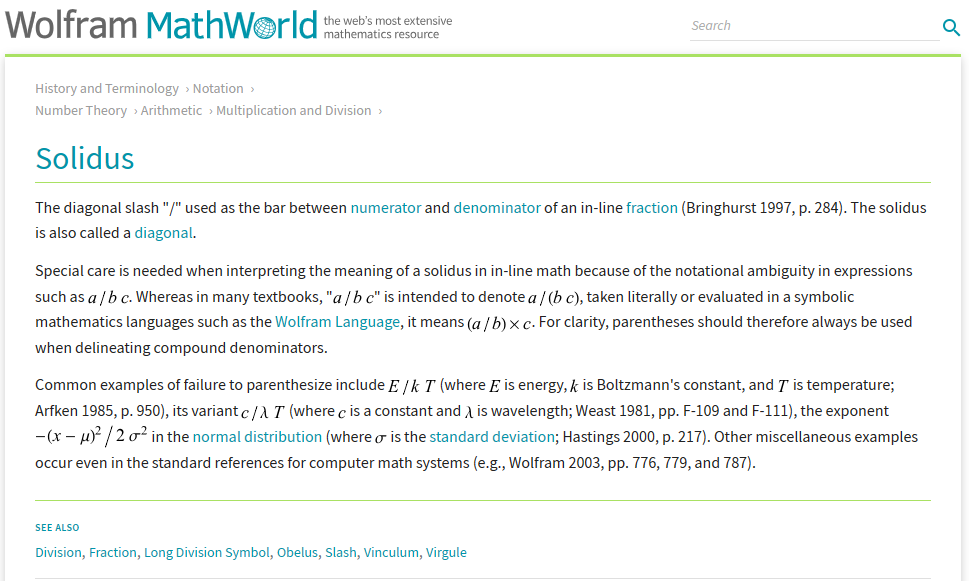
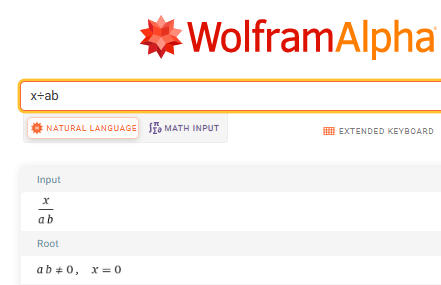


 Sunday Morning Greek Blog
Fascinating Scott, thank you!
Comment by Blue Collar Theologian — April 29, 2023 @ 1:48 am |
Interesting connection to Greek.
Comment by Michael Wilson — April 29, 2023 @ 6:35 am |
I love analyzing fractals!
Comment by Scott Stocking — April 29, 2023 @ 8:08 am |
I’m tired and this seems like you nerd out (and that’s a good thing)
Comment by SLIMJIM — April 30, 2023 @ 9:17 am |
Oh, yeah. I can get pretty nerdy sometimes. I wrote a 25-page paper about the variant readings in Acts 2:42 involve whether there should be a comma, or the word “and,” or nothing.
Comment by Scott Stocking — April 30, 2023 @ 1:36 pm |
Thats so awesome
Comment by SLIMJIM — April 30, 2023 @ 2:15 pm
https://sundaymorninggreekblog.com/2011/06/26/the-nature-of-%e2%80%9cthe-fellowship%e2%80%9d-%ce%ba%ce%bf%ce%b9%ce%bd%cf%89%ce%bd%ce%b9%cc%81%ce%b1-koinonia-in-acts-242-excursus-on-acts-238/ Here is the link to the blog post that condenses my 25-page paper.
Comment by Scott Stocking — April 30, 2023 @ 3:14 pm
flour for 3 ppl when 2 ppl needed 6 cups of flour… So i need 5 less cups for more ppl?
The confusion with the equation comes in at the 6÷2(3) part… Universally you have to perform the operations in the parenthesis first…
But after that whether or not you perform the distributive property first depends on what is being asked by the creator of the question…
Since 6÷2(3) is literally the same as 6÷2*3. If I’m asking how many cups of flour do i need to add for 3 ppl instead of 2… Then I’m looking for you to use PEMDAS and go left to right when you see any numbers outside parenthesis
But if i want to know how many more servings 3 cups of flour will give me… Then i would use the distributive property… Which would tell me that 3 cups of flour will add 1 more serving…
In that case 6÷2(3) gives me 1
The problem with the equation is it’s poorly written. It’s unambiguous. It assumes you know what the author is asking. But we don’t. The correct answer all depends on what is being asked by the equation.
Comment by supamand — June 5, 2023 @ 3:31 am
I’m not following how you’re assigning the units to each form of the expression. Would you mind mapping that out for me each way? It seems you’re confusing units.
Comment by Scott Stocking — June 5, 2023 @ 7:24 am
I think I see what you’re saying here, but you don’t need to make the equation so complicated in this case. If 6 cups of flour are necessary for every 2 persons, then you have 6 cups/2 persons, or 3 cups/person. Then if you want to know how many cups of flour for three people, just multiply 3 cups/person by 3 persons and get 9 cups. By defining the units that way, you are correct in treating the 6/2 separately, and as such, that should be in parentheses since that is the ratio you need to determine how much flour for however many people, which is my point. If you use units to define the values in the expression, then it makes sense to organize the expression the way it fits the units.
I agree the question is ambiguous IF you just focus on operations and NOT on the linguistic clues in the syntax of the expression. I’m keen to the linguistics of the expression, partly because of my historical experience with similarly formatted expressions and partly because I can see the connection between the construction of implicit multiplication and the implicit multiplication of exponents. What I and others are saying (Stephen Worlfram is one who I think would agree with me) is that there’s more to PEMDAS than just the operations. There’s another level that must be discerned, and that we must teach people to discern, if there’s ever going to be any agreement. Still, the best way to avoid ambiguity is to group accordingly using parentheses.
Then there’s the whole issue of established formulas, as in the following example:
Jerry’s Custom Jars has an intelligent robotic machine that can apply a label or ribbon of any given height around the circumference of a round mason jar and cut it exactly so it fits on the jar with no gaps or overlaps. They have an order for 35 mason jars with a simple yellow ribbon completely around the middle of each jar with no gaps or overlaps for a local VFW dinner honoring veterans. The jars will be centerpieces at the tables. How many jars can Jerry completely wrap with 500″ of ribbon for jars with a 2″ radius in the middle?
I would write the equation as
500″ ÷ 2π(2)”/jar,
because I have an instinctive, historical understanding that 2πr is the circumference of a circle, so why would I need to bother putting parentheses around that, given that I know it represents a single unit or distinct formula? But because some people focus solely on the operation and not the syntax or linguistics of the formula or aren’t smart enough to recognize the circumference formula, I’m expected to apply parentheses. I would to make it unambiguous to those with a limited understanding of PEMDAS, but I wouldn’t need it myself.
So the true answer to the question is 39 jars with some ribbon left over. If someone works that from a perspective of operations ONLY and doesn’t discern the circumference formula, they’d get an answer of 1570 jars, which is clearly absurd given the parameters of the expression. Those of us who see it differently are unwittingly biased against the long history we have of seeing the deeper principles behind PEMDAS. Thank you for reading.
Comment by Scott Stocking — June 5, 2023 @ 5:12 pm
Here is the fractals post I had for Dr. Jason Lisle’s YouTube video on it.
Comment by koineroad — May 5, 2023 @ 12:47 pm |
You are truly an idiot. PEMDAS Is and has always been sufficient. The answer is and always has been 16. You probably failed a test in college and it pissed you off so bad you thought you would get on the Internet and lie to people and convince them that you’re not an idiot….. but you are. DUMBASS
Comment by Jason — June 27, 2023 @ 2:11 pm |
Jason, thank you for your feedback. I decided to approve your unprofessional and vile comment to showcase that many people like you are more emotional about PEMDAS than intellectual. So thank you for modeling that and making your position look extremely weak juxtaposed to my intellectual analysis of the issue. If you or anyone else can’t behave yourselves more professionally and politely in future comments, I’ll think twice about approving them. FYI, I was a straight-A student in math throughout junior high and high school, and I passed my two semesters of college calc and one semester of differential equations before switching majors. So I know math, and I know how I solved problems. If you want to offer a more constructive analysis of my position like Frank did below, I’d be happy to respond to that. Otherwise, I’ll let your comment serve as a warning of how not to behave in my blog. Peace to you.
Comment by Scott Stocking — June 27, 2023 @ 6:12 pm
love the reply you were given.
order of operations … exceptions ^^ think has been forgotten.
to the op I’m currently arguing the reason to a several teachers that have taught post secondary education :/
I remember students arguing about correct answer I’m guessing you may have been one of them. I just quietly did my work and figured out either tricks on my own or someone taught me those tricks. Does this mean students are smarter than teachers?
also remember teachers telling you not to trust a calculator and had to learn it the hard way, well this 16/1 probably should be proof enough.
Comment by A — September 21, 2025 @ 1:44 am
[…] If you like this article, you may also like https://sundaymorninggreekblog.com/2023/04/28/8-%c3%b7-22-2-1-why-pemdas-alone-is-not-enough/ […]
Pingback by Toward an “Active” PEMDAS: Strengthening Its Theoretical Foundation | Sunday Morning Greek Blog — June 1, 2023 @ 10:00 pm |
Great conversation. I’m “Team Frank”.
Comment by MB — July 26, 2023 @ 7:20 am |
Thank you for weighing in. Please check out WolframAlpha’s definition of “solidus,” which documents that my way is taught in most textbooks. https://www.wolframalpha.com/input?i=solidus&assumption=%7B%22C%22%2C+%22solidus%22%7D+-%3E+%7B%22MathWorld%22%7D
Comment by Scott Stocking — July 26, 2023 @ 7:25 am
Expressions 1-8 are all fine. You start losing it on expression 9 though. While 2(2+2) is in fact 8, that is not the equation. In expression 7 you have a(b+c) = ab + bc which is true, but the a in this equation is 8/2, not 2. So you must multiply 8/2 by (2+2), giving an equivalent of 8/2*2 + 8/2*2, which is 8 + 8, which is indeed 16. There is nothing implied or anything about the denominator 2 and the sum (2+2). 2(2+2) is just a normal multiplication 2 times (2+2), so the term to multiply using the distributive property is 8/2. The only way to group the 2 to the 2+2 would be to use parenthesis, 8/(2(2+2)), this would equal 1.
Expression 11. 8/2m can be interpreted as either (8/2)m or 8/(2m). How can we know which it is? There has to be a way to distinguish ambiguities. Enter PEMDAS! We have an order of operations that we use to distinguish in which order the operations occur. In this case it is division and multiplication, left to right. So, 8/2m is 8 divided by 2, multiplied by m, or 4m not 4/m.
Expression 12. Your equation, 8/(2+2)2, is not equivalent to 8/2(2+2). You cannot just move a denominator. Dividing by 2 is equivalent to multiplying by 1/2 or 0.5. Rewriting this equation would be 8 * 0.5(2+2), then you can move it, 8*(2+2)0.5. This reduces to (8*2 + 8*2)0.5, or (16 + 16)0.5, or (32)0.5, or 16.
Addendum (added 5/14/23). I’m not sure what you’re trying to say here. 8*(1/2*(2+2)) is indeed 16, you can either add first, 8(1/2(4)), or 8(2), or 16, or distribute first, 8((1/2*2)+(1/2*2)), or 8(1+1), or 8(2), or 16. Those both check out to 16. I’m not sure what you’re doing to divide (2+2) by 2?
Still Not Convinced? (Added weekend of 5/20/23). I still don’t know what you’re trying to say here. To get -1 you need to multiply the 1/2 by -2, 1/2*-2 = -1. So you must then multiply the other side also by -2. So 16 * -2 is indeed equal to -32. To go further with this point, you got an answer of -2. -2 * -2 is 4, not the 1 you claim.
Making It Real. Using your first example, v= d/t with d = 36 miles and t = 6(2 + 2 + 2) hours. Here, t is the quantity of 6(2+2+2), so that has to be in parenthesis. So, the equation is not 36/6(2+2+2), the equation is, 36/(6(2+2+2)), which is equal to 1, not 36. The same applies to your other equations here as well.
So in the end, 8/2(2+2) is indeed equal to 16, not 1.
Comment by Frank — June 27, 2023 @ 2:08 pm |
Thank you for your response, Frank. Your tone represents the kind of dialogue I would expect on this topic, unlike Jason’s vitriol above. I will answer your response starting from the top.
You claim the obelus only refers to the number immediately after it, and you use the obelus to turn 8 ÷ 2 into an improper fractional coefficient of (2 + 2). Yet the obelus, and the solidus (/) for that matter, in printed math both typically represent a linear replacement for the vinculum (fraction bar), and thus both would take on the “grouping” function of the vinculum, that is, everything that comes after the obelus, especially since it is the sole extant symbol in the expression, goes “after” (i.e., under) the vinculum. As such, there is NO logical or technical explanation of why the obelus would be treated differently by only treating the first number after it as the divisor. The very form of the obelus itself demonstrates that its horizontal line represents the vinculum, while the dot above represents the dividend before it, and the dot below represents the divisor that comes after it.
As such, by kidnapping the 2 from its partner (2 + 2), you’re changing the fundamental nature of the relationship between the implicitly multiplied elements. You’re forcing a divorce and pitting one against the other in an improper fraction (8/2). Even the term “improper” fraction implies that something untoward is going on with your methodology. What you’re doing to the expression is immoral and deceptive, if unwittingly so.
Note that here, I am using the terms “dividend” and “divisor” intentionally for the obelus. The expression is not yet in fractional form at this point, so it is technically wrong to refer to the elements as “numerator” and “denominator.” And on a side note, the entire expression is one “term,” because the addition sign is within parentheses, and what’s in the parentheses is subject to multiplication. You can’t break out just what comes after the addition sign as a separate term. So the argument that some make that there’s more than one term here is disproven.
Now the other issue at play here is the “sacred” connection of implied multiplication, especially in print form. WolframAlpha acknowledges this in its definition of the “solidus”:
“Whereas in many textbooks, “a/bc” is intended to denote a/(bc), taken literally or evaluated in a symbolic mathematics languages (sic) such as the Wolfram Language, it means (a/b) × c.”
So Wolfram Alpha supports the fact that many of us learned from textbooks (especially before calculators were the norm) that the answer to the expression is 1, that the product after the obelus is the divisor as Lennes wrote in 1917. However, when the calculator and computer languages came along, they were not programmed with the intuition and linguistic instinct that many of us learned in print (there are exceptions among and within the brands). When people started plugging these expressions into such devices, the devices had no regard for the sacred connection represented by implicit multiplication. The devices treated the ENTIRE expression as a linear equation without regard to parentheses, unless they were intentionally added. In contrast, our (those of us who get the answer 1) intuition tells us the parentheses are implied around the WHOLE product after the obelus. As a result, some of you chose to allow the calculator or computer to do your thinking for you, and you lost or never developed the instinctive connection represented by implicit multiplication. As such, the literal PEMDAS you preach is inferior to the methods we learned by developing our intuition because it derives from a corrupted form of artificial intelligence (AI). That answers your concern about Expression 11.
Now, back to the expression at hand. Given that the 2(2 + 2) represents a sacred bond that cannot and should not be broken, I’m not doing anything wrong with the “denominator” as you call it. So when you say “You cannot just move a denominator” with respect to Expression 12, you’re failing to recognize the sacred connection of implicit multiplication. I’m not moving a denominator because, as I demonstrated above and supported with older and newer academically sound sources, the whole product after the obelus is the divisor, or in your words, the denominator. I’ve merely commuted the elements of the denominator.
As for the addendum on 5/14, my point there was to show how the sacred connection of implied multiplication is changed by the way strict PEMDAS disciples work the problem. I’ve already demonstrated that above, so I don’t need to revisit it here. The only thing I would add is that, to make explicit what our instincts tell us, we would rewrite it:
8
———
2(2 + 2)
If no parentheses are needed for that, then why would we need them for the obelus? The vinculum is a vertical form of implied division, just as juxtaposition to parentheses is a form of implied multiplication. Of course, the expression with the vinculum would be reduced to a proper fraction, or in this case, a whole number, 1.
The point about the negative sign was only to illustrate that when a negative sign appears before parentheses without an express coefficient, the signs of the terms within the parentheses are supposed to change. That is, the coefficient is an implied -1 multiplied through the parentheses. Your strict PEMDAS would treat that the same as the 2 after the obelus and get a completely different answer than the expression implies.
Finally, as for the “Making It Real” section, my point there is that, since the expression has context and I know what the terms before and after stand for, I don’t need to put parentheses around the divisor/denominator because I know what it stands for. If I were plugging it into a “dumb” calculator, then yes, I would need to put parentheses around the divisor/denominator for the calculator to work according to my instincts (and isn’t that the way we should use a calculator?). But some of us can still do math without a calculator, and some of us can even do it with a slide rule, if you know what that is, so we don’t always need the calculator. The same would go for any such established formulas. Revolutions of a wheel = d/2πr is one such example.
The bottom line here is that calculators need the parentheses for clarity. As humans who have a certain instinctual and linguistic understanding of the expressions we see in a math problem, we don’t always need those. We recognize a certain form and solve accordingly. Our way of thinking is the highway, because it depends on human intelligence and insight. The strict view of PEMDAS promoted by some is a capitulation to the flawed AI of the computer age and seems to lack the kind of reflective analysis and critical thinking I’ve demonstrated here.
Peace to you, and again, thank you for your polite response.
Scott
Comment by Scott Stocking — June 27, 2023 @ 10:16 pm |
Thanks for your reply. I don’t agree with the name-calling above. If you don’t agree with someone doesn’t mean you need to start calling names. Sometimes people don’t agree, and that’s ok.
With that said, I don’t think we are going to see eye to eye, but I’ll try anyway.
The majority of what we are saying is, is 8/2(2+2) equal to 8/(2(2+2)) or (8/2)(2+2). You’re saying the former, I’m saying the latter. I say the latter as that follows the order of operations. 8 should divided 2 before multiplying because dividing comes before multiplying in the order of operations of this equation, left to right. Since there is no grouping on the 2(2+2) it should just go left to right.
From what I understand of your justification, what you’re saying is that because 2(2+2) is an implied multiplication that the 2(2+2) is part of the denominator.
Now to your reply.
First, the obelus and the solidus are the same thing. There is no difference, they both divide in the same way. 2÷2*2 and 2/2*2 are the same statement. However, as you have shown yourself, the vinculum is different as it does imply grouping. For example,
2
—-
2*2
This is not the same as 2/2*2. An equal statement to the above would be 2/(2*2). The vinculum implies that since the 2*2 is under the bar that it is part of the denominator. Why does this imply grouping, because it is actually under the bar.
Also, you said, “As such, there is NO logical or technical explanation of why the obelus would be treated differently by only treating the first number after it as the divisor.” So let me ask you, what is 2/4/2?
Is it, (2/4)/2, or is it 2/(4/2), is it 1/4 or is it 1? According to your definition above (“everything that comes after the obelus”) this would be 1, but according to the order of operations this would be 1/4. If you say that 2/4/2 is 1 then I think we’re done here and you’re probably just trolling at this point. However, if you say that it’s 1/4, then that goes against what you said in your last reply.
Second, implied multiplication is exactly what it says and nothing else, two values are implied that they multiply. 2(2) is the same as 2*2. Just because 2(2) is after a division 2/2(2) does not mean that 2(2) is in the denominator. It literally just means that it multiplies, 2/2*2. 2/2(2) and 2/2*2 are the same statements, equal to 2 not 1/2.
Third, changing the value to be a negative doesn’t change how the statement evaluates. -(2+2) is the same as -1(2+2), so 8/-1(2+2) still is 8 divided by -1, times the quantity 2+2. Again, to change the equation to get a -1, you must multiply by -2. 1/2 * -2 is equal to -1. Then to get the equation to solve you also need to multiply the other side by -2, so -2 * 16 is equal to -32. Where is this a problem? You also still failed to mention how your equation doesn’t equate when you multiply by the -2. -2 * -2 is 4, not the original 1 that you said this equation was.
Fourth, your “Making it real” section you were trying to imply that your v=d/t would look like 36/6(2+2+2) and then try to prove that it is incorrect, but your assumption was wrong because you have to input the value of t into the equation of v=d/t but an equivalent of v=d/t is v=(d)/(t) which would make the substituted equation v=(36)/(6(2+2+2)) which is 1 not 36 like you implied. Substituting without the parenthesis is incorrect and gives you the wrong answer.
Fifth, you just admitted that we need parenthesis for clarity, but since you are smart (“certain instinctual and linguistic understanding of the expressions”) you know what everyone always intended?
8/2(2+2) is intentionally ambiguous just so people like you and I would debate it, but, there is still one clear answer when you follow the order of operations and that is 16.
Thank you for your time.
Comment by Frank — June 29, 2023 @ 11:06 am
Yeah, we probably won’t see eye-to-eye, but I appreciate the discussion. My sticking point is the implicit multiplication. I view that as inseparable, like a prefix on a word or an inseparable prefix on a German verb. I was taught to recognize that as an inseparable term. So the parentheses aren’t really an issue. In my mind, I’m trained to put implied parentheses around it, if you will. Many of us who get the answer 1 do that instinctively. And with one extant operational sign, that seals it for me. It’s just a simple A/B problem for me at that point.
As for your 2/4/2 example, I would actually agree with you that it’s 1/4. There are two extant operational signs, so I’d follow OOO at that point, in the absence of parentheses. I would rewrite it as multiplicative inverses and multiply to prove its 1/4 either way: (2/1) * (1/4) * (1/2). Apply the associative property either way, and you get the same answer.
Peace to you, and thank you for the comment.
Comment by Scott Stocking — June 29, 2023 @ 7:18 pm
Are we starting to see your arguments crack?
If 2/4/2 is 1/4 then “everything that comes after the obelus” is an incorrect way to look at an equation. Let me try another question, what is -4x^2? Is it (-4*x)^2, or is it -4*(x^2)? Lets say x is 2, is it -8^2 or 64, or is it -4*4 or -16? If you say it’s -16 then you’d have a hard sell on why you think your previous claim is true. If you claim the answer is 64, I’ll just say you’re wrong.
I am a person who always kept my old textbooks in case anything ever needed to be looked up again. This is the first time I think I’ve had to look up something in my old college math textbook. There is no mention whatsoever of Implied Multiplication (Or Juxtaposition). I wonder why that may be, do you have any reason why the author of a college textbook would leave out such an important rule?
Comment by Frank — July 3, 2023 @ 2:31 pm
No, not really. Although I admit I’m still working some kinks out. When I said everything after the obelus, I was referring specifically to that kind of expression, with one extant sign.
Someone else pointed out to me the -4x^2 issue, and I have to admit that the exponent takes precedence in that, so it’s (-1)(4)(x^2).
That doesn’t really change my position on grouping, but a I need to qualify it a bit. Grouping takes precedence over LTR MDAS with extant operational signs. But I would provide an order of precedence for grouped expressions as well. I define grouped expressions as anything without an operational sign that suggests some sort of function upon or between the numbers. It’s a linguistic structure. So as in PEMDAS, parentheses first, then exponents and factorials, then implied or proximate multiplication.
I’m also tempted to define a fraction with a vinculum as implied division as well, different from signed division with an obelus or a solidus. Although it’s a convenient way to express division, especially when you have polynomial expressions, I don’t think it’s intended to be a universal substitute for another form of a division sign. It’s kind of complicated to explain. I’ve already said I don’t think it’s right to assume that in 8 ÷ 2(2 + 2), the 8 ÷ 2 is a fractional coefficient of the expression. First of all, it would be an improper fraction, so that’s bad form for an expression. Second, the obelus is a simple operational sign, so I don’t think it’s rational to think it only applies to part of an implicitly multiplied element. That seems to imply some sophistication for the sign.
Again, thank you for the discussion. This has been an exercise in “thinking out loud,” which is how the scientific method should work. Peace to you.
Comment by Scott Stocking — July 3, 2023 @ 4:47 pm
Thanks for your reply. I have (I think) one last question for you involving implied multiplication. I don’t think I’ve even really heard about it growing up all the way through college. I’ve seen it, but it’s always been “just multiply” the numbers. So my question is, how is it not just multiply, why do we have this extra rule where it doesn’t seem like one should exist?
I’ll even go out on somewhat of a simple proof.
If there is a number x, such that a(b+c) = x and a*(b+c) = x, for any value a, b and c, then the x must be the same value for both equations. Thus meaning that a(b+c) = a*(b+c) for all numbers a, b and c.
Now, if you can show me any number that disproves the above statement, i.e. find any numbers for a, b and c where those equations are not equal and I will bow down and call you a mathematical god. If you cannot, how can you possibly say that they are different and have different rules?
Comment by Frank — July 3, 2023 @ 7:12 pm
I don’t have any of my high school textbooks, and my college calculus textbook doesn’t even have an obelus in it as far as I can tell. I think what’s going on in my mind is that I’m used to seeing a standardly written division problem (especially one with variables) written with the vinculum as such:
9a^2
——
3a
which of course when written that way everyone agrees the answer is 3a. But when someone rewrites that with an obelus and doesn’t use parentheses to “group” the denominator, my mind still sees the same problem with the same answer: 3a. The same goes with the problem at hand. I’m accustomed to two standardized forms that aren’t used in the expression. First, if someone wants to say 8÷2 is the coefficient of the expression, that’s definitely NOT a standard way to write a fractional coefficient, especially if you don’t put parentheses around it. If someone wants me to think that, they’d have to write the expression as follows:
8
— (2 + 2)
2
But that creates a related problem, in that a coefficient would also be in its simplest form, so you have an improper fraction used as a coefficient where a whole number would do. The improper fraction would be okay if there’s no way to simplify it to a whole number, as in the equation for the volume of a sphere:
4
— πr^3
3
The second standard I would expect is that if you want two of the three values in the expression to be multiplied together, you wouldn’t make them the first and last values in the expression. You’d write the expression in such a way to avoid any confusion as to what you expected to be multiplied together:
8(2 + 2)
———
2
So whether intentionally or not, the expression is an extremely poor example of a mathematics problem, and people shouldn’t be using such a poorly written expression to promote something that they expect to be a standard way of working equations. That being said, I’m not inclined to give props to the people who try to push a poorly written expression as the basis for a standard. I’ll fight it tooth and nail if I have to, because it’s bad pedagogy.
One final thing: PEMDAS is for the most part applied to hypothetical, that is, non-real-world equations. A good example is the formula for a pitcher’s earned run average (ERA), taken from the MLB Web site: “The formula for finding ERA is: 9 x earned runs / innings pitched.” Let i = innings pitched and R = earned runs. We wouldn’t write that equation 9 ÷ i(R), right? In your way of thinking, you’d get the right answer, of course, but it doesn’t fit the logic of how the stat is formally calculated and what its significance is. The best way to write it is 9R/i or
9R
—
i
My point here is that most standardized formulas for things we encounter daily (whether we see them or not) are written in such a way that you don’t have to worry about PEMDAS. They’re simplified enough that the “order” is inherent in the formula. And if that formula happens to come after a division sign (as in calculating the number of revolutions of a wheel over a certain distance) instead of under a vinculum, most people will know to keep the formula intact and not start playing PEMDAS games with it.
Again, thank you for the dialogue and feedback. It helps me clarify and solidify my position even more. Peace to you.
Scott
Comment by Scott Stocking — July 6, 2023 @ 10:35 pm
I agree with almost everything you’ve said here.
9a^2
——
3a
Is 3a. I’ve mentioned that in my previous post that the vinculum does imply grouping because you can clearly see that the 3a is under the bar. However, the above equation is not equal to 9a^2/3a. This equation would be,
9a^2
—- a
3
Which becomes 3a^2*a, or 3a^3. Although, I also do agree that the equation itself is silly and should just be written 9a^2(a)/3, or 9a^3/3, or 3a^3, but I disagree that it’s incorrect. In mathamatics it is part of the journey to get to the reduced state, rarely do you start with a reduced function.
For example, this statement, a-b where b is a-1 is equal to 1. You could have this statement, or you could just call it 1, but 1=1 doesn’t really mean anything whereas a-b where b is a-1 is equal to 1 implies something about a and b. This could be extrapilated out to a-b where b is a-c is equal to c.
My point is, just because something seems silly doesn’t mean it’s incorrect. We have the order of operations only to tell us in which order the operations are calculated in.
It sounds like maybe you’re starting to agree that 8/2(2+2) is 16 which is,
8
—(2+2)
2
whereas
8
——
2(2+2)
is 1.
I agree that 8/2(2+2) could be written differently, 8(2+2)/2, or 4(2+2) but that’s not what was given to us, but all three of these statements are the same and the only way to get there is to use the order of operations.
So hopefully you can see where the people who get 8/2(2+2) = 16 come from, and I think that is where I’m going to leave it.
Good day.
Comment by Frank — July 13, 2023 @ 11:28 am
Hi Scott,
In a long-ago reply here, you wrote: “The bottom line here is that calculators need the parentheses for clarity. As humans who have a certain instinctual and linguistic understanding of the expressions we see in a math problem, we don’t always need those. We recognize a certain form and solve accordingly. Our way of thinking is the highway, because it depends on human intelligence and insight. The strict view of PEMDAS promoted by some is a capitulation to the flawed AI of the computer age”
In your analysis, you cited Wolfram Alpha as “the gold standard.” Here is a recent inquiry on the Wolfram Alpha “Natural Language” calculator
https://www.wolframalpha.com/input?i=where+a%3Dbc%2C+a%C3%B7bc
Input:
where a=bc, a÷bc
Answer:
“Input interpretation
a
—– where a=bc
bc
Result: 1″
In the step-by-step solution, it explains:
“Result
Step 1
Evaluate
a
—–
bc
where a=bc
a
—– =
bc
bc
——
bc ”
Note that the Wolfram Alpha calculator system converted the original expression a÷bc into the top-and-bottom fraction of a over bc & then to bc over bc (because a=bc).
In the expression a÷bc, a=8 b=2 c=(1+3), which, after substituting for the variables, results in a÷bc=8÷2(1+3) which is the same as the fraction 8 over 2(1+3), which calculates to 8÷8 or the fraction 8 over 8, all of which equals 1.
— Dee
Comment by Dee R. — September 22, 2025 @ 3:03 pm
Yes, Wolfram interpreted those forms correctly when letters were used. However, when I started substituting numbers in for the variables it worked the other way. See the examples in my original article.
Scott
Comment by Scott Stocking — September 22, 2025 @ 3:06 pm
I am aware that Wolfram incorrectly applies PEMDAS when the substituted form of a÷bc is input as 8÷2(1+3). I have brought this to the attention of the Wolfram Alpha staff, but have never gotten a reasonable explanation for this discrepancy. Perhaps you could add your voice to those of us asking what that discrepancy is about, since there must only ever be one correct result for the same mathematical proposition when all that is being done is substituting in the value of the variables.
This is what I sent Wolfram Alpha recently & am still awaiting a reply:
“When I input a(b+c)÷a(b+c), the Wolfram Alpha calculator gave 1 as the result. Then when I asked ab÷ab, the calculator also gave 1 as the result. But when I followed up with asking 2b÷2b, the Wolfram Alpha calculator gave b^2 as the result. In ab÷ab if a=2, isn’t that the same thing as 2b÷2b, which equals 1?”
Maybe you will be able to get through to the Wolfram Alpha staff that there is a fatal inconsistency in their calculator programming which needs to be addressed — it recognizes the monomial “bc” as being one term holding a single total combined value which is the product of its factors, but fails to recognize the same term as holding a single combined total value when its factors have been numerically substituted in. Implied multiplication is still one term, similar to the multi-digit constant”524,” which contains implied multiplication and implied addition: 5(100)+2(10)+4(1) — no parentheses are necessary around a monomial to be recognized as one term holding a single total combined value, no matter what other operations are being performed in the expression.
Comment by Dee R. — September 22, 2025 @ 3:51 pm
I notified them as well when I first discovered the issue in 2023. I don’t think I ever heard back from them.
Scott
Comment by Scott Stocking — September 22, 2025 @ 3:52 pm
Perhaps you could try asking the question again. The more they hear from people on this issue, the likelier they are to address it. You can remind them that you never got a response from two years ago & are now requesting a response ASAP.
Comment by Dee R. — September 22, 2025 @ 4:05 pm
Hi Scott,
So…let’s start with 40÷20=2. No one is going to argue that that division expression equals anything other than 2.
Both 40 & 20 are monomials (one inseparable term holding a single value), so no parentheses are necessary for “40” and “20” to each be understood as one “unit.”
What is 40? Four tens. What is 20? Two tens.
So 40÷20=4(10)÷2(10). That division still equals 2, because it’s 40÷20 factored out as multiples of 10.
Now let’s replace the “10’s” inside the parentheses with the variable “y”: 4(10)÷2(10)=4y÷2y.
When y=10:
4y÷2y=4(10)÷2(10)=40÷20=2
You can use this proof method for any of the implied multiplication via juxtaposition division-by-a-monomial expressions to show that progression of monomial factoring, starting with the end result.
— Dee R.
Comment by Dee R. — October 3, 2025 @ 6:20 pm
Hi Scott,
Here’s an idea to settle the dispute, once & for all…
For anyone who believes that 8 ÷ 2(2 + 2) does not equal 1, suggest that each of them phone their local high school and ask to speak with the Chair of the Math Department (make an appointment to do so, or ask for an email address to send an inquiry).
The questions to pose to that Math Department Chair are:
In the expression 8÷2(2 + 2), can 8 be factored out as 2(2 + 2), making the expression 2(2 + 2)÷2(2 + 2)?
If the expression can correctly be rewritten as 2(2 + 2)÷ 2(2 + 2), could it be rewritten as xy÷xy, with x=2 & y=(2+2) or y=4?
What is the quotient of xy÷xy when x=2 & y=4 (with each calculation step shown)?
Can the expression xy÷xy when x=2 & y=4 be rewritten as the fraction xy over xy? If so, please show how to calculate its value.
~ ~ ~ ~ ~ ~ ~
I’m betting that there is no high school Math Department Chair who is going to say that the expression xy÷xy when x=2 & y=4 equals anything but 1 — because this is very straightforward division-by-a-monomial.
— Dee
Comment by Dee R. — October 28, 2025 @ 3:46 pm
This is all silly. The only thing and debate here is the order of operations. You mention an order of operations that I was unaware of, two numbers next to each other, without an operation symbol gets precedence over left to right. I am not aware of sexual. I don’t think it’s correct, but if it is, you’re right (1)and if it’s not, you’re wrong (16).
The math is the math, and that does not change. Order of operations is a language syntax issue. It’s scarcely different than how the placement of a comma can change the meaning of sentence.
Finally, your velocity example is completely wrong. I am extremely confident that anytime a variable is represented by a letter, that variable must be calculated in full and not broken up into pieces as you have done, which would be completely insane and make algebra, completely unworkable in any sense.
Comment by Rich, fellow math nerd — June 29, 2023 @ 5:49 pm |
Thank you for your response. The implicit multiplication represented by the right side of the expression is akin to a prefixed word in a regular sentence, or in German, a verb with an inseparable prefix. If you strip the prefix from the word and put it in a different place in the sentence, you change the meaning of the sentence. Same goes for the coefficient here. The coefficient is not intended to be separated by OOO. OOO was never intended to alter those fundamental relationships.
If you think my velocity equation is wrong, then please suggest a different way to construct it. Put your keystrokes where your statements suggest.
Thank you for your response. Peace.
Comment by Scott Stocking — June 29, 2023 @ 6:36 pm |
Thank you for explaining it.
Comment by Erin Kastenschmidt — September 14, 2023 @ 8:37 pm |
Glad you enjoyed it. I need to update it, because I’ve found several discipline-specific style manuals that further support a juxtaposed or implied multiplication expression after a sign of division should be taken as the whole divisor.
Comment by Scott Stocking — September 14, 2023 @ 8:41 pm |
Thank you.
Very clear explanation.
My only suggestions are about terms and factors, that haven’t been mentioned much. Factors multiplied are single terms.
8 is a single term.
8/2 is 2 terms.
Euler, Elements of Algebra
Page 34, para 89.
“when we multiply both its terms, or its numerator and denominator,”
8/2(3) is 2 terms, as is 8/2(2+2).
storyofmathematics.com
Definition
A term is any single number or variable. An expression contains two or more terms. If two numbers or variables or both
are multiplied by each other, we consider them as a single term.
“0:51 So in this example, you have three terms.
0:56 The first term is 2 times 3.
0:59 The second term is just the number 4.
1:01 And the third term is 7 times y.”
Khan Academy Terms, Factors and Coefficients Transcript.
So the expression is the term 8, divided by the term 2(4) or 2(2+2), to give the
answer of 1.
Comment by Doug Hendrie — October 30, 2023 @ 1:29 pm |
Thank you, Doug. I appreciate the references you cited. Glad you enjoyed the read.
Scott
Comment by Scott Stocking — November 3, 2023 @ 3:10 pm |
You’re wrong and willfully ignorant. You have misapplied the Properties and Axioms of math and you’re too mathematically incompetent to realize it…
Let me explain the Distributive Property… Using a similar expression 6÷2(1+2)= 9 not 1
The Distributive Property is a PROPERTY of Multiplication NOT Parentheses and not Parenthetical Implicit Multiplication. As such it has the same priority as Multiplication and Multiplication does not have priority over Division.
The Distributive Property is congruent with the Order of Operations it doesn’t supercede the Order of Operations… The Order of Operations work because of the Properties and Axioms of math not in spite of them…
The Distributive Property when fully applied is an act of ELIMINATING the need for parentheses by drawing the TERMS inside the parentheses out not by drawing factors in… If you can’t draw a factor in and get the same result as drawing the TERMS inside the parentheses out then you haven’t applied the Distributive Property correctly…
The Distributive Property does NOT change or cease to exist because of parenthetical implicit multiplication…
The axiom a(b+c)= ab+ac however the variable “a” represents the TERM or TERM value i.e Monomial factor of the TERM outside the parentheses not just a numeral next to the parentheses. In this case a = 6÷2 OR 3. People just automatically assume that “a” is a single numeral…
6÷2(1+2)= 6÷2×1+6÷2×2 Distributive Property
Parentheses removed…
6÷(2(1+2))= 6÷(2×1+2×2) Distributive Property.
Inner parentheses REMOVED
This can be further demonstrated using the vinculum….
6
——(1+2)= 6÷2(1+2)= 9
2
6
———— = 6÷(2(1+2))= 1
2(1+2)
A vinculum (horizontal fraction bar) serves as a grouping symbol. Neither the obelus or solidus serve as grouping symbols. The vinculum groups operations within the denominator and when written in an inline infix notation extra parentheses are required to maintain the grouping of operations within the denominator….
________
2(1+2) = (2(1+2)) two grouping symbols each
That over bar (vinculum) is a grouping symbol
_______ _________
2(1+2) = 2×1+2×2
(2(1+2))= (2×1+2×2)
Note that when applying the Distributive Property one grouping symbol was REMOVED from each notation…
6. 6
———— = 6÷(2(1+2)) = 6÷(2×1+2×2) = ————–
2(1+2) 2×1+2×2
If you choose to Distribute the 2 into the parentheses by itself you have to do one of two things. Either take the division symbol with it, as division is right side Distributive or change the division to multiplication by the reciprocal…
÷2= ×0.5
So… 6÷2(1+2)= 6(1÷2+2÷2) still equals 9
Or… 6÷2(1+2)= 6(0.5×1+0.5×2) still equals 9
Variables can represent more than just a numeral and it’s important to understand that when you replace a variable with a constant value or a set of operations that represent a constant value that you apply grouping symbols where called for by the Order of Operations and the basic rules and principles of math… example 6÷a does not have parentheses BUT a= 2+4 so 6÷a = 6÷(2+4) not 6÷2+4. BUT if a=2×3 and we have a÷2 we can write 2×3÷2 because we evaluate Multiplication and Division equally from left to right…
a(b+c)… a=12÷3, b= 2×3, c= 2^2 we have…
12÷3(2×3+2^2) = 4(6+4)= 4(10)= 40
ab+ac =
12÷3×2×3+12÷3×2^2=
4×2×3+4×4=
8×3+16=
24+16=
40. <<< same answer
What most people don't understand is that you can't factor a denominator without maintaining all operations of that factorization WITHIN a grouping symbol. You can factor out LIKE TERMS from an expanded expression… 6÷2×1+6÷2×2+6÷2×3^2-6÷2×4=
6÷2(1+2+3^2-4) as the LIKE TERM 6÷2 was factored out of the expanded expression.
I hope this helps you understand the issue a little better….
You're confusing and conflating an Algebraic Convention given to coefficients and variables that are directly prefixed and form a composite quantity by this convention to Parenthetical Implicit Multiplication. They are not the same thing…
a/bc = a/(bc) by Algebraic Convention
a/b(c)= ac/b by the Commutative and Distributive Properties…
a/b(c) = a×b⁻¹(c) NOW the expression is Associative…
Wolfram Alpha supports the fact that 8÷2(2+2)= 8÷2×2+8÷2×2 …. Wolfram supports the fact that 8÷2(2+2)= (2+2)8÷2. Wolfram supports the fact that 8÷2(2+2)= 8×2⁻¹(2+2) AND Wolframalpha supports the fact that…
8
——-(2+2) = 8÷2(2+2)
2
Wolframalpha supports 16
Mathway supports 16
Mathpapa supports 16
Tiger Algebra supports 16
Google supports 16
Symbolab supports 16
Desmos supports 16
Photomath supports 16
Comment by Richard — November 1, 2023 @ 9:21 pm |
Mr. Smith: I will approve your post because I believe in the First Amendment, but I suspect at least part of your post was plagiarized from Facebook. For now, I’ll give you the benefit of the doubt that you’re the Richard Smith from the Math Challenge page on Facebook where I documented that at least a portion of your response was copied from and pasted here. (Yes, it’s plagiarism if you quote yourself from another previously published source and don’t acknowledge the original source.)
Before I get into responding to your short-sighted view of the Distributive Property, I want to cite some historical evidence that the ambiguity of such expressions as are promulgated on social media was called out nearly 100 years ago in Florian Cajori’s seminal work, A History of Mathematical Notation (1928), section 242, on the “Order of Operations.”
“242 Order of Operations in terms containing both ÷ and ×. –If an arithmetical or algebraical term contains ÷ and ×, there is at present no agreement as to which sign shall be used first. ‘It is best to avoid such expressions.’ [M. A. Bailey, American Mental Arithmetic (New York, 1892), p. 41)].” After citing three textbook examples of the day that recommend different ways of addressing the issue (i.e., in order as they occur or multiplication first; one textbook says to put the divided numbers in parentheses), he notes that “an English committee [“The Report of the Committee on the Teaching of Arithmetic in Public Schools” Mathematical Gazette, Vol. VII (1917), p. 238. See also p. 296] recommends the use of brackets to avoid ambiguity in such cases.” Because such ambiguity still exists today, as evidenced by the rightful detractors from your position, your failure to avoid this historically documented ambiguity of the expression leaves the answer at best open to interpretation, and at worst, demonstrates you’re just trolling people with your convoluted explanation. I’m pretty sure there are very few fifth graders today who could speak in terms of “monomials” and your nuanced definition of “term.”
Note here that this applies to expressions where the multiplication symbol is extant. In section 238, in discussing Leibniz’ Notation, he equates
a:(bc) with a:bc
(the colon being the symbol of division for Leibniz), so it’s clear that, in a division problem where the denominator consists of two implicitly multiplied factors, such implicitly multiplied factors are considered the ENTIRE denominator, with or without parentheses around the factors, and has been that way for over 100 years. I have already demonstrated in Wolfram’s description of Solidus that such occurrences in standardized formulas that do not have the parentheses in written form need to typically be enclosed in parentheses when input into a calculator or online problem-solving format.
The less convoluted way to look at this, and one much easier for a fifth grader to understand, is that given there is only one operational sign, the obelus, what comes before the obelus is the dividend, and the entire expression after the obelus is the divisor. Without clarifying parentheses, the problem is open to such interpretation, because the ENTIRE expression is itself one “term” as you define it. You can’t on the one hand say “parentheses first” (which would bypass the distributive property) and then claim the distributive property somehow gives you two terms to work with. Additionally, you can’t, on the one hand, claim the vinculum is a grouping symbol, and then not group underneath it everything that comes after the obelus! That’s a glaring contradiction in what you attempted to demonstrate above. If the obelus and vinculum have different functions as you claim (one doesn’t group; the other does; please cite a credible primary source for such an assertion, because I don’t believe that assertion to be true), then replacing one with the other is NOT making an equivalent substitution, and you’re changing the nature of the expression in doing so. With obelus, it’s clear what is the dividend and what is the divisor. When you insert the vinculum, you split the divisor of the original expression!
Finally (for the time being, anyway), implicit multiplication should be considered in the same category with other expressions of implicit multiplication, namely the “exponents” step. What is an exponent if not a representation of implicit multiplication (3^3 = (3)(3)(3)); a factorial is also an expression of implicit multiplication (3!=(3)(2)(1)). So why shouldn’t 2(2+2) or, in your plagiarized example, 2(1+2), be considered at the exponent level as well? No one has ever given a decent explanation of why that shouldn’t be the case.
I’ll deal with your misguided conception of the distributive property at another time. Suffice it for now to say I’ve never ever seen the distributive property defined in such a way as to include an obelus. It’s only about multiplication and addition. Again, cite a credible, primary source if you can find one.
Peace,
Scott
Comment by Scott Stocking — November 3, 2023 @ 8:41 am |
Let me address your misconception of the Distributive Property, Mr. Smith. If the distributive property is defined in terms of a(b + c) = ab + ac, then if you’re substituting something into the variable that isn’t a single integer or a different single-letter variable, it would be customary to place the substituted expression in parentheses to indicate without a doubt the entire expression replaces the variable. In the case of your example, then, it’s not clear, and perhaps intentionally and maliciously ambiguous, to not put 6 ÷ 2 in parentheses to stand for the single variable “a” of the generic description of the Distributive property. It leaves the question open, as I stated above, about the role of the divisor. If your side wants to insist that the 2(1 + 2) must have parentheses around it to be understood as the whole divisor, then our side is equally justified to insist you must put parentheses around the 6 ÷ 2 to indicate it stands for a single entity before the parentheses. All your pedantic babbling about monomials and terms is irrelevant at that point. If you want to be clear and be clearly understood, use parentheses. If you want to be an Internet troll, continue on as is.
If we look at it as a simple dividend ÷ divisor problem, then we would say the divisor is in the form of the Distributive Property, which is then divided into the dividend (6), thus obtaining the answer of 1. But since you fail to follow standard procedure of placing parentheses around the 6 ÷ 2, you cannot claim unequivocally that that expression is the coefficient of what is in the parentheses. It’s a simple as that really, and it shows why your convoluted explanation lacks any theoretical validity. Your conception of the problem is misguided and just plain wrong. The answer to the example you use and the expression I discuss is 1 in both instances, indisputably and indubitably.
Let me also say something about the linguistics of the expression. Someone may look at your example and say “Six divided by twice the sum of (1 + 2)” and come up with the correct answer of 1. This is, in fact, how Wolfram solves the text version of the problem, 6/(2 (1 + 2)). It places the entire divisor (without parentheses) under the vinculum in graphic form. The form you see here with the solidus and extra parentheses is how it’s copied into WordPress (I copied the answer with the vinculum and directly pasted it here without any editorial intervention), because the Comments section here doesn’t handle graphics. So again, this is one more nail in the coffin of your argument.
Peace to you,
Scott
Comment by Scott Stocking — November 3, 2023 @ 10:09 am |
Hi Richard —
You used Mathway’s calculator & Symbo Lab’s calculator as examples to prove your stance that the answer is 16. Here’s a link to Mathway’s calculator:
https://www.mathway.com/Algebra
and to Symbo Lab’s calculator:
https://www.symbolab.com/solver/step-by-step/2x%5Cdiv2x?or=input
Type in 2x÷2x into the input box. You’ll get an answer of 1, even though a division sign (obelus) is used & the statement has no parentheses anywhere.
Now, in that statement of “2x÷2x,” x = (2+2). So let’s plug in the value of “x” in that statement:
2(2+2)÷2(2+2)
Now run that input through Mathway’s calculator & through Symbo Lab’s calculator. It delivers an answer of 16 in both cases.
Mathematically, can you please explain how that statement has a different value from “2x÷2x,” when all you did was plug in the value of “x”?
Comment by Dee — February 22, 2024 @ 11:25 am |
You ROCK, Dee! Thank you for all the examples you’ve provided! Peace.
Comment by Scott Stocking — February 22, 2024 @ 7:00 pm
You ROCK, too, Scott! Thanks for writing the original column — lots of good stuff there.
Let me know if you’re ever planning to come to NYC — it would be fun to meet up (you have my email via WordPress).
— Dee
Comment by Dee — February 23, 2024 @ 8:51 am
My wife and I would love to go to NYC at some point.
Comment by Scott Stocking — February 23, 2024 @ 1:37 pm
Fantastic! Let me know when & we’ll arrange to meet up. Lots of good restaurants in NYC, so bring your appetite!
Comment by Dee — February 23, 2024 @ 2:20 pm
Sorry for the extremely late response. Never got notified of this post…
All variables have a coefficient written or not. Constants can be coefficients but constants do not have coefficients. Parentheses are a grouping symbol, a symbol of inclusion/aggregation… Parentheses do not have coefficients, numerals and variables have coefficients…
x÷x = 1x÷1x = 1
x÷1(x)= 1x÷1(1x)= x^2
x÷x(x)= 1x÷1x(1x)= x
People confuse and conflate two different types of Implicit multiplication …. One without a delimiter and one with a delimiter..
Type 1… Implicit Multiplication between a coefficient and variable… A special relationship given to coefficients and variables that are directly prefixed i.e. juxstaposed WITHOUT a delimiter and forms a composite quantity by Algebraic Convention… Example 2y or BC
This type of Implicit Multiplication is given priority over Division and most other operations but not all other operations… This can be seen in most Algebra text books or Physics book. Physics uses this type of Implicit Multiplication quite heavily..
Type 2… Implicit Multiplication between a TERM and a Parenthetical value that have been juxstaposed without an explicit operator but WITH a delimiter…The parentheses serve to delimit the two sub-expressions..
Parenthetical implicit multiplication. The act of placing a constant, variable or TERM next to parentheses without a physical operator. The multiplication SYMBOL is implicit, implied though not plainly expressed, meaning you multiply the constant, variable or TERM with the value of the parentheses or across each TERM within the parenthetical sub-expression.
Parentheses group and give priority to operations WITHIN the symbol of INCLUSION not outside the symbol.
Terms are separated by addition and subtraction not multiplication or division. The axiom for the Distributive Property is a(b+c)= ab+ac but what most people fail to understand is that each of those variables represents a constant value OR a set of operations that represent a constant value…
A single TERM expression like 6÷2(1+2) has two sub-expressions. The single TERM sub-expression 6÷2 juxstaposed to the two TERM parenthetical sub-expression 1+2. The lack of an explicit operator implies multiplication between the TERM or TERM value outside the parentheses and the parenthetical value or across each TERM within the parenthetical sub-expression… The parentheses DELIMIT the TERM 6÷2 from the two TERMS 1+2 maintaining comparison and contrast between the two elements…
Implicit multiplication is always by juxstaposition but not all juxstaposition is Implicit multiplication. Example 2½ = 2.5 not 2 times ½…
There is “implicit multiplication” WITH delimiters and there is “implicit multiplication WITHOUT delimiters. Two different types of Implicit multiplication and mathematically different.
6÷2y the 2y has no delimiter…. 6÷2y=3÷y by Algebraic Convention.
6÷2(a+b) has a delimiter… 6÷2(a+b)= 3a+3b by the Distributive Property…
6y÷2y = 6y÷(2y) = 6y÷(2*y)
6y÷2(y)= (6y÷2)(y)= 6y÷2*y
6y÷2y(y)= (6y÷(2y))(y)= 6y÷(2y)*y= 6y÷(2*y)*y
÷2y the denominator is 2y
÷2(y) the denominator is 2
Comment by Richard Smith — September 23, 2024 @ 2:58 pm
Hi Richard —
I read what you wrote, and it still seems that implied multiplication must be done first, before executing the division, because a monomial has a single value (the PRODUCT of the factors). Consider the following word problem:
In this scenario, I own & run a diner which serves a Breakfast Special from early morning opening until 11 AM. Today, at 10:58 AM, the last of the Breakfast Special customers left the restaurant. But then, at 10:59 AM, two separate groups of a dozen people each come into the diner, wanting to get the Breakfast Special. The 2 separate groups of a dozen customers each are seated at their own table. Each member of the 2 groups, consisting of a dozen people each, wants eggs. I go into the restaurant kitchen to see how many eggs I have left. When I open the refrigerator, I see that there are 4 full cartons of a dozen eggs each left on the shelf.
Split evenly among the customers in the diner for the Breakfast Special, how many eggs does each customer get?
The proposition is:
4 dozen eggs divided by 2 dozen customers = ?
I would appreciate it if you would please mathematically solve that word problem & show all of the steps you used to arrive at the correct answer.
— Dee
Comment by Dee — September 25, 2024 @ 1:47 pm
Scott writes: “I do not deny the importance of PEMDAS, but the reality of the problem is, any basic math problem like this can only have one correct answer. It’s not and never a matter of personal interpretation. Otherwise, the foundations of mathematics would crumble into oblivion, and not even Common Core could save us (not that it ever did anyone any good). This is math; it doesn’t care about and is never affected by your feelings about it.”
PEMDAS alone can’t save us and never could. Think of PEMDAS as a basic set of training wheels and nothing more. It is a ruleset put into place at an early time in our lives when math simplicity was key, not completeness. PEMDAS is nothing more than a basic math helper tool, but one that has an incomplete understanding of mathematics.
Mathematics, like any computer language, has syntax rules. If that syntax isn’t absolutely clear, the math problem can’t be solved. No, not even one answer. Like failing the syntax check when writing C language, failing a syntax check when writing a math problem results in the same exact dilemma, there can be no answer because of a failed syntax check.
However, with 8 ÷ 2(2 + 2), people seem to wish to try their hand at attempting to solve this syntactically problematic equation anyway. There is only ONE logical way to solve this problem IF you choose to ignore the glaring RED syntax error and forge ahead anyway. PEMDAS was devised for use by students BEFORE they have an understanding of implied multiplication. Once multiplication by juxtaposition (implied multiplication) becomes understood during Algebra, a different more advanced ruleset (aka. style guide) comes into play. What ruleset is that?
That ruleset is that 8 ÷ 2(2 + 2) is the same as 8 / 2(2 + 2). Most algebra texts have style guides that state that any equation delimited by a slash (/) automatically moves what’s left of the slash into the numerator and what’s right of the slash into the denominator… all of it (unless there’s an operator that stops this). Thus, 8/2(2+2) is the same as the fraction…
8
——-
2(2+2)
where 8/2*(2+2) (using the explicit * operator) is understood as
8
– * (2+2)
2
The above proves why using the correct syntax is critical. The * halts the Algebra rule which applies to /.
PEMDAS doesn’t agree with Algebra text rules when an equation includes juxtaposition. That disagreement is mostly because PEMDAS isn’t even aware of multiplication by juxtaposition.
Thus, the assumed solving logic for the equation 8 ÷ 2(2 + 2) is to apply advanced math rules ONLY. Why? Simple, because it contains multiplication by juxtaposition, an advanced math Algebra concept. Thus, logic dictates that the basic grade school learned PEMDAS rules can’t and don’t apply. Thus, any answer conceived using PEMDAS is, indeed, incorrect because PEMDAS has no knowledge of multiplication by juxtaposition.
With all of this said, grade school math instructors WILL teach their students using PEMDAS and WILL interpret and thus solve this problem as though it were written (8 ÷ 2) * (2 + 2) using PEMDAS rules, even though the original version of this equation 8 ÷ 2(2 + 2) contains the more advanced Algebra concept, math by juxtaposition. Regardless, the syntax error still persists.
Comment by commorancy — November 5, 2023 @ 11:32 pm |
Thank you. I’ve seen similar responses to this problem that raise the issue of syntax from a computational language perspective as you have, and they always follow your line of thinking. Your point about PEMDAS being a beginning math paradigm is something I had just concluded in responding to Richard (see his comment below) on one of his Facebook posts the other day. It’s almost like PEMDAS is used as a justification for a poorly constructed expression or an excuse to give kids “busy work” in math class instead of fostering a little more critical and theoretical thinking about math that is sorely lacking from our modern education system these days. I’ve made the point several times on Facebook that most standard, real-world equations are written in such a way that PEMDAS or Order of Operations is really a moot point. The most anyone needs to know for those is the first two steps (parentheses and exponents); after that, the rest of the standardized formula/equation falls into place quite naturally, reading from left to right. As an editor and erstwhile linguist, I’ve come to appreciate the value of a concisely written “plain language” instruction or explanation. It occurs to me that perhaps math texts for grade schoolers should adopt that same principle as well instead of expecting the unsuspecting to know how to “juggle” the elements of an expression according to their strict (and misguided) application of PEMDAS/OOO.
Comment by Scott Stocking — November 6, 2023 @ 8:40 pm |
PEMDAS, BODMAS, BEDMAS and BIDMAS all have their place when learning early mathematics. The point in using these helpers is in simplifying the rationale of how to solve simple left-to-right formatted mathematical equations. These tools are used at a time when students are between 6 and 11 years of age. At these ages, teaching a more advanced concept like multiplication by juxtaposition would probably prove impossible. To begin throwing Algebra concepts at an 7 year old who can barely grasp what 6 ÷ 2 means would make for a challenging grade school situation. A few students may be able to grasp these more advanced math concepts this early, but many more would not. At that level of math understanding, these advanced math concepts also aren’t really needed yet. Trying to teach 7 year old students the rules of Algebra is tantamount to throwing a student into the deep end of a pool before they know how to properly swim.
PEMDAS is intended to cater to all students of all maturity levels. There’s nothing wrong with using PEMDAS (et al) as long as they’re used to teach students with the type of mathematical problems that are best designed for use with PEMDAS. When advanced mathematical concepts, such as juxtaposition become involved, PEMDAS more or less makes way for more advanced mathematical understanding and rules. Attempting to teach these more advanced rulesets to 6-11 year olds is more than likely to confuse them at time when they need clarity and simplicity to grasp the basics.
Instead, mathematics courses need to become more clear as we move through them. For example, Algebra class should explain that while PEMDAS is useful for left-to-right formatted equations, many non-linear written Alegbra problems cannot be solved using PEMDAS alone. This needs to become a point of clarity and discussion when beginning advanced math classes like Algebra, Trigonometry and Calculus. However, I guess by the time students reach to these advanced math classes, it is assumed that they will “learn the ropes” on their own and learn as they “go along”.
Comment by commorancy — November 6, 2023 @ 9:10 pm
That’s a valid solution. I did just read your blog article on the expression and really appreciate your perspective. I recently looked up the various journal style guides to see how they handle it, and found it exactly as you said. The professional journals give precedence to implied/juxtaposed multiplication.
Comment by Scott Stocking — November 6, 2023 @ 9:19 pm
Yep, which is why so many calculators also give juxtaposition this precedence. It also seems that the multiplication by juxtaposition rule before division dates back to at least the 1920s or possibly earlier… it seems before the PEMDAS teaching term was even coined. Just some history there.
Comment by commorancy — November 6, 2023 @ 9:51 pm |
I thought I was replying at the other level, but instead it made a new comment. Gotta love WordPress sometimes.
Comment by commorancy — November 6, 2023 @ 9:52 pm |
I cited some of that history in my response to Richard on this blog a couple days ago. I recently bought Florian Cajori’s book “History of Mathematical Notation” for a little “light” reading.
Comment by Scott Stocking — November 6, 2023 @ 9:55 pm |
Good find. I just found that Cajori’s book is available in a Kindle edition, but it’s ~$20, same as a used copy. I’ve just added it to my Amazon holiday list in case someone wants to gift me a copy. Otherwise, I’ll check out Half-Price Books soon and see if I can find a copy there. I’d like to read that book.
Comment by commorancy — November 6, 2023 @ 10:06 pm
Totally wrong.. its 16. always 16. wolfram alpha gets you 16 too.
Comment by Scott A pike — November 29, 2023 @ 7:11 am |
Wolfram Alpha is way more than just a homework help site. If you enter “eight divided by twice the sum of two plus two” in the input field, it returns the answer of “1”. Also look at its description of Solidus. It explains that juxtaposed multiplication after a sign of division requires parentheses to be properly understood, and gives some examples of real-world formulas to prove it.
Comment by Scott Stocking — November 29, 2023 @ 7:53 am |
[…] 8 ÷ 2(2 + 2) = 1: Why PEMDAS Alone Is Not Enough […]
Pingback by SMGB Indices | Sunday Morning Greek Blog — December 3, 2023 @ 4:40 pm |
I have occasionally used
F=ma. Newtons 2nd law of motion.
Divide both sides by ma. Now
F/ma = 1. Assign F = 60 Newtons,
m=15 kilograms and a = 4 meters
per second per second.
Then
60/15(4). If the strict PEMDAS folks
don’t get an answer of 1 then I have no idea what the value represents or the units to assign to it.
Comment by Ray Morse — December 30, 2023 @ 1:04 pm |
Mathematicians are trained not to use implied multiplication. They write the text books used in their classes. They know how to write expressions and equations without using it. Engineers and Scientists however use the notation for simplifying their math. Math professors know that, but they don’t teach Engineering and science classes.
Comment by Ray Morse — December 30, 2023 @ 1:25 pm |
Let’s talk about monomials…
from Study. com math teaching site:
https://study.com/learn/lesson/monomial-examples-factors.html
FAQs: “How do you identify a monomial?
Monomials are the product of a coefficient, and a variable or variables.”
A monomial has a single value so it’s as if it already has parentheses around it, in much the same way an exponent with a base number never needs to be encased inside parentheses. In both cases, you’re told how many times to multiply a quantity.
The monomial “2x” means “x” taken two times:
2x = [x + x]
from Cue Math teaching website:
https://www.cuemath.com/algebra/dividing-monomials/
“Practice Questions on Dividing Monomials”
“Q.1. Divide. 15a^2b^3 ÷ 5b”
The correct answer is listed as:
3a^2b^2
That means they’re teaching students that even though a division sign (obelus) is used to indicate “divided by,” the statement should be treated as a top-and-bottom vertical fraction, with 15a^2b^3 as the numerator & 5b as the denominator — with NO PARENTHESES anywhere in the statement.
The “2” in “2x” is not a stand-alone number — it’s the coefficient in a monomial which tells you how many times to multiply a quantity (which is actually adding the quantity to itself), in much the same way that an exponent tells you how many times to multiply the base number by itself. Just as the exponent is “attached” to the base number, the coefficient of a monomial is “attached” to the variable (factor). Thus, the monomial division statement “2x divided by 2x” is: [ x + x ] ÷ [ x + x ]. Notice that the coefficient “disappears” when the statement is written out in its most basic form (as the indicated additions of the quantity). That proves, once and for all, that “peeling off” the coefficient of the monomial (the “2” in “2x”) & using it in some other operation is not valid.
In the monomial division statement “2x ÷ 2x,” if x equals 4 [expressed as (2+2) ], it is:
2(2+2) ÷ 2(2+2)
which is also written as
8 ÷ 2(2+2) or 8 / 2(2+2)
which is the same as…
8
______
2(2+2)
…which has a quotient of 1.
A monomial has one single value (not two separate values that can be pulled apart). And division is fractions, no matter which division symbol is used — they all mean “divided by” & separate the numerator from the denominator. Do all of the operations indicated in the numerator, then do all of the operations indicated in the denominator, and finally divide the numerator by the denominator. Division has to go LAST. The Order of Operations as PEMDAS is incorrect for division statements — also known as fractions.
Comment by Dee — February 18, 2024 @ 4:34 pm |
i am very sorry but this article is very very wrong and i have no clue why you are trying everything to falsely make the equation =1 when in fact when you input it in a calculator, it gives you 16 as YOU showed. multiplication and division have the same priority thus you the number you are multiplying the parenthesis is actually 8/2 which is 4. in real physics you will never get an accurate answer using your methods and i m sorry for people that read this to find a proper answer.
Comment by tudorlasus — February 19, 2024 @ 1:34 pm |
It’s really quite a simple, third-grade solution to get the correct answer of 1. The obelus divides the expression into a dividend (term on the left) and a divisor (monomial term on the right). These equate to the numerator (dividend) and denominator (divisor) in fractional terms. Therefore, the correct way to interpret the expression is 8 ÷ 2(2+2) = 8 ÷ 8 = 8/8 = 1. Easy peasy lemon squeezy.
Comment by Scott Stocking — February 19, 2024 @ 6:37 pm |
The problem seems to be that the computer programmers who set it up as a straight-across-Order-of-Operations (as PEMDAS) statement obviously missed that day in school when the Basic Algebra teacher went over what a “term” is, gave examples of how to recognize a monomial & how to divide one monomial by another monomial.
In the statement 8÷2(2+2) , the “8” can be factored out as “2(2+2),” making the statement…
2(2+2) ÷ 2(2+2)
Replace what’s inside both sets of parentheses in the statement with the variable “x” — in other words…
x = (2+2)
Now the statement is:
2x ÷ 2x
which can be written as
2x / 2x
or as
2x
___
2x
from Wikipedia’s page “Division (mathematics)”:
https://en.wikipedia.org/wiki/Division_(mathematics)
“The simplest way of viewing division is in terms of quotition and partition: from the quotition perspective, 20 / 5 means the number of 5s that must be added to get 20. In terms of partition, 20 / 5 means the size of each of 5 parts into which a set of size 20 is divided. For example, 20 apples divide into five groups of four apples, meaning that “twenty divided by five is equal to four”. This is denoted as 20 / 5 = 4, or
20
___ = 4
5
In the example, 20 is the dividend, 5 is the divisor, and 4 is the quotient.”
“Notation
Division is often shown in algebra and science by placing the dividend over the divisor with a horizontal line, also called a fraction bar, between them. For example, “a divided by b” can written as:
a
__
b
which can also be read out loud as “divide a by b” or “a over b“. A way to express division all on one line is to write the dividend (or numerator), then a slash, then the divisor (or denominator), as follows:
a/b
Any of these forms can be used to display a fraction. A fraction is a division expression where both dividend and divisor are integers (typically called the numerator and denominator), and there is no implication that the division must be evaluated further. A second way to show division is to use the division sign (÷, also known as obelus though the term has additional meanings), common in arithmetic, in this manner:
a ÷ b”
Bottom line: Division is fractions.
Given that x is not zero, 2x divided by 2x equals 1, no matter which division notation is used.
Comment by Dee — February 21, 2024 @ 12:48 pm |
Thank you for your comment. I’m glad you made the point about how calculators and most computers treat the expression “as a straight-across-Order-of-Operations (as PEMDAS) statement.” Playing around in Wolfram’s platform seems to highlight this kind of functionality. I think I added the examples of how Wolfram handles two slightly different ways of writing out the expression in text form. In Wolfram, if I use the text phrase “eight divided by two times the sum of two plus two,” Wolfram’s platform really has no way of distinguishing the phrase “two times” as somehow intrinsically linked by juxtaposition to (2 + 2). It treats the word “times” as a written operator and subsequently solves the expression from left to right as if there were no juxtaposition. We might be able to imply that juxtaposition by the way we say the phrase or inflect our voice, but Wolfram’s language model doesn’t appear to be that sophisticated at this point.
However, if I type out “eight divided by twice the sum of two plus two,” then Wolfram’s language model treats “twice” as an adverb and, even though “twice” means “two times,” the language model then recognizes the phrase after “divided by” as the whole divisor, that is, it treats it as its own term or monomial. The absence of the word “times” causes the model (apparently) to think less linearly and recognize there is an intrinsic juxtaposed or implied connection there. It acts the same way with the word “thrice,” but when I tried fourfold, fivefold, etc., it stopped recognizing the intrinsic connection.
Scott
PS This post has been my most viewed post by a 5 to 1 margin since last June. Are you aware of any large groups or conferences where this article or this topic is being discussed? Thank you.
Comment by Scott Stocking — February 21, 2024 @ 10:29 pm
I am not aware of another site that is currently discussing this issue – I wish there was.
It really does seem to be a programming issue. On several math teaching sites & online calculators, when I type in “2x/2x,” it automatically converts the statement into a top-and-bottom fraction, with “2x” on top & “2x” on the bottom, showing the quotient of 1. When “x=(2+2),” that makes the same mathematical statement”2(2+2)/2(2+2),” and the very same calculator tells me that the result is now 16.
Here are a couple of those calculators that gave two different answers to what is the same statement, when x=(2+2):
[ first input as 2x/2x and then as 2(2+2)/2(2+2) or 8/2(2+2) ]
https://www.mathway.com/Algebra
https://www.symbolab.com/solver/trigonometric-simplification-calculator/2x%20%5Cdiv%202x?or=input
…and these got a quotient of 1 in both forms:
https://quickmath.com/webMathematica3/quickmath/equations/solve/basic.jsp#c=solve&v1=%255Cfrac%257B8%257D%257B2%255Cleft%25282%2B2%255Cright%2529%257D
https://www.mathpapa.com/algebra-calculator.html
It boils down to understanding that division can be expressed as a fraction. With a fraction bar, everything “North” of the division symbol is the numerator & everything “South” of the division symbol is the denominator. In a horizontally written division statement (with an obelus or solidus), everything “West” of the division symbol is the is the numerator & everything “East” of the division symbol is the denominator (unless otherwise indicated with parentheses). It’s as if you wrote the top-and-bottom fraction on a sheet of paper & then rotated it 90 degrees to the left, in terms of directional position of the numerator & denominator, relative to the division symbol.
Some computer programmers remembered that day in school when monomial division was covered & programmed the calculator accordingly. Others forgot it altogether. And yet another group of programmers remembered the part with the coefficient & variable together being one term with a single value, but did not account for finding out the actual value of “x” & plugging in the numbers — which ought to give you the same result.
A certain group of calculator programmers need some refresher math tutoring.
— Dee in NYC
Comment by Dee — February 22, 2024 @ 9:17 am
from Study .com:
https://study.com/learn/lesson/monomial-examples-factors.html
from FAQ’s:
“How do you identify a monomial?
Monomials are the product of a coefficient, and a variable or variables.”
————-
from Algebra Class. com:
https://www.algebra-class.com/dividing-monomials.html
“Dividing monomials“
“Remember: A division bar and fraction bar are synonymous!”
—————
from Algebra Practice Problems.com , which teaches young students how to work out math problems:
https://www.algebrapracticeproblems.com/dividing-monomials/
“Any division of monomials can also be expressed as a fraction:
8x3 y2 z
8x3 y2 z ÷ 2x2y = __________ = 4xyz
2x2y
—————
Note that the original monomial division statement “8x3 y2 z ÷ 2x2y” uses a division sign (obelus) & there are no parentheses anywhere in the statement.
That being the case, 2x divided by 2x can be written horizontally as…
2x ÷ 2x or as 2x / 2x
…which is synonymous with the top-and-bottom fraction…
2x
___
2x
…and given that “x” does not equal zero, the statement has a quotient of 1, no matter which division symbol is used.
Any calculator that delivers a different result was programmed by someone who did not fully understand how to divide monomials (as a fraction — with no parentheses necessary). The statement is dividing one monomial by another monomial, with each monomial having a single value which is the PRODUCT of the coefficient multiplied by the variable.
In the monomial division statement “2x ÷ 2x,” x = (2+2)
Plug in the value of “x” & solve.
Comment by Dee — February 23, 2024 @ 3:25 pm |
Addendum:
Here’s another online calculator that gives the quotient of 1, whether input as…
2x ÷ 2x
or as
2(2+2) ÷ 2(2+2)
or as
8 ÷ 2(2+2):
https://www.snapxam.com/solver?p=8%5Cdiv2%5Cleft(2%2B2%5Cright)&method=0
…because it’s the exact same statement, no matter which division symbol is used.
Comment by Dee — February 22, 2024 @ 10:04 am |
I have had near arguments with people over this topic. In most cases, I facetiously admit defeat. You know the old saying: Argue with an idiot and they will bring you down to their level and beat you with experience.
I’m glad to see your depth of knowledge, based on mathematical laws, truly explain this concept. It’s hard to grasp for those who didn’t move beyond Algebra 1. I’m not being condescending; there is really a clear difference in mathematical education though. As you’ve stated, and I remember learning, the ‘math properties’ must be upheld first and foremost before submitting to ‘PEMDAS’ or other such acronyms used for basic math.
Most people have never even heard of the terms ‘obelus’ or ‘solidus’. So, how can they even follow, understand, or interpret a basic math problem? I’ve even tried a simple approach to explain these internet brainbusters. How can 8 ÷ 2(2 + 2) = 16 vs = 1? The numerator is 8. The denominator is 2(2 + 2) which is also 8, based on the distributive property, which is a Law! That computation = 1. To derive an answer of 16, you’re somehow suggesting that you’re reading the problem as 8 ÷ 0.5 which does equal 16. But how did you get there? I’ll wait for that explanation…
LOL…Perhaps this hotly contested topic is the crux of perplexion that’s prohibited NASA from returning to the moon. You know, because in 1969, this answer was indeed 1. Now, it’s 16. Or 9, for the other circulating stumper of 6 ÷ …yeah, you know the rest. (By the way, an answer of 9 for the preceding can only be achieved if 6 is divided by two thirds aka 0.667.) Haha!
On a personal note, I have to give credit to where it’s due. We all learn from someone. I’ve cherished the opportunity to learn Calc/Logic/Mechanics/E&M (and the prerequisite courses) in high school, taught by two great professors. They happened to be a married couple that passionately presented higher level mathematics and physics to a small handful of capable students. That was nearly 30 years ago. I’m forever grateful!
Scott, thank you for posting this. It reassures me that humanity still has a fighting chance…
~Alexis
Comment by Alexis — February 27, 2024 @ 7:07 am |
Thank you for reading, Alexis. I’m glad to have restored your hope in humanity! :-) I’m approaching 10K views for this article in the 10 months since I first posted it. That seems pretty significant for a post that’s completely off-topic from the theme of my blog. I wish I could be a fly on the wall whenever a math class or other group discusses my article. –Scott
Comment by Scott Stocking — February 27, 2024 @ 6:17 pm |
Indeed, Alexis, the quotient of the statement 8 ÷ 2(2 + 2) is, was, and always will be 1, once it is understood that it’s the monomial division statement:
2x ÷ 2x
…when x = (2+2)
Comment by Dee — February 28, 2024 @ 2:22 pm |
I agree with your explanation and really enjoyed reading this article. I have been called ignorant and other names because my answer was 1. 2 seconds to see the problem and got 1 for my answer. I was brilliant in math to the point I’ve had teachers apologize for saying I was wrong when they discovered the text book was wrong. Not saying I’m a genuis but I see math as enjoyment, I’ve read up on math, laws rules, the people on Facebook that arguing about it being 16 will not read into that to understand how it’s 1 instead 16, most on there that get 1 do it by accident but a few have actually mention the rule you used to get 1 as well. Glad to see your post and I’ll read more of your articles for sure
Comment by Josh Jones — March 9, 2024 @ 8:19 pm |
Thank you for reading. I know where you’re coming from. I was doing algebra in 6th grade in a self-paced class (in a public school, no less!). When I got to 7th grade, they wouldn’t put me in an algebra class, so I got stuck in general math and was begging the teacher for more work. There’s a new one on the Math Challenge group on FB now I’ve been responding to. Every time, I hone my arguments just a little bit more. The “new” (to me, anyway) problem is 60 ÷ 5(1 + (1 + 1)). Of course, that equals 4. Peace to you, and don’t get too grumpy about that lost hour of sleep tonight (if you’re in America, that is).
Scott
Comment by Scott Stocking — March 9, 2024 @ 10:05 pm |
Hmm. Below is a link to an article from Oct. 2023 that says X (formerly known as Twitter) has the “new” problem as:
60 ÷ 5(1 + 1(1 + 1))
https://www.hindustantimes.com/trending/viral-brain-teaser-can-you-solve-this-maths-question-using-bodmas-101697993980364.html
…which I believe holds the quotient of 3.
Here’s why:
First, take care of the innermost set of parentheses: (1+1) = 2
Now it’s…
60 ÷ 5(1 + 1(2))
…which brings up the question of whether what’s now inside the remaining parentheses is (2(2)) or if it is 1 + 1x [ i.e. x= (2) ] , with the 1 immediately to the left of the inner parentheses as the coefficient of what is in the innermost parentheses.
Personally, I believe that the coefficient to the left of what’s in the innermost parentheses, makes the statement…
60 ÷ 5(1+1(1+1))
60 ÷ 5(1+1(2))
60 ÷ 5(2(2))
which is…
60 ÷ 5(4)
60 ÷ 20
You see what I mean?
Comment by Dee — March 11, 2024 @ 12:42 pm
Check out this online calculator on this “new” problem:
https://quickmath.com/webMathematica3/quickmath/equations/solve/basic.jsp#c=solve&v1=%255Cfrac%257B60%257D%257B5%255Cleft%25281%2B1%255Cleft%25281%2B1%255Cright%2529%255Cright%2529%257D
I typed in the problem using a slash & it made it into the top-and-bottom fraction…
60
______________
5(1+1(1+1))
…which, according to that calculator, ultimately yields the quotient of 4. Apparently, it interprets the coefficient of what’s in the innermost parentheses is 1 (not the sum of “1+1” as I thought it was) — plus one after that.
I stand corrected.
Comment by Dee — March 11, 2024 @ 3:21 pm
Yes, the “1 + 1” before the parentheses would only be summed first if it was also in parentheses. But since the second “1” is juxtaposed to the parenthesis, then that should be multiplied first. Thank you for the link.
Scott
Comment by Scott Stocking — March 11, 2024 @ 10:14 pm
I now realize that my first solution was incorrect, as you point out. Inside the outer parentheses, it’s 1 + 1x, with x = 2.
The statement 60 ÷ 5(1+1(1+1)) is 20b ÷ 5b, with b = (1 + 1 (1+1)), or written as b = 3.
5b is “b” taken 5 times, which is…
5b = b + b + b + b + b
which in this case is…
5b = (1 + 1 (1+1)) + (1 + 1 (1+1)) + (1 + 1 (1+1)) + (1 + 1 (1+1)) + (1 + 1 (1+1))
5b = 3 + 3 + 3 + 3 + 3
Either way, 5b = 15
The statement is one monomial divided by another monomial. By definition, a monomial is one term, so it never needs to be encased in parentheses to comprehend that it has the single value of the PRODUCT of the coefficient multiplied by the variable (factor). Therefore, the coefficient can’t be ripped away from the variable (factor) & used in some other operation before calculating the value of the monomial itself.
Those who want to believe that the statement equals 36 need to stop depending on calculators which may have been programmed by someone who missed that day in 9th grade Basic Algebra class, when the teacher covered what a term is & how to divide one monomial by another monomial — as a top-and-bottom FRACTION. When any division statement is read aloud, the words, “divided by,” separate the numerator from the denominator, regardless of which division symbol is used (obelus, solidus or vinculum). Therefore, the statement
60 ÷ 5(1+1(1+1))
is properly written as the fraction…
60
______________
5(1+1(1+1))
…which has a quotient of 4.
Comment by Dee — March 12, 2024 @ 10:22 am
Scott —
After you said that in a horizontally written division statement, the numerator is everything to the left of the division symbol (obelus or solidus) & the denominator is everything to the right of the division symbol, someone brought up a statement something along the lines of 4/2/4, questioning where the numerator is & where the denominator is in that multiple division statement. In the case of 4/2/4, he answer is either one half or it’s 8. depending on whether the numerator is just 4 or if the numerator is four-halves.
After contemplating this issue, it is clear that in a horizontally written statement which uses multiple division symbols, parentheses would indeed be necessary to delineate the numerator & denominator, respectively. However, in a horizontally written division statement containing only a single division symbol, the numerator is everything to the left of the division symbol & the denominator is everything to the right of the division symbol.
— Dee
Comment by Dee — March 14, 2024 @ 8:53 am |
Dee: If we’re talking about using an obelus, then a problem like 6 ÷ 3 ÷ 4 should be worked left to right, per PEMDAS. The obelus, solidus, and vinculum group what they encounter to the next extant sign (+-x÷) not in a parenthetical construct but the obelus by itself does NOT represent the same relationship that a true fraction does. However, if you write the expression using the solidus, then you have an issue of how to group the terms, since the solidus typically serves the same function as the vinculum in that it groups what comes after. So if you write the expression 6/3/4, you have a genuinely ambiguous expression which would lead to confusion about which answer is correct. Is it ½ or 8? It’s up to the interpretation of the reader. However, if you write it like this: 6 ÷ ¾ or 6/¾, where there is an attempt to distinguish the true denominator, then you have a little more clarity. The problem arises, then, about the role of PEMDAS at this point. Why? Because strict PEMDAS would say you follow the order of the signs, so it’s no different than 6 ÷ 3 ÷ 4 at that point (½). But most of us learned when faced with a problem written in such a way that it’s clear we’re dividing by a fraction, PEMDAS is suspended. We first invert and then change the obelus to a multiplication sign. That’s NOT a PEMDAS step! So 6 ÷ ¾ or 6/¾ becomes 6 x 4 ÷ 3, or 8. Here’s the inconsistency that proves juxtaposed multiplication does take priority: The strict PEMDASian would say 6 ÷ 3(4) is THE SAME AS 6 ÷ ¾! It’s obvious to the naked eye that the two expressions are in fact NOT equal and not intended to communicate the same value. The solidus is a grouping symbol just like the parentheses, so there is an extra NON-PEMDAS step taken to solve the division by a fraction problem. In the same way, then, when looking at 6 ÷ 3(4), we take the extra step of applying the parentheses around the 3(4) to account for the grouping of the vinculum or solidus.
Scott
Comment by Scott Stocking — March 14, 2024 @ 11:53 am |
In response to your reply that, “If we’re talking about using an obelus, then a problem like 6 ÷ 3 ÷ 4 should be worked left to right, per PEMDAS,” I disagree. The obelus and solidus are synonymous & therefore interchangeable.
from Wikipedia’s “Slash” page:
https://en.wikipedia.org/wiki/Slash_(punctuation)#:~:text=of%20a%20ring.-,Division,18th%20or%20early%2019th%20century.
“Mathematics“
“Fractions
The fraction slash ⟨ ⁄⟩ is used between two numbers to indicate a fraction or ratio. Such formatting developed as a way to write the horizontal fraction bar on a single line of text. …This notation is known as an online, solidus”
“Division
The division slash ⟨ ∕⟩, equivalent to the division sign ⟨ ÷⟩, may be used between two numbers to indicate division. For example, 23 ÷ 43 can also be written as 23 ∕ 43. This use developed from the fraction slash in the late 18th or early 19th century”
—————-
With that being the case, your horizontally written statement of 6 ÷ 3 ÷ 4 is exactly the same as 6/3/4. And as you point out, that statement is ambiguous. Therefore, parentheses would have to be installed to indicate whether it was (6/3)/4 or 6/(3/4).
also from Wikipedia’s “Slash” page:
“Nowadays fractions, unlike inline division, are often given using smaller numbers, superscript, and subscript (e.g., 23⁄43).”
So if your statement was written with the denominator indicated by the superscript and subscript fraction, as 6 ÷ ¾ or as 6 / ¾ , then the numerator & denominator would be clear.
Comment by Dee — March 14, 2024 @ 4:52 pm
I prefer Wolfram to Wikipedia. He explains how the solidus is interpreted in written notation as opposed to how it works in computer language without parentheses. The main issue in the end in my mind is why are people pushing poorly written, ambiguous expressions to try to prove a point about PEMDAS? I always come back to to the fact that most formal equations for real-world values are written unambiguously, the whole PEMDAS debate is mostly irrelevant. https://www.wolframalpha.com/input?i=solidus&assumption=%7B%22C%22%2C+%22solidus%22%7D+-%3E+%7B%22MathWorld%22%7D
Comment by Scott Stocking — March 14, 2024 @ 5:14 pm
Scott —
Let me just say that I am thoroughly enjoying our conversation on this subject, even though we slightly disagree on some points.
I actually don’t agree with your assertion that statements like 8 ÷ 2(2 + 2) are “poorly written.” It’s as clear as day, once one realizes that it’s the monomial division of 2x divided by 2x, with x = (2 + 2). The statement has a quotient of 1 — since anything other than zero which is divided by itself equals 1.
As for the Wolfram explanation of, “He explains how the solidus is interpreted in written notation as opposed to how it works in computer language without parentheses,” that just proves my point about some computer programmers having been absent on the day in 9th grade Basic Algebra class, when the teacher covered what a “term” is & how to divide one monomial by another monomial. Other programmers seem to have been present that day & wrote their calculator programs to account for that kind of monomial division — which is clearly understood sans additional parentheses.
— Dee
Comment by Dee — March 14, 2024 @ 5:46 pm
What is interesting is that, since Wolfram uses a language model, if you type in “Eight divided by twice the sum of two plus two,” it returns the answer 1, but if you change the “twice” to “two times,” it returns the answer 16. So he does seem to have some of that built in, but when it keys on the word “times,” there are no other contextual clues to interpret that as anything but simple multiplication. It works for “thrice” as well, but once you get to “fourfold” and beyond, it doesn’t work. I don’t think I tried “quadruple.”
Comment by Scott Stocking — March 14, 2024 @ 5:54 pm
The fact that Wolfram’s online calculator (and others) yields two different answers to the same division statement with numerical input vs. language input, points to the computer programmer not fully understanding & accounting for the underlying concept of dividing one monomial by another monomial.
Implied multiplication by juxtaposition means that the viewer of the mathematical statement is looking at a monomial — all you have to do is replace whatever is in parentheses with a variable such as “x,” to see it clearly.
What some programmers have failed to recognize is that a monomial such as “2x” has, by definition, a single value which is the PRODUCT of the coefficient multiplied by a variable or variables. Put another way, the monomial “2x” holds the total value of two “x’s,” which can also be written as…
2x = [ x + x ]
It’s not a computer language problem — it’s a computer programmer problem. Some computer programmers did get it 100% right & wrote their calculator program to account for how to properly execute monomial division.
The people who insist that PEMDAS is the ONLY way to correctly calculate 8 ÷ 2(2 + 2), should stop depending on online calculators to do their thinking for them. Instead, they should start using their own brain to reason out what it is that they’re actually looking at. In this case, what they’re looking at is one monomial being divided by another monomial:
2x / 2x
…which is the same as the fraction…
2x
___
2x
with x = (2+2)
Comment by Dee — March 15, 2024 @ 1:35 pm
I really do appreciate your feedback. Considering others’ feedback always helps me sharpen my own thinking and leads me to more concise ways to express my thoughts and arguments. When I say “language,” what I’m really talking about is linguistics. Merriam-Webster defines it as “the study of human speech including the units, nature, structure, and modification of language.” I take “speech” to mean the written word as well as the spoken word, especially since as a preacher I’ve gotten into the habit of writing out my sermons so I can make more intentional use of my language as opposed to speaking extemporaneously. And in the context of this article, I don’t just mean words alone, but any symbols or figures that we use to communicate, calculate, or cantillate (how’s THAT for an alliteration!): numbers, punctuation, “character” words (e.g., ampersand, &), mathematical and scientific symbols, proofreading symbols, and even music notation.
All of these elements of language, and linguistics more broadly, have their place in their appropriate contexts, and they are subject to their own respective set of rules for putting them together in a coherent form that communicates the message and meaning we intend subject to the rules and conventions of their respective contexts. When someone composes a musical score, the main melody or tune is subject to certain patterns that follow the chords that underlie the melody. If the tune doesn’t match the chords, it sounds, well, discordant. The notes of the melody, harmony, or even a descant are not strictly random. They typically have some relationship with the chord, and often playing a note that doesn’t exactly fit the chord prefigures a change in the chord or even a change in the key signature. Intentional discordancy is not without significance either, as it could communicate chaos or irrationality.
When we write a sentence, we generally expect a subject and verb to be close together and to arrange direct and indirect objects appropriately with any modifiers or prepositions, and so forth. For example, consider the difference between the three sentences, which have the exact same words.
1. I eat fish only on Friday.
2. I eat only fish on Friday.
3. I only eat fish on Friday.
Sentence #1 is truly ambiguous, because the placement of “only” can be taken either way. Is it “Fish is the only thing I eat on Friday” (akin to Sentence #2) or “Friday is the only day I eat fish” (akin to Sentence #3)? Does that sound familiar in the context of this post? More on that in a bit.
In the blog post, I make reference to the relationship between the definite article, noun, and adjective in a Greek adjectival phrase. The position of (or absence of) the definite article impacts how the phrase can be interpreted. I’ll use transliterated words to demonstrate.
1. kalos logos [beautiful word]
2. ho kalos logos OR logos ho kalos [the beautiful word]
3. ho logos kalos OR kalos ho logos [the word is beautiful]
In Greek, Phrase #1, which has no definite article (the indefinite article “a” can fairly be implied absent other contextual clues), would be considered ambiguous by itself. We would need contextual clues to know whether it means “a beautiful word” or “a word is beautiful.” (Greeks do not have to use a form of the copulative verb “to be” if that is the only verb in the sentence.) In Phrase #2, the definite article precedes the adjective, which means the adjective is attributive, that is, it directly modifies the noun. It doesn’t matter if the noun is first or last; it’s attributive either way. Phrase #3 has a predicate construction. This means that the noun is the subject of a sentence, and the adjective would come after the verb in that sentence. In this case, it typically doesn’t matter where the adjective is, although there may be a nuanced difference one way or the other.
Given those three examples (music, English adverb placement, and Greek definite article placement), I think anyone who’s reading this is starting to see the bigger picture of how linguistics influences mathematics as well, especially in the context of the expression at hand. So let me use the expression in the same way I used the sample phrases above:
A. 8 ÷ 2(2 + 2) = 1 (in Dee’s and my worldview) or 16 (in the competing worldview)
B. (8 ÷ 2)(2 + 2) = 16 (in both worldviews)
C. 8 ÷ (2(2 + 2)) = 1 (in both worldviews)
Expression A seems unambiguous form the perspective of one’s worldview then. But are both worldviews equally valid? We can make arguments from our respective worldviews to try to convince others, but it is very difficult to convince one to change their worldview without a powerful defining event that shakes their worldview to the core. Otherwise, we’re comfortable with our ways. I happen to think that several of the arguments I’ve made to support my worldview are quite devastating to the competing worldview, but alas! there has been very little evidence of any change of heart among them.
Just like the position of adverbs and definite articles, so then is the generous use of parentheses needed to clearly avoid the ambiguity of the given expression. But let me make yet another appeal here for the case that the given expression, in light of my demonstration here, is not really ambiguous at all. The juxtaposition of the 2 to (2 + 2) is akin to Phrase #2 in my Greek examples above. The attachment between the two places them in an attributive relationship (the 2 is the definite article; the (2 + 2) is the adjective). The 2 directly modifies the (2 + 2) by telling us how many of them we need to divide by and keeps the monomial on one side of obelus WITHOUT an extant multiplication sign. In other words, it isn’t separated from its cofactor by the “action” of the obelus. There is no need for the extant multiplication sign because the relationship is clearly defined. If one were to place a multiplication sign between the 2 and (2 + 2), that would emphasize that the 2 and (2 + 2) are NOT cofactors and sever the relationship between them. This would make the expression like Greek Phrase #3 above, where the modifier is divorced from the modified and dragged kicking and screaming all alone into the action of the obelus. That which appeared to modify the (2 + 2) now modifies the 8. The implications of the expression change by adding the multiplication sign. Additionally, in the case of Greek Phrase #3, if we would add the implied copulative verb where it is not technically needed, that would also place emphasis on the verb and suggest a more nuanced meaning. (This also happens with Greek verbs; most Greek verb forms have an ending that tells you what “person” [1st, 2nd, 3rd, or I/we; you/you; he, she, it/they] is the subject of the verb. If there is no subject accompanying the verb, the corresponding pronoun is implied [“He eats”]. If a Greek pronoun is used as the subject, that implies emphasis [“He himself eats”],)
This may seem kind of heady to some, but I hope I’ve made my position a little easier to understand. My worldview and what I consider the strength of my arguments here and elsewhere, along with a ton of historical evidence, do convince me that the given expression is unambiguous and has no need of extra parentheses to understand it. For those who think writing ambiguous expressions is somehow educational and instructive when you know there are those who see through your ruse, I declare that you have met your match in me. Game over. Checkmate!
Scott
Comment by Scott Stocking — March 15, 2024 @ 6:26 pm
Thank you for enlightening me about grammatical construction in the Greek language — fascinating. At one time, I did speak & read Hebrew, which seems like it might have some similarities, but that was quite a while ago — I would need a refresher course!
I totally see what you’re saying regarding the syntax issue, with relation to spoken or written language (words) & I agree with you on that score.
On the subject of mathematical expressions akin to 8 ÷ 2(2 + 2), I would like to share this word problem example of the reason that the coefficient cannot be detached from the variable (factor):
We’ll go back to the original internet example I first encountered in 2011:
48 ÷ 2(9 + 3)
Let’s say I own a diner, and just as the breakfast special was about to end, 2 different groups of a dozen people each, walked in & were seated at separate tables. All of those customers ordered eggs. I look in the restaurant’s refrigerator & see that I have 4 dozen eggs left. If each customer receives an equal number of eggs, how many eggs does each customer get?
4 dozen eggs divided by 2 dozen customers
4 dozen ÷ 2 dozen
(also written as: 4 dozen / 2 dozen)
Viewing it in that context, it is apparent that “4 dozen” is a single quantity of eggs (48 eggs) & “2 dozen” is the single quantity of customers (24 customers). In other words, the 4 in “4 dozen” & the 2 in “2 dozen” cannot be separated from the factor (“dozen”) and used in another operation in the statement.
Numerically, the statement is…
4(12) ÷ 2(12)
…or…
4(9+3) ÷ 2(9+3)
…which is the monomial division of…
4x ÷ 2x
…when x=12 or x= (9+3).
What are your thoughts on this illustration?
Comment by Dee — March 16, 2024 @ 1:53 pm
That’s a great example. I’ve created similar ones for other problems. I majored in Hebrew in seminary, but much of my work lately has been in Greek, as is indicated by the name of the blog. Thank you for reading!
Comment by Scott Stocking — March 16, 2024 @ 1:59 pm
I deliberately chose to use the word “dozen” because we are all accustomed to buying eggs in that “unit,” which is a box of 12 eggs. It’s easy to understand that when there are 4 full standard packages of eggs, there are 48 eggs in all. That mental image of “4 dozen eggs,” highlights the reason that the coefficient of 4 cannot be separated from its factor of “dozen.” Since multiplication is just a fast way of doing addition, the value of the term “4 dozen” is actually…
1 dozen + 1 dozen + 1 dozen + 1 dozen
Also, everyone can easily picture two individual groups of a dozen people, with each group seated as a “unit” of 12 customers at two separate tables in a restaurant, understanding that there are 24 total customers now seated in the restaurant, who are all ordering eggs for breakfast.
The use of “dozen” makes it easy to understand that…
4 dozen divided by 2 dozen = 2
…which can be numerically calculated as…
4(12) / 2(12) =
48 / 24 = 2
…or calculated by canceling out the like factor of “dozen,” leaving the statement as…
4 / 2
…which, of course, also equals 2.
And if the word “dozen” is replaced with a variable such as “x,” then the statement is…
4x / 2x
…which is one monomial being divided by another monomial
[ with x=(9+3) or x=(9+3) }
Implied multiplication by juxtaposition indicates that a term is a monomial — never needing parentheses around it, any more than “4 dozen” needs to be completely encased in a set of parentheses to be understood as one term with a single value. Therefore, the “4” in the term “4 dozen,” or the “2” in the term “2 dozen” cannot be detached and used in some other operation in the statement before calculating the total value of the monomial, first.
Comment by Dee — March 18, 2024 @ 10:17 am
Exactly! That’s my point elsewhere about using other “count” adjectives or adverbs (twice, thrice, etc.). Thank you!
Comment by Scott Stocking — March 18, 2024 @ 10:20 am
Yes, we are in agreement — words like “dozen” definitely clarify what quantities in the statement are actually being divided.
It’s nice to find someone else who is using some brain power to reason out what the statement means, rather than depending on some online calculator to do the thinking, or using rote memorization of a concept which does not fully comprehend one monomial being divided by another monomial (i.e. The Order of Operations as PEMDAS).
Comment by Dee — March 18, 2024 @ 10:31 am
Did you see my latest post on in this? I combined one of my comments back to you with another I’d posted FB a few days earlier. I posted it on Saturday.
Comment by Scott Stocking — March 18, 2024 @ 10:37 am
The issue that could arise with using language such as “twice” or “thrice,” is that it can still be seen as indicating multiplication, rather than seen as repeated additions (which is what multiplication actually is, in its most basic form). In other words, “twice” or “thrice” will make some people insert an explicit multiplication sign between the coefficient & the factor, thus making it appear that the division should be done with the coefficient first, before multiplying the factor. The proposition of a quantity of eggs being divided by a quantity of diner customers might be a better illustration of one monomial being divided by another monomial — most people can easily conceive of 4 dozen eggs being evenly portioned amongst 2 dozen people as…
(12 + 12 + 12 + 12) ÷ (12 + 12)
…which is…
48 ÷ 24
…which equals 2 eggs per diner customer.
The coefficient of “4” in “4 dozen” & the coefficient of “2” in “2 dozen actually “disappear” when the indicated number of additions is written out.
Comment by Dee — March 18, 2024 @ 2:16 pm
“Dozen” could lead to multiplication as well, because it’s a quantity by itself, even though it “cancels out” in your breakfast example. But “twice,” “thrice,” etc. are not strictly quantities by themselves, and this is where the linguistic aspect comes into play. “Twice” is an adverb. We can’t just say “8 divided by twice.” “Twice” needs more information to make a complete adverbial phrase that should be treated as a unit: “twice the sum of two plus two.” Mentally we would still do that multiplication, or recognize that when we say it like that, we should place a vinculum over or parentheses around 2(2 + 2) because the adverbial phrase is a unit.
Comment by Scott Stocking — March 18, 2024 @ 10:00 pm
Yes, it’s possible that “dozen” might lead to multiplication, as well. My experience with using the word “dozen,” though, is that people can easily visualize what “4 dozen” eggs looks like, on a shelf in the refrigerator — they see it as 4 “units” of 12 eggs each, as…
1 dozen + 1 dozen + 1 dozen + 1 dozen
rather than seeing it as…
4 * 12
It’s a subtle difference in how people view it — but it drives home the point that the coefficient (in this case, “4”) cannot be “ripped away” from the factor (“dozen”) & used in some other operation in a larger mathematical statement. The coefficient actually “disappears” when the indicated additions are written out. In the case of “4 dozen,” the coefficient of “4” doesn’t actually exist as a number unto itself — it just tells you how many times to add a quantity to itself, in much the same way that an exponent tells you how many times to multiply the base quantity by itself.
Comment by Dee — March 19, 2024 @ 10:49 am
Correction:
Should have been…
[ with x=12 or x=(9+3) }
Comment by Dee — March 18, 2024 @ 10:20 am
[…] original PEMDAS article has received quite a bit of traffic in the 11 months since I posted it. I’m well over 10,000 […]
Pingback by 8 ÷ 2(2 + 2) = 1, Part 2: A Defense of the Linguistic Argument | Sunday Morning Greek Blog — March 16, 2024 @ 12:38 pm |
… [Trackback]
[…] Read More here: sundaymorninggreekblog.com/2023/04/28/8-÷-22-2-1-why-pemdas-alone-is-not-enough/ […]
Trackback by URL — March 21, 2024 @ 8:37 pm |
I don’t know if this has already been asked (too many comments to read through).
You stated:
Thus 4m2 ÷ 2m = 4m2/2m, not (4m2/2)m.”
Please justify how the expression simplifies to 2m ‘using all real numbers’?
Do ‘all real numbers’ not include ZERO?And last I heard, 0/0 is undefined.
Comment by Andrew Wilhelm — April 1, 2024 @ 8:48 am |
Thank you for reading. Expression 1 is a specific example of an expression in a similar format to the one with the variable m. I’m saying Expression 1 uses real numbers instead of variables. Of course, the expression quoted from the source would be true for m = any nonzero real number. The main point is that the juxtaposed 2m is handled as a single, inseparable value, so the 2(2+2) must be treated as a single inseparable value as well.
Comment by Scott Stocking — April 1, 2024 @ 9:25 am |
[…] 8 ÷ 2(2 + 2) = 1: Why PEMDAS Alone Is Not Enough […]
Pingback by The PEMDAS Chronicles: Confronting Social Media Ignorance of PEMDAS’s Theoretical Foundation | Sunday Morning Greek Blog — April 1, 2024 @ 5:57 pm |
I believe that PEMDAS is yes an acronym to remember the order of operations. I also believe that if the order is followed the way it was written there wouldn’t be any debate as to a right or wrong answer. I have an example 50/2(2+3)
This would become 50/2(5) same as
50/2×5 so parentheses first ✅
now PEMDAS says left to right MD whichever is first so
50/2=25✅
25×5=125✅ this is not wrong it’s 100% correct
if you go out of order and M first
50/10=5 the argument is the M has power over the left to right operation
you get a complete different answer that’s wrong because operations not followed correctly
my question is why? If the order is followed correctly there is only one answer and no debate.
The PEMDAS way is what is taught from elementary school on up and even into college.
Every test I’ve taken through school and college the PEMDAS way was correct and I never missed a question.
now today every single question like this I’m apparently wrong using pemdas and everyone wants to argue.
Comment by Steven Gray — May 4, 2024 @ 12:28 am |
Thank you for your contribution. What I’m discovering as I look at a number of different math textbooks is that most of them will not ever present an expression in this form precisely because it is ambiguous. A good math textbook will go out of its way to ensure the expression cannot be misunderstood. I would argue that 50/2(5) (to use your example) has a different nuance than 50/2 x 5. In the latter case, it seems clear that the 50/2 should be calculated first, then multiplied by 5. But when numbers are juxtaposed for multiplication, that has always meant to me since I started algebra in an advanced summer school class after 5th grade that the multiplied terms are to be calculated first, especially since the solidus (or vinculum/fraction bar if this text editor would allow it) implies by definition (e.g., see WolframAlpha) that what comes after it is to be taken as the whole denominator until another extant sign is used. The solidus is NOT and was never intended to be a substitute for the obelus. It is a substitute for the fraction bar in texts that do not have the ability to print display-type fractions (see Cajori for this). Last week, I showed the title problem to my two grand-nephews who are straight-A JH and HS math students, and they both agreed that the answer is 1, so that only confirms my arguments I make in this article.
Consider an expression that uses a mixed number, that is, a whole number juxtaposed to a display-type fraction. Let’s modify your example a bit and make it 50/2½. Now some might get technical and try to make that 50 ÷ 2 x ½ (= 12½) or 50 ÷ 2 + ½ (=25½) without the presence of parentheses to group the mixed number. But what is really meant here by the use of two different fraction styles is 50 ÷ (2 + ½). The juxtaposed mixed number 2½ has implied parentheses around it first of all, and then since we’re dividing by a mixed number, we have to convert that mixed number to an improper fraction, then invert the improper fraction and multiply by 50 to get the correct answer 20. When you do that, you’re violating the strict order suggested by PEMDAS by converting the mixed number to an improper fraction first. PEMDAS doesn’t account for dividing by a mixed number or dividing by number in the form of a fraction.
In the case of your original example then, the 2(5), because it is a juxtaposed form, should be calculated first just as we did the mixed number. The fact that the title expression is presented with an obelus further confirms in my mind that it’s a simple A ÷ B problem, with A = 8 and B = 2(2 + 2) without the extant multiplication sign. Thank you for reading.
Scott
Comment by Scott Stocking — May 8, 2024 @ 10:41 pm |
You say:
“The PEMDAS way is what is taught from elementary school on up and even into college.”
from YouTube” “Fractions are Divisions (5th grade math)”
The teacher in the video rewrites every horizontal division statement (using a slash) as a top-and-bottom fraction.
~ ~ ~ ~ ~ ~ ~
from teaching site Mometrix:
https://www.mometrix.com/academy/dividing-monomials/
“Dividing Monomials Practice Question Video“
from the transcript:
“Hello, and welcome to this video on dividing monomials. A monomial is a mathematical expression that has only one term. 4x, xy^3, and 23a^4 are all examples of monomials. So xy^3 doesn’t quite look like this might be a monomial, but it is because x and y^3 are multiplied just like 4 and x are multiplied together in 4x. So all three of these are examples of monomials.”
“Remember, fraction bars always represent division”
See problem #3 at 3:05 into the video:
8x^5y^3 ÷ x^2yThe quotient is ultimately shown to be: 8x^3y^2 The only way that that works is if the division statement is treated as the top-and-bottom fraction…
8x^5y^3
————
x^2y
~ ~ ~ ~ ~ ~ ~
from Algebra Class .com:
https://www.algebra-class.com/dividing-monomials.html
“Dividing Monomials”
“Remember: A division bar and fraction bar are synonymous!”
~ ~ ~ ~ ~ ~ ~
from BYJUS .com teaching website:
“In Algebra, a polynomial with a single term is known as a monomial. When a monomial is divided by a monomial, first divide the coefficients of the variable and then divide the variable when the variables are present in both the numerator and denominator. For example, assume two monomials, 50 xy and 5y. Now the monomial 50xy is divided by 5y, we will get
= 50xy/5y
= 10x
Thus, the quotient value obtained is 10x, which is the result of the division process.”
~ ~ ~ ~ ~ ~ ~
Note that there are no parentheses used in any parts of the horizontally written monomial division statements on those math teaching websites. Also note that In none of those examples & step-by-step explanations was the numerical coefficient of a monomial “peeled off” from the variable factor(s) & used separately in a division operation, as you say should be done. Instead, the entire term altogether is treated as a single entity (because of juxtaposition). In other words, the coefficient was treated as inseparable to the full monomial term (factor or factors), just as an exponent is inseparable from its base quantity. A coefficient tells you how many times to add a quantity to itself (e.g. 2x = x + x) & an exponent tells you how many times to multiply a quantity by itself (e.g. x^2.= x * x).
~ ~ ~ ~ ~ ~ ~
from Third Space Learning teaching website:
https://thirdspacelearning.com/us/math-resources/topic-guides/number-and-quantity/fractions-as-division/#:~:text=Fractions%20can%20be%20interpreted%20as,5%20into%202%20equal%20parts.
“How does this relate to 5th grade math?
Number and Operations—Fractions
Interpret a fraction as division of the numerator by the denominator
a
— = a ÷ b
b
~ ~ ~ ~ ~ ~ ~
Fifth graders are being taught that “Division is a fraction and a fraction is division.” And 9th grade Basic Algebra students are being taught that a monomial such as “2x” is one term, and that a single term being divided by another single term does not get pulled apart, no matter which side of the division symbol it’s on. In other words, given that x does not equal zero, 2x divided by 2x equals 1, no matter which division symbol is used — and is understood to be a single term with one value (the PRODUCT of the coefficient & the variable) which does not require parentheses.
Comment by Dee — May 14, 2024 @ 4:30 pm |
Thank you for those examples of monomials, Dee. It’s important to see that many others agree with our consensus on this. The only thing I would take a slight issue with is the characterization of division with the fraction bar. While I think we both agree that 3 ÷ 4 is not a monomial, the display fraction
3
—
4
is a monomial. That doesn’t change the fact about the display fraction being different (and from here on out, I’ll use the easier single-character form with a solidus to represent that), I would not agree that the display form is thus treated like a regular division problem. So 6 ÷ 3 ÷ 4 (= ½) is NOT the same as 6 ÷ ¾ (which causes us to invert and multiply, thus giving the answer 8). The display fraction should be treated first and foremost as a monomial before any division, when necessary, takes place.
I came across this interesting take on order of operations from a 1984 Elementary Algebra for College Students textbook (Drooyan/Wooten):
1. Perform any operation inside parentheses, or above or below a fraction bar.(!!)
2. Compute all indicated powers.
3. Perform all other multiplication operations and any division operations in the order in which they occur from left to right.
4. Perform additions and subtractions in order from left to right.
Here’s another anomaly of OOO/PEMDAS: How are most of us taught to multiply two fractions? Let’s say ⅝ * ⅔? We’re not taught to divide 5 by 8, then multiply by 2, then divide by 3, right, even though that would give us a correct decimal answer (with a pesky repeating decimal!) if we entered it linearly like that in a calculator? We’re taught to multiply across, as if the fraction bar extends through the multiplication sign. But also, we’re taught to look for common factors that can cancel out to put the fraction in its simplest, reduced form. So the precise answer would be 5/12 (reduced from 10/24) whereas the calculator would return a more difficult (but imprecisely correct) form to work with or 0.4166666….
And if you were dividing those two fractions, ⅝ ÷ ⅔ the order WOULD matter. If you treated them strictly as a linear division problem, then you would get 125/1200 or 5/48. But since they’re written in display form as monomials, we would invert and multiply, so it would become 5/8 * 3/2 or 15/16.
Scott
Comment by Scott Stocking — May 14, 2024 @ 5:30 pm
You say:
“I would not agree that the display form is thus treated like a regular division problem. So 6 ÷ 3 ÷ 4 (= ½) is NOT the same as 6 ÷ ¾ (which causes us to invert and multiply, thus giving the answer 8).”
Fifth graders are being taught that “Division is a fraction and a fraction is division.” Here’s another example:
“Fraction and Whole-Number Division. Grade 5.
https://www.youtube.com/watch?v=hfuIUuELmBk
Throughout that YouTube teaching video, students are shown a horizontally written division statement as equal to the same dividend & divisor as a top-and-bottom fraction.
~ ~ ~ ~ ~ ~
As for a statement which includes more than one division symbol, parentheses would be necessary to indicate what part is the overall numerator & what part is the overall denominator. In your example of 6 ÷ 3 ÷ 4, it has to be shown as either (6 ÷ 3) ÷ 4, which is also correctly written as the vertical fraction of (6 ÷ 3) over 4, or as 6 ÷ (3 ÷ 4), which is also correctly written as the vertical fraction of 6 over 3 ÷ 4).
~ ~ ~ ~ ~ ~ ~
Also, you may be interested in these two articles:
from Texas Instruments, on implied multiplication having precedence over explicit multiplication or division:
https://education.ti.com/en/customer-support/knowledge-base/ti-83-84-plus-family/product-usage/11773#:~:text=Implied%20multiplication%20has%20a%20higher,as%20they%20would%20be%20written.
and from an article on a site called “The Math Doctors”:
https://www.themathdoctors.org/order-of-operations-historical-caveats/
This one mentions the grammar of math & likens it to language grammar — as you did.
Among the piece’s points was this:
“The Order of Operations rules as we know them could not have existed before algebraic notation existed; but I strongly suspect that they existed in some form from the beginning – in the grammar of how people talked about arithmetic when they had only words, and not symbols, to describe operations. It would be interesting to study that grammar in Greek and Latin writings and see how clearly it can be detected.”
The rest of the blog piece is definitely also worth a read.
Comment by Dee — May 15, 2024 @ 1:34 pm
I watched the YouTube video, which addresses a theme I’ve discussed before about fractions. What the video demonstrates is that a division problem with an obelus can be converted to a monomial in the form of a display fraction. So instead of getting “2-divided-by-8” portions of pizza, the students are getting “one-fourth” of a pizza. Fractions help us see the relation of the parts to the whole more so than a straight division problem expressed as 2 ÷ 8. We don’t typically want to convert that into a decimal or percentage, because that’s just being too formal and nerdy (as I’m wont to do myself :-) ). People would look at you weird. Of course, you could always work from the perspective of the number of slices of pizza and say that each student gets 2 slices. The video is a good demonstration of the relationship between an obelus and a fraction bar, but since it’s directed at kids, it doesn’t fully capture the theoretical nuances between the two ways to indicate “division” or “parts of a whole.”
Fractions are also required for precision, especially when truncating a repeating decimal can create problems later on for a complex equation or series of interdependent equations. You want to keep the fractional parts intact until the end of the series of calculations when you can then decide how much of the decimal, if any, would be necessary for the precision you need or whether you just need to keep the fraction.
That’s why I balk a bit, then, about saying a fraction is “just” a division problem. You’ll notice that the “fraction” is never fully resolved into a decimal in that video, so the only calculation that takes place is reduction of the fraction by eliminating common factors. The fraction’s utility goes far beyond basic math skills, so I think it’s important to keep that distinction in mind.
As for the quote from the Math Doctors blog, Cajori’s “A History of Mathematical Notations” goes all the way back to the Egyptian and Babylonian mathematical and scientific texts available. Of note, the Egyptians would represent a “decimal” by a series of fractions added together.
Scott
Comment by Scott Stocking — May 15, 2024 @ 7:38 pm
Scott,
Here is more proof of what is being taught to young math students:
from cK-12 teaching website:
https://www.ck12.org/flexi/cbse-math/divide-fractions/how-do-you-turn-a-division-problem-into-a-fraction/#:~:text=To%20turn%20a%20division%20problem,the%20denominator%20(bottom%20part).
“To turn a division problem into a fraction, simply place the dividend (the number being divided) as the numerator (top part) and the divisor (the number you’re dividing by) as the denominator (bottom part). For example, if you have a division problem like 6 ÷ 3, you can rewrite it as a fraction:
6
—
3 “
~ ~ ~ ~ ~ ~ ~
from Greene Math teaching site:
https://www.greenemath.com/Algebra1/33/DividingPolynomialsbyMonomialsLesson.html
“How to Divide a Polynomial by a Monomial
In this lesson, we will learn how to divide a polynomial by a monomial (polynomial with one term). In order to perform this action, we will think back on operations with fractions. Let’s think about the following problem:
12 ÷ 3 = 4
We can re-write this problem using a fraction bar. A fraction bar represents the division of the numerator by the denominator. In our example, 12 is being divided by 3, this means in fractional form, 12 is our numerator and 3 is our denominator:
12
__ = 4
3 “
and further down…
“Dividing a Polynomial by a Monomial
“Example 1: Find each quotient.
(4x^4 + 2x^3 + 32x^2) ÷ 8x^2
Let’s set up the division problem using a fraction:
4x^4 + 2x^3 + 32x^2
————————-
8x^2 “
~ ~ ~ ~ ~ ~ ~
from Socratic .org:
https://socratic.org/questions/how-do-you-determine-if-7-2-is-a-monomial
“How do you determine if
7
—
2
is a monomial?”
Answer #2 on Nov. 27, 2016:
“Explanation:
…According to Regents prep:
‘A monomial is the product of non-negative integer powers of variables. Consequently, a monomial has NO variable in its denominator. It has one term. (mono implies one).’ “
and further down…
“Just to provide more clarity, here are a few examples that are not monomials:
7
__ → It has a variable in its denominator.
2x “
~ ~ ~ ~ ~ ~ ~
from Cue Math teaching website:
https://www.cuemath.com/algebra/monomial/
“Example 3: Is 12y/x a monomial expression? Justify your answer.
Solution: The expression has a single non-zero term, but the denominator of the expression is a variable. Therefore, the expression 12y/x is not a monomial.”
Note that in that example, the horizontally written division statement of “12y/x” is considered to be a fraction (i.e. as 12y over x), by virtue of referring to the single term to the right of the slash as “the denominator.”
~ ~ ~ ~ ~ ~ ~
from YouTube teaching video:
“Determining why an algebraic expression is NOT a monomial (Example)“
See Example #1 in the video:
5
—-
n^3
~ ~ ~ ~ ~ ~ ~
from Waynesville MO school district:
https://www.waynesville.k12.mo.us/cms/lib07/MO01910216/Centricity/Domain/603/A1%20C8%20MID%20QUIZ%20LESSONS%201%20TO%204.pdf
Example #3″
3x
—
5y
SOLUTION:
“…A monomial cannot have a variable in the denominator of the fraction, so the term is not a monomial.”
~ ~ ~ ~ ~ ~ ~
from Vendantu math teaching site:
https://www.vedantu.com/maths/monomial-in-maths
“Monomial Definition
…Monomials in Maths do not have a variable in the denominator.”
~ ~ ~ ~ ~ ~ ~
All of that proves that 2x / 2x is not, in and of itself, a monomial — it is dividing one monomial by another monomial. It also proves that where there is an obelus or slash in a horizontally written division statement, it is always understood to be a top-and-bottom fraction, with the numerator as the term to the left of the division symbol & the denominator as the term to the right of the division symbol.
Comment by Dee — May 16, 2024 @ 11:06 am
Thank you again, Dee, for these examples. My sense is that this format is being used because of its utility in performing the actual calculation, especially with polynomials that have a single term in the denominator. Depending on the level of the student, the vertical juxtaposition form with the fraction bar/vinculum becomes visually easier to work with if you break down both the numerator and denominator into their prime factors. Then you can just cancel out pairs of common factors from the numerator and denominator to get the answer. In more complex equations, this is fine IF the fraction reduces to a whole number. However, as I’ve said before, you can’t always eliminate the fractional form if the denominator would lead to a repeating decimal. It’s the same logic that’s used when, if we wind up with an irrational root in the denominator of the fraction, we have to multiply the fraction by the unit fraction containing the irrational root to move the root to the numerator and get a whole-number denominator. The root isn’t converted to a decimal form unless you need it for something like currency or a linear measurement.
It still doesn’t change my contention that the vinculum is NOT just another form of the obelus and therefore not always exactly equivalent to the obelus in function. It’s used when it’s necessary to display the answer in fractional form (and thus the moniker “display fraction”) and not just simple division.
Scott
Comment by Scott Stocking — May 16, 2024 @ 5:26 pm
Scott,
Here is what is currently being taught to young math students:
from cK-12 teaching website:
https://www.ck12.org/flexi/cbse-math/divide-fractions/how-do-you-turn-a-division-problem-into-a-fraction/#:~:text=To%20turn%20a%20division%20problem,the%20denominator%20(bottom%20part).
“To turn a division problem into a fraction, simply place the dividend (the number being divided) as the numerator (top part) and the divisor (the number you’re dividing by) as the denominator (bottom part). For example, if you have a division problem like 6 ÷ 3, you can rewrite it as a fraction:
6
—
3 “
~ ~ ~ ~ ~ ~ ~
from Greene Math teaching site:
https://www.greenemath.com/Algebra1/33/DividingPolynomialsbyMonomialsLesson.html
“How to Divide a Polynomial by a Monomial
In this lesson, we will learn how to divide a polynomial by a monomial (polynomial with one term). In order to perform this action, we will think back on operations with fractions. Let’s think about the following problem:
12 ÷ 3 = 4
We can re-write this problem using a fraction bar. A fraction bar represents the division of the numerator by the denominator. In our example, 12 is being divided by 3, this means in fractional form, 12 is our numerator and 3 is our denominator:
12
__ = 4
3 “
and further down…
“Dividing a Polynomial by a Monomial
“Example 1: Find each quotient.
(4x^4 + 2x^3 + 32x^2) ÷ 8x^2
Let’s set up the division problem using a fraction:
4x^4 + 2x^3 + 32x^2
—————————
8x^2 “
~ ~ ~ ~ ~ ~ ~
from Socratic .org:
https://socratic.org/questions/how-do-you-determine-if-7-2-is-a-monomial
“How do you determine if
7
—
2
is a monomial?”
Answer #2 on Nov. 27, 2016:
“Explanation:
…According to Regents prep:
‘A monomial is the product of non-negative integer powers of variables. Consequently, a monomial has NO variable in its denominator. It has one term. (mono implies one).’ “
and further down…
“Just to provide more clarity, here are a few examples that are not monomials:
7
__ → It has a variable in its denominator.
2x “
~ ~ ~ ~ ~ ~ ~
from Cue Math teaching website:
https://www.cuemath.com/algebra/monomial/
“Example 3: Is 12y/x a monomial expression? Justify your answer.
Solution: The expression has a single non-zero term, but the denominator of the expression is a variable. Therefore, the expression 12y/x is not a monomial.”
Note that in that example, the horizontally written division statement of “12y/x” is considered to be a fraction (i.e. as 12y over x), by virtue of referring to the single term to the right of the slash as “the denominator.”
~ ~ ~ ~ ~ ~ ~
from YouTube teaching video:
“Determining why an algebraic expression is NOT a monomial (Example)“
See Example #1 in the video:
5
—-
n^3
~ ~ ~ ~ ~ ~ ~
from Waynesville MO school district:
https://www.waynesville.k12.mo.us/cms/lib07/MO01910216/Centricity/Domain/603/A1%20C8%20MID%20QUIZ%20LESSONS%201%20TO%204.pdf
Example #3:
3x
—
5y
SOLUTION:
“…A monomial cannot have a variable in the denominator of the fraction, so the term is not a monomial.”
~ ~ ~ ~ ~ ~ ~
from Vedantu math teaching site:
https://www.vedantu.com/maths/monomial-in-maths
“Monomial Definition
…Monomials in Maths do not have a variable in the denominator.”
~ ~ ~ ~ ~ ~ ~
All of those links prove that 2x / 2x is not, in and of itself, a monomial — it is dividing one monomial by another monomial. It also proves that where there is an obelus or slash in a horizontally written monomial division statement, it is always understood to be a top-and-bottom fraction, with the numerator as the entire monomial term to the left of the division symbol & the denominator as the entire monomial term to the right of the division symbol.
— Dee
Comment by shtickware — May 16, 2024 @ 12:20 pm
Scott,
Here is what is currently being taught to young math students:
from cK-12 teaching website:
https://www.ck12.org/flexi/cbse-math/divide-fractions/how-do-you-turn-a-division-problem-into-a-fraction/#:~:text=To%20turn%20a%20division%20problem,the%20denominator%20(bottom%20part).
“To turn a division problem into a fraction, simply place the dividend (the number being divided) as the numerator (top part) and the divisor (the number you’re dividing by) as the denominator (bottom part). For example, if you have a division problem like 6 ÷ 3, you can rewrite it as a fraction:
6
—
3 “
~ ~ ~ ~ ~ ~ ~
from Greene Math teaching site:
https://www.greenemath.com/Algebra1/33/DividingPolynomialsbyMonomialsLesson.html
“How to Divide a Polynomial by a Monomial
In this lesson, we will learn how to divide a polynomial by a monomial (polynomial with one term). In order to perform this action, we will think back on operations with fractions. Let’s think about the following problem:
12 ÷ 3 = 4
We can re-write this problem using a fraction bar. A fraction bar represents the division of the numerator by the denominator. In our example, 12 is being divided by 3, this means in fractional form, 12 is our numerator and 3 is our denominator:
12
__ = 4
3 “
and further down…
“Dividing a Polynomial by a Monomial
“Example 1: Find each quotient.
(4x^4 + 2x^3 + 32x^2) ÷ 8x^2
Let’s set up the division problem using a fraction:
4x^4 + 2x^3 + 32x^2
—————————
8x^2 “
~ ~ ~ ~ ~ ~ ~
from Socratic .org:
https://socratic.org/questions/how-do-you-determine-if-7-2-is-a-monomial
“How do you determine if
7
—
2
is a monomial?”
Answer #2 on Nov. 27, 2016:
“Explanation:
…According to Regents prep:
‘A monomial is the product of non-negative integer powers of variables. Consequently, a monomial has NO variable in its denominator. It has one term. (mono implies one).’ “
and further down…
“Just to provide more clarity, here are a few examples that are not monomials:
7
__ → It has a variable in its denominator.
2x “
~ ~ ~ ~ ~ ~ ~
from Cue Math teaching website:
https://www.cuemath.com/algebra/monomial/
“Example 3: Is 12y/x a monomial expression? Justify your answer.
Solution: The expression has a single non-zero term, but the denominator of the expression is a variable. Therefore, the expression 12y/x is not a monomial.”
Note that in that example, the horizontally written division statement of “12y/x” is considered to be a fraction (i.e. as 12y over x), by virtue of referring to the single term to the right of the slash as “the denominator.”
~ ~ ~ ~ ~ ~ ~
from YouTube teaching video:
“Determining why an algebraic expression is NOT a monomial (Example)“
https://http://www.youtube.com/watch?v=4RklpEfc8Zo
See Example #1 in the video:
5
—-
n^3
~ ~ ~ ~ ~ ~ ~
from Waynesville MO school district:
https://www.waynesville.k12.mo.us/cms/lib07/MO01910216/Centricity/Domain/603/A1%20C8%20MID%20QUIZ%20LESSONS%201%20TO%204.pdf
Example #3:
3x
—
5y
SOLUTION:
“…A monomial cannot have a variable in the denominator of the fraction, so the term is not a monomial.”
~ ~ ~ ~ ~ ~ ~
from Vedantu math teaching site:
https://www.vedantu.com/maths/monomial-in-maths
“Monomial Definition
…Monomials in Maths do not have a variable in the denominator.”
~ ~ ~ ~ ~ ~ ~
All of those links prove that 2x / 2x is not, in and of itself, a monomial — it is dividing one monomial by another monomial. It also proves that where there is an obelus or slash in a horizontally written monomial division statement, it is always understood to be a top-and-bottom fraction, with the numerator as the entire monomial term to the left of the division symbol & the denominator as the entire monomial term to the right of the division symbol.
— Dee
Comment by shtickware — May 16, 2024 @ 12:26 pm
i have tried to submit a reply (including links) to you several times & have not seen it posted. What am I doing wrong?
Comment by shtickware — May 16, 2024 @ 12:32 pm |
It occurs to me that at least a piece of the issue with a statement such as 6 ÷ 2(1 + 2) is that parentheses have a dual meaning: 1) They indicate a grouping within the parentheses *** and *** 2) They indicate multiplication by juxtaposition just outside the parentheses (with no explicit operator).
It seems that some people only recognize parentheses meaning #1 & do not consider parentheses meaning #2 in their calculations, even though #2 can also be true in the same mathematical statement. For example: 6 ÷ 2(1 + 2)
(1 + 2) = 3
Which then makes the statement…
6 ÷ 2(3)
The parentheses still remain, so the second meaning of parentheses must still be resolved, by multiplying 2 by 3, before performing the division:
2(3) = 6
which makes the statement…
6 ÷ 6 = 1
In addition to that, since division is a fraction (and vice versa), the only way to correctly calculate the quotient for a division expression is to first do all of the operations in the numerator, then do all of the operations in the denominator, and then finally, divide the numerator by the denominator. PEMDAS (also known as BODMAS) is the wrong methodology to solve any division statement, regardless of the division notation being used (obelus, slash, or fraction bar). All division symbols are synonymous because they all mean “divided by” & separate the numerator (dividend) from the denominator (divisor).
Comment by shtickware — May 16, 2024 @ 2:42 pm |
Sorry, not sure why these didn’t show up right away. I’ve removed them from spam and approved them. Scott
Comment by Scott Stocking — May 16, 2024 @ 11:46 pm |
Actually parentheses serve teo purposes. 1. To group and give priority to operations INSIDE the symbol not outside the symbol… 2. They serve to delimit (separate) the TERM outside the parentheses from the TERM or TERMS within the parenthetical sub-expression…
Parentheses do not indicate multiplication, that’s a falsehood. The placement of a constant, variable or TERM next to parentheses without an explicit operator means that the Multiplication SYMBOL is implicit, imied though not plainly expressed…
Terms are separated by Addition and Subtraction, joined by Multiplication AND Division. 6÷2 is a single TERM sub-expression juxstaposed outside the parentheses as a whole to the two TERM sub-expression inside the parentheses… There is no mathematical difference between 6÷2(1+2) and 6÷2×(1+2) despite the false and misleading information, subjective opinions and willful ignorance people have about parenthetical implicit multiplication…
Comment by Richard Smith — September 23, 2024 @ 3:12 pm |
People confuse and conflate two different types of Implicit multiplication …. One without a delimiter and one with a delimiter..
Type 1… Implicit Multiplication between a coefficient and variable… A special relationship given to coefficients and variables that are directly prefixed i.e. juxstaposed WITHOUT a delimiter and forms a composite quantity by Algebraic Convention… Example 2y or BC
This type of Implicit Multiplication is given priority over Division and most other operations but not all other operations… This can be seen in most Algebra text books or Physics book. Physics uses this type of Implicit Multiplication quite heavily..
Type 2… Implicit Multiplication between a TERM and a Parenthetical value that have been juxstaposed without an explicit operator but WITH a delimiter…The parentheses serve to delimit the two sub-expressions..
Parenthetical implicit multiplication. The act of placing a constant, variable or TERM next to parentheses without a physical operator. The multiplication SYMBOL is implicit, implied though not plainly expressed, meaning you multiply the constant, variable or TERM with the value of the parentheses or across each TERM within the parenthetical sub-expression.
Parentheses group and give priority to operations WITHIN the symbol of INCLUSION not outside the symbol.
Terms are separated by addition and subtraction not multiplication or division. The axiom for the Distributive Property is a(b+c)= ab+ac but what most people fail to understand is that each of those variables represents a constant value OR a set of operations that represent a constant value…
A single TERM expression like 6÷2(1+2) has two sub-expressions. The single TERM sub-expression 6÷2 juxstaposed to the two TERM parenthetical sub-expression 1+2. The lack of an explicit operator implies multiplication between the TERM or TERM value outside the parentheses and the parenthetical value or across each TERM within the parenthetical sub-expression… The parentheses DELIMIT the TERM 6÷2 from the two TERMS 1+2 maintaining comparison and contrast between the two elements…
Implicit multiplication is always by juxstaposition but not all juxstaposition is Implicit multiplication. Example 2½ = 2.5 not 2 times ½…
There is “implicit multiplication” WITH delimiters and there is “implicit multiplication WITHOUT delimiters. Two different types of Implicit multiplication and mathematically different.
6÷2y the 2y has no delimiter…. 6÷2y=3÷y by Algebraic Convention.
6÷2(a+b) has a delimiter… 6÷2(a+b)= 3a+3b by the Distributive Property…
6y÷2y = 6y÷(2y) = 6y÷(2*y)
6y÷2(y)= (6y÷2)(y)= 6y÷2*y
6y÷2y(y)= (6y÷(2y))(y)= 6y÷(2y)*y= 6y÷(2*y)*y
÷2y the denominator is 2y
÷2(y) the denominator is 2
Comment by Richard Smith — September 23, 2024 @ 3:12 pm |
Hi Richard —
In response to your contention that the term 2y is somehow different to the term 2(y,) I just Googled “what is the difference between the mathematical term 2y and the term 2(y)?” and here was the A.I. response:
https://www.google.com/search?q=what+is+the+difference+between+the+mathematical+term+2y+and+the+term+2%28y%29%3F&sca_esv=5ac10ce223656a07&sca_upv=1&rlz=1C1PRFI_enUS728US728&biw=1311&bih=643&ei=12D0ZqmqKNie5NoP77CI4Qc&ved=0ahUKEwjp8crV5t6IAxVYD1kFHW8YInwQ4dUDCBA&uact=5&oq=what+is+the+difference+between+the+mathematical+term+2y+and+the+term+2%28y%29%3F&gs_lp=Egxnd3Mtd2l6LXNlcnAiSndoYXQgaXMgdGhlIGRpZmZlcmVuY2UgYmV0d2VlbiB0aGUgbWF0aGVtYXRpY2FsIHRlcm0gMnkgYW5kIHRoZSB0ZXJtIDIoeSk_SJfpAlAAWIvdAnABeAGQAQGYAc4CoAHTMKoBCTYyLjExLjAuMbgBA8gBAPgBAZgCNqACkSbCAggQABgHGAgYHsICBhAAGAgYHsICCxAAGIAEGIYDGIoFwgIIEAAYgAQYogTCAggQABiiBBiJBcICCBAhGKABGMMEwgIKECEYoAEYwwQYCsICBRAhGKsCwgIFECEYoAHCAgQQIRgKmAMAkgcHNDEuMTIuMaAH6McC&sclient=gws-wiz-serp
“What you’re solving for
The difference between the mathematical term
and the term .
Helpful information
How to solve
Explain the meaning of each term and compare them.
Step 1
Explain the meaning of the term 2y.
2y means 2 multiplied by y.
Step 2
Explain the meaning of the term 2(y).
2(y) also means 2 multiplied by y. The parentheses are used to emphasize the multiplication, but they don’t change the meaning.
Step 3
Compare the two terms.
2y and 2(y) are equivalent expressions. They represent the same mathematical operation.
Solution:
There is no difference between the mathematical term 2y and 2(y).”
— Dee
Comment by Dee — September 25, 2024 @ 3:57 pm
This might be silly here.
For the PEMDAS claims of 16. Are they not ignoring PEMDAS to get 16? To clear parenthesis in 8÷ 2(2+2). You could say there are 2 ways to resolve the parenthesis. You could say (2+2) =4 and the equation becomes 8 ÷ 2 x 4 or you could use distributive law that uses multiplication which makes the equation 8÷8. Now PEMDAS as they say makes multiplication a higher precedent than addition so why would you use addition to resolve the parenthesis when there is a way to multiply out of them? Is it not counter to PEMDAS to use addition over multiplication? Or am I misunderstanding something here?
Comment by Wally — May 24, 2024 @ 3:20 am |
Hi, Wally, thank you for your comment. I would agree that the distributive property should take precedence in solving the problem. But the issue is that the prevailing understanding of PEMDAS/Order of Operations is that multiplication and division are done left-to-right in order of occurrence, not multiplication first. There are some, and apparently increasingly more, who think multiplication should come first, especially when the multiplication is implied by juxtaposition, that is, the absence of an operational sign.
Those who troll the Internet with their view that it is 16 assume that the 8 ÷ 2 is the whole coefficient of what is inside the parentheses, but in my mind, that assumes a false function about the obelus (÷). For many like me, the intuitive nature of the binding by juxtaposition cannot be undone by an operational sign. If the problem had been written with the 8 over the 2 with a fraction bar and then placed next to parentheses, they might have a point. Historically, though (see Cajori), the obelus groups what is after it until another operational sign is encountered. That is my position.
But, as for all problems like this, the best way to be clear about your intentions is to overuse parentheses. Never assume someone knows the rules you’re playing by.
Comment by Scott Stocking — May 24, 2024 @ 8:01 am |
Wally, that is an excellent point about using the Distributive Property to eliminate the parentheses, before doing the division.
And here’s something else from Wikipedia’s Order of Operations page:
https://en.wikipedia.org/wiki/Order_of_operations
“Multiplication denoted by juxtaposition (also known as implied multiplication https://en.wikipedia.org/wiki/Implied_multiplication) creates a visual unit and has higher precedence than most other operations. In academic literature, when inline fractions are combined with implied multiplication without explicit parentheses, the multiplication is conventionally interpreted as having higher precedence than division, so that e.g. 1 / 2n is interpreted to mean 1 / (2 · n) rather than (1 / 2) · n. *For instance, the manuscript submission instructions for the *Physical Review https://en.wikipedia.org/wiki/Physical_Review journals directly state that multiplication has precedence over division,and this is also the convention observed in physics textbooks such as the Course of Theoretical Physics https://en.wikipedia.org/wiki/Course_of_Theoretical_Physics by Landau https://en.wikipedia.org/wiki/Lev_Landau and Lifshitz https://en.wikipedia.org/wiki/Evgeny_Lifshitz and mathematics textbooks such as Concrete Mathematics https://en.wikipedia.org/wiki/Concrete_Mathematics by Graham https://en.wikipedia.org/wiki/Ronald_Graham, Knuth https://en.wikipedia.org/wiki/Donald_Knuth, and Patashnik https://en.wikipedia.org/wiki/Oren_Patashnik.“
— Dee
Comment by shtickware — May 29, 2024 @ 12:59 pm |
Re-read the Wiki article… Inline fractions combined with implicit multiplication WITHOUT explicit parentheses… Like 6÷2y, the 2y has no explicit parentheses and is considered a composite quantity by Algebraic Convention…. 6/2(y) has explicit parentheses that serve to delimit the TERM outside the parentheses from the TERM or TERMS within the parenthetical sub-expression…
6÷2y and 6÷2(y) are not mathematically the same….
6÷2y = 6÷(2y) but 6÷2(y)= (6÷2)(y)
Comment by Richard Smith — September 23, 2024 @ 3:17 pm
Thank you for your comment, Richard. Your statements are probably the most thoughtful and original of those who’ve commented here and on Facebook. However, I would argue that 6 ÷ 2y and 6 ÷ 2(y) are identical, and here’s why. (I’m addressing this comment specifically, but bringing in elements of the four other comments you made today.)
You speak in your other comments posted today about “delimiters.” That is all well and good, but I believe you’re missing the fact that “2y” does in fact have a delimiting factor, a constant coefficient vs. a variable coefficient. (See Merriam-Webster’s definition of coefficient; the term essentially means “cofactor.”) The fact that the two coefficients are different in form (one is a number; the other is a letter) provides a sufficient delimiting factor to know that the terms would in fact be multiplied together. Additionally, if I were to substitute in a value for y (let’s use ½, and by this offset format, I mean 1 over 2 with a vinculum, as this text editor cannot properly format a display fraction with a vinculum), in the form 2y, I would have to use the delimiting parentheses to do that, i.e., 2(½). If I substitute it into the 2(y), the delimiting parentheses are already there, so I would not need to add an extra set of parentheses to imply multiplication; the substitution would be identical to 2y: 2(½).
In the case of multiplication of numbers, then, it would be impossible in your view to have a true implicit multiplication of numbers without some sort of delimiter, so you could never create, at least not with our current symbolic structure, a true “composite,” as you call it that is intended to be treated as a monomial. Therefore, the parentheses are a necessary sign of multiplication, and as such the multiplication function of the parentheses must be completed before any other external operator can act on that monomial. So 6 ÷ 2y = 6 ÷ 2(y) = 3/y and 6 ÷ 2(1 + 2) = 6 ÷ (2(1 + 2)) = 1. My argument and conclusion then is that the juxtaposition is a separate factor from the parentheses, and that juxtaposition trumps whatever delimiting factor the parentheses may have.
The linguistic difference is important here as well. The current expression, absent of any context, can be read two ways: Eight divided by twice the sum of two plus two or eight divided by two times the sum of two plus two. The former statement makes clear that “twice the sum of two plus two” is intended to be the whole denominator, but someone who is not keen to our discussion here may not think about whether there’s an extra set of parentheses in play, especially if they learned as I and many others did that that expression would have the answer 1. When you type that text into WolframAlpha, it returns the answer 1. The latter expression is ambiguous, however, especially in the absence of any verbal clues one might use to describe the problem. Wolfram by necessity interprets the text very literally: 8, divided by 2, times (2 + 2) because it interprets the word “times” as an operation. But if I were to read it out loud and say the “2 times the sum of (2 + 2)” or “2 times 2 + 2” part really quickly, someone might hear that verbal clue and think I’m implying the “2 times 2 + 2” is the denominator. If I read everything at the same speed, I might legitimately expect someone to get the answer 16. I’ll return to the ambiguity issue later.
Permit me to drill down even further. Let’s suppose that for 2y I substitute in the ½ for the y and not use any delimiter since there is no traditional delimiter symbol extant in 2y. That results in 2½. By itself and out of context, that looks like a mixed number, right? But if I say I mean the ½ to substitute for the y, then I get the answer 1. But that’s kind of silly, right? Because then we would have in form two identical expressions with different answers. The parentheses are necessary to distinguish implied multiplication from the implied addition of the mixed number. The juxtaposition comes into play here as well, because in the mixed number 2½, the juxtaposition of a whole number and a fraction (again, the different types of numbers function as delimiters) implies a monomial, and if you divide by that monomial, you have to manipulate it first into an improper fraction before you can properly calculate it. So if 2½ is a monomial, 2(½) must also then be a monomial by virtue of juxtaposition. It would be inconsistent to say that the juxtaposition in one type of number implies something opposite in the other type of number. I reject that inconsistency and insist that 2(½) or 2(y) or 2(1 + 2) are all to be treated as a single “composite” (again, your term) number just as you say 2y is below regardless of the preceding operational sign.
Just recently I have come to make a distinction that is important here, and that I believe would simplify greatly the concept of “order of operations.” In describing the numbers above as “monomials,” it occurs to me that these are “functionally” different from a typical order of operations application in a simpler expression that only contains extant signs and is worked left to right. The mixed number and the juxtaposed multiplication are what I would call “functional monomials,” because the form they are in implies a particular function, and in some cases special treatment. I would include in this category the exponents, because the juxtaposition of a superscript power implies a special application of the multiplication operation without using the multiplication sign. The same would go for fractional powers, or roots, and factorials. I would also include logarithmic and trigonometric functions. The forms are “functional” because they involve more complex operations than just simple multiplication or addition. Unless you need a decimal value, the forms should be in their simplest terms without resorting to decimals, unless the decimal value is rational and terminates at or before the thousandths place. Precision is important.
Still not convinced? A fraction is also a functional monomial with a grouping “delimiter” (vinculum or fraction bar [vertical juxtaposition], or in inline text, the solidus [horizontal or offset juxtaposition]). The standard teaching about dividing a fraction has always been to apply the multiplicative inverse rule. Every textbook I have ever seen does not use parentheses to indicate an expression like 2 ÷ ½ needs to treated as anything but 2 * 2 ÷ 1. It should never be interpreted as 2 ÷ 1 ÷ 2. Now I will say that if I had some other operation in the numerator or denominator, the using the solidus would require me to delimit the numerator and denominator with parentheses to avoid confusion and ambiguity. (1 + 2) / (6 – 3) wouldn’t require parentheses if we were able to use the vinculum. But that doesn’t negate or diminish the grouping power of the solidus vis-à-vis the vinculum. Conclusion: if you can have a functional monomial fraction (implicit division), you can have a functional monomial with implicit multiplication to a parenthetical element since one operation is the inverse of the other. Again, consistency here is key. (NOTE: In some cases, it may be necessary to take an extra step of calculating a common denominator if you’re adding fractions.)
In the order of operations then, functional monomials (including expressions or values in parentheses) take precedence over what I would call “operational monomials,” that is, those elements in a standard expression that have to be multiplied or divided based on extant operational signs outside of or not subject to any grouping considerations. In an expression like 8 ÷ 4 + 2 – 10 x 2, the 8 ÷ 4 and 10 x 2 or both “operational” monomials, because you have to calculate them before continuing with the addition and subtraction.
The simplified “order of operations” then would be:
1. Functional Monomials
2. Operational Monomials
3. Addition/Subtraction LTR.
I said I would address the ambiguity of such expressions, so I’ll do that now. Two points to make here: First, there is apparently no unified, standardized, or peer-reviewed statement of order of operations. Otherwise, we wouldn’t see so many different nuances of it in all the screenshots that people on the Math Challenge page want to throw at us to try to convince us their answer of 16 is correct. Of all the arguments I’ve made of a technical or theoretical nature over the last 18 months of writing about this issue, no one has ever produced anything to counter them except a constant refrain, “This is the way it should be done and let all the rest be fools.” Your work, Richard, comes the closest, but it is full of holes as I’ve been demonstrating. I’ve never seen the Distributive include division. In fact, there are no formal math properties about division, only addition and multiplication. The lack of a consistent, unified expression of order of operations leaves many questions unanswered.
Second, I have a collection of several math textbooks going back almost 100 years from all educational levels, grade school to college, basic math to second-year college algebra to calculus. I have tried to find in all of those examples of an expression written like the one that is the subject of this article, 8 ÷ 2(2 + 2). Regardless of grade level or subject, I have NEVER found expressions written like this. Some of the textbooks go out of their way to use generous bracketing to ensure the intended order of operations. Standardized formulas for various measures are always formatted so that no one has to do the mental gymnastics you demand for the current expression. If the intention is as you say, then the expression should be formatted differently to avoid confusion. You could put parentheses around the 8 ÷ 2 to clarify that intention. If you intend the 2 alone to be a denominator, then WHY IN THE WORLD do you bind it by juxtaposition/implicit multiplication to a parenthetical expression when it’s never intended from your perspective to actually be multiplied to the parenthetical expression? It’s intentionally confusing and vague. The people who edit these math textbooks are smart enough to realize the form of expressions like this is ambiguous, so they reject such expressions and ask the authors to make them unambiguous.
So expressions like the subject of this article aren’t really found historically or currently in math textbooks, what does this say about the use of such expressions to try to push what they consider an absolute truth? There’s a name for that. Using a premise that is rarely if ever acknowledged in common, peer-reviewed sources and then criticizing people like me who call it out is called the “Straw Man” argument. It’s like Kamala criticizing Trump for supporting Project 2025 when he has expressly stated he’s never read it and doesn’t support it. Straw Man arguments are destroyed on arrival, so nothing you have written has convinced me, and people who examine your words closely versus my arguments will see the inherent shortcomings and inconsistencies of your position.
Again, thank you for contributing. Your input has helped to solidify my position and sharpen my arguments against yours. That is value of a society built on free speech.
Comment by Scott Stocking — September 23, 2024 @ 8:07 pm
Hi Richard —
You said:
“Inline fractions combined with implicit multiplication WITHOUT explicit parentheses… Like 6÷2y, the 2y has no explicit parentheses and is considered a composite quantity by Algebraic Convention…. 6/2(y) has explicit parentheses that serve to delimit the TERM outside the parentheses from the TERM or TERMS within the parenthetical sub-expression…
6÷2y and 6÷2(y) are not mathematically the same….
6÷2y = 6÷(2y) but 6÷2(y)= (6÷2)(y)”
~ ~ ~ ~ ~ ~
6÷2y is exactly the same as 6÷2(y) because the multiplication is still implied in both cases. The only difference is that in 6÷2(y), the parentheses are superfluous (i.e. unnecessary), since the monomial term means, “Two y’s,” or put another way, “Twice y” in both cases, with or without parentheses around the “y.”
When y=(1+2) or y=3, then 6÷2y=1 & therefore 6÷2(y)=1 as well, because 2y & 2(y) hold the same single value which is the PRODUCT of the factors in implied multiplication.
If you still disagree, would you please show some examples from algebra teaching websites (via links) that show that 2y & 2(y) are different from one another? I looked but couldn’t find anything which explicitly demonstrates that those two implied multiplications have different meanings and/or hold different values.
— Dee
Comment by Dee — September 25, 2024 @ 2:26 pm
The Distributive Property is a PROPERTY of Multiplication NOT Parentheses and not Parenthetical Implicit Multiplication. As such it has the same priority as Multiplication and Multiplication does not have priority over Division.
The Distributive Property is congruent with the Order of Operations it doesn’t supercede the Order of Operations… The Order of Operations work because of the Properties and Axioms of math not in spite of them…
The Distributive Property when fully applied is an act of ELIMINATING the need for parentheses by drawing the TERMS inside the parentheses out not by drawing factors in… If you can’t draw a factor in and get the same result as drawing the TERMS inside the parentheses out then you haven’t applied the Distributive Property correctly…
The Distributive Property does NOT change or cease to exist because of parenthetical implicit multiplication…
The axiom a(b+c)= ab+ac however the variable “a” represents the TERM or TERM value outside the parentheses not just a numeral next to the parentheses. In this case a = 6÷2 OR 3. People just automatically assume that “a” is a single numeral…
A variable can represent a single value, a set of operations that represent a TERM that represents a single value or a solution set…
6÷2(1+2)= 6÷2×1+6÷2×2 Distributive Property…Parentheses removed…
6÷(2(1+2))= 6÷(2×1+2×2) Distributive Property… Inner parentheses REMOVED
Comment by Richard Smith — September 23, 2024 @ 3:13 pm |
The author of this terrible piece of garbage starts out intelligently then derails from there…
The Author obviously FAILS to understand the Properties (Laws) and Axioms (PRINCIPLES) of math that he is proclaiming proves him right when they absolutely prove him wrong. Especially the Distributive Property… LMAO 🤣🤣🤣 PEMDAS works because of the Properties and Axioms of math not in spite of them.. The Properties and Axioms of math are CONGRUENT with the Order of Operations for which PEMDAS is nothing more than a childish acronym and a simplistic approach to the basic rules and principles of math…
Comment by Richard Smith — May 29, 2024 @ 3:12 pm |
Mr. Smith, in his singularly monolithic ravings on the Facebook “Math Challenge” page, repeats (and plagiarizes) his tired arguments that describe HOW order of operations works, especially when it comes to implied multiplication by juxtaposition, but he never once defends why he thinks that is valid as opposed to my contention that implied multiplication by juxtaposition “binds more tightly,” which has strong historical and current support as I have demonstrated with primary sources in my articles. He has blind allegiance to the standard narrative and never once has shown any shred of critical or creative thinking. Nor has he or any of his ilk ever addressed other inconsistencies and arguments I’ve presented. They ALWAYS return to “this is the way order of operations works and anathema on those who think critically about the process.”
Mathematics has linguistic and syntactic elements to it just as any spoken and written language does. These elements are often overlooked by those like Mr. Smith who are apparently ignorant of those elements. “The John to threw dog ball the” makes no sense because it doesn’t follow basic rules of English grammar. A basic English indicative sentence has the construction noun-verb-direct object-indirect object pattern, so we put the words in a certain order to make sense. In a language like Greek, you can get away with mixing up the word order more, because nouns, adjectives, and verbs have inflections that help you understand how the words fit into the sentence, and even a word’s position in the sentence can suggest something about its meaning or significance.
Formal mathematics respects that syntax, attempting to make standardized formulas for everyday use, whether simple or complex, are designed to be solved left-to-right without having to do the gymnastics the OOO Nazis demand on expressions like the one in the title. The number before the obelus (÷) is by definition a “dividend.” This means it is a number that will be divided by something. but the OOO Nazis insist that the parenthetical part of the expression must be multiplied by the dividend! So even though it comes AFTER the obelus, for some reason the OOO Nazis insist that it is NOT part of the “divisor,” the number that comes after the obelus. Even though the format of the expressions places the parenthetical part as a cofactor of the number immediately after the obelus, for some strange reason, that relationship is flipped on its head by the OOO Nazis by making the parenthetical, implicitly multiplied portion a cofactor of the dividend (sounds like an oxymoron, right?) instead of cofactor of the divisor. We don’t talk like that; we shouldn’t do math like that.
Mr. Smith and his ilk have NEVER addressed that part of my argument from a theoretical perspective but have just simply stated “We’ve never done it that way before.” So I allow his comment here because I believe in letting people speak their peace, but I have rejected the plagiarized rant he submitted. I don’t allow plagiarized or unsourced material. If he or his ilk can’t produce an original thought or a theoretical rebuttal to my arguments, I will not waste your time with his rantings.
Scott
Comment by Scott Stocking — May 30, 2024 @ 6:01 pm |
Hi Richard —
The way that monomial division is currently being taught to young students is this:
from BYJUS teaching website:
“What is Meant by Dividing Monomials?”
https://byjus.com/dividing-monomials-calculator/
“In Algebra, a polynomial with a single term is known as a monomial. When a monomial is divided by a monomial, first divide the coefficients of the variable and then divide the variable when the variables are present in both the numerator and denominator. For example, assume two monomials, 50 xy and 5y. Now the monomial 50xy is divided by 5y, we will get
= 50xy/5y
= 10x ”
~ ~ ~ ~ ~ ~ ~
from Cue Math teaching website: https://www.cuemath.com/algebra/dividing-monomials/
“Practice Questions on Dividing Monomials”
Q.1. Divide. 15a^2b^3 ÷ 5b
Correct answer is shown as 3a^2b^2.
~ ~ ~ ~ ~ ~ ~
from Greene Math teaching website: https://www.greenemath.com/Algebra1/33/DividingPolynomialsbyMonomialsLesson.html
“Dividing a Polynomial by a Monomial”
See examples #1, #2 & #3: All are originally written as horizontal expressions using an obelus as the division symbol, which are all immediately rewritten as top-and-bottom fractions with the monomial denominator being the entire term to the right of the division sign — with no parentheses around it.
In example #1, the denominator is 8x^2
In example #2, the denominator is 6x^2
In example #3, the denominator is also 6x^2
~ ~ ~ ~ ~ ~ ~
from Teachoo . com: https://www.teachoo.com/9708/2961/Dividing-monomial-by-monomial/category/Dividing-two-monomials/
“Dividing Monomial by Monomial”
“Let’s do some more examples
6x^3 ÷ 3x^2
… = 2x ” ~ ~ ~ ~ ~ ~ ~ ~ ~
from Cool Math .com: https://www.coolmath.com/algebra/05-division-of-polynomials/01-dividing-by-monomials-01
“Dividing by Monomials”
“Let’s do one
(18x^4 -10x^2 + 6x^7) ÷ 2x^2
Let’s rewrite it like this:
18x^4 -10x^2 + 6x^7 —————————— = 2x^2
…
9x^2 – 5 + 3x^5 ~ ~ ~ ~ ~ ~ ~ ~
from Mometrix Test Preparation: https://www.mometrix.com/academy/dividing-monomials/
See example #3 on the video:
8x^5y^3 ÷ x^2y
The eventual answer is shown to be 8x^3y^2…which only works if 8x^5y^3 is the entire numerator & x^2y is the entire denominator of the top-and-bottom fraction. ~ ~ ~ ~ ~ ~ ~ ~ ~
from FlexBooksCK12.org: Algebra I Concepts https://flexbooks.ck12.org/cbook/ck-12-algebra-i-concepts-honors/section/7.12/primary/lesson/division-of-a-polynomial-by-a-monomial-alg-i-hnrs/
“Division of a Polynomial by a Monomial”
“Remember that a fraction is just a division problem!”
“Review Complete the following division problems.”
“Review” problems #3, #4, #5, #8, #9 & #11 all have the entire monomial to the right of the obelus as the denominator (with no parentheses). ~ ~ ~ ~ ~ ~ ~
from Lumen Learning .com: https://courses.lumenlearning.com/uvu-introductoryalgebra/chapter/9-5-dividing-polynomials-by-a-monomial/
“When there are coefficients attached to the variables, we divide the coefficients and divide the variables.”
“EXAMPLE: Find the quotient: 56x^5 ÷ 7x^2
Solution
Rewrite as a fraction.
56x^5 ———- 7x^2
…Answer
56x^5 ÷ 7x^2 = 8x^3
~ ~ ~ ~ ~ ~ ~
from Geeks for Geeks teaching website: https://www.geeksforgeeks.org/how-to-divide-monomials/#
“Example 16mn ÷ 4n
= 4mn ”
How to divide monomials?”
“Consider the following example
15x^2y/5x
… 3xy “
~ ~ ~ ~ ~ ~ ~
from Math Monks teaching website:
https://mathmonks.com/monomial/dividing-polynomials-by-monomials
“Example 1
Simplify: (18m^7 + 12m^6 – 24m^5) ÷ 6m^4
Solution:
18m^7 + 12m^6 – 24m^5 ———————————– 6m^4 ”
“Thus, (18m^7 + 12m^6 – 24m^5) ÷ 6m^4 is simplified to 3m^3 + 2m^2 – 4m.”
~ ~ ~ ~ ~ ~ ~
from collegedunia .com teaching website:
https://collegedunia.com/exams/division-of-polynomial-by-another-monomial-definition-types-methods-mathematics-articleid-3403
“For example
6m^5 + 2m^4 – 8M^2 ÷ 2m^2
Solution:
6m^5 + 2m^4 – 8m^2 ÷ 2m^2
6m^5 + 2m^4 – 8m^2 —————————– 2m^2
Solution:
3m^3 + 1m^2 – 4
~ ~ ~ ~ ~ ~ ~
from Math-Only-Math .com:
“Division of Monomials”
https://www.math-only-math.com/division-of-monomials.html#:~:text=Division%20of%20monomials%20means%20product,quotient%20of%20their%20literal%20coefficients.&text=i.e.%20when%2015mn%20is%20divided%20by%203m%2C%20the%20quotient%20is%205n.&text=i.e.%20when%2015mn%20is%20divided%20by%205n%2C%20the%20quotient%20is%203m .
See initial explanation & then problems 1, 2 & 3 with step-by-step solutions for each. All use an obelus & then the horizontally written division statement is immediately converted to a top-and-bottom fraction — with no parentheses around the monomial denominator, at any time.
~ ~ ~ ~ ~ ~ ~
In light of the way the algebraic concept of monomial division is currently being taught (i.e. that division is a fraction & no parentheses are necessary around a monomial divisor/denominator), here is a division statement for you to work out, given that x does not equal zero:
2x / 2x = ?
Comment by shtickware — May 31, 2024 @ 10:38 am |
I don’t agree with your application of as you used pemdas in this equation (I really hate the mnemonic names given to the order of operations).the way it should have been applied which still preserves the laws is like this:
8÷2(2+2)=
(8÷2)(2+2)=
(2+2)(8÷2)
in other words because the multiplication and division in this equation are of equal precedence it was never 2(2+2) it was the quotient of 8÷2 times (2+2) and by looking at the problem from this perspective you are preserving the commutative law of math.
A÷BC=
(A÷B)C=
C(A÷B)
further more when looking at the distributive property taking this into account
8÷2(2+2)=
(8÷2)(2+2)=
(4)(2+2)=
(4)2+(4)2=
16
so there again it doesn’t violate any mathematical laws we simply used the quotient of the division (which came first) as the number to do our calculations with. On this subject the order of operations is very clear all multiplication and division from left to right. There is no exception for implied or juxtaposed multiplication.
Comment by Jason Davis — August 17, 2024 @ 3:15 pm |
For as long as I’ve been alive and long before that, math and algebra texts have taught that a juxtaposed value implying multiplication after an obelus is treated as a monomial. That would be consistent with how a mixed number is treated (e.g., 3 1/2, implied addition) and a fraction (solidus or vinculum; implied division). If you divide by a fraction, the fraction is treated as a monomial and you would invert and multiply. So your conception of it isn’t consistent with historical reality and practice. Bottom line is the expression is ambiguous at best, so parentheses should be used to remove all doubt. However, history favors my view.
Comment by Scott Stocking — August 17, 2024 @ 3:49 pm |
Mometrix Test Preparation wrote back to me, after I sent them an email detailing how their math teaching website was contradictory, as illustrated below:
from Mometrix’s “Order of Operations (PEMDAS)” page:
https://www.mometrix.com/academy/order-of-operations/?nab=2&utm_referrer=https%3A%2F%2Fwww.google.com%2F
“Multiplication and division are inverse operations, so they are considered a set. This means we would use whichever operation comes first, from left to right.”
~ ~ ~ ~ ~ ~
…and from Mometrix’s “Dividing Monomials” page:
https://www.mometrix.com/academy/dividing-monomials/
“Hello and welcome to this video on dividing monomials. A monomial is a mathematical expression that has only one term.4x, xy^3, and 23a^4 are all examples of monomials. So xy^3 doesn’t quite look like this might be a monomial, but it is because x and y^3 are multiplied together just like 4 and x are multiplied together in 4x. So all three of these are examples of monomials.”
“Remember, fraction bars always represent division”
“Let’s try another one.
8x^5y^3 ÷ x^2yFirst, divide the coefficients by one another. Remember, the second term has a coefficient of 1.””…= 8x^3y^2″
* . * . * . * . * . *
That can only be true if the fraction for the expression “8x^5y^3 ÷ x^2y
” is the fraction…
8x^5y^3
__________
x^2y
~ ~ ~ ~ ~ ~ ~
Fifth grade math teaches that Division=Fraction & Fraction=Division. However, the order of operations as PEMDAS is taught with the claim that multiplication & division are “the same.” The contradiction is that in a fraction, division must go LAST. In Basic Algebra, examples of dividing by a monomial demonstrate that implied multiplication takes precedence (there are many instances of this being the case, all over the web). Here is an excerpt from Mometrix’s reply on that glaring contradiction:
“Although it is convention to assume everything on the left [of the obelus] is the numerator and everything on the right is the denominator, we need to state it and never leave it as an unspoken implication.”
~ ~ ~ ~ ~ ~
That is explicit acknowledgement of the way a division expression (using an obeleus) has correctly been interpreted, for generations of mathematics practitioners — and how it is still being taught, today.
Comment by Dee — August 22, 2024 @ 9:03 am
Thank you for submitting this. I’m having a little trouble discerning where Mometrix’s response begins. Is it the statement about the obelus?
Scott
Comment by Scott Stocking — August 22, 2024 @ 10:55 pm
Hi Scott —
Below, in quotes, is an excerpt from Mometrix Test Preparation’s reply to my email to them, concerning a glaring contradiction on their math teaching website, regarding Fraction=Division (and therefore, Division=Fraction) vs. going strictly left-to-right in an expression written with an obelus, with the order of operations as PEMDAS (or GEMDAS), performing multiplications & divisions as they appear in the expression:
“Although it is convention to assume everything on the left [of the obelus] is the numerator and everything on the right is the denominator, we need to state it and never leave it as an unspoken implication.”
— Dee
Comment by Dee — August 25, 2024 @ 3:20 pm
Thank you for clarifying. I really haven’t stopped thinking about this whole issue ever since I published my first blog post. The view that some have that the obelus somehow creates a monomial coefficient with the coefficient of the number before the parentheses has never been something I’ve seen taught or even alluded to in all my years doing math. It seems to me that the x/÷ and +/- part of the Order of Operations (or the (MD)(AS) of PEMDAS) is of a different nature than implied operations by juxtaposition, and thus expressions that use operational signs take lower priority than expressions or terms that don’t have an operational sign. I think the following distinction would go a long way toward resolving the issue and imposing consistency with juxtaposed forms. Here’s what I think:
In the expression at hand, 8 ÷ 2(2 + 2), the ones who think the answer is 16 treat the 8 ÷ 2 part of that as a monomial or a term. I would call this an OPERATIONAL MONOMIAL, because it uses an extant operational sign and thus would be subject to the MD or x/÷ part of the OOO. However, those of us who believe the 2(2 + 2) should be calculated first, or to use Mometrix distinction above, that what comes after the obelus is considered the denominator, take the view that that is a monomial by itself, would give this a higher priority than the operational monomial that uses the sign. So once the work inside the parentheses is given its proper priority and we’re left with 2(4), without an operational sign, this term as written should be considered a FUNCTIONAL MONOMIAL.
Making this distinction then is important because then we can identify other functional monomials that do not imply multiplication. When we do that, then we can apply a consistent rule to all functional monomials. I can think of a few other forms that could fall into the category of a functional monomial.
The most obvious is the mixed number. Take the example of 3¾. If we want to use division or multiplication on such a number, we would have to convert it into an improper fraction first (violating the strictest sense of OOO) or put it into a calculator in parentheses “(3 + ¾)” In other words, we don’t violate the integrity of the mixed number by assuming that the implied addition of the whole number and fraction comes after any other multiplication or division used upon the mixed number. The mixed number has an implied set of parentheses around it. Because of that, we can place it in the category of a functional monomial, and thus give it priority over any extant operational signs in the expression. In other words, it’s considered at the parentheses level.
The same goes with fractions. It seems a lot of text books these days, partially based on some of the material you’ve researched, seems to say that a fraction is a division problem. But I find that extremely narrow and limiting, especially since it’s not always necessary to convert a fraction into a decimal by dividing. At its most basic level, a fraction is a counting problem, at least if and until you do need a decimal answer to move forward. Take the example of our mixed number above. If I have 15 pies to split between 4 people, the mixed number tells me that’s three whole pies and three quarter-slices of a pie. But if the pies are already cut into quarter sections, then I would know I have to give 15 quarter-slices to each member. We don’t want to break it down any lower than that, because (presumably) were not going put the three remaining pies in a blender and then divide that four ways by weight or volume! The fraction 15/4, like the mixed number, is a functional monomial because in that form, it gives us the information we need.
This makes sense, then, especially for dividing by a fraction, because most of us were taught when we divide by a fraction, we invert the fraction and multiply across. The process of inverting the fraction violates OOO, unless we consider it a functional monomial that takes priority over any extant operations in the expression. The vinculum, then (and I would argue the inline solidus as well) should NOT be considered an operational sign, but a functional sign indicating the relationship between the two numbers. And as a functional monomial, it would be calculated at the parentheses level in OOO. I have a college algebra textbook that says exactly that for order of operations.
Are there other functional monomials then? Of course! Any use of an exponent creates a functional monomial, because it’s a term without an explicit sign that uses juxtaposition and superposition to identify how it’s calculated. A factorial would be the same thing. Are there more? Let’s add trig functions, logarithmic functions, derivatives, and integrals. I think you can begin to see how limiting that second step of OOO to exponents creates an extremely narrow view of OOO and potentially creates a great deal of confusion.
I did a quick search of the internet for the term “functional monomial,” but the closest thing I found was a reference to “functional monomial fractions,” and the description seemed to be referring to some sort of advanced calculus function and not the basic distinction I’m making here.
That’s probably more than you wanted to hear, but I’ve been stewing on that idea for a couple days and wanted to get my thoughts out before I have to jet off for a three-day business trip.
Thank you for reading and interacting.
Scott
Comment by Scott Stocking — August 25, 2024 @ 5:28 pm
Scott —
Fifth grade math teaches that Division=Fraction & Fraction=Division. See third Space Learning:
https://thirdspacelearning.com/us/math-resources/topic-guides/number-and-quantity/fractions-as-division/#:~:text=To%20change%20a%20division%20equation,cfrac%7B1%7D%7B7%7D
~ ~ ~ ~ ~ ~ ~
Also see Australian Association of Mathematics Teachers:
https://topdrawer.aamt.edu.au/Fractions/Big-ideas/Fractions-as-division
“Fractions as Division”
“Anyone who has studied secondary school mathematics would probably be comfortable with the convention of ‘a over b’ meaning ‘a divided by b’.”
~ ~ ~ ~ ~ ~ ~
Now consider this…
from Medium .com Math:
https://medium.com/cw-math/seriously-its-just-division-58bac796f1a1#:~:text=The%20History%20of%20Division%20Notation,equal%20to%2024%20%C3%B7%206.%E2%80%9D
“The History of Division Notation
In “Elements of Arithmetic,” (1893), William J. Milne writes, “(144) A fraction may be regarded as expressing unexecuted division. Thus, 15/4 is equal to 15 ÷ 4; 24/6 is equal to 24 ÷ 6.”
~ ~ ~ ~ ~ ~ ~
An obelus, a slash & a fraction bar all represent a division operation.
8 ÷ 2(2+2) =
8
________
2(2+2)
…and is the same as…
2x ÷ 2x
…or…
2x
___
2x
…when x=(2+2) or x=4.
— Dee
Comment by Dee — August 26, 2024 @ 12:35 am
The medium.com quote would be consistent with my view.
Comment by Scott Stocking — August 26, 2024 @ 3:55 am
Scott —
Now consider this…
from Medium .com Math:
https://medium.com/cw-math/seriously-its-just-division-58bac796f1a1#:~:text=The%20History%20of%20Division%20Notation,equal%20to%2024%20%C3%B7%206.%E2%80%9D
“The History of Division Notation
In “Elements of Arithmetic,” (1893), William J. Milne writes, “(144) A fraction may be regarded as expressing unexecuted division. Thus, 15/4 is equal to 15 ÷ 4; 24/6 is equal to 24 ÷ 6.”
~ ~ ~ ~ ~ ~ ~
from My Study Notes .eu [Europe]:
https://www.mystudynotes.eu/sub/MATH-Fractions.html
“Fractions“
“1…
NOTE: A fraction also expresses unexecuted division, the numerator being the dividend and the denominator the divisor. Thus, ⅞ is equal to 7÷8.”
2. The line between the numerator and denominator means divided by or ÷. So, ¾ is equivalent to 3 ÷ 4.”
~ ~ ~ ~ ~ ~ ~
An obelus, a slash & a fraction bar, all represent a division operation.
8 ÷ 2(2+2) =
8
________
2(2+2)
…and is the same as…
2x ÷ 2x
…or…
2x
___
2x
…when x=(2+2) or x=4.
— Dee
Comment by Dee — August 26, 2024 @ 12:57 am
I would disagree that the line always means “divided by.” The fraction 3/4 could mean simply “3 out of 4” as in “Studies show that 3 out of 4 people like pancakes.”
Comment by Scott Stocking — August 26, 2024 @ 4:02 am
I’ve recently read an article from a university professor in which he stated that one whether you use the / symbol or the ÷ symbol it’s doesn’t matter and that when dealing with a math problem like the one stated above. The formula A÷B(C)=A(C)÷B should be applied. Which in this case means that
8÷2(2+2)=
8(2+2)÷2=
when solved this way it still gives you the answer of 16 without the need for additional parentheses.
Comment by JASON DAVIS — September 25, 2024 @ 2:49 pm
I’d like to see a reference to that article. Why write an expression with implied multiplication when you never intend to carry out the implied multiplication? This is a poor way to write an expression, and you’d be hard-pressed to find any textbook that presents an expression this way and expects it to be worked backwards like this professor does. The expression is a straw man, so it’s disingenuous to try to push an absolute principle based on such.
Comment by Scott Stocking — September 25, 2024 @ 2:57 pm
Hi Jason —
You said, “I’ve recently read an article from a university professor in which he stated that one whether you use the / symbol or the ÷ symbol it’s doesn’t matter and that when dealing with a math problem like the one stated above. The formula A÷B(C)=A(C)÷B should be applied. Which in this case means that
8÷2(2+2)=
8(2+2)÷2=
when solved this way it still gives you the answer of 16 without the need for additional parentheses.”
Because anyone can write an article on an open-submission website, and claim to be an “expert” on a given subject, I have to ask:
What university? What professor? What website was the article published on? What exactly was the article about? What was the context of that example?
I would appreciate it if you would please supply the link(s) that answer those questions.
— Dee
Comment by Dee — September 25, 2024 @ 3:27 pm
Scott —
You said, “I would disagree that the line always means “divided by.” The fraction 3/4 could mean simply ‘3 out of 4’ as in ‘Studies show that 3 out of 4 people like pancakes.’ ” As I have shown, math teaching websites & math textbooks have demonstrated, the fraction 3/4 is an unexecuted division.
Previously, I supplied links to a number of math teaching websites, all instructing young Basic Algebra students to take a monomial division expression written with an obelus & “Rewrite as a fraction,” to calculate the value of the expression. In those worked examples of division one monomial by another monomial (showing the solution, with the first step being to write the expression as a top-and-bottom fraction), the numerator was the term to the left of the obelus & the denominator was the entire term to the right of the obelus. Would you like to see more examples of that being the case?
— Dee
Comment by Dee — August 26, 2024 @ 12:26 pm |
It is correct to say that going from 3 ÷ 4 is a fraction 3/4 (or top & bottom fraction). What I’m saying is that the reverse is not true. If you put 3 ÷ 4 into a calculator, you would get 0.75. My point is that we don’t always need to get to the decimal. Many scientific calculators that have the more realistic displays will not reduce a fraction to a decimal if the decimal value isn’t finite (i.e., if the decimal value is repeating). Especially in those cases, the fraction remains because it’s necessary for absolute precision. I’m not about going along with what all these Web sites say; it’s really good to know that information and some seem to be more thoughtful about the subject than others, but I’m arguing for a more thoughtful paradigm.
Scott
Comment by Scott Stocking — August 26, 2024 @ 9:16 pm |
Let me add a couple definitions as a response to myself:
An operational monomial is a monomial created by extant multiplication or division operation within an expression without the use of parentheses. So in 8 ÷ 2(2 + 2), the “8 ÷ 2” is an operational monomial. Another example would be that in the expression 8 ÷ 2 + 2 x 4, the “8 ÷ 2” and “2 x 4” are both operational monomials, because they must be calculated before the addition or subtraction takes place.
A functional monomial is a number form created by juxtaposition without the use of operational signs that may require additional manipulation or calculation to successfully work the expression they’re used in. Examples include:
– Mixed numbers 3¾ (implied addition; it must be treated as “(3 + ¾)” with necessary parentheses when multiplying or dividing.
– Display fractions (top/bottom with a vinculum or using a solidus): 3/4 = ¾ = [three over four] or [three fourths].
– Juxtaposed multiplication: in the expression 8 ÷ 2(2 + 2), “2(2 + 2)” is a functional monomial.
– An exponential expression: 3^3 or 3³.
– Any factorial: 7!
– Any trigonometric function (e.g., sin x; 2 cos² x)
– Any logarithmic function (log 693; ln 25)
A functional monomial takes priority as an implied parenthetical term (like the mixed number) and is calculated in the parentheses step prior to any extant operational signs.
Scott
Comment by Scott Stocking — August 26, 2024 @ 9:59 pm
I am unaware of any official terminology of “operational monomial” or “functional monomial.” Do you have any reference for the use of those terminologies?
As far as entering 3/4 into a calculator & getting the decimal “.75” as the result, that’s how a given calculator was programmed to calculate division input.
As previously explained via a math textbook, a fraction is an unexecuted division. In 5th grade, young math students are specifically instructed that Division=Fraction & Fraction=Division. On teaching websites, examples of Fraction=Division & Division=Fraction are provided, such as 12÷3 = 12/3 = the top-and-bottom fraction of 12 over 3 — all of which have a quotient of 4. As far as I can tell, young math students are never “untaught” the concept that all division notation is interchangeable with one another (i.e. that an obelus = a slash & a slash = a fraction bar, which means that an obelus = a fraction bar).
8 ÷ 2(2 + 2) =
8/2(2+2) =
8
________
2(2+2)
…which equals 1.
Comment by Dee — August 31, 2024 @ 4:25 pm
Dee, instead of giving a long response, I’ll refer you to my post https://sundaymorninggreekblog.com/2024/03/16/8-%c3%b7-22-2-1-part-2-a-defense-of-the-linguistic-argument/, which I modified tonight to include a discussion of “operational monomial” vs. “functional monomial.” Enjoy, and thank you for commenting.
Comment by Scott Stocking — September 1, 2024 @ 6:26 pm
I skimmed through the blog piece you linked to. Here are some thoughts on the subject of “operational signs”:
According to what is taught in 5th grade math, all over the world, Fractions=Division & Division=Fractions.
from Lumen Learning .com:
“Use Division Notation”
https://courses.lumenlearning.com/wm-developmentalemporium/chapter/notation-and-modeling-division-of-whole-numbers/
See section labeled, “OPERATION SYMBOLS FOR DIVISION.”
~ ~ ~ ~ ~ ~
This concept of the interchangeability of division notations is reinforced again in Basic Algebra, when students are instructed to “Rewrite as a fraction,” when given a monomial division expression which is originally written with an obelus, without parentheses around the monomial divisor/denominator.
Obelus = Slash = Fraction Bar
All three of those division notation symbols are “operational signs,” since they all mean “divided by” & separate the numerator (dividend) from the denominator (divisor). And a monomial is one term with a single value which is the PRODUCT of the coefficient multiplied by the variable factor or factors., An example of a monomial is “2x.”
The number 48 is understood to be the implied sum of the products of the implied multiplications of 4(10) & 8(1), without having to encase 48 in parentheses. It’s the same with all monomials — no parentheses are necessary around a monomial, in order to be understood as the product of the implied multiplication of the coefficient by the variable factor or factors. As such, the monomial “2x” is understood to hold the single value of “twice x.”
When x does not equal zero, the product of twice x divided by the product of twice x equals 1, regardless of which division notation is used to write it:
2x ÷ 2x = 1
2x / 2x = 1
2x
___ = 1
2x
Comment by Dee — September 1, 2024 @ 11:31 pm |
Good morning, Dee. I’m not disputing anything you’re saying. As I said before, what I’m arguing for is a bit of a paradigm shift, so I’m not beholden to the party line or what’s commonly established. Your example at the end of your comment, though, sparked another path in support of those who agree with our position. What if we approached the expression from the perspective of ratios and proportions?
For those readers who don’t remember ratios and proportions from math, a ratio or proportion in its most basic sense is just a statement of two equal fractions expressed with different terms. When we say “2 is to 3 as 4 is to 6,” we’re saying 2/3 = 4/6. The basic format then is a/b = c/d. The technical terms here are important. The outside terms (a & d; 2 & 6) are called “extremes,” and the inside terms (b & c; 3 & 4) are called “means.” In any true proportion, the product of the means is equal to the product of the extremes. If these were formatted as display fractions with a vinculum, some of you might recognize that you would “cross-multiply” the numerator of the first fraction and the denominator of the second fraction and vice versa, so you’d get 2 x 6 = 3 x 4 –> 12 = 12 and ad = bc.
So let’s put the current expression in the form of a ratio with the two different answers discussed and see what happens.
8 ÷ 2(2 + 2) = 16 is rewritten as “8 is to 2(2 + 2) as 16 is to 1,” but let’s replace the 1 with the variable X to see if we get the answer 1 with our cross-multiplication check.
8 ÷ 2(2 + 2) = 1 is rewritten as “8 is to 2(2 + 2) as 1 is to 1,” but let’s replace the final “1” with the variable X to see if we get the same answer 1 with our cross-multiplication check.
In the first case, we get 8X = 16(2(2 + 2)) –> 8X = 16(8) –> X = 16. 16 ≠ 1, so the answer 16 is false.
In the second case, we get 8X = 1(2(2 + 2)) –> 8X = 1(8) –> X = 1. 1 = 1, so the answer 1 is true.
I wonder how our detractors will talk their way out of this!
Peace,
Scott
Comment by Scott Stocking — September 2, 2024 @ 9:20 am |
Scott —
Using a comparison of ratios (proportion) to prove the case is PERFECT!
from Study .com:
https://study.com/academy/lesson/solving-problems-involving-proportions.html
“The formula of proportion can be used to find the missing value in a proportion. The formula states that cross products are equal in a proportion. In the proportion 2/3 = 4/6, the cross products 2×6 and 3×4 are both equal to 12.”
~ ~ ~ ~ ~ ~ ~
Your proportion equation conclusively proves, once and for all, that 16 is an incorrect answer to 8 ÷ 2(2 + 2) & that 1 is demonstrably the correct answer.
— Dee
Comment by Dee — September 2, 2024 @ 11:09 am
Wouldn’t this be cleared up if it were written as a fraction 8 over 2(2+2)? Doesn’t the fraction bar act as a collecting operator? It would be the same as 8÷(2(2+2)) Just interested.
Comment by Ed Taylor — September 2, 2024 @ 2:19 pm |
Yes, it would, and that’s how I believe the expression should be interpreted, with or without a clarifying grouping symbol. Thank you for reading. —Scott
Comment by Scott Stocking — September 2, 2024 @ 2:24 pm |
Ed —
You said: “Wouldn’t this be cleared up if it were written as a fraction 8 over 2(2+2)? Doesn’t the fraction bar act as a collecting operator? It would be the same as 8÷(2(2+2))”
Exactly.
Fifth grade math teaches that Fraction=Division & Division=Fraction.
Obelus = Slash = Fraction Bar
A few years later in school, in Basic Algebra, this concept is reiterated, telling students to “Rewrite as a fraction,” when presented with a division expression originally written horizontally with an obelus (division sign) or slash & no parentheses encasing the monomial denominator/divisor (i.e. to the right of the obelus or slash). There are numerous examples, all over the web, on various Basic Algebra teaching websites, which, once again, illustrate that Division=Fraction.
The order of operations as PEMDAS is taught such that multiplications & divisions are done in the order they appear, from left-to-right. That methodology ignores that a division expression can be written using a fraction bar, in which case DIVISION MUST GO LAST! A monomial, such as “2x,” does not need to have any kind of brackets surrounding it, to be understood as one term with a single value (the PRODUCT of the coefficient & the variable factor or factors).
The division expression of 8÷2(2+2) is dividing one monomial by another monomial, which can be represented as “2x divided by 2x,” whether writing it with an obelus, a slash or a fraction bar, when x=(2+2) or x=4. The quotient is 1, in all cases.
— Dee
Comment by Dee — September 5, 2024 @ 3:04 pm |
Hey, all! Thank you for making this post so popular! Just a quick note that I’ll be off the grid for a week to rejuvenate. I’ll catch up with any comments when I return.
Comment by Scott Stocking — September 5, 2024 @ 11:05 pm |
Hi Scott —
I submitted two new replies to Richard Smith, today, but I don’t see either of them posted here. Perhaps they wound up in the site’s spam folder?
— Dee
Comment by Dee — September 25, 2024 @ 3:19 pm |
Hi, Dee. They’re both showing automatically approved, and I went and approved them again just to be sure, so they should show up. Let me know if you still don’t see them after a while.
Comment by Scott Stocking — September 25, 2024 @ 3:33 pm
Scott —
I still don’t see one of the posts I sent which replied to Richard Smith, yesterday. That post wound up with this:
“The proposition is:
4 dozen eggs divided by 2 dozen customers = ?
I would appreciate it if you would please mathematically solve that word problem & show all of the steps you used to arrive at the correct answer.”
Could you check to see if that one was posted?
— Dee
Comment by Dee — September 26, 2024 @ 3:59 pm |
Dee, your comment is at the end of the thread of responses under Richard’s comment. In my view, the comment it’s posted under is #11, and it’s the last comment before #12 starts. I’m not sure what your view looks like, but it’s possible you may have to expand your comments. If you search for the word “dozen,” you should find it. It’s marked as “Approved” in my view.
Scott
Comment by Scott Stocking — September 26, 2024 @ 8:18 pm |
OK, thanks!
Comment by Dee — September 27, 2024 @ 12:28 pm |
Is there a way to check if my comment with the word problem was ever received by Richard Smith? If not, would you re-send it, so he will get a “ping” that there was a reply to his post? I really would like to see how he goes about solving that word problem of “4 dozen eggs divided by 2 dozen customers.”
Comment by Dee — September 27, 2024 @ 2:10 pm |
He should have been pinged.
Comment by Scott Stocking — September 27, 2024 @ 2:36 pm
ok so for whatever reason I’m unable to reply to a question asked about a comment that I made. So first off to address the question I don’t remember the professors name but it was on a math discussion site like wolfram or something. That being said while I was going back through trying to find the discussion that I had previously reference. I came across a comment from someone on Facebook that reminded me of the other proof that I’ve commonly used to show people that they are wrong.
8÷2(2+2)=8×1/2(2+2)
This is 100% fact. By using the multiplicative inverse property you have eliminated the question of whether implied multiplication comes first since it all becomes multiplication (at which point the order doesn’t matter).
Further more when you are solving the problem by doing the implied multiplication first you are effectively changing the problem to
8÷(2(2+2))
Which is inequal to 8×1/2(2+2) meaning that it violates the multiplicative inverse property and therefore is an improper way of trying to solve this problem.
Comment by Jason Davis — September 29, 2024 @ 8:03 am |
Juxtaposition is a form of grouping that implies parentheses around the monomial. A true multiplicative inverse would not only include the “2” but the whole monomial 2(2 + 2) in the denominator. Otherwise, you wind up with the expression 8÷2(2+2)=8÷(2/(2 + 2)). In other words whether you multiply or divided the 2 and (2 + 2), you get the same answer. That’s just wrong.
Comment by Scott Stocking — September 29, 2024 @ 8:09 am |
So let me get this straight first we have the implied multiplication. Now you are saying that in addition to the implied multiplication we have to add implied parentheses? Where does all the implied stop? You’re setting it up like a set of Russian nesting dolls to carefully craft a narrative that doesn’t exist.
Let let me put it this way. What if we we added a little something to your problem
8÷2(2+2)^2
because of your theory of the implied multiplication also implies parentheses this new equation would become
8÷(2(2+2))^2
which also violates the order of operations in addition to the multiplicative inverse property. When you add things to a problem that aren’t there to begin with you only compound the mistakes you are making taking you further and further away from the correct answer
Comment by Jason Davis — September 29, 2024 @ 8:28 am
The implied multiplication is not in question. What I’m pointing out is that when you use juxtaposition to imply an operation, you automatically create the implied parentheses. A mixed number is a whole number juxtaposed to a fraction with implied addition. Typically you would have to convert that to an improper fraction first to work with it, or at least find a common denominator if you’re just adding them. That step is done before the regular MDAS steps, thus at the parentheses level of OOO. Adding the exponent adds an additional level of ambiguity to the expression; if I were editing that in a textbook, I would certainly request the author use clarifying parenthesis. However, my view would be to solve the parenthetical, raise the parenthetical to the power since that takes precedence over other operations, then the implied multiplication, then finally the division. So eight divided by twice the square of the sum of two plus two.
And as I showed in the previous response, the way you’re working the problem is a “back-formation” of an expression that has parentheses around (2/(2 + 2)). So you’re doing the same thing I’m doing, but creating a false equivalence in the process.
Comment by Scott Stocking — September 29, 2024 @ 11:42 am
I’m getting the feeling that Richard Smith & Jason Davis will never show their mathematical solution to the word problem that I have posed (i.e. 4 dozen eggs divided by 2 dozen diner customers). I suspect that they won’t show what method they used to arrive at the correct solution of 2 eggs per person, because that word problem clearly demonstrates the reason that multiplication by juxtaposition must be executed BEFORE the division operation — that 4 dozen is a single quantity of eggs [4(12)=48 eggs] divided by 2 dozen customers which is a single quantity of people [2(12)=24 people], so 4 dozen eggs divided by 2 dozen diner customers is…
4(12)÷2(12)=
4(12)=48
2(12)=24
48÷24=2 eggs per diner customer
…or it can be done by cancelling like factors, as…
4(12)÷2(12)=
Cancel the factor of “dozen” (i.e. 12), leaving…
4÷2=2 eggs per diner customer
4(12)÷2(12) does not equal 288, which is the answer that PEMDAS gives you, unless you recognize that 4(12)÷2(12) is the same as the monomial division of…
4x÷2x
which can also be written as…
4x/2x
or as…
4x
___
2x
…when x=”a dozen,” or in mathematical terms, x=12.
Comment by Dee — October 1, 2024 @ 12:43 pm
Honestly, I wouldn’t hold my breath for a response from them. Richard frequents the Math Challenge page on FB, so most of his attention is focused there. As for your “dozen” solution, that is the same principle that I use to suggest that the expression could be read “eight divided by twice the sum of two plus two.” In other words, the “dozen” and the “twice” are intended suggest a unified compound or monomial as you and I have been calling it. Thank you for your input.
Scott
Comment by Scott Stocking — October 1, 2024 @ 1:04 pm
Yes, “twice” has virtually the same usage as “dozen.” With that said, though, I think “dozen” is a term that everyone understands to mean 12, particularly as it applies to packages of eggs. As a result, everyone can easily picture 4 full cartons of a dozen eggs each in the refrigerator, understanding that that is a total of 48 individual eggs. Also, it’s easy to picture two separate groups of a dozen people, for a combined total of 24 people in the diner. And everyone understands that 48 eggs split evenly among 24 people means that each person gets 2 eggs.
It’s 4x/2x when x=12.
Comment by Dee — October 1, 2024 @ 1:22 pm
on a side note your explanation is wrong on another point assuming your theory it wouldn’t be
8÷(2/(2+2) as you proposed it would in fact be
8÷2(2+2)=
8÷(2(2+2))=
8×(1/(2(2+2)))
Comment by Jason Davis — September 29, 2024 @ 8:37 am |
Hi Jason —
You wrote: “So let me get this straight first we have the implied multiplication. Now you are saying that in addition to the implied multiplication we have to add implied parentheses?”
Think of it this way…
Let’s take the number 248. What that actually represents is…
2 hundreds + 4 tens + 8 ones
…which is written out mathematically as…
2(100) + 4(10) + 8(1)
That’s the implied multiplication and implied addition that make up the number 248. But of course it’s understood to represent a single quantity — without having to put explicit parentheses around the monomial “248.”
Here’s a math lesson from 5th grade level, on a couple of teaching websites:
from Third Space Learning:
https://thirdspacelearning.com/us/math-resources/topic-guides/number-and-quantity/fractions-as-division/#:~:text=To%20change%20a%20division%20equation,cfrac%7B1%7D%7B7%7D
“Interpret fractions as division Here you will learn about interpreting fractions as division, including understanding a fraction as a division equation, understanding a division equation as a fraction, and solving word problems involving understanding a fraction as division.
Students will first learn about interpreting fractions as division as part of number and operations–fractions in 5th grade.”
~ ~ ~ ~ ~ ~
from IXL math tutoring site:
https://www.ixl.com/math/lessons/fractions-as-division#:~:text=You%20can%20use%20fractions%20to,numerator%20divided%20by%20the%20denominator.&text=This%20rule%20can%20help%20you%20solve%20real%2Dworld%20problems
“Fractions as Division”
“You can use fractions to represent division.”
“Let’s try an example:
Mason has 2 pounds of trail mix. He wants to divide it into 6 equal portions for each day of a camping trip. How many pounds of trail mix will be in each portion?
…You can show that division with a fraction.
2 ÷ 6 =
2
___
6 “
~ ~ ~ ~ ~ ~
And later in school, in Basic Algebra…
from Mometrix’s “Dividing Monomials” page:
https://www.mometrix.com/academy/dividing-monomials/
“Hello and welcome to this video on dividing monomials. A monomial is a mathematical expression that has only one term.4x, xy^3, and 23a^4 are all examples of monomials. So xy^3 doesn’t quite look like this might be a monomial, but it is because x and y^3 are multiplied together just like 4 and x are multiplied together in 4x. So all three of these are examples of monomials.”
“Remember, fraction bars always represent division”
“Let’s try another one.
8x^5y^3 ÷ x^2y
First, divide the coefficients by one another. Remember, the second term has a coefficient of 1.”
”…= 8x^3y^2″
* . * . * . * . * . *
That can only be true if the expression “8x^5y^3 ÷ x^2y” is the fraction…
8x^5y^3
__________
x^2y
~ ~ ~ ~ ~ ~ ~
That is explicit acknowledgement of the way a division expression (using an obelus) has correctly been interpreted, for generations of mathematics practitioners — and how it is still being taught today.
The way you have interpreted the Order of Operations as PEMDAS is incorrect because the parentheses indicate the presence of a monomial (i.e. in the case of 2(2+2), that can be represented as “2x,” when x=(2+2) or x=4). A monomial is defined as one term with a single value — the PRODUCT of its factors.
Consider this word problem:
In this scenario, I own & run a diner which serves a Breakfast Special from early morning opening until 11 AM. Today, at 10:58 AM, the last of the Breakfast Special customers left the restaurant. But then, at 10:59 AM, two separate groups of a dozen people each come into the diner, wanting to get the Breakfast Special. The 2 separate groups are seated at their own table. Each member of the 2 groups, consisting of a dozen people each, wants eggs. I go into the restaurant kitchen to see how many eggs I have left. When I open the refrigerator, I see that there are 4 full cartons of a dozen eggs each left on the shelf.
Split evenly among the Breakfast Special customers in the diner , how many eggs does each customer get?
The proposition is a single quantity of eggs split among a single quantity of customers:
4 dozen eggs divided by 2 dozen customers = ?
I would appreciate it if you would please mathematically solve that word problem & show all of the steps you used to arrive at the correct answer.
— Dee
Comment by Dee — September 30, 2024 @ 1:04 pm |
it would quite simply be 4÷2=2 in this scenario. you are comparing apples to apples. the common thread here being dozen. so there’s no need for a further breakdown just like adding
1/4+1/4=
2/4=
1/2
instead what you are trying to do is find the lowest common denominator by multiplying 4×4 to get 16 then adding 4/16+4/16 to get 8/16 which equals 1/2. while they both result in the same answer. you just did a bunch of unnecessary work for nothing
Comment by Jason Davis — October 1, 2024 @ 6:57 pm
In answer to the word problem regarding 4 dozen eggs split evenly among 2 dozen customers, your answer was…
“it would quite simply be 4÷2=2 in this scenario. you are comparing apples to apples. the common thread here being dozen. so there’s no need for a further breakdown…”
What you did was cancel out the like-factor of “dozen,” which mathematically speaking is 12. So the original proposition you started with was…
4 dozen divided by 2 dozen
Dozen=12, so it’s…
4(12) divided by 2(12)
…which is written with a division symbol (obelus) as…
4(12)÷2(12)
Then you cancelled out the like-factor of 12, leaving 4÷2=2. Of course, that is correct. It could also have been done mathematically correctly as…
4(12) divided by 2(12)=
4(12)=48
…making the expression…
48÷2(12)=
2(12)=24
48÷24=2
Thanks for proving that like-factors can be cancelled out…which also demonstrates that juxtaposition must be done before division.
Comment by Dee — December 4, 2024 @ 10:00 am |
I find it amusing when you explain that PEMDAS is convention not a mathematical law (to which I whole heartedly agree) but then spend and exorbitant amount of time arguing for what is also a different convention but trying to pass it off as a mathematical law. I am one of those engineers who was absent in 9th grade but somehow was able to parlay my math deficiency into a 40 year career that has included 12 US patents and contributions like modern defibrillators that save lives and Bayesian reasoning engines that have saved major network router companies millions of dollars diagnosing router failures. I am curious what you have contributed other than a lot of mathematical masturbation over one convention versus another convention. Science and engineering move on while you quote 100 year old mathematical conventions that are arguably not relevant in today’s world of computers and AI.
Comment by carlbenvenga — October 19, 2024 @ 6:43 pm |
While I appreciate your contributions to technology and the improvement of the human condition, that alone does not give you license to assume my analysis is “masturbation” as you call it. I tend to approach things from a historical-critical perspective, so my analysis looks at the longitudinal perspective of the issue and adds some insight from the field of linguistics.
Older sources shouldn’t be a problem for someone of your credentials, unless you think Einstein’s Theory of Relativity is outdated. Looking at the historical record demonstrates that that the present concerns were addressed back then, but modern scholarship has gotten lazy and has ignored historical precedence.
I have asked repeatedly in threads for a theoretical justification for ignoring the primacy of multiplication by juxtaposition (a form of grouping; not sure why that’s not obvious) when the primacy of addition by juxtaposition is honored when dividing by a mixed number or the primacy of inverting and multiplying when dividing by a juxtaposed display fraction. The arguments ARE relative, because the linear nature of computer formulas don’t typically recognize the significance of juxtaposition unless the extra parentheses are applied to capture an author’s intention.
As for what I have contributed, I am a Greek and Hebrew scholar who has read through the Greek New Testament twice and consult the Greek and Hebrew texts regularly when preparing sermons or articles, so I understand not only linguistic principles but how other languages have presented numbers historically. I was also the revision editor for the third edition of Mosby’s Dental Dictionary, an editorial proofreader of the three-volume Dictionary of American Family Names by Oxford Press, and am credited as a contributing writer for the Jeremiah Study Bible, among other publishing support credits.
Comment by Scott Stocking — October 19, 2024 @ 10:23 pm |
So you acknowledge your credentials are in history and linguistics and not mathematics. The basic fault in your mathematical reasoning is your premise that the equation in question should be evaluated upon the principles of algebraic equations, when in fact it is clearly an arithmetic equation with no variables involved.
You even admit and demonstrate this when the equation as written is entered into your referenced Alpha Wolfram web application and it returns the value 16. It is only when you torture the equation into an algebraic form by introducing and substituting variables that you achieve your answer of value 1. You then proclaim that this demonstrates that calculators are unreliable in their algorithms.
You and your like-minded commenters go so far as asserting that programmers of calculator algorithms were absent on the day in math class that enlightened people, such as yourself, were taught the correct mathematical convention. You and your like-minded commenters then drone on about monomials and how the binding of coefficients to variables and multiplication by juxtaposition proves your point, Unfortunately, these are algebraic rather than arithmetic concepts. There are no monomials in the equation in question. It is an arithmetic equation without variables.
One like-minded commenter even goes further to suggest we have failed to return to the moon because modern day students of mathematics are taught incorrectly. They suggest that PEDMAS is only for the unenlightened and those of limited mathematical training and understanding.
Since you are a historian, perhaps you should study the history of computing? You might learn that from the very first programming languages developed in the 1950’s until the present, arithmetic equations expressed in linear form, such as the equation in question, have been evaluated with what is commonly called “infix” notation and algorithms that follow the convention of PEDMAS.
The programming for all missions to the moon were governed by this convention for arithmetic equations and all programming languages and calculators continue to be governed by this notation for arithmetic equations. You would also discover that algebraic equations expressed with a calculator, or a programming language evaluate as you suggest to a value of 1, not because of your touted concept of multiplication by juxtaposition, but because variables in calculators and programming languages implicitly enforce what would be explicit parentheses in a linearly written algebraic equation.
Your proclamation that calculators are not reliable is a very poor choice of words for a linguist such as yourself. Calculators are consistent and reliable. Calculators and programming languages around the world that are based on “infix” notation consistently and reliably produce the same result for arithmetic equations. These same calculators and programming languages that process algebraic equations consistently ad reliably produce the result that you assert is the only correct result of value 1 (for both arithmetic equations and algebraic equations).
Your initial premise is wrong for arithmetic equations which is the type of equation in question. As us dumb programmers like to say: “garbage in equals garbage out”. If you start with the wrong assumption you are going to get the wrong answer no matter how solid your logic.
Funny thing about science and mathematics is that, unlike history, they are not static fields of study, they progress as knowledge, techniques, and conventions improve. You are behind the times. It is said that those that cannot adapt will eventually perish.
While Biblical scholarship is laudatory field, my experience with Biblical scholars is that they have interesting things to say, but they also are renowned for quibbling over pointless and inconsequential details. If I am not mistaken this is widely held stereotype of Jewish scholars that argue over the Torah.
I find your ponderings very loquacious, but also very obtuse. I wonder if you intend it to be that way, employing the age-old debating tactic of one can often convince people or win an argument by confusing the facts.
Comment by carlbenvenga — October 20, 2024 @ 2:23 am
“Carl”: Thank you for commenting again. Your logical fallacies and use of argumentative tactics replete with bias only serve to strengthen both my own argument and demonstrate the weaknesses of your position.
First of all, let me disavow your elitist snobbery by suggesting my primary area of academic focus is linguistics (specifically biblical languages) somehow disqualifies me from discussing mathematics and algebra. I did happen to make it through my Differential Equations course in college (along with Physics, Chemistry, Advanced Calculus, etc.) before deciding engineering wasn’t my calling in life. I have always maintained a deep interest in and understanding of mathematics and its related disciplines throughout my post-baccalaureate career, even though I rarely had much need to use them professionally. I did on a couple occasions in my life have the opportunity to teach K–12 math and science courses in private schools, and I regularly hone my math skills by using them in home projects (esp. trig and geometry) and by working random problems I encounter that interest me. The kind of logic you’re employing to try to disqualify me from discussing this topic could be turned on you to suggest that you shouldn’t be using the English language to communicate if you’ve never formally studied linguistics, etymology, or syntax.
Scott
Comment by Scott Stocking — October 20, 2024 @ 1:02 pm
Let’s deal with your (and others’) assertions that the expression at hand is “arithmetic” and not “algebra.” This is absurd to even the casual observer because:
• Algebra is a discipline of mathematics that describes the “generalization of arithmetic in which letters representing numbers are combined according to the rules of arithmetic.” Since the two fields are interdependent, you are hard pressed to suggest one has different rules than the other. (Definition from Merriam-Webster, 2024)
• “Mathematics” is a science that comprises algebra, arithmetic, geometry, trigonometry, etc., so those who say is an oxymoron to say algebra isn’t mathematics, because algebra is in fact a subset of mathematics.
• To suggest that expressions formed in similar ways, whether with numbers or variables or a combination of both, is to introduce an inconsistency into the science that does not exist in the real world. Suggesting such is a blatant logical fallacy.
Scott
Comment by Scott Stocking — October 20, 2024 @ 1:02 pm
Let me deal with one other misconception you promulgated in the above response, that history is “static” (i.e., unchanging). On the one hand, explorers and archaeologists are constantly learning new aspects of history that qualify or challenge long-held conclusions in all fields of study, science included. On the other hand, if your suggestion that arithmetic is somehow different than algebra is true, then why aren’t the principles of arithmetic, at least as promulgated by your (mis)conception of PEDMAS/PEMDAS, represented in algebraic notation? If 8/2(2 + 2) is worked differently than x³/xy, why is it in algebraic notation (the latter) that is commonly interpreted as x²/y instead of x²y??? It would seem to me that arithmetic has “evolved” to more closely represent algebraic notation, especially given that PEMDAS/Order of Operation principles have not been consistently held either throughout history or across different cultures and languages.
Scott
Comment by Scott Stocking — October 20, 2024 @ 1:03 pm
As for calculators and computational languages, this is where the area of linguistics plays a role. Calculators and computers are programmed linearly when it comes to mathematics. They don’t recognize the historical view that many have about juxtaposition as a type of grouping that implies priority over operations that are extant. So when the computer processor encounters the above expression as written, it can only interpret it literally and linearly: 8 divided by 2 times the sum of 2 + 2. It takes each operation in order (and only assumes that the word “times” means “multiplied by”) as written because it doesn’t have any clues as to the grouping intention.
However, someone else may come along and read that expression as: 8 divided by twice the sum of 2 + 2. That paints a completely different picture, correct? WolframAlpha correctly interprets that as 8 ÷ [2(2 + 2)]. Some older math textbooks I’ve used also teach that, in story problems at least, when you see a phrase like “2 of [whatever]” or “2 pairs of [whatever]” and so forth, they are to be interpreted as multiplication as well, and that part of the expression would be considered “grouped.” So the linguistic evidence for considering the 2(2 + 2) as a grouped term, even without the extra brackets around it, along with my previous rebuttal about your misconceptions, is strong and compelling. You can’t blow it off by simply saying something to the effect of, “We’ve never done it that way before.”
Scott
Comment by Scott Stocking — October 20, 2024 @ 1:04 pm
I consider your arguments fully eviscerated at this point, but you’re welcome to try to refute me some more if you like. As for those who suggested we’ve never been back to the moon because of this, I’m sure you recognize that I don’t believe that, especially since we’ve sent rovers and probes to land on or explore other planets and areas of our galaxy.
Scott
Comment by Scott Stocking — October 20, 2024 @ 1:04 pm
Logical Fallacies
Please enumerate my logical fallacies for my edification. The format of your response makes it hard to distill out all the fallacies you assert I have promulgated.
Argumentative Tactics
I believe very early in your last response you characterized me as being an elitist snob? I think this could be reasonably considered argumentative. Or do you not apply the same standard of conduct to yourself that you expect of blog commenters?
Elitist Snobbery
As mentioned above you accused me of elitist snobbery, while having previously made comments about programmers missing that day in Algebra class when things were explained correctly. I think this comment could be reasonably considered elitist snobbery.
Perusing your loquacious and obtuse blog entries and responses, it could also be reasonably perceived that you are an elitist snob as well. Again, do you not apply the same standard of conduct to yourself that you expect of blog commenters?
Disqualified From Discussing Mathematics
Nowhere did I ever state you were disqualified from discussing mathematics. Those are your words and not mine. I merely pointed out that you are not an expert in mathematics, and are a layman such as myself, and thus subject to the same potential for mistakes and misconceptions in your beliefs and use of mathematics.
Nowhere did I ever state I was an expert in mathematics. As a matter of fact, I stated that from your perspective, I am deficient in my math skills, but despite that I was very successful making a living for 40 years using my deficient skills in mathematics to do complex tasks.
Never Studied Linguistics Comparison
This comparison is absurd and is a logical fallacy on your part. Shame on you. A sad and desperate debate tactic in my opinion. As mentioned above, nowhere did I ever say that you were disqualified from discussing mathematics.
Arithmetic Versus Algebraic.
Nowhere did I say that Algebra was not Mathematics. Those are your words not mine. Algebra is an extension of Arithmetic that introduces the concepts of variables, polynomials, and coefficients among other things. Coefficients necessitate your oft cited concept of multiplication by juxtaposition and require an additional convention of operational precedence. They are tightly bound to their associated variable. An Algebraic equation requires a convention that I would suggest calling (PEC)(MD)(AS) where the C represents the multiplication between a coefficient and its associated variable.
“To suggest that expressions formed in similar ways, whether with numbers or variables or a combination of both, is to introduce an inconsistency into the science that does not exist in the real world. Suggesting such is a blatant logical fallacy”
I have introduced no inconsistency into the real world. I have merely suggested that conventions for algebraic equations are a superset of the conventions of arithmetic equation. By the way, I find it ironic that you used the phrase “real world” when you continue to stress mathematical theory, where as I am an engineer that actually practices mathematics in the real world to build real things.
I assert you are confusing the tight binding between a coefficient and its associated variable with the notation that says a value or variable followed by an opening parenthesis is short hand for a standard multiplication operator.
My Comment About Mathematics Versus History
Admittedly a poor choice of words on my part. I beg forgiveness because I am not a linguist. I unintentionally confused the discussion at hand with this statement.
I can understand your obsession with justifying your position based on historical precedence. I get it that you are a historian. It is great for the subjective fields of study like the law where assumptions and precedence is all we really have to build upon.
Unfortunately, it does not carry the same weight when we talk about hard sciences like mathematics. Hard sciences are about discovering what we believe to be immutable truths about the universe. However, at best, we can only build approximations, and when a better approximation is developed, we discard the old approximation and adopt the better one.
We Have Never Done It That Way Before
Once again you are going to extremes to try and dismiss my arguments. Nowhere did I ever say that or imply that we have never done it that way before. If anything, my message has been that “we don’t do it that way anymore” because of the dominance of computers and programming languages that pervades almost every aspect of our lives. The very technologies that allow you to have a blog and me to respond to that blog.
Calculators and Computational Languages
You are correct that computational languages do not recognize the historical view of mathematical conventions. That is one of my points! I assert that historical conventions that are not compatible with computational languages are irrelevant in the modern world.
Story Problems Argument
You lost me in your story problems argument and natural language processing for mathematics. Even linguistic laymen, such as myself, know that the placement of a comma in a sentence can drastically change the meaning of the sentence. Well established conventions for writing story problems and translating into mathematical equation are desperately need. But alas, I am not aware of any that are universally recognized.
Consider Your Arguments Fully Eviscerated
I find it amusing that you had to add some “extra viscera” not of my body of arguments to “fully eviscerate” me. It seems a very “hollow” victory in my opinion. Get the pun? I know it is a weak pun, but of course I am not a linguist.
Pig In The Mud
A wise man once told me that when you wrestle a pig in the mud, at some point, you must realize that the pig enjoys it. Right or wrong. Argumentative or not. I think you are one those intelligent people with a pig’s temperament. Wrestle on! But without me. I won’t be responding anymore to your blog.
Comment by carlbenvenga — October 20, 2024 @ 4:47 pm
I’m sorry you’re not inclined to continue a lively exchange. Surely you understand that I am passionate about my conclusions and to this point I have not been swayed in the least away from them. The “elitism” critique is based on your claimed accomplishments (for which I thanked and praised you), but you seemed to suggest by them that my lack of accomplishments in a math-intensive industry somehow suggested I was deficient in math. When you said something about having difficulties in ninth grade, I had assumed you overcame those difficulties as demonstrated by your accomplishments. I am giving you credit for that, even if you may still feel you’re not quite where you’d like to be. I would never assume that someone with your accomplishments was deficient in math or was a layman in math. I am in awe of the engineering field, as I had desired that for myself at one point, but for whatever reason, I could never get the math right in Circuits class, even though the equations seemed relatively simple. I took it as a sign from God that a career in anything involving the application of mathematics was not the direction he wanted me to go, but he never took away my love for and fascination with math and physics and the theory behind them. I probably would have made a pretty good math teacher and theorist though.
I would disagree with your contention that the historical application of written mathematical conventions is irrelevant for the current “Information Age.” In my current job, I previously had to review reports on performance metrics, namely things like hold times on customer service calls and the percentage of dropped calls. In reviewing some of these monthly reports, I noticed at one point that the monthly average of some of the metrics had been calculated by taking the average of the daily averages rather than the aggregated average for the month. In other words, the average on the report was Σ (a/b) over the number of days (d) in the months (a is dropped calls, b is total calls), or Σ (a/b) ÷ d. However, the formula should have been Σa/Σb for d days. I think you can see how that difference could have affected metric compliance, especially on weekends when call volume was much lower and a dropped call had a greater impact on the daily percentage and potentially could have cost the company in fines if not caught. My point is, it’s important to understand how a formula or expression is supposed to work or was intended to work so it can be programmed correctly for the computer. In some cases, that would mean adding parentheses in the computer code where they might not be present or might be implied in the written formula.
Another example would be calculating the number of rotations of a tire over a certain distance (d ÷ 2πr). Most learned people like you and I would recognize that as a formula and treat the 2πr as a single, inseparable value, but in computer code that processes literally and linearly, it would have to be written d ÷ (2 * π * r) so the computer wouldn’t interpret it as (d/2) * π * r.
I do apologize for coming on too strong and misinterpreting your intentions. I’ve been arguing my points on Facebook for quite some time now, and certain arguments trigger me to challenge mistakenly perceived (on my part) intentions when I should take a step back and be more mindful. As a peace offering, I found the link to your patent applications and present it here to honor your accomplishments: https://patents.justia.com/inventor/carl-benvenga.
Peace,
Scott
Comment by Scott Stocking — October 21, 2024 @ 6:14 pm
A word problem for you to solve:
In this scenario, I own & run a diner which serves a Breakfast Special from early morning opening until 11 AM. Today, at 10:58 AM, the last of the Breakfast Special customers left the restaurant. But then, at 10:59 AM, two separate groups of a dozen people each come into the diner, wanting to get the Breakfast Special. The 2 separate groups are each seated at their own table. Each member of the 2 groups, consisting of a dozen people apiece, wants eggs. I go into the restaurant kitchen to see how many eggs I have left. When I open the refrigerator, I see that there are 4 full cartons of a dozen eggs each left on the shelf.
Split evenly among the Breakfast Special customers in the diner , how many eggs does each customer get?
The proposition is a single quantity of eggs split among a single quantity of customers:
4 dozen eggs divided by 2 dozen customers = ?
I would appreciate it if you would please solve that word problem & show each & every mathematical step you used to arrive at the correct answer.
— Dee
Comment by Dee — October 21, 2024 @ 2:04 pm |
Carl —
A word problem for you to solve:
In this scenario, I own & run a diner which serves a Breakfast Special from early morning opening until 11 AM. Today, at 10:58 AM, the last of the Breakfast Special customers left the restaurant. But then, at 10:59 AM, two separate groups of a dozen people each come into the diner, wanting to get the Breakfast Special. The 2 separate groups are each seated at their own table. Each member of the 2 groups, consisting of a dozen people apiece, wants eggs. I go into the restaurant kitchen to see how many eggs I have left. When I open the refrigerator, I see that there are 4 full cartons of a dozen eggs each left on the shelf.
Split evenly among the Breakfast Special customers in the diner , how many eggs does each customer get?
The proposition is a single quantity of eggs split among a single quantity of customers:
4 dozen eggs divided by 2 dozen customers = ?
I would appreciate it if you would please solve that word problem & show each and every mathematical step you used, to arrive at the correct answer.
— Dee
Comment by Dee — October 23, 2024 @ 12:05 pm |
While I’m not willing to attempt to debate math at this level these two University Professors with PhD’s in Mathematics that have written their own article which is posted in the University website, who refute your answer and give their reason why…
https://www.sfu.ca/education/news-events/2022/september-2022/the-simple-reason-a-viral-math-equation-stumped-the-internet.html
Comment by Jolene — October 22, 2024 @ 6:53 am |
Thank you, Jolene, for the link to this article. As with most attempts to try to suggest my premise is flawed somehow, this article in fact only strengthens my resolve that I am correct.
Regardless of the educational level of the professors (Rina Zazkis – Faculty of Education – Simon Fraser University; the other author is not listed in the faculty directory), the premise of the article is that expression is incorrectly written with algebraic syntax, therefore it shouldn’t be interpreted by “algebraic” rules but by “arithmetic” rules. I find this distinction to be a red herring, and a stinking, rotten red herring at that. How is anyone supposed to know the expression was “incorrectly” written? Where’s the receipt? What’s the context? If anything, it was intentionally miswritten to foment the online argument and “break” the Web. Here are several issues with the juvenile argument these two professors of education make:
1. The original article did not originally appear in a peer-reviewed journal nor on the college’s Web page, which puts it on the same level as my article. The article originally appeared in an online forum, and several commenters make similar points to what I have made, especially about the ambiguity of the expression and the lack of clarifying parentheses. (The simple reason a viral math equation stumped the internet)
2. As professors of education, they should realize that the average person is probably not going to remember anything from elementary school math that suggests that expressions with only numbers should always have extant operational signs (I’ll explain the problem with this in my next point). In the absence of an extant operational sign, then, the expression itself has the syntax of an algebraic expression, and those who graduated from arithmetic to algebra would work it as an algebraic expression, but see #3.
3. To suggest that expressions that mimic the supposed algebraic syntax shouldn’t be worked algebraically is absurd. It would be natural for me at my educational level to assume that arithmetic has “evolved” to adopt algebraic syntax. After all, what logical reason is there for the algebraic template of an expression to be worked differently once you substitute numbers in? By this logic, if you have the expression 8 ÷ 2b in algebra it would simplify to 4/b. But if I then substitute a value in for b, you would say I then have arithmetic problem, and the answer to the first by their (mis)conception of PEMDAS syntax (8 ÷ 2(4)) or 8 ÷ 2 x 4 would in fact be 16 in their world, but the answer to the simplified form of the algebraic expression would be 4/4 or 1. Why these sixteeners can’t see the illogic and inconsistency of that is beyond me. This highlights the ambiguity of the expression and the absolute need for clarifying parentheses.
4. At the very least, from an educational perspective, once you learn algebra, are you expected to go back to basic arithmetic principles even if you were aware of the distinction these authors (and others) are trying to make? It’s like going back to baby food after developing to the point of eating solid food (a parallel thought is found in Hebrews 5:11–6:3). The authors are trying to say that there’s only one way to work an expression that they claim is not written correctly even though they offer no evidence of who the original author is or what their intention was. In other words, they’re using a poorly written expression to try to prove an absolute truth. That’s bad logic and bad science.
5. With the expression written as is, we have an obvious case of grouping, or implied parentheses. Grouping (parentheses aren’t the only way to group; mixed numbers are grouped by horizontal juxtaposition with implied addition; fractions are grouped by horizontal juxtaposition using a solidus or vertical juxtaposition using a vinculum/fraction bar implying division). The division symbol (obelus) does not have the same grouping function as a solidus or vinculum. Placing a number juxtaposed with a parenthetical expression is a way of grouping by juxtaposition to imply multiplication. How hard is that to figure out?
6. In 1631, a Bible printer inadvertently omitted “not” in Exodus 20:14, which should have read “Thou shalt not commit adultery.” That version came to be known as “The Wicked Bible.” The printer was obviously completely embarrassed by such a glaring omission. If the authors of this expression intended for the expression to be worked arithmetically, then they should have written the expression that way. But since they didn’t (whoever “they” were), we are left to deal with it as it is. It is the “wicked” expression in that, instead of instructing people in the correct way to both write and interpret expression, they use it to belittle those who don’t hold to their esoteric and obtuse distinction between arithmetic and algebra.
7. You would be hard-pressed to find any modern textbook that presents an expression in this manner expecting the mental gymnastics the sixteeners claim is necessary to work the expression their way. If anything, promulgating an expression like this has served to confirm its ambiguity for that very reason: textbook writers don’t want to present a potentially confusing syntax to the learners using their textbooks. Even style guides for publications in mathematics recommend that such an expression be rewritten for clarity or have parentheses around the (8 ÷ 2) to clearly indicate the intended order of operations.
Nice try, Jolene, but these professors and their junior-high level of reasoning just don’t cut it.
Peace,
Scott
Comment by Scott Stocking — October 22, 2024 @ 10:03 pm |
Hi Jolene —
I understand why you don’t want to argue with the conclusions of two university professors. With that said, I would ask you to consider the following word problem & please solve it, showing each and every mathematical step you used along the way, to arrive at the correct answer:
In this scenario, I own & run a diner which serves a Breakfast Special from early morning opening until 11 AM. Today, at 10:58 AM, the last of the Breakfast Special customers left the restaurant. But then, at 10:59 AM, two separate groups of a dozen people each come into the diner, wanting to get the Breakfast Special. The 2 separate groups are each seated at their own table. Each member of the 2 groups, consisting of a dozen people apiece, wants eggs. I go into the restaurant kitchen to see how many eggs I have left. When I open the refrigerator, I see that there are 4 full cartons of a dozen eggs each left on the shelf.
Split evenly among the Breakfast Special customers in the diner , how many eggs does each customer get?
The proposition is a single quantity of eggs split among a single quantity of customers:
4 dozen eggs divided by 2 dozen customers = ?
— Dee
Comment by Dee — November 2, 2024 @ 5:24 pm |
I’m sorry but I have to disagree. 8 / 2(2+2) = 1 is incorrect. 8 / 2(2+2) = 16 just as it shows in your screenshot of Wolfram Alpha. Because 8/2(2+2) = 8/2. (4) =. 4(4) = 16.
However, the expression 8 / (2(2+2)) = 1 is in fact correct, because. 8/ (2(2+2)) =. 8/(2(4)) = 8/8 = 1.
PEMDAS does in fact work perfectly well for both equations.
Comment by Anthony — October 24, 2024 @ 5:49 pm |
No one has ever offered a convincing explanation why the logic changes from algebra to arithmetic. If 8/2b = 4/b, then substituting a value for b should not make that expression false. 8/2(4) = 4/4 = 1. It’s really that simple.
Comment by Scott Stocking — October 24, 2024 @ 7:11 pm |
Hi Anthony —
I understand what your contention is, as to the reason that you believe the answer to 8/2(2+2) is 16 and not 1. With that said, I would ask you to consider the following word problem & please solve it, showing each and every mathematical step you used along the way, to arrive at the correct answer:
In this scenario, I own & run a diner which serves a Breakfast Special from early morning opening until 11 AM. Today, at 10:58 AM, the last of the Breakfast Special customers left the restaurant. But then, at 10:59 AM, two separate groups of a dozen people each come into the diner, wanting to get the Breakfast Special. The 2 separate groups are each seated at their own table. Each member of the 2 groups, consisting of a dozen people apiece, wants eggs. I go into the restaurant kitchen to see how many eggs I have left. When I open the refrigerator, I see that there are 4 full cartons of a dozen eggs each left on the shelf.
Split evenly among the Breakfast Special customers in the diner , how many eggs does each customer get?
The proposition is a single quantity of eggs split among a single quantity of customers:
4 dozen eggs divided by 2 dozen customers = ?
— Dee
Comment by Dee — November 2, 2024 @ 5:27 pm
if I may reply to all jargon in the posts below concerning PEMDAS and all other ways to compute mathamatics:
SYNTAX counts and does determine mathematical laws.
in PEMDAS 6÷2(2+1) = 9. This is correct in PEMDAS.
In PEMDAS 6÷2[(2+1)] = 1
I have used brackets and parenthesis as a visual aid.
There is a difference between DOUBLED parentheticals and REDUNDANT parentheticals. Redundant means that the duplicate can be omitted, whereas doubled parentheticals hold FUNCTION, but not always Value.
for example: A man has two apples; the apples are duplicates and are not redundant. A computer system may have a redundant power supply, but are not duplicates.
All of this allows embedded parentheticals which are solved innermost to outermost. This allows for statements like 92 ÷ [3(2+1)].
Similarly, this is how the debate of whether or not an implied statement is relevant.
The danger of PEMDAS is using it as a technique gets overly complicated while “showing the work”.
Now everyone can debate Soludus etc. As much as they want. Perhaps the traditional math is now confusing lol.
in summary language was created before mathematics. Children learn language before mathematics. Language determines mathematical law, not the other way around. 6 ÷ 2(2+1) = 9. If 1 is the result obtained, the everyday math book has been interpreted incorrectly.
Comment by john Siauris comeau — November 17, 2024 @ 1:56 pm |
Thank you for your response, John. I’m not sure how doubled parentheses {“6÷2[(2+1)] = 1”} would change anything one way or the other. Does this have something to do with how a computer might read the expression? The conclusion I’ve come to after a year and a half of discussing this expression is that the juxtaposition of “2” with “(2+2)” should be interpreted as a single value, [2(2+2)]. The principle of juxtaposition applies to mixed numbers, 3¾ implying addition; fractions as a unit of value using a vinculum or solidus, whether offset or inline, which imply but do not require you to immediately carry out division; or exponents 2³. The juxtaposition is a matter of both position (either horizontal or vertical) and a symbol or orientation feature defining the relationship of the juxtaposition. So the technical explanations would be like this:
1. Mixed Number: Whole number juxtaposed to a display fraction (vinculum) or offset fraction (solidus) of a comparable print height centered vertically to the whole number with no space in between. If you’re forced to use an inline fraction (e.g., 3 3/4), an interceding space between the whole number and inline fraction is necessary to clarify.
2. Fraction (display): Vertically juxtaposed numerals or expressions separated by a fraction bar or vinculum (centered vertically on the line of text) with the numerals or expressions centered horizontally above and below the bar. In many textbooks, such fractions are displayed with full-sized numbers. Some fonts may offer single character options in with small numbers. Division is implied, but not immediately calculated depending on context and position in an expression, especially if the resulting decimal would not be finite.
3. Fraction (offset): Diagonally juxtaposed smaller numbers separated with a solidus (forward slash) as described with the mixed number. Division is implied, but not immediately calculated depending on context and position in an expression, especially if the resulting decimal would not be finite.
4. Multiplication: A numeral or parenthetical expression immediately juxtaposed to another value in parentheses (left or right) is taken as a single, inseparable value just as the items above are. The juxtaposition implies multiplication and thus implies parentheses or other brackets around such an expression. So 8 ÷ 2(2 + 2) = 8 ÷ (2)(2 + 2) = 8 ÷ (2 + 2)2 = 8 ÷ [2(2 + 2)] = 1.
5. Exponent/Powers: The juxtaposition of the base with a superscripted power (fraction or whole number). The superscript implies repeated multiplication: 2³.
6. Factorial: Juxtaposition of a number with the exclamation point: 6!
It’s unclear to me why anyone who understands the role of juxtaposition in numbers would suggest that only in implied multiplication would you not treat that as a single value to be calculated before extant operational signs are considered.
Scott
Comment by Scott Stocking — November 20, 2024 @ 4:51 pm |
Hi John —
After reading your comment, which included “6 ÷ 2(2+1) = 9,” I am very interested in seeing how you go about solving the following word problem:
In this scenario, I own & run a diner which serves a Breakfast Special from early morning opening until 11 AM. Today, at 10:58 AM, the last of the Breakfast Special customers left the restaurant. But then, at 10:59 AM, two separate groups of a dozen people each come into the diner, wanting to get the Breakfast Special. The 2 separate groups are each seated at their own table. Each member of the 2 groups, consisting of a dozen people apiece, wants eggs. I go into the restaurant kitchen to see how many eggs I have left. When I open the refrigerator, I see that there are 4 full cartons of a dozen eggs each left on the shelf.
Split evenly among the Breakfast Special customers in the diner , how many eggs does each customer get?
The proposition is a single quantity of eggs split among a single quantity of customers:
4 dozen eggs divided by 2 dozen customers = ?
Please show each mathematical step you take, from beginning to end, so that everyone here can fully understand how you arrived at the correct answer.
— Dee
Comment by Dee — November 20, 2024 @ 8:06 pm |
I find it interestingly that even wolframalpha claims the answer is 16 when you put in the equation 8÷2(2+2). Yet you use it as a source to claim it isn’t 16.
Comment by Joleen — November 23, 2024 @ 3:08 pm |
Thank you for commenting. You’re taking that out of context from the rest of the Wolfram examples, which show that the form of the expression is not handled consistently in its various steps.
Scott
Comment by Scott Stocking — November 23, 2024 @ 10:59 pm |
Hi Joleen,
You said, “wolframalpha claims the answer is 16 when you put in the equation 8÷2(2+2).” Responding to your assertion that Wolfram Alpha’s calculator is correct, without any flaws, here’s a link to Wolfram Alpha’s calculator:
https://www.wolframalpha.com/input?i=divide+2x+by+2x
In the “Natural Language” input, I put in, “divide 2x by 2x,” and the answer given by Wolfram Alpha’s calculator is 1.
In that example, x=4 or x=(2+2). When the value of x is plugged into the expression, it makes the mathematical expression…
2(2+2)/2(2(2+2) =
2(2+2) = 8, so the expression then becomes…
8/2(2+2) = 1
But– when I input, “2x divided by 2x,” the answer given by Wolfram Alpha’s calculator is “x squared”:
https://www.wolframalpha.com/input?i=2x+divided+by+2x
Wolfram Alpha is inconsistent in its answer to the same mathematical proposition, depending on how it is presented.
~ ~ ~ ~ ~ ~
In the same vein, here’s a simple word problem for you to solve:
In this scenario, I own & run a diner which serves a Breakfast Special from early morning opening until 11 AM. Today, at 10:58 AM, the last of the Breakfast Special customers left the restaurant. But then, at 10:59 AM, two separate groups of a dozen people each come into the diner, wanting to get the Breakfast Special. The 2 separate groups are each seated at their own table. Each member of the 2 groups, consisting of a dozen people apiece, wants eggs. I go into the restaurant kitchen to see how many eggs I have left. When I open the refrigerator, I see that there are 4 full cartons of a dozen eggs each left on the shelf.
Split evenly among the Breakfast Special customers in the diner , how many eggs does each customer get?
The proposition is a single quantity of eggs split among a single quantity of customers:
4 dozen eggs divided by 2 dozen customers = ?
Please show each mathematical step you take, from beginning to end, so that everyone here can fully understand how you arrived at the correct answer. If there is more than one mathematical method to arrive at the correct answer, please show all of the alternatives.
— Dee
Comment by Dee — November 25, 2024 @ 3:53 pm |
Joleen,
Correction in my explanation of “divide 2x by 2x”:
Instead of 2(2+2)/2(2(2+2) , it should have said…
2(2+2)/2(2+2)
–Dee
Comment by Dee — November 25, 2024 @ 3:57 pm |
Hi Joleen,
You said, “wolframalpha claims the answer is 16 when you put in the equation 8÷2(2+2).” Using Wolfram Alpha’s “Natural Language” input, I entered, “Divide 2x by 2x.” Here’s the restult:
https://www.wolframalpha.com/input?i=Divide+2x+by+2x
Wolfram Alpha’s calculator gives the final answer of 1.
In that monomial division expression, x=4 or x=(2+2)
Plugging in the value of x makes the expression…
2(2+2)/2(2+2)
2(2+2) = 8
so the expression then becomes…
8/2(2+2)
…which Wolfram Alpha says equals 1, when stated as “Divide 2x by 2x.”
However, entering in the Natural Language” input, “2x divided by 2x,” the very same Wolfram Alpha calculator gives the final answer of “x squared,” as shown here:
https://www.wolframalpha.com/input?i=2x+divided+by+2x
Wolfram Alpha’s calculator is inconsistent in solving the same monomial division expression.
~ ~ ~ ~ ~ ~
In that same vein of monomial division expressions, here’s a simple word problem for you to solve:
In this scenario, I own & run a diner which serves a Breakfast Special from early morning opening until 11 AM. Today, at 10:58 AM, the last of the Breakfast Special customers left the restaurant. But then, at 10:59 AM, two separate groups of a dozen people each come into the diner, wanting to get the Breakfast Special. The 2 separate groups are each seated at their own table. Each member of the 2 groups, consisting of a dozen people apiece, wants eggs. I go into the restaurant kitchen to see how many eggs I have left. When I open the refrigerator, I see that there are 4 full cartons of a dozen eggs each left on the shelf.
Split evenly among the Breakfast Special customers in the diner , how many eggs does each customer get?
The proposition is a single quantity of eggs split among a single quantity of customers:
4 dozen eggs divided by 2 dozen customers = ?
Please show each mathematical step you take, from beginning to end, so that everyone here can fully understand how you arrived at the correct answer. If there is more than one mathematical method of solving the monomial division expression in this word problem, please show all of the alternatives.
— Dee
Comment by Dee — November 25, 2024 @ 4:13 pm |
Just went to WolframAlpha in Math mode to check something based on some comments in the past 24 hours. Here’s what I found when I entered the following phrases/expressions:
(a) “Divide 8 by 2(2 + 2)” yields 1 as the answer (Notice the English syntax is active voice imperative mood)
(b) “8 divided by 2(2 + 2)” yields 1 as the answer (Notice the English syntax is passive voice, indicative mood; same result as active voice)
(c) “8 ÷ 2(2 + 2)” yields 16 as the answer (Technically same grammar as (b))
Why do (b) and (c) yield different answers?
Scott
Comment by Scott Stocking — November 25, 2024 @ 9:28 pm |
I did as you did — went to Wolfram Alpha & input “Divide 8 by 2(2+2),” and the answer is ultimately shown as 1.
https://www.wolframalpha.com/input?i=divide+8+by+2%282%2B2%29
…and…
“8 divided by 2(2+2)”
https://www.wolframalpha.com/input?i=8+divided+by+2%282%2B2%29
In both cases, Wolfram Aplha shows the first step as the top-and-bottom fraction…
8
__________
2(2+2)
…which is further confirmation that FRACTION=DIVISION, and therefore, DIVISION=FRACTION!
~ ~ ~ ~ ~ ~
Apparently, the programmer who worked on Wolfram Alpha’s system’s application of the division sign (obelus) must have missed that day in 5th grade math when the teacher went over the fact that a fraction is division and vice versa. That programmer also missed that day in 9th grade Basic Algebra class when the teacher went over how to divide by a monomial, in which students are instructed to take a monomial division expression which uses an obelus, and “Rewrite as a fraction,” as shown on a bunch of math tutoring websites.
Comment by Dee — November 26, 2024 @ 2:20 pm
Nice, the only this I saw that I don’t agree with is in the first wolfram reference.
when you write a*(b+c) that is read as a times one group of b plus c.
It says a*(b+c)= ab+ac. I believe this is incorrect. This is properly written as
a*1(b+c)=a*(1b+1c) keeping in mind that the whole point of the parentheses was to make the addition precedence higher than the explicit multiplication.
knowing this if you move to 8/(2+2) everyone does the implied multiplication with out even thinking about it and return an answer of 2. But as soon as you point out that the expression should be written as 8/1(2+2) the story changes.
8/1(2+2)=4
8,/2(2+2)=1
8/3(2+2)=8/12.
thanks for your time.
Robert.
Comment by Robert Shull — November 27, 2024 @ 9:07 pm |
Hi Robert —
You say, “8/1(2+2)=4”
How did you get that result? It seems like 8/1(2+2) should either come out to 2 or 32, depending on whether one subscribes to juxtaposition going first before division (i.e. 1(2+2)=4 & then 8/4 which equals 2), or adhering to strict PEMDAS which requires performing all of the multiplications and division in order from left to right (i.e. inside parentheses (2+2)=3, then going back to the left where it’s 8/1=8 & then 8*4=32).
— Dee
Comment by Dee — December 2, 2024 @ 12:26 pm |
Oops — I made a typo.
Obviously, 2+2=4, not 3.
Comment by Dee — December 2, 2024 @ 12:29 pm |
I used to think it’s 1. It’s 16. “RS-fg5mf”‘s comments on this video helped. One of many helpful comments: “Parentheses i.e. grouping symbols only group and give priority to operations INSIDE the symbol not outside the symbol. 2(4) is not a parenthetical priority and is exactly the same as 2×4”.
So our goal is to simplify, not distribute. Let’s also remove the division for simplicity
Denominator:
8 ÷ 2(2 + 2) =8 x 1(2+2) =4×1(2+2) =4(4) =16
——-
2
Fraction:
8 ÷ 2(2 + 2) =8 x (1/2) (2+2) =4(4) =16
Decimal:
=8(.5)(2+2) =4(4) =16
Most importantly: The associative property doesn’t disappear with PEMDAS in these examples. AxB(C) is the same as CxAxB. Sure, it’s not multiplying the parenthesis, but it doesn’t need to. Because it’s multiplying at least 1 thing. Thinking, “my proof no longer fits” doesn’t matter if the proof is no longer applicable. Math is still mathing.
I saw all sorts of calculator references, arguments about the history about the form of math and such. I got really into the reasoning, but it honestly is just rules lawyering. Sure, if you add in symbols that cause order of operations, you’ll get a different answer. But keep it simple. Let’s simplify it. Multiplication can happen in any order. So simplify to “8 x .5 x 4”. Type it in a calculator 1 operation at a time, or all 3. And you get 16.
Comment by Lu — December 20, 2024 @ 10:16 am |
Thank you for your response, Lu. I also have a forthcoming video that will explain my position more succinctly. The fact of the matter is that we’re dealing with a dividend and a divisor. The dividend precedes the extant, explicit obelus, while the divisor, an implicit expression, comes after the obelus. Implicit expressions, or implicit operations as I will call them in my video, take priority over explicit operations. If the problem were 8 ÷ ¾, then using the principle you describe, that is, breaking the implicit connection of the 2(2 + 2) and inserting an explicit operation, then the former expression would become 8 ÷ 3 ÷ 4 (the implicit fraction bar becomes an explicit obelus) and the answer would be 8/12 or ⅔.
I’m sure you agree that is not the correct way to address the issue, because we’re all taught when dividing by a fraction (implicit division as a single unit of value), you invert the fraction and multiply. In other words, you solve the issue of the implicit value FIRST, and then proceed with solving the expression by executing the explicit operation, the now-multiplication sign. In the same way, the expression at the heart of my article here has an implicit expression that must be addressed FIRST before the explicit operation. Therefore, the 2(2 + 2) must be solved first before executing the explicit division. The answer is 8/8 = 1.
The other thing you should notice here, and indeed when solving any implicit expressions before the LTR addition & subtraction, is that the process rewrites the expression so that division is performed LAST, and either remains implicit, in the form of a fraction (esp. if the fraction would convert to a nonterminating decimal) or reduces to a whole number.
Scott
Comment by Scott Stocking — December 20, 2024 @ 12:42 pm |
Found an error I couldn’t edit, in my post. I’m not sure this impacts your reply
Denominator:
8 ÷ 2(2 + 2) =8 x 1(2+2) =4×1(2+2) =4(4) =16
——-
2
First, I wrote a novel, with more humble wording like, “Let me know if this has errors” that I gutted for length. I’m no math major, professor, etc. I’m likely butchering some very obvious things. I haven’t had a math class in a decade. I just saw some patterns that seemed to fit with the numerous folks that convinced me the answer wasn’t 1, and am aiming to get a grasp on this.
The whole idea I have is to remove the fraction from the question. Not add others. So even though this may have been the fastest way for you to show my idea is wrong, it doesn’t bring me closer to understanding why I’m wrong here. I’m a visual learner. Maybe your video will help me understand your take better, or at least if my current understanding of the math of the formulas of the PEMDAS folks is flawed in some way.
My understanding is this is a distinction between the 2 formulas:
(8 ÷ 2) (2 + 2)
8 ÷ (2(2 + 2))
Comment by Lu — December 20, 2024 @ 6:14 pm
Ah, it’s formatting of the page that’s changing. One last try:
Denominator:
8 ÷ 2(2 + 2)
=8 x 1(2+2)
————-
2
=4×1(2+2)
=4(4)
=16
Comment by Lu — December 20, 2024 @ 6:31 pm
It is unfortunate that WordPress makes it difficult to format math expressions. I did read your other recent comment below, but I’ll respond to that and this one here to keep it chronological. You are correct that the debate is whether the expression should be understood as (8 ÷ 2)(2 + 2) = 16 or 8 ÷ [2(2 + 2)] = 1. The expression is ambiguous, as it relies on people making one of two assumptions as to how it is worked. Nothing inherent in the expression as written that suggests a unified way to understand the expression. In fact, I would argue that an expression should be written in such a way as to force the understanding one way and only one way.
Those who are firm in their understanding that the answer MUST BE 16 (I’ll call them 16ers) insist that the expression must be understood based on a linear application of the Order of Operations rule, otherwise known as PEMDAS in America. PEMDAS, or Order of Operations, as I understand it has never been fully vetted theoretically that I have found. Even most 16ers admit it is a convention, not a theoretical construct. But those of us who believe and defend the answer as 1 (I’ll call us 1-ers) apply a different and completely valid paradigm to the answer, that of dividend (the number or expression to the left of the obelus sign) and divisor (the number or expression to the right of the obelus sign). But I would also argue that we 1-ers do respect the Order of Operations principles, but understand its organization is more dynamic than linear.
The 16ers typically believe that whether an operation is explicit (has an actual operational sign) or implicit (the operation is understood by the format) the order should always be the same: parentheses, exponents, multiplication & division LTR, addition & subtraction LTR. They have no problem “breaking” the implicit relationship to disconnect the 2 from its implicit relationship with (2 + 2). A verbal parallel to this might be represented by the two phrases “I scream” and “ice cream.” When you move the /s/ sound from after the word break to before the word break, you change the entire meaning of the expression. Consider also the visible parallel of the written word: “Fire on the submarine!” means something very different when you add a comma: “Fire on the sub, Marine!”
Given these parallels, interpreting the expression such that the answer is 16 disrupts the meaning and intention of the expression as written (assuming it was written with honest and noble motives). It is more natural, so we think, to assume that an expression 2(2 + 2), since it implies multiplication also implies a set of parentheses or other brackets around it. Since we 1-ers tend to use the dividend/divisor paradigm, it’s also easy for us to see the divisor having an extra set of parentheses around it to show its inseparable connection. It requires less mental effort to make that connection and is innately more instinctive, especially when compare them with how other implicit operations or constructions are resolved.
The dynamism of the relationship in the Order of Operations as typically presented suggests, then, that every aspect of an expression that uses either implicit or explicit grouping should be worked first in the Order of Operations, and only then can one move on to ungrouped explicit operations. Even so, it is inevitable that somewhere along the line, you’ll run into another fraction as you’re working in the lower part of the operational order.
I hope this helps you understand my position.
Scott
Comment by Scott Stocking — December 20, 2024 @ 10:13 pm
Hi Lu,
After reading your comment to Scott, it seems to me that you are interpreting the division proposition incorrectly. To illustrate the correct way to interpret division (as a fraction, in which everything to the left of the obelus or slash is the numerator & everything to the right of the obelus or slash is the denominator, here is a simple word problem for you to solve:
In this scenario, I own & run a diner which serves a Breakfast Special from early morning opening until 11 AM. Today, at 10:58 AM, the last of the Breakfast Special customers left the restaurant. But then, at 10:59 AM, two separate groups of a dozen people each come into the diner, wanting to get the Breakfast Special. The 2 separate groups are each seated at their own table. Each member of the 2 groups, consisting of a dozen people apiece, wants eggs. I go into the restaurant kitchen to see how many eggs I have left. When I open the refrigerator, I see that there are 4 full cartons of a dozen eggs each, left on the shelf.
Split evenly among the Breakfast Special customers in the diner , how many eggs does each customer get?
The proposition is a single quantity of eggs split evenly among a single quantity of customers:
4 dozen eggs divided by 2 dozen customers
4 dozen divided by 2 dozen = ?
Please show each mathematical step you take, from beginning to end, so that it can be fully understood how you arrived at the correct answer. If you find more than one mathematical method of solving the monomial division expression in this word problem, please show all of the alternatives.
— Dee
Comment by Dee — December 20, 2024 @ 1:07 pm |
Hi Dee!
I appreciate the example. Frankly I’ve been up all night, and word questions are a strong weakness of mine. I’ll have to look at this with fresh eyes. I’m wondering if I may be able to edit part of the 8 ÷ 2(2 + 2) equation with an exponent and realize some obvious flaw, or if algebraic equations would just confuse me even more after so long without working with them.
My understanding the debate is between these 2 formulas. Is that true?
(8 ÷ 2) (2 + 2)
8 ÷ (2(2 + 2))
In a day, I have been firmly convinced of both from a variety of perspectives. It’s a humbling experience.
Comment by Lu — December 20, 2024 @ 6:28 pm
Hi Lu,
I understand that this whole thing can seem very confusing. That’s the reason the I believe a word problem best illustrates how to figure out the correct way to interpret the mathematical expression.
The word problem I posed boils down to this:
4 dozen eggs split evenly among 2 dozen diner customers
The question is how many eggs does each customer get?
Mathematically written out, the proposition is this:
a dozen = 12
4 units of a dozen each is 4 times 12, which can be written using juxtaposition (indicating that that is a single quantity of eggs), as…
4(12)
…so 4 dozen = 4(12) = 48
So I have 48 individual eggs to be split evenly among 2 dozen people.
Two dozen people is a single quantity of people — two groups of 12 people each, which is written using juxtaposition as…
2(12)
…so 2 dozen is…
2(12) = 24
Now we have 48 eggs divided equally among 24 people. Written mathematically, that…
48 ÷ 24
…which calculates out to 2.
So after doing the division of 4 dozen eggs by 2 dozen customers, each diner customer gets 2 eggs.
There is also another way to solve that word problem:
4 dozen divided by 2 dozen can be simplified by cancelling out the like-factor of “dozen,” as follows:
4(12) ÷ 2(12) =
4 ÷ 2 = 2
~ ~ ~ ~ ~ ~ ~ ~ ~
The first internet division meme I saw, back in 2011, involving PEMDAS or juxtaposition, was this:
48 ÷ 2(9+3) = ?
For all intents and purposes, that’s the identical proposition to that word problem I just posed. The term “48” can be factored as 4(9+3) or 4(12) — divided by 2(9+3) or 2(12), which can be thought of as 4 dozen eggs divided by 2 dozen people.
If you remember learning monomial division from 9th grade basic algebra, then you will understand that 4 dozen divided by 2 dozen can be written using a variable such as “x.” In that word problem, that would be 4x divided by 2x, when x=12.
4x ÷ 2x = “
Cancel out the like factor of “x” and the expression becomes…
4 ÷ 2 = 2
Plugging in the value of “x” in 4x ÷ 2x becomes…
4(12) ÷ 2(12) =
48 ÷ 24 = 2
The same thing can be done with 8 ÷ 2(2 + 2).
8 ÷ 2(2 + 2)
8 can be factored as…
2(2+2)
…making the expression..
2(2+2) ÷ 2(2 + 2) =
If I told you that I have 8 chocolate bars (let’s say, 2 packs of 4 bars each — each pack made up of 2 bars of milk chocolate + 2 bars of dark chocolate), and I want to distribute the chocolate bars evenly among 2 groups of children each composed of 2 boys and 2 girls, how would you do that math to figure out how many bars of chocolate each child would get?
— Dee
Comment by Dee — December 22, 2024 @ 1:51 pm
I have a new video explaining my position in a more theoretical construct. https://rumble.com/v61xfdh-stockings-order-or-why-8-22-2-1.html
Comment by Scott Stocking — December 22, 2024 @ 4:49 pm
Hi Scott —
I see that the video is nearly 21 minutes long. I will have to try to find that time, somewhere along the way — maybe watch it in pieces. With only seeing the opening five minutes, I know that I agree with everything you’re saying. The Order of Operations as “PEMDAS” needs to be reworked to be “PJEMASD,” because division is a fraction (and vice versa), and therefore, division must go last. The Order of Operations as PJEMASD can easily be remembered as, “Please just excuse my Aunt Sally Dee,” meaning the Order of Operations is actually properly done as: Parentheses, Juxtaposition, Exponents, Multiplication (explicit), Addition/Subtraction, Division.
The reason that that is correct is that when calculating the value of a fraction, all of the indicated operations in the numerator are done, then all of the operations in the denominator, and then finally, divide the numerator by the denominator. The only time that additional parentheses would be necessary in a linearly written division expression (i.e. a linear fraction) is if there is more than one division symbol — to define in which order to perform the multiple divisions.
Example to illustrate the concept of writing multiple divisions in a linear form:
8/4/2
As written, it is unclear whether the order should be the quotient of 8 divided by 4 (which is 2) then divided by 2 (which makes it 2 divided by 2 which equals 1), or if it should be 8 divided by the quotient of 4 divided by 2 (i.e. 8 divided by 2 which equals 4). Therefore, a set of parentheses need to be installed to delineate where the “main” numerator is & where the “main” denominator is.
To clarify the order of the divisions, the multi-division expression should either be written as…
8/(4/2)
…or as…
(8/4)/2
…to clarify the author’s intent.
The bottom line is that there should only be one possible answer to any division expression.
In a division expression with only one division symbol, the division must go last, as is done when calculating the value of a top-and-bottom fraction.
— Dee
Comment by Dee — December 23, 2024 @ 10:17 am
Thank you, Dee. I’m not saying to rearrange the MDAS part of PEMDAS/OOO outright. It still should be worked in MDAS order, but unless you can reduce to a whole number during the process, the final decision about whether to present the answer as a fraction (implied and incomplete division) or a decimal (completed division) should be left until the end (or whatever the instructions is to the student working the expression).
Comment by Scott Stocking — December 23, 2024 @ 11:11 am
Scott —
I understand that you are not advocating “to rearrange the MDAS part of PEMDAS/OOO outright.” That is, in fact, what I am advocating. “PEMDAS,” as it is understood by many, is incomplete. “Parentheses” has been take to mean ONLY what is INSIDE the parentheses, and does NOT include the juxtaposition alongside the parentheses BEFORE going onto the next step which is Exponents.
The Distributive Law (a LAW, not just a convention) refutes that idea of not doing the implied multiplication first. In 9th grade Basic Algebra class, we learned that…
a(b+c)=ab+ac
No Basic Algebra textbook has ever specifically instructed students NOT to use the Distributive Law when such a construct (i.e. juxtaposition) is part of a larger mathematical expression.
The word problem I posed clearly demonstrates the reasons that implied multiplication must be done before division:
How many eggs does each Breakfast Special diner customer get, when there are 4 dozen eggs being split evenly among 2 dozen customers?
4 dozen eggs divided by 2 dozen customers
The two questions which must be answered before making the final calculation are:
1) How many total eggs are there?
4 cartons of 12 eggs apiece is mathematically written as…
4(12)
…so there are 48 total eggs.
…and…
2) How many total customers are there?
2 groups of a dozen customers each is mathematically written as…
2(12)
…so there are 24 total diner customers.
4 dozen divided by 2 dozen
4 dozen ÷ 2 dozen
4(12) ÷ 2(12) =
48 ÷ 24 = 2
Therefore, each Breakfast Special diner customer gets 2 eggs.
As illustrated in that word problem (the total number of eggs divided by the total number of diner customers), juxtaposition must be accepted as a single total value of the implied grouping — the PRODUCT of the factors. When using a variable such as “x” (which does not equal zero), 4x holds the value of 4 x’s & 2x holds the value of 2 x’s. When x=12, plugging in the value of x when x=12, 4x÷2x is 4(12)÷2(12) which is, in that word problem, 48 eggs divided by 24 people, which means that each diner customer gets 2 eggs.
Implied multiplication (juxtaposition) is implied grouping.
–Dee
Comment by wonderlandautomaticbc35a5411f — December 23, 2024 @ 12:35 pm
Scott —
To clarify that in PEMDAS, the Parentheses step includes juxtaposition, I am advocating that the acronym be changed to PJEMASD (remembered as, “Please just excuse my Aunt Sally Dee”),” because juxtaposition must always piggyback on the Parentheses, and division must go last.
Implied multiplication (juxtaposition) is implied grouping. That is clearly illustrated by the word problem I posed, which calculates 4 dozen eggs being divided by 2 dozen Breakfast Special diner customers. The proposition is a single quantity of eggs divided by a single quantity of customers:
4 dozen eggs = 4(12) = 48 total eggs
2 dozen customers = 2(12) = 24 customers
48 eggs ÷ 24 customers = 48÷24= 2
That’s as clear as it gets.
— Dee
Comment by wonderlandautomaticbc35a5411f — December 23, 2024 @ 12:47 pm |
I do get what you’re saying, Dee. The trend is (and I didn’t realize this when I originally wrote my article) to move away from the acronyms all together and just call it “Order of Operations. The concept of division and fractions is so dynamic that it’s kind of difficult really put it in a solid place in an acronym. I would still leave it MDAS, because if you have an expression like 8 + 6 ÷ 2, you would still do the division first. When I say division is “last,” that has a dual meaning: it is first and foremost a division problem that involves multiplying by the reciprocal of the divisor, and subsequently in the broader scheme of the process, waiting until the entire expression, or along the way grouped portions of it, are resolved to the point of deciding what to do with any remaining fractions.
Scott
Comment by Scott Stocking — December 23, 2024 @ 8:05 pm |
Scott–
Yes, you’re correct. The key is to emphasize that Division=Fraction. When a division expression is written linearly (on one line, using either an obelus or slash) it’s just a matter of determining what is the numerator & what is the denominator. A whole bunch of math tutoring websites instruct Basic Algebra students to take a monomial division statement originally written linearly as 4x÷2x, to, “Rewrite as a fraction.” In the case of 4x÷2x, that would be…
4x
—–
2x
…which of course equals 2 (given that x does not equal zero).
As previously discussed, in a linear division expression which contains only one division symbol, everything to the left of the division symbol is the numerator & everything to the right is the denominator. In a linear division expression containing more than one division symbol, additional parentheses are needed to clarify the order of the multiple divisions.
On the subject of juxtaposition, implied multiplication must be done first because it is implied grouping. See “Distributive Law,” which affirmatively states that a(b+c)=ab+ac. Also see the definition of & examples of “Monomials,” such as 4x & 2x, which are always treated as a single entity, because a monomial’s total value is the PRODUCT of its factors.
It’s that simple.
–Dee
Comment by Dee R. — December 24, 2024 @ 8:06 am
I urge you to read the blog piece linked to below, written by a teacher of high school mathematics, or ‘maths,’ as they say in British English. The word “Brackets” refers to parentheses.
from Find Tutors website in the UK:
https://www.findtutors.co.uk/blog/many-get-this-clickbait-question-wrong-get-bracketed-order
from the blog piece:
“”A common objection I have heard at this point is “it means do what is inside the brackets“. Well, that is what you are taught in primary school, when there are no co-efficients, but in high school you are introduced to bracketed expressions that have co-efficients, and corrspondingly the Distributive Law (“law” because you must do it, always). I find it interesting though that so many people remember a rule from primary school, and not what it was superseded by in high school”
“So no, it’s not “inside the brackets” first, it’s brackets first (which includes any non-1 co-efficient).”
“Another thing that trips people up is not understanding Terms. An example of this, which also shows another example of things being written more concisely, is 2a=(2xa). Terms are separated by operators and joined by brackets, so if we intend 2xa to be treated as a single term – since it’s currently 2 terms when written that way (a 2 and an a separated by a x) – we can indicate that by putting it in brackets, (2xa), or we can do it the way Mathematicians invented to write it more concisely, which is to leave out the multiplication sign, and just write it as 2a, hence 2a=(2xa).”
“And, to re-iterate the previous point, when we have 2(2+2) there is no multiplication symbol, just a co-efficient that needs to be distributed over the brackets – there is just ‘2 outside of 2 plus 2.’
“The common mistake I have seen people make here (probably the most common mistake of them all actually) is to say “well 2(2+2)=2*(2+2)”. No, it’s not. Can you see why? It’s because you took 1 term and broke it up into 2 terms, and in the context of our original example, that would change the answer(!) – 8÷2(2+2)=8÷(4+4)=8÷8=1, but 8÷2x(2+2)=8÷2×4=4×4=16! THAT is why Terms and the Distributive Law matter!”
“The Distributive Law – a(b+c)=(ab+ac) and this is the first step in solving brackets, and brackets is always first in order of operations, so if there is a bracketed term then the first thing we have to do is expand (and simplify) the brackets. #DontForgetDistribution
Terms – Terms are separated by operators and joined by brackets. i.e. 2(2+2) is a single term, with a co-efficient of 2, and similarly 2a is a single term, because there’s no operator separating the 2 and the a.”
“SUMMARYOrder of operations – BEDMAS – Brackets Exponents Division Multiplication Addition Subtraction, and don’t forget the mnemonic isn’t the rules! It’s just a way to remember the rules – Brackets, then Exponents, then Division and Multiplication (division left-to-right), and finally Addition and Subtraction. The Distributive Law – a(b+c)=(ab+ac) and this is the first step in solving brackets, and brackets is always first in order of operations, so if there is a bracketed term then the first thing we have to do is expand (and simplify) the brackets. #DontForgetDistributionTerms – Terms are separated by operators and joined by brackets. i.e. 2(2+2) is a single term, with a co-efficient of 2, and similarly 2a is a single term, because there’s no operator separating the 2 and the a. #MathsIsNeverAmbiguous”
~ ~ ~ ~ ~ ~
That’s exactly how I remember Basic Algebra concepts being taught, as they apply to terms (specifically coefficients & parentheses/brackets). A term has a single value — the PRODUCT of its factors.
— Dee
Comment by Dee R. — December 26, 2024 @ 5:07 pm
Thank you for finding that, Dee. I’ll post the link to my Rumble video as well.
Comment by Scott Stocking — December 26, 2024 @ 5:48 pm
This “maths” teacher in the UK put it very succinctly: A term with a coefficient other than one is part of the Parentheses (Brackets) step. That’s because a term, such as “2a,” has a single value (i.e. the PRODUCT of its factors, 2 & a)
As a result of the Distributive Law, in the expression 8÷2(2+2), the “2(2+2)” part of the statement is identical to the variable “a” in the term “2a,” when a=(2+2).
It seems that a whole lot of people forgot about “terms” & how they work, from 9th grade Basic Algebra. It also seems that they forgot how to plug in the value of a variable, once it’s discovered.
Given that the variable “a” does not equal zero, then 2a÷2a always equals 1. When a=(2+2), then plugging in the value of “a” makes it 2(2+2)÷2(2+2), which then becomes 8÷2(2+2), which is 8÷8…which equals 1.
Case closed.
Comment by Dee R. — December 27, 2024 @ 8:22 am
Hi Scott —
Here is an explanation that sums up the proposition very nicely:
https://producers.wiki/wiki/The_equation_that_broke_the_Internet
from the piece:
“Disstributive law, in mathematics, the law relating the operations of multiplication and addition, stated symbolically, a(b + c) = ab + ac; that is, the monomial factor a is distributed, or separately applied, to each term of the binomial factor b + c, resulting in the product ab + ac.
–Encyclopedia Britticana
Therefore, in 6÷2(1+2)=?, we start with the Distributive Law in the Parenthesis step of the Order of Operations.
6÷2(1+2)=?
6÷(2*1 + 2*2)=?
6÷(2 + 4)=?
6÷(6)=?
6÷6=1
Processing Rules
In the majority of incorrect proofs the respondent will cite PEMDAS or BODMAS, we all agree that parentheses or brackets are processed first. However, some respondents incorrectly resolve the [P]arentheses or [B]rackets of PEMDAS – BODMAS, for some reason, these solvers believe that they can resolve within the parentheses, but neglect to multiply the adjacent and dependent coefficient.”
“Parentheses
Wolfram Mathworld on parenthetical expressions:
Parentheses are used in mathematical expressions to denote modifications to normal order of operations (precedence rules):
1 Parentheses are used in mathematical expressions to denote modifications to normal order of operations (precedence rules)…
[…]
3 Parentheses are used to enclose the variables of a function in the form f(x), which means that values of the function f are dependent upon the values of x.
–Wolfram Parenthesis ”
Parenthetical Expressions
“Parenthetical Expression. The parenthesis was described in Chapter 1 as a grouping symbol. When an algebraic expression is enclosed by a parenthesis it is known as a parenthetical expression. When a parenthetical expression is immediately preceded by coefficient, the parenthetical expression is a factor and must be multiplied by the coefficient. This is done in the following manner.
5(a + b) = 5a + 5b3a(b – c) = 3ab – 3ac
–“Technical Shop Mathematics / Edition 2”, by John G. Anderson, ISBN-13:9780831111458, Industrial Press, Inc., 02/28/1983, Page:138 ”
“Explicit vs Implicit (implied) multiplication
Implied multiplication has a higher priority than explicit multiplication to allow users to enter expressions, in the same manner as they would be written.–Implied Multiplication Versus Explicit Multiplication on TI Graphing Calculators ”
“6÷2(1+2) has two EXPLICIT operators, division and addition. However, IMPLIED multiplication tells us to IMPLICITLY multiply, [2(2+1)], in the P step of PEMDAS. In the division step, we must apply division to the (entire) implicitly connected parenthetical expression. We cannot apply division to the coefficient (2) and then not apply division to the factor (2+1).”
~ ~ ~ ~ ~ ~ ~
There it is, in a nutshell.
— Dee
Comment by Dee R. — January 10, 2025 @ 5:08 pm |
I like that last one on TI calculators. I may have to add that to my upcoming video on implicit operations. Thank you.
Comment by Scott Stocking — January 10, 2025 @ 5:57 pm |
I’m glad you found some value in that post, which includes the TI explanation..
The post also emphasizes that the Distributive LAW is not just a convention — it MUST be executed every single time, in the “Parentheses” step of PEMDAS. It’s all about algebraic “terms” — specifically, dividing one monomial by another monomial. My word problem about the number of eggs left to serve the Breakfast Special, to split evenly among groups of diner customers is 4 dozen eggs divided by 2 dozen customers. Put mathematically, that’s…
4a divided by 2a when a=12.
4a ÷ 2a = 2
Comment by Dee R. — January 12, 2025 @ 2:14 pm
I posed the expression to a 14-year-old HS freshman honor’s algebra student yesterday. He got the answer 1 and said the same thing about the distributive property. Distribute first, then divide. That warmed my heart immensely.
Scott
Comment by Scott Stocking — January 12, 2025 @ 2:18 pm
Of course that was the correct answer. The Distributive Law RULES! The term 2(2+2) is a monomial which holds the single value of the product of its factors — just as in the monomial term “2a,” when a=(2+2).
Comment by Dee R. — January 12, 2025 @ 2:26 pm
Hi Scott —
Here are a couple of additional online lessons which demonstrate for students how to execute division by a monomial:
from Algebra Practice Problems:
“How to divide a monomial by a monomial”
https://www.algebrapracticeproblems.com/dividing-monomials/
~ ~ ~ ~ ~ ~ ~
from the BBC:
See: “Simplifying terms by dividing”
https://www.bbc.co.uk/bitesize/articles/zdq6nk7#zcwmh4j
After the explanation of the correct procedure to divide by a monomial, scroll down to Quiz questions 7, 8, 9 & 10. All four of those quiz questions give a monomial division problem which is originally written with an obelus. In the solution given for each of those quiz questions, students are instructed to write the division expression as a top-and-bottom fraction, with the entire term to the right of the obelus as the denominator (i.e. not just using the numerical coefficient of the monomial term as the denominator). Thus, implied multiplication’s precedence is demonstrated in all cases, for young British students who are learning the principles of Basic Algebra.
— Dee
Comment by Dee R. — January 27, 2025 @ 5:04 pm
In the algebraic division expression below, given that none of the variables equal zero, what is its value (and show why)?
a(b+c) / a(b+c) =
Comment by Dee R. — January 29, 2025 @ 1:45 pm
Distribute first, then divide. (ab + ac)/(ab + ac) = 1
Comment by Scott Stocking — January 29, 2025 @ 2:27 pm
Hi Scott,
The blog piece linked to below (written by a mathematics teacher in the UK) says it all, very succinctly:
“8÷2(2+2)=? Many get this clickbait question wrong. How to get bracketed order of operations right.”
https://www.findtutors.co.uk/blog/many-get-this-clickbait-question-wrong-get-bracketed-order
from the piece:
“This brings us to the first place where many people go wrong (which will be discussed more shortly) – exactly what ‘multiplication’ means, particularly when it comes to the 2(2+2) part. Let me tell you that multiplication means literally any multiplication symbols, and there are NO multiplication symbols in this expression! In 8÷2(2+2) we only have division, brackets, and addition, and we always do brackets first. Anyone who does the division before solving the brackets (which many people do) has just violated the order of operations rules. The reason they do that, they argue, is that 2(2+2)=2*(2+2), and further (as per our previous point), they think you have to do division before multiplication (which is incorrect in itself anyway). But this isn’t actually multiplication, it’s distribution, which brings us to…”
“THE DISTRIBUTIVE LAW
The Distributive Law in symbols is a(b+c)=(ab+ac), and is a subset of the topic expanding brackets (and in order of operations we have to do brackets first, so therefore we have to apply the Distributive Law). In a(b+c), “a” is known as a co-efficient of the bracketed term (we shall be talking more about terms shortly)”
“When we do a(b+c)=(ab+ac), we say that we have distributed a over b+c. So we can see here that Year 7-8 Maths textbooks all say the same thing – for any bracketed term which has a co-efficient, we must distribute that co-efficient over everything that is inside the brackets first. Further, in order of operations, we must do brackets first, which therefore means if there is any bracketed term we must expand brackets/distribute first. And so, this means when we have 8÷2(2+2), that means we must solve 2(2+2) first, before we do the division, otherwise we are violating order of operations rules.”
“A common objection I have heard at this point is “it means do what is inside the brackets“. Well, that is what you are taught in primary school, when there are no co-efficients, but in high school you are introduced to bracketed expressions that have co-efficients, and corrspondingly the Distributive Law (“law” because you must do it, always).”
“You are possibly familiar with expanding brackets for quadratic expressions. i.e. (a+b)(c+d)=(ac+ad+bc+bd). Well, when we have a single co-efficient, as opposed to another set of brackets, we could still write that in brackets! i.e. (a)(b+c). Would people still argue that we don’t multiply (b+c) by a in this case? And yet this is the same expression, just without a in brackets… because Mathematicians don’t like to write out things which are un-necessary! In fact the full expression would be written as 1(a)(b+c), but we leave out a co-efficient of 1, and we leave out brackets if there’s only a single term inside it anyway.”
~ ~ ~ ~ ~ ~
— Dee
Comment by Dee R. — January 29, 2025 @ 6:27 pm
Hi, Dee. Sorry it’s taken me a while to respond. I’ve had a crazy busy two weeks including my dad having a heart attack on my birthday last week. He’s okay now, but we’re scrambling to find him more appropriate housing. I believe you’ve shared this article with me before, but thank you for raising it again in support of the answer I gave below. Not sure if you’ve seen my Rumble video yet: here’s the link for that https://rumble.com/v61xfdh-stockings-order-or-why-8-22-2-1.html
I’m decompressing from my crazy two weeks tonight, so not thinking too much about this now, but will get back at it tomorrow hopefully with another video.
Scott
Comment by Scott Stocking — January 31, 2025 @ 5:41 pm
Hi Scott —
Here are a couple of additional online lessons which demonstrate for students how to execute division by a monomial:
from Algebra Practice Problems:
“How to divide a monomial by a monomial”
https://www.algebrapracticeproblems.com/dividing-monomials/
~ ~ ~ ~ ~ ~ ~
from the BBC:
See: “Simplifying terms by dividing”
https://www.bbc.co.uk/bitesize/articles/zdq6nk7#zcwmh4j
After the explanation of the correct procedure to divide by a monomial, scroll down to Quiz questions 7, 8, 9 & 10. All four of those quiz questions give a monomial division problem which is originally written with an obelus. In the solution given for each of those quiz questions, students are instructed to write the division expression as a top-and-bottom fraction, with the entire term to the right of the obelus as the denominator (i.e. not just using the numerical coefficient of the monomial term as the denominator). Thus, implied multiplication’s precedence is demonstrated in all cases, for young British students who are learning the principles of Basic Algebra.
~ ~ ~ ~ ~ ~ ~
Here’s a question for the PEMDAS crowd:
How is the value of a variable plugged into an expression, once it is known?
When a=12:
4a = ?
2a = ?
…ergo, when a=12…
4a divided by 2a = ?
…which is also correctly written as…
4a / 2a = ?
— Dee
Comment by Dee R. — January 27, 2025 @ 5:13 pm |
I appreciate this very much! I wish I had found your information sooner because you did a much better job of explaining it, along with many proofs, than I ever could.
I have commented on multiple Facebook posts containing these problems, and even after showing proof of the correct answer, which I called it an Equality Proof Test, where the problem written as left distributive = problem written as right distributive yields an answer of 1 = 1 all day and all night where as the method giving an answer of 16 cannot and does not work because 16 ≠ 4, I still get naysayers.
The problem as written is a simple method of:
a ÷ b = c, where a = 8 and b = 2(2 + 2)
and not the method of:
a ÷ b × c = d where a = 8, b = 2, and c = (2 + 2)
I even cited an actual dictionary definition of “Coefficient” which defines what it is, what it does, and how it gets correctly used. The publisher even included examples such as x(y), x(a + b), x(a – b), etc. and the definition states a number or variable multiplied with an unknown quantity such as 4 in the term 4x, x in the term x(y), x in the term x(a + b), x in the term x(a – b), etc. It can’t get anymore clearer than that. The definition alone is almost it’s own indirect citation of Distributive Law without actually saying:
x(a + b) = xa + xb
Syntax does matter all day and all night and laws beat conventions all day and all night. Mathematics lays it all out right there in front of them plain as day, but still the naysayers refuse to acknowledge any of it and will argue up and down that they are right and we are wrong.
I must say, though, that when I put it back on them with the challenge to do just exactly as I did and demonstrate fully, using a valid proof test, to try to get their answer of 16 to verify and prove out, that is where the buck stops, and I haven’t had even one single naysayer yet who could refute my proof of 1 being correct to show any such proof on their end of 16 being correct instead.
I did have one make a final comment of they were right and that’s all they cared about, and I simply said I will let that comment speak for itself.
I also told them before hand, when they first got started, that it is their right to disagree, but rule number 1 of public speaking is if a person is going to naysay then they should be prepared put to their money where the comment line is by having their irrefutable and undeniable proof ready to go before even make the first keystroke.
I guess there is just no convincing the diehard 16ers of how this stuff actually works.
Thank you, though, for providing such a wealth of information well beyond anything I was able to think of up to this point!
I’ve always known how to do it because my teacher taught it to us one and the same including the tests to prove methods and answers as definitively correct or incorrect. In fact, they actually required us to show that proof for each and every math problem we did in class and on homework, quizzes, and tests, in addition to showing all the steps of working the problems and the answers to those problems, and now I have further confirmation, with your information, that I’m not the only one lucky enough to have had a teacher who took the time to teach and explain things all the way out so thank you very much for this being out here to find.
Comment by Shawn — March 18, 2025 @ 2:55 am |
[…] 8 ÷ 2(2 + 2) = 1: Why PEMDAS Alone Is Not Enough April 28, 2023 […]
Pingback by SMGB Indices | Sunday Morning Greek Blog — March 25, 2025 @ 6:01 pm |
[…] Correct the Misapplication of Order of OperationsMy original critique, ever expanded and updated, 8 ÷ 2(2 + 2) = 1: Why PEMDAS Alone Is Not EnoughMy Rumble videos:Stocking’s Order: Juxtapositional Grouping Is FoundationalStocking’s […]
Pingback by 8 ÷ 2(2 + 2) = 1: End the Ambiguity! Make a Rule! | Sunday Morning Greek Blog — May 26, 2025 @ 2:07 pm |
thanks so much for this. I cannot understand why people are changing the () to parenthesis and not just solving the problem as is … I read a university study where they got 16 but hey SAID THE PROBLEM WAS WRITTEN WRONG .. lol. you can’t make this up! Your explanation was grand.
Comment by danielle aragon — July 2, 2025 @ 11:31 pm |
Thank you, Danielle! I do hope you get a chance to read some of my other articles on the topic where I build the theoretical framework for juxtapositional binding. Happy Independence Day!
Scott Stocking
Comment by Scott Stocking — July 3, 2025 @ 4:23 pm |
[…] keep up with myself, as you might discern if read my regularly updated original article, 8 ÷ 2(2 + 2) = 1: Why PEMDAS Alone Is Not Enough | Sunday Morning Greek Blog or any of the other several articles I’ve written on the subject. But as I feel like […]
Pingback by Stocking’s Reciprocation©: Another Definitive Proof 8 ÷ 2(2 + 2) = 1 | Sunday Morning Greek Blog — August 4, 2025 @ 10:46 pm |
Hi Scott,
It recently occurred to me that the only issue that really matters is whether 8÷2(2+2) is the fraction 8 over 2(2+2), so I Googled if the improper fraction of forty-eight twenty-fourths can be written as 48 slash 24 on one horizontal line as 48/24. The AI answered, “Yes.” Then I asked if the slash in 48/24 is interchangeable with the obelus (division sign). Once again, AI answered, “Yes.” Then I asked if the slash & obelus are interchangeable, and AI said, “Yes.” Then I asked if 48/24 was the same as 48 over 24, and once again, the reply was, “Yes.”
The Transitive Property of Equality:
If a=b & b=c, then a=c
Fraction Bar=Slash & Slash=Obelus, so Fraction Bar=Obelus (and vice versa)
Following all of that, I asked AI if in 48 slash 24, 48 could be factored out as 4(12) & 24 factored out as 2(12), and the response was, “Yes,” showing the expression as the top-and-bottom fraction of 48 over 24 becoming 4(12) over 2(12).
In other words, the AI system understood that 48 slash 24 is the linear form of the fraction 48 over 24 which comes out to 2. Therefore, when 48 is factored out as 4(12) & 24 is factored out as 2(12), making the expression 4(12)/2(12), it must come out to the same quotient of 2 because the terms have not changed & the division operation is the same. In fact, when I Googled the question of, “Since 48/24 can be factored out as 4(12)/2(12), how is that calculated?,” AI showed the top-and-bottom fraction of 4*12 over 2*12, and said that the like-factor of 12 can be cancelled out, leaving 4 over 2 which equals 2. There was no mention of absolutely requiring parentheses around the factored out terms if written as the horizontal fraction which started out as 48 slash 24, becoming 4(12)/2(12).
The bottom line is that bona fide math teaching websites all over the world confirm that Fraction=Division (thus Division=Fraction), and affirmatively instructing students to “Rewrite as a fraction,” when the original division expression uses an obelus, and that a fraction may correctly be written on a single horizontal line using a slash, so Fraction Bar=Slash=Obelus, which means that Fraction Bar=Obelus.
Anyone who disputes that Obelus=Slash=Fraction Bar can Google the following:
“Does 48÷24=48/24=the top-and-bottom fraction of 48 over 24?”
The AI answer is:
“Yes, all three expressions are equivalent ways of representing the same division operation. They all equal the value of 2.
48÷24 is a common way to write division.
48/24 is another common notation, often used in calculators and programming.
The top-and-bottom fraction of 48 over 24 is written as
48
—–
24
which also represents the division of 48 by 24.”
48÷24=48/24=
48
—– =
24
4(12)
——– =
2(12)
48
——– =
2(12)
48
—– = 2
24
48/24=4(12)/2(12)=48÷2(12)=48÷24=2
According to mathematical division notation interchangeability, the method of calculation is indisputable.
— Dee
Comment by Dee R. — October 31, 2025 @ 5:04 pm |
Hi Scott,
The following is the AI response to a question I posed on Google search:
“The principle of the Substitution Property of Equality (or related to Leibniz’s Law of the Indiscernibility of Identicals in logic), asserts the fundamental idea that if two quantities are equal, one can be replaced by the other in any mathematical expression or statement without changing its truth value. The equals sign represents a symmetric relationship, meaning that if A=B, then B=A and either A can substitute for B or B can substitute for A.
Using the Substitution Property
In your example, given that z=8 and y=4, the monomial 2y is equal to 2(4), which simplifies to 8.
You correctly substitute the numbers for the variables in the expression z÷2y: z÷2y=8÷2(4)=8÷8=1
You also correctly illustrate that the reverse substitution yields the same result and the equality holds true in both directions:8÷2(4)=z÷2y=8÷2(4)=8÷8=1 ”
~ ~ ~ ~ ~ ~ ~
In accordance with Leibniz’s Law/Substitution Property of Equality & “the equals sign represents a symmetric relationship (i.e. in both directions of the equals sign),” then the monomial xy when x=2 & y=4, or 2y when y=4, must maintain its monomial “identity” of being one term holding the single value of the product of its factors, whether written as xy, 2y, or 2(4), since they are all exactly equal.
Thus, given that:
z=8
x=2
y=4
8÷2(4)=z÷xy
Substituting back from z÷xy, one step at a time…
z÷xy
8÷xy
8÷2y
8÷2(4)
Calculating the value of the monomial xy or 2y…
xy=2(4)=8
2y=2(4)=8
…making the expression & its substitutions
z÷xy=8÷xy=8÷2y=8÷2(4)=8÷8=1
Per Leibniz’s Law/Substitution Property of Equality, what is true on the left side of the equals sign MUST ALSO BE TRUE on the right side of the equals sign, so by definition, going back and forth with substitutions from numbers to letter-variables and letter-variables to numbers cannot change the structure and value of a monomial term such as xy or 2y [even when written with its numerical substitutions as 2(4)] and cannot change the value of the entire expression.
Equal equals equal.
— Dee
Comment by Dee R. — December 22, 2025 @ 2:47 pm |
Hi, Dee. Happy New Year to you! Sorry I haven’t responded until now, but my entire family was in Europe for the Christmas holiday to be with my son when he got engaged to his Polish girlfriend. Still recovering a bit from the jet lag. What you cited is absolutely correct and should be universally accepted. It still befuddles me that some cannot see it. Peace and success to you in the new year.
Scott Stocking
Comment by Scott Stocking — January 1, 2026 @ 7:30 pm |
Hi Scott —
Belated happy New Year to you! I hope you & your family had a great time in Europe on vacation.
Back on-topic, I recently had a “chat” with Google’s AI, and this was part of the “conversation,” after I had brought up Leibniz’s Law/Substitution Property of Equality in relation to 8÷2(4) being IDENTICAL to 8÷2y when y=4 & the definition of a monomial (with examples of that. shown on bona fide math teaching websites like Cue Math & Siyavula):
Google AI:
“Conclusion
To separate the “2” from the “(4)” to perform division first (resulting in 16) is a procedural error that treats a bound term as two independent arithmetic numbers. This violates the definition of a monomial and the Substitution Property of Equality. Therefore, 8÷2(4) must always equal 1 to remain mathematically consistent with the rules of algebra.”
“In algebraic instruction, a term like 2x is a “monomial,” meaning it is a single mathematical unit.”
“As you noted, performing the multiplication first is the only way to satisfy the Substitution Property of Equality, as it treats the substituted numbers as the identical unit they represented when written as a variable,” in reference to the structure of 2y as a monomial (defined as one term, holding the combined value of the product of its factors), being substituted for as 2(4).”
~ ~ ~ ~ ~ ~ ~ ~
That really sums it up.
— Dee
Comment by Dee R. — January 13, 2026 @ 4:46 pm
That’s good. Maybe these AI programs are coming around.
Scott
Comment by Scott Stocking — January 13, 2026 @ 11:42 pm
Scott —
I suppose it depends on how the question is parsed. I just thought you might be able to use some of that phraseology, whenever you write a new blog piece on the subject.
The bottom line is that xy & 2y are each a monomial, which is confirmed by every algebra textbook & bona fide teaching website on the planet (check definition of a “monomial” & examples thereof). In this case, x=2 & y=4, which, according to Leibniz’s Law/Substitution Property of Equality, the reverse is true as well: 2=x & 4=y, since the equals sign is bidirectional. Therefore, in 8÷2(4), any or all of the numbers can be substituted for a letter-variable, as, say, z=8, x=2, y=4, in which case, all of the following are “IDENTICALS”:
z÷xy
8÷xy
8÷2y
z÷2y
z÷2(4)
8÷2(4)
In each case, as per Leibniz’s Law/Substitution Property of Equality, xy=2(4) & 2y=2(4), which means that 2(4)=xy & 2(4)=2y because the equals sign goes in both directions. Thus, via the Transitive Property of Equality (e.g. when a=b & b=c, then a=c), xy=2(4), 2y=2(4) & xy=2y, meaning that xy, 2y & 2(4) are identical to one another, all of which equal 8.
If you do a Google search, phrased exactly as follows, the result comes up as 1:
Given that x=2, y=4: 8÷xy, substituted in as 8÷2y & then as 8÷2(4)
In “Step 3,” it says:
“Following the order of operations, we first resolve the multiplication in the denominator or implicitly group the terms as indicated by the user’s substitution path 2(4)=8. We then perform the division:
8÷8=1 ”
Note where it says, “…we first resolve the multiplication in the DENOMINATOR…,” once again reinforcing the interchangeability of the obelus & fraction bar.
— Dee
Comment by Dee R. — January 14, 2026 @ 10:41 am