Learning Outcomes
After taking this class, the participant will be able to:
- Explain the differences, benefits, and disadvantages of the three major translation theories;
- Describe the source and purpose of the tools included in a study Bible;
- Use different versions in personal Bible study based on personal needs and preferences.
Step 1 of the Bible study method we’ll be discussing is “Get a Bible.” Sounds simple enough, right? Go to Parable or Divine Truth, grab one off the shelf, pay for it, and be on your way. But what do you find when you get there?



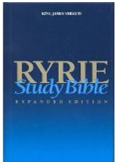

So how do you decide? It depends on what you want.
Translation Theories
Literal translations try to stay as close to the word order and standard meaning of the words as possible. These sometimes seem very choppy to read and they tend translate idiom literally rather than translating the meaning of the idiom. If you want technical accuracy, try a literal or word-for-word translation like the New American Standard Bible (NASB), English Standard Version (ESV), or the King James Version (KJV).Note the translation of Psalm 1:1–2 from the English Standard Version:
Blessed is the man
who walks not in the counsel of the wicked,
nor stands in the way of sinners,
nor sits in the seat of scoffers;
2 but his delight is in the law of the Lord,
and on his law he meditates day and night.
Paraphrase or free translations are on the opposite end of the spectrum. Examples of paraphrases would be The Message (Eugene Peterson) and The Living Bible (Kenneth Taylor). These tend to take great liberty with the original text (when the original text is consulted!) or work from another English version and attempt to rewrite the text in contemporary, colloquial language. Here is Psalm 1:1–2 from The Message, translated and paraphrased by Eugene Peterson (note: Eugene Peterson has consulted the original texts in Hebrew, Aramaic, and Greek):
(The Message)
How well God must like you—
you don’t hang out at Sin Saloon,
you don’t slink along Dead-End Road,
you don’t go to Smart-Mouth College.
2 Instead you thrill to God’s Word,
you chew on Scripture day and night.
Dynamic equivalent translations take a middle-of-the-road approach between literal and paraphrase. They arrange the word order so it sounds more natural to the reader, like reading a newspaper or popular novel. Here is Psalm 1:1–2 from both the new edition of the NIV (©2011) and the New Living Translation, which we usually place on the screen for Mark’s sermons:
(NIV: tends to be a little closer to the literal)
1 Blessed is the one
who does not walk in step with the wicked
or stand in the way that sinners take
or sit in the company of mockers,
2 but whose delight is in the law of the Lord,
and who meditates on his law day and night.
(NLT, second edition, a little closer to the paraphrase)
1 Oh, the joys of those who do not
follow the advice of the wicked,
or stand around with sinners,
or join in with mockers.
2 But they delight in the law of the Lord,
meditating on it day and night.
Study Bibles
A study Bible is not a translation theory like the three described above, but a tool that combines the insights of a number of different resources in order to give you a broader picture of the context, meaning, and application of Scripture. Keep in mind that the notes in a study Bible represent someone else’s interpretation of the passage or verse. These notes should not be considered “Scripture,” but scriptural helps. Study Bibles come in every shape and size, for any number of demographic categories you can conjure up, and for most major versions of the Bible.
Some good study Bibles are The Life Application Bible (available with different Bible versions), The Archaeological Study Bible (with 1984 NIV), and the 1984 NIV Study Bible. Study Bibles may also have cross-references to parallel passages or to similar wording in other verses. Following these cross-references in your study time may serve to enrich your understanding of Scripture and help you see its interconnectedness.
Comparing Translations
Most online and app-based Bible Web sites will give you the opportunity to compare translations of a verse or passage. This is often helpful in Bible study when you have a passage who’s meaning may not be quite clear or that speaks to a difficult concept.
Note on the New International Version (NIV)
The New International Version underwent an update for 2011. The previous version of the NIV was published in 1984, over a quarter century ago. In 2001, Today’s New International Version (TNIV) was published, which included gender-neutral language where the original author was addressing both men and women. The 2011 edition of the NIV is essentially the TNIV with some minor adjustments. The TNIV is no longer being published. The new NIV Study Bibles have now gone through a couple versions since the 2011 update. Personally, I’m using the Zondervan NIV Study Bible edited by Kenneth Barker, the first one to come out after the update.
Since I first published this guide, I have also had the opportunity to contribute study notes to the Jeremiah Study Bible, available with the NIV, NKJV, and ESV.
Here is a comparison of Hebrews 13:17–18 in the NIV 1984, TNIV, and NIV 2011 editions.
|
NIV 1984 |
TNIV |
NIV 2011 |
| 17 Obey your leaders and submit to their authority. They keep watch over you as men who must give an account. Obey them so that their work will be a joy, not a burden, for that would be of no advantage to you. 18 Pray for us. We are sure that we have a clear conscience and desire to live honorably in every way. |
17Have confidence in your leaders and submit to their authority, because they keep watch over you as those who must give an account. Do this so that their work will be a joy, not a burden, for that would be of no benefit to you. 18Pray for us. We are sure that we have a clear conscience and desire to live honorably in every way. |
17 Have confidence in your leaders and submit to their authority, because they keep watch over you as those who must give an account. Do this so that their work will be a joy, not a burden, for that would be of no benefit to you. 18Pray for us. We are sure that we have a clear conscience and desire to live honorably in every way. |
Peace!
Scott Stocking
 Sunday Morning Greek Blog