This article was inspired by a response to a reader’s comment on one of my other PEMDAS/OOO articles. I thought the point I made was worthy enough to be a separate post.
The idea that a fraction is identical to a division problem with an obelus just doesn’t hold water if you analyze the uses of fractions. For example, if I say I ate two-thirds of an apple pie, I’m not intending that to be a division problem. It’s a ratio indicating how much of the pie I ate, i.e., it’s a stand-alone value, or a monomial. We must consider as well that a fraction is more accurate than a decimal if the decimal value has a repeating pattern. Perhaps you’re familiar with the proof that 0.999999…. (repeating to infinity) equals 1.0. If 1/3 (0.333…..) + 2/3 (0.666…..) = 1.0, then the sum of the decimal equivalents must equal 1. Via mathematical proof, this is proven true. However, you never actually get to the point of being able to “carry the 1,” so the decimal equivalent of the sum of the fractions is 10^(-∞) off.
Granted, such a difference in real measurement is not humanly perceptible, but it does reveal a potential issue when talking about astronomical or microscopical measurements, for example. Even if the fraction is part of a larger expression or formula, it’s always possible that the denominator of the fraction will “cancel out” exactly as a common factor with another element in the expression, so the simplification process is the “division,” but it may not be with the numerator of the fraction. For example, if I have the expression 6 x (2/3), I “cancel” the common factor of three from the 6 (leaving 2) and the denominator 3 (leaving 1, thus a whole number), so I’m left with 2 x 2 = 4. Division is happening in the cancellation of the common factor, but it happens with an element outside of the fraction itself. Therefore, the fraction itself is NOT a division problem. There are other elements acting on the fraction.
What is key to the monomial discussion, then, is the juxtapositional binding. In the expression 8 ÷ 2(2 + 2), for the sixteeners to claim that somehow the 8 ÷ 2 becomes a fractional coefficient is contrary to the concept of the fraction. The obelus doesn’t have the binding property inherent with the fraction construction, so to replace the obelus with a fraction bar and say “they’re grouped” while unbinding the 2 from the (2 + 2) defies the clearly indicated juxtapositional binding. They try to have it both ways, but for whatever reason, they’re not seeing that. (Personally, I think they got burned at some point thinking they were justified in adding the multiplication sign and they got corrected by someone who believes as we do, and instead of thinking it through, they hunkered down in their rebellion, but that’s another story.)
This is where the linguistic aspect comes into play. We’ve seen how Wolfram interprets “Eight divided by twice the sum of two plus two” as 1, but “Eight divided by two times the sum of two plus two” as 16. “Twice” and “two times” mean the same thing at face value, but “twice” binds to the “two plus two” as an adverbial modifier, while “two times” is treated as a subject-verb combination. The latter treats “two” as the subject and “times” as the verb substituting for the multiplication sign, thus 2 x (2 + 2). “Twice” has the multiplication implied in the adverbial phrase “twice the sum of two plus two,” so this more accurately reflects the implied multiplication of 2(2 + 2). As such, 2(2 + 2) is the mathematical equivalent of an adverbial phrase intended to be taken as a semantic unit, with or without the external parentheses, just like a fraction by itself is not a division problem, but a singular or monomial value. Therefore, 8 ÷ 2(2 + 2) = 1. Period. End of debate.
In today’s educational environment, there is a lack of critical thinking development. Young people are trained in mathematics simply to get to the point of an answer, not to learn the theory behind mathematics. In other words, they’re trained like calculators, and in this instance, they’re trained to process a problem like a cheap calculator would solve it instead of taking a broader view of the linguistic aspects of any mathematical expression. It’s really no different than giving a non-English speaker an English text and English dictionary and asking them to translate without any concept of grammatical rules, syntax, idioms, etc. PEMDAS/OOO is a formula designed to follow how a calculator solves an expression, not how students of math have solved the expressions in the past and certainly not to make the paradigm consistent with algebra, which treats an expression like 8 ÷ 2a as 8 ÷ (2a) and NOT 8 ÷ 2 x a. The linguistic argument supports the algebraic view of such expressions and therefore supports the same view for arithmetic.
(NOTE: This article was modified September 1, 2024, to include two new terms I recently coined: “functional monomial” and “operational monomial.” New material is in italics. When I say “PEMDAS” I’m implying Order of Operations (OOO) as well.
My original PEMDAS article has received quite a bit of traffic in the 11 months since I posted it. I’m well over 10,000 views at this point, which for the narrow appeal of my usual topics on this blog, is significant for me. It represented about one-third of the total views I had last year overall. The article has generated enough discussion that has allowed me to continue to fine-tune my arguments and further solidify my position that, bottom line, juxtaposed multiplication takes priority over any signed operations. I want to present a couple different views here, neither of which I feel has been adequately disputed by those who think showing me a page from a grade school math textbook is enough to convince me my arguments are faulty. I’ll start with an even stricter interpretation of PEMDAS then what the online PEMDASians apply, and then I’ll discuss the linguistic and syntactical arguments that has yet to be refuted by the paltry evidence the PEMDASians try to put forth.
A Stricter(!) Application of PEMDAS/OOO
(NOTE: This section is modified from post I made on Facebook to a different expression with similar issues.)
To refresh your memory, here is the expression in question:
8 ÷ 2(2 + 2)
Let’s start at the parentheses level of PEMDAS, shall we? The first step is simple enough. Add 2 + 2 to get 4, leaving us with:
8 ÷ 2(4)
Let’s set aside for a moment that this violates the distributive property to work what is inside the parentheses first, which would imply the expression becomes 8 ÷ (4 + 4} before solving what the parenthetical expression.
You’ll notice that we have parentheses around the 4, so we need to perform the function syntactically suggested by the parentheses, multiplication, to remove them. Notice I say “syntactically,” because math isn’t just about numbers, signs, and symbols; it’s about how those are arranged in an expression. This is the fatal error that the PEMDASians make: They fail to acknowledge the implicit relationships suggested by the presence of the parentheses.
The presence of the parentheses represents two issues: First, the juxtaposition itself implies parentheses around BOTH juxtaposed numbers as a single unit of value. We see this with mixed numbers, where the horizontal juxtaposition of a whole number and a fraction IMPLY addition, yet we treat the mixed number as one value. You’d be hard pressed to find a textbook that always puts parentheses around a mixed number in any expression. We also see this with fractions. Keep in mind that a fraction is not always intended to be a division problem. The figure 3/4 (diagonally juxtaposed with a solidus; or its display equivalent with vertical juxtaposition separated by a fraction bar or vinculum) would typically be pronounced “three-fourths.” The expression “3 ÷ 4” would be pronounced “3 divided by 4.” There is a qualitative difference between the two expressions, and we cannot assume that one substitutes for the other. It would be rare, but not unheard of, to see such a fraction with parentheses around it in an expression, because the fraction, like the mixed number, represents a single value.
The logical conclusion from this line of reasoning is this: If a juxtaposed mixed number is considered a single value and a juxtaposed fraction is a single value, then juxtaposed cofactors that use parentheses around one or more of the numbers to distinguish the values of the cofactors (i.e., “2(4),” “(2)(4),” and “(2)4”) all represent a single value of “twice four” as opposed to “24,” which represents “twenty-four” with no intervening parentheses. The lack of an operational sign (remember, the vinculum and solidus in in-line texts are grouping symbols first and foremost, NOT operational signs; only the obelus is an actual operational sign) in these three formats (implied multiplication, mixed number, display fraction) suggests that these forms do NOT fall with the last four steps of the “order of operations”/PEMDAS and instead should be given a higher priority. I would consider these “functional monomials,” because the function they perform is not explicitly stated by the use of operational signs but by the syntax of the format. This priority is heightened by the fact that when you have to divide by a mixed number or a fraction, you have to manipulate the fraction and the extant operational sign to properly work the expression.
Because “functional monomials” do not use explicit operational signs outside of their use in parentheses, they belong in the first two steps of PEMDAS/OOO where we find other functional monomials that reflect implied operations: powers (e.g., 33) and roots, factorials (e.g., 5!), and trig and log functions (e.g., 2 cos2 x; log10 423), among others. They are calculated before any other operational signs acting upon them and are not disturbed or separated by preceding operational signs. (See below for the discussion of “operational monomials” in contrast to “functional monomials.”
If you accept my first point above, then, this second point is moot, but I’ll address it anyway. We can’t get rid of the parentheses (remember, we’re still in the parentheses step) until we perform the function inherent in the parentheses. The PEMDAS/OOO charts get it wrong when they interpret “inside the parentheses” as only what is in-between the parentheses. “Inside” also means “inherent in the nature of,” so the function of the parentheses must be performed as well in the absence of any extant sign. The parentheses are still present, so we’re still in the parentheses step of PEMDAS. It’s at this point that the PEMDASians want to just simply replace the parentheses with a multiplication sign. But where in the parentheses step does it allow that kind of substitution? You have a syntactical relationship between the 2 and the (4) that simply disappears if one makes such a substitution. That substitution is not a valid or necessary math function when evaluating the written expression! Yes, you must use the multiplication key on a calculator if you really need to use one for this type of problem, but that is a matter of technology and not of math theory. The only way to address the parentheses at this point in the process and finish the parentheses step in PEMDAS is to perform the implicit multiplication first, because the juxtaposition creates an implied set of parentheses around the 2(4). Only then are we done with the parentheses step and are left with the simplified expression:
8 ÷ 8
Which of course equals 1.
Still not convinced that substituting the multiplication sign for the parentheses isn’t valid (except when you’re entering it into a calculator, but we’re not using a calculator here), then consider this. The relationship between the two 8’s is that of a dividend to a divisor only. We wouldn’t look at the way that is written and say 8 is the numerator and the other 8 is the denominator. It’s not written that way. We could only do that if we used a vinculum or fraction bar. As such, then, the vinculum, which is a juxtapositional symbol implying division, creates a unique relationship between the two numbers not implied by the obelus. As such, it’s not a valid substitution! With the vinculum, the numbers represent a part of a whole or the whole divided into parts. (I work in a field that requires a significant amount of government reporting on data, and they are always speaking of the populations in terms of which set is the numerator and which set is the denominator.) If the vinculum is such a juxtapositional tool that it creates or represents a unique relationship between the two numbers, then the parentheses serves the same purpose for multiplication. The 2(4) can’t be reduced to a simple multiplication. Depending on the context in which such an expression might arise, it may refer to a single quantity, like a bundle of 2 packages of golf balls with 4 balls in each package (8 golf balls).
Therefore, the only way one can claim that 8 ÷ 2 is somehow the term multiplied by what is in parentheses is to unequivocally declare it so by putting it in parentheses or constructing it as a block fraction using a vinculum vertically centered on the (2 + 2). As I said above, an expression using the obelus is NOT syntactically or linguistically equivalent to a fraction using the same numbers. Since the PEMDASians have failed to clarify the function of 8 ÷ 2 by enclosing it in parentheses, they do not have any solid ground to stand on to insist the answer is 16. This is where my other new term applies, “operational monomial.” If the problem had been written 8 ÷ 2 x (2 + 2), then those who believe the answer is 16 would have a point, because PEMDAS/OOO rules tell us division comes first, so they would then be correct to say the 8 ÷ 2 is the “term” as they define it that serves as the coefficient to the parenthetical expression. Since the expression uses an extant operational sign, it falls in the last four steps of PEMDAS/OOO, after the first two steps that represent “functional monomials.”
Explaining the Linguistic and Syntactical Arguments
(NOTE: This is copied from a response I made on the original article, with a few minor edits.) When I say there is a “linguistic” or “syntactical” component to the given expression, what I’m talking about is how Merriam-Webster defines the term: “The study of human speech including the units, nature, structure, and modification of language.” I take “speech” to mean the written word as well as the spoken word, especially since as a preacher I’ve gotten into the habit of writing out my sermons so I can make more intentional use of my language as opposed to speaking extemporaneously. And in the context of this article, I don’t just mean words alone, but any symbols or figures that we use to communicate, calculate, or cantillate (how’s THAT for an alliteration!): numbers, punctuation, “character” words (e.g., ampersand, &), mathematical and scientific symbols, proofreading symbols, and even music notation.
All of these elements of language, and linguistics more broadly, have their place in their appropriate contexts, and they are subject to their own respective set of rules for putting them together in a coherent form that communicates the message and meaning we intend subject to the rules and conventions of their respective contexts. When someone composes a musical score, the main melody or tune is subject to certain patterns that follow the chords that underlie the melody. If the tune doesn’t match the chords, it sounds, well, discordant. The notes of the melody, harmony, or even a descant are not strictly random. They typically have some relationship with the chord, and often playing a note that doesn’t exactly fit the chord prefigures a change in the chord or even a change in the key signature. Intentional discordancy is not without significance either, as it can communicate chaos or irrationality.
When we write a sentence, we generally expect a subject and verb to be close together and to arrange direct and indirect objects appropriately with any modifiers or prepositions, and so forth. For example, consider the difference between the three sentences, which have the exact same words.
I eat fish only on Friday.
I eat only fish on Friday.
I only eat fish on Friday.
Sentence #1 is truly ambiguous, because the placement of “only” can be taken either way. Is it “Fish is the only thing I eat on Friday” (akin to Sentence #2) or “Friday is the only day I eat fish” (akin to Sentence #3)? Does that sound familiar in the context of this post? More on that in a bit.
In the original article, I make reference to the relationship between the definite article, noun, and adjective in a Greek adjectival phrase. The position of (or absence of) the definite article impacts how the phrase can be interpreted. I’ll use transliterated words to demonstrate.
kalos logos [beautiful word]
ho kalos logos OR logos ho kalos [the beautiful word]
ho logos kalos OR kalos ho logos [the word is beautiful]
In Greek, Phrase #1, which has no definite article (the indefinite article “a” can fairly be implied absent other contextual clues), would be considered ambiguous by itself. We would need contextual clues to know whether it means “a beautiful word” or “a word is beautiful.” (Greeks do not have to use a form of the copulative verb “to be” if that is the only verb in the sentence.) In Phrase #2, the definite article precedes the adjective, which means the adjective is attributive, that is, it directly modifies the noun (“The beautiful word”). It doesn’t matter if the noun is first or last; it’s attributive either way. Phrase #3 has a predicate construction. This means that the noun is the subject of a sentence, and the adjective would come after the verb in that sentence. In this case, it doesn’t matter where the adjective is, although there may be a nuanced implication one way or the other. Either way, the translation is still “The word is beautiful,” so no difference there.
Given those three examples (music, English adverb placement, and Greek definite article placement), I think anyone who’s reading this is starting to see the bigger picture of how linguistics (in this case, specifically syntax) influences mathematics as well, especially in the context of the expression at hand. So let me use the expression in the same way I used the sample phrases above:
8 ÷ 2(2 + 2) = 1 (in my worldview and the worldview of those who are of the same mind) OR 16 (in the competing worldview)
(8 ÷ 2)(2 + 2) = 16 (in both worldviews; NOTE: if the expression had been written with (8 ÷ 2) as a block fraction with a vinculum centered vertically on the (2 + 2), there would be no argument that it equals 16; see text for my critique of that, however.)
8 ÷ (2(2 + 2)) = 1 (in both worldviews)
Expression A seems unambiguous from the perspective of one’s worldview then. But are both worldviews equally valid? We can make arguments from our respective worldviews to try to convince the other side, but it is very difficult to convince one to change their worldview without a powerful defining event that shakes their worldview to the core. Otherwise, we’re comfortable with our ways. I happen to think that several of the arguments I’ve made to support my worldview are quite devastating to the competing worldview, but alas! there has been very little evidence of any change of heart among their hardliners.
Just like the position of adverbs and definite articles, so then is the generous use of parentheses needed to clearly avoid the ambiguity of the given expression. But let me make yet another appeal here for the case that the given expression, in light of my demonstration here, is not really ambiguous at all. The juxtaposition of the 2 to (2 + 2) is akin to Phrase #2 in my Greek examples above. The attachment between the two places them in an attributive relationship (the 2 is the definite article; the (2 + 2) is the adjective). The 2 directly modifies the (2 + 2) by telling us how many of that quantity we need to divide by and keeps the monomial on one side of obelus without an extant multiplication sign. In other words, it isn’t separated from its cofactor by the “action” of the obelus. There is no need for the extant multiplication sign because the relationship is clearly defined. If one were to place a multiplication sign between the 2 and (2 + 2), that would emphasize that the 2 and (2 + 2) are not cofactors and sever the relationship between them. This would make the expression like Greek Phrase #3 above, where the modifier is divorced from what it modifies modified and dragged kicking and screaming all alone into the action of the obelus. That which appeared to modify the (2 + 2) now modifies the 8. The implications of the expression change by substituting the multiplication sign. Additionally, in the case of Greek Phrase #3, if we would add the implied copulative verb where it is not technically needed, that would also place emphasis on the verb and suggest a more nuanced meaning.
Greek verbs demonstrate a similar phenomenon; most Greek verb forms have an ending that tells you what “person” [1st, 2nd, 3rd, or I/we; you/you; he, she, it/they] is the subject of the verb. If there is no explicit subject accompanying the verb, the corresponding pronoun is implied [“He eats”]. If a Greek pronoun is used as the subject, that implies emphasis [“He himself eats”]; so an extant multiplication sign emphasizes the function of the sign over the relationship between the two cofactors when the multiplication is implied by parentheses. The bottom line for the Greek phrases, then, is when you add a word that isn’t necessary for the base form of what you’re communicating, you alter the meaning of what you’re communicating. You also alter the meaning when you add a multiplication sign that isn’t necessary for the basic calculation of the given expression.
This may seem kind of heady to some, but I hope I’ve made my position a little easier to understand. My worldview and what I consider the strength of my arguments here and elsewhere, along with a ton of historical evidence, do convince me that the given expression is unambiguous and has no need for extra parentheses to understand the answer to be 1. For those who think writing ambiguous expressions is somehow educational and instructive when you know there are those who think otherwise, I declare that you have met your match in me. Game over. Checkmate!
I recognize this is off-topic for my blog, but I love math. And I also discovered that Greek grammar has some features of math properties or laws, so it’s only mostly off-topic.
For expressions and equations that have elements featuring a mix of explicit and implicit operations, implicit operations should be done first without immediate regard to or influence of explicit operational signs. Implicit operations include any form of grouping that involves paired grouping symbols, any juxtapositional grouping or pairing without explicit operational signs implying a particular operation, or a combination of both.
Supporting Evidence for the Bottom Line (added 01/19/24, ~5:45 am CST)
In the .pdf file linked below, the first table describes Implicit Constructions in mathematics and demonstrates that they each have their own unique Syntax and Orientation that leads to an implication (thus the word “implicit”) for how they’re handled in any math expression, specifically that they are given priority in the Order of Operations over explicit (existing) operational signs (+ – x ÷). The second table demonstrates the actual Implicit Operations that take place (e.g., finding a common denominator; converting to an improper fraction, etc.) before addressing explicit operational signs. In ALL cases, implicit operations should be worked prior to explicit operational signs.
I know this is a Greek language blog, but math uses Greek characters sometimes, so there’s at least a tenuous connection. And all truth is God’s truth, even in Mathematics, for which God created the principles, properties, and laws. Being a former high school math teacher myself, I was disappointed at the lack of knowledge of fundamental laws and properties in math that led to many people thinking Expression 1 did not equal 1 in certain viral social media threads. In an effort to restore some truth to people’s mathematical knowledge, I present the following proof that the answer to Expression 1 is ALWAYS AND FOREVER 1.
Expression 1
8 ÷ 2(2 + 2)
Conventions vs. Laws
Many people in the social media chains trying to tackle this problem were claiming that following the order of operations they learned in and impressively remembered from grade school was the correct way to approach the problem:
Parentheses
Exponents
Multiplication/Division LTR
Addition/Subtraction LTR
This order is commonly known in American math as PEMDAS and recalled by the sentence “Please Excuse My Dear Aunt Sally.” I do not deny the importance of PEMDAS, but the reality of the problem is, any basic math problem like this can only have one correct answer. It’s not and never a matter of personal interpretation. Otherwise, the foundations of mathematics would crumble into oblivion, and not even Common Core could save us (not that it ever did anyone any good). This is math; it doesn’t care about and is never affected by your feelings about it.
PEMDAS is only a tool for organizing the operations in the problem, but by itself, it is not sufficient to solve the problem correctly. In fact, PEMDAS isn’t a mathematical law at all. It is merely an agreed-upon convention to work “linear” math problems. Math does have many laws or properties that come into play and must be considered in the PEMDAS process, and PEMDAS is subservient to these laws. Nothing about the correct solution I’m about to show you violates PEMDAS, provided you correctly interpret the forms of the individual expressions within the larger expression and how the various laws and principles apply.
If you think back to your primary school math lessons, you may have a vague memory of a set of laws[1] about the relationships of numbers in certain types of expressions. For example, the Associative Properties of addition and multiplication say that no matter how you group the numbers in their respective equations, the sum (addition) or product (multiplication) will always be the same. The Commutative Properties for these two operations are similar; the order of the order or arrangement of the elements in an expression does not affect the value of either expression. These Associative Properties are represented in Expressions 2 and 3, while the Commutative Properties are in 4 and 5:
Expression 2: Associative Property of Addition:
(a + b) + c = a + (b + c)
Expression 3: Associative Property of Multiplication:
(a * b) * c = a * (b * c)
Expression 4: Commutative Property of Addition
a + b = b + a
Expression 5: Commutative Property of Multiplication.
ab = ba
The expressions on either side of the equal sign in the respective equations above reveal another principle of math, that of identical expressions. They look different, but regardless of the values assigned to each variable, they will always be equal. This is also called an identity.[2]
The other important thing to know is that PEMDAS, unlike the Associative and Commutative Properties, is not a law! It is merely a convention for solving a problem that is subject to these laws. PEMDAS does NOT usurp these laws. This is where people are getting tripped up on solving Expression 1 or similar expressions for that matter. I will demonstrate how the correct application of these laws within the framework of PEMDAS will ALWAYS yield the answer of 1, NOT 16 or some other number.
Solving the Expression
One other law must be brought to the fore to solve this expression: the Distributive Property. This is slightly different from the other four laws, in that it involves both addition and multiplication, and it establishes a common equation form that must be worked the same way every time it is found within an equation. Wolfram Research is considered one of the premier math knowledge platforms in the world, so I will draw on their examples of the Distributive Property to make my point. If anyone wants to challenge me on my conclusions drawn from this source, you’ll have to do better than a cheesy homework help Web site. The Wolfram Web sites have two different ways of writing the Distributive formula. BOTH equations are identical expressions and should be solved the same way every time regardless of where they fall in an equation.
Expression 6: Distributive with intervening multiplication operator
a * (b + c) = ab + ac (and of course, if you’re using all real numbers, combine like terms).[3],[4]
Expression 7: Distributive without intervening multiplication operator
a(b + c) =ab + ac (and of course, if you’re using all real numbers, combine like terms).[5]
Whether the expression has the multiplication operator or not, you would treat both as an expression to be solved BEFORE leaving the P step in PEMDAS. The actions UPON the parenthetical result must be completed BEFORE leaving the P step.
For purposes of demonstration later on, we can also apply the Commutative Property of Multiplication to the Distributive property form. We have two “factors” (the a and the (b + c)), so we can rearrange them and still have the same result. In the case of the current form, if we put the a term to the left as written in Expression 7 above, this form of the expression is said to be left distributive (i.e., the a multiplies through from left to right). If the a term is to the right of the parentheses, then the form is called right distributive.[6] See Expression 8 below. The right distributive form of the expression is an identical expression to the left distributive form. I will use this to demonstrate that PEMDAS is not consistent if you don’t first solve the expression in distributive property form.
Expression 8
(b + c)a = ba + ca (and combine like terms if using all real numbers).
Are you with me so far? Maybe you see where I’m going with this? The expression to the right of the division sign must be processed as and simplified to an individual, inseparable term, because it is in the form of a Distributive Property expression. It has parentheses after all, so it must be dealt with before being divided into 8. So here’s the explanation of solving the equation as written:
This then leaves you with the final expression (Expression 10) to be solved:
Expression 10
8 ÷ (8) = 1
QED
Why the Answer Is NEVER 16 or Any Other Number
I am going to offer several proofs or citations that demonstrate why PEMDAS is not sufficient by itself to solve this problem. The first citation comes from a 1935 textbook for advanced algebra.7 Here is what the authors say:
“If the multiplication of two or more numbers is indicated, as in 4m or 5a2, without any symbol of multiplication, it is customary to think of the multiplication as already performed.
Thus 4m2 ÷ 2m = 4m2/2m, not (4m2/2)m.”
This equation (original to the authors’ text) has the same basic form of Expression 1, with the only difference being all real numbers are used in Expression 1. I’m guessing that all of you agree that the expression to the immediate right of the equal sign in the example above is the correct way to interpret the expression on the Left. And of course, the expression on the right simplifies down to simply 2m. The other form, which you get if you do strict PEMDAS without any other consideration, simplifies to 2m3. You all know the 2m is correct, right? That’s the way we all learned how to process variables with coefficients. So if m = 2, we should expect an answer of 4, not 16. 4(4) ÷ 2(2) = 16 ÷ 4 = 4. If you do it the strict PEMDAS only way, then you get 4(4)/2 * 2 = 16/2 * 2 = 16. Wrong answer, therefore, the wrong method to solve.
[Additional notes and evidence added 08/05/2023 (italicized).]
From Wolfram MathWorld, the following article on Precedence, which you get to from the WolframAlpha description of “Order of Operations,” discusses the concept of “advanced operations” that “bind more tightly.” It then contrasts that with “simple operations.” Although Wolfram does not detail what those two concepts embrace, multiplication by juxtaposition (or “implied multiplication”) would be one of those advanced operations that “bind more tightly” and thus have precedence (what is an exponent or factorial if not implied multiplication?), while a “simple operation” would include any expression with all operational signs extant and leave nothing to be implied.
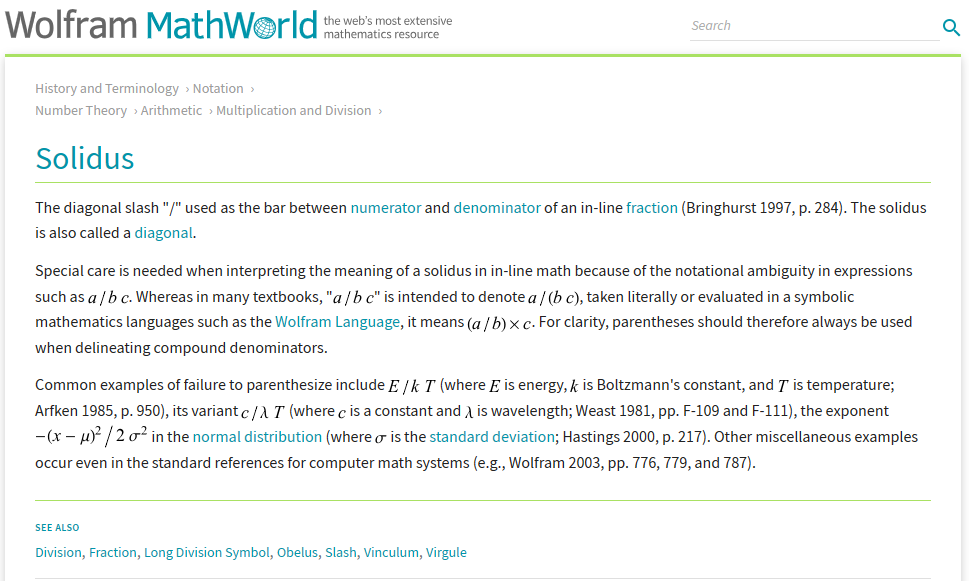
In Wolfram MathWorld’s discussion of the “solidus,” they confirm that most textbooks teach that an equation in the form of a ÷ bc should be interpreted as a ÷ (bc) and NOT ac ÷ b, and then acknowledge that most computational languages, including Wolfram, treat the expression without parentheses in a strictly linear manner without acknowledging the implied multiplication. They say that in order to solve the problem the way the textbooks teach it, or the way most people who actually use real-world equations where it makes a difference, you MUST enter the parentheses in most computational languages (that is the context of MathWorld), including in most calculators. Here’s the definition:
This is solid evidence that the answer to Expression 1 should be 1 and not 16. I’m not blowing smoke, and I’m not trolling. Those who get the answer 16 should rethink their logic.
[Here ends the addition of new material on 08/05/23]
Let’s make the expression in question look a little more like the example I just gave, and remember, that is from an advanced algebra book written by a couple math professors from Columbia U and the U of Southern California. For the expression in question, let m = (2 + 2) and substitute it into the expression, giving us Expression 11.
Expression 11
8 ÷ 2m
You Sixteeners should see right away the error of your PEMDAS-only ways. We don’t break the coefficient away from the variable, so we wouldn’t break it away from what we substitute into the variable. It works both ways. Just like the problem from the textbook, we can clearly see that the answer to “simplified” expression is not 4m, but 4/m. Since we let m = (2 + 2), 4/(2 + 2) = 4/4 = 1. QED.
If that historical example isn’t enough to convince you that PEMDAS alone isn’t correct, consider the following based on my discussion of right- and left-distributive above. As the original equation is written, I’ve already thoroughly demonstrated that the part of the main expression right of the division sign must be treated as an inseparable expression. But for the sake of argument, let’s consider the contention that PEMDAS alone applies without calling on the Distributive Property. As many Sixteeners have demonstrated, this works out to (8/2) * (2 + 2), or 16. However, if we substitute the right-distributive form of the expression in question for the left distributive form, we get Expression 12. Remember, whether right or left, the two expressions are considered equal, or identical.
Expression 12
8 ÷ (2 + 2)2
Expression 12 is, by definition, identical to Expression 1, so we should expect the same answer, right? However, if you apply the PEMDAS-only method on this form of the equation, you get (8/4) * 2, or 4. This PROVES that PEMDAS alone is not sufficient to solve the whole expression, because you get different answers for identical expressions! That is logically impossible in a first-order math equation with real numbers. NOTE: Because I demonstrated that the expressions are themselves equal or identical before solving them, you can’t turn around and say they’re not identical because they get different answers with PEMDAS-only. Distributive property is a law; PEMDAS is a convention. Law trumps convention.
QED
One-Time
Monthly
Yearly
Make a one-time contribution. You do NOT have to contribute to access the article.
Make a monthly donation
Make a yearly donation
Choose an amount
$5.00
$15.00
$100.00
$5.00
$15.00
$100.00
$5.00
$15.00
$100.00
Or enter a custom amount
$
Your contribution is appreciated. Your contribution is NOT tax deductible. I will report all contributions on the appropriate Federal self-employment income tax form.
Most basic calculators don’t typically recognize the Distributive Property from what I’ve seen. In fact, if you read the manuals of most scientific calculators, you’ll find them admitting that you may need to use parentheses to force it to act according to the laws of mathematics in some instances. (See definition of Solidus above.) So don’t trust your calculators. In fact, I’m willing to bet whoever submitted that problem in the first place most likely knew that about calculators and is rolling on the floor laughing their butts off that many were fooled by the calculator, thus resulting in the social media melee over the problem.
A Comparison to Greek
Since this is primarily a blog about interpreting the Greek New Testament (and occasionally the Hebrew/Aramaic Old Testament), I couldn’t help but notice that the Commutative and Distributive Properties apply to Greek adjectives and nouns. In Greek, if the definite article is with the adjective and the adjective modifies a noun, then it doesn’t matter which comes first. The phrases are still translated the same way (article+adjective+noun = noun+article+adjective). The same goes for the noun. If the article is with the noun, then the noun is the subject of the phrase and the adjective is the predicate: (article+noun+adjective = adjective+article+noun). The grammatical case, number, and gender of the noun (subject, object, possessive, etc.) distribute through the article and any adjectives associated with it. Who knew solving a math problem would lead me to discover that Greek grammar has some mathematical logic to it!
My opinions are my own, but my well-reasoned conclusions are indisputable!
Scott
Addendum (added 5/14/23)
PEMDAS is shortsighted. It ignores mathematical properties (that is, laws), which take precedence over order of operations like PEMDAS (an accepted convention, not a law or property). I would suggest the “P” in PEMDAS should not only stand for Properties first, but secondarily for Parentheses. Properties are to PEMDAS what the U.S. Code is to subregulatory guidance in legislative speak. Subregulatory guidance has no authority without the force of law behind it. PEMDAS has no power without the force of mathematical properties behind it.
If you use strictly PEMDAS without recognizing the Distributive Property, you wind up with the following, as the sixteeners are interpreting this:
8 ÷ 2(2+2)
Becomes
8 ÷ 2(4)
Becomes
8 ÷ 2 * 4
But let’s not stop there. This becomes, using the multiplicative inverse to change from division to multiplication:
(8 * 1/2) * 4
And applying the Associative property of multiplication, this becomes
8 * (1/2 * 4)
Substituting back in the original parenthetical expression
8 * (1/2 * (2+2))
Look at what happens to the last half of the equation: You’re now dividing (2+2) by 2 when the syntax of the original expression clearly indicates they should be multiplied together using the Distributive Property. The sixteeners have fundamentally changed the syntax of the original expression, which is a violation of the whole process of solving the equation. That’s why 16 is incorrect!
You can’t simply dismiss the Distributive Property here. A property is a law of math that essentially requires no proof. It is superior to and has precedence over PEMDAS, which is not a property at all and, to my knowledge, has never been proven to account for all things could be going on in an expression. That’s why Property should come before parentheses in PEMDAS.
Why You Can’t Trust Graphing Calculators
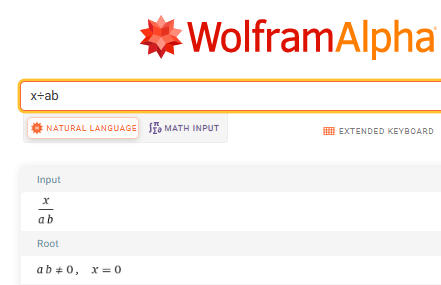
Look at how Wolfram Alpha handles the basic form of the expression in question as we gradually add information. All images grabbed from Wolfram Alpha on 5/14/23 around 10:30 pm CST). NOTE: I have an acknowledged request to Wolfram Alpha to investigate why the following is happening.
Now provide the values for x, a, b.
Substitute in 8 for x.
Add parentheses with the substitution; same result; solution is 1.
Then put in the 2+2 directly. Solution again is 1. Note that it’s NOT (8/a) * (2+2)
But when I directly enter a value for a, the logic changes.
And the expression as written behaves similarly.
So clearly PEMDAS by itself is not sufficient to process the problem, because you can see that even some of the best graphing calculators don’t process the basic form of the equation consistently. Arguments from your graphing calculator don’t cut it for me. Those are just AI. This is a real demonstration of faulty logic in certain formats. You can’t have two different answers to the same expression. The answer 1 is right; 16 is wrong.
Still Not Convinced? (Added weekend of 5/20/23)
What happens to the way you solve the problem if you change the 2 to a negative sign?
8 ÷ -(2 + 2)
Because the negative sign implies that what is inside the parentheses is multiplied by-1, would you PEMDAS-only proponents then have (8 ÷ -1) x (2 + 2) = -32? ABSOLUTELY NOT! Even the Sixteeners have to admit that the problem should be read as 8 ÷ -4 = -2, thus proving my point that what is outside a parenthetical expression (in this case, -1) and multiplied by implication must be solved first to fully deal with the parentheses.
Or how about if the problem is 6 ÷ 3!? The expression 3! represents an implied multiplication relationship, just as 2(2+2) is. So if it’s implied multiplication, is it then deconstructed to 3*2*1 or 1*2*3? Do you see the problem if you deconstruct it like that? Which order?!? According to the logic of the Sixteeners, it should be. But of course that’s silly. You wouldn’t break up the factorial, just as you shouldn’t break up the two factors of 2(2+2) and make one a divisor.
Making It Real
Here are a few examples of how applying PEMDAS-only to real-world formulas could potentially be disastrous. I posted the following examples on a Facebook post dedicated to one of the viral equations and got no end of criticism for proving PEMDAS wasn’t relevant to solving the problems, because the values now had units of measurement applied, which automatically groups the expressions without the need to resort to extra parentheses or brackets. (I cleaned this up a bit because of the limitations of responding on an iPhone that doesn’t have ready access to the obelus symbol that I’ve found.)
What is the context of the equation? Is it a velocity formula, where v= d/t with d = 36 miles and t = 6(2 + 2 + 2) hours = 36 hours? Then v = 1 mile/hour. Going 36 miles in 36 hours does NOT yield a velocity of 36 miles/hour!
Is it a density formula, where D = m/V with m = 36 kg and V = 6(2 + 2 + 2) cubic cm = 36 cubic cm? Then the answer is 1 kg/cubic cm. Who says the obelus doesn’t have grouping powers!
Johnny, Freddy, Rita, Ginger, Gary, and Nancy each have two apples, two oranges, and two bananas to share with their classmates. The class has 36 people including themselves and the teacher. How many pieces of fruit may each person have? 36 classmates ÷ 6(2 + 2 + 2) classmates*pieces of fruit/classmate) = 36 classmates / 36 pieces of fruit = 1 classmate for every 1 piece of fruit. It’s not 36 pieces of fruit for each classmate!
The resulting equations are PEMDAS-naive, proving that PEMDAS is not always necessary to solve these types of expressions.
[1] Reitz, H. L. & Crathorne, A. R. College Algebra, Third Ed. New York: Henry Holt and Co., 1929, pp. 4–5.
[3] If the parenthetical part of the expression has an exponent, you would follow PEMDAS process the exponent before distributing the a through the result (e.g., a(b + c)2 = a(b2 + 2bc + c2) à ab2 + 2abc + ac2.
[4] See the definition at Distributive — from the MathWorld Classroom (wolfram.com) (accessed 04/27/23), where Wolfram also indicates the concept is part of 5th grade math standards in California. The fact that it is a 5th grade standard may explain why the multiplication sign is used.
[5] See a more detailed description at distributive – Wolfram|Alpha (wolframalpha.com) (accessed 04/28/23). This more detailed description includes both expressions, with and without the multiplication sign.



 Sunday Morning Greek Blog